Are you ready to stand out in your next interview? Understanding and preparing for Refrigeration System Repair interview questions is a game-changer. In this blog, we’ve compiled key questions and expert advice to help you showcase your skills with confidence and precision. Let’s get started on your journey to acing the interview.
Questions Asked in Refrigeration System Repair Interview
Q 1. Explain the difference between high-side and low-side pressure in a refrigeration system.
The high-side and low-side pressures in a refrigeration system refer to the pressure levels at different points in the cycle. Think of it like a water slide: the high side is the top of the slide where the water (refrigerant) is under high pressure, and the low side is the bottom where the pressure is significantly lower.
High-side pressure is the pressure in the discharge line of the compressor and the condenser. It reflects the pressure of the hot, high-temperature refrigerant gas after it’s been compressed. This pressure is typically much higher than atmospheric pressure.
Low-side pressure is the pressure in the suction line of the compressor and the evaporator. It represents the pressure of the cool, low-temperature refrigerant as it evaporates and absorbs heat from the space being cooled. This pressure is usually slightly above or near atmospheric pressure, depending on the refrigerant and system design.
Understanding the difference is crucial for diagnosing problems. Significant deviations from normal operating pressures often indicate malfunctions within the system.
Q 2. Describe the function of a compressor in a refrigeration cycle.
The compressor is the heart of the refrigeration system. Its primary function is to increase the pressure and temperature of the refrigerant vapor. Imagine it as a pump that pushes the refrigerant through the system.
After the refrigerant absorbs heat in the evaporator (becoming a low-pressure, low-temperature gas), the compressor sucks it in and compresses it. This compression raises both the pressure and temperature of the refrigerant, turning it into a hot, high-pressure gas ready to release its heat in the condenser.
Compressor failures are a common cause of refrigeration system malfunctions. Common issues include faulty motors, worn-out pistons or valves, and refrigerant leaks within the compressor itself.
Q 3. What are the common refrigerants used in commercial refrigeration systems?
Commercial refrigeration systems utilize various refrigerants, with the choice often dictated by factors like efficiency, environmental impact, and application. Regulations regarding refrigerant use are constantly evolving.
- HFCs (Hydrofluorocarbons): These are commonly used, including R-404A, R-407C, and R-448A. They are generally more efficient than older refrigerants, but their global warming potential is a significant consideration.
- CO2 (R-744): Carbon dioxide is a natural refrigerant gaining popularity due to its extremely low global warming potential. It requires specialized system designs and components due to its high operating pressures.
- Ammonia (R-717): Ammonia is a natural refrigerant with excellent thermodynamic properties and a low global warming potential. However, it is toxic and requires specialized safety precautions during handling and maintenance.
- Hydrocarbons (e.g., propane, R-290): These are natural refrigerants with low environmental impact but are flammable and require careful handling.
The selection of a refrigerant involves a careful evaluation of performance, environmental responsibility, safety regulations, and cost considerations.
Q 4. How do you troubleshoot a system with high head pressure?
High head pressure (discharge pressure) signifies a problem in the high-pressure side of the system. Troubleshooting involves a systematic approach to identify the root cause. Here’s a step-by-step process:
- Check the condenser fan motors: Ensure they are operating correctly and not restricted. A faulty fan motor or restricted airflow will result in a high head pressure.
- Inspect the condenser coils for cleanliness: Dirty coils restrict airflow, leading to increased pressure. Clean them thoroughly if necessary.
- Check for refrigerant overcharge: Too much refrigerant can cause high head pressure. Use a refrigerant scale to measure the charge and remove excess refrigerant if found.
- Examine the condenser for leaks: Leaks allow air or other non-condensables into the system, raising the pressure. Use leak detection equipment to check for any leaks.
- Inspect the compressor for issues: A faulty compressor valve or motor can increase head pressure. You may need to test the motor amperage or assess for signs of restricted internal flow.
- Check the expansion valve (or metering device): If the expansion valve is restricted, it can cause a back-pressure buildup and high head pressure. Testing its operation is essential.
Remember safety precautions when working with high-pressure refrigerants.
Q 5. How do you troubleshoot a system with low suction pressure?
Low suction pressure indicates a problem on the low-pressure side of the system. This usually means insufficient refrigerant, a restriction in the refrigerant flow, or a problem with the evaporator.
- Check the refrigerant charge: Low suction pressure is frequently caused by insufficient refrigerant. Use a refrigerant scale to measure the charge and add refrigerant if needed. Remember, adding refrigerant without addressing underlying issues is just a temporary fix.
- Inspect the evaporator for ice or frost buildup: Excessive frost or ice suggests a restriction in the airflow over the evaporator coils, reducing heat absorption and lowering suction pressure. Thoroughly defrost the evaporator and check the airflow for restrictions.
- Check for air or non-condensables in the system: Air or other non-condensables in the low-side can reduce the system’s ability to efficiently transfer heat. This often requires vacuuming the system to remove them.
- Inspect the metering device: If the expansion valve or capillary tube is restricted or malfunctioning, it can result in low suction pressure. This requires testing and potentially replacing the component.
- Check the compressor: A malfunctioning compressor might be unable to pull enough refrigerant into the system.
Systematic troubleshooting, coupled with careful pressure readings, will pinpoint the root cause.
Q 6. Explain the purpose of a condenser in a refrigeration system.
The condenser’s job is to reject the heat absorbed by the refrigerant from the space being cooled. Think of it as a radiator in a car engine – it cools the hot refrigerant.
After the compressor increases the pressure and temperature of the refrigerant, the hot, high-pressure gas enters the condenser. Here, the refrigerant releases its heat to the surrounding environment (often air or water) and changes from a high-pressure gas into a high-pressure liquid. This process is crucial for completing the refrigeration cycle.
Condenser issues, such as dirty coils or restricted airflow, will directly impact the system’s cooling capacity and efficiency.
Q 7. Describe the function of an evaporator in a refrigeration system.
The evaporator is where the refrigerant absorbs heat from the space you want to cool. It’s like a heat sponge that absorbs warmth.
The high-pressure liquid refrigerant enters the evaporator, where it expands and changes into a low-pressure, low-temperature gas. As it does so, it absorbs heat from the surrounding air, cooling the space. The now low-pressure, low-temperature gas then returns to the compressor to begin the cycle anew.
Proper airflow across the evaporator is critical for efficient cooling. Restricted airflow or a dirty evaporator will greatly impact its cooling capacity.
Q 8. What are the different types of expansion devices used in refrigeration systems?
Expansion devices in refrigeration systems control the flow of refrigerant, regulating the pressure and temperature drop as it changes from a high-pressure liquid to a low-pressure vapor. This is crucial for efficient cooling. There are several types, each suited to different applications:
Capillary Tube: A simple, inexpensive device consisting of a small-diameter tube. The refrigerant’s pressure drop is controlled by the tube’s length and diameter. It’s commonly found in smaller systems, like refrigerators and freezers, due to its simplicity and low cost. However, it lacks adjustability and can be affected by system changes.
Thermostatic Expansion Valve (TXV): This is a more sophisticated device that uses a sensing bulb to measure the evaporator’s superheat. The valve adjusts the refrigerant flow based on this measurement, maintaining a consistent superheat and optimizing cooling efficiency. They’re widely used in larger systems where precise control is essential, offering greater efficiency than capillary tubes.
Electronic Expansion Valve (EEV): An EEV uses an electronic controller to regulate refrigerant flow based on various inputs, including evaporator temperature, superheat, and system pressure. This provides even more precise control and optimization compared to TXVs, particularly beneficial in complex and variable-load applications. They offer the most precise control but are more expensive and complex.
Automatic Expansion Valve (AXV): This simpler valve responds to evaporator pressure to regulate refrigerant flow. It’s less precise than a TXV or EEV and is generally used in smaller, less demanding applications.
Q 9. How do you identify a refrigerant leak?
Identifying a refrigerant leak requires a systematic approach. Visual inspection for signs of oil or refrigerant on components is a first step, but subtle leaks require more sophisticated methods:
Electronic Leak Detectors: These devices use sensors to detect refrigerant vapor in the air. They’re highly sensitive and can pinpoint even small leaks. It is important to note there are detectors for different refrigerants so choosing the right one is key.
Ultrasonic Leak Detectors: These detect the high-frequency sound produced by escaping refrigerant. This is especially useful for finding leaks in hard-to-reach areas or enclosed spaces.
Dye Tracing: Adding a fluorescent dye to the refrigerant allows for visualization of leaks under UV light. This is helpful for larger, more accessible leaks.
Pressure Testing: A pressure test with nitrogen can help locate leaks, though requires careful system isolation to avoid damage.
Remember to always follow manufacturer instructions and safety procedures when using leak detection methods.
Q 10. What safety precautions should be taken when working with refrigerants?
Working with refrigerants demands strict adherence to safety precautions. Refrigerants can be toxic, flammable, and contribute to global warming. Key precautions include:
Proper Personal Protective Equipment (PPE): Always wear safety glasses, gloves, and appropriate respiratory protection.
Ventilation: Ensure adequate ventilation in the work area to prevent refrigerant buildup.
Fire Prevention: Be aware of the flammability of certain refrigerants and take necessary precautions to prevent ignition sources.
Refrigerant Handling Procedures: Follow manufacturer instructions and local regulations for handling, recovery, and recycling.
Awareness of Health Hazards: Understand the potential health effects of exposure and seek immediate medical attention if exposure occurs.
Training and Certification: Obtain proper training and certification before handling refrigerants. EPA certification is often required.
Q 11. Explain the importance of proper refrigerant recovery and recycling.
Proper refrigerant recovery and recycling are crucial for environmental protection and resource conservation. Recovering refrigerant prevents its release into the atmosphere, minimizing ozone depletion and global warming. Recycling reclaims used refrigerant, reducing the need for new production, saving energy and resources. The process involves:
Recovery: Removing refrigerant from a system and storing it in a recovery cylinder.
Recycling: Cleaning and processing recovered refrigerant to meet purity standards for reuse.
Reclamation: A more rigorous process that returns refrigerant to its original purity specifications.
Failure to properly recover and recycle refrigerants can result in significant environmental damage and legal penalties. It’s a vital responsibility for any refrigeration technician.
Q 12. What is the purpose of a receiver tank in a refrigeration system?
A receiver tank in a refrigeration system acts as a storage reservoir for liquid refrigerant. It’s commonly found in larger systems where a significant amount of liquid refrigerant is needed. The main functions are:
Liquid Storage: Provides a supply of liquid refrigerant to meet the cooling demand.
Pressure Stabilization: Helps maintain a consistent liquid pressure within the system.
Think of it like a water tower in a city’s water system; it provides a readily available supply and helps maintain pressure consistency.
Q 13. Describe the function of a filter-drier in a refrigeration system.
The filter-drier, often simply called a drier, is a crucial component that protects the refrigeration system from contamination. It serves several vital functions:
Moisture Removal: Removes moisture from the refrigerant, which can cause serious problems like acid formation and compressor damage. Think of it as a filter for the refrigerant’s circulatory system.
Acid Neutralization: Neutralizes acids that may be present in the system, preventing corrosion and further damage.
Contaminant Removal: Removes other contaminants such as dirt, metal particles, and other debris.
A clogged or ineffective filter-drier can lead to significant system problems, highlighting its importance for maintaining optimal refrigeration system operation. Regular inspection and replacement are essential aspects of preventative maintenance.
Q 14. How do you diagnose a faulty compressor?
Diagnosing a faulty compressor involves a systematic approach combining visual inspection, measurement, and analysis. The first step is observing the compressor itself for abnormalities such as unusual noises, vibrations, or overheating. Further diagnosis includes:
Checking the Electrical Supply: Verify proper voltage and current to the compressor’s terminals.
Measuring Compressor Amperage: High amperage draw can indicate problems like a shorted winding or mechanical friction.
Listening for Sounds: Abnormal noises, such as knocking, rattling, or squealing, indicate internal mechanical problems.
Checking Compressor Pressure: High or low pressure readings can help identify potential issues.
Testing the Crankcase Heater (if applicable): In systems utilizing crankcase heaters, ensuring they are properly functional is vital to avoid oil slugging issues.
If the problem isn’t immediately apparent, additional checks of system pressure, refrigerant charge, and expansion devices may be needed to diagnose the root cause of the compressor malfunction.
Q 15. How do you troubleshoot a system with ice buildup?
Ice buildup in a refrigeration system is a common problem indicating a deficiency in the system’s ability to effectively remove heat. This usually points to issues with airflow, refrigerant charge, or the evaporator itself.
Troubleshooting Steps:
- Check Airflow: Inspect the evaporator coil for obstructions like dust, debris, or frost buildup. Poor airflow restricts heat transfer, leading to ice formation. Clean the coil thoroughly and ensure proper air circulation around the unit.
- Refrigerant Charge: Insufficient refrigerant reduces the system’s cooling capacity. Low refrigerant can cause the evaporator to freeze. A qualified technician should use gauges to check refrigerant levels and pressures. Leaks need to be identified and repaired before recharging.
- Evaporator Issues: A damaged or clogged evaporator coil can also cause ice buildup. This may require replacement or extensive cleaning, depending on the extent of the damage.
- Defrost Cycle (for systems with automatic defrost): If the system has an automatic defrost cycle, ensure it’s functioning correctly. A malfunctioning defrost timer, heating element, or defrost sensor can prevent proper defrosting.
- Temperature Settings: Ensure the thermostat is set to the correct temperature. Setting the temperature too low can lead to excessive ice formation.
Example: I once encountered a walk-in freezer with excessive ice buildup. Initially, I suspected a refrigerant leak. However, after a thorough inspection, I found that the evaporator coil was completely clogged with ice and frost due to poor air circulation caused by a faulty fan motor. Replacing the motor resolved the issue.
Career Expert Tips:
- Ace those interviews! Prepare effectively by reviewing the Top 50 Most Common Interview Questions on ResumeGemini.
- Navigate your job search with confidence! Explore a wide range of Career Tips on ResumeGemini. Learn about common challenges and recommendations to overcome them.
- Craft the perfect resume! Master the Art of Resume Writing with ResumeGemini’s guide. Showcase your unique qualifications and achievements effectively.
- Don’t miss out on holiday savings! Build your dream resume with ResumeGemini’s ATS optimized templates.
Q 16. How do you troubleshoot a system with overheating issues?
Overheating in a refrigeration system is a serious problem that can lead to compressor failure and other costly damages. It usually stems from issues with refrigerant flow, condenser problems, or insufficient airflow.
Troubleshooting Steps:
- Refrigerant Charge: Overcharging the system with refrigerant can restrict airflow within the condenser and lead to overheating. Undercharging can also cause overheating as the compressor works harder to compensate. Proper refrigerant charge is crucial, and gauges should be used to check pressures and temperature.
- Condenser Issues: A dirty or clogged condenser coil restricts heat dissipation, leading to overheating. Clean the coil regularly to ensure efficient heat transfer. Bent fins can also reduce efficiency and should be repaired or replaced.
- Airflow: Insufficient airflow around the condenser can cause overheating. Ensure that the condenser fan is functioning correctly and there are no obstructions blocking air circulation.
- Compressor Issues: A malfunctioning compressor can overheat due to internal issues or insufficient lubrication. Listen for unusual noises or check for excessive vibration. A faulty compressor will likely require replacement.
- Ambient Temperature: High ambient temperatures can also contribute to overheating. The system may struggle to dissipate heat effectively in excessively hot conditions.
Example: I remember a case where a walk-in cooler was overheating due to a clogged condenser coil. The buildup of dust and debris significantly hampered heat dissipation, leading to high compressor head pressure and potential damage. Cleaning the condenser coil quickly resolved the problem.
Q 17. What are the common causes of compressor failure?
Compressor failure is a major concern in refrigeration systems, often resulting in significant downtime and repair costs. Several factors contribute to compressor failure:
- Lack of Lubrication: Insufficient or contaminated oil can cause internal friction and damage to the compressor components.
- High Discharge Pressure: Excessive discharge pressure, often due to system overcharge, restricted airflow, or condenser problems, can severely stress the compressor.
- Electrical Issues: Power surges, voltage fluctuations, or faulty wiring can damage the compressor motor windings.
- Refrigerant Contamination: Moisture or other contaminants in the refrigerant can lead to corrosion and damage within the compressor.
- Mechanical Wear and Tear: Over time, normal wear and tear on moving parts can lead to compressor failure. This is exacerbated by running the compressor under stressful conditions.
- Overheating: Prolonged exposure to high temperatures can damage the compressor’s internal components.
Example: A system with a history of overheating eventually suffered a compressor failure due to a combination of high discharge pressures and insufficient lubrication. The high head pressure caused excessive wear and tear on internal parts, eventually leading to a complete compressor seizure.
Q 18. How do you test the operation of a pressure relief valve?
Testing a pressure relief valve is crucial for safety, as it prevents excessive pressure buildup that could lead to catastrophic system failure. However, it requires careful handling and is often best left to trained professionals.
Testing Methods (generally involve using specialized tools and gauges):
- Visual Inspection: Check the valve for any signs of physical damage, corrosion, or leaks.
- Pressure Test: Gradually increase the system pressure using a compressor or nitrogen tank while monitoring the pressure gauge. The pressure relief valve should open at its designated pressure setting, releasing pressure and preventing further increase.
- Functional Test: Simulate a pressure surge using appropriate equipment and observe if the valve opens and releases pressure as designed.
Important Note: Improper testing of a pressure relief valve can be dangerous. It’s highly recommended to have this procedure performed by a certified refrigeration technician.
Safety Precautions: Always wear appropriate safety glasses and gloves when working with high-pressure refrigeration systems. Ensure adequate ventilation in the work area.
Q 19. Explain the concept of superheat and subcooling in a refrigeration system.
Superheat and subcooling are crucial thermodynamic properties in refrigeration systems that indicate the efficiency of heat transfer. They’re measured in degrees Fahrenheit or Celsius.
Superheat: The superheat is the difference between the actual temperature of the refrigerant gas leaving the evaporator and its saturation temperature at the same pressure. A higher superheat (within the optimal range) indicates that the evaporator is adequately absorbing heat, while insufficient superheat suggests potential issues like low refrigerant charge or restricted airflow.
Subcooling: Subcooling is the difference between the actual temperature of the refrigerant liquid leaving the condenser and its saturation temperature at the same pressure. Higher subcooling ensures that the liquid refrigerant entering the metering device is entirely liquid and not a mixture of liquid and vapor, preventing inefficient operation.
Analogy: Imagine boiling water. Superheat is like continuing to heat the water after it starts boiling. Subcooling is like letting the boiled water cool down completely before pouring it.
Q 20. How do you calculate the superheat and subcooling of a system?
Calculating superheat and subcooling requires measuring temperatures and pressures at specific points in the refrigeration cycle using gauges and temperature sensors. Then you consult a refrigerant pressure-temperature chart (P-T chart) specific to the refrigerant used.
Superheat Calculation:
- Measure suction line temperature: Use a temperature sensor to measure the temperature of the refrigerant vapor in the suction line leaving the evaporator.
- Measure suction line pressure: Use a pressure gauge to measure the pressure in the suction line.
- Find saturation temperature: Using the P-T chart for your refrigerant, find the saturation temperature corresponding to the measured suction line pressure.
- Calculate superheat: Subtract the saturation temperature from the measured suction line temperature:
Superheat = Suction Line Temperature - Saturation Temperature
Subcooling Calculation:
- Measure liquid line temperature: Use a temperature sensor to measure the temperature of the refrigerant liquid in the liquid line leaving the condenser.
- Measure liquid line pressure: Use a pressure gauge to measure the pressure in the liquid line.
- Find saturation temperature: Using the P-T chart for your refrigerant, find the saturation temperature corresponding to the measured liquid line pressure.
- Calculate subcooling: Subtract the saturation temperature from the measured liquid line temperature:
Subcooling = Liquid Line Temperature - Saturation Temperature
Note: The ideal superheat and subcooling values vary depending on the specific refrigeration system and refrigerant used. Manufacturer’s recommendations should always be consulted.
Q 21. What are the different types of refrigeration systems (e.g., vapor compression, absorption)?
Several types of refrigeration systems exist, each with its own operating principles and applications.
- Vapor-Compression Refrigeration: This is the most common type, utilizing a refrigerant that changes state between liquid and vapor to transfer heat. It consists of a compressor, condenser, expansion valve, and evaporator. This system is widely used in residential and commercial refrigeration.
- Absorption Refrigeration: This system uses heat as the primary energy source instead of electricity. A refrigerant, typically water, is absorbed by an absorbent (like lithium bromide) and then released to produce cooling. These systems are often employed in applications where electricity is scarce or expensive, such as solar-powered cooling systems.
- Air-Cycle Refrigeration: Instead of a refrigerant, air is used as the working fluid. It’s generally less efficient than vapor-compression systems but finds applications where flammability or toxicity is a concern.
- Thermoelectric Refrigeration: This method uses the Peltier effect to create cooling. An electrical current passed through a semiconductor junction generates a temperature difference, producing cooling on one side and heat on the other. These are often used in small-scale applications like portable coolers.
- Magnetic Refrigeration: This technology leverages the magnetocaloric effect—the change in temperature of a material when subjected to a changing magnetic field. While still under development, it promises higher efficiency and environmentally friendly refrigerants.
Q 22. Describe the principles of thermodynamics related to refrigeration.
Refrigeration relies heavily on the principles of thermodynamics, specifically the second law, which governs heat transfer from a colder region to a warmer one. This seemingly counterintuitive process is achieved using a refrigerant, a substance that readily changes phase between liquid and gas, absorbing heat during evaporation and releasing heat during condensation.
Think of it like this: Imagine sweating on a hot day. Your body’s heat is absorbed by the sweat (liquid), which then evaporates (turns to gas), taking that heat energy with it. A refrigeration system does something similar, but in a controlled and efficient manner using a compressor, condenser, expansion valve, and evaporator. The compressor increases the pressure of the refrigerant gas, forcing it into the condenser where it releases heat into the environment and condenses back to a liquid. This liquid then passes through an expansion valve, reducing its pressure and causing it to evaporate in the evaporator, absorbing heat from the space to be cooled. This completes the cycle.
- Compression: Increases the pressure and temperature of the refrigerant gas.
- Condensation: Releases heat from the high-pressure, high-temperature refrigerant gas, causing it to condense into a liquid.
- Expansion: Reduces the pressure and temperature of the liquid refrigerant.
- Evaporation: Absorbs heat from the surroundings, causing the liquid refrigerant to evaporate into a gas.
Q 23. Explain the difference between R-22 and R-410A refrigerants.
R-22 (chlorodifluoromethane) and R-410A (a blend of difluoromethane and pentafluoroethane) are both refrigerants, but they differ significantly in their chemical composition and environmental impact. R-22 is an older refrigerant, known for its ozone-depleting properties, hence its phasing out under the Montreal Protocol. R-410A is a hydrofluoroolefin (HFO) blend designed as an environmentally friendly replacement, having zero ozone depletion potential (ODP). However, R-410A still has a global warming potential (GWP), though significantly lower than R-22.
Practically, this means that while both cool effectively, R-22 systems are becoming increasingly difficult and expensive to maintain due to the restrictions on its use. R-410A systems are generally more energy-efficient but require specific equipment and often necessitate higher operating pressures.
Another key difference lies in their operating pressures. R-410A typically operates at higher pressures than R-22, requiring components designed for that higher pressure.
Q 24. What is the role of a sight glass in a refrigeration system?
A sight glass is a small, transparent component installed in the liquid line of a refrigeration system. Its primary function is to allow visual inspection of the refrigerant flow. By observing the refrigerant inside, technicians can identify the presence of air or other non-condensables, check for moisture contamination, and assess the overall quality of the refrigerant.
For example, you might see a steady stream of clear liquid, indicating proper refrigerant flow. Conversely, bubbles or a foamy appearance can suggest the presence of air or other contaminants. The sight glass often includes a drier, which helps remove moisture from the refrigerant.
Q 25. How do you interpret the readings on a pressure gauge?
A pressure gauge in a refrigeration system displays both high-side and low-side pressures, providing critical information about the system’s operation. These pressures are essential in diagnosing issues and ensuring proper function. High-side pressure reflects the pressure in the condenser, indicating the pressure of the hot, high-temperature refrigerant gas. Low-side pressure reflects the pressure in the evaporator, representing the pressure of the low-temperature, low-pressure refrigerant vapor.
By comparing these pressures to the manufacturer’s specifications for a particular refrigerant, a technician can identify problems such as refrigerant leaks, compressor issues, or restricted flow in the system. For instance, unusually high high-side pressure might indicate a restriction in the condenser, while unusually low low-side pressure could point to a restricted evaporator or refrigerant leak. The temperature of the refrigerant will also influence these readings; very cold temperatures mean lower pressures.
Q 26. Explain the importance of maintaining proper oil levels in a refrigeration system.
Proper oil levels are critical for the lubrication and performance of the compressor, the heart of the refrigeration system. The compressor’s moving parts need sufficient oil to prevent friction, wear, and overheating. Insufficient oil can lead to premature compressor failure and costly repairs.
Imagine an engine without oil—it would seize up very quickly. The compressor is no different. The oil also helps seal the compressor and acts as a refrigerant lubricant, reducing wear. Regularly checking and maintaining the oil level, often through observation of oil sight glasses or dipsticks, is crucial for the longevity and efficiency of the refrigeration system.
Q 27. Describe your experience with different types of refrigeration equipment.
Throughout my career, I’ve worked extensively with various refrigeration equipment, including residential, commercial, and industrial systems. This encompasses diverse applications such as air conditioning units (split systems, packaged units, VRF systems), commercial refrigerators and freezers, walk-in coolers, ice machines, and industrial chillers. I have experience with both conventional and newer refrigeration systems using different refrigerants.
I’ve also worked on systems using different types of compressors, from reciprocating and scroll compressors to centrifugal compressors in larger industrial setups. This experience has provided me with a broad understanding of different system designs, controls, and troubleshooting strategies.
For example, I once worked on a large commercial refrigeration system that unexpectedly started experiencing temperature fluctuations. Through careful pressure checks, temperature readings, and analysis of the system’s logs, I identified a faulty expansion valve causing inconsistent refrigerant flow. Replacing the valve resolved the issue and restored the system’s performance.
Q 28. What troubleshooting tools and equipment are you familiar with?
My toolbox includes a wide range of specialized tools and equipment for diagnosing and repairing refrigeration systems. These include:
- Pressure gauges (both high and low side): for accurately measuring system pressures.
- Refrigerant charging scales: for precise refrigerant charging.
- Vacuum pump: for evacuating air and moisture from the system during repair or installation.
- Leak detectors (electronic and halide torch): for locating refrigerant leaks.
- Temperature probes: for measuring temperatures at various points in the system.
- Multimeters: for checking electrical components and control circuits.
- Refrigerant recovery and recycling equipment: for environmentally responsible refrigerant handling.
- Manometers: for measuring small pressure differentials.
- Various wrenches and hand tools: for component disassembly and assembly
In addition to these tools, I am proficient in utilizing various diagnostic software and system controls, which are essential for modern refrigeration systems.
Key Topics to Learn for Refrigeration System Repair Interview
- Refrigerant Cycles: Understanding the different types of refrigeration cycles (vapor-compression, absorption, etc.), their components, and how they operate. Consider analyzing efficiency and environmental impact.
- Component Diagnostics & Repair: Troubleshooting malfunctions in compressors, condensers, evaporators, expansion valves, and other key components. Practice diagnosing issues based on symptoms and using appropriate testing equipment.
- Electrical Systems: Familiarity with wiring diagrams, motor controls, safety devices (e.g., overload relays), and troubleshooting electrical faults within refrigeration systems.
- Safety Procedures and Regulations: Demonstrate knowledge of handling refrigerants safely, adhering to industry safety standards, and understanding relevant environmental regulations (e.g., EPA regulations on refrigerant handling).
- Troubleshooting and Problem-Solving: Develop your ability to systematically identify problems, analyze symptoms, and implement effective repair solutions. Practice explaining your diagnostic process clearly and concisely.
- Maintenance and Preventative Measures: Understanding routine maintenance tasks, predictive maintenance strategies, and how to prevent common system failures. This includes cleaning, lubrication, and inspections.
- System Design and Installation (if applicable): Depending on the role, familiarity with the principles of refrigeration system design, installation procedures, and best practices may be crucial.
Next Steps
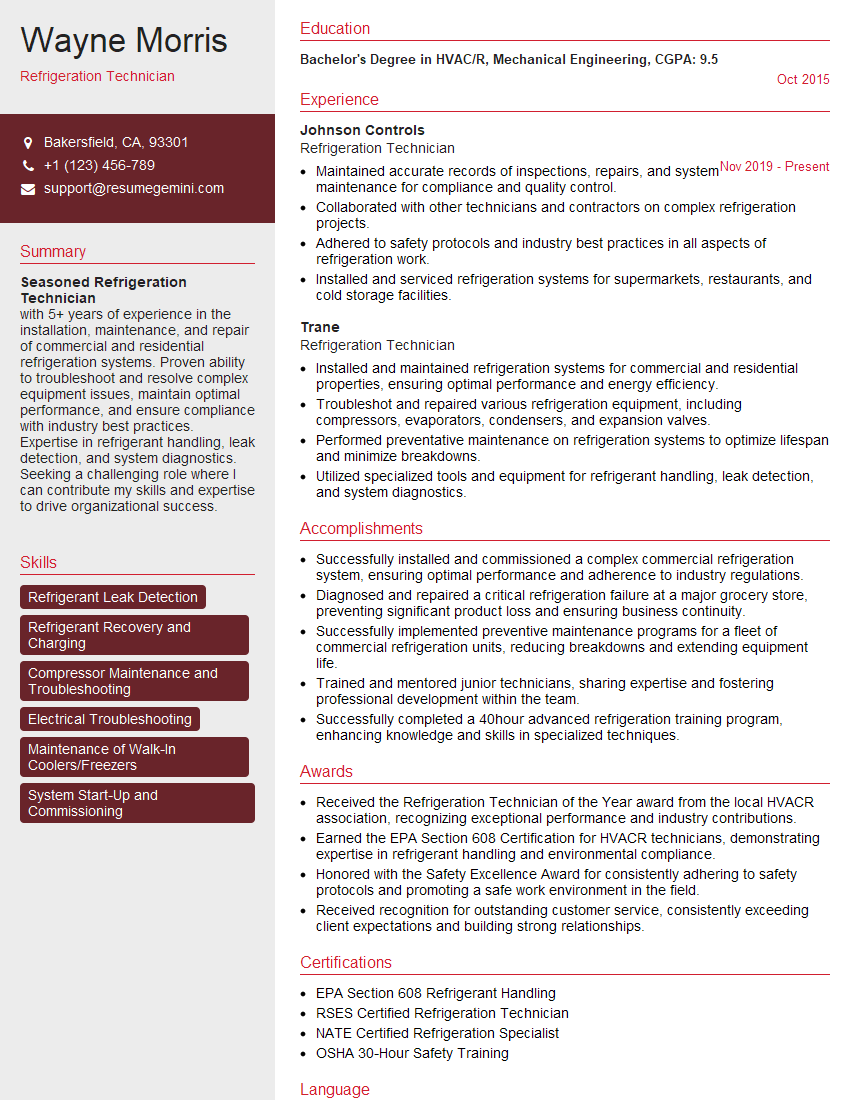
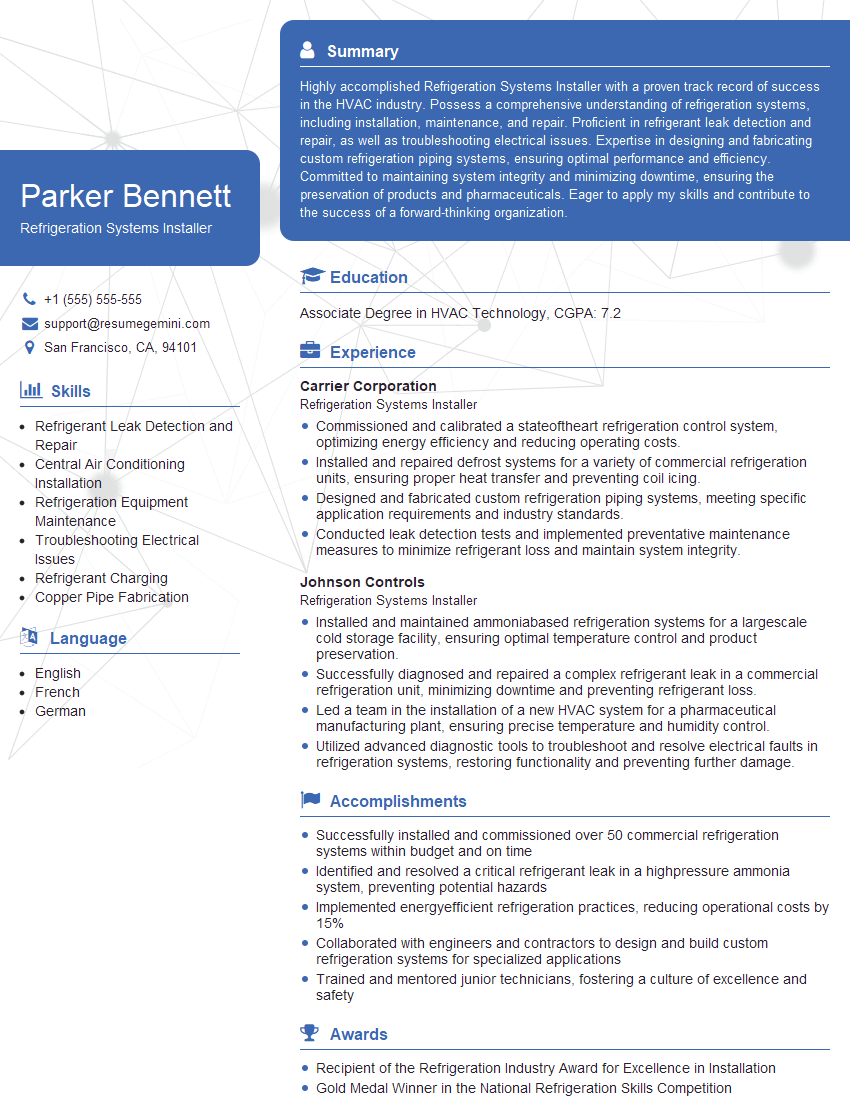
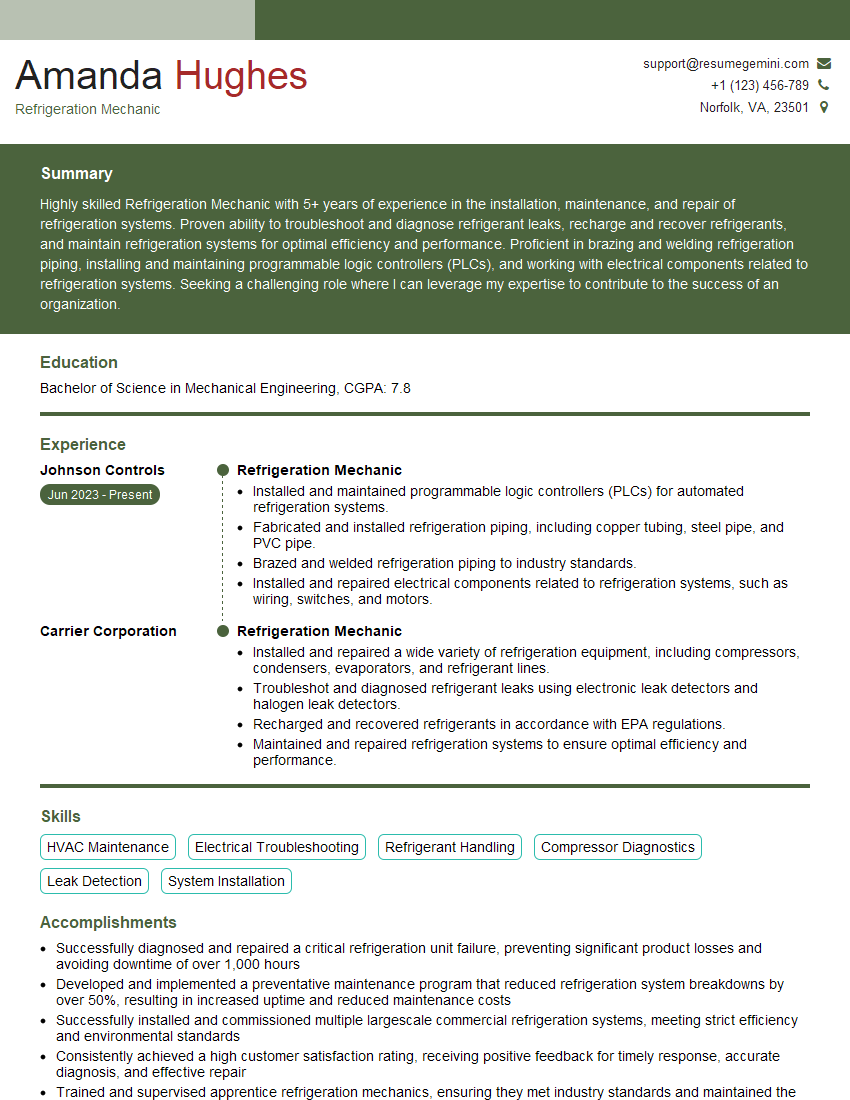
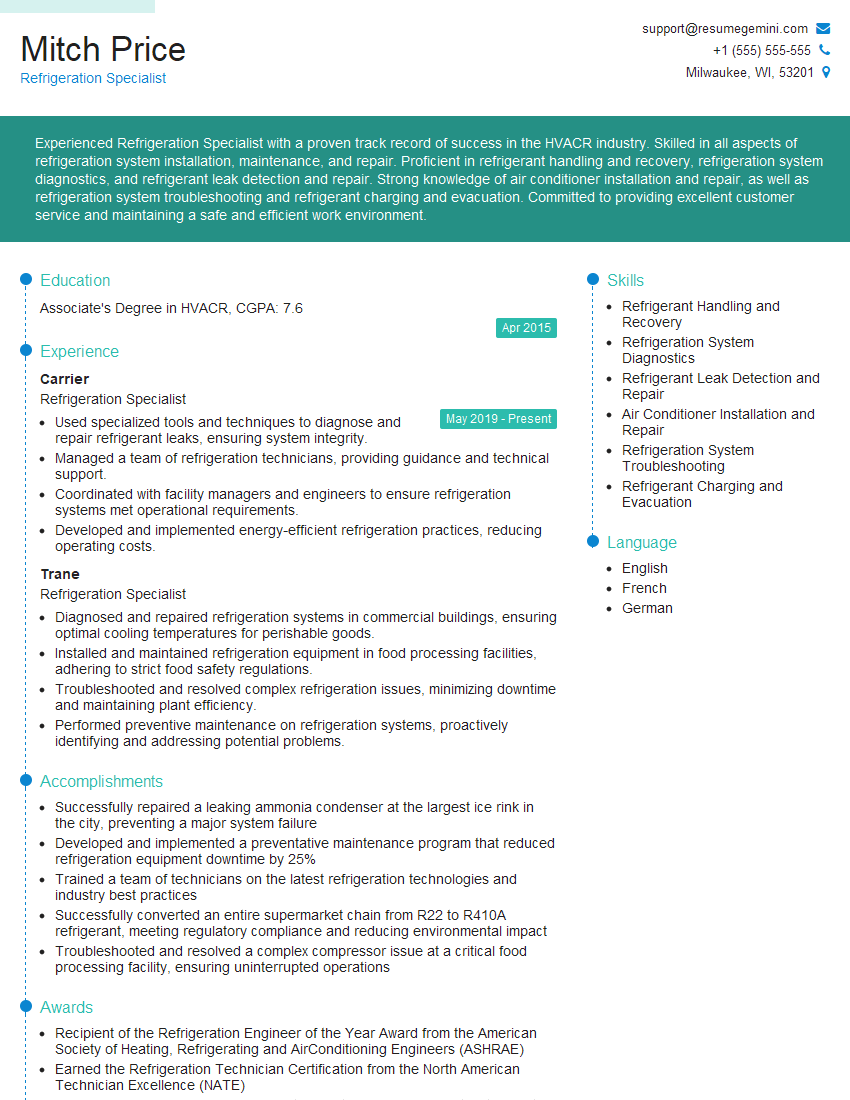
Mastering Refrigeration System Repair opens doors to a rewarding career with excellent growth potential. Demand for skilled technicians is consistently high, offering opportunities for advancement and specialization. To maximize your job prospects, creating a strong, ATS-friendly resume is essential. ResumeGemini is a trusted resource that can help you build a professional resume that highlights your skills and experience effectively. Examples of resumes tailored to Refrigeration System Repair are available to guide you. Invest time in crafting a compelling resume – it’s your first impression on potential employers.
Explore more articles
Users Rating of Our Blogs
Share Your Experience
We value your feedback! Please rate our content and share your thoughts (optional).
What Readers Say About Our Blog
Really detailed insights and content, thank you for writing this detailed article.
IT gave me an insight and words to use and be able to think of examples