Interviews are more than just a Q&A session—they’re a chance to prove your worth. This blog dives into essential Reliability Engineering Principles interview questions and expert tips to help you align your answers with what hiring managers are looking for. Start preparing to shine!
Questions Asked in Reliability Engineering Principles Interview
Q 1. Explain the difference between reliability, availability, and maintainability (RAM).
Reliability, Availability, and Maintainability (RAM) are three crucial metrics used to assess the performance and effectiveness of a system, especially in engineering and operational contexts. They are interconnected but distinct concepts:
- Reliability refers to the probability that a system will perform its intended function without failure for a specified period under stated conditions. Think of it as the system’s ability to *do its job* consistently. A highly reliable car, for example, rarely breaks down.
- Availability focuses on the percentage of time a system is operational and ready to perform its function. This includes not just the time it’s running flawlessly, but also the time it’s down for planned or unplanned maintenance. A system can be highly reliable but have low availability if it requires frequent, lengthy maintenance. Think of a server that rarely crashes (high reliability) but needs regular updates that temporarily take it offline (low availability).
- Maintainability is the ease with which a system can be repaired or restored to operational status when it fails. This encompasses factors like the availability of spare parts, the training level of maintenance personnel, and the system’s design for easy access to components. A system with high maintainability can be back online quickly after a failure, even if that failure was due to low reliability.
In essence, a highly reliable system is expected to rarely fail, while a highly available system is expected to be operational most of the time, and a highly maintainable system is expected to be quickly restored to operation if it fails.
Q 2. Describe different reliability testing methods (e.g., accelerated life testing, HALT).
Reliability testing methods aim to evaluate a product’s or system’s ability to withstand stress and operate within specified parameters over time. Several methods exist, each with its own advantages and disadvantages:
- Accelerated Life Testing (ALT): This method subjects the product to higher-than-normal stress levels (e.g., higher temperature, voltage, vibration) to accelerate the failure process and obtain reliability data more quickly. The data collected is then extrapolated to predict the product’s lifetime under normal operating conditions. This is cost-effective but requires careful design to ensure that the accelerated stress accurately reflects real-world failure mechanisms.
- Highly Accelerated Life Testing (HALT): This is a more aggressive approach than ALT. HALT aims to identify the product’s weak points by rapidly and systematically increasing stress levels until failures occur. It’s valuable for early-stage design verification and robustness assessment. The rapid stress changes can lead to unpredictable failures, providing useful information about design flaws.
- Environmental Stress Screening (ESS): ESS involves exposing the product to various environmental stresses to identify and eliminate early failures. This helps to improve the product’s reliability and reduce the risk of field failures. It’s commonly used during manufacturing to weed out defective units.
- Burn-in testing: A long-duration test under normal operating conditions to identify early failures. It’s effective for eliminating components likely to fail early in the life cycle.
The choice of method depends on factors such as the product’s complexity, available resources, and the stage of the product development lifecycle.
Q 3. What are failure modes and effects analysis (FMEA) and fault tree analysis (FTA)? How are they used?
Failure Modes and Effects Analysis (FMEA) and Fault Tree Analysis (FTA) are both proactive reliability engineering techniques used to identify potential failures and their consequences. They differ significantly in their approach:
- FMEA is a bottom-up approach that systematically examines each component and process to identify potential failure modes, their causes, and their effects on the system. It aims to prioritize these potential failures by considering their severity, occurrence, and detectability (Severity x Occurrence x Detection = Risk Priority Number). The goal is to proactively mitigate risks by implementing corrective actions.
- FTA is a top-down approach that starts with a specific undesired event (e.g., system failure) and works backward to identify the combination of events that could lead to this undesired outcome. It visually represents these events using a fault tree diagram, allowing for a clearer understanding of the failure pathways and the relative importance of individual components or events. This helps in identifying critical components and areas for improvement.
Example: Imagine an automated coffee machine. FMEA would analyze each component (e.g., water pump, grinder, heating element) to identify potential failures (e.g., pump failure, grinder jam, heating element burnout) and their consequences (e.g., no water dispensing, no coffee grinding, no hot water). FTA, on the other hand, would start with the top event “no coffee dispensed” and work backward to identify the different combinations of component failures that could cause this. Both methods are powerful, and using them together can provide a comprehensive view of system reliability.
Q 4. Explain Weibull analysis and its applications in reliability engineering.
Weibull analysis is a statistical method used to model and analyze the time-to-failure data of a product or system. It’s particularly useful when dealing with data that follows a non-normal distribution. The Weibull distribution is characterized by two parameters:
- Shape parameter (β): This parameter describes the shape of the distribution and indicates the type of failure pattern. β < 1 indicates decreasing failure rate (infant mortality), β = 1 indicates constant failure rate (random failures), and β > 1 indicates increasing failure rate (wear-out).
- Scale parameter (η): This parameter represents a characteristic life of the product and indicates the scale of the distribution.
Applications:
- Predicting product lifetime: Weibull analysis can be used to estimate the probability of survival or failure at any given time.
- Identifying failure mechanisms: By examining the shape parameter, you can get insights into the dominant failure mechanism.
- Optimizing maintenance strategies: Understanding failure patterns helps in determining appropriate maintenance schedules (e.g., preventative maintenance for wear-out failures).
- Comparing different designs or materials: By fitting Weibull distributions to data from different designs, one can compare their reliability characteristics.
In practice, Weibull analysis involves fitting a Weibull distribution to the observed time-to-failure data, and then using the estimated parameters to make predictions or draw conclusions about the product’s reliability.
Q 5. How do you calculate Mean Time Between Failures (MTBF) and Mean Time To Repair (MTTR)?
Mean Time Between Failures (MTBF) and Mean Time To Repair (MTTR) are critical metrics used to assess system reliability and maintainability:
- MTBF: This metric represents the average time between consecutive failures of a system. It’s calculated by dividing the total operating time by the number of failures observed during that time. A high MTBF suggests high reliability. For example, if a system operated for 10,000 hours and experienced 2 failures, then the MTBF = 10,000 hours / 2 failures = 5,000 hours.
- MTTR: This metric is the average time it takes to repair a failed system and restore it to operational status. It’s calculated by dividing the total downtime due to repairs by the number of repairs performed. A low MTTR indicates high maintainability. If the total downtime was 100 hours for those same 2 repairs, then MTTR = 100 hours / 2 repairs = 50 hours.
Important Note: MTBF is typically used for repairable systems, while Mean Time To Failure (MTTF) is used for non-repairable systems. MTTF calculations are similar to MTBF but are typically based on the time until the first failure.
Q 6. What are the key metrics used to assess the reliability of a system?
Several key metrics are used to assess system reliability. Here are some of the most important:
- MTBF (Mean Time Between Failures): Already discussed above.
- MTTF (Mean Time To Failure): Already discussed above.
- MTTR (Mean Time To Repair): Already discussed above.
- Availability: The percentage of time a system is operational (often expressed as a percentage or a decimal). Availability = (Uptime) / (Uptime + Downtime)
- Failure Rate (λ): The number of failures per unit of time (e.g., failures per 1000 hours). It’s the reciprocal of MTBF (λ = 1/MTBF).
- Reliability Function (R(t)): The probability that a system will survive until time t without failure. Often expressed as a curve showing the decreasing probability of survival over time.
- Mean Time To First Failure (MTTF1): The average time until the first failure for a system.
- Reliability Growth: This shows how reliability improves over time during a system’s development and testing.
The specific metrics used depend on the application and the nature of the system being analyzed.
Q 7. Describe different types of redundancy and their impact on system reliability.
Redundancy is a technique used to improve system reliability by incorporating duplicate or backup components. Different types of redundancy exist:
- Active Redundancy (Parallel Redundancy): Multiple components operate simultaneously, and the output of the components is combined or selected to ensure continued operation even if one or more components fail. For example, a flight control system might have triple redundant computers, with a voting mechanism selecting the most likely correct output.
- Passive Redundancy (Standby Redundancy): One component is active, and a backup component only operates if the primary component fails. This is generally cheaper than active redundancy because only one component is active, but switching to the backup might take some time.
- N-Modular Redundancy (NMR): A system consists of N identical modules operating in parallel. The output is typically determined by a voting system that chooses the most common output from the modules. Usually a majority vote is sufficient (e.g., 3-Modular Redundancy: 2 out of 3 modules need to be functioning).
- Hybrid Redundancy: A combination of active and passive redundancy techniques to optimize the tradeoff between cost, performance and reliability. For example, one module might operate actively while one or more others stand by, ready to replace the active unit if it fails.
The impact of redundancy on system reliability is significant. It dramatically reduces the probability of system failure by masking or mitigating the effects of component failures. The choice of redundancy technique depends on factors such as the criticality of the system, cost constraints, and performance requirements.
Q 8. Explain the concept of a reliability block diagram (RBD).
A Reliability Block Diagram (RBD) is a graphical representation of a system’s reliability. Think of it like a flowchart, but instead of showing process steps, it shows the components and how they contribute to the overall system’s success or failure. Each component is represented by a block, and the connections between blocks illustrate the system’s architecture. If one block fails, it can cause the entire system, or a part of it, to fail, depending on how the blocks are connected (series, parallel, or a combination).
For example, imagine a simple bicycle. The RBD might show blocks representing the frame, wheels, handlebars, and brakes. If any of these blocks fail (e.g., a broken wheel), the bicycle’s functionality is impaired. The connections in the RBD would demonstrate how these components are related and how failure in one part impacts the whole. A more complex system, such as a spacecraft, will have a significantly more intricate RBD showcasing numerous interconnected components with different failure modes.
RBDs are invaluable for identifying critical components, assessing system reliability, and planning maintenance strategies. They provide a visual and easily understandable tool for engineers to analyze system reliability and make informed decisions about redundancy, design improvements, and risk mitigation.
Q 9. How do you handle reliability data that is censored or incomplete?
Handling censored or incomplete reliability data is a common challenge in reliability engineering. Censoring occurs when we don’t observe the exact failure time of a component. For example, a test might be stopped before all components fail (right censoring), or a component might be replaced before failure (left censoring). Incomplete data arises from various reasons, including missing records or inaccurate measurements.
Several techniques are used to address this:
- Survival Analysis Methods: These statistical methods, such as Kaplan-Meier estimation, specifically account for censored data. The Kaplan-Meier method provides an estimate of the survival function, which shows the probability of a component surviving beyond a certain time.
- Maximum Likelihood Estimation (MLE): MLE is a powerful technique to estimate parameters of a probability distribution (like the Weibull distribution) from censored data by finding the parameter values that maximize the likelihood of observing the data.
- Data Imputation: This involves filling in missing data points based on available information. However, this should be done cautiously, as it can introduce bias if not handled properly. Multiple imputation, where multiple plausible values are imputed for each missing data point, can reduce the bias.
Choosing the right approach depends on the nature and extent of the missing data. A thorough understanding of the censoring mechanism is crucial to select appropriate statistical methods and ensure reliable reliability estimations. For instance, in a field study of a specific product, a dataset may contain instances where the device was still working during the conclusion of the study. This situation necessitates the use of survival analysis techniques to correctly interpret the available data.
Q 10. Discuss the importance of root cause analysis in reliability engineering.
Root Cause Analysis (RCA) is paramount in reliability engineering because it goes beyond merely fixing symptoms to uncovering the fundamental reasons for failures. Without RCA, you’re treating the illness, not the disease; your solution might be a temporary fix leading to repeated failures. Think of it as detective work – you’re investigating the ‘why’ behind a failure, not just the ‘what’.
Several RCA methods exist, including:
- 5 Whys: A simple iterative technique where you repeatedly ask ‘why’ to delve deeper into the causes of a failure. For instance: Why did the system crash? (Because the server overloaded). Why did the server overload? (Because the traffic was unusually high). And so on…
- Fishbone Diagram (Ishikawa Diagram): A visual tool that categorizes potential causes of a failure (materials, methods, manpower, machinery, measurement, environment). Each branch represents a potential cause category, and smaller branches represent specific causes under each category.
- Fault Tree Analysis (FTA): A deductive technique used to model the various combinations of events that could lead to a top-level system failure. It uses Boolean logic gates to illustrate cause-and-effect relationships and probabilities.
Effective RCA is crucial for implementing corrective actions that prevent recurrence. It leads to better designs, improved processes, and enhanced system reliability by addressing the root causes rather than simply addressing the symptoms. For example, a root cause analysis revealing inadequate training as a reason for equipment misuse will lead to implementing a comprehensive training program which is much more effective than simply replacing the damaged equipment.
Q 11. Explain different types of preventive maintenance strategies.
Preventive maintenance (PM) aims to prevent failures before they occur. Different strategies exist, each with its own advantages and disadvantages:
- Time-Based Maintenance (TBM): This is the simplest approach. Maintenance is performed at fixed intervals (e.g., every 1000 hours or every year). While easy to schedule, it can lead to over-maintenance or under-maintenance depending on actual component degradation.
- Condition-Based Maintenance (CBM): Maintenance is triggered by the condition of the equipment, rather than time. Sensors and monitoring systems track relevant parameters (e.g., vibration, temperature, pressure) and alert maintenance personnel when thresholds are exceeded. This approach minimizes unnecessary maintenance but requires advanced monitoring capabilities.
- Predictive Maintenance (PdM): This goes a step beyond CBM by using data analysis and predictive modeling to forecast when failures are likely to occur. Machine learning algorithms can analyze sensor data to anticipate potential failures and schedule maintenance proactively. This maximizes uptime and minimizes downtime.
- Reliability-Centered Maintenance (RCM): A systematic approach that focuses on maintaining the functions of the equipment rather than simply replacing parts at fixed intervals. It involves identifying critical components and failure modes, and then selecting appropriate maintenance tasks to mitigate the risk of failure. RCM is often a customized approach requiring thorough analyses.
The best strategy often involves a combination of these approaches. For example, a system might employ TBM for routine checks but rely on CBM or PdM for critical components.
Q 12. What are the key considerations for designing reliable products or systems?
Designing reliable products or systems requires careful consideration of several factors:
- Robust Design: Designing products to withstand variations in operating conditions and manufacturing tolerances. This involves using design for six sigma (DFSS) methodologies.
- Component Selection: Choosing high-quality components with well-established reliability characteristics. This often involves considering component failure rates and using high-quality suppliers.
- Redundancy and Fail-Safe Mechanisms: Incorporating backup systems or components to ensure system operation even if one component fails. This can be passive (e.g., a spare component ready to be switched in) or active (e.g., a parallel system automatically taking over when the primary system fails).
- Modular Design: Designing the system with replaceable modules so that failures can be isolated and repaired quickly, minimizing downtime.
- Testing and Verification: Rigorous testing at different stages of the design process to identify and address potential weaknesses. This might involve environmental testing, accelerated life testing, and failure mode and effects analysis (FMEA).
- Design for Manufacturing (DFM): Ensuring that the design is manufacturable and that the manufacturing process is capable of producing consistently reliable products.
- Maintainability: Designing the system to be easily maintained and repaired. This can include using standardized parts, providing easy access to components, and developing clear maintenance procedures.
A well-designed, reliable product minimizes failures, enhances user satisfaction, and reduces maintenance costs.
Q 13. How do you balance cost and reliability in product design?
Balancing cost and reliability is a fundamental trade-off in product design. Increased reliability often comes at a higher cost. The goal is to achieve an acceptable level of reliability while staying within budgetary constraints. This can be managed through:
- Cost-Benefit Analysis: Evaluating the cost of improving reliability against the benefits (reduced downtime, improved customer satisfaction, avoided warranty claims). This involves quantifying both costs and benefits in monetary terms.
- Prioritization: Focusing on improving the reliability of critical components that have the most significant impact on system performance and cost. This involves performing reliability allocation studies, often using an importance measure and allocation factors to spread reliability requirements among the various subsystems.
- Redundancy Optimization: Carefully choosing the level of redundancy. While more redundancy increases reliability, it also increases cost. The optimal level of redundancy is the one that provides an acceptable level of reliability at an acceptable cost.
- Design Optimization Techniques: Using design optimization techniques (e.g., Design of Experiments (DOE), simulation) to identify designs that meet reliability requirements while minimizing cost.
- Value Engineering: Analyzing all aspects of the design to find ways to improve reliability without significantly increasing cost. This may involve using alternative materials, simplifying designs, or finding more cost-effective manufacturing methods.
Ultimately, the balance depends on the specific application and risk tolerance. A medical device requires a much higher level of reliability than a consumer toy, even if it means a higher cost.
Q 14. Describe your experience with reliability prediction techniques.
Throughout my career, I have extensively used various reliability prediction techniques. My experience encompasses both traditional methods and more advanced techniques incorporating machine learning.
My expertise includes:
- Part Count Method: A simple, widely-used method that estimates system reliability based on the reliability of its individual components. This requires knowledge of component failure rates, often obtained from component handbooks or historical data.
- Stress-Strength Interference Methods: These methodologies assess reliability by considering the interaction between component stresses and its strength. If the stress exceeds the strength, a failure occurs. Statistical distributions model stress and strength, and reliability is estimated as the probability that the strength exceeds the stress.
- Weibull Analysis: A powerful technique used to model and analyze time-to-failure data. The Weibull distribution is versatile and can describe various failure patterns (constant, increasing, or decreasing failure rates). Maximum likelihood estimation or other methods are employed to estimate the parameters of the Weibull distribution, providing insights into the reliability characteristics of the component.
- Markov Models: These mathematical models analyze systems with multiple states and transitions between states. They are particularly useful for modelling systems with repair or maintenance activities, allowing for the calculation of reliability, availability, and maintainability (RAM).
- Accelerated Life Testing (ALT): A methodology where components are subjected to higher-than-normal stress levels to accelerate failure mechanisms. This significantly reduces testing time but requires careful consideration of the test conditions and extrapolation to normal operating conditions.
Furthermore, in recent projects, I have leveraged machine learning algorithms, such as neural networks and support vector machines, for reliability prediction based on large datasets of sensor data and historical failure records. These advanced techniques provide more accurate and insightful predictions, allowing for more effective preventive maintenance strategies and informed design decisions.
Q 15. How do you use statistical software (e.g., Minitab, R) in reliability analysis?
Statistical software is indispensable in reliability analysis. Tools like Minitab and R provide the computational power and statistical functions necessary to analyze failure data, predict future performance, and support informed decision-making. For instance, in Minitab, I frequently use capabilities like:
- Survival analysis: To model the time-to-failure data using methods such as Kaplan-Meier estimation, which helps visualize and understand the failure rate over time. I also use this to compare the reliability of different designs or components.
- Reliability plotting: Creating Weibull plots, which visually represent the distribution of failure data and help identify potential failure modes or underlying distributions. This allows us to predict future reliability and make comparisons.
- Regression analysis: To investigate the relationship between different factors (e.g., temperature, stress) and the product’s failure rate. This helps to identify potential design weaknesses and improve the product’s reliability.
- Hypothesis testing: Testing claims about the reliability of different components, or identifying if changes to the production process made a statistically significant improvement in reliability. Examples include using t-tests or ANOVA tests depending on the data and hypotheses.
In R, its flexibility allows for more customized analysis. I often use packages like ‘survival’ for more advanced survival analysis techniques and ‘ggplot2’ for generating publication-quality reliability plots. For example, I’ve used R to create custom reliability growth models which were crucial in demonstrating to management the impact of continuous improvement efforts.
Career Expert Tips:
- Ace those interviews! Prepare effectively by reviewing the Top 50 Most Common Interview Questions on ResumeGemini.
- Navigate your job search with confidence! Explore a wide range of Career Tips on ResumeGemini. Learn about common challenges and recommendations to overcome them.
- Craft the perfect resume! Master the Art of Resume Writing with ResumeGemini’s guide. Showcase your unique qualifications and achievements effectively.
- Don’t miss out on holiday savings! Build your dream resume with ResumeGemini’s ATS optimized templates.
Q 16. Explain the concept of system architecture and its impact on reliability.
System architecture significantly impacts reliability. It refers to the overall design and arrangement of components within a system. A well-designed architecture anticipates potential failure points and incorporates redundancy and fault tolerance mechanisms.
Imagine a simple system like a bicycle. A poorly designed architecture might have all the components connected in a single, fragile chain. A single failure (a broken chain) results in complete system failure. However, a better architecture might incorporate multiple gears and a robust frame, allowing for continued operation even with some component failure (e.g., a minor gear malfunction).
In complex systems, architectural choices are crucial. Series systems (all components must function for system success) are inherently less reliable than parallel systems (system operates as long as at least one component works). Modular design, where components are independent and replaceable, improves maintainability and reliability. Effective architecture also considers factors like component diversity, to minimize the chance of cascading failures, and error detection and recovery mechanisms.
Q 17. What are some common reliability challenges in your field of experience?
Common reliability challenges I’ve encountered include:
- Unforeseen failure modes: Real-world conditions are complex. Testing may not always reveal all possible failure modes, leading to unexpected failures in the field. For example, a component that performs flawlessly under lab conditions might fail due to unforeseen vibration in real-world use.
- Supplier quality variations: Variations in component quality from different suppliers can dramatically affect the overall system reliability. Strict quality control and supplier management are essential.
- Data scarcity: Sufficient failure data is often hard to gather, especially for low-failure-rate products or new technologies. This can make accurate reliability prediction challenging.
- Environmental factors: Temperature, humidity, vibration, and other environmental factors can significantly impact reliability. Designs must account for the operating environment.
- Human factors: Human error in operation, maintenance, or manufacturing can significantly contribute to failures.
Addressing these challenges requires a multifaceted approach, combining robust design, rigorous testing, and effective data analysis.
Q 18. How do you communicate technical reliability information to non-technical audiences?
Communicating technical reliability information to non-technical audiences requires careful consideration. Jargon should be avoided, and complex statistical concepts translated into simple terms. Visual aids such as charts, graphs, and diagrams are highly effective.
For instance, instead of saying “The mean time between failures (MTBF) improved by 15%,” I might say “The system is now expected to run for 15% longer between repairs, resulting in less downtime and lower maintenance costs.” Using relatable analogies can help; for example, comparing reliability to the reliability of a car or a household appliance. Storytelling and real-world examples can also make the information more engaging and memorable.
Focusing on the business impact of reliability improvements (e.g., cost savings, increased productivity, improved customer satisfaction) is key to gaining buy-in from stakeholders.
Q 19. Describe your experience with reliability standards and regulations (e.g., MIL-STD-704).
My experience includes working with various reliability standards and regulations, including MIL-STD-704 (which deals with the reliability program for systems and equipment development and production) and others like IEC 61709 (for photovoltaic power systems). My work involves understanding and implementing these standards, ensuring designs comply with relevant regulations, and incorporating best practices into our reliability processes.
For example, with MIL-STD-704, I’ve been involved in defining reliability program plans, establishing reliability requirements, conducting reliability analyses, and documenting reliability test results. Understanding these standards is crucial for demonstrating compliance, managing risks, and ensuring product quality and customer satisfaction. I often use these standards as a starting point to develop more detailed and customized reliability requirements for our specific projects.
Q 20. What are the differences between series and parallel systems in terms of reliability?
Series and parallel systems differ fundamentally in their reliability behavior. In a series system, all components must function for the system to work. The reliability of the entire system is the product of the individual component reliabilities. If one component fails, the entire system fails. Think of a string of Christmas lights: if one bulb burns out, the entire string goes dark.
In a parallel system, the system functions as long as at least one component works. The overall system reliability is higher than the reliability of any individual component. Think of multiple power generators supplying a building; if one generator fails, others can maintain power. The reliability of a parallel system is calculated as 1 minus the product of the individual component unreliability (1-Ri).
Therefore, series systems are inherently less reliable than parallel systems because a single point of failure can cause complete system failure. Parallel systems are more resilient to failures, but they often have greater complexity and cost.
Q 21. How do you use data to identify areas for improvement in reliability?
Data is central to identifying areas for reliability improvement. I utilize several approaches:
- Failure mode and effects analysis (FMEA): This systematic method identifies potential failure modes, their effects, and their severity. This helps prioritize areas needing attention.
- Failure data analysis: Analyzing historical failure data, often using statistical methods mentioned earlier, reveals patterns and trends in failures. This can help to pinpoint the most common failure modes and their root causes.
- Reliability testing: Conducting accelerated life tests and other reliability tests provides data on component and system performance under stress. This data helps in identifying weaknesses in design or manufacturing processes.
- Root cause analysis (RCA): When a failure occurs, conducting a thorough RCA to identify the underlying root causes is crucial for preventing recurrence. This often involves fault tree analysis and fishbone diagrams.
Combining these data analysis techniques with knowledge of the system’s architecture and operational environment provides a comprehensive picture of reliability challenges. The data informs the implementation of corrective and preventive actions, leading to continuous improvement in reliability and reducing overall costs.
Q 22. Explain your approach to conducting a reliability assessment for a new product.
Assessing the reliability of a new product is a systematic process that begins long before the product reaches the market. My approach involves a multi-stage process encompassing design reviews, failure mode and effects analysis (FMEA), accelerated life testing, and reliability modeling.
- Design Reviews: Early in the design phase, I meticulously review designs to identify potential failure points. This is often done using Failure Mode and Effects Analysis (FMEA), a structured approach to identify potential failure modes, their effects, severity, and likelihood. We prioritize the mitigation of high-risk failures.
- Accelerated Life Testing: To speed up the reliability testing process and minimize time to market, accelerated life testing is crucial. This involves subjecting components or systems to higher than normal stress levels (e.g., temperature, voltage, vibration) to induce failures faster than under normal operating conditions. We use statistical methods to extrapolate results to predict the product’s reliability under normal operating conditions. For example, we might use Arrhenius modeling for temperature-accelerated testing.
- Reliability Modeling: I utilize reliability models such as Weibull, exponential, or lognormal distributions to describe the failure characteristics of the product. These models help us predict the probability of failure over time, the mean time to failure (MTTF), and other key reliability metrics. We use software such as Reliasoft to perform these analyses.
- Data Analysis and Reporting: Data collected during testing is meticulously analyzed to verify reliability predictions and identify areas for improvement. Comprehensive reports are generated to document the findings and recommendations.
For example, during a recent project developing a new medical device, I implemented a rigorous FMEA process that identified a critical failure mode related to a particular sensor. This led to design changes that significantly improved the sensor’s reliability, preventing potential patient safety issues and costly recalls.
Q 23. Describe your experience with using design of experiments (DOE) techniques in reliability engineering.
Design of Experiments (DOE) is a powerful statistical tool that helps optimize product design for reliability. My experience with DOE encompasses various techniques, such as full factorial designs, fractional factorial designs, and Taguchi methods.
For instance, I used a fractional factorial design to investigate the impact of four factors (temperature, humidity, voltage, and vibration) on the reliability of a new server component. This efficient approach allowed us to assess the main effects and some interactions of the factors with a significantly smaller number of experiments compared to a full factorial design, saving considerable time and resources. We used Minitab statistical software to design the experiment, collect and analyze the data, and determine optimal settings to maximize reliability.
The results from the DOE guided improvements to the server’s design, leading to a 30% increase in its predicted mean time between failures (MTBF). DOE has proven invaluable in optimizing reliability while considering multiple design parameters.
Q 24. How do you stay up-to-date with the latest advancements in reliability engineering?
Staying current in reliability engineering requires continuous learning. I actively participate in several key methods to maintain my expertise:
- Professional Organizations: I’m a member of the Society of Reliability Engineers (SRE) and actively participate in their conferences and webinars, which provide updates on the latest techniques and research findings.
- Publications and Journals: I regularly read leading reliability engineering journals such as the IEEE Transactions on Reliability and Reliability Engineering and System Safety. These provide insights into cutting-edge advancements and emerging trends.
- Online Courses and Webinars: Platforms like Coursera and edX offer valuable courses on reliability engineering, allowing me to deepen my understanding of specific topics like prognostics and health management.
- Industry Conferences and Workshops: Participating in industry-specific conferences allows me to network with peers, learn from expert presentations, and stay informed about new technological advancements and best practices.
Continuous learning is paramount in this rapidly evolving field. This ensures my approaches remain current and effective in addressing the challenges of today’s complex systems.
Q 25. What are some common software or tools you use for reliability engineering tasks?
My reliability engineering toolkit includes a range of software and tools, depending on the specific task. Some key ones include:
- Reliasoft: A comprehensive software package offering functionalities for reliability data analysis, life data analysis (Weibull analysis, etc.), reliability prediction, and FMEA.
- Minitab: Primarily used for DOE, statistical process control (SPC), and other statistical analyses related to reliability data.
- Excel with appropriate add-ins: Excel remains a valuable tool for data management, basic statistical analysis, and creating reports. Add-ins such as the Data Analysis Toolpak enhance its capabilities.
- Simulation software (e.g., MATLAB/Simulink): Used for modeling complex systems and predicting reliability under various operating conditions.
The choice of software depends heavily on the project scope and complexity. For simple analyses, Excel may suffice, while complex projects demanding advanced statistical modeling necessitate software like Reliasoft or Minitab.
Q 26. Explain how you handle conflicting priorities between reliability and other product development goals.
Balancing reliability with other product development goals like cost, schedule, and performance is a common challenge. My approach emphasizes proactive communication and collaborative decision-making.
I advocate for reliability to be integrated into the product development process from the outset, not as an afterthought. This is achieved by:
- Clearly defining reliability targets: Early establishment of acceptable reliability levels, expressed as MTBF, failure rates, etc., ensures everyone is working towards a common goal.
- Cost-benefit analysis: Evaluating the trade-offs between reliability improvements and their associated costs is crucial. Investing in higher-reliability components might increase upfront costs but significantly reduce long-term costs associated with failures and repairs.
- Risk management: Identifying and mitigating high-risk reliability issues helps manage potential schedule delays and cost overruns. This might involve employing redundancy, robust design principles, or comprehensive testing.
- Collaboration: Open communication and collaboration with design engineers, manufacturing, and marketing teams ensure that reliability concerns are addressed within the overall product development plan.
Compromises are sometimes necessary, but these should be data-driven and based on a thorough understanding of the risks and benefits involved.
Q 27. Describe a time you had to make a difficult decision regarding a product’s reliability.
In a previous project involving a high-speed data acquisition system, we faced a difficult decision concerning the system’s reliability. During testing, we observed a higher-than-expected failure rate due to a specific component’s susceptibility to high temperatures.
We had two choices: 1) Replace the component with a more reliable, but significantly more expensive option, delaying the product launch; or 2) implement less robust thermal management and risk a higher failure rate in the field. The decision was complex, considering the project’s tight deadlines and budgetary constraints.
After carefully evaluating the risks associated with each option, considering the cost of potential field failures (including warranty replacements, customer dissatisfaction, and potential legal issues), we opted for the more expensive, higher-reliability component. While this meant a slight delay in the product launch, it ultimately proved to be the better decision in the long run, preventing costly field failures and protecting our company’s reputation. This experience reinforced the importance of considering the full lifecycle cost and potential risks when making reliability-related decisions.
Q 28. Explain your experience with implementing a reliability improvement program.
Implementing a reliability improvement program involves a structured approach focusing on data-driven decision-making, continuous improvement, and employee engagement. My approach typically includes:
- Baseline Assessment: The first step involves a thorough assessment of the current reliability performance using historical data, failure reports, and field data. This identifies areas needing improvement.
- Root Cause Analysis: For each identified failure mode, a rigorous root cause analysis (RCA) is conducted. Tools like the ‘5 Whys’ technique or Fishbone diagrams help pinpoint the underlying causes of failures.
- Corrective Actions: Based on the RCA, corrective actions are implemented to address the root causes. These might include design modifications, process improvements, or improved quality control measures.
- Preventive Measures: Beyond addressing existing problems, preventive measures are implemented to prevent future failures. This could include implementing robust design principles, improving testing procedures, or enhancing training for maintenance personnel.
- Monitoring and Measurement: Key reliability metrics are continuously monitored to track progress and assess the effectiveness of the implemented improvements. Regular reviews help identify areas where further action is needed.
- Continuous Improvement: Reliability improvement is an ongoing process, not a one-time fix. The program should incorporate regular reviews, continuous feedback loops, and adaptation to evolving needs.
For example, I helped implement a reliability improvement program for a manufacturing company experiencing high failure rates in their assembly process. By implementing SPC charts, improving operator training, and introducing more rigorous quality control checks, we achieved a significant reduction in defects and improved overall product reliability.
Key Topics to Learn for Reliability Engineering Principles Interview
- Reliability Fundamentals: Understanding key concepts like Mean Time Between Failures (MTBF), Mean Time To Repair (MTTR), Failure Rate, and Availability. Explore different distributions (e.g., Weibull, Exponential) used to model failure behavior.
- Failure Modes and Effects Analysis (FMEA): Learn how to conduct FMEA studies to proactively identify potential failure modes and their impact. Practice applying risk priority numbers (RPN) and developing mitigation strategies.
- Reliability Testing and Data Analysis: Understand different types of reliability testing (e.g., accelerated life testing, reliability growth testing) and how to analyze the resulting data to estimate reliability parameters.
- Maintainability and Availability: Explore the relationship between maintainability, reliability, and overall system availability. Learn how to improve system availability through design and maintenance strategies.
- Reliability Block Diagrams (RBDs) and Fault Tree Analysis (FTA): Master the use of RBDs and FTAs for modeling system reliability and identifying critical failure points. Practice applying these techniques to complex systems.
- Preventive Maintenance and Predictive Maintenance: Understand the difference between these approaches and their impact on system reliability and cost-effectiveness. Explore relevant techniques such as condition monitoring and vibration analysis.
- Reliability-Centered Maintenance (RCM): Learn the principles of RCM and how to apply it to develop effective maintenance strategies that optimize reliability and minimize costs.
- Software Reliability Engineering: Understand the unique challenges of ensuring the reliability of software systems and the techniques used to assess and improve software reliability.
Next Steps
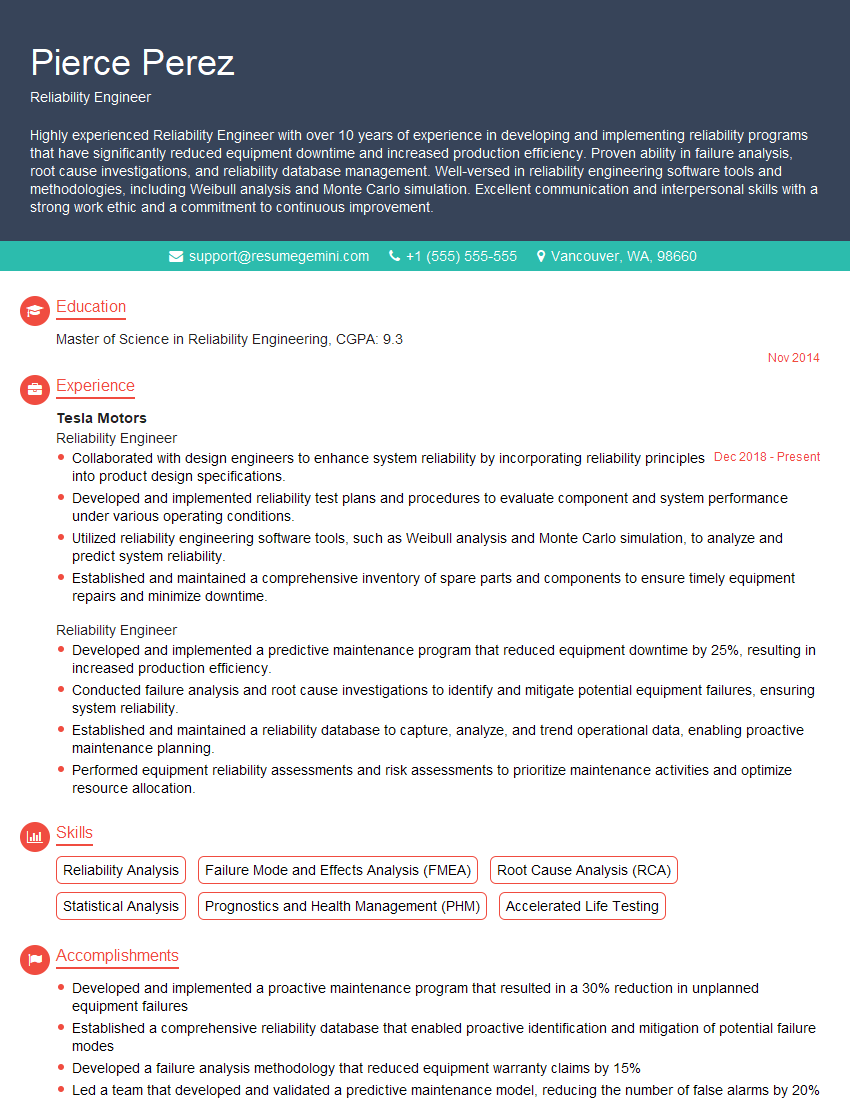
Mastering Reliability Engineering Principles is crucial for career advancement in this high-demand field. A strong understanding of these concepts will significantly enhance your interview performance and open doors to exciting opportunities. To further strengthen your job application, focus on building an ATS-friendly resume that showcases your skills and experience effectively. ResumeGemini is a trusted resource to help you create a professional and impactful resume. We provide examples of resumes tailored to Reliability Engineering Principles to guide you through the process, ensuring your qualifications shine.

Explore more articles
Users Rating of Our Blogs
Share Your Experience
We value your feedback! Please rate our content and share your thoughts (optional).
What Readers Say About Our Blog
Really detailed insights and content, thank you for writing this detailed article.
IT gave me an insight and words to use and be able to think of examples