The thought of an interview can be nerve-wracking, but the right preparation can make all the difference. Explore this comprehensive guide to Retrofitting and Upgrading Systems interview questions and gain the confidence you need to showcase your abilities and secure the role.
Questions Asked in Retrofitting and Upgrading Systems Interview
Q 1. Explain the difference between retrofitting and upgrading a system.
Retrofitting and upgrading are both methods to improve existing systems, but they differ significantly in scope and approach. Think of it like this: retrofitting is like patching up an old house, making necessary repairs and improvements to extend its lifespan, while upgrading is like building a new addition or completely renovating it, leading to significant performance enhancement.
Retrofitting focuses on addressing specific deficiencies or failures within an existing system while maintaining its core functionality. It usually involves replacing or repairing components to restore performance to acceptable levels. For example, retrofitting an older building’s heating system might involve replacing an inefficient boiler with a more modern, energy-efficient model. The overall system architecture remains largely unchanged.
Upgrading, on the other hand, aims to enhance the system’s overall capabilities, often introducing newer technologies and functionalities. It’s a more extensive process that could involve replacing significant portions of the system or completely overhauling its design. Upgrading the same heating system could mean switching to a completely different system, such as geothermal heating, significantly altering the system’s architecture and capabilities.
Q 2. Describe your experience with lifecycle cost analysis in system retrofits.
Lifecycle cost analysis (LCCA) is crucial for making informed decisions in system retrofits. It helps evaluate the long-term financial implications of different retrofit options, considering factors beyond the initial investment. In my experience, we use LCCA to compare the costs of various retrofits over the system’s projected lifespan, including initial costs, maintenance, energy consumption, and potential replacements. We’ll create detailed spreadsheets factoring in inflation, energy price fluctuations, and the potential for increased efficiency leading to lower operating costs.
For example, when retrofitting a building’s insulation, LCCA helps us compare the upfront cost of installing high-performance insulation against the long-term savings in heating and cooling costs. It allows us to identify the option with the lowest overall cost over the building’s lifetime. This analysis ensures that we choose the most cost-effective solution, even if the initial investment is higher. I’ve used this method successfully on multiple projects, often leading to clients choosing slightly more expensive upfront options that drastically reduced long-term costs.
Q 3. How do you identify potential risks and challenges during a system retrofit project?
Identifying potential risks and challenges in a system retrofit project requires a proactive and systematic approach. We typically use a risk assessment matrix that considers factors such as:
- Technical Risks: Compatibility issues between new and existing components, unforeseen structural limitations, and difficulties in integrating new technology into legacy systems.
- Operational Risks: Disruptions to ongoing operations during the retrofit, potential downtime, and challenges in coordinating work with other ongoing projects.
- Regulatory Risks: Non-compliance with building codes, safety regulations, and environmental standards.
- Budgetary Risks: Unforeseen cost overruns due to hidden defects, unexpected delays, or the need for additional materials or labor.
- Scheduling Risks: Delays caused by material shortages, permit approvals, or unforeseen technical issues.
We mitigate these risks through detailed planning, thorough site surveys, robust quality control measures, and contingency planning. For instance, if we anticipate potential compatibility issues, we’ll conduct extensive testing before initiating the retrofit. If there’s a risk of operational disruptions, we’ll plan the work carefully to minimize downtime.
Q 4. What are the key considerations for integrating new technology into legacy systems?
Integrating new technology into legacy systems requires careful consideration of compatibility, data migration, security, and potential disruptions to existing operations. We must ensure seamless communication between the old and new systems to prevent operational failures. A phased approach is often best, starting with a pilot program to test the integration before a full-scale implementation.
For example, integrating a new cloud-based system into an older on-premise system requires careful planning for data migration, ensuring data integrity and security during the transition. We would establish protocols for data backups and recovery, address security concerns regarding data access and privacy, and carefully map out the functionality and communication between both the new and old systems. We also ensure the new system has the capacity to handle current and future data requirements. Thorough testing, including integration tests and user acceptance tests, is critical to identify and resolve any problems before the full rollout.
Q 5. Explain your process for selecting appropriate retrofit materials and components.
Selecting appropriate retrofit materials and components involves a multi-faceted process that focuses on functionality, durability, safety, and cost-effectiveness. We consider several factors:
- Compatibility: The materials must be compatible with existing components and the overall system architecture.
- Performance: The materials must meet or exceed the required performance standards in terms of energy efficiency, durability, and safety.
- Durability: The chosen materials should have a long lifespan to minimize the need for future replacements.
- Cost-effectiveness: We compare different materials based on their initial cost, life-cycle cost, and potential for long-term savings.
- Sustainability: We prioritize environmentally friendly and sustainable materials whenever feasible.
We typically consult manufacturers’ specifications, conduct material testing, and review industry best practices to ensure that we select the most appropriate materials for the project. We may also involve experts, such as structural engineers or material scientists, to ensure the materials can withstand the existing environmental conditions and provide long-term reliability.
Q 6. How do you ensure compliance with relevant codes and regulations during a retrofit?
Compliance with relevant codes and regulations is paramount in system retrofits. We establish a comprehensive compliance program that covers all aspects of the project. This starts with identifying all applicable codes and regulations based on the location and type of system being retrofitted. We then develop a compliance plan that outlines the steps needed to meet these requirements, which is reviewed and approved by relevant authorities.
Throughout the project, we maintain meticulous documentation of all compliance-related activities, including inspections, tests, and certifications. This ensures that the retrofitted system meets all applicable standards. For example, in a building retrofit, we meticulously follow all building codes related to fire safety, accessibility, and energy efficiency. We work closely with inspectors and regulatory bodies throughout the project to ensure that the retrofit meets all necessary requirements before obtaining final approval.
Q 7. Describe your experience with managing project timelines and budgets for retrofit projects.
Managing project timelines and budgets for retrofit projects requires meticulous planning and ongoing monitoring. We use project management software to create detailed schedules, outlining all tasks and their dependencies. This enables us to track progress effectively and identify potential delays early on. We also establish a robust budget control system, tracking actual expenditures against the planned budget. We regularly review the budget and schedule to ensure that the project remains on track.
Regular meetings with the project team and stakeholders ensure everyone is informed about the progress, any potential challenges, and corrective measures. Effective communication is key to resolving issues promptly and avoiding costly delays. For example, if we encounter unexpected delays due to material shortages, we explore alternative sourcing options or adjust the schedule accordingly. If cost overruns are anticipated, we work with the client to explore options to mitigate the impact, potentially through value engineering or scope changes.
Q 8. How do you handle unforeseen technical challenges during a system retrofit?
Unforeseen technical challenges are inevitable in retrofitting. My approach focuses on proactive planning and a flexible, problem-solving mindset. First, we meticulously review existing system documentation, conducting thorough site surveys and inspections to identify potential issues *before* starting the project. This minimizes surprises. However, when unexpected problems arise, I follow a structured process:
- Immediate Assessment: The team immediately assesses the impact of the challenge on the project timeline and budget, and the safety of personnel.
- Root Cause Analysis: We conduct a thorough root cause analysis to understand *why* the problem occurred. This often involves consulting technical manuals, contacting manufacturers, and brainstorming solutions with the team.
- Solution Development: Based on the analysis, we develop multiple potential solutions, evaluating each for feasibility, cost-effectiveness, and safety. We prioritize solutions that minimize disruption and ensure the long-term integrity of the system.
- Implementation and Monitoring: Once a solution is selected, we implement it carefully, closely monitoring the system’s performance to ensure the fix is effective and doesn’t create new problems.
- Documentation: The entire process, including the unexpected challenge, its resolution, and any lessons learned, is meticulously documented. This helps us avoid similar issues in future projects.
For example, during a HVAC retrofit in an older building, we unexpectedly discovered asbestos insulation. We immediately halted work, contacted specialists, and implemented a safe asbestos removal plan, adding to the project timeline and budget but ensuring everyone’s safety and regulatory compliance. The experience led us to include more thorough asbestos testing in our pre-project assessments for similar future projects.
Q 9. What are the common causes of failure in retrofit projects, and how can they be avoided?
Common causes of retrofit project failure include inadequate planning, poor communication, unrealistic budgets, and neglecting existing system limitations.
- Inadequate Planning: Insufficient site surveys, neglecting to account for hidden complexities in existing systems, and failing to obtain necessary permits lead to delays and cost overruns.
- Poor Communication: Misunderstandings between stakeholders (clients, engineers, contractors) regarding scope, schedule, and expectations result in conflict and project failure.
- Unrealistic Budgets: Underestimating costs associated with unforeseen complications, material price fluctuations, and labor costs leads to financial difficulties.
- Neglecting System Limitations: Attempting to retrofit a system beyond its capabilities can cause system instability and failure. For instance, installing a modern high-efficiency HVAC system into a building with insufficient ductwork leads to poor performance and potential damage.
Avoidance Strategies:
- Comprehensive Planning: Conduct thorough site surveys, detailed design reviews, and risk assessments to identify potential problems before they arise.
- Open Communication: Establish clear communication channels and protocols. Regularly update stakeholders on progress, challenges, and potential solutions.
- Realistic Budgeting: Include contingency funds to cover unforeseen expenses. Develop detailed cost estimates based on historical data and expert assessments.
- System Assessment: Thoroughly assess the capabilities and limitations of the existing system to ensure compatibility with the proposed retrofit.
Q 10. Describe your experience with commissioning and testing retrofitted systems.
Commissioning and testing are crucial for ensuring the proper functionality and safety of retrofitted systems. My experience involves a multi-stage approach.
- Pre-commissioning: This involves reviewing design documents, verifying equipment installation, and performing functional tests of individual components. We check wiring diagrams, ensure proper insulation, and verify sensor calibration, for example.
- Integrated System Testing: This phase involves testing the interaction of all components within the retrofitted system. For example, if retrofitting a building management system (BMS), this phase involves testing the communication between the BMS, HVAC equipment, and lighting controls.
- Performance Testing: This stage involves rigorous testing to ensure the retrofitted system meets the performance specifications. This might involve measuring energy efficiency, verifying temperature control accuracy, or assessing the system’s response to various load conditions. We often use specialized monitoring equipment during this phase.
- Documentation: All testing procedures, results, and any deviations from specifications are meticulously documented. This documentation is crucial for demonstrating compliance with regulations and warranties.
In one project involving a boiler retrofit, pre-commissioning revealed a faulty pressure sensor. Identifying this early saved us significant time and prevented potential system failures during operation. Comprehensive testing ensured the new boiler met efficiency and safety standards before handing over the project to the client.
Q 11. How do you ensure the safety of personnel during a system retrofit?
Safety is paramount in retrofit projects. We implement a layered safety approach based on risk assessment, training, and strict adherence to safety regulations and procedures.
- Risk Assessment: Before commencing work, a thorough risk assessment identifies potential hazards associated with the project, such as working at heights, exposure to hazardous materials (e.g., asbestos, lead), and electrical hazards. We develop specific control measures to mitigate these risks.
- Permit-to-Work System: A permit-to-work system ensures that only authorized personnel access designated work areas. This system controls access to potentially hazardous areas and prevents unauthorized entry.
- Personal Protective Equipment (PPE): We provide and ensure the correct use of PPE, including hard hats, safety glasses, gloves, and respirators, depending on the tasks and identified hazards. We conduct regular training to reinforce proper PPE usage.
- Lockout/Tagout Procedures: We strictly follow lockout/tagout procedures for isolating energized equipment to prevent accidental starts and electrical shocks.
- Emergency Response Plan: An emergency response plan outlines procedures for handling incidents, including fire, injury, or equipment malfunctions, and ensures adequate first aid and emergency services are available.
Regular safety inspections, toolbox talks, and ongoing training ensure that safety remains a top priority throughout the project. For example, during an electrical retrofit, we implemented a strict lockout/tagout procedure to prevent electrical shocks. We trained all personnel on this procedure and consistently monitored adherence.
Q 12. Explain your experience with different types of system retrofits (e.g., electrical, mechanical, software).
I possess extensive experience across various system retrofits:
- Electrical Retrofits: This includes upgrading electrical panels, replacing outdated wiring, installing energy-efficient lighting, and implementing building automation systems (BAS). For example, I’ve worked on upgrading older industrial facilities to meet modern electrical codes and improving energy efficiency by up to 30%.
- Mechanical Retrofits: This involves upgrading HVAC systems, replacing aging plumbing, installing energy-efficient insulation, and improving building envelope performance. I have experience optimizing HVAC systems in commercial buildings, resulting in significant energy savings and improved indoor air quality.
- Software Retrofits: This focuses on updating control systems, integrating new software applications, and improving data management capabilities. I’ve upgraded industrial control systems (ICS), implementing cybersecurity measures and improving operational efficiency. This often involves working with SCADA systems and PLC programming.
My approach involves a holistic understanding of system interactions. For example, an HVAC retrofit might necessitate related electrical upgrades to accommodate new equipment. My expertise allows me to integrate these aspects seamlessly, ensuring overall system efficiency and reliability.
Q 13. Describe your experience with documentation and reporting for retrofit projects.
Detailed documentation and reporting are integral to successful retrofit projects. My experience includes:
- As-built Drawings: Creating accurate as-built drawings reflecting the final configuration of the retrofitted system. This is crucial for future maintenance and upgrades.
- System Manuals: Developing comprehensive system manuals detailing the operation and maintenance procedures for the updated systems. This includes schematics, wiring diagrams, and component specifications.
- Test Reports: Compiling detailed test reports documenting the commissioning and testing process, including all results and observations. These reports demonstrate compliance with specifications and relevant regulations.
- Progress Reports: Providing regular progress reports to stakeholders, including timelines, budget updates, and any challenges encountered. These reports keep everyone informed and allow for proactive problem-solving.
- Project Closure Reports: Creating comprehensive project closure reports summarizing the project’s scope, achievements, challenges, and lessons learned. These reports serve as valuable resources for future projects.
I utilize both digital and physical documentation methods, ensuring accessibility and long-term preservation of important information. This structured approach ensures clear communication and allows for efficient knowledge transfer within and between projects.
Q 14. How do you communicate technical information effectively to both technical and non-technical stakeholders?
Effective communication is crucial, especially when dealing with both technical and non-technical stakeholders. My approach involves tailoring my communication style to the audience.
- Non-technical Stakeholders: I use clear, concise language, avoiding jargon and technical terms. I use visuals such as diagrams and charts to explain complex concepts simply. I focus on the benefits and outcomes of the retrofit rather than technical details.
- Technical Stakeholders: I communicate using precise terminology and detailed technical information. I utilize technical drawings, specifications, and data analysis to support my explanations. I ensure open discussion and collaboration to ensure everyone is on the same page.
For example, when presenting a retrofit plan to a client, I start by highlighting the key benefits – improved energy efficiency, reduced operating costs, and enhanced safety. Then, I provide more detailed technical information to the engineering team, discussing specific component specifications and implementation strategies. This multi-faceted approach ensures everyone understands the project’s scope and implications.
Q 15. What is your approach to risk management in retrofit projects?
Risk management in retrofit projects is paramount. My approach is proactive and multi-layered, starting with a thorough risk assessment. This involves identifying potential hazards throughout the project lifecycle – from initial planning and design to implementation and post-retrofit monitoring. We categorize risks by likelihood and impact, using a matrix to prioritize them.
For example, in a building automation system retrofit, we’d consider risks like equipment failure, incompatibility with existing systems, unforeseen construction issues, and budget overruns. Each risk is then assigned mitigation strategies. These strategies might involve redundancy in critical components, thorough testing, contingency planning for delays, and robust change management processes. We continuously monitor and reassess risks throughout the project, adapting our strategies as needed. Regular reporting and communication keep stakeholders informed of any emerging risks and the steps taken to address them.
Finally, we incorporate a robust contingency plan to handle unforeseen circumstances and minimize project disruptions. This might include allocating a buffer in the budget or schedule, identifying alternative suppliers, or having backup procedures in place.
Career Expert Tips:
- Ace those interviews! Prepare effectively by reviewing the Top 50 Most Common Interview Questions on ResumeGemini.
- Navigate your job search with confidence! Explore a wide range of Career Tips on ResumeGemini. Learn about common challenges and recommendations to overcome them.
- Craft the perfect resume! Master the Art of Resume Writing with ResumeGemini’s guide. Showcase your unique qualifications and achievements effectively.
- Don’t miss out on holiday savings! Build your dream resume with ResumeGemini’s ATS optimized templates.
Q 16. Describe your experience with different project management methodologies (e.g., Agile, Waterfall).
My experience spans both Waterfall and Agile methodologies. Waterfall suits projects with well-defined requirements and minimal expected changes. I’ve used it successfully in large-scale infrastructure retrofits where detailed planning and sequential execution are crucial. For example, upgrading a legacy power grid often benefits from the structured approach of Waterfall, ensuring each stage is completed before the next begins.
However, Agile is often preferred for projects with evolving requirements or where iterative development is beneficial. In software system retrofits, for instance, an Agile approach allows for continuous feedback, enabling adjustments based on testing and user input. We might use Scrum, breaking the project into sprints with regular reviews and adaptations. This ensures flexibility and responsiveness to changing needs. My approach is to select the methodology best suited to the specific project’s complexities and constraints.
Q 17. How do you handle conflicts and disagreements within a project team during a retrofit?
Conflict resolution is a key skill in project management. My approach emphasizes open communication and collaborative problem-solving. When disagreements arise, I facilitate a structured discussion, ensuring all parties have a chance to express their perspectives. I focus on understanding the root cause of the conflict, not just the symptoms.
For example, if a disagreement emerges between the engineering team and the client over a design change, I’d first ensure everyone understands the technical implications and the client’s needs. We’d then collaboratively explore alternative solutions that satisfy both technical requirements and the client’s expectations. If necessary, I might involve a neutral third party to mediate. The goal is always to reach a consensus that benefits the overall project and maintains positive working relationships within the team.
Documentation is crucial; all agreements and decisions are recorded to prevent future misunderstandings.
Q 18. How do you prioritize tasks and manage competing demands during a system retrofit?
Prioritization in retrofit projects relies on a clear understanding of project goals, constraints, and dependencies. I use techniques like MoSCoW analysis (Must have, Should have, Could have, Won’t have) to categorize tasks based on their importance and urgency. This helps prioritize critical tasks while managing expectations around less critical ones.
We also employ critical path analysis to identify the sequence of tasks that directly impact the project timeline. This allows us to focus resources on tasks that are most likely to cause delays. Furthermore, we use tools like Kanban boards or Gantt charts to visualize the project schedule and track progress, making it easy to identify potential bottlenecks and adjust priorities as needed. Regular progress meetings and status reports keep everyone informed and aligned.
Q 19. Describe your experience with different types of system architectures and their impact on retrofits.
My experience encompasses various system architectures, including monolithic, microservices, and client-server. Understanding these architectures is crucial for successful retrofits. A monolithic system, for instance, requires a more comprehensive approach to upgrading, often involving a significant downtime. Migrating a monolithic application to a microservices architecture, while more complex initially, can offer greater flexibility and scalability in the long run.
Client-server architectures require consideration of both client and server-side upgrades, potentially involving compatibility issues between different versions. The impact on retrofits is significant; a poorly planned retrofit can lead to instability, data loss, or even complete system failure. Thorough impact assessments, compatibility testing, and staged rollouts are key to minimizing risks during the upgrade process.
Q 20. How do you ensure the long-term sustainability of a retrofitted system?
Ensuring long-term sustainability involves several key aspects. First, we prioritize selecting high-quality, durable components with long lifespans and readily available support. Second, we design for ease of maintenance and upgrade. This might involve modular design, standardized components, and clear documentation.
Regular maintenance and monitoring are critical, including preventive maintenance schedules to detect and address potential issues before they escalate. Finally, we establish a process for future upgrades, considering scalability and potential technological advancements. This might include creating a roadmap for future improvements or developing a modular system that can adapt to new technologies. This proactive approach minimizes the risk of obsolescence and extends the lifespan of the retrofitted system.
Q 21. What are some common challenges encountered when upgrading outdated software systems?
Upgrading outdated software systems presents unique challenges. Technical debt, accumulated over time through shortcuts or poorly documented code, can significantly complicate upgrades. Compatibility issues with newer hardware or software are common. The absence of proper documentation or the unavailability of original developers adds to the complexity.
Another challenge is data migration; transferring data from an old system to a new one without data loss or corruption is critical. Furthermore, testing is vital to ensure the upgraded system functions correctly and meets user requirements. Finally, user training is often overlooked, but essential for a smooth transition and user adoption of the new system. A successful upgrade requires careful planning, thorough testing, and effective communication with all stakeholders.
Q 22. How do you ensure data integrity during a system upgrade?
Data integrity is paramount during system upgrades. Think of it like meticulously moving all your belongings from an old house to a new one – you can’t afford to lose anything! We ensure this through a multi-layered approach. First, a comprehensive data backup is performed before any changes are implemented. This backup is verified to ensure its completeness and accessibility. Then, during the upgrade process itself, we employ techniques like database mirroring or shadowing, which create a real-time copy of the database, allowing for rollback if necessary. Finally, post-upgrade, thorough data validation checks are carried out to confirm that all data has been migrated successfully and remains accurate. This might involve comparing checksums or using specialized data comparison tools. For example, in a recent upgrade of an e-commerce platform, we used a database mirroring solution to ensure that no order data was lost during the server migration. If any discrepancies were found, automated alerts would flag the issue, and the rollback mechanism would be triggered.
Q 23. Describe your experience with testing and validation procedures for upgraded systems.
Testing and validation are crucial stages, akin to test-driving a car before buying it. My experience encompasses various testing methodologies, including unit testing (testing individual components), integration testing (testing how different components work together), system testing (testing the entire system as a whole), and user acceptance testing (UAT) – where end-users validate the system meets their requirements. We utilize both automated and manual testing, leveraging tools like Selenium for automated UI testing and JUnit for unit testing. Automated tests increase efficiency and ensure consistent testing. For example, in a recent project involving a hospital’s patient management system upgrade, we performed rigorous integration tests to ensure seamless communication between the new system and existing medical devices, avoiding potential data inconsistencies or delays in critical care situations.
Q 24. What are the key performance indicators (KPIs) you would use to measure the success of a retrofit project?
Measuring the success of a retrofit project requires a clear set of KPIs. These typically fall under categories like cost, schedule, and performance. Key examples include: Cost: Actual cost versus planned budget; Schedule: Project completion time versus planned timeline; Performance: System uptime after the upgrade; Efficiency: Improvement in throughput or processing speed; User Satisfaction: Feedback scores from end-users regarding the usability and functionality of the upgraded system. For instance, in a manufacturing plant retrofit, we tracked the reduction in production downtime as a key indicator of success, alongside the improvement in machine efficiency following the upgrade.
Q 25. How do you handle stakeholder expectations during a system upgrade project?
Managing stakeholder expectations is an art. Proactive communication is key. We start by clearly defining project goals, timelines, and potential risks upfront. Regular progress reports, using clear, non-technical language, are provided to all stakeholders. We also establish clear communication channels – email, regular meetings, or dedicated project management software – to keep everyone informed. Transparent communication builds trust and helps manage expectations. For instance, if delays are anticipated, we explain the reasons promptly and offer alternative solutions to mitigate the impact on the stakeholders. This approach fosters collaboration and buy-in throughout the project lifecycle.
Q 26. Describe your experience with change management processes during system retrofits.
Change management is crucial for minimizing disruption during system retrofits. We employ a structured approach, involving careful planning, communication, and training. This typically involves:
- Assessment: Identifying all impacted users and systems.
- Planning: Developing a detailed change management plan that includes timelines, responsibilities, and communication strategies.
- Implementation: Rolling out changes incrementally where possible, minimizing disruption.
- Training: Providing thorough training to users on the new system, ensuring they are comfortable with the changes.
- Support: Offering ongoing support and troubleshooting after the upgrade.
Q 27. How do you address potential downtime during a system upgrade?
Minimizing downtime is a top priority. Strategies include:
- Phased Rollouts: Implementing the upgrade in stages, minimizing the impact on the overall system.
- Parallel Operation: Running the old and new systems simultaneously for a period, allowing for a smooth transition.
- Weekend or Off-Peak Upgrades: Scheduling the upgrade during periods of low system usage.
- Rollback Plan: Having a well-defined plan in place to revert to the previous system if issues arise.
Q 28. Explain your experience with system backups and disaster recovery planning in the context of retrofits and upgrades.
System backups and disaster recovery planning are essential for minimizing the impact of unforeseen events. Before any upgrade, we perform full system backups, including databases, configurations, and applications. These backups are stored securely, often in multiple locations, using techniques like cloud storage or geographically distributed servers. We also develop a comprehensive disaster recovery plan, outlining procedures for restoring systems in case of failures. This plan includes strategies for data restoration, system recovery, and communication protocols to ensure business continuity. Regular testing of the disaster recovery plan is crucial to verify its effectiveness. In a recent project involving a financial institution, we used a 3-2-1 backup strategy – three copies of data, on two different media types, with one copy offsite – to ensure data security and recoverability.
Key Topics to Learn for Retrofitting and Upgrading Systems Interview
- System Assessment and Analysis: Understanding the current system’s functionality, limitations, and potential upgrade paths. This includes identifying areas for improvement and potential risks associated with upgrades.
- Feasibility Studies and Cost-Benefit Analysis: Evaluating the technical and economic viability of different retrofitting and upgrading options. Practical application involves comparing various solutions and justifying the chosen approach.
- Design and Planning: Developing detailed plans for implementation, including material selection, scheduling, and resource allocation. This involves considering safety regulations and minimizing downtime.
- Implementation and Testing: Executing the retrofitting or upgrading plan, performing rigorous testing to ensure functionality and safety, and documenting the process. Real-world examples involve troubleshooting issues during implementation.
- Integration with Existing Systems: Understanding the complexities of integrating new or upgraded components seamlessly into the existing infrastructure. Problem-solving involves addressing compatibility issues and mitigating potential conflicts.
- Health and Safety Regulations: Adherence to relevant safety standards and regulations throughout the entire process. Practical application includes risk assessments and safety protocols.
- Project Management Techniques: Utilizing project management methodologies (e.g., Agile, Waterfall) to manage time, resources, and budgets effectively.
- Troubleshooting and Diagnostics: Identifying and resolving issues that may arise during and after the retrofitting or upgrading process.
- Documentation and Reporting: Creating comprehensive documentation of the entire process, including design specifications, implementation details, and test results. This is crucial for future maintenance and upgrades.
Next Steps
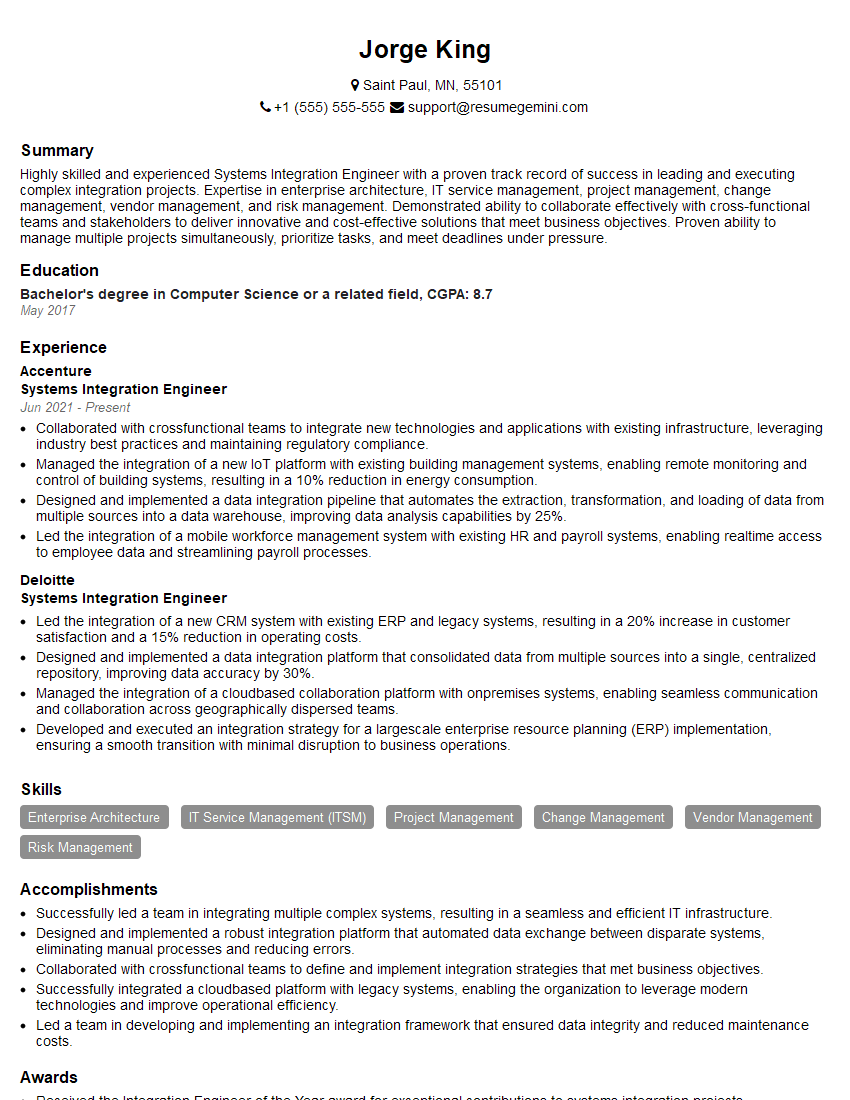
Mastering Retrofitting and Upgrading Systems is crucial for career advancement in many industries. It demonstrates your ability to solve complex problems, manage projects effectively, and stay abreast of technological advancements. To significantly boost your job prospects, focus on crafting an ATS-friendly resume that clearly highlights your skills and experience in this field. ResumeGemini is a trusted resource that can help you build a professional and impactful resume, ensuring your application stands out. Examples of resumes tailored to Retrofitting and Upgrading Systems are available to help you get started.
Explore more articles
Users Rating of Our Blogs
Share Your Experience
We value your feedback! Please rate our content and share your thoughts (optional).
What Readers Say About Our Blog
Really detailed insights and content, thank you for writing this detailed article.
IT gave me an insight and words to use and be able to think of examples