Feeling uncertain about what to expect in your upcoming interview? We’ve got you covered! This blog highlights the most important Sampling and preparing cotton samples for grading interview questions and provides actionable advice to help you stand out as the ideal candidate. Let’s pave the way for your success.
Questions Asked in Sampling and preparing cotton samples for grading Interview
Q 1. Describe the different methods used for sampling cotton bales.
Sampling cotton bales is crucial for accurate grading and quality assessment. Several methods ensure a representative sample is obtained. The most common include:
Core Sampling: A long, hollow tube is inserted into the bale, extracting a core sample that represents the bale’s entire depth. This is a quick and relatively inexpensive method, suitable for large-scale operations. Think of it like taking a core sample from a layer cake to understand its complete composition.
Hand Sampling: This involves manually extracting small portions of cotton from various points within the bale. It requires more skill and time but allows for visual inspection of the cotton’s condition. It’s useful when you need a detailed visual assessment or suspect inconsistencies in the bale.
Mechanical Sampling: Specialized machines are employed to automatically extract samples from multiple bales simultaneously. This greatly increases efficiency and reduces labor costs, ideal for high-throughput testing environments. Think of it like an automated system extracting samples from many boxes of cereal at once.
The choice of method depends on factors like bale size, the resources available, and the desired level of detail in the analysis. Often, a combination of methods is used to ensure the most representative sample.
Q 2. Explain the importance of representative sampling in cotton grading.
Representative sampling is absolutely paramount in cotton grading because it directly impacts the accuracy of the quality assessment. If the sample doesn’t truly represent the entire bale, the grading results will be skewed, leading to potentially inaccurate pricing and trading decisions. Imagine trying to judge the quality of a whole batch of apples by only looking at one apple – it’s highly unlikely to be truly representative.
A non-representative sample may misrepresent the fiber length, strength, micronaire, color, and other crucial properties. This can lead to disputes between buyers and sellers and potential financial losses. Therefore, careful sampling techniques, as described previously, are employed to minimize bias and ensure the sample accurately reflects the overall quality of the cotton bale.
Q 3. What are the common instruments used for measuring fiber length and strength?
Several instruments are used to measure cotton fiber length and strength. For fiber length:
High Volume Instrument (HVI): This system measures several fiber properties, including length, and is the industry standard for automated testing. It uses advanced optical sensors for precise measurement.
AFIS (Advanced Fiber Information System): Another automated system, AFIS, provides detailed analysis of fiber length distribution and other properties. It’s known for its accurate and detailed data output.
For fiber strength:
Uster Tensometer: This device measures the breaking strength of individual fibers or small bundles, providing insights into the fiber’s tensile properties. It’s like a tiny, powerful machine that tests how much force a fiber can withstand before breaking.
HVI system (again): The HVI system also incorporates strength measurement capabilities. While not as precise as the Uster Tensometer for individual fibers, it provides a good overall strength index for the whole sample.
The choice of instrument depends on the required level of detail, the budget, and the specific fiber properties of interest.
Q 4. How do you identify and classify different types of cotton fiber?
Cotton fiber types are classified based on several characteristics including length, strength, fineness (micronaire), and color. Different varieties exhibit unique combinations of these properties. The most common classification schemes consider staple length (fiber length) and strength. For example:
Extra Long Staple (ELS): This is high-quality cotton with exceptionally long fibers, resulting in strong, luxurious fabrics. Examples include Pima and Egyptian cotton.
Long Staple: Longer than average fibers, producing strong and durable fabrics. It’s a step below ELS in terms of length but still desirable for higher-quality products.
Medium Staple: Commonly used for a wide range of applications, it represents the majority of cotton production. The balance between cost and quality makes it very versatile.
Short Staple: Shorter fibers that are typically used for less demanding applications, like lower-grade yarns and fabrics.
Beyond length and strength, color, micronaire (fiber fineness), and maturity also play roles in fiber classification and grading, contributing to the overall quality assessment.
Q 5. What are the key factors affecting cotton fiber quality?
Cotton fiber quality is influenced by a multitude of factors, broadly categorized into environmental and genetic factors:
Environmental Factors: Climate (temperature, rainfall, sunlight), soil conditions (fertility, drainage), and pest and disease infestations all have a significant impact on fiber development. Think of it like how a plant will grow better in some conditions than others.
Genetic Factors: The cotton variety (cultivar) plays a major role. Different varieties possess different traits influencing fiber length, strength, fineness, and maturity. This is like how different apple varieties produce apples with different tastes and textures.
Agricultural Practices: Farming practices like irrigation, fertilization, pest control, and harvesting techniques significantly affect fiber quality. Proper management leads to better quality and higher yields.
These factors interact in complex ways, resulting in variations in fiber quality even within the same field or bale. Understanding these factors is essential for producing high-quality cotton.
Q 6. Explain the HVI system and its significance in cotton grading.
The High Volume Instrument (HVI) system is an automated testing system that measures several key cotton fiber properties simultaneously. This includes fiber length, strength, uniformity, maturity, micronaire, and color. The data generated allows for accurate and objective grading of cotton based on a standardized set of parameters.
Its significance lies in its ability to provide rapid, high-throughput testing, which has revolutionized cotton grading. Before the HVI system, testing was slower, more labor-intensive, and potentially less accurate, leading to inconsistencies in grading and potential disputes. Now, the HVI system ensures objective, consistent grading, enabling efficient and fair trade practices within the global cotton market.
The detailed data obtained from the HVI is vital for both buyers and sellers, assisting them in making informed decisions based on the exact quality and suitability of the cotton for specific textile applications. For example, a manufacturer needing high-strength cotton can easily filter samples based on the HVI strength data, reducing the risk of selecting unsuitable cotton for their needs.
Q 7. Describe the process of preparing a cotton sample for testing.
Preparing a cotton sample for testing involves several crucial steps to ensure the accuracy and reliability of the results. These steps are designed to create a representative subsample that can be easily handled by the testing instruments:
Opening and Cleaning: The initial sample may contain trash (leaves, seeds, etc.). It is cleaned using specialized machines to remove these contaminants, providing a cleaner sample for testing.
Fiber Separation: The cleaned cotton is then processed to separate the individual fibers. This ensures accurate fiber property measurements by preventing clumping or entanglement.
Weighing and Conditioning: The sample is weighed to determine the amount needed for analysis. It’s also conditioned (exposed to a specific temperature and humidity) to standardize moisture content, as moisture can affect testing outcomes. It’s like preheating an oven to ensure consistent baking temperatures.
Preparation for Specific Tests: Depending on the tests to be performed (e.g., fiber length, strength, micronaire), further preparation steps may be necessary, following the specific guidelines for each instrument.
Careful sample preparation is critical for generating reliable test results, ensuring accurate cotton quality assessment, and informing trading decisions.
Q 8. How do you ensure the accuracy and reliability of cotton testing results?
Ensuring accurate and reliable cotton testing results hinges on meticulous sampling, proper sample preparation, and the use of calibrated instruments. Think of it like baking a cake – if your initial ingredients aren’t measured correctly, the final product won’t be as expected.
- Representative Sampling: We employ statistically sound methods to select samples that accurately reflect the entire cotton bale or lot. This often involves taking core samples from multiple locations within the bale, ensuring a diverse representation of fiber characteristics. For instance, we might take samples from the top, middle, and bottom of a bale to account for potential variations in compression and fiber quality.
- Proper Sample Preparation: Before testing, cotton samples undergo careful preparation to eliminate extraneous materials and ensure uniformity. This includes cleaning the sample to remove leaf, trash, and other impurities that could skew test results. We might use specialized equipment like a cotton press to create a consistent, uniform sample for testing.
- Calibration and Maintenance: All instruments used for testing, such as the high volume instrument (HVI) for fiber properties, are regularly calibrated and maintained according to strict protocols. This ensures accuracy and consistency in measurements across different testing sessions and locations. Regular calibration checks are crucial to prevent systematic errors and ensure that the equipment is performing optimally.
- Quality Control: We implement rigorous quality control measures throughout the entire process. This includes using certified reference materials to check the accuracy of our instruments and procedures, and employing trained personnel to perform the testing and data analysis.
By adhering to these principles, we significantly reduce the likelihood of errors and increase the confidence we can place in our cotton testing results. This translates to more informed decisions regarding cotton grading, pricing, and processing.
Q 9. What are the common defects found in cotton fibers, and how are they assessed?
Cotton fibers can suffer from various defects, impacting their quality and ultimately the yarn produced from them. These defects are assessed visually and through instrumental measurements.
- Short Fiber Length: Shorter fibers result in weaker, less durable yarns. We measure fiber length using instruments like the AFIS (Advanced Fiber Information System) which provides detailed length distributions.
- Weak Fiber Strength: Weak fibers break easily during spinning, leading to yarn imperfections. Strength is measured using instruments like the Stelometer, which determines the force needed to break a fiber bundle.
- Color Variations: Uneven color can be due to immature fibers or staining. Visual assessments combined with colorimetric measurements quantify color uniformity.
- Trash Content: Foreign materials like leaves, stems, and seeds reduce fiber quality and can damage spinning machinery. Trash content is assessed by visual inspection and sometimes quantified by weight.
- Fiber Maturity: Immature fibers have thinner walls and are weaker. Maturity is often assessed using the HVI’s Micronaire reading.
- Fiber Damage: Physical damage during harvesting or processing, such as broken fibers or damaged fiber walls, reduce quality. This is assessed visually under magnification.
The assessment of these defects involves a combination of visual examination, using a variety of magnifications and lighting conditions, and instrumental measurements. A skilled grader uses these observations to assign a quality grade to the cotton.
Q 10. Explain the different cotton grading systems used globally.
Several cotton grading systems exist globally, each with its own specific parameters and standards. While they differ in their details, they all aim to provide a standardized way to assess and classify cotton quality.
- The USDA System (United States): This is a widely recognized system that classifies cotton based on fiber length, strength, micronaire (fiber fineness and maturity), and color. It assigns a grade, staple length, and micronaire value, creating a detailed profile of the cotton’s quality.
- The Egyptian System: Egypt, a significant cotton producer, uses a system focused on extra-long staple cotton. Grading emphasizes factors like length, fineness, strength, and whiteness, reflecting the premium quality of Egyptian cotton.
- The Indian System: India, another major producer, employs a system that often categorizes cotton based on fiber length, strength, and color, and sometimes incorporates other quality parameters like trash content.
- International Cotton Classification: There’s a push towards greater standardization and harmonization, reflected in international collaborations to define quality parameters that are more broadly applicable.
It’s important to understand the specific grading system used when evaluating a cotton sample, as the grading parameters and interpretations can vary significantly. For example, the standards for ‘extra-long staple’ might differ slightly between the Egyptian and Indian systems.
Q 11. How do you interpret cotton grading reports?
Cotton grading reports provide a summary of the cotton’s quality characteristics. Interpreting them requires understanding the specific grading system used and the parameters reported. A typical report will include:
- Grade: A letter or number representing the overall quality, reflecting aspects like color and cleanliness. A higher grade indicates better quality.
- Fiber Length: Indicating the average length of the fibers, crucial for yarn strength and fineness. Longer fibers generally mean stronger yarns.
- Fiber Strength: Measured as the force needed to break a fiber bundle, influencing yarn strength and durability.
- Micronaire: A measure of fiber fineness and maturity, influencing yarn softness and spinnability. A specific range is preferred for optimal yarn quality.
- Color: Expressed as a color grade or index, reflecting how white or stained the cotton is. Whiter cotton is typically more desirable.
- Trash Content: The percentage of foreign materials present. Lower levels indicate better quality.
- Uniformity: Measures the consistency of fiber properties across the sample.
By examining these parameters together, we can form a comprehensive understanding of the cotton’s quality, suitability for specific yarn types, and its expected processing performance. For example, a high strength and long staple length indicate suitability for premium yarns, while a higher trash content might indicate the need for more rigorous cleaning processes.
Q 12. Describe the relationship between fiber properties and yarn quality.
The relationship between fiber properties and yarn quality is fundamental in textile manufacturing. The quality of the cotton fiber directly impacts the properties of the yarn spun from it. Think of it as building a house – using strong, high-quality bricks (fibers) will result in a stronger, better house (yarn).
- Fiber Length: Longer fibers produce stronger, smoother yarns with less hairiness. Shorter fibers lead to weaker, fuzzier yarns.
- Fiber Strength: Stronger fibers result in stronger, more durable yarns, less prone to breakage during processing and use.
- Fiber Maturity: More mature fibers have thicker walls and are stronger and more resistant to damage during spinning. They produce higher-quality yarns.
- Fiber Fineness (Micronaire): This influences the yarn’s softness and hand feel. The optimum micronaire range is dependent on the desired yarn characteristics.
- Fiber Uniformity: Consistent fiber properties throughout the sample result in more uniform yarns with fewer imperfections.
Understanding these relationships is crucial for selecting appropriate cotton for specific yarn types and end-uses. For instance, high-quality extra-long staple cotton is used for luxury fabrics, whereas shorter, stronger fibers might be better suited for industrial applications.
Q 13. What are the standard procedures for handling and storing cotton samples?
Proper handling and storage of cotton samples are critical to maintaining their integrity and ensuring accurate test results. Neglecting these steps can lead to degradation of the fiber and unreliable data.
- Cleanliness: Samples should be handled with clean hands and gloves to avoid contamination with dust, oils, or other substances that could affect testing results.
- Protection from Moisture: Cotton is susceptible to moisture absorption, which can lead to mold and mildew growth and affect fiber properties. Samples must be stored in dry conditions with low humidity.
- Protection from Light: Exposure to direct sunlight can damage cotton fibers, reducing their quality. Samples should be stored in dark, cool environments.
- Proper Packaging: Samples are often sealed in airtight containers or bags to protect them from environmental factors and pests.
- Temperature Control: Consistent temperature helps maintain fiber integrity and prevents degradation.
- Pest Control: Cotton is susceptible to insect damage. Storage areas need to be free from pests to prevent contamination.
Following these procedures helps ensure that the cotton samples remain representative of the original bale and provide reliable data for grading and other analyses. Imagine trying to judge a piece of art after it’s been exposed to rain and sunlight – the same principle applies to cotton samples.
Q 14. How do you deal with inconsistencies or discrepancies in sampling results?
Inconsistencies or discrepancies in sampling results require careful investigation to identify and address the root cause. It’s crucial to maintain a systematic approach to ensure data integrity.
- Repeat Sampling: If discrepancies are significant, we repeat the sampling process to see if the inconsistencies persist. This could involve taking additional samples from the same bale or lot using different sampling techniques.
- Instrument Calibration: Verify that all instruments used for testing are properly calibrated and functioning correctly. A malfunctioning instrument could be the source of the discrepancy.
- Review of Procedures: Carefully examine all steps in the sampling and testing process to identify any procedural errors or deviations from standard protocols. This involves double-checking each stage, from sample preparation to data analysis.
- Statistical Analysis: Employ statistical methods to analyze the data and determine if the observed variations are within acceptable ranges of variability. This step helps distinguish between random fluctuations and significant differences.
- Sample Handling: Investigate potential problems with sample handling, storage, and transportation, looking for any environmental factors that might have affected the samples.
By systematically investigating these potential sources of error, we can identify the cause of the discrepancies and take corrective actions. This ensures the reliability of our results and improves the overall quality control of our cotton testing procedures. Remember, identifying and resolving discrepancies reinforces the accuracy of our work, contributing to a reliable and trusted assessment of cotton quality.
Q 15. Explain the role of micronaire in cotton quality assessment.
Micronaire is a crucial measurement in cotton quality assessment, representing the fineness and maturity of cotton fibers. It’s essentially a measure of fiber weight per unit length, expressed as a dimensionless number. A higher micronaire value indicates thicker, more mature fibers, while a lower value suggests thinner, less mature fibers.
Why is this important? Micronaire directly impacts the yarn’s properties. Higher micronaire values generally lead to stronger yarns with better spinning performance, but they might also result in a coarser hand feel in the finished fabric. Conversely, lower micronaire values can produce finer, softer fabrics but with potentially weaker yarns and lower spinning efficiency. Think of it like this: imagine trying to make a rope – thicker, stronger fibers (higher micronaire) make a tougher rope, whereas thinner fibers might make a more delicate, but less robust one. The ideal micronaire range depends on the intended end-use of the cotton; for example, high-quality apparel fabrics often require a specific micronaire range for optimal softness and drape.
Career Expert Tips:
- Ace those interviews! Prepare effectively by reviewing the Top 50 Most Common Interview Questions on ResumeGemini.
- Navigate your job search with confidence! Explore a wide range of Career Tips on ResumeGemini. Learn about common challenges and recommendations to overcome them.
- Craft the perfect resume! Master the Art of Resume Writing with ResumeGemini’s guide. Showcase your unique qualifications and achievements effectively.
- Don’t miss out on holiday savings! Build your dream resume with ResumeGemini’s ATS optimized templates.
Q 16. What are the implications of improper sampling techniques?
Improper sampling techniques can lead to significant inaccuracies in cotton quality assessment, impacting trading decisions, processing efficiency, and ultimately, the quality of the final product. The consequences can be substantial.
- Biased Results: If the sample isn’t representative of the entire bale or lot, the test results will be misleading. For instance, sampling only from the top of a bale might give a different picture than sampling from the entire bale’s cross-section. This could lead to misclassification of the cotton quality and subsequent disputes.
- Economic Losses: Inaccurate assessments can lead to incorrect pricing of cotton, resulting in financial losses for buyers and sellers. A bale wrongly classified as high-quality might fetch a premium price, leading to substantial losses if its actual quality is lower.
- Processing Problems: Inconsistent cotton quality due to inaccurate sampling can disrupt the spinning process. Unexpected variations in fiber properties can cause machine breakdowns, increase production costs, and produce yarn of inconsistent quality.
- Reputational Damage: Repeated instances of inaccurate assessments can harm the reputation of the sampling agency or the company involved, affecting future business dealings.
To avoid these pitfalls, adhering to standardized sampling procedures, using appropriate equipment, and rigorous training of personnel are crucial.
Q 17. Describe your experience with different types of cotton testing equipment.
Throughout my career, I’ve gained extensive experience with a wide array of cotton testing equipment. This includes:
- Micronaire instruments: I’m proficient in operating both the AFIS (Advanced Fiber Information System) and HVI (High Volume Instrument) systems for precise micronaire measurements. These instruments provide a comprehensive analysis of fiber properties.
- Fiber strength testers: I’ve used various instruments to determine the tensile strength and elongation of cotton fibers, helping to assess their overall strength and durability.
- Fiber length analyzers: I have experience with different fiber length analyzers which provide insights into the length distribution within a cotton sample, a key factor in determining yarn quality and processing suitability.
- Colorimeters: Accurate color assessment is vital, and I am skilled in using colorimeters to quantify the color of cotton samples, ensuring consistent shades across batches.
- Moisture meters: Precise moisture content is critical for accurate weight determination and processing; I use different types of moisture meters to determine the moisture content of cotton samples.
My experience extends to both manual and automated testing equipment, enabling me to adapt to various testing environments and methodologies.
Q 18. How do you maintain the accuracy and calibration of testing equipment?
Maintaining the accuracy and calibration of testing equipment is paramount for reliable results. This is achieved through a multi-faceted approach:
- Regular Calibration: All instruments undergo regular calibration checks using certified standards. The frequency of calibration varies depending on the equipment and manufacturer’s recommendations; some instruments require daily calibration, while others may need it weekly or monthly.
- Preventive Maintenance: Regular cleaning and preventative maintenance are performed to prevent malfunctions. This includes checking components, replacing worn parts, and ensuring the instrument operates within its specifications.
- Quality Control Checks: Internal quality control checks are performed routinely. This involves testing known samples of cotton with known characteristics to verify the equipment’s accuracy. Discrepancies are investigated and corrective actions taken.
- Operator Training: Proper training of operators is essential to ensure correct usage and handling of the equipment, minimizing the risk of errors due to mishandling.
- Documentation: All calibration and maintenance activities are meticulously documented and recorded, creating an auditable trail.
This rigorous approach ensures that the equipment produces reliable and accurate results, underpinning the integrity of our cotton quality assessments.
Q 19. What are the best practices for documentation and record-keeping in cotton sampling and grading?
Documentation and record-keeping are critical for traceability, accountability, and adherence to industry standards. Our system follows a detailed, organized approach:
- Sample Identification: Each sample is uniquely identified with a detailed tracking number that includes the bale number, date of sampling, and location.
- Sampling Procedure: A detailed description of the sampling procedure is recorded, including the method used (e.g., core sampling, hand sampling), the number of samples taken, and the location of sampling within the bale or lot.
- Test Results: All test results are meticulously recorded, including the date and time of testing, the equipment used, and the person who conducted the test.
- Chain of Custody: A chain of custody is maintained for each sample, documenting its movement and handling from sampling to testing to archiving.
- Data Management: We utilize a digital database to store all sampling and testing data, enabling easy retrieval and analysis of information. This data is regularly backed up to ensure data integrity.
This comprehensive documentation system ensures traceability throughout the entire process, meeting industry standards and facilitating efficient dispute resolution, if needed. The records provide a detailed history of each cotton sample, improving overall quality control and operational transparency.
Q 20. How do you ensure compliance with industry standards and regulations?
Compliance with industry standards and regulations is a top priority. We adhere strictly to international standards such as ISO standards for cotton testing and relevant national regulations. This commitment is demonstrated through:
- Regular Audits: Our testing facilities undergo regular internal and external audits to ensure our processes align with the latest industry standards and regulations.
- Personnel Training: Our staff receives ongoing training on the latest standards, regulations, and best practices in cotton sampling and grading. This includes training on proper sampling techniques, equipment operation, and data analysis.
- Equipment Calibration: As mentioned earlier, our commitment to regular equipment calibration ensures the accuracy and reliability of our test results, crucial for regulatory compliance.
- Traceability Systems: Our robust traceability systems, including detailed documentation and chain of custody, ensure compliance with regulations requiring clear provenance and tracking of cotton samples.
- Quality Management System (QMS): We maintain a robust QMS that ensures consistent adherence to standards, facilitates continuous improvement, and addresses potential non-conformances promptly.
Maintaining compliance is not merely a matter of regulatory adherence; it’s crucial for building trust with clients and maintaining the integrity of our services in the global cotton market.
Q 21. Describe a situation where you had to troubleshoot a problem related to cotton sampling or testing.
One time, we encountered a significant discrepancy in the micronaire readings from a particular batch of cotton. Initial tests showed unusually low micronaire values, suggesting immature fibers. This was unexpected, given the supplier’s reputation and the historical data for this particular cotton variety.
To troubleshoot, we followed a systematic approach:
- Re-sampling: We re-sampled the bale multiple times, ensuring representative sampling from various locations within the bale.
- Equipment Verification: We thoroughly checked the micronaire instrument for any calibration issues or malfunctions, recalibrating it using certified standards.
- Multiple Tests: We performed multiple tests on the same sample using different instruments to rule out equipment-specific errors.
- Comparative Analysis: We compared the results with other fiber properties (e.g., fiber length, strength) to see if other factors could explain the low micronaire.
- Supplier Consultation: We contacted the supplier to investigate potential processing or growing factors that might have impacted fiber maturity.
After careful investigation, we discovered that a recent change in the supplier’s ginning process had inadvertently led to an increase in immature fibers. By identifying this root cause, we were able to resolve the issue and prevent similar occurrences in the future. This incident highlighted the importance of thorough investigation, detailed record-keeping, and effective communication with suppliers to ensure the accuracy of our cotton quality assessments.
Q 22. How do you stay up-to-date with the latest advancements in cotton quality assessment?
Staying current in cotton quality assessment requires a multi-pronged approach. I actively participate in industry conferences like those hosted by the International Cotton Association (ICA) and the National Cotton Council (NCC), attending workshops and seminars on the latest testing methodologies and technologies. I also subscribe to key industry publications such as Cotton International and peer-reviewed journals focusing on textile science and fiber technology. Furthermore, I maintain a professional network with researchers and experts in the field, engaging in regular discussions and knowledge sharing. This combined strategy ensures I remain abreast of advancements in areas such as high-volume instrument (HVI) technology improvements, new fiber quality parameters, and emerging grading standards.
Q 23. What are the environmental considerations related to cotton production and processing?
Environmental considerations in cotton production and processing are paramount. Sustainable cotton farming practices are crucial to minimize the environmental footprint. This includes reducing water consumption through efficient irrigation techniques like drip irrigation, minimizing pesticide and herbicide use through integrated pest management (IPM) strategies, and promoting soil health through practices like crop rotation and cover cropping. Processing also presents challenges. The textile industry is a significant water consumer; minimizing water usage during processes like ginning and scouring is critical. Furthermore, wastewater treatment to remove pollutants and dyes before discharge is essential. The use of renewable energy sources in cotton processing facilities is also gaining traction as a way to reduce carbon emissions. Overall, a holistic approach incorporating sustainable agricultural practices and environmentally responsible processing is key to ensuring the long-term viability of the cotton industry.
Q 24. Explain the difference between staple length and fiber length.
While often used interchangeably, staple length and fiber length are distinct. Staple length refers to the average length of a cotton fiber as measured from the seed after ginning, providing an indication of yarn strength and fineness. It is determined using instruments like the AFIS (Advanced Fiber Information System). Fiber length is a more general term encompassing the total length of a single cotton fiber, including variations and irregularities. It might be determined by various methods including High Volume Instrument (HVI) measurements. Think of it this way: staple length is like the average height of students in a class, while fiber length is like the individual height of each student. In practice, staple length is the more commonly used parameter for cotton grading and quality assessment because it provides a consistent and reproducible metric for comparison.
Q 25. How does moisture content affect cotton fiber properties?
Moisture content significantly impacts cotton fiber properties. High moisture content leads to increased fiber strength and elongation initially, but prolonged exposure can lead to degradation and reduced quality due to microbial growth. Conversely, excessively low moisture content can make fibers brittle, susceptible to breakage, and difficult to process. Optimal moisture content is crucial for spinning and fabric manufacturing. Accurate moisture measurement is therefore vital; deviations can affect yarn quality, fabric strength, and overall product performance. For example, during the spinning process, insufficient moisture can lead to increased yarn breakage, reducing productivity and impacting the final fabric quality.
Q 26. What is your experience with different types of cotton, such as upland or extra-long staple?
My experience encompasses a wide range of cotton types. I have extensive hands-on experience with upland cotton, which constitutes the vast majority of global production, focusing on its various grades and quality characteristics. I also have significant experience with extra-long staple (ELS) cotton, such as Pima and Egyptian cotton. ELS cotton, known for its superior fiber length, strength, and luster, presents unique challenges and opportunities in terms of processing and value addition. Understanding the specific characteristics of each type and their suitability for different end-use applications is critical. This includes knowledge of their fiber fineness, maturity, and uniformity, impacting yarn strength, fabric drape, and overall textile quality. For instance, I’ve been involved in projects assessing the suitability of ELS cotton for high-end apparel applications, where its superior properties are highly valued.
Q 27. Describe your proficiency in using statistical methods in data analysis related to cotton quality.
Statistical methods are integral to my work. I routinely use descriptive statistics (mean, standard deviation, etc.) to summarize cotton quality data from HVI instruments or other testing methods. Inferential statistics, such as ANOVA and t-tests, are applied to compare the quality of different cotton samples or treatments. Regression analysis is used to model relationships between different fiber properties and assess their influence on yarn or fabric quality. I am also proficient in using statistical software such as R or SAS to manage and analyze large datasets, generating reports and visualizations to effectively communicate findings. This proficiency ensures objective and data-driven decision-making in quality assessment and quality control.
Q 28. How do you handle challenging or ambiguous situations related to cotton quality assessment?
Handling ambiguous situations in cotton quality assessment often involves a systematic approach. First, I carefully review all available data, including instrument readings, visual inspections, and any relevant background information. Second, I consult with colleagues and experts to gain different perspectives and identify potential biases. Third, I may conduct additional tests or analyses to clarify uncertainties. If discrepancies persist, a thorough investigation is conducted, examining the sampling procedure, testing methodology, and instrument calibration to identify potential sources of error. Documentation of the entire process is crucial for transparency and accountability. This detailed approach ensures a thorough investigation to identify the root cause of the ambiguity, leading to well-informed conclusions and appropriate actions. A case in point would be instances where HVI data shows unexpected variability—I would follow this systematic process to ensure I identify any procedural errors or instrument malfunction before providing a definitive assessment.
Key Topics to Learn for Sampling and preparing cotton samples for grading Interview
- Cotton Fiber Properties: Understanding fiber length, strength, micronaire, color, and trash content – their impact on quality and grading.
- Sampling Techniques: Mastering various sampling methods (e.g., core sampling, hand sampling) to ensure representative samples are collected from bales or lots.
- Sample Preparation: Learning the proper procedures for cleaning, conditioning, and preparing samples for accurate grading (e.g., using laboratory equipment, adhering to industry standards).
- Grading Standards: Familiarizing yourself with relevant grading systems (e.g., USDA standards) and the criteria used to assess cotton quality.
- Quality Control Measures: Understanding and implementing quality control procedures to ensure the accuracy and consistency of sampling and grading processes.
- Data Analysis and Reporting: Learning how to accurately record and interpret sample data, generate reports, and communicate findings effectively.
- Troubleshooting and Problem-Solving: Developing skills to identify and resolve issues related to sampling inconsistencies, equipment malfunctions, or deviations from standard procedures.
- Safety Procedures: Understanding and adhering to all relevant safety protocols when handling cotton and operating laboratory equipment.
- Industry Best Practices: Staying updated on the latest industry trends, technologies, and best practices in cotton sampling and grading.
Next Steps
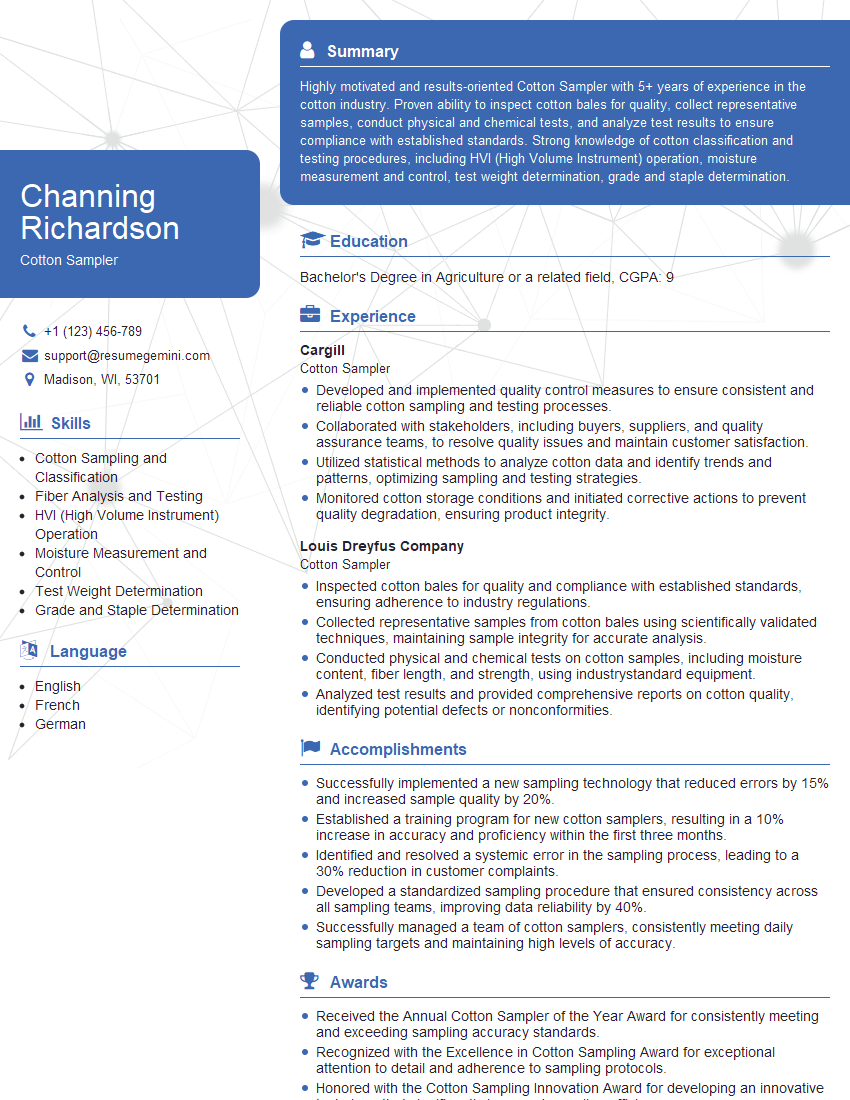
Mastering sampling and preparing cotton samples for grading is crucial for advancing your career in the textile industry. It demonstrates your technical expertise and attention to detail, opening doors to higher-level positions and increased earning potential. To maximize your job prospects, focus on creating a compelling and ATS-friendly resume that showcases your skills and experience effectively. ResumeGemini is a trusted resource that can help you build a professional and impactful resume. Examples of resumes tailored to Sampling and preparing cotton samples for grading are available to guide you through the process.



Explore more articles
Users Rating of Our Blogs
Share Your Experience
We value your feedback! Please rate our content and share your thoughts (optional).
What Readers Say About Our Blog
Really detailed insights and content, thank you for writing this detailed article.
IT gave me an insight and words to use and be able to think of examples