Every successful interview starts with knowing what to expect. In this blog, we’ll take you through the top Score Editing and Proofreading interview questions, breaking them down with expert tips to help you deliver impactful answers. Step into your next interview fully prepared and ready to succeed.
Questions Asked in Score Editing and Proofreading Interview
Q 1. Explain the difference between copy editing and proofreading in the context of musical scores.
Copy editing and proofreading in musical scores are distinct yet complementary processes. Think of it like building a house: copy editing is like ensuring the blueprints are accurate and complete, while proofreading is the final check for any minor errors before construction begins.
Copy editing focuses on the larger aspects of the score. This includes clarifying ambiguities in notation, ensuring consistency in style (e.g., consistent use of slurs, articulation markings), verifying the accuracy of clefs, key signatures, and time signatures across the entire piece, and checking for structural inconsistencies. A copy editor might re-organize sections for better clarity or suggest improvements to the overall layout. For example, a copy editor might notice a repeated passage that could be more efficiently notated using a repeat sign.
Proofreading, on the other hand, is a more meticulous process that takes place after copy editing. It’s the final check for minor errors such as spelling mistakes (in titles or text within the score), accidental notes or rests, incorrect spacing, or inconsistencies in font size. It’s about catching those tiny slips that might escape the copy editor’s eye. Imagine a single wrong note – a proofreader is the one catching that last detail before the score goes to print or performance.
Q 2. Describe your experience with music notation software (e.g., Sibelius, Finale).
I’m proficient in both Sibelius and Finale, having utilized them extensively throughout my career. My expertise extends beyond basic input and encompasses advanced techniques, such as creating custom templates, utilizing advanced notation features (like microtonal notation or complex rhythmic notation), and troubleshooting technical issues. I’ve worked on projects ranging from solo piano pieces to large orchestral scores and have found both programs to be invaluable tools. In Sibelius, for instance, I frequently leverage its powerful scripting capabilities to automate repetitive tasks, boosting efficiency in complex projects. In Finale, I find its engraving options extremely useful for creating professional-looking scores.
For example, I once used Sibelius’s playback features to pinpoint a rhythmic ambiguity in a contemporary composition, then used Finale’s sophisticated engraving tools to create a cleaner, more easily readable version of the score, clarifying the composer’s intentions for performers.
Q 3. How do you handle discrepancies between a composer’s intentions and the written score?
Handling discrepancies between a composer’s intentions and the written score requires careful diplomacy and a deep understanding of music theory and notation. First, I would seek clarification directly from the composer whenever possible. Open communication is key. If direct communication is not possible, I would meticulously examine the score for any clues that might suggest a possible explanation for the discrepancy. This could involve examining the context of the passage, looking for patterns in the composer’s style, or consulting related materials like sketches or program notes.
If the discrepancy remains unresolved, I would document the issue thoroughly, noting the different interpretations and justifying my approach in an accompanying editor’s report. For instance, if a passage seems rhythmically ambiguous, I might present both interpretations to the conductor or performer in a note clarifying the options and suggesting a preferred reading based on the overall musical context. Transparency and clear documentation are crucial in these situations.
Q 4. What strategies do you use to ensure accuracy and consistency in score editing?
Maintaining accuracy and consistency is paramount. My strategies include creating a detailed style sheet at the beginning of any project, outlining all notational conventions and formatting choices. This serves as a constant reference throughout the editing process. I also employ a methodical approach, often working in sections and meticulously checking each detail against the style sheet and the preceding and following sections.
Furthermore, I utilize the software’s spell-check and find/replace functions to identify and correct inconsistencies automatically where appropriate. Finally, I always conduct a final, comprehensive review of the entire score before delivering the final product, often printing the score to catch any errors that might be overlooked on screen. It is much like proofreading a book, you see things differently on paper versus screen.
Q 5. How do you identify and correct errors in musical notation, such as wrong clefs, key signatures, or rhythms?
Identifying errors in notation requires a keen eye and a solid understanding of music theory. I start by carefully reviewing each element of the score, systematically checking for errors in clefs, key signatures, time signatures, and rhythms. I utilize the software’s playback function to listen for any discrepancies that might not be immediately apparent visually. This often reveals subtle rhythmic errors or inconsistencies in pitch.
For instance, a misplaced accidental can easily be missed visually but create a jarring effect when played. Similarly, a wrong clef could lead to notes being played an octave too high or low. My approach involves visually inspecting the score and listening to its playback, ensuring both are congruent.
Example: A wrong clef in the treble staff could incorrectly display notes as C4 instead of C5
Q 6. Describe your workflow for editing a complex orchestral score.
Editing a complex orchestral score is a multi-stage process. It begins with a thorough review of the entire score to understand its structure and the composer’s intentions. Next, I create a style sheet that addresses every aspect of the score’s notation, including instrument-specific conventions. Then, I edit the score in sections, carefully checking for consistency within and between sections. This stage involves verifying all aspects of the notation (key signatures, time signatures, clefs, dynamics, articulation) and correcting any errors.
After the initial edit, I conduct a playback check to detect any aural inconsistencies. Once the major editing is complete, I perform a thorough proofread. Finally, I create a detailed editor’s report outlining all changes made. This includes providing a justification for any significant alterations to the original score. The entire workflow prioritizes accuracy, consistency, and clear communication with the composer.
Q 7. How familiar are you with various musical styles and their notational conventions?
My familiarity with musical styles and their notational conventions is extensive. I have experience editing scores from various periods and genres, including Baroque, Classical, Romantic, 20th-century, and contemporary music. I am comfortable working with diverse notational practices, from historical practices of figured bass to contemporary microtonal systems. For example, I’m familiar with the complexities of mensural notation in Baroque music, just as I am with the more fluid notation often found in Minimalist compositions. This breadth of experience ensures I can provide accurate and sensitive editing for a wide range of musical works.
My approach always involves researching the relevant stylistic conventions for any given piece, ensuring that any editorial interventions are both accurate and respectful of the composer’s aesthetic choices. I don’t impose my personal preferences; instead, I ensure the score adheres to established conventions for its style and period.
Q 8. How do you prioritize tasks when faced with multiple deadlines?
Prioritizing tasks with multiple deadlines in score editing requires a strategic approach. I utilize a combination of methods, including prioritizing by urgency and importance using a system like the Eisenhower Matrix (urgent/important). This helps me quickly identify which tasks need immediate attention and which can be scheduled later.
For example, if I have a deadline for a major orchestral work and a smaller piano piece due simultaneously, the orchestral score takes precedence due to its complexity and the likely greater time commitment. I break down larger projects into smaller, manageable tasks, creating a detailed schedule with realistic timeframes for each. This helps prevent feeling overwhelmed and allows for better time management. Finally, I utilize project management tools and software to track progress and ensure adherence to deadlines.
Q 9. Explain your experience with quality assurance processes in score editing.
My quality assurance (QA) process in score editing is multi-layered. It starts with a thorough understanding of the composer’s style and intentions, which forms the basis for all subsequent checks. I then perform a detailed review of the score, checking for accuracy in notation, consistency of style, and adherence to best practices. This includes verifying note values, rhythms, key signatures, time signatures, clefs, articulations, dynamics, and any other musical instructions.
After the initial edit, a rigorous proofreading process follows. I cross-check the edited score against the original manuscript (if available) multiple times, focusing on detecting any accidental omissions or errors introduced during the editing process. This process often incorporates printing the score to allow for easier visual inspection. Finally, I conduct a final review for typos or inconsistencies. This rigorous QA ensures the delivered score is accurate, consistent, and of the highest professional standard.
Q 10. How do you handle feedback from composers or other stakeholders?
Handling feedback from composers or stakeholders requires diplomacy, active listening, and a willingness to collaborate. I approach feedback as an opportunity for improvement and refinement. I always acknowledge the feedback received and strive to understand the reasoning behind the comments. If the feedback conflicts with established musical practice or if clarity is needed, I initiate a respectful discussion to clarify the composer’s intent.
For example, if a composer requests a change that could create a notational inconsistency, I would explain the potential implications and offer alternative solutions. The aim is to reach a consensus that satisfies both the composer’s artistic vision and the principles of clear and accurate musical notation. Clear and professional communication throughout this process is paramount.
Q 11. What are some common errors you encounter while proofreading musical scores?
Common errors encountered during proofreading include inconsistencies in key signatures or time signatures, incorrect note values or rhythms, accidental ledger lines, missing or misplaced rests, errors in dynamic markings or articulations, and incorrect chord voicings. Typos in text elements such as titles, composer names, and copyright information are also frequent. Furthermore, errors in beaming, slurring, and other musical phrasing elements are common.
For example, a common error is a missing accidental which can dramatically alter the harmony and melody. Another frequently occurring issue is a misplaced bar line, which can affect rhythm and overall structure. Identifying and correcting these subtle errors is a crucial part of the proofreading process, requiring a keen eye for detail and a solid understanding of musical notation.
Q 12. How proficient are you in using music engraving software for making corrections?
I am highly proficient in using various music engraving software such as Sibelius, Finale, and Dorico. I can efficiently utilize their tools for making corrections, including manipulating notes, rhythms, articulations, and dynamics. I’m skilled at working with different instrument palettes, creating custom styles, and ensuring consistent notation throughout a score. My proficiency extends to using the software’s features for advanced tasks such as generating parts and scores, and exporting files in various formats.
For instance, I routinely use Sibelius’s powerful editing tools to quickly fix errors in complex passages without disrupting the overall layout. Understanding the nuances and shortcuts of each software enables me to complete corrections with precision and speed, ensuring a high level of quality control.
Q 13. Describe your approach to editing scores with multiple instruments and complex harmonies.
Editing scores with multiple instruments and complex harmonies requires a systematic and layered approach. I start by meticulously analyzing the individual instrument parts to ensure consistency with the overall score. This includes checking for voice leading, ensuring that harmonies are correctly notated, and verifying that each part complements the other within the context of the overall ensemble. A thorough understanding of voice leading, counterpoint, and harmony is essential.
Furthermore, I use software tools to aid in identifying potential issues, such as checking for collisions in the layout and ensuring a clear and readable presentation of the music. I pay close attention to voicing, ensuring that each instrument part is playable and musically effective. Regular review and cross-checking between parts is crucial in catching potential discrepancies.
Q 14. How would you handle a situation where the original score is illegible or incomplete?
Handling illegible or incomplete original scores presents a unique challenge. My approach involves a multi-step process. First, I carefully examine the available material, attempting to decipher as much information as possible. I might use magnification tools or digital enhancement techniques to improve legibility. Second, I consult with the composer or copyright holder (if possible) to gather additional information or clarify ambiguous passages.
If the missing information is significant, I might explore using similar works by the composer as a guide to reconstruct missing sections, employing best practices in musical inference and adhering to the composer’s known stylistic conventions. Throughout this process, I maintain meticulous documentation of my decisions and interpretations, transparently communicating any assumptions or reconstructions made during the restoration process. The aim is to create a complete and accurate representation of the composer’s intent while acknowledging the limitations imposed by the incomplete or damaged original material.
Q 15. How do you ensure the final score is visually appealing and easy to read?
Ensuring a visually appealing and readable score is paramount. It’s about more than just correct notes; it’s about clear communication. I approach this through several key strategies. First, I utilize appropriate spacing and sizing. Cramped staves are a recipe for errors and frustration. I ensure sufficient space between staves, systems, and measures, adjusting based on the complexity of the music. For example, dense passages might require slightly larger note heads or more generous spacing than simpler sections. Second, I use consistent and logical formatting. This includes consistent use of font size and style, clear articulation markings, and proper placement of dynamic markings. A good example would be ensuring all crescendo markings slant in the same direction and are of uniform size.
Third, I pay close attention to system breaks. Ideally, system breaks should occur at logical musical points—not mid-phrase or in the middle of a crucial rhythmic pattern. Finally, I leverage the software’s capabilities to automatically check for spacing inconsistencies and potential visual clutter.
Career Expert Tips:
- Ace those interviews! Prepare effectively by reviewing the Top 50 Most Common Interview Questions on ResumeGemini.
- Navigate your job search with confidence! Explore a wide range of Career Tips on ResumeGemini. Learn about common challenges and recommendations to overcome them.
- Craft the perfect resume! Master the Art of Resume Writing with ResumeGemini’s guide. Showcase your unique qualifications and achievements effectively.
- Don’t miss out on holiday savings! Build your dream resume with ResumeGemini’s ATS optimized templates.
Q 16. What is your experience with different file formats used for musical scores?
My experience encompasses a wide range of music notation file formats, including MusicXML (.xml), which is an excellent format for interchange between different software programs; PDF (.pdf), a ubiquitous format for sharing and printing; Sibelius (.sib, .slp), Finale (.mus, .fim), and Dorico (.dorico) native files, which offer the highest level of detail preservation; and even older formats like MusicTeX (.tex) when required. Understanding the strengths and limitations of each format is crucial. For instance, while PDF is great for distribution, it’s not ideal for editing; MusicXML provides strong cross-platform compatibility, but might lose some nuances during conversion. My workflow often involves selecting the best format depending on the project’s needs and collaboration requirements.
Q 17. Describe your method for checking for consistency in dynamics, articulation, and expression markings.
Checking for consistency is a methodical process involving both visual inspection and utilizing software tools. I begin with a global overview, scanning for obvious discrepancies—a sudden change in dynamics, an inconsistent use of staccato or legato markings. Then I proceed systematically, measure by measure, checking for uniform application of articulation and expression markings. For example, if a composer uses ‘cresc.’ frequently, I ensure its placement is always consistent—not sometimes above and sometimes below the staff. Software tools can often help automate some of this process, highlighting inconsistencies in things like dynamic levels or articulation symbols across different sections of the score.
Imagine a piece with numerous accents. I would visually scan for any instances where an accent is inconsistently placed, too large or small compared to others, or missing where it should be. Finally, I make sure to create a legend or key, if needed, to explain any unusual or bespoke notations.
Q 18. How do you manage and organize large musical score files?
Managing large score files requires a strategic approach. First, clear and descriptive file naming is essential—something like ‘SymphonyNo1_Movement1_v3.mus’ instead of ‘score.mus’. Second, I utilize a well-organized folder structure, often grouping files by project, movement, or instrument. This allows for easy retrieval and prevents unnecessary searching. Third, I leverage the software’s features for organizing sections within a score, such as using layers and palettes to manage complexity. Finally, for extremely large scores, splitting them into smaller, manageable files can improve performance and editing efficiency.
A real-world example would be working on an opera score. Instead of having a monolithic file for the whole opera, I’d have separate files for each act, and potentially even separate files for each individual aria within an act. This keeps the individual files smaller and faster to work with.
Q 19. What are your strategies for identifying and resolving inconsistencies in tempo and time signatures?
Identifying and resolving inconsistencies in tempo and time signatures requires careful attention to detail and a good understanding of musical structure. I start by creating a global overview of tempo and time signature changes, noting any abrupt or illogical shifts. Software tools can highlight inconsistencies here too. For example, a sudden jump from 4/4 to 3/8 with no discernible reason would be flagged. Once inconsistencies are identified, I examine the surrounding musical context to determine the correct tempo and time signature. If the inconsistencies are the result of errors, I’ll correct them. If they are deliberate but poorly notated, I’ll work with the composer to clarify their intentions and achieve consistent notation.
Consider a piece changing tempo multiple times with metronome markings. I would carefully review each tempo change and verify the logical flow of the tempo markings and ensure the indicated tempo makes musical sense.
Q 20. How familiar are you with copyright and intellectual property issues related to music scores?
I’m very familiar with copyright and intellectual property issues surrounding musical scores. I understand that musical scores are protected by copyright, and unauthorized reproduction, distribution, or adaptation is illegal. This includes not only the printed score but also digital versions. In my work, I always ensure I have the necessary permissions to edit or handle scores, respecting the rights of composers and publishers. My workflow always includes checking for copyright information and obtaining appropriate permissions before I commence work on any project.
In practical terms, this means obtaining written permission from the copyright holder before undertaking any editing or publishing of a musical score. Failure to do so could result in legal repercussions.
Q 21. How would you handle a deadline conflict?
Handling deadline conflicts involves clear communication and proactive problem-solving. First, I’d assess the severity of the conflict—is it a minor delay or a significant one? Then, I’d immediately communicate the issue to the relevant parties (composer, publisher, conductor), explaining the situation and possible solutions. These solutions might include prioritizing the most critical aspects of the score, negotiating a revised deadline, or seeking additional assistance if feasible. Transparency is key here. Open communication helps manage expectations and find mutually acceptable solutions. My goal is always to deliver high-quality work while respecting the deadlines, even if adjustments are needed.
For instance, if a large section of the score needs extensive revisions which push the deadline, I might suggest prioritizing the first few pages for the immediate performance while completing the revisions for later publication.
Q 22. Describe your experience working collaboratively with composers or other musicians.
Collaboration is the cornerstone of successful score editing. I thrive in team environments, working closely with composers to understand their artistic vision and ensure the final score accurately reflects their intent. This involves frequent communication, often involving detailed discussions about nuances in phrasing, articulation, and dynamics. For example, I recently worked with a composer who had a unique approach to rhythmic notation. Through several iterative feedback sessions, we refined the notation to ensure clarity and readability while preserving the composer’s original creative expression. My role isn’t just to correct errors, but also to offer informed suggestions that enhance the overall musical impact.
Another example involved working with a string quartet. I helped them refine their bowing choices in the score, ensuring a smooth transition between sections while maintaining the expressive impact the composer envisioned. This involved interpreting their performance preferences and transcribing those choices accurately into the notation.
Q 23. How do you approach editing scores in foreign languages?
Editing scores in foreign languages requires a multi-faceted approach. First, I leverage translation tools and dictionaries to understand the linguistic context within the score, particularly any text-based instructions or annotations. I then cross-reference the translated text with the musical content to ensure that the markings correctly correspond to the musical phrases and structures. This involves familiarizing myself with any language-specific musical conventions or terminology. For example, Italian is commonly used for musical markings, and understanding the nuances of its use within a score is crucial for accurate editing. Sometimes, direct communication with a native speaker may be necessary to resolve ambiguities or uncertainties.
Crucially, my focus remains on the musical notation itself. Even without fully understanding the foreign language text, I can still identify inconsistencies or errors in musical notation, such as incorrect clefs, accidental misplacements, or rhythmic inaccuracies. Accuracy in the musical notations takes precedence, even if the linguistic comprehension is somewhat limited. I always prioritize verifying the accuracy of the musical components over purely linguistic translations.
Q 24. What are your strengths and weaknesses as a score editor?
My strengths lie in my meticulous attention to detail, a deep understanding of music theory and notation, and proficiency in various music notation software packages like Sibelius and Finale. I am efficient, able to meet tight deadlines, and capable of adapting to different compositional styles and notation preferences. I pride myself on my ability to anticipate potential issues and propose solutions proactively. For example, I often proactively identify potential performance challenges and suggest edits to ensure clarity and efficiency for performers.
However, like any expert, I also acknowledge areas for development. While I am proficient in many software applications, staying abreast of the newest updates and features in all of them can be challenging. I am also actively working to expand my knowledge of less commonly used musical styles and notational conventions. This continuous learning is critical in this dynamic field.
Q 25. How do you stay current with changes in music notation practices and technology?
Staying current is paramount in this field. I achieve this through several strategies: I regularly attend workshops and conferences on music notation and technology. This provides an opportunity for professional development and networking with peers, learning about the latest advancements firsthand. I also subscribe to relevant professional journals and online publications, keeping informed about best practices and new software releases. Active participation in online forums and communities dedicated to music notation offers valuable insights into current trends and problem-solving strategies.
Furthermore, I actively seek out and analyze scores from contemporary composers, observing their notational choices and learning from their innovative approaches. Finally, I make it a point to stay updated on the latest versions of music notation software, making use of the tutorials and help documentation that software publishers provide.
Q 26. What resources do you use to research musical styles or notational conventions?
My research often involves a combination of resources. I frequently consult authoritative books and scholarly articles on music history and theory, providing a deep understanding of historical and contemporary musical styles. Online databases like JSTOR and Grove Music Online provide access to a wealth of information on musical composers, styles, and conventions. I also make use of primary source materials – scores themselves – studying the notation practices of renowned composers from different eras.
In addition to these traditional resources, I leverage the power of online communities and forums. These platforms often provide insights and discussions on specific notational questions or ambiguities that can be invaluable in resolving complex issues. The collaborative nature of these online discussions is crucial for staying up to date with current trends.
Q 27. What is your salary expectation for this role?
My salary expectation for this role is commensurate with my experience and expertise in score editing and proofreading, as well as the responsibilities involved. I am open to discussing a specific range based on the details of the position and the organization’s compensation structure. I am confident that my skills and contributions would justify a competitive compensation package.
Q 28. Why are you interested in this position?
I am deeply interested in this position because it offers a unique opportunity to combine my passion for music with my expertise in score editing. I am drawn to [Company Name]’s reputation for [mention a specific aspect, e.g., high-quality work, commitment to innovation, etc.]. The opportunity to work on [mention specific projects or types of projects if known] would be particularly exciting. I believe my meticulous attention to detail, my collaborative spirit, and my commitment to continuous learning would make me a valuable asset to your team.
Key Topics to Learn for Score Editing and Proofreading Interview
- Understanding Musical Notation: Thoroughly grasp the nuances of musical notation, including clefs, key signatures, time signatures, rhythmic notation, and articulation markings. Practice reading and interpreting complex scores.
- Error Identification & Correction: Develop sharp skills in identifying common errors like incorrect notes, rhythms, accidentals, and articulations. Practice correcting these errors while preserving the composer’s intent.
- Style and Conventions: Familiarize yourself with different musical styles and their associated editing conventions. Understanding historical styles is crucial for accurate editing.
- Software Proficiency: Demonstrate familiarity with music notation software such as Sibelius, Finale, or Dorico. Highlight your experience with score editing features and workflows within these programs.
- Proofreading Techniques: Master meticulous proofreading techniques, including systematic checks for consistency, accuracy, and clarity throughout the score. Practice different proofreading methods for efficiency.
- Collaboration & Communication: Understand the importance of clear communication with composers and other collaborators. Practice explaining your editing choices and justifying corrections professionally.
- Copyright and Legal Aspects: Gain a basic understanding of copyright law and its implications for score editing and publishing. This demonstrates professional responsibility.
Next Steps
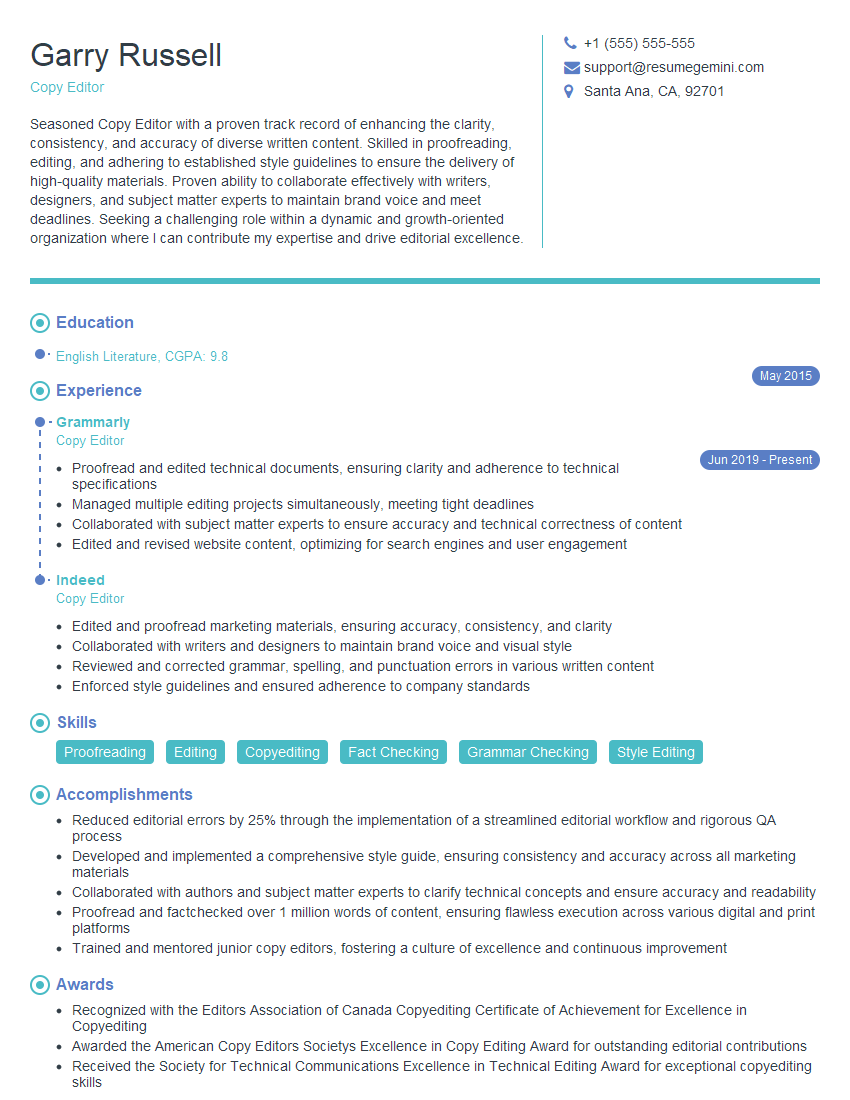
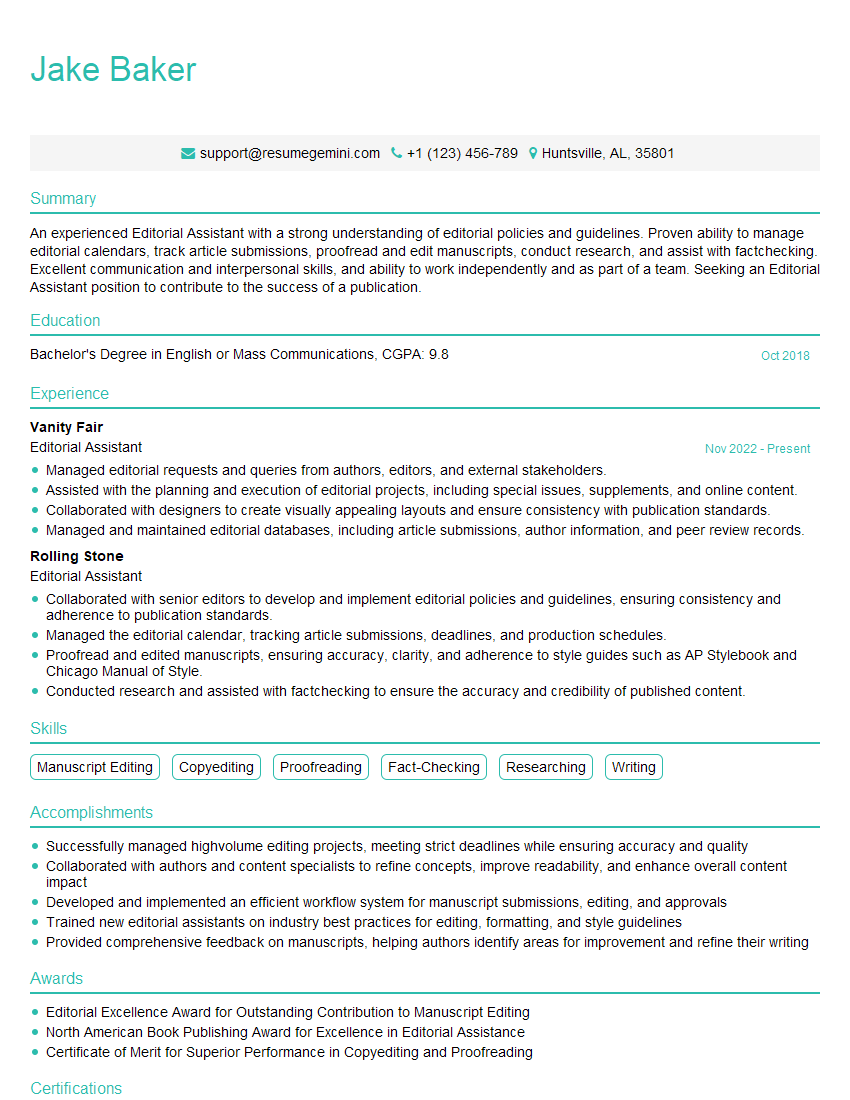
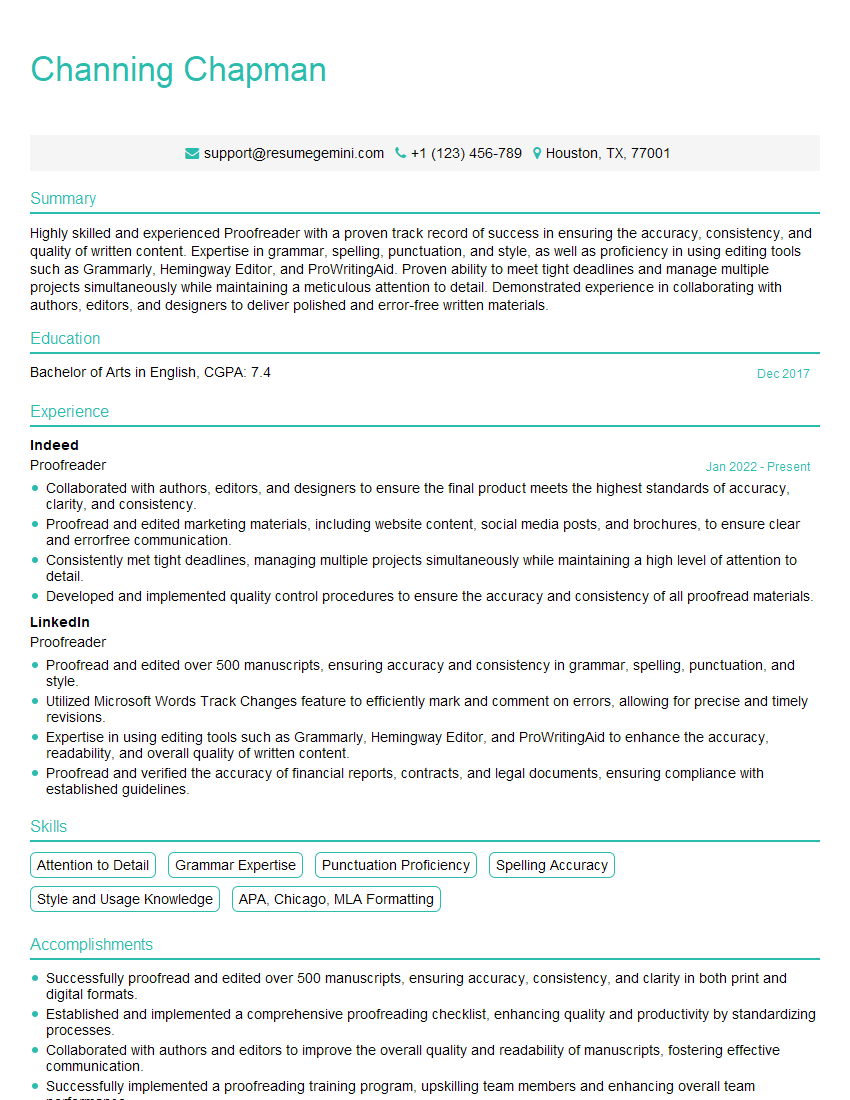
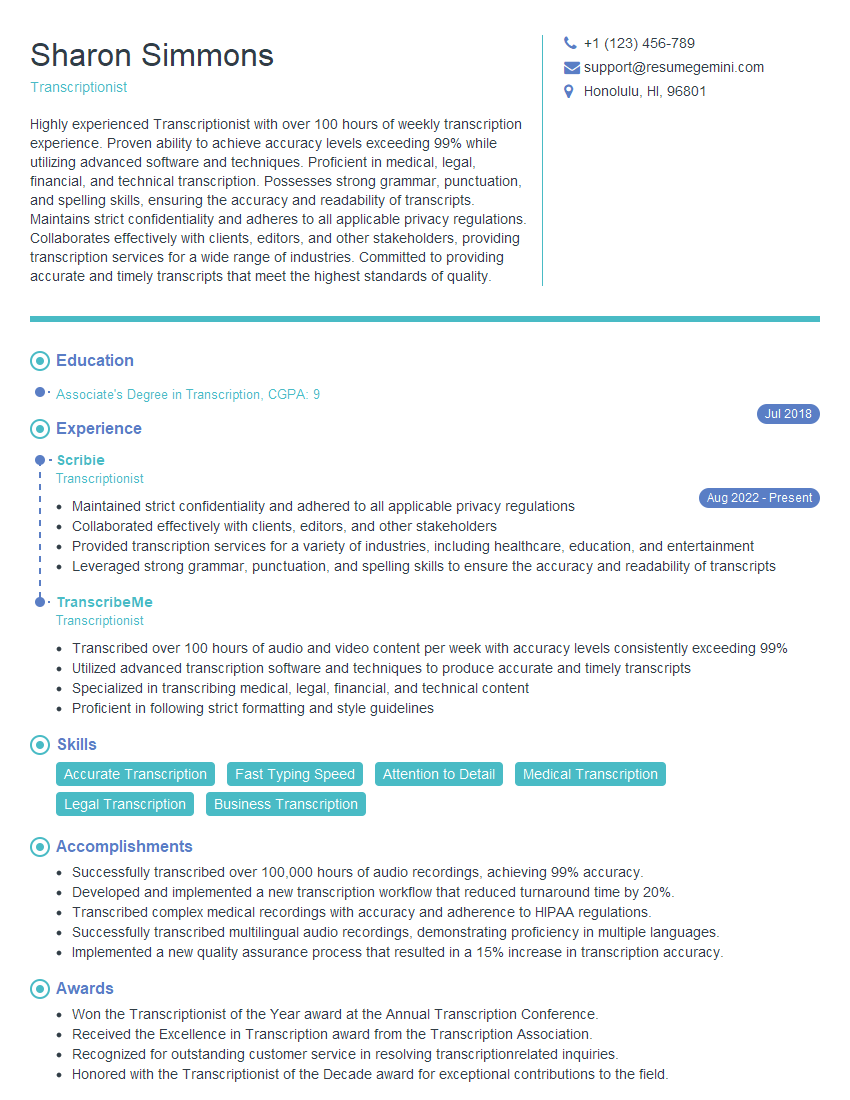
Mastering score editing and proofreading opens doors to exciting careers in music publishing, orchestration, composition, and academia. These highly sought-after skills are essential for ensuring the accuracy and artistic integrity of musical works. To maximize your job prospects, create a compelling and ATS-friendly resume that highlights your expertise. ResumeGemini is a trusted resource to help you build a professional resume that showcases your abilities effectively. Examples of resumes tailored to Score Editing and Proofreading are available to help you get started.
Explore more articles
Users Rating of Our Blogs
Share Your Experience
We value your feedback! Please rate our content and share your thoughts (optional).
What Readers Say About Our Blog
Really detailed insights and content, thank you for writing this detailed article.
IT gave me an insight and words to use and be able to think of examples