Cracking a skill-specific interview, like one for Sequential Art, requires understanding the nuances of the role. In this blog, we present the questions you’re most likely to encounter, along with insights into how to answer them effectively. Let’s ensure you’re ready to make a strong impression.
Questions Asked in Sequential Art Interview
Q 1. Explain the difference between sequential art and illustration.
While both sequential art and illustration utilize visual storytelling, their core purpose and structure differ significantly. Illustration is typically a single image conveying a specific idea or emotion, often working independently. Think of a magazine cover or a book’s dust jacket. Sequential art, on the other hand, is a series of images – panels – arranged to create a narrative unfolding over time. It’s akin to a film, using visuals and panel arrangement to tell a story in a specific sequence. The key difference lies in the temporal aspect; illustration freezes a moment, while sequential art creates a flow of time and action.
For instance, a single illustration might depict a heroic figure standing defiantly, but a sequential art sequence could show that same figure’s journey to that moment, detailing the challenges overcome and the emotions experienced along the way.
Q 2. Describe your process for developing a compelling narrative through visuals.
Developing a compelling visual narrative starts with a strong foundation: a clear story outline with well-defined characters, setting, conflict, and resolution. I begin by creating a detailed script or storyboard, breaking the narrative into key scenes and moments. This storyboard functions as a blueprint, guiding the visual development. Each panel is then considered carefully: what emotion needs to be conveyed? What action should be emphasized? What perspective will best serve the narrative?
Then comes the visual execution. I prioritize clarity and visual storytelling techniques such as use of angles, perspective, and character poses to enhance narrative impact. I constantly evaluate whether the visuals are effectively supporting the narrative flow, making necessary adjustments to ensure engagement and understanding.
For example, in a scene of rising tension, I might use increasingly tighter panels, high-angle shots, and sharp lines to convey the growing unease. Conversely, a moment of peace could be represented by wider panels, low-angle shots, and softer lines.
Q 3. How do you incorporate pacing and rhythm in your sequential art?
Pacing and rhythm in sequential art are controlled primarily through panel size, arrangement, and the amount of detail within each panel. Large panels with detailed backgrounds generally slow down the pace, inviting the reader to linger. Small panels, conversely, quicken the pace, creating a sense of urgency or fast-paced action.
The arrangement of panels also plays a crucial role. A sequence of small panels placed vertically can create a sense of mounting tension, while a horizontal arrangement can represent a broader, more expansive moment. The use of gutters (the space between panels) also impacts rhythm. Narrow gutters suggest a fast pace, wider gutters allow for a more contemplative rhythm. I often use variations in panel shape and size, creating a visual rhythm that complements the narrative’s emotional arc.
Imagine a chase scene: Small, numerous panels would depict the rapid movement, while a larger panel might show the character’s breathless expression at a crucial moment in the chase.
Q 4. Discuss your approach to character design and its role in storytelling.
Character design is paramount; it’s the visual embodiment of personality, background, and role in the narrative. I begin by defining the core characteristics of each character: physical attributes, attire, posture, and expressions. These visual elements work in tandem to convey personality traits, social status, and even underlying emotions. Consider the difference between a character with slumped shoulders and one standing tall; the posture alone tells a story.
Furthermore, consistency in character design is crucial across the entire narrative. Any deviations should be purposeful, used to reflect character development or changes in circumstances. Subtle changes in attire or expression can be powerful in conveying character arcs, indicating the impacts of events on their physical and emotional state.
For example, I might design a protagonist with sharp, defined features to reflect their determination, while their antagonist might possess softer features that hide a sinister nature.
Q 5. Explain your understanding of panel layout and its impact on the reader’s experience.
Panel layout is the choreography of visual storytelling. It guides the reader’s eye through the sequence of events, influencing the pace and emotional impact of the narrative. Different layouts can create different moods and effects. A grid layout creates a sense of order and predictability, while a more dynamic, less structured layout can create a sense of chaos or unpredictability.
I often experiment with panel shapes and sizes, using varying panel borders to direct the reader’s gaze, focusing on crucial details. Techniques like bleeding panels, or panels that extend beyond the standard grid, can create an immersive effect. Consider the impact of a large panel dominating a page compared to a series of smaller panels. The former might highlight a significant moment, while the latter might emphasize the rapid progression of events. Careful planning of panel layout is paramount to successful sequential art.
Q 6. How do you use visual metaphors and symbolism in your work?
Visual metaphors and symbolism add depth and richness to sequential art, allowing for nuanced storytelling beyond the literal. For example, a recurring motif of shadows might symbolize an impending threat or a character’s inner darkness. Similarly, the use of color can be symbolic: warm colors often convey comfort and hope, while cold colors might represent isolation or fear.
I carefully select and implement visual metaphors and symbols, ensuring they align with the overall narrative and theme. Overuse can dilute the effectiveness, so subtlety is key. The goal is to enhance the story through visual cues, enriching the reader’s understanding and creating layers of meaning.
A recurring image of a wilting flower could symbolize a character’s deteriorating emotional state, while vibrant, flourishing plants might represent renewed hope or recovery.
Q 7. Describe your process for creating believable backgrounds and environments.
Creating believable backgrounds and environments is crucial for grounding the narrative and enhancing its immersive quality. My process begins with thorough research, understanding the setting’s historical context, geographical location, and cultural aspects. I then use a combination of observation, photography, and reference materials to build a detailed visual understanding of the environment.
I consider factors such as lighting, perspective, and the level of detail appropriate to the scene. Overly detailed backgrounds can detract from the narrative focus, while overly simplistic ones may lack the necessary depth and believability. Finding the right balance is key. For instance, a close-up shot might have a less detailed background, whereas a wide shot would require more detailed background elements.
I might sketch out rough drafts, gradually refining the details to create a visually compelling and consistent environment that complements the story and its characters. This can involve using digital painting techniques or traditional methods, depending on the style and requirements of the project.
Q 8. How do you manage deadlines and prioritize tasks in a sequential art project?
Managing deadlines and prioritizing tasks in sequential art is crucial for successful project completion. It’s akin to orchestrating a complex symphony – each element needs to be timed perfectly. My approach involves a multi-stage process.
- Detailed Breakdown: I begin by breaking down the entire project into smaller, manageable tasks. This could include scripting, thumbnailing, penciling, inking, coloring, and lettering. Each stage receives a realistic timeframe based on past experience and the complexity of the project.
- Prioritization Matrix: I utilize a prioritization matrix, often employing the Eisenhower Matrix (Urgent/Important), to identify tasks that need immediate attention and those that can be scheduled later. This ensures that critical elements aren’t overlooked due to time constraints.
- Agile Methodology: I often adapt agile methodologies, reviewing progress regularly and adjusting timelines as needed. This iterative approach allows for flexibility and addresses unforeseen challenges.
- Time Blocking: I employ time blocking to allocate specific time slots for each task. This focused approach enhances productivity and minimizes distractions. For example, I might dedicate two hours to inking a particular page, ensuring a consistent pace.
- Regular Check-ins: Consistent self-check-ins and communication with clients (if applicable) maintain project transparency and allow for early identification and resolution of any potential roadblocks.
This structured approach allows me to deliver high-quality work consistently, even under tight deadlines. For instance, on a recent comic book project, using this system helped me stay on schedule despite having to revise several pages due to editorial feedback.
Q 9. What software and tools are you proficient in for creating sequential art?
Proficiency in various software and tools is essential for creating professional sequential art. My skillset includes a blend of industry-standard programs and specialized applications.
- Digital Painting & Illustration: I’m highly proficient in Adobe Photoshop and Clip Studio Paint. These tools allow for precise linework, digital inking, coloring, and texture creation. I also utilize their layer management capabilities extensively for efficient workflow.
- 3D Modeling (Supplementary): While not always directly used in sequential art, I have experience with Blender for creating 3D models that can serve as references for dynamic poses or complex environments. This enhances the realism and accuracy of my artwork.
- Vector Graphics: I’m familiar with Adobe Illustrator for creating clean vector art, particularly helpful for lettering and logos.
- Hardware: I utilize a high-resolution drawing tablet (Wacom Cintiq) and a powerful computer to ensure smooth performance and high-quality output.
The choice of software often depends on the project’s style and requirements. For example, while Photoshop might be ideal for a photorealistic style, Clip Studio Paint’s brush engine might be preferred for a more painterly approach.
Q 10. Discuss your experience with different printing methods and their impact on artwork.
Understanding different printing methods and their impact on artwork is paramount for achieving the desired visual outcome. Different methods affect color reproduction, detail resolution, and overall texture.
- Offset Printing: This is a common method for mass production, offering excellent color accuracy and sharp details. However, it can be costly for smaller runs. The paper choice significantly impacts the final look and feel, influencing color saturation and vibrancy.
- Digital Printing: More versatile and cost-effective for smaller runs, digital printing offers quick turnaround times. The quality can vary depending on the printer and chosen paper, sometimes showing less vibrancy compared to offset.
- Screen Printing: Ideal for bold, graphic designs with a textured feel, it’s less suitable for detailed artwork. Color mixing is more limited compared to digital or offset printing.
- Fine Art Printing (Giclée): Used for high-quality reproductions, this method uses archival inks on fine art papers, ensuring longevity and color accuracy. It’s perfect for showcasing artwork with delicate details.
Before selecting a printing method, I consider factors such as the project’s budget, required quantity, and desired aesthetic. For instance, a comic book would likely benefit from offset printing for mass distribution, while a limited-edition art print might be better suited for giclée printing.
Q 11. How do you handle feedback and critique on your work?
Handling feedback and critique is an integral part of the creative process. It allows for growth and improvement. My approach focuses on constructive engagement and a growth mindset.
- Active Listening: I listen carefully to feedback, ensuring I understand the points raised before formulating a response.
- Contextualization: I consider the source and intention behind the feedback. Feedback from a seasoned editor might hold more weight compared to a casual comment.
- Objective Evaluation: I evaluate the validity of the critique objectively, considering its relevance to the project’s goals and target audience.
- Open Dialogue: I engage in open dialogue, asking clarifying questions if needed. This collaborative approach ensures mutual understanding and facilitates problem-solving.
- Selective Implementation: I don’t necessarily implement all feedback, but carefully choose the suggestions that genuinely enhance the artwork, aligning with my creative vision and the project’s requirements.
I view constructive criticism as an opportunity to refine my skills. For example, feedback on inconsistent line weight helped me refine my inking technique considerably.
Q 12. Explain your understanding of color theory and its application in sequential art.
Color theory is the foundation of compelling visual storytelling in sequential art. Understanding color relationships significantly impacts mood, emotion, and character development.
- Color Harmonies: I use color harmonies (complementary, analogous, triadic, etc.) to create visually appealing and balanced compositions. For instance, complementary colors (like blue and orange) can create high contrast and visual interest.
- Color Temperature: Warm colors (reds, oranges, yellows) often convey feelings of warmth, energy, and excitement, while cool colors (blues, greens, purples) often evoke calmness, tranquility, or sadness.
- Color Saturation and Value: Manipulating saturation (intensity) and value (lightness/darkness) allows me to create depth, focus the viewer’s attention, and enhance the narrative. For example, desaturated colors can create a sense of unease or melancholy.
- Symbolic Use of Color: Color can be used symbolically to represent character traits or themes. A recurring color associated with a villain might foreshadow their actions or intentions.
In a recent project featuring a character struggling with internal conflict, I used contrasting cool and warm colors to visually represent this emotional tension, using cool blues and greens for moments of doubt and warm reds and oranges for moments of anger and resolve.
Q 13. Describe your approach to creating dynamic and expressive poses and actions.
Creating dynamic and expressive poses and actions requires a deep understanding of human anatomy, movement, and storytelling principles. My approach incorporates several key elements:
- Anatomical Accuracy: A solid understanding of anatomy provides a foundation for creating believable and convincing poses. Even stylized characters benefit from underlying anatomical accuracy.
- Reference Studies: I frequently utilize photographs, videos, and even life-drawing sessions as references. This ensures the poses are fluid, natural, and accurately reflect the intended action.
- Gesture Drawing: Practicing gesture drawing helps to capture the essence of movement and energy in quick sketches. This is crucial for depicting dynamic actions and conveying emotion.
- Perspective and Foreshortening: Mastering perspective and foreshortening is crucial for creating the illusion of depth and three-dimensionality. This creates impactful visual storytelling.
- Exaggeration and Stylization: While maintaining anatomical believability, I strategically use exaggeration and stylization to emphasize emotion and create visually striking compositions.
For instance, in depicting a character sprinting, I might exaggerate the forward lean and the extension of their limbs to emphasize the speed and effort.
Q 14. How do you ensure visual consistency throughout a long-form project?
Maintaining visual consistency throughout a long-form project is essential for a cohesive and professional outcome. It’s like maintaining a consistent brand identity – each panel must feel like part of the whole.
- Style Guide: I create a comprehensive style guide early in the project, documenting character designs, color palettes, environments, and even lettering styles. This serves as a constant reference throughout the creative process.
- Character Model Sheets: Detailed model sheets for each character ensure consistency in their appearance across different panels. This includes multiple views and details such as clothing textures and hairstyles.
- Color Palette Consistency: Using consistent color palettes and applying color schemes with a color picker minimizes variations in tone and hue across the artwork.
- Regular Self-Checks: Regularly reviewing the artwork against the style guide helps to identify and correct any inconsistencies early on.
- Digital Asset Management: Using efficient digital asset management ensures easy access to reference materials and consistency in using approved elements.
For example, in a graphic novel spanning multiple chapters, adherence to a well-defined style guide ensured the reader experienced a consistent visual narrative, enhancing the overall impact of the storytelling.
Q 15. Describe your experience with collaborating with writers or other artists.
Collaboration is the lifeblood of sequential art. I’ve worked extensively with writers, inking artists, colorists, and letterers, often across geographical boundaries and various communication platforms. My approach emphasizes clear communication from the outset. This includes thorough script breakdowns, collaborative mood boards to establish visual style and tone, and regular check-ins throughout the process. For example, with one writer, we used a shared online document to annotate the script, making notes about character design, panel layouts, and specific visual details. This collaborative approach ensured that the final product effectively translated the narrative vision.
With other artists, I prioritize understanding individual strengths. If I’m working with an inker whose linework is particularly bold, I’ll adjust my pencils to complement that style, fostering a unified aesthetic. Open and honest feedback is crucial; we share work in progress, offering constructive criticism and suggestions. For instance, on a recent project, the colorist suggested a palette change that dramatically improved the mood of a key scene.
Career Expert Tips:
- Ace those interviews! Prepare effectively by reviewing the Top 50 Most Common Interview Questions on ResumeGemini.
- Navigate your job search with confidence! Explore a wide range of Career Tips on ResumeGemini. Learn about common challenges and recommendations to overcome them.
- Craft the perfect resume! Master the Art of Resume Writing with ResumeGemini’s guide. Showcase your unique qualifications and achievements effectively.
- Don’t miss out on holiday savings! Build your dream resume with ResumeGemini’s ATS optimized templates.
Q 16. How do you balance artistic vision with commercial considerations?
Balancing artistic vision with commercial considerations is a constant negotiation. My personal artistic style leans towards detailed, slightly painterly work, but I understand that the project’s target audience and publishing platform might influence the final style. I’ve learned to adapt my approach without compromising artistic integrity. For instance, a project aimed at a younger audience might necessitate simpler linework and brighter colors than a more mature, genre-driven project. This doesn’t mean sacrificing quality – rather, finding ways to make the art both appealing and effective within the given parameters. It often involves detailed discussions with editors about deadlines and constraints, and exploring different approaches to find optimal solutions. Finding that balance is a process of compromise, adaptation and effective communication.
Q 17. How do you stay updated on current trends in sequential art?
Staying current in sequential art requires continuous engagement with the field. I actively follow industry blogs, participate in online forums dedicated to sequential art (such as those on various art platforms), and attend both physical and virtual conferences and workshops. Regularly exploring various comics, graphic novels and manga keeps me informed on current trends in storytelling and visual styles. This also involves looking beyond comics to other visual mediums like film, animation, and fine art for inspiration and new approaches. Experimenting with new digital tools and software and studying the work of fellow artists further enhances my skillset and exposes me to diverse techniques.
Q 18. Discuss your understanding of copyright and intellectual property rights.
Copyright and intellectual property rights are fundamental in sequential art. I understand that copyright protects original artistic works, including the visual elements of a comic or graphic novel, as well as the narrative. This protection extends to the individual panels, character designs, and overall story. I carefully review contracts, ensuring a clear understanding of ownership rights. I always retain the rights to my artwork unless explicitly stated otherwise in a contract, while acknowledging that the publisher holds rights for the specific publication of my work. When collaborating, contracts specify ownership and usage rights to avoid disputes. Similarly, I am aware of fair use principles, which allows limited use of copyrighted material under specific circumstances. I avoid infringement by always seeking permission when utilizing existing material.
Q 19. Describe a challenging project and how you overcame the obstacles.
One challenging project involved illustrating a historical graphic novel with extremely limited reference material. The setting was a 17th-century European city, and finding accurate depictions of clothing, architecture, and everyday life proved difficult. To overcome this, I immersed myself in historical research, studying period paintings, architectural blueprints, and archival photographs. I consulted with historians and visited relevant historical sites, creating detailed sketches and studies to inform my final artwork. This meticulous approach, while time-consuming, ensured historical accuracy and added depth to the storytelling. Using digital painting software allowed me to experiment with different textures and lighting to enhance the atmosphere, overcoming the limitations posed by a lack of direct reference material.
Q 20. How do you create a sense of atmosphere and mood in your art?
Creating atmosphere and mood in sequential art is crucial for engaging the reader. I use a variety of techniques to achieve this, including light and shadow, color palettes, and panel composition. For example, a dark, muted color palette with harsh shadows can create a sense of foreboding, while warmer colors and soft lighting can evoke a feeling of comfort. Panel composition also plays a crucial role; close-ups can emphasize emotion, while wide shots can establish a setting and mood. The use of perspective also contributes significantly; a low angle can convey power, whereas a high angle can make a character appear vulnerable. Careful consideration of line weight, texture and detail further contribute to creating a cohesive and immersive atmosphere.
Q 21. What are your strengths and weaknesses as a sequential artist?
My strengths lie in detailed character design, atmospheric rendering, and narrative pacing within sequential art. I excel at establishing mood and setting through visual storytelling and possess a strong understanding of panel layouts. My weaker areas include rapid sketching and incorporating dynamic action sequences; I’m actively working on improving my skills in these areas through focused practice and feedback from other artists. I aim for continuous self-improvement through consistent study, practice, and seeking constructive criticism to address my weaknesses and further hone my strengths.
Q 22. Explain your process for creating believable facial expressions and emotions.
Creating believable facial expressions and emotions in sequential art hinges on understanding human anatomy and psychology. It’s not just about drawing a smile; it’s about conveying the entire emotional state.
- Anatomy: I meticulously study the muscles of the face. Understanding how muscles like the orbicularis oculi (around the eye) and zygomaticus major (smiling muscle) contract and relax allows me to accurately depict subtle nuances of emotion. For example, a genuine smile involves the eyes crinkling, unlike a forced smile which only affects the mouth.
- Psychology: I delve into the psychology of expression. A character’s emotional state informs their posture, their gaze, even the micro-expressions that flash across their face. Fear might be conveyed through widened eyes and a slight trembling of the mouth, while anger might manifest in clenched jaws and narrowed eyebrows. I often refer to reference photos of actors portraying specific emotions to refine my work.
- Context is Key: The context surrounding the expression is crucial. A character’s expression should align with their personality, their history, and the events unfolding in the narrative. A normally cheerful character expressing sadness carries more weight than a perpetually melancholic character doing the same.
For instance, in a recent project, I had a character experiencing a moment of profound loss. Instead of drawing a stereotypical crying face, I focused on the subtle details: a slight trembling of the lip, downcast eyes, and a slumped posture. This conveyed a deeper sense of grief compared to a more exaggerated depiction.
Q 23. How do you approach the design of a compelling cover for a graphic novel?
Designing a compelling graphic novel cover is crucial; it’s the first impression, the hook that lures readers in. My approach involves a multi-step process:
- Understanding the Story: The cover must accurately reflect the story’s genre, tone, and central conflict. It’s not just an illustration; it’s a microcosm of the narrative itself. I analyze the plot, identify key themes, and select iconic imagery.
- Visual Concept: I brainstorm several visual concepts, sketching rough thumbnails to explore different compositions, color palettes, and character portrayals. I consider the typography and its placement in relation to the imagery. The title needs to be easily readable and visually appealing.
- Target Audience: Understanding the target audience is vital. A young adult fantasy novel will have a drastically different cover design than a mature crime thriller.
- Strong Visual Impact: The cover needs a strong visual impact—it needs to grab attention. This often means employing high contrast, dynamic composition, and evocative imagery. I might choose a striking color palette or use bold lines to draw the reader’s eye to the main focal point.
- Iteration and Refinement: Once I have a chosen concept, I iterate on the design. This involves refining the composition, adjusting the color palette, and experimenting with different textures and styles until the cover perfectly embodies the essence of the graphic novel.
For example, for a dystopian sci-fi graphic novel, I might use a dark, gritty color palette, showcasing a lone character silhouetted against a towering, oppressive cityscape. This immediately sets the tone and hints at the world within.
Q 24. Describe your understanding of different narrative structures in sequential art.
Narrative structure in sequential art is crucial for guiding the reader through the story. Different structures offer diverse pacing and emotional impact:
- Linear Narrative: This is the most common structure, proceeding chronologically from beginning to end. Think of a typical comic book or manga, where events unfold in a straightforward sequence.
- Nonlinear Narrative: This structure jumps back and forth in time, using flashbacks or flash-forwards to enrich the narrative. This can create suspense, reveal character backstories, or provide context.
- Parallel Narrative: This structure presents multiple storylines simultaneously, often interweaving them to create a complex narrative. This allows for multiple perspectives and interwoven plots.
- Episodic Narrative: This structure consists of a series of self-contained stories, each with a beginning, middle, and end, but collectively contributing to a larger narrative arc. Think of anthology comics.
- In Media Res: The story begins in the middle of the action, then uses flashbacks to fill in the background information. This instantly grabs the reader’s attention.
Understanding these structures allows me to choose the most effective approach for each project, ensuring that the storytelling flows naturally and keeps readers engaged.
Q 25. Explain your experience with different art styles and techniques.
My experience spans a variety of art styles and techniques. I’m comfortable working in both traditional and digital mediums.
- Traditional Techniques: I’m proficient in various traditional media, including pencils, inks, watercolors, and gouache. These methods allow for a unique texture and expressive quality that digital art sometimes struggles to replicate. I often use traditional techniques for sketching and initial concept work.
- Digital Techniques: I’m fluent in digital painting and illustration software such as Adobe Photoshop and Clip Studio Paint. Digital art allows for greater flexibility, precision, and ease of revisions. I often use digital techniques for inking, coloring, and final rendering.
- Style Versatility: My style is versatile and adapts to the project’s needs. I can create realistic, stylized, or cartoonish art depending on the genre and target audience. I’ve worked on projects ranging from realistic superhero comics to whimsical children’s books.
My aim is to use the techniques and styles that best serve the story’s visual needs, rather than adhering rigidly to any single aesthetic.
Q 26. How do you incorporate visual storytelling elements like gutters and bleed?
Gutters and bleed are fundamental elements of visual storytelling in sequential art. They are crucial for pacing, emphasizing imagery, and creating a dynamic reading experience.
- Gutters: The space between panels is called the gutter. It’s not just empty space; it’s where the reader actively participates in the storytelling, filling in the gaps between panels. The size and shape of the gutter influence the pacing and flow of the narrative. A larger gutter can suggest a longer passage of time or a greater distance between events, while a smaller gutter implies a fast-paced sequence.
- Bleed: Bleed refers to the extension of an image beyond the trim edge of the page. This creates a sense of dynamism and expansiveness, drawing the reader’s eye and emphasizing certain elements. It can be used to create dramatic effects, emphasizing the scope of a scene or a character’s emotion.
For example, a dramatic scene might use a large bleed to emphasize a character’s emotional state, while a series of smaller panels with tight gutters would convey a fast-paced action sequence. Mastering the use of gutters and bleed is a key skill for any sequential artist.
Q 27. What are your career aspirations in the field of sequential art?
My career aspirations involve establishing myself as a versatile and sought-after sequential artist. I aim to create compelling and impactful graphic novels that resonate with readers.
- Expanding My Portfolio: I’m continuously working to expand my portfolio with diverse projects, exploring different genres and styles.
- Collaboration: I’m eager to collaborate with writers, editors, and other artists to create high-quality graphic novels and comics.
- Industry Recognition: I aim to achieve recognition within the sequential art community through awards, exhibitions, and publications.
- Teaching and Mentoring: Ultimately, I’d like to share my knowledge and experience by teaching and mentoring aspiring sequential artists.
My goal is to contribute meaningfully to the world of graphic novels, crafting stories that entertain, challenge, and inspire readers.
Q 28. Describe your preferred workflow for creating sequential art from concept to completion.
My workflow is iterative and adaptive, but generally follows these steps:
- Concept and Script: I begin with a solid concept and script, working closely with the writer to visualize the story. This involves developing character designs, establishing visual motifs, and sketching preliminary layouts.
- Thumbnails and Layout: I create rough thumbnails and page layouts to plan panel sequences and pacing. This stage is crucial for determining the flow and visual rhythm of the narrative.
- Pencils: I then create detailed pencil sketches for each page, refining the character designs, backgrounds, and composition. This step focuses on the narrative and visual details.
- Inking: The inked pages define the line art and solidify the visual details. I may use traditional inks or digital inking techniques.
- Coloring: Coloring adds mood, atmosphere, and visual richness to the pages. I choose palettes that align with the story’s tone and style.
- Lettering and Final Touches: The final step involves adding lettering and making any final adjustments to ensure the pages are visually polished and ready for publication.
Throughout this process, I regularly review my work, making adjustments as needed to ensure that the visual storytelling is clear, engaging, and impactful.
Key Topics to Learn for Sequential Art Interview
- Narrative Structure & Pacing: Understanding how panels and gutters influence storytelling rhythm and reader engagement. Practical application: Analyze successful comics to identify effective pacing techniques.
- Character Design & Development: Creating visually compelling and emotionally resonant characters through design choices and storytelling. Practical application: Develop a character sketch with detailed backstory and motivations.
- Composition & Layout: Mastering panel arrangements, visual flow, and guiding the reader’s eye through the page. Practical application: Experiment with different panel layouts to achieve specific narrative effects.
- Visual Storytelling Techniques: Utilizing visual metaphors, symbolism, and other techniques to convey complex ideas and emotions without relying solely on dialogue. Practical application: Create a visual representation of an abstract concept.
- Perspective & Anatomy: Accurately depicting figures and environments to create believable and engaging visuals. Practical application: Practice drawing figures in various perspectives and poses.
- Style & Aesthetics: Understanding different artistic styles and their applications in sequential art, and developing your own distinct style. Practical application: Research and analyze various comic book styles.
- Software Proficiency: Demonstrating competency in industry-standard software (e.g., Photoshop, Clip Studio Paint). Practical application: Create a sample comic page using your preferred software.
- Industry Knowledge & Trends: Staying up-to-date with current trends and practices within the sequential art industry. Practical application: Research current successful comics and graphic novels.
Next Steps
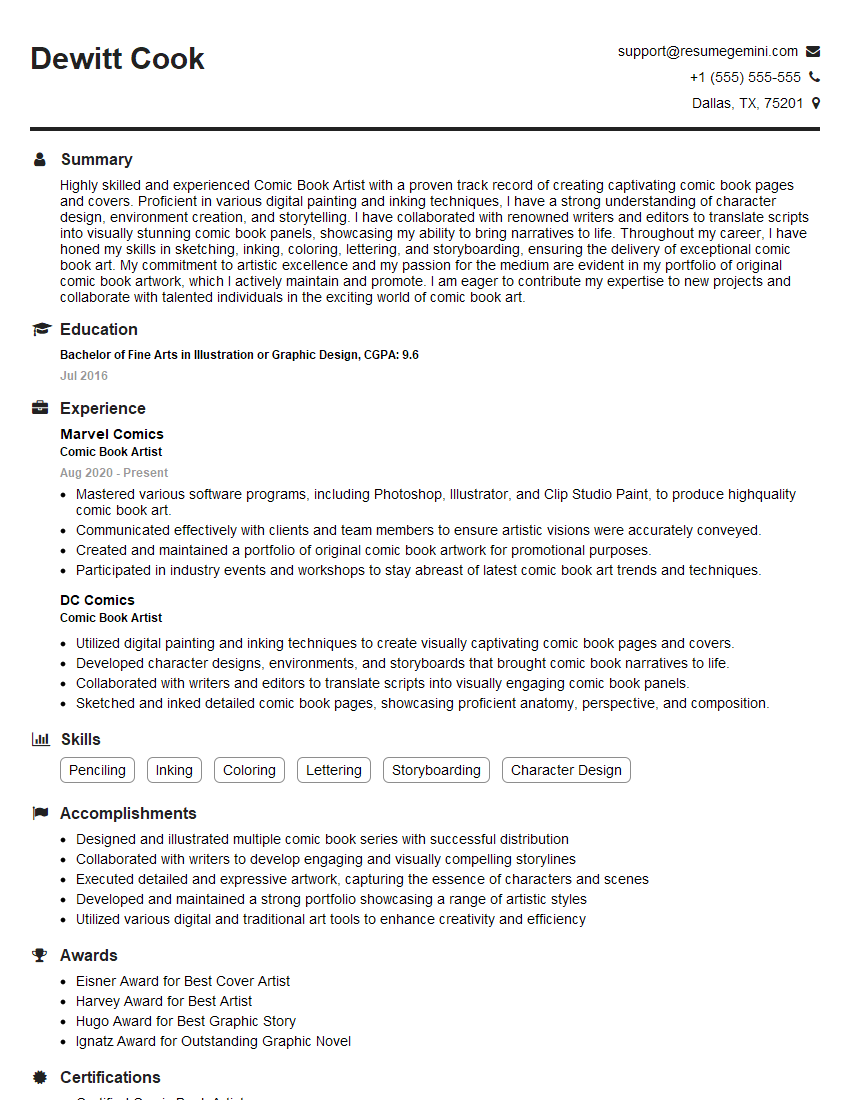
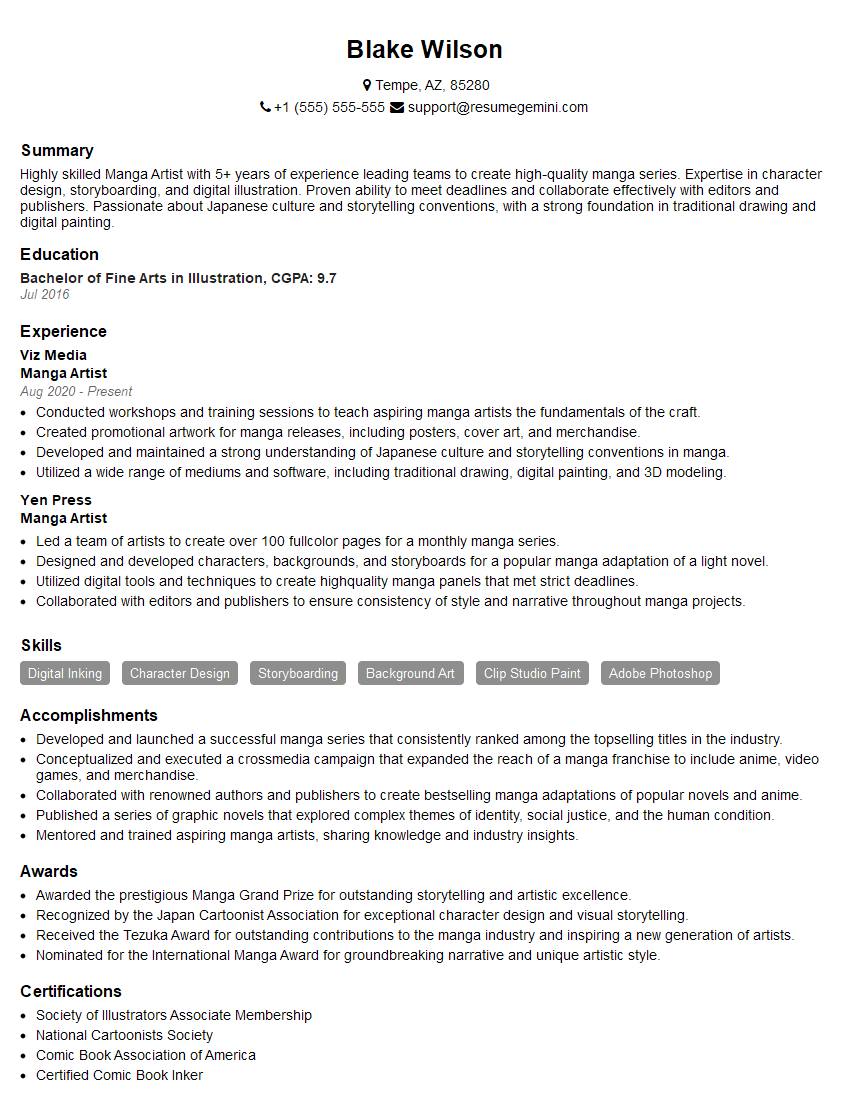
Mastering sequential art opens doors to exciting careers in comics, animation, graphic novels, game design, and more. To significantly boost your job prospects, creating an ATS-friendly resume is crucial. This ensures your skills and experience are effectively highlighted for recruiters. We strongly recommend using ResumeGemini to build a professional and impactful resume. ResumeGemini offers a user-friendly interface and provides examples of resumes tailored specifically to Sequential Art, helping you present yourself in the best possible light.
Explore more articles
Users Rating of Our Blogs
Share Your Experience
We value your feedback! Please rate our content and share your thoughts (optional).
What Readers Say About Our Blog
Really detailed insights and content, thank you for writing this detailed article.
IT gave me an insight and words to use and be able to think of examples