Feeling uncertain about what to expect in your upcoming interview? We’ve got you covered! This blog highlights the most important Sight Reading and Aural Skills interview questions and provides actionable advice to help you stand out as the ideal candidate. Let’s pave the way for your success.
Questions Asked in Sight Reading and Aural Skills Interview
Q 1. Explain the process of sight-reading a new piece of music.
Sight-reading is the ability to perform a musical piece from its written score without prior preparation. It’s a skill built on a combination of technical proficiency, musical understanding, and strategic approach. The process unfolds in several stages:
- Initial Glance: Begin with a quick overview of the entire piece. Note the key signature, time signature, tempo markings, and overall structure (e.g., number of sections, presence of repeats). This provides a crucial framework for understanding the piece’s character and challenges.
- Section-by-Section Analysis: Break the piece down into smaller, manageable sections. Focus on one section at a time, carefully examining the melodic contour, rhythmic patterns, and harmonic progressions. Identify potential difficulties or tricky passages beforehand.
- Strategic Finger Placement: Plan your fingerings in advance, especially for challenging passages. Efficient fingerings contribute significantly to accuracy and fluency. Think ahead to avoid awkward transitions.
- Controlled Execution: Start playing slowly and deliberately. Prioritize accuracy over speed initially. Gradually increase tempo as your familiarity and confidence grow.
- Listening and Adjustment: Listen critically to your own playing and adjust accordingly. Be prepared to adapt and make corrections as you proceed. Don’t be afraid to pause and re-group if necessary.
Imagine learning a new language – you wouldn’t start by speaking fluently. Instead, you’d learn the alphabet, grammar, and vocabulary, before gradually constructing sentences. Sight-reading is similar; it’s a gradual process of decoding musical notation and translating it into performance.
Q 2. Describe your approach to analyzing a musical score before sight-reading.
Analyzing a score before sight-reading is crucial. My approach involves a systematic process:
- Key Signature and Time Signature: I immediately identify the key signature to understand the tonal context and potential harmonic relationships. The time signature dictates the rhythmic framework; I mentally subdivide the beats to anticipate rhythmic complexities.
- Range and Tessitura: Assessing the vocal or instrumental range helps determine the comfort and feasibility of playing the piece. The tessitura (the part of the range most frequently used) indicates potential areas of strain or ease.
- Melodic and Harmonic Analysis: I briefly scan the melody, looking for leaps, repeated patterns, and any unusual melodic shapes. I also note the harmonic progression – identifying cadences, modulations, and any significant harmonic changes.
- Rhythmic Complexity: I look for any complex or unusual rhythmic patterns, paying attention to syncopation, tuplets, and unusual note values. Identifying these challenges beforehand allows me to plan my approach and manage them effectively.
- Dynamics and Articulation: Understanding the dynamic markings (e.g., piano, forte) and articulation marks (e.g., legato, staccato) informs the expressive quality of my performance.
This preliminary analysis acts like a roadmap, making the sight-reading process much smoother and more efficient. It’s akin to previewing a route on a map before embarking on a journey.
Q 3. How do you handle unfamiliar key signatures or time signatures while sight-reading?
Unfamiliar key signatures and time signatures can initially present challenges, but with practice, they become manageable. My approach involves:
- Key Signatures: I quickly identify the key signature and mentally visualize the corresponding notes on the staff. I may mentally play a simple scale or arpeggio in that key to internalize it. Frequent exposure to various key signatures through practice gradually reduces the cognitive load.
- Time Signatures: I focus on understanding the basic pulse and subdivision of the time signature. For example, in 6/8, I recognize the underlying pulse as two dotted-quarter notes. I break down complex rhythms into their smaller constituent parts and practice counting them regularly.
For instance, encountering a piece in Db major (with six flats) might initially seem daunting. However, by quickly recognizing the key and mentally playing a Db major scale, I can prepare myself for the characteristic intervals and harmonic relationships within the piece. The same applies to unusual time signatures, such as 5/4 – by understanding the pulse and subdivisions, I can approach the rhythmic complexities more effectively.
Q 4. What strategies do you employ to maintain accuracy and tempo during sight-reading?
Maintaining accuracy and tempo during sight-reading requires a combination of techniques:
- Controlled Breathing: Proper breathing technique helps maintain a steady tempo and supports phrasing. Deep, controlled breaths provide stability and prevent rushing or slowing down.
- Metronome Practice: Regular practice with a metronome develops a strong sense of pulse and helps train the ability to play accurately at different tempos. This develops internal timing.
- Subdivision: Consciously subdividing the beats helps maintain accuracy, particularly in complex rhythmic passages. For example, subdividing a quarter note into eighth notes or sixteenth notes allows for smoother execution.
- Focus and Concentration: Maintaining focus and concentration is paramount. Minimize distractions and cultivate mental discipline to stay engaged with the music. Practice mindfulness and mental focus techniques to improve this.
Imagine running a marathon; pacing and breathing are crucial for sustaining energy and completing the race. Similarly, controlled breathing, and consistent tempo using a metronome are crucial in sight-reading for a successful ‘completion’ of the piece.
Q 5. How do you identify and correct mistakes quickly while sight-reading?
Identifying and correcting mistakes quickly requires a proactive approach:
- Anticipation: Look ahead in the score as you play to anticipate challenges and prepare accordingly. This reduces the likelihood of errors.
- Self-Correction: Listen critically to your own performance. If you hear a mistake, stop briefly, identify the error, and correct it deliberately. Don’t dwell on mistakes, but learn from them.
- Mental Rehearsal: Before playing a difficult passage, mentally rehearse it, visualizing the fingerings and rhythms. This prepares your mind and body for the challenge.
- Flexibility: Be prepared to adjust your approach if necessary. If a section is proving exceptionally difficult, it’s acceptable to slow down or break it down into smaller units.
Think of it like editing a written document; it’s easier and more efficient to catch and correct typos as you write, rather than at the end. Similarly, correcting mistakes while sight-reading is more effective when done promptly.
Q 6. Describe your method for memorizing music efficiently.
Memorizing music efficiently involves a multi-faceted approach that goes beyond simply repeating the piece:
- Chunking: Divide the piece into smaller, manageable sections. Learn each section thoroughly before moving on to the next. This makes the process less overwhelming.
- Active Recall: Instead of passively reviewing the piece, actively try to recall it from memory. Play it from memory and identify areas that need more attention. This strengthens retention.
- Aural Learning: Sing or hum the melody, and internalize the harmonic progressions. Listening to your own playing is crucial; the brain encodes information differently when you’re actively listening.
- Kinesthetic Learning: Feel the music with your body and instrument. Pay attention to the physical movements required for playing the piece. This physical memory reinforces the memorization process.
- Spaced Repetition: Review the piece at increasing intervals. For example, review it after one day, then after three days, then after a week, and so on. This reinforces memory over time.
Think of building a house – you wouldn’t build the entire thing at once; you’d build it section by section, ensuring each part is secure before moving on to the next. Likewise, memorizing music efficiently involves building those secure sections before uniting them.
Q 7. How do you approach sight-reading complex rhythmic patterns?
Sight-reading complex rhythmic patterns requires a structured approach:
- Subdivision: Break down complex rhythms into their smallest components. For instance, a triplet can be subdivided into three equal parts. This helps to establish the precise timing of each note.
- Counting and Clapping: Practice counting and clapping the rhythm before playing it on the instrument. This helps internalize the rhythm independently of the instrument’s physical demands.
- Body Movement: Use body movements to reinforce rhythmic patterns. For example, tap your foot, nod your head, or use hand gestures to emphasize the rhythmic pulse and subdivisions.
- Visual Cues: Use visual cues on the score to help you track the rhythm. Mentally group notes into rhythmic units, and use pencil marks or mental highlighting techniques to help guide your playing.
- Pattern Recognition: Look for recurring rhythmic patterns within the piece and utilize your knowledge of musical phrasing and rhythmic groupings to your advantage. Identifying and exploiting patterns improves efficiency.
Approaching complex rhythms like a code requires breaking it into its smaller components. It’s like solving a puzzle; understanding each piece and how they fit together unlocks the whole picture.
Q 8. Explain your technique for sight-reading challenging melodic intervals.
Sight-reading challenging melodic intervals requires a multifaceted approach combining theoretical understanding with practical application. It’s not just about recognizing the interval but understanding its inherent qualities – its size, direction, and its effect on the overall melodic contour.
My technique begins with quickly identifying the type of interval (major second, perfect fifth, etc.). I then contextualize it within the surrounding notes. Is it a stepwise motion, a leap, or part of a larger arpeggiated figure? This helps me anticipate the direction and size of subsequent intervals. For instance, if I see a large leap upwards, I’m prepared for a potential downward motion to balance the phrase.
I also rely heavily on intervallic patterns. Recognizing familiar intervallic sequences (e.g., a perfect fifth followed by a major third often suggests a dominant-tonic resolution) can significantly improve reading speed and accuracy. Finally, I practice regularly with exercises focusing specifically on intervallic jumps, gradually increasing the complexity. This focused training builds my muscle memory and improves my ability to quickly recognize and execute even the most challenging intervals.
Q 9. How do you apply your aural skills to improve your sight-reading abilities?
Aural skills are the cornerstone of effective sight-reading. Strong aural skills allow me to anticipate the sound before I even play the notes. This predictive ability is crucial for handling unexpected melodic turns and harmonic shifts.
For instance, if I’m sight-reading a piece with complex harmonies, my aural training allows me to instantly hear the implied chords and predict the likely melodic direction. This is particularly helpful in navigating chromatic passing tones or unexpected harmonic progressions that might otherwise catch me off guard. Similarly, my ability to internalize intervals and melodic patterns from listening enables me to recognize them more rapidly on the page, accelerating my sight-reading speed. I regularly incorporate ear training exercises into my practice routine, focusing on interval recognition, melodic dictation, and harmonic analysis. This ensures a constant reinforcement between hearing and reading, creating a synergistic relationship between the two.
Q 10. Describe your experience with different musical styles and how they influence your sight-reading approach.
My experience spans a wide array of musical styles, from Baroque counterpoint to contemporary jazz improvisation. Each style presents unique challenges and demands a nuanced sight-reading approach.
Baroque music, for example, often features complex contrapuntal lines requiring a keen awareness of voice leading and harmonic relationships. In contrast, jazz improvisation demands a flexibility and responsiveness that requires a high degree of improvisational skill and an intuitive grasp of harmonic substitutions and chord progressions. My approach adapts to these differences. With Baroque music, I prioritize careful note-by-note analysis and a thorough understanding of the harmonic structure. With jazz, I focus on understanding the underlying harmonic framework and developing a feel for the rhythmic and melodic phrasing. This adaptability, honed through extensive exposure to diverse styles, allows me to approach any piece with the appropriate level of analytical rigor and improvisational freedom.
Q 11. What are some common challenges encountered during sight-reading, and how do you overcome them?
Sight-reading, while a rewarding skill, presents several common challenges. One is encountering unfamiliar rhythmic patterns or note values. Another is dealing with sudden changes in key or tempo. Finally, complex harmonies or awkward melodic leaps can also impede progress.
I overcome these challenges through a combination of strategic practice and adaptive techniques. For rhythmic challenges, I slow down the tempo initially, focusing on accurate articulation and rhythmic precision. For unexpected key changes, I mentally transpose to my ‘home’ key to better grasp the harmonic context. When facing complex passages, I break them down into smaller, manageable chunks, practicing each section repeatedly until fluency is achieved. Consistent practice and a methodical approach, coupled with the ability to adapt my strategy to the specific challenges presented, are key to navigating these difficulties.
Q 12. Explain the concept of melodic dictation.
Melodic dictation is the process of transcribing a melody heard aurally onto musical notation. It’s a fundamental aural skills exercise that develops critical listening and notational skills. It’s like being a musical stenographer, taking down a musical idea heard as it unfolds, representing the pitches and rhythms accurately on paper.
Think of it like writing down a spoken sentence – you listen carefully to each word and its intonation, then write it down using the appropriate spelling and punctuation. In melodic dictation, you listen to the melodic phrase, identifying the intervals, rhythm, contour and overall shape of the melody. Then you write it in musical notation.
Q 13. Describe your process for dictating a melodic phrase.
My process for dictating a melodic phrase is iterative and involves several distinct phases. First, I listen attentively to the entire phrase without attempting to write anything. This allows me to grasp the overall contour, range, and character of the melody. Second, I break the phrase down into smaller sections, dictating each section individually. I start with the most prominent notes, marking their pitch and rhythm. I use a pencil at this stage to allow for corrections. Third, I refine the notation, adding details such as articulation and dynamics, paying close attention to subtle rhythmic variations and melodic inflections. Finally, I listen to the entire phrase again, comparing my notation to the original performance and making any necessary adjustments.
This step-wise approach ensures accuracy and helps to avoid errors caused by rushing. It’s important to listen actively and trust your ears – if something sounds off, it’s important to make the correction.
Q 14. How do you handle ambiguous melodic contours during dictation?
Ambiguous melodic contours often arise due to factors like the context of the surrounding music, or the use of microtones. Handling these situations requires a combination of careful listening and informed guesswork. I approach these ambiguities by considering the musical context. Is the piece in a major or minor key? Are there any harmonic clues that might suggest a specific interval or note?
I also consider the overall melodic contour. If the melody is predominantly stepwise, an ambiguous interval is more likely to be a small interval. Conversely, if the melody features frequent leaps, a larger interval is more likely. I might use a question mark or other notation to indicate uncertainty. In cases of significant ambiguity, I clearly indicate the areas of uncertainty in my notation with explanatory notes. The goal is not necessarily to achieve perfect transcription on the first attempt, but to create an accurate representation of the music while acknowledging the ambiguity. This process encourages further listening and analysis, which strengthens one’s aural skills further.
Q 15. Explain the concept of rhythmic dictation.
Rhythmic dictation is the skill of accurately transcribing a rhythmic pattern heard aurally onto a musical staff. It involves identifying and notating the durations of notes and rests, encompassing simple and complex rhythmic structures. Think of it like writing down a recipe after hearing someone describe it – you need to capture not just the ingredients, but the precise amounts and order.
It’s a crucial element of music theory and musicianship, strengthening your internal rhythmic clock and your ability to internalize and reproduce complex rhythmic patterns. This skill is particularly important for sight-reading, composition, improvisation, and ensemble playing.
Career Expert Tips:
- Ace those interviews! Prepare effectively by reviewing the Top 50 Most Common Interview Questions on ResumeGemini.
- Navigate your job search with confidence! Explore a wide range of Career Tips on ResumeGemini. Learn about common challenges and recommendations to overcome them.
- Craft the perfect resume! Master the Art of Resume Writing with ResumeGemini’s guide. Showcase your unique qualifications and achievements effectively.
- Don’t miss out on holiday savings! Build your dream resume with ResumeGemini’s ATS optimized templates.
Q 16. Describe your process for dictating a rhythmic pattern.
My process for dictating a rhythmic pattern involves several steps. First, I listen attentively to the entire pattern at least twice to grasp its overall feel and structure. I’ll mentally divide the pattern into smaller, manageable chunks to avoid getting overwhelmed by complexity. Next, I focus on identifying the strongest beats and the pattern’s underlying meter. I then analyze the durations of individual notes and rests, paying attention to any accents or syncopations. I’ll often tap my foot or clap along to reinforce the rhythmic pulse. Finally, I carefully notate the pattern onto the staff, double-checking for accuracy against what I heard.
For example, if I hear a dotted quarter note followed by an eighth note rest and then two eighth notes, I’ll mentally break this down and translate it carefully to the staff, taking note of the specific durations. This systematic approach ensures accuracy and minimizes errors.
Q 17. How do you deal with syncopation and complex rhythmic structures during dictation?
Syncopation and complex rhythms present a greater challenge, but the same fundamental principles apply. I would initially identify the underlying pulse or meter, which often helps to contextualize the displaced accents characteristic of syncopation. I then focus on clearly identifying the beginning and end points of each note in relation to the beat. For example, a syncopated eighth note on the ‘and’ of beat 1 requires careful listening and precise notation.
For complex rhythms, I frequently employ subdivision techniques. Breaking down complex durations into smaller, more manageable units (e.g., dividing a dotted half note into three quarter notes) simplifies the process significantly. Furthermore, I might use a pencil to lightly sketch out possible interpretations before finalizing my notation to explore different possibilities, checking the result against the sound.
Q 18. Explain how you would teach melodic dictation to a beginner student.
Teaching melodic dictation to beginners begins with the fundamentals. I’d start with simple, stepwise melodies using only whole, half, and quarter notes, focusing on intervals of seconds and thirds. I’d play the melody repeatedly, encouraging students to sing along to internalize the contour. Visual aids like solfège syllables can greatly assist in associating sounds with notation. Then, I introduce the concept of a staff, notes on the lines and spaces, and how the vertical position of the notes relates to pitch. I would progressively introduce more complex melodies and intervals, gradually increasing the rhythmic complexity. Regular practice, feedback, and positive reinforcement are essential for building confidence.
For example, a simple exercise might begin with a C-D-E-F melody, focusing solely on stepwise motion before introducing leaps and more complex rhythms.
Q 19. Explain how you would teach rhythmic dictation to a beginner student.
Teaching rhythmic dictation to beginners requires a playful, hands-on approach. I’d start by establishing a clear sense of pulse and beat through body percussion (clapping, tapping). Simple rhythmic patterns, using only whole, half, and quarter notes, are initially presented. These patterns should be repeated multiple times to allow for internalization. Visual aids like rhythmic notation charts can help make the association between sound and notation clearer. I would then gradually introduce dotted notes, rests, and simple syncopation, making sure that each step has been well-understood before proceeding.
Games and activities, such as rhythmic echo (teacher plays, student repeats), rhythmic dictation using simple body percussion, and creating original rhythmic patterns, enhance student engagement and build their confidence. Consistent practice is vital for building a strong internal rhythmic sense.
Q 20. Explain the concept of interval recognition.
Interval recognition is the ability to identify the distance between two pitches. It’s fundamental to music theory and harmony, crucial for understanding melodic contour, chord construction, and harmonic relationships. Think of it as understanding the ‘steps’ between notes, similar to understanding the distance between two points on a map. The interval is measured in half steps, with a half step being the smallest interval in Western music.
Intervals are classified by their size and quality (major, minor, perfect, augmented, diminished), with each having a unique sonic characteristic. Recognizing intervals accurately is essential for sight-reading, ear training, composition, improvisation, and analysis.
Q 21. Describe your method for identifying intervals accurately.
My method for accurately identifying intervals relies on a combination of auditory skills and theoretical knowledge. Initially, I focus on establishing a clear reference pitch (usually the lower note). I then carefully analyze the distance between the reference pitch and the second pitch, focusing on whether the interval ascends or descends. I can mentally ‘count’ the half steps or use solfège to determine the interval size. This approach requires extensive practice and familiarity with interval qualities and sizes.
For example, if I hear a major third, I can immediately recognize that it comprises four half steps, whether the sound is a C-E or any other equivalent major third. I regularly use keyboard exercises and interval training software to strengthen my recognition skills. Context is also important; for instance, the context within a chord can frequently aid in the identification of the interval.
Q 22. How do you distinguish between major and minor intervals?
The difference between major and minor intervals lies primarily in the size of the interval in half steps. A major interval is larger than its minor counterpart. Think of it like this: major intervals are ‘happy’ and minor intervals are ‘sad’. This is a simplistic way to remember the feeling they evoke, but the core difference is mathematical.
- Major Third: A major third spans four half steps (e.g., C to E).
- Minor Third: A minor third spans three half steps (e.g., C to Eb).
This pattern extends to other intervals: major seconds are larger than minor seconds, major sevenths are larger than minor sevenths, and so on. Understanding this half-step difference is crucial for recognizing intervals accurately and is fundamental to sight-reading and aural skills development.
For example, if you hear an interval and recognize it’s a third, you can determine if it’s major or minor by counting the half steps between the notes. This is a skill developed through consistent practice and ear training exercises.
Q 23. Explain the concept of chord recognition.
Chord recognition is the ability to identify a chord’s root, type (major, minor, diminished, augmented), and inversion solely by listening. It’s a cornerstone skill for musicians, enabling quick understanding of harmonic contexts in various musical situations. It’s like having a mental library of chord sounds that you can instantly recall and identify.
The process involves recognizing the characteristic sonic qualities of each chord type. This includes: the specific intervals between the notes, the overall ‘texture’ or ‘color’ of the chord, and its function within the harmonic progression.
For instance, a major chord often sounds bright and stable, while a minor chord tends to sound darker and more melancholic. Diminished chords create a sense of tension, while augmented chords offer a unique and often unstable quality.
Q 24. Describe your method for identifying different chord types.
My method for identifying chord types involves a systematic approach combining aural analysis and theoretical knowledge. I begin by identifying the lowest note (the bass note), which often provides a strong clue to the root. I then listen carefully for the characteristic intervals between the notes.
- Major Chords: Root, major third, perfect fifth (intervals of 4 and 7 half steps).
- Minor Chords: Root, minor third, perfect fifth (intervals of 3 and 7 half steps).
- Diminished Chords: Root, minor third, diminished fifth (intervals of 3 and 6 half steps).
- Augmented Chords: Root, major third, augmented fifth (intervals of 4 and 8 half steps).
Beyond this, I consider the overall ‘sound’ of the chord. Practice and experience allow me to quickly distinguish the unique sonic fingerprints of each chord type. I also consider the harmonic context; how the chord functions within a progression provides significant clues. For example, a chord that resolves to a tonic often has specific characteristics, which can help in its identification.
Q 25. How do you recognize inversions of chords?
Chord inversions occur when a chord’s notes are rearranged, with a note other than the root appearing in the bass. Recognizing inversions requires understanding how the bass note changes the harmonic character while the chord’s quality remains the same. For instance, a C major chord in root position is C-E-G. In first inversion, it would be E-G-C, and in second inversion, G-C-E.
To identify inversions, I focus on the bass note and the intervals above it. If the bass note is the third of the chord, it’s a first inversion. If it’s the fifth, it’s a second inversion. The intervals between the bass and the other notes provide the key to recognizing which inversion is being played. Practice with various chord types in different inversions is essential to develop this skill. A solid understanding of interval recognition is fundamental to successful inversion identification.
Q 26. Explain your approach to analyzing harmonic progressions.
Analyzing harmonic progressions involves understanding the relationships between successive chords, their functions (tonic, dominant, subdominant, etc.), and the overall emotional and structural effect they create. It’s a bit like understanding the narrative structure of a story.
My approach starts with identifying the individual chords and their types. Then, I determine their functions within the key and analyze how they lead to each other. I look for patterns like the common I-IV-V-I progression in major keys or the ii-V-I progression that is very common in jazz and popular music. I also consider cadences (concluding phrases), which often involve a dominant chord resolving to the tonic. Analyzing the voice leading, which is how the individual notes move between chords, also reveals the logic behind the harmonic flow.
For example, a series of chords that create a feeling of tension and release indicates a certain structural approach. Understanding these patterns and their emotional implications improves not only sight-reading but also composition and improvisation skills.
Q 27. Describe how you use aural skills in ensemble performance.
Aural skills are absolutely crucial for successful ensemble performance. They enable musicians to blend their sounds effectively, maintain accurate intonation, and respond dynamically to their fellow performers. It’s like a seamless conversation between musical instruments.
In ensemble playing, I use aural skills to constantly monitor the intonation and timing of both my own part and the parts of other musicians. I listen for subtle tuning discrepancies and adjust my playing accordingly to ensure a cohesive and balanced sound. I also listen for rhythmic precision, responding to subtle tempo changes and ensuring a consistent rhythmic pulse across all instruments. Moreover, aural skills play a significant role in shaping dynamics and phrasing, ensuring a musically satisfying performance. I use my ears to anticipate the next phrases and musical gestures, allowing me to create a unified and expressive musical performance.
Q 28. Explain how you use aural skills in improvisation.
Aural skills are the foundation of effective improvisation. They allow musicians to create melodies and harmonies spontaneously and respond creatively to musical contexts. It’s the ability to freely create music in the moment.
In improvisation, I rely heavily on my aural memory of scales, chords, and common melodic patterns. I listen intently to the harmonic progression and build my improvisations upon the underlying structure. I also use my ear to guide my melodic choices, ensuring that my phrases are coherent and fit the overall harmonic context. My aural skills assist in selecting notes that create a sense of flow and musical interest, while ensuring that the improvisation feels both spontaneous and structured. Intensive ear training and practice are essential for developing these skills and allow me to react intuitively and creatively to the musical conversation that arises during improvisation.
Key Topics to Learn for Sight Reading and Aural Skills Interview
Preparing for a Sight Reading and Aural Skills interview can feel daunting, but with focused preparation, you can confidently showcase your abilities. Remember, the key is demonstrating a solid understanding of both the theory and practical application of these essential skills.
- Rhythmic Accuracy: Understanding complex time signatures, syncopation, and rhythmic notation. Practice reading rhythms independently and within musical contexts.
- Melodic Dictation: Accurately transcribing melodies heard aurally, focusing on intervals, contour, and phrasing. Develop strategies for recognizing and notating melodic patterns.
- Harmonic Analysis: Identifying chords, progressions, and cadences in both written and aurally presented music. Practice analyzing different musical styles and periods.
- Interval Recognition: Quickly and accurately identifying intervals both aurally and visually. Develop a strong understanding of interval relationships and their function within harmony.
- Key Signatures & Transposition: Fluently reading and understanding key signatures and their impact on melodic and harmonic content. Practice transposing melodies and harmonies into different keys.
- Sight-Reading Strategies: Develop efficient eye-hand coordination and techniques for navigating complex musical scores. Practice with diverse musical styles and levels of difficulty.
- Aural Skills Problem-Solving: Approach unfamiliar musical examples methodically, breaking down complex passages into smaller, manageable sections. Develop strategies for identifying and correcting errors in transcription.
Next Steps
Mastering Sight Reading and Aural Skills is crucial for a successful career in music. These skills are fundamental for many roles, demonstrating proficiency in musicianship and musical comprehension. To increase your chances of landing your dream job, a well-crafted resume is essential. An ATS-friendly resume, optimized for applicant tracking systems, ensures your qualifications are seen by hiring managers. We highly recommend using ResumeGemini to build a professional and effective resume tailored to highlight your unique skills. ResumeGemini provides examples of resumes specifically designed for candidates with expertise in Sight Reading and Aural Skills, helping you present your qualifications in the most compelling way possible.
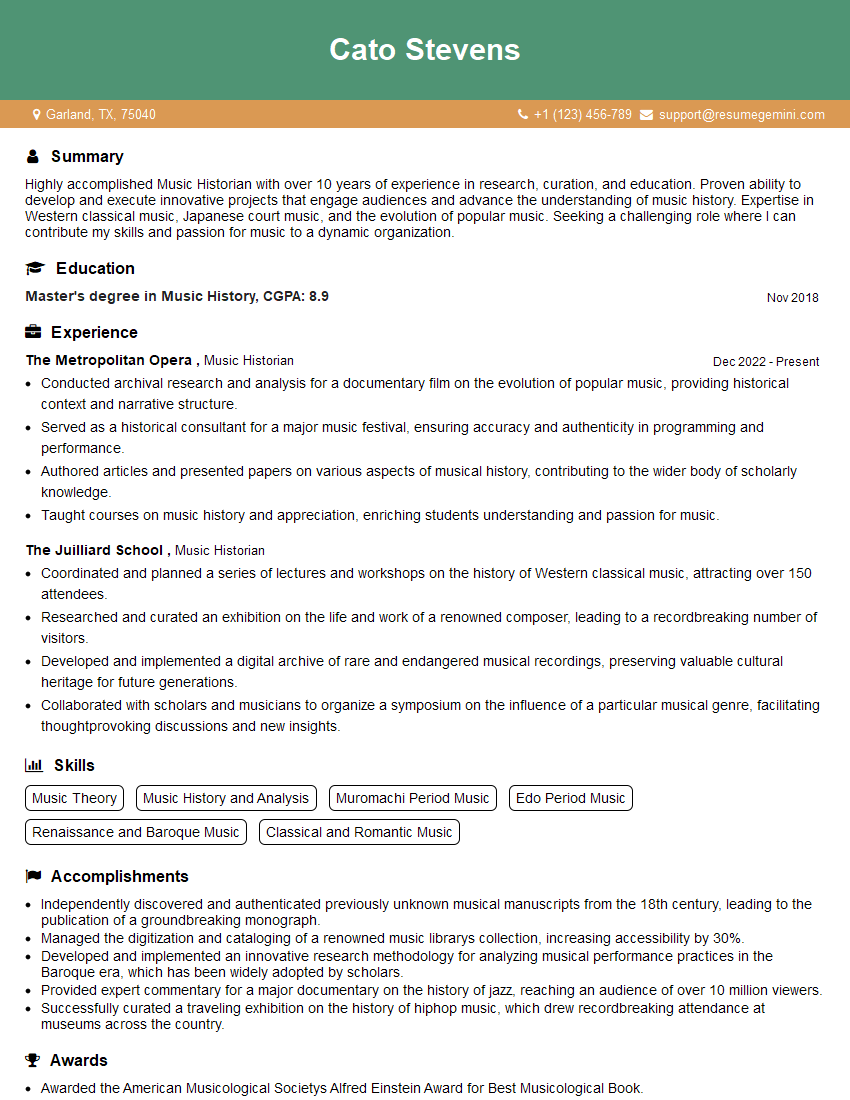
Music Historian Resume Sample
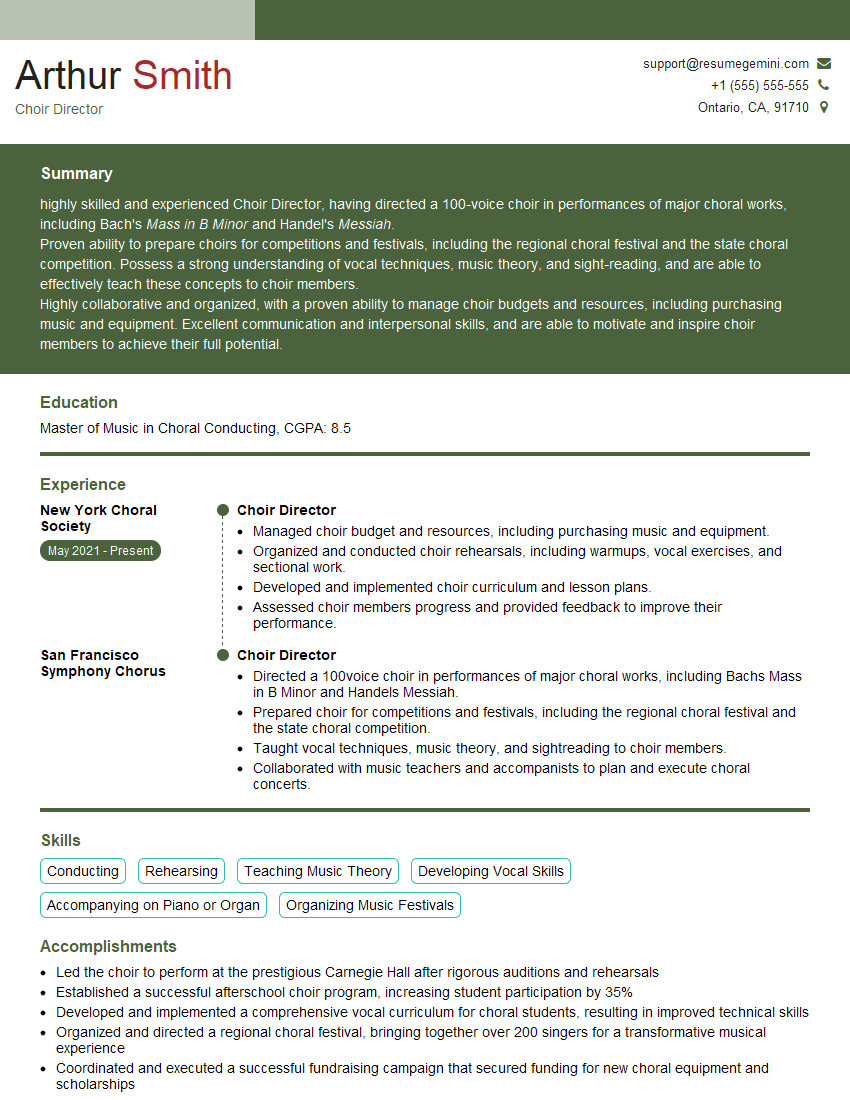
Choir Director Resume Sample
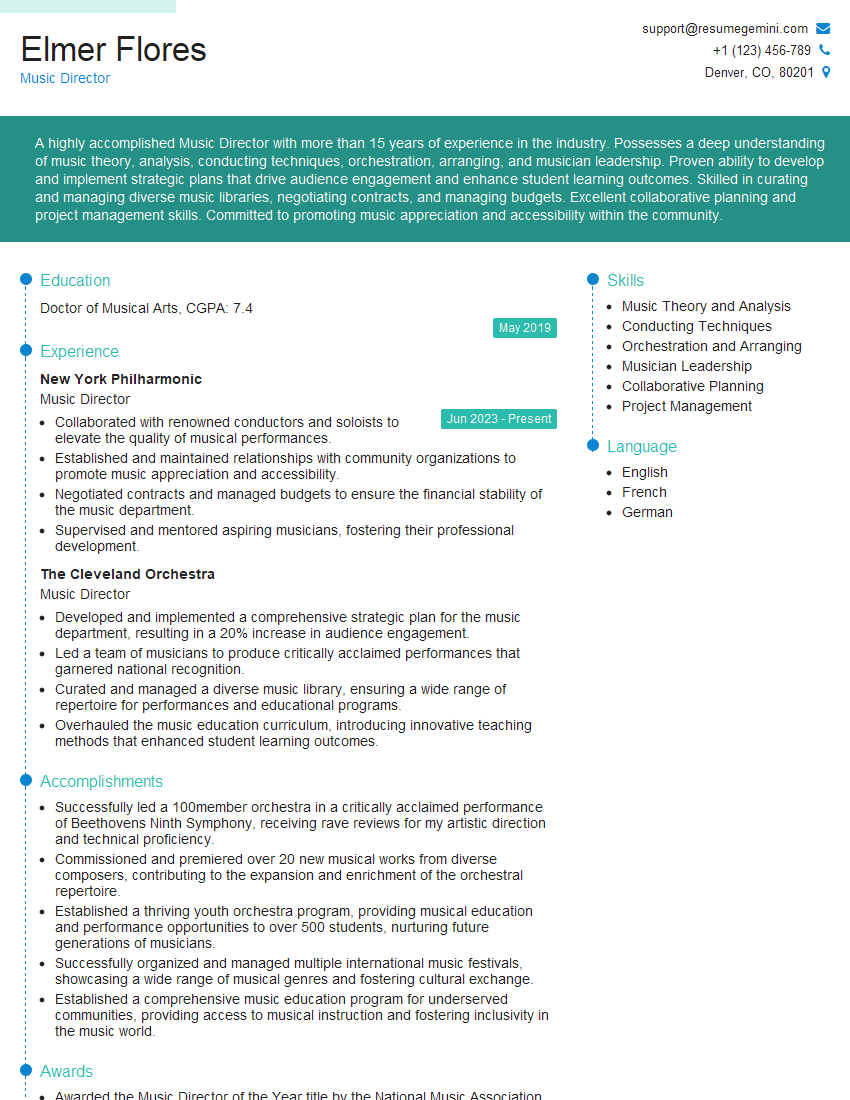
Music Director Resume Sample
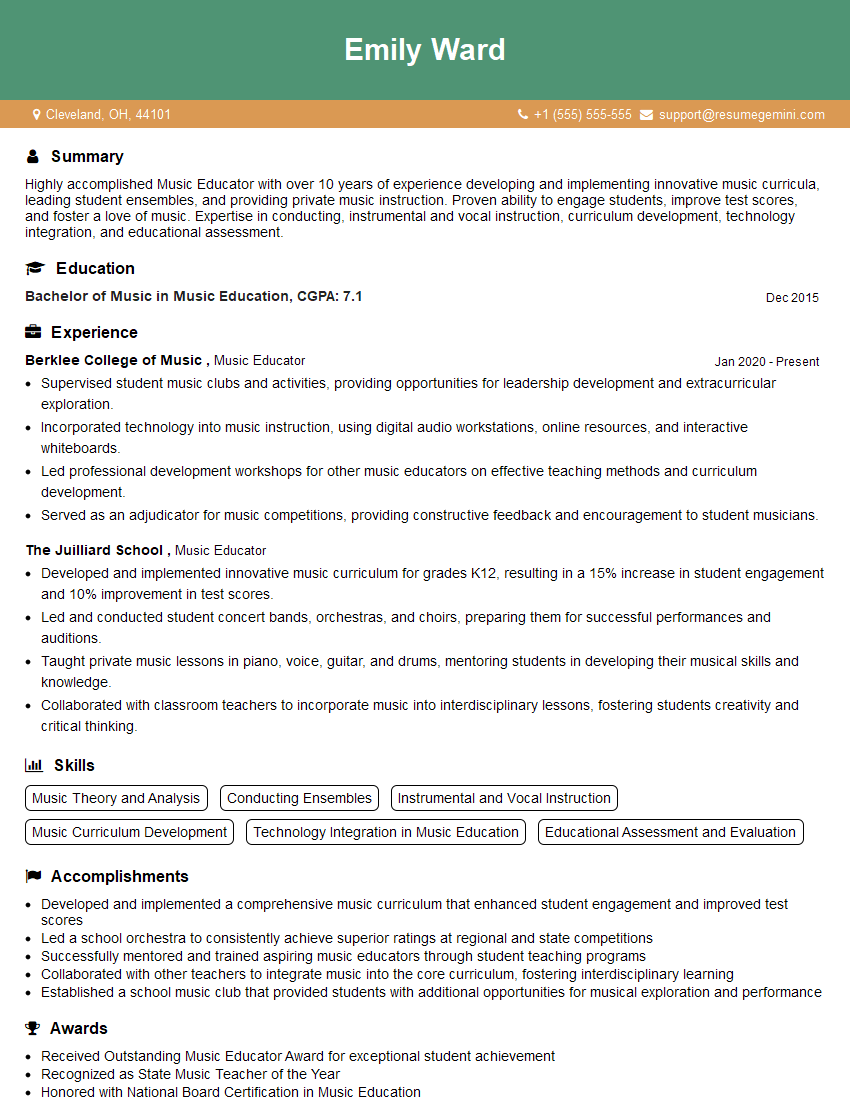
Music Educator Resume Sample

Music Teacher Resume Sample
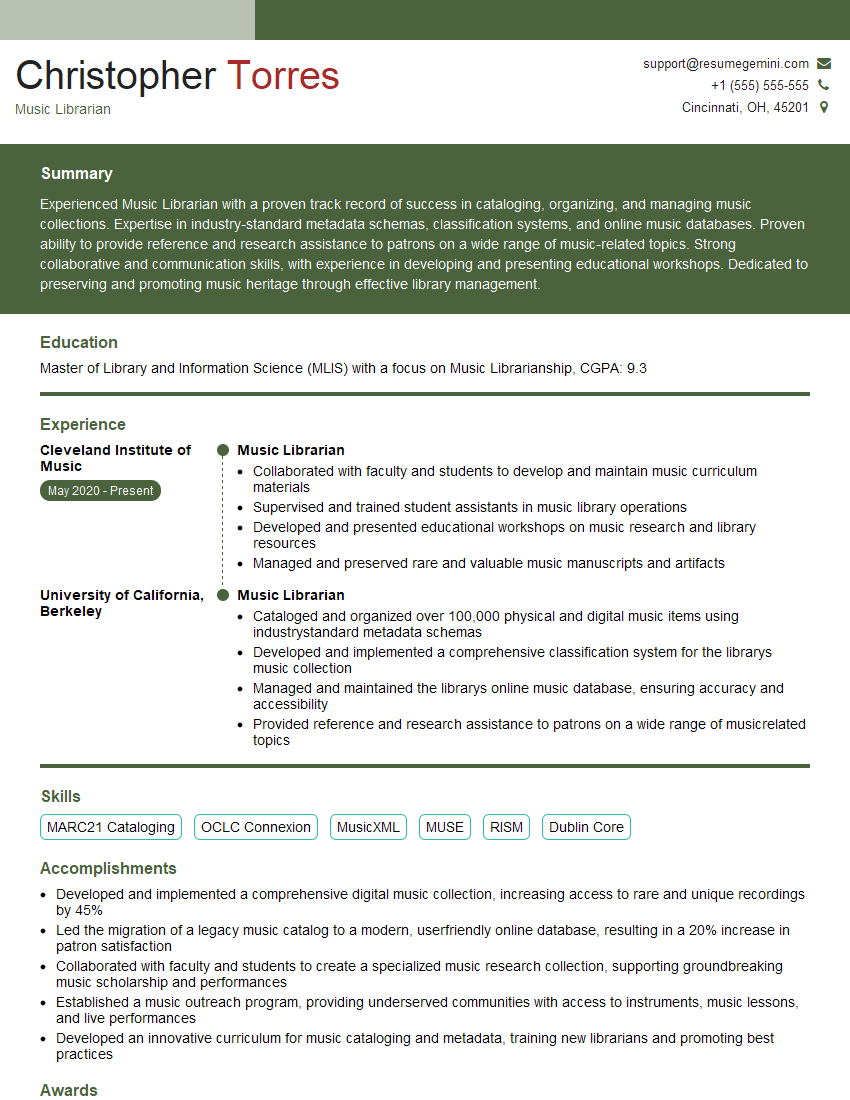
Music Librarian Resume Sample
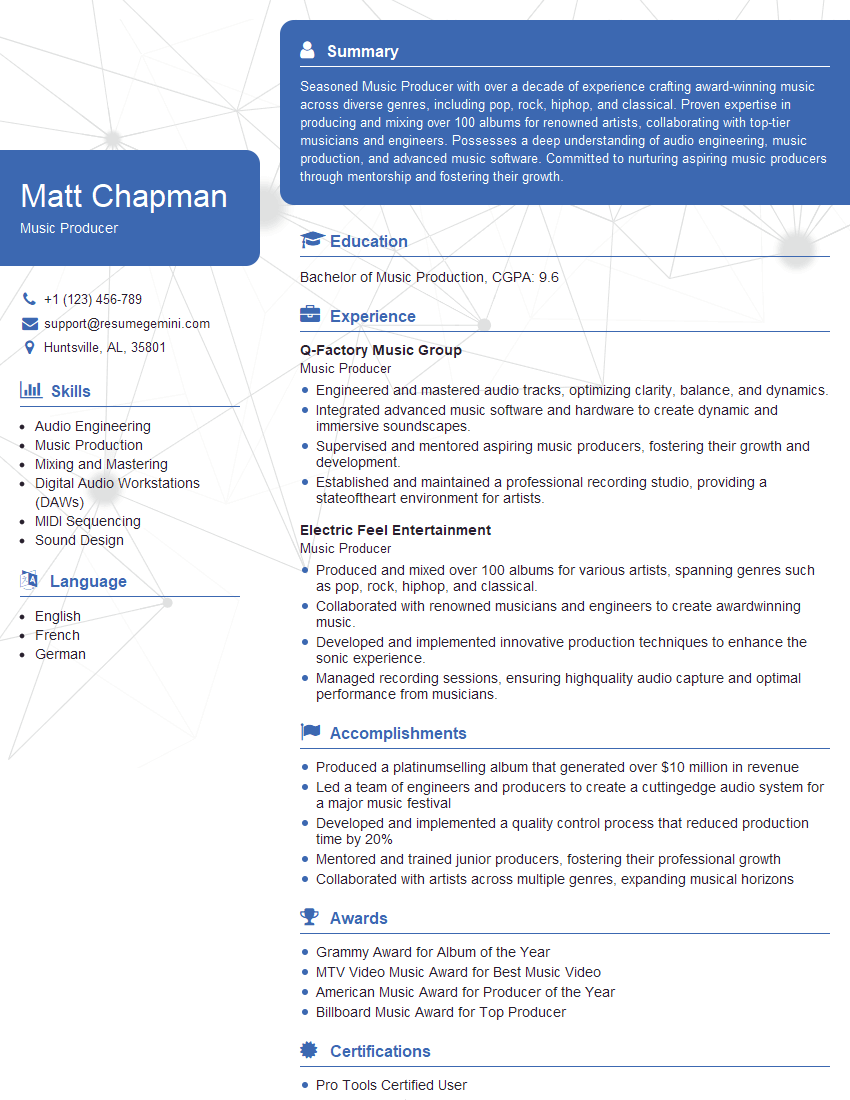
Music Producer Resume Sample
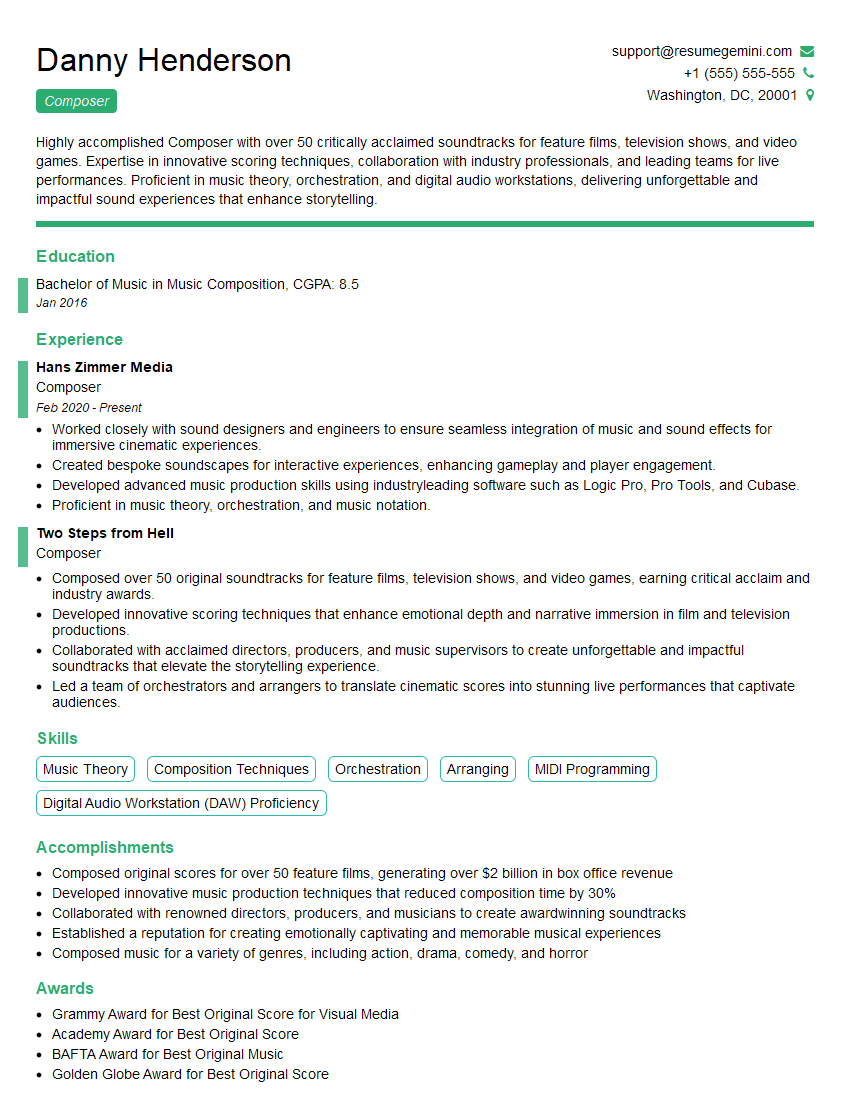
Composer Resume Sample
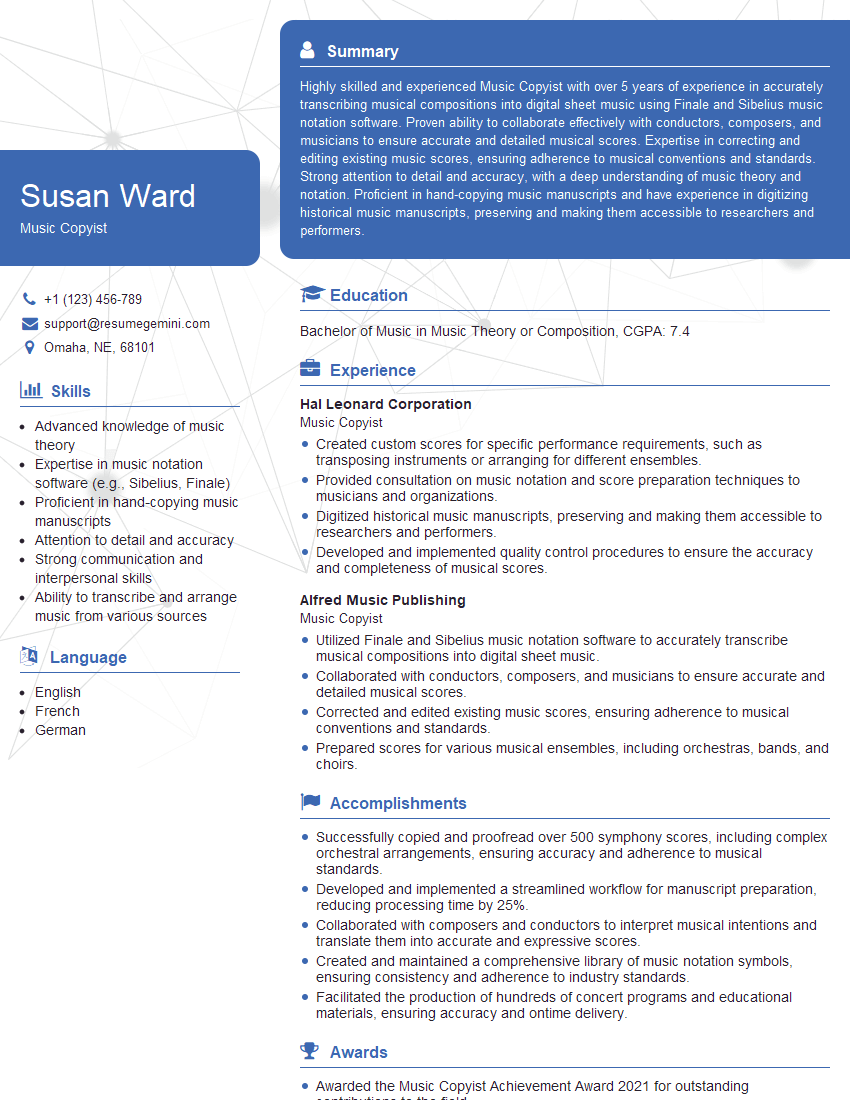
Music Copyist Resume Sample

Orchestra Conductor Resume Sample
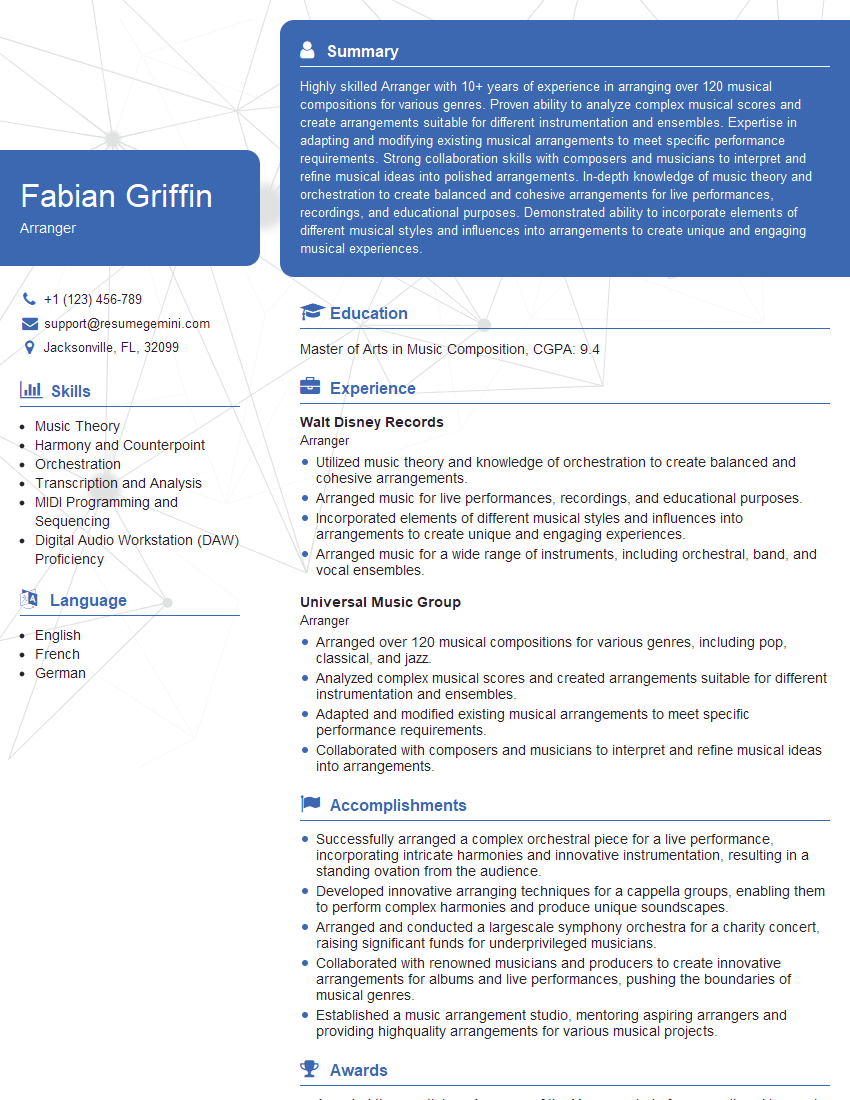
Arranger Resume Sample

Sound Engineer Resume Sample
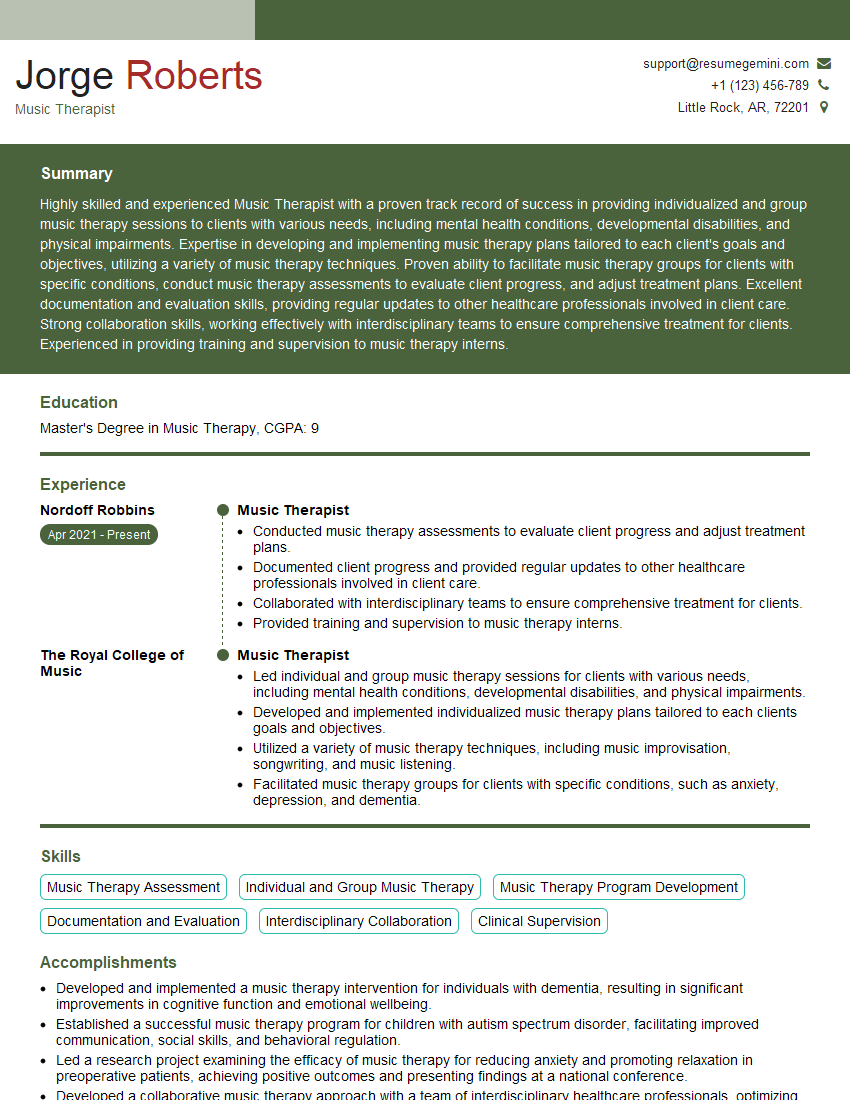
Music Therapist Resume Sample
Explore more articles
Users Rating of Our Blogs
Share Your Experience
We value your feedback! Please rate our content and share your thoughts (optional).
What Readers Say About Our Blog
Really detailed insights and content, thank you for writing this detailed article.
IT gave me an insight and words to use and be able to think of examples