The right preparation can turn an interview into an opportunity to showcase your expertise. This guide to Software Modeling and Simulation interview questions is your ultimate resource, providing key insights and tips to help you ace your responses and stand out as a top candidate.
Questions Asked in Software Modeling and Simulation Interview
Q 1. Explain the difference between discrete-event and continuous simulation.
The core difference between discrete-event and continuous simulation lies in how they model time and changes within the system. Discrete-event simulation focuses on events that occur at specific points in time, causing instantaneous changes in the system’s state. Think of it like a series of snapshots – the system remains unchanged between events. Continuous simulation, on the other hand, models systems that change continuously over time. It tracks variables that evolve smoothly, often governed by differential equations.
Discrete-Event Example: Imagine simulating a call center. Each call arrival and call completion is a discrete event. The system’s state (number of calls waiting, number of agents busy) changes instantly at these event times. The time between events doesn’t require detailed tracking; we only care about the events themselves.
Continuous Example: Simulating the flight of a rocket. The rocket’s position, velocity, and fuel level change continuously over time, governed by physical laws expressed as differential equations. We need to track these variables at every instant to understand the system’s behavior.
In essence, discrete-event is best suited for systems with distinct, clearly defined events, while continuous simulation excels at modeling systems with smooth, continuous changes.
Q 2. Describe your experience with various modeling languages (e.g., Simulink, AnyLogic, Modelica).
I have extensive experience with several prominent modeling languages, each offering unique strengths depending on the project’s needs. My experience includes:
- Simulink: Primarily used for modeling and simulating dynamic systems, particularly control systems and signal processing. I’ve leveraged Simulink’s block diagrams to design, analyze, and verify control algorithms for robotic systems, focusing heavily on model-in-the-loop (MIL) and software-in-the-loop (SIL) testing. For example, I used Simulink to model and simulate the control system for a drone, validating its stability and responsiveness under various conditions.
- AnyLogic: This agent-based modeling tool has been invaluable for simulating complex systems with interacting agents. I’ve used AnyLogic to model supply chains, analyzing the impact of disruptions on inventory levels and delivery times. In one project, I modeled a hospital emergency room to optimize patient flow and reduce wait times, leveraging AnyLogic’s ability to integrate discrete-event and agent-based modeling paradigms.
- Modelica: My work with Modelica has focused on modeling and simulating physical systems, leveraging its equation-based approach. This is particularly useful for multi-domain modeling, where systems involve electrical, mechanical, and thermal components. A recent project involved using Modelica to model a hybrid electric vehicle, analyzing its fuel efficiency and emissions under different driving conditions.
Each of these tools provides a different approach to model building, and selecting the appropriate tool often depends on the problem’s complexity, the nature of the system, and the desired level of detail in the simulation.
Q 3. What are the key steps in the software modeling and simulation process?
The software modeling and simulation process typically involves these key steps:
- Problem Definition: Clearly define the system to be modeled, its boundaries, and the objectives of the simulation. What questions are we trying to answer?
- Model Conceptualization: Develop a high-level understanding of the system’s structure and behavior. This may involve creating diagrams (e.g., UML diagrams, state diagrams) to represent the system’s components and interactions.
- Model Development: Translate the conceptual model into a formal representation using a chosen modeling language. This phase involves selecting appropriate modeling techniques and parameterizing the model.
- Model Verification and Validation: Ensure the model accurately represents the intended system (verification) and that the simulation results are meaningful and reliable (validation). This is a critical step.
- Experimentation and Analysis: Run simulations, collect data, and analyze the results to answer the research questions or achieve the simulation objectives.
- Documentation and Reporting: Document the entire modeling and simulation process, including the model’s assumptions, limitations, and the conclusions drawn from the simulation results.
Effective communication and collaboration are essential throughout this process, especially between modelers, domain experts, and stakeholders.
Q 4. How do you validate and verify your simulation models?
Validating and verifying simulation models is crucial to ensuring their credibility. Verification confirms that the model is implemented correctly – that it accurately reflects the design specifications. Validation confirms that the model adequately represents the real-world system it aims to emulate. These are distinct but complementary processes.
Verification techniques typically involve code reviews, static analysis, and unit testing to ensure the model’s internal consistency and correct implementation. For example, we might use automated tools to check for errors in the model’s equations or logic.
Validation is more challenging. It often involves comparing simulation results with real-world data or known theoretical results. If real-world data is scarce, we might use expert judgment or comparison with simpler, well-understood models. Sensitivity analysis can also help assess the model’s robustness to changes in input parameters. For instance, if we’re modeling traffic flow, we might validate the model by comparing simulated traffic patterns with real-world traffic data from sensors.
A robust validation strategy might include multiple validation approaches to strengthen confidence in the model’s accuracy.
Q 5. Explain different types of model verification techniques.
Model verification employs several techniques to ensure the model is correctly implemented and behaves as intended. These include:
- Structural Verification: This examines the model’s structure to identify inconsistencies or errors. Techniques include code reviews, static analysis, and consistency checks to make sure the relationships between different components are logically sound.
- Behavioral Verification: This focuses on the model’s dynamic behavior. Techniques include unit testing (testing individual model components), integration testing (testing interactions between components), and simulation with known inputs to check that outputs match expectations.
- Code Coverage Analysis: This assesses how much of the model’s code has been executed during testing. High code coverage suggests better testing thoroughness.
- Formal Methods: These employ mathematical techniques to prove the correctness of the model, often used in safety-critical applications. This might involve using model checkers or theorem provers to verify properties of the model.
The choice of verification technique depends on factors such as the model’s complexity, the level of confidence required, and available resources.
Q 6. Discuss your experience with different types of simulations (e.g., Monte Carlo, agent-based).
My experience encompasses a range of simulation types. Here are some examples:
- Monte Carlo Simulation: I’ve used this extensively to quantify uncertainty in models. For instance, in financial modeling, I’ve used Monte Carlo simulations to project investment returns, considering variability in market conditions. This involved running thousands of simulations with randomly sampled inputs to generate a distribution of possible outcomes.
- Agent-Based Simulation: As mentioned earlier with AnyLogic, agent-based modeling has been crucial for projects involving interacting agents. Modeling social dynamics, like the spread of an epidemic or the formation of opinions in a social network, is well-suited to this approach. I have used this approach to simulate crowd behavior in emergency evacuation scenarios.
- Discrete-Event Simulation: This forms the backbone of many of my projects, particularly in areas like manufacturing and logistics. Simulating factory production lines, optimizing warehouse layouts, or analyzing queuing systems in call centers all benefit from this approach. I’ve used it to analyze the efficiency of various production line configurations.
The choice of simulation type is heavily dependent on the nature of the system being modeled. Often, a hybrid approach incorporating multiple simulation types proves beneficial.
Q 7. How do you handle uncertainty and variability in your models?
Handling uncertainty and variability is critical for realistic and useful simulations. Several strategies can be employed:
- Probabilistic Modeling: Instead of using fixed values for parameters, I incorporate probability distributions that reflect the uncertainty in their true values. For example, instead of assuming a constant customer arrival rate in a queuing system, I might use a Poisson distribution to model the random arrival times.
- Sensitivity Analysis: This helps to identify parameters that significantly affect the simulation’s output. This allows focusing on reducing uncertainties in the most critical parameters. This approach helps identify areas where more precise data is needed.
- Monte Carlo Simulation (revisited): As mentioned before, Monte Carlo simulation is a powerful technique to quantify uncertainty. By running many simulations with different random samples from the input distributions, we obtain a distribution of output values, revealing the range of possible outcomes and associated probabilities.
- Fuzzy Logic: In cases where there is imprecision or vagueness in the model’s parameters, fuzzy logic can be a valuable tool. It allows representing parameters and relationships as fuzzy sets, handling uncertainty in a more nuanced way.
The choice of technique depends on the nature of the uncertainty and the desired level of detail. Often, a combination of techniques provides the most robust and accurate way to handle uncertainty in the simulation.
Q 8. What are some common challenges in software modeling and simulation?
Software modeling and simulation, while powerful, presents several challenges. One major hurdle is model complexity. Real-world systems are often incredibly intricate, and accurately representing them in a model can be a monumental task. This complexity can lead to difficulties in model verification and validation, ensuring the model accurately reflects reality.
Another significant challenge is data limitations. Building accurate simulations often requires vast amounts of high-quality data, which may be unavailable, expensive to acquire, or simply incomplete. Incomplete data can lead to inaccurate or unreliable simulation results.
Computational cost is a recurring problem. Complex simulations, especially those involving large-scale systems or detailed physics, can demand significant computational resources and time. This can be a bottleneck in model development and analysis.
Finally, model uncertainty is an ever-present concern. No model is perfect. There will always be uncertainties in the parameters, assumptions, and simplifications made during model creation. Understanding and quantifying these uncertainties is crucial for drawing meaningful conclusions from simulation results.
For example, simulating traffic flow in a smart city requires dealing with the complexity of driver behavior, traffic light coordination, and road network topology. Data limitations arise from incomplete sensor data or difficulties in collecting accurate driver behavior information. The computational cost increases significantly as the scale of the city’s road network grows. Finally, uncertainty stems from factors such as unforeseen weather events or unexpected road closures.
Q 9. How do you optimize simulation models for performance?
Optimizing simulation models for performance involves a multi-pronged approach. The first step is model simplification. Identifying non-essential details and removing them can drastically improve performance without sacrificing critical accuracy. This might involve using simpler mathematical models or reducing the level of detail in geometry.
Algorithmic efficiency is crucial. Choosing efficient algorithms for solving equations and processing data is vital. For instance, using fast solvers for linear algebra or employing parallel computing techniques can significantly speed up the simulation.
Code optimization is another key aspect. This involves techniques such as using appropriate data structures, vectorization, and minimizing redundant computations. Profiling the code to identify performance bottlenecks can guide this optimization process.
Hardware optimization should not be overlooked. Using high-performance computing resources like multi-core processors, GPUs, or cloud computing services can provide substantial improvements in simulation speed. Leveraging parallel computing frameworks like OpenMP or MPI can be highly effective.
For example, in a fluid dynamics simulation, we can simplify the geometry by using a coarser mesh, optimize the solver by using a multigrid method, and use parallel computing to speed up the calculations. Optimizations like these can lead to significant improvements in runtime and allow for exploring more scenarios.
Q 10. Explain your experience with parallel and distributed computing in simulations.
I have extensive experience using parallel and distributed computing in simulations. Parallel computing, where multiple processors work concurrently on the same problem, is crucial for handling computationally intensive tasks. I’ve worked extensively with frameworks like MPI (Message Passing Interface) and OpenMP (Open Multi-Processing) to parallelize simulation codes.
MPI is particularly well-suited for large-scale simulations requiring distributed memory across multiple machines. I’ve employed it in large-scale climate modeling, where each processor handles a different region of the globe. OpenMP, on the other hand, is beneficial for shared memory systems, allowing efficient parallelization of computationally intensive loops within a single program.
Distributed computing extends this further, leveraging a network of computers to solve a problem. I’ve used cloud computing platforms like AWS and Azure for running simulations requiring massive computing power, distributing the workload across numerous virtual machines. This is particularly relevant for very large-scale simulations such as those used in weather forecasting or financial modeling. Effective decomposition of the problem is crucial to ensure efficient utilization of distributed resources.
In one project involving simulating the flow of traffic across a large metropolitan area, we employed a hybrid approach, using MPI to distribute the simulation across multiple servers and OpenMP to parallelize computations within each server. This approach significantly reduced the simulation runtime from days to hours.
Q 11. Describe your experience with data acquisition and pre-processing for simulations.
Data acquisition and pre-processing are critical initial steps in any simulation project. My experience involves various techniques, including sensor data acquisition from various sources (e.g., GPS trackers, meteorological stations, industrial sensors). This often requires interfacing with different hardware and software systems, requiring expertise in data communication protocols and data formats.
Pre-processing is equally crucial. Raw data usually needs cleaning, transformation, and validation before being usable in a simulation. This involves handling missing data, outliers, and inconsistencies. Techniques like data interpolation, smoothing, and filtering are frequently used to prepare the data for simulation input.
I’m proficient in using various tools and programming languages for data processing, including Python with libraries like Pandas and NumPy, and MATLAB. I’ve also utilized specialized software for processing specific data types, such as GIS software for geographic data. Data validation is done through various techniques like consistency checks, range checks, and plausibility checks to ensure the quality of the data used for simulation.
For instance, in a project involving simulating wind turbine performance, we acquired wind speed and direction data from meteorological towers. The data underwent pre-processing to remove outliers, fill in missing values using interpolation, and ensure consistency across different measurement instruments.
Q 12. How do you choose the appropriate modeling technique for a given problem?
Choosing the right modeling technique depends heavily on the specific problem, available data, and desired level of detail. There’s no one-size-fits-all solution. The process involves carefully considering several factors.
First, problem definition is crucial. Clearly understanding the problem’s scope, objectives, and relevant variables is essential. This guides the choice between a deterministic or stochastic model, discrete or continuous model, and the level of detail required.
Data availability plays a significant role. Some techniques require extensive data, while others can work with limited information. For example, agent-based modeling might be suitable when individual behavior data is available, while system dynamics modeling might be preferred when only aggregate data exists.
Computational resources also influence the choice. Complex, high-fidelity models might require significant computational power, while simpler models can be implemented with limited resources.
Model validation and verification are also key considerations. The selected technique should allow for thorough validation against real-world data and verification of the model’s internal consistency.
For instance, simulating the spread of an infectious disease might involve an agent-based model if individual interactions are important or a compartmental model if only aggregate population dynamics are relevant. The choice depends on the data availability and the goals of the simulation.
Q 13. Explain your experience with different types of model calibration techniques.
Model calibration is the process of adjusting model parameters to improve its agreement with observed data. My experience encompasses several calibration techniques. Least squares estimation is a widely used method, aiming to minimize the sum of squared differences between simulated and observed data. This is particularly effective when dealing with continuous data.
Maximum likelihood estimation is another approach that seeks to find the parameter values that maximize the likelihood of observing the actual data. This technique is suitable when the probabilistic model of the system is known.
Bayesian methods offer a more comprehensive approach, incorporating prior knowledge about the parameters and updating this knowledge based on the observed data. This allows for quantifying the uncertainty associated with the calibrated parameters.
Evolutionary algorithms, such as genetic algorithms, are useful for calibrating complex models with many parameters, especially when traditional methods are computationally expensive or get stuck in local optima. They provide a robust optimization technique.
The choice of calibration technique depends on the model’s complexity, the nature of the data, and the level of uncertainty we wish to quantify. In a recent project simulating reservoir behavior, we employed Bayesian methods to calibrate parameters, which allowed us to account for uncertainty in geological data and improve the prediction accuracy of the model.
Q 14. How do you ensure the accuracy and reliability of your simulation results?
Ensuring accuracy and reliability in simulation results is paramount. This requires a rigorous approach encompassing several steps. Model verification ensures the model is correctly implemented and behaves as intended. This often involves code reviews, unit testing, and comparing the model’s behavior to simplified analytical solutions.
Model validation assesses the model’s ability to accurately represent the real-world system. This involves comparing simulation results to real-world observations and quantifying the discrepancies. Techniques like sensitivity analysis help determine the influence of each parameter on the simulation output.
Uncertainty quantification is crucial. Simulations should account for uncertainties in model parameters and inputs. Methods like Monte Carlo simulation can be used to propagate uncertainties through the model and determine the range of possible outcomes.
Documentation is a vital aspect. Clearly documenting the model’s assumptions, parameters, and limitations ensures transparency and reproducibility. It also facilitates future updates and modifications.
Peer review plays a crucial role in identifying potential biases or errors. Having independent experts review the model and results enhances confidence in the simulation’s accuracy and reliability. For example, in a climate change simulation, thorough validation against observed climate data, uncertainty quantification of model parameters, and transparent documentation are essential to ensure credibility and build trust in the projected results.
Q 15. What are the ethical considerations in using software modeling and simulation?
Ethical considerations in software modeling and simulation are paramount, especially when the simulations impact real-world decisions. We must consider the potential for bias in models, ensuring fairness and avoiding discriminatory outcomes. For instance, a model used for loan applications must not inadvertently discriminate against specific demographics. Furthermore, transparency is crucial. The assumptions, limitations, and potential biases of the model should be clearly documented and communicated to stakeholders. This helps ensure accountability and allows for informed decision-making. Finally, the potential consequences of using the simulation must be thoroughly evaluated. If a simulation is used to design a safety-critical system, for example, the potential for errors and their impact must be carefully assessed and mitigated. Ignoring ethical considerations can lead to flawed decisions, unfair outcomes, and even catastrophic failures.
Career Expert Tips:
- Ace those interviews! Prepare effectively by reviewing the Top 50 Most Common Interview Questions on ResumeGemini.
- Navigate your job search with confidence! Explore a wide range of Career Tips on ResumeGemini. Learn about common challenges and recommendations to overcome them.
- Craft the perfect resume! Master the Art of Resume Writing with ResumeGemini’s guide. Showcase your unique qualifications and achievements effectively.
- Don’t miss out on holiday savings! Build your dream resume with ResumeGemini’s ATS optimized templates.
Q 16. How do you communicate complex simulation results to non-technical audiences?
Communicating complex simulation results to non-technical audiences requires a strategic approach. Instead of relying on technical jargon and detailed data, I focus on visual representations like charts, graphs, and concise summaries. Think of it like translating a complex scientific paper into a compelling story. I use analogies to relate the simulation results to familiar concepts. For example, explaining complex network behavior using the analogy of traffic flow on a highway. I also emphasize the key findings and their implications, translating technical terms into plain language and avoiding overly technical details. Interactive dashboards and presentations can further improve understanding by allowing users to explore the data at their own pace and focus on the aspects most relevant to them. Finally, I always encourage questions and aim for a dialogue rather than a one-way presentation to ensure complete understanding.
Q 17. Describe your experience with version control for simulation models.
Version control is essential for managing the evolution of simulation models, especially in collaborative projects. I have extensive experience using Git, a widely adopted distributed version control system. Git allows multiple developers to work concurrently on the model, track changes, and revert to previous versions if needed. Each change is documented with a descriptive commit message, providing a history of the model’s development and facilitating understanding of modifications. Branching capabilities in Git allow for parallel development and testing of different features without affecting the main model. Moreover, I use platforms like GitHub or GitLab to host and manage repositories, providing a centralized location for the model files and version history. This robust system ensures model integrity, allows for easy collaboration, and minimizes the risk of data loss or accidental overwrites, even in large and complex projects.
Q 18. What is your experience with different types of simulation software?
My experience encompasses a range of simulation software, each tailored to specific needs. I’m proficient in AnyLogic, a powerful agent-based modeling tool I’ve utilized for simulating complex systems involving autonomous agents, like supply chains or crowd dynamics. I’ve also worked extensively with MATLAB/Simulink for system dynamics modeling and control system design, especially for projects requiring advanced mathematical modeling. Furthermore, I have experience with specialized software like COMSOL for multiphysics simulations, and simpler tools like Arena for discrete event simulations. The choice of software depends critically on the problem’s characteristics and the desired level of detail. My understanding of these tools’ strengths and limitations allows me to make informed decisions about which tool best fits a given task.
Q 19. Explain your understanding of object-oriented modeling in simulations.
Object-oriented modeling (OOM) is a powerful paradigm for building complex simulations. It involves representing system components as objects with defined properties (attributes) and behaviors (methods). For example, in a traffic simulation, individual vehicles could be objects with attributes like speed, position, and type, and methods like accelerate, brake, and change lanes. The relationships between objects are defined through classes and inheritance, promoting code reusability and modularity. OOM enhances the model’s clarity and maintainability, making it easier to understand, modify, and extend. It allows for the creation of hierarchical models, simplifying the representation of complex systems. This approach fosters scalability and allows for easier model validation and verification.
Q 20. How do you handle complex system interactions in your simulations?
Handling complex system interactions requires a structured approach. I typically start by identifying the key components and their interactions, often using diagrams like UML activity diagrams or statecharts to visually represent the flow of events and data. Then, I use suitable modeling techniques to represent these interactions. For instance, agent-based modeling is well-suited for systems with many interacting agents, while system dynamics modeling is appropriate for modeling feedback loops and emergent behavior. I often use co-simulation techniques when the system comprises distinct subsystems simulated using different tools. This involves exchanging data between the individual simulations. Careful consideration is given to the communication protocols and data formats to ensure accurate and efficient interaction. Data validation and verification steps are crucial throughout the process to ensure that the simulation accurately reflects the real-world system.
Q 21. Describe your experience with model reduction techniques.
Model reduction techniques are vital for managing the computational complexity of large-scale simulations. These techniques aim to simplify the model while retaining its essential characteristics. I have experience with various methods, including model order reduction (MOR) for reducing the dimensionality of dynamic systems, and aggregation techniques for grouping similar components in agent-based models. The choice of technique depends on the specific model and the desired level of accuracy. MOR techniques, like balanced truncation, are effective for reducing the number of state variables in dynamic systems, leading to faster simulation times. Aggregation methods, like clustering, can simplify large agent-based models by grouping agents with similar behavior. Proper validation and verification are critical to ensure that the reduced model accurately represents the original system’s key behaviors.
Q 22. What is your experience with sensitivity analysis in simulations?
Sensitivity analysis is crucial in simulation because it helps us understand how changes in input parameters affect the output. Imagine building a bridge – you wouldn’t just guess at the strength of the materials; you’d test them rigorously. Sensitivity analysis is that rigorous testing for our simulations. We systematically vary input parameters, one at a time or in combinations, to see how much the output changes. This allows us to identify the most influential parameters, those that have the biggest impact on the simulation’s results. This information is vital for efficient model calibration, uncertainty quantification and robust decision-making.
For example, in a financial model predicting stock prices, sensitivity analysis might reveal that interest rates have a far greater impact than inflation rates. This allows us to focus our efforts on accurately forecasting interest rates. Techniques include One-at-a-time (OAT), Variance-based methods (Sobol indices), and screening methods like Morris method, each offering different advantages depending on the model’s complexity and the number of parameters.
In my experience, I’ve used sensitivity analysis extensively in climate modeling, where it helped pinpoint the most influential factors driving changes in temperature and precipitation. This guided subsequent research and model improvements, leading to more accurate climate projections.
Q 23. Explain your understanding of different types of simulation error sources.
Simulation errors stem from various sources, broadly categorized into model error and solution error. Model error arises from simplifications and assumptions made during model development. Think of it like building a scale model of a car – it captures the essential features, but inevitably omits details. This discrepancy between the real system and the model is the model error. Types of model error include structural error (incorrect representation of relationships), parametric error (incorrect values for parameters), and conceptual error (fundamental flaws in the model’s assumptions).
Solution error, on the other hand, refers to errors introduced during the numerical solution process. This is like using an inaccurate measuring tool when building the car model – even if your design is perfect, you end up with inaccuracies. These errors can arise from truncation errors (approximation inherent in numerical methods) and round-off errors (limitations in computer representation of numbers).
Another significant error source is data error – inaccurate or incomplete input data used to run the simulation. Garbage in, garbage out applies perfectly here. We use techniques like data validation, uncertainty quantification and sensitivity analysis to minimize these errors. In a recent project simulating traffic flow, we carefully calibrated our model using real-world traffic data and implemented validation checks throughout the process to minimize the impact of these diverse error sources.
Q 24. How do you manage large and complex simulation projects?
Managing large and complex simulation projects requires a structured approach. I typically employ a systems engineering methodology, breaking the project down into manageable modules with clearly defined interfaces. This is similar to building a skyscraper – you don’t construct it all at once; you build floor by floor, with detailed plans for each part. Tools like project management software (e.g., Jira) are invaluable for tracking progress, assigning tasks, and managing dependencies.
Version control systems (like Git) are crucial for managing code and model changes, ensuring that everyone works with the most up-to-date version. Establishing clear communication channels, utilizing collaborative platforms, and holding regular meetings keep the team aligned. Furthermore, rigorous testing and validation throughout the development lifecycle is crucial to catch errors early and prevent costly rework later. A well-defined project plan with milestones, deliverables, and responsibilities significantly improves project predictability and success. For example, in a recent large-scale simulation of a power grid, we leveraged these techniques to ensure on-time delivery and adherence to quality standards.
Q 25. Describe your experience with model-based systems engineering (MBSE).
Model-Based Systems Engineering (MBSE) is a powerful approach that uses models as the primary means of information exchange and analysis throughout the system lifecycle. It’s like having a comprehensive digital blueprint for a complex system, enabling better communication and understanding across different engineering disciplines. Instead of relying solely on documents, MBSE leverages modelling languages such as SysML (Systems Modeling Language) to capture system requirements, behavior, structure, and verification criteria.
My experience with MBSE involves using SysML to model complex aerospace systems, enabling early identification of design flaws and enabling stakeholders to collaboratively explore different design alternatives. The use of model-based simulations within MBSE allows for early verification and validation of system requirements before physical prototypes are built. This greatly reduces development costs and time to market. For instance, I have used MBSE to simulate the interactions between different components of an aircraft’s flight control system, identifying potential conflicts and improving system performance before any physical testing.
Q 26. Explain your understanding of different types of statistical analysis used in simulations.
Statistical analysis plays a vital role in interpreting simulation results, allowing us to draw meaningful conclusions from the data. The choice of analysis depends on the type of simulation and the questions we want to answer. Common techniques include:
- Descriptive statistics: Summarizing simulation outputs using measures like mean, standard deviation, and percentiles to gain a general understanding of the system’s behavior.
- Hypothesis testing: Formally testing hypotheses about the system using statistical tests like t-tests or ANOVA to determine if observed differences are significant or due to chance.
- Regression analysis: Investigating the relationships between input parameters and output variables to understand the system’s sensitivity to changes in inputs.
- Time series analysis: Analyzing simulation output over time to identify trends, seasonality, and other patterns, especially crucial in simulations involving dynamic systems.
- Monte Carlo methods: These methods involve running many simulations with randomly varied inputs to determine the probability distribution of the output and estimate uncertainty.
In a recent project analyzing supply chain resilience, we used Monte Carlo simulations coupled with regression analysis to identify the factors most likely to disrupt supply chains and quantify the risk associated with each disruption.
Q 27. How do you use simulations to support decision-making?
Simulations are invaluable for supporting decision-making by providing a safe and controlled environment to test various scenarios and strategies before implementing them in the real world. Imagine testing a new marketing campaign – you wouldn’t launch it nationally without first seeing how it performs in a smaller test market. Simulations play that same role for larger and more complex systems.
We can use simulations to:
- Evaluate alternative strategies: Comparing the outcomes of different approaches to identify the optimal solution. For example, simulating different traffic management strategies to optimize traffic flow in a city.
- Assess risk and uncertainty: Quantifying the potential impact of different risks and uncertainties, allowing for proactive mitigation strategies. A prime example would be simulating the effect of climate change on infrastructure to develop appropriate adaptation measures.
- Optimize system performance: Finding the best settings and parameters for a system to maximize its efficiency. For instance, using simulations to optimize energy consumption in a building.
In a previous project involving resource allocation in disaster relief operations, simulations helped optimize the deployment of resources, resulting in significantly improved response times and reduced casualties.
Q 28. Describe your experience with integrating simulations with other systems.
Integrating simulations with other systems enhances their capabilities and applicability. This integration can range from linking a simulation model to a database for data input and output to embedding it within a larger decision support system. For example, a simulation model for predicting customer demand might be integrated with an inventory management system to automatically adjust stock levels.
Common integration methods include:
- API Integration: Using application programming interfaces to exchange data and control the simulation remotely.
- Database Integration: Connecting the simulation to a database to access and store simulation data.
- GUI Integration: Creating a user-friendly interface to interact with the simulation.
In a project involving the design of a smart traffic management system, I integrated a traffic flow simulation model with a real-time traffic data feed and a traffic control system. This allowed for dynamic adjustments to traffic signals based on current conditions, improving traffic flow and reducing congestion. The use of APIs allowed a seamless exchange of information, ensuring real-time responsiveness.
Key Topics to Learn for Software Modeling and Simulation Interview
- Discrete Event Simulation (DES): Understanding the principles of DES, including event scheduling, model building, and analysis of simulation results. Practical application: Modeling a manufacturing process to optimize efficiency.
- Agent-Based Modeling (ABM): Grasping the concept of autonomous agents, their interactions, and emergent behavior. Practical application: Simulating traffic flow in a city to improve urban planning.
- System Dynamics Modeling: Familiarity with feedback loops, stock and flow diagrams, and system behavior over time. Practical application: Modeling the spread of an infectious disease to inform public health strategies.
- Model Validation and Verification: Knowing the difference between validation (does the model accurately represent reality?) and verification (does the model accurately reflect the design?). Practical application: Applying statistical methods to assess model accuracy and reliability.
- Simulation Software and Tools: Experience with popular simulation packages (e.g., AnyLogic, Arena, Simulink). Practical application: Demonstrating proficiency in at least one relevant software package.
- Data Analysis and Interpretation: Ability to analyze simulation outputs, draw meaningful conclusions, and communicate findings effectively. Practical application: Presenting simulation results to stakeholders in a clear and concise manner.
- Optimization Techniques: Understanding how to use simulation to optimize system parameters and improve performance. Practical application: Applying optimization algorithms to find the optimal configuration for a complex system.
- Software Development Principles: Applying sound software engineering practices to build robust and maintainable simulation models. Practical application: Utilizing object-oriented programming principles in model development.
Next Steps
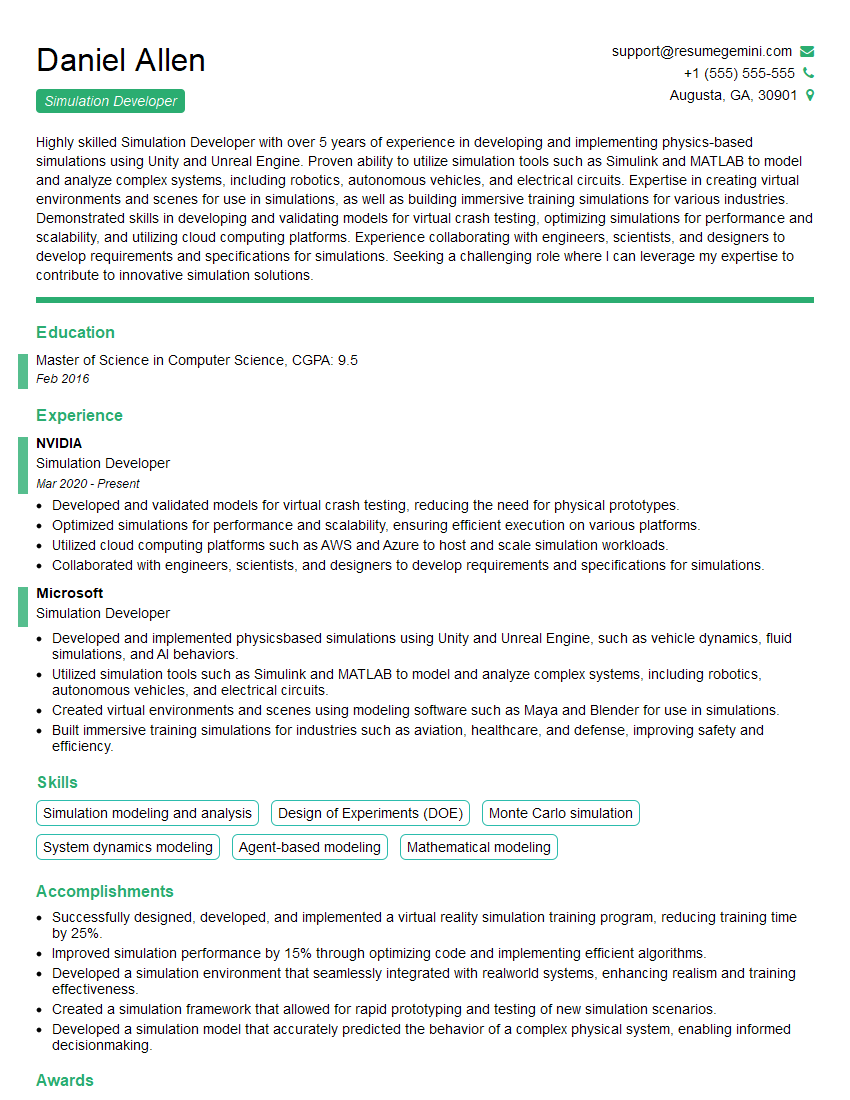
Mastering Software Modeling and Simulation opens doors to exciting and impactful careers in various industries. To significantly enhance your job prospects, create an ATS-friendly resume that highlights your skills and experience effectively. ResumeGemini is a trusted resource to help you build a professional and compelling resume that showcases your expertise in this field. Examples of resumes tailored to Software Modeling and Simulation are available to guide you through the process. Take the next step towards your dream career today!
Explore more articles
Users Rating of Our Blogs
Share Your Experience
We value your feedback! Please rate our content and share your thoughts (optional).
What Readers Say About Our Blog
Really detailed insights and content, thank you for writing this detailed article.
IT gave me an insight and words to use and be able to think of examples