Preparation is the key to success in any interview. In this post, we’ll explore crucial Soldering Silver interview questions and equip you with strategies to craft impactful answers. Whether you’re a beginner or a pro, these tips will elevate your preparation.
Questions Asked in Soldering Silver Interview
Q 1. What types of silver solder are commonly used, and what are their melting points?
Silver solder comes in various alloys, each with a different melting point determined by the proportion of silver, copper, and zinc. Common types include:
- Easy Solder (Low-Temperature): Typically melts around 1300-1350°F (704-732°C). It’s excellent for delicate work or situations where high heat could damage components.
- Medium Solder (Medium-Temperature): Melts around 1350-1450°F (732-788°C). This is a versatile option used in a wide variety of applications.
- Hard Solder (High-Temperature): Melts around 1450-1600°F (788-871°C). Ideal for applications requiring exceptional strength and durability. It often provides a stronger joint than easy or medium solder.
The exact melting point can vary slightly depending on the specific manufacturer and alloy composition. Always consult the manufacturer’s specifications for precise melting point information.
Q 2. Explain the difference between hard, medium, and easy silver solder.
The difference between hard, medium, and easy silver solder lies primarily in their melting points and resulting joint strength. Think of it like this: easy solder is like a low-heat glue, while hard solder is like a high-strength epoxy.
- Easy Solder: Lowest melting point, making it ideal for delicate work, thinner metals, and situations where overheating is a concern. It results in a slightly weaker joint than medium or hard solder.
- Medium Solder: A balance between melting temperature and joint strength, offering a good compromise for many applications. It’s versatile and widely used.
- Hard Solder: Highest melting point, producing the strongest joint. This is crucial for applications where the joint needs to withstand significant stress or high temperatures. However, it requires more precise temperature control and can be more challenging to work with.
The choice of solder depends entirely on the project’s specific requirements. A jeweler making delicate earrings might prefer easy solder, while a blacksmith crafting a heavy-duty gate might opt for hard solder.
Q 3. Describe the proper flux application techniques for silver soldering.
Proper flux application is critical for successful silver soldering. Flux cleans the metal surfaces, preventing oxidation and ensuring proper solder flow. Here’s how:
- Cleanliness is Key: Begin with thoroughly cleaned metal surfaces. Any dirt, grease, or oxides will impede the flux’s effectiveness.
- Apply Thinly: Use a small amount of flux; too much can cause problems. Apply a thin, even coat to the areas where the solder will flow. Think of it as lubrication for the solder.
- Methods: Flux can be applied with a brush, a toothpick, or a specialized flux applicator. A brush is excellent for larger areas, while a toothpick is precise for smaller joints.
- Reapply if Necessary: If you’re working on a complex piece, you might need to reapply flux as needed to prevent oxidation during the soldering process.
Remember, the goal is to create a clean surface for the solder to adhere to. Inadequate flux can lead to poor solder flow and weak joints.
Q 4. How do you prevent oxidation during the silver soldering process?
Oxidation is the enemy of silver soldering. It forms a layer on the metal surfaces, preventing proper solder flow and creating weak, brittle joints. Here’s how to minimize it:
- Use Flux: As mentioned before, flux is the primary defense against oxidation. It chemically cleans the surfaces and protects them from re-oxidation during heating.
- Quick Heating: Heat the metal quickly to the soldering temperature to minimize the time exposed to air and oxidation.
- Controlled Atmosphere: For critical projects, consider soldering in a controlled atmosphere (like a small enclosed area with a slight flow of inert gas) to further reduce oxidation.
- Borax: Borax, a natural flux, can be used in combination with or instead of commercial silver soldering flux.
By implementing these techniques, you ensure the solder flows smoothly and creates strong, reliable joints.
Q 5. What safety precautions are necessary when silver soldering?
Silver soldering involves high temperatures and potentially hazardous materials, so safety is paramount. Always:
- Ventilation: Work in a well-ventilated area to avoid inhaling fumes. A fume extractor is highly recommended.
- Eye Protection: Wear safety glasses or a face shield to protect your eyes from sparks and spatter.
- Heat-Resistant Gloves: Protect your hands from burns with heat-resistant gloves.
- Proper Clothing: Wear clothing that covers exposed skin to minimize the risk of burns.
- Fire Safety: Keep a fire extinguisher nearby and be aware of potential fire hazards.
- Proper Disposal: Dispose of used flux and solder responsibly according to local regulations.
Never compromise on safety. A small injury can quickly derail a project and possibly result in serious consequences.
Q 6. Explain the importance of using the correct torch temperature for silver soldering.
The correct torch temperature is essential for successful silver soldering. Too low, and the solder won’t melt; too high, and you risk overheating the workpiece, weakening it or damaging surrounding components. Here’s the importance:
- Achieving the Right Melt: Each type of silver solder has a specific melting point. The flame needs to reach and maintain that temperature to melt the solder cleanly and consistently.
- Preventing Damage: Overheating can lead to warping, discoloration, or even melting of the workpiece material. A properly controlled flame allows for precise heating and minimizes the risk of damage.
- Consistent Joints: Maintaining the correct temperature ensures a uniform, strong solder joint throughout the workpiece, preventing weak points.
Practice is key to mastering torch temperature control. Start with small test pieces to develop a feel for the heat required for your particular setup and solder type.
Q 7. How do you clean silver solder joints after soldering?
Cleaning silver solder joints is vital to remove flux residue and reveal the finished work’s beauty and quality. Here’s how:
- Pickling: Submerge the soldered piece in a pickling solution (usually a dilute solution of sulfuric or nitric acid). This dissolves the flux residue. Always follow the manufacturer’s instructions and take necessary safety precautions when working with acids.
- Neutralization: After pickling, neutralize the piece by rinsing it thoroughly with water and then baking soda solution to neutralize any remaining acid.
- Brushing/Scraping: Gently brush the joints with a fine wire brush or use a brass brush to remove any remaining residue.
- Polishing (Optional): Depending on the application, polishing might be necessary to achieve the desired finish.
Proper cleaning is essential not just for aesthetics but also to prevent corrosion of the solder joint over time. A thorough cleaning ensures longevity and reliability.
Q 8. Describe your experience with different soldering techniques (e.g., torch soldering, induction soldering).
My experience encompasses a wide range of silver soldering techniques. Torch soldering, my most frequent method, offers precise control over heat application, ideal for intricate pieces. I use both propane and oxygen torches, adjusting the flame size and intensity depending on the project’s scale and the silver’s thickness. Induction soldering, on the other hand, provides faster heating, especially beneficial for larger, heavier pieces or mass production scenarios. It’s crucial to understand the heat transfer characteristics of each technique; for example, torch soldering requires a more delicate touch to avoid overheating the silver, whereas induction soldering necessitates careful control of the induction coil’s position and power settings to prevent uneven heating and potential warping.
I’ve also worked with various fluxing and cleaning processes specific to each technique, ensuring optimal solder flow and joint integrity. For instance, I use different fluxes for different types of silver alloys, and understand how the application method affects solderability. Each technique necessitates different skills and safety precautions, and years of experience have allowed me to master them all, adapt to various scenarios, and optimize my workflows for efficiency and quality.
Q 9. How do you troubleshoot common problems encountered during silver soldering (e.g., cold joints, porosity)?
Troubleshooting is a crucial part of silver soldering. Cold joints, characterized by a weak, unsoldered area, usually stem from insufficient heat, inadequate flux, or a contaminated surface. I address this by re-cleaning the joint surfaces, applying fresh flux, and reheating the area with a focused flame, ensuring the solder flows smoothly and completely. Porosity, small holes in the solder joint, is often due to the presence of oxides or contaminants on the surfaces. This is tackled using thorough cleaning, and sometimes, using a higher-quality flux that is better at removing oxides and impurities. Another common issue is solder bridging, where solder flows between unwanted areas. This typically occurs due to excessive solder or uneven heating; I counteract this by using a smaller amount of solder, precisely controlling the heat application, and perhaps employing a more effective flux to improve the solder flow.
Sometimes, I need to delve into more advanced troubleshooting, such as adjusting the flame temperature and size with the torch or power settings with induction soldering. I also regularly check my equipment for proper functionality to ensure that consistent results are maintained. Prevention is always key: thorough preparation and meticulous attention to detail dramatically reduce the chances of encountering these problems.
Q 10. What are the different types of joints used in silver soldering (e.g., butt, lap, tee)?
Silver soldering utilizes a variety of joints, each selected based on the specific design and mechanical requirements. Butt joints are simple, joining two pieces end-to-end; they require precise alignment for strength. Lap joints overlap two pieces, offering a larger surface area for soldering, thus greater strength. Tee joints connect three pieces in a ‘T’ shape, commonly used for more complex structures. Other joint types include edge joints, where the edges of two components are joined, and corner joints, which connect two components at a corner.
The choice of joint significantly impacts the structural integrity of the finished piece. For example, a butt joint in a high-stress application might require additional reinforcement, whereas a lap joint offers inherent strength due to the larger surface area. Understanding the strengths and weaknesses of each joint is essential for successful silver soldering.
Q 11. How do you determine the appropriate amount of solder to use for a given joint?
Determining the correct solder amount is crucial for creating a strong, aesthetically pleasing joint. Too little solder results in a weak joint, while too much can lead to solder bridges and an unattractive finish. The ideal amount depends on several factors including the joint type, the size of the gap between components, and the silver alloy used. Typically, I use a very small amount – often just enough to create a capillary effect, where the solder flows easily into the gap between two parts through surface tension.
I often use a visual guide: The solder should completely fill the gap, creating a smooth, even joint, but not overflow significantly. Experience plays a significant role here, allowing for a keen sense of judgment about what will be sufficient, preventing waste and improving efficiency.
Q 12. Explain the process of preparing silver components for soldering.
Preparing silver components for soldering is a critical step that directly affects the quality of the final joint. It begins with thorough cleaning. I meticulously remove any dirt, grease, or oxides from the surfaces to be soldered using various methods, including a solvent cleaner followed by a thorough rinsing. This step is essential because contaminants prevent the solder from adhering properly, resulting in weak or porous joints. Next, I flux the pieces, using a suitable flux for the specific silver alloy. Flux helps remove any remaining oxides, protects the metal from oxidation during heating, and improves the flow of the solder.
Often, I use a combination of mechanical and chemical cleaning methods; for example, I might use steel wool for a light cleaning followed by a flux. Finally, I carefully position the pieces in a jig or other suitable holding device, ensuring correct alignment and stability during the soldering process. This preparation dramatically enhances the solderability and makes for a stronger, more reliable joint.
Q 13. How do you handle different types of silver alloys during soldering?
Different silver alloys have varying melting points and soldering characteristics. For example, sterling silver (92.5% silver) has different properties compared to fine silver (99.9% silver) or other silver alloys with different compositions. This requires careful consideration of the solder type and technique. I always match the solder’s melting point to the alloy being soldered; using a solder with a lower melting point minimizes the risk of melting the base metal during the process.
The choice of flux is equally critical. Certain fluxes are better suited for specific silver alloys, so I select appropriately. For instance, some fluxes may not be compatible with certain alloys and could lead to undesirable results, including discoloration. Years of practice have taught me how to adapt my methods to the specific demands of each alloy, choosing the optimal flux, solder, and technique for consistent, high-quality results.
Q 14. What tools and equipment are essential for silver soldering?
Essential tools and equipment for silver soldering include a reliable heat source (propane torch, induction heater), various types of silver solder (selecting the right melting point and alloy is crucial), appropriate fluxes for different silver alloys, a selection of soldering aids like jigs and tweezers for holding pieces securely, a suitable work surface, fire-resistant mat, safety glasses, gloves and adequate ventilation.
Additional tools, depending on complexity, can include a quenching solution (for fast cooling and minimizing warping), pickling solutions (for removing any flux residue), various brushes for cleaning, and different types of files and sandpaper for finishing. Having the right tools and maintaining them properly enhances both safety and the quality of the soldering.
Q 15. Describe your experience with various soldering torches and their applications.
My experience with soldering torches spans several types, each suited to different applications. For delicate work on smaller silver pieces, I prefer a butane micro-torch offering precise flame control. Its smaller flame minimizes heat damage to surrounding areas. For larger projects, a propane torch provides a more powerful and consistent heat source, necessary for quicker heating of thicker silver. I also use an oxygen/acetylene torch for situations needing extremely high temperatures, like joining very thick gauges of silver or working with high-karat gold alloys which have higher melting points. The choice of torch always depends on the scale and complexity of the project; the goal is to apply the precise amount of heat needed to create a strong, clean solder joint without damaging the surrounding metal.
For instance, while making a intricate silver filigree brooch, the butane micro-torch was ideal for controlling heat on tiny solder joints. But when constructing a large sterling silver bowl, the propane torch’s heat efficiency was crucial for a faster, more even heating across the larger surface area.
Career Expert Tips:
- Ace those interviews! Prepare effectively by reviewing the Top 50 Most Common Interview Questions on ResumeGemini.
- Navigate your job search with confidence! Explore a wide range of Career Tips on ResumeGemini. Learn about common challenges and recommendations to overcome them.
- Craft the perfect resume! Master the Art of Resume Writing with ResumeGemini’s guide. Showcase your unique qualifications and achievements effectively.
- Don’t miss out on holiday savings! Build your dream resume with ResumeGemini’s ATS optimized templates.
Q 16. How do you maintain and clean your soldering equipment?
Maintaining soldering equipment is vital for longevity and safety. After each use, I thoroughly clean my torches. For butane torches, this involves carefully wiping down the nozzle to remove any residual solder or flux. Propane and oxygen/acetylene torches require more rigorous cleaning, which may include disassembling parts to remove carbon buildup. This is crucial to prevent clogging and ensure a clean, consistent flame. The cleaning method varies depending on the type of torch and the build-up, but it always involves using appropriate tools, such as brass brushes, to prevent damage to the torch itself.
I also regularly inspect the fuel lines for any cracks or damage and check the gas flow for optimal performance. Regular maintenance prevents potential hazards and ensures the torch is always ready for use. Ignoring maintenance can lead to inconsistent flames, fuel leaks, and potential injury.
Q 17. What is the importance of proper ventilation when silver soldering?
Proper ventilation is paramount when silver soldering because the process produces fumes that are harmful if inhaled. Silver solder fluxes often contain chemicals that, when heated, release toxic gases. These fumes can irritate the respiratory system and, in high concentrations, pose serious health risks. I always work in a well-ventilated area, ideally using a fume extractor hood. If a fume extractor isn’t available, working outdoors or in a room with open windows and good air circulation is essential. Neglecting proper ventilation puts the craftsperson at unnecessary risk of health problems.
I once worked with a colleague who consistently disregarded ventilation guidelines. He suffered repeated bouts of respiratory irritation. This emphasizes the critical need for safe working practices.
Q 18. What are the characteristics of a high-quality silver solder joint?
A high-quality silver solder joint is characterized by several key features. It should be visually smooth and even, with no gaps or porosity. The solder should flow cleanly, completely filling the joint to create a strong and seamless connection. The joint should exhibit a uniform, shiny surface free from discoloration or oxidation which would indicate imperfections in the soldering technique or inadequate cleaning. A good joint also shows proper capillary action – the solder has been drawn evenly into the joint line.
The strength and durability of the joint are also paramount. A well-executed solder joint should withstand the stresses it will face in the finished piece. Testing the strength, while not always practical for every piece, often involves gently flexing the piece to ensure the connection holds.
Q 19. Describe the process of annealing silver before soldering.
Annealing silver before soldering is a crucial step to improve the soldering process. Annealing is the process of heating the silver to a specific temperature and then slowly cooling it. This relieves internal stresses within the metal, which can result from prior shaping or working. These stresses can cause warping or cracking during soldering. The annealing process softens the metal, making it more malleable and easier to solder. It improves the flow of the solder, ensuring a better joint. The optimal annealing temperature for silver depends on the alloy but is typically around 650-700 degrees Celsius.
The process involves heating the silver uniformly to the annealing temperature using a torch or a kiln and then allowing it to cool slowly, often by turning off the heat and allowing it to cool naturally in the furnace or air. Rapid cooling can reintroduce stresses into the metal, negating the benefits of the annealing process.
Q 20. How do you work with intricate designs when silver soldering?
Working with intricate designs when silver soldering requires patience, precision, and specialized techniques. I utilize various methods to mitigate the risk of overheating or damaging delicate features. For instance, I often use small pieces of solder, known as ‘bits’, to target specific areas, minimizing heat exposure. I may solder one section at a time, allowing ample cooling time between soldering operations, to avoid heat transferring through the piece. I also use heat sinks, such as graphite blocks or copper pads, to absorb excess heat away from vulnerable areas. These protect delicate sections from the heat of the soldering process.
Furthermore, using a low-temperature silver solder and a micro-torch facilitates better control during the process. The use of flux, applied judiciously and only on the specific join to be soldered is crucial to ensure controlled solder flow.
Q 21. What are some techniques to prevent solder from flowing where it’s not wanted?
Preventing solder flow where it’s unwanted involves employing several techniques. Firstly, the use of heat sinks, mentioned previously, is crucial. Strategically placing heat sinks diverts the heat away from areas where you don’t want solder to flow. Secondly, precise flame control and application of the soldering material are essential. Small amounts of solder applied very directly are far better than larger amounts applied haphazardly. Thirdly, using masking techniques, like covering unwanted areas with graphite or heat-resistant tape, effectively prevents the solder from spreading. Finally, preparing the pieces meticulously is important. If the solder joints are well-fitted and only the necessary area has flux applied, the solder will only flow where it’s needed.
A good analogy is painting: masking tape prevents paint from going where it shouldn’t; similarly, heat sinks and masking in soldering prevent uncontrolled solder flow.
Q 22. How do you repair a damaged silver solder joint?
Repairing a damaged silver solder joint depends heavily on the nature of the damage. If it’s a simple crack or a small area of separation, you can often reflow the existing solder. This involves carefully cleaning the joint with a suitable flux, applying heat with a torch or soldering iron (choosing the appropriate temperature for your silver solder alloy), and introducing fresh solder to the weakened area. Think of it like patching a crack in a wall – you’re adding material to reinforce the existing structure.
However, if the joint is severely damaged or broken completely, you’ll need to remove the old solder entirely. This usually requires careful application of heat and perhaps a solder sucker or braid to draw the molten solder away. Once clean, you can then prepare the surfaces for a new solder joint, ensuring they’re properly fitted and clean before applying flux and fresh solder. Imagine it’s like rebuilding a wall – you need to remove the damaged section entirely before constructing a new, strong joint.
In both cases, the use of appropriate flux is crucial. The right flux will clean the metal surfaces, ensuring a strong bond. Choosing the correct solder with a suitable melting point is also vital to avoid overheating the components.
Q 23. What are the environmental considerations associated with silver soldering?
Silver soldering, while producing beautiful and strong joints, does have environmental considerations. Primarily, the fluxes used can contain potentially harmful chemicals. Many modern fluxes are designed to be relatively benign, but it’s crucial to work in a well-ventilated area to mitigate inhalation of fumes. Always consult the safety data sheet (SDS) for the specific flux you are using and follow all recommended safety precautions.
Furthermore, the soldering process itself generates fumes and potentially hazardous particles. Proper ventilation is again essential. Consider using a fume extractor to further minimize your exposure to harmful substances. Proper disposal of used flux and solder is also critical, as some components might require special handling.
Finally, remember that silver itself is a precious metal. While the amount used in a single project might be small, responsible sourcing and minimizing waste are important considerations for both economic and environmental reasons.
Q 24. Explain your experience with different types of solder pick-up techniques.
My experience with solder pick-up techniques is extensive, spanning various methods depending on the job. For smaller projects or intricate work, I often employ the ‘dipping’ method, where I briefly dip the soldering iron tip into a small amount of solder. This provides precise control and avoids excess solder.
For larger projects requiring a more substantial amount of solder, I prefer the ‘pre-placed’ technique. I place the solder directly onto the joint before applying heat. This approach allows for better control over the solder flow and ensures complete coverage. It’s especially useful when working on pieces with complex geometries.
The ‘wicking’ method is valuable for repairing broken joints or removing excess solder. A solder wick, a braided copper mesh, is placed on the solder, and heat is applied, causing the molten solder to be absorbed into the wick. This is a highly controlled method for cleaning up and removing unwanted solder.
Finally, the choice of technique also depends on the type of soldering iron or torch being used. For example, a larger torch may lend itself to pre-placed techniques for larger projects, while smaller projects using a fine soldering iron would benefit from the dipping method.
Q 25. How do you ensure the structural integrity of soldered silver components?
Ensuring structural integrity in soldered silver components requires meticulous attention to detail at every stage of the process. This begins with proper joint design. A well-designed joint should have sufficient surface area to provide ample strength. Overlapping components, creating a mechanical joint in addition to the soldered one, significantly increases durability.
The cleanliness of the components is paramount. Any oxides or contaminants on the silver surfaces will prevent a strong solder bond. Thorough cleaning with appropriate solvents and the use of a suitable flux are essential. I often use ultrasonic cleaning for intricate or hard-to-reach areas.
Proper heating is also crucial. The components must be heated evenly to achieve a uniform solder flow and avoid uneven stress points that could compromise the joint’s strength. Overheating, however, can damage the components themselves. Experienced control of the heat source is key.
Finally, post-soldering inspection is critical. After the joint has cooled, a careful visual inspection should be performed to ensure the solder has flowed properly and fully covered the joint. If there are any defects, it’s better to correct them rather than risk structural failure in the future.
Q 26. What are your preferred methods for evaluating the quality of your silver soldering work?
Evaluating the quality of my silver soldering work involves a multi-faceted approach. Visual inspection is the first step. I look for a smooth, continuous solder fillet, free of voids or cracks. The fillet should be evenly distributed around the joint, indicating consistent heat application and good solder flow. A dull or uneven finish might signal insufficient heat or inadequate cleaning.
Beyond visual inspection, I often perform a strength test, though the approach depends on the application. For jewellery, a gentle bend or twist test can reveal any weakness in the joint. For more robust applications, I may use specialized testing equipment to determine the joint’s tensile strength.
Lastly, a crucial aspect of quality control is documentation. I maintain detailed records of my work, including the materials used, the soldering techniques employed, and any observations made during the process. This meticulous approach allows me to track my work, identify any potential problems, and continuously refine my technique.
Q 27. How would you handle a soldering job with a tight deadline?
Handling a soldering job with a tight deadline requires efficient planning and execution. Firstly, I’d thoroughly review the project requirements and identify any potential bottlenecks. A clear understanding of the scope of work helps to prioritize tasks and allocate time effectively. It’s similar to planning a complex recipe; you need to lay out each ingredient and step.
Secondly, I’d optimize my workflow. This might involve using faster techniques where appropriate or breaking down complex tasks into smaller, more manageable units. This approach prevents mistakes arising from rushing. It’s akin to assembling a piece of furniture, focusing on one section at a time.
Thirdly, I’d prioritize quality over speed. While the deadline is important, cutting corners can lead to defects that ultimately increase the completion time. By maintaining a high standard of work, I can minimize errors, allowing me to finish the job on time and to a high standard of quality.
Communication is also key. If I encounter unforeseen difficulties, I’ll communicate with the client proactively to manage their expectations.
Q 28. Describe a time you had to troubleshoot a complex soldering problem.
I once encountered a challenging problem while soldering a complex silver mechanism for a vintage clock. The intricacy of the design made it difficult to achieve even heat distribution, resulting in inconsistent solder flow and weak joints. Several attempts resulted in unsuccessful solder joints and damaged components.
To solve this, I first analyzed the problem systematically. I identified uneven heat distribution as the root cause. I then experimented with different heat sources and application techniques. I found that using a smaller, more focused flame allowed me to precisely control the heat. Using a micro torch also helped in heating the parts evenly.
Further, I adjusted my soldering position and incorporated the use of heat sinks to protect sensitive nearby components from overheating. This allowed for a far more controlled and precise application of heat. After implementing these changes, I successfully completed the soldering, resulting in strong and well-formed joints.
This experience reinforced the importance of systematic troubleshooting, adaptability, and the need to explore different approaches when faced with complex problems. The ability to calmly assess the situation, experiment with solutions, and learn from failures is crucial in this field.
Key Topics to Learn for Your Soldering Silver Interview
- Fundamentals of Silver Soldering: Understanding the different types of silver solder (e.g., hard, medium, easy), their melting points, and appropriate flux choices.
- Joint Design and Preparation: Mastering techniques for creating strong, visually appealing, and leak-proof soldered joints. This includes proper fitting, cleaning, and preparation of the metal pieces before soldering.
- Soldering Techniques: Proficiency in various soldering methods (e.g., torch soldering, induction soldering) and understanding the importance of controlled heat application and proper filler metal flow.
- Flux Selection and Application: Knowing how to select the right flux for different applications and understanding its role in removing oxides and promoting good solder flow.
- Safety Procedures and Precautions: Thorough understanding of safety protocols including proper ventilation, eye protection, and handling of potentially hazardous materials.
- Troubleshooting Common Issues: Identifying and resolving problems such as cold joints, porous joints, and solder bridging. Developing a systematic approach to diagnosing and fixing soldering defects.
- Material Selection and Compatibility: Understanding the properties of various metals and alloys commonly used in conjunction with silver soldering and their impact on the soldering process.
- Post-Soldering Finishing Techniques: Knowing how to clean and finish soldered joints to achieve a professional and aesthetically pleasing outcome. This might include techniques like filing, polishing, and pickling.
- Practical Applications and Case Studies: Being able to discuss real-world applications of silver soldering, such as jewelry making, metal fabrication, and repair work. Demonstrating understanding through examples.
Next Steps
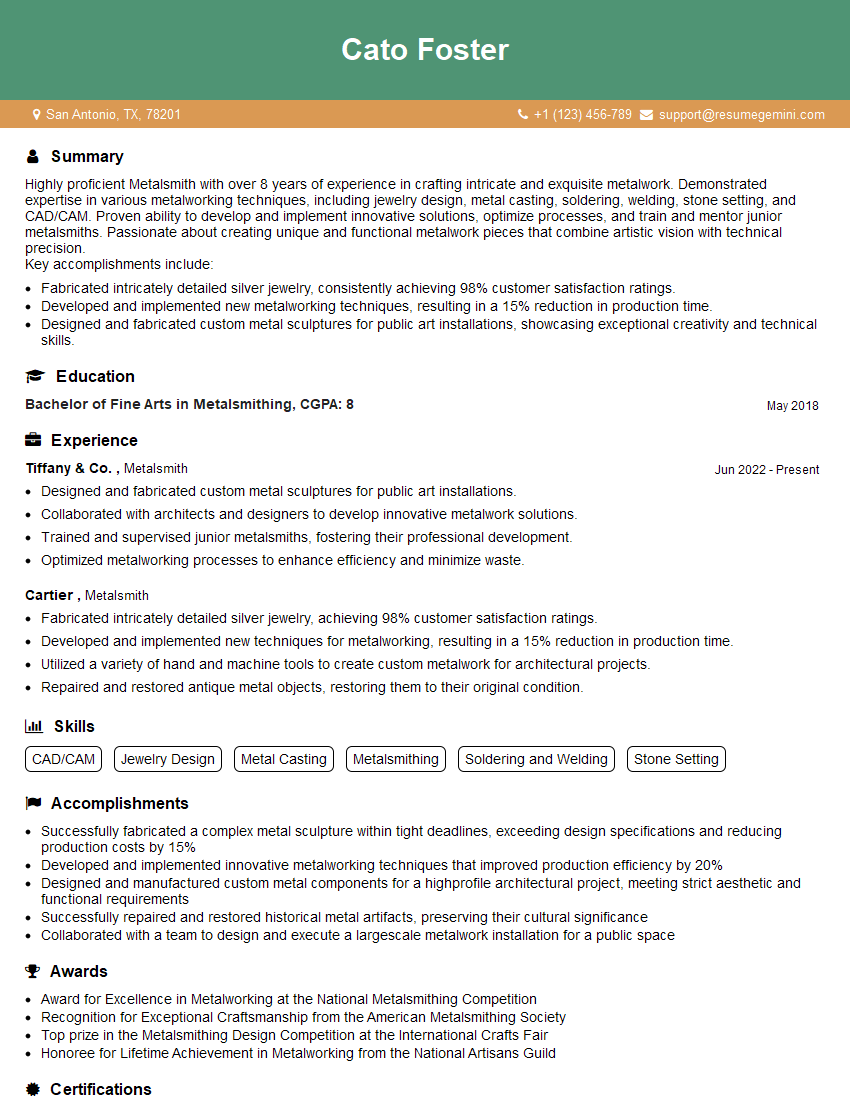
Mastering silver soldering opens doors to exciting opportunities in various skilled trades and artistic pursuits. To significantly boost your job prospects, crafting an ATS-friendly resume is crucial. ResumeGemini is a trusted resource to help you build a professional and impactful resume that highlights your skills and experience effectively. ResumeGemini provides examples of resumes tailored to the silver soldering field, allowing you to learn best practices and tailor your own resume for success. Take the next step towards your dream career – create a standout resume with ResumeGemini today.


Explore more articles
Users Rating of Our Blogs
Share Your Experience
We value your feedback! Please rate our content and share your thoughts (optional).
What Readers Say About Our Blog
Really detailed insights and content, thank you for writing this detailed article.
IT gave me an insight and words to use and be able to think of examples