Feeling uncertain about what to expect in your upcoming interview? We’ve got you covered! This blog highlights the most important Sound Design for Animation interview questions and provides actionable advice to help you stand out as the ideal candidate. Let’s pave the way for your success.
Questions Asked in Sound Design for Animation Interview
Q 1. Explain your workflow for designing sound effects for a cartoon character.
My workflow for designing sound effects for a cartoon character is a multi-stage process, blending creativity with technical precision. It begins with a thorough understanding of the character’s personality and the director’s vision.
- Character Analysis: I study the character’s animation, paying close attention to their movements, expressions, and overall demeanor. Is the character clumsy, graceful, mischievous, or heroic? This dictates the sonic palette I’ll use.
- Sound Design Brainstorming: I brainstorm a range of sound effect ideas, considering both realistic and fantastical options. For instance, a heavy character might have weighty footsteps created with layered recordings of boots on various surfaces, while a spritely character might have lighter, more playful sounds created with springs or small bells.
- Sound Recording & Manipulation: I use a combination of field recording (capturing real-world sounds) and sound synthesis (creating sounds digitally) to build the character’s sound library. This might include recording the sounds of different materials impacting each other to create impact sounds, or using synthesizers to create whimsical sounds for magical abilities.
- Sound Editing and Layering: Once I have a library of sounds, I carefully edit and layer them to create the final sound effect. This involves adjusting volume, pitch, panning, and adding reverb or other effects to create depth and realism.
- Iteration and Refinement: I consistently review the sound design within the context of the animation, making adjustments as needed. This iterative process is crucial for achieving the perfect blend of visual and auditory storytelling.
For example, for a character tripping, I might layer the sound of a small thud, a surprised gasp (possibly using a vocal sample), and perhaps a slightly comedic ‘boing’ sound from a spring to create a playful yet realistic effect.
Q 2. Describe your experience with Foley recording and its application in animation.
Foley recording is the process of recreating everyday sounds in sync with picture. It’s invaluable in animation, adding a layer of realism and detail that elevates the viewing experience beyond what’s visually presented. My experience with Foley is extensive, having worked on numerous projects where Foley artists carefully reproduce the sounds of footsteps, clothing rustling, object impacts, and much more in a soundproof studio.
In animation, Foley is particularly useful for enhancing character movement. For example, instead of using generic ‘footstep’ sound effects, we might use Foley to capture the specific sound of a character’s shoes on different surfaces (carpet, wood, gravel). This level of detail helps to ground the animation, making it feel more tangible and immersive.
One project I worked on involved a character running through a forest. Instead of relying solely on pre-recorded sound effects, we had a Foley artist create the sound of feet crunching on leaves, branches snapping, and the character’s clothing brushing against trees. This resulted in a far more immersive and authentic auditory experience.
Q 3. How do you approach creating a soundscape that enhances the emotional impact of a scene?
Creating a soundscape that amplifies a scene’s emotional impact requires a nuanced approach. It’s about aligning sound design choices with the narrative and emotional arc.
- Identifying the Emotion: The first step is to pinpoint the exact emotion the scene intends to evoke – fear, joy, sadness, suspense, etc.
- Sound Palette Selection: I select a sound palette that complements the emotion. High-pitched, dissonant sounds can create tension, while warm, low-frequency sounds can evoke comfort.
- Dynamic Range: The use of dynamic range is crucial; subtle shifts in volume and intensity can reflect the emotional arc. For example, a gradual crescendo in sound can build suspense effectively.
- Sound Textures: Utilizing specific sonic textures can powerfully impact the emotional landscape. Harsh, metallic sounds evoke danger, while soft, organic sounds can create a sense of peace.
- Musical Underscoring: Music plays a critical role in shaping emotion. The music and sound effects should complement each other to build a holistic emotional impact.
For a scene depicting a character facing a terrifying creature, I might utilize low rumbles, echoing whispers, and high-pitched screeches alongside a tense musical score to heighten the feeling of fear and dread.
Q 4. What software and hardware are you proficient in for animation sound design?
My proficiency spans a wide range of software and hardware. Software-wise, I’m highly skilled in digital audio workstations (DAWs) like Pro Tools and Logic Pro X. I also leverage sound design software such as Sound Forge for editing and processing, and I use various synthesizers, such as Native Instruments Kontakt and Spectrasonics Omnisphere, for creating unique sounds.
My hardware includes a high-quality audio interface (Focusrite Scarlett), studio monitors (Yamaha HS8), a selection of microphones (for field recordings and voice work), and a collection of percussion instruments and other sound-making objects for Foley work. I also utilize a high-performance computer capable of handling large audio files and complex processing tasks.
Q 5. How do you handle feedback and revisions on your sound design work?
Handling feedback and revisions is a critical part of the sound design process. I approach it collaboratively, viewing feedback as an opportunity to refine and enhance the audio.
- Active Listening: I carefully listen to any feedback provided, striving to understand the perspective and concerns of the director, producer, or other stakeholders.
- Clarification: If needed, I ask clarifying questions to ensure I fully grasp the feedback and its intended impact.
- Implementation: I implement the requested changes, meticulously documenting any adjustments made.
- Iteration and Testing: I often iterate and test the revisions within the context of the animation to assess their effectiveness.
- Communication: I maintain open and consistent communication throughout the revision process, updating stakeholders on progress and sharing revised audio for approval.
My aim is to ensure the final product not only meets but exceeds expectations.
Q 6. Describe your experience with ADR (Automated Dialogue Replacement).
ADR, or Automated Dialogue Replacement, is the process of re-recording dialogue in a studio setting after filming or animation is complete. My experience with ADR encompasses working closely with voice actors to ensure the dialogue seamlessly integrates with the visual performance. It’s a crucial process for refining dialogue delivery, removing background noise, or addressing issues that may have arisen during initial recording.
I ensure the ADR sessions are well-organized, with clear cues and reference tracks. I also have the technical expertise to handle synchronization and audio mixing to ensure smooth transitions between the ADR and original footage. Communication and collaboration are key; I work closely with the voice actors to maintain the performance’s natural flow and emotional tone.
Q 7. How do you balance sound effects and music to create a cohesive audio experience?
Balancing sound effects and music in animation requires careful consideration to create a cohesive audio experience. The goal is not to have them compete but rather to complement and enhance each other.
- Frequency Balancing: I avoid overlapping frequencies between sound effects and music to prevent muddiness and clarity issues. For example, music might occupy lower frequencies, while sound effects occupy the mid and high frequencies.
- Dynamic Contrast: I use dynamic contrast to create a sense of ebb and flow between sound effects and music. During action scenes, the sound effects might take prominence, while during quieter moments, the music can take center stage.
- Timing and Rhythmic Alignment: I consider the timing of both music and sound effects, ensuring they align rhythmically to support the pacing of the scene.
- Emotional Synergy: The music and sound effects should work in unison to amplify the emotional impact of the scene. They are integral parts of the overall narrative, and should not clash in mood or tone.
A good analogy is a chef meticulously balancing flavors in a dish. Each element contributes to the overall taste, none overpowering the others.
Q 8. Explain your approach to designing sound for different animation styles (e.g., 2D, 3D, stop-motion).
My approach to sound design varies significantly depending on the animation style. Each style demands a unique sonic palette and approach to sound manipulation.
- 2D Animation: Often leans towards a more stylized and expressive approach. I might use cartoonish sound effects, exaggerated Foley, and a musical score that’s clearly defined and perhaps even slightly over-the-top. Think of the classic Looney Tunes – the exaggerated ‘boings’ and ‘thwacks’ are quintessential examples. I’d focus on clarity and impact, making sure every sound is easily understood, even with limited budget or resources.
- 3D Animation: Allows for a higher degree of realism and detail. While stylization is still an option, I tend to prioritize creating a believable soundscape. This involves incorporating realistic ambient sounds, meticulously crafted Foley work, and a score that subtly integrates with the narrative. Imagine a Pixar film – the sounds are often incredibly detailed, contributing immensely to the immersion and emotional connection.
- Stop-Motion Animation: Often benefits from a tactile and slightly ‘rougher’ sound design. I might use recordings of real-world materials and manipulate them to enhance the stop-motion’s inherent charm. This tactile feel is crucial. The sounds are often closely tied to the physicality of the puppets or objects, allowing the audience to appreciate the craftmanship.
In all cases, I prioritize close collaboration with the director and visual artists to ensure the sounds seamlessly integrate with the overall aesthetic and storytelling.
Q 9. How do you manage large audio projects and maintain organization?
Managing large audio projects requires meticulous organization. My workflow involves a combination of digital asset management (DAM) systems and a robust folder structure. I use a project-specific naming convention for all audio files (Project_Name_Scene_SFX_001.wav, for example) to avoid confusion. I also rely heavily on metadata tagging, ensuring each sound effect is accurately described and categorized (e.g., ‘footsteps_gravel_run’).
Furthermore, I leverage DAW (Digital Audio Workstation) features like track grouping and color-coding to maintain clarity within complex sessions. Version control is crucial; I regularly save backups and use collaborative platforms like Dropbox or Google Drive to allow seamless access for the team.
Regular communication with the team is key. We use daily or weekly check-ins to keep everyone updated on progress and address any potential roadblocks.
Q 10. Describe your experience with sound design for different genres of animation (e.g., comedy, drama, action).
My experience spans various animation genres, and each demands a tailored approach. The sonic landscape drastically changes depending on the story being told.
- Comedy: Requires exaggerated sounds and often employs comedic timing. Think slapstick sounds, exaggerated Foley, and a whimsical score. The emphasis is on creating a humorous response from the viewer.
- Drama: Demands subtlety and nuance. The sounds should enhance the emotional tone and build tension or suspense. This often involves ambient soundscapes, carefully chosen musical cues, and realistic or understated sound effects. The focus is on creating emotional resonance.
- Action: Typically uses impactful and explosive sounds, with an emphasis on high-energy effects. The sonic elements directly support and heighten the visual action sequence. Expect a fast-paced score, combined with powerful sound effects.
The key is adapting my techniques to create an effective sonic environment that complements each genre’s inherent characteristics.
Q 11. How do you ensure your sound design complements the visual elements of the animation?
Sound design shouldn’t just exist alongside animation; it should elevate it. I approach this by focusing on two key aspects: visual storytelling and emotional resonance.
Visual Storytelling: I carefully listen to the picture to understand the visual cues. If a character is running, the sounds of their feet striking the ground must precisely match the pace and surface. Similarly, the sounds of objects interacting should realistically mirror what the audience sees. This careful synchronization helps in creating a cohesive and believable experience.
Emotional Resonance: Sound can profoundly impact the emotional weight of a scene. A melancholic scene might benefit from low-frequency sounds and a wistful score; a thrilling chase scene might benefit from high-frequency sounds and a fast-paced, intense score. Understanding the emotional trajectory of the animation informs the sound design choices.
The interplay between these two elements creates a powerful synergy between the visual and auditory experiences.
Q 12. Explain your process for creating realistic or stylized sound effects.
Creating realistic or stylized sound effects relies on a combination of recording, processing, and synthesis. The approach varies depending on the desired outcome.
- Realistic Sound Effects: This often involves recording real-world sounds and then manipulating them through techniques such as equalization (EQ), compression, and reverb. For example, recording the sound of a door creaking and enhancing it with a slight reverb to create an atmospheric effect is a common approach. Using field recordings offers a great foundation for realistic sounds.
- Stylized Sound Effects: This often involves using sound synthesis, manipulating existing recordings in creative ways, or combining both approaches. I might use a synthesizer to generate a specific sound, and then process it to create an exaggerated effect. For instance, a cartoonish ‘boing’ spring sound could be achieved this way. This often involves experimentation and creative layering.
In both instances, I continuously iterate, listening back and refining my creations until they precisely match the scene’s requirements. It’s a balance between finding or creating a suitable base sound and then shaping it to perfection.
Q 13. How do you collaborate effectively with other members of the animation production team?
Collaboration is paramount in animation. I actively participate in regular screenings and feedback sessions with the director, animators, composers, and other sound designers. This early and consistent communication is vital. I provide early sound design drafts and seek their feedback, making necessary adjustments based on their input.
Clear communication channels are essential. We utilize project management software to track progress, share files, and leave comments. Constructive criticism is embraced as a way to refine the sound design and enhance the overall experience.
I find active listening and a willingness to compromise are key to successful collaboration. It’s not just about contributing my expertise; it’s also about understanding and integrating the visions of others.
Q 14. Describe your experience working with different audio formats and codecs.
My experience encompasses a broad range of audio formats and codecs. I’m proficient in working with various file formats, including WAV, AIFF, MP3, and Ogg Vorbis. The choice of format often depends on the specific requirements of the project and the delivery platform.
Understanding codecs is crucial for optimizing file size and audio quality. I routinely work with lossless codecs (like WAV and AIFF) during the production process to preserve audio fidelity, and then consider lossy codecs (like MP3) for delivery when necessary, balancing audio quality with file size efficiency. The project’s needs will determine the best choice.
My familiarity with different audio formats and codecs ensures seamless integration within various production pipelines and efficient delivery for different platforms.
Q 15. How do you troubleshoot common audio problems during post-production?
Troubleshooting audio problems in post-production is a crucial part of animation sound design. It’s like being a detective, systematically investigating the source of the issue. My approach involves a layered investigation, starting with the most obvious and moving towards the more complex.
- Listening Carefully: The first step is always to listen attentively to pinpoint the problem. Is it a lack of clarity, distracting noise, inconsistencies in levels, or something else? This initial auditory analysis guides the next steps.
- Checking Levels: I meticulously check audio levels throughout the sequence. Are there any clipping issues (peaks exceeding 0dBFS)? Are dialogue, sound effects, and music balanced properly? I often use a visual waveform analyzer to help me identify these issues.
- Analyzing the Source: I then trace the problem back to its source. Is the issue with the original recording (e.g., microphone placement, background noise), the editing process (e.g., incorrect fades, unintended cuts), or the mixing stage (e.g., conflicting frequencies, phase cancellation)?
- Using EQ and Compression: Once identified, I use tools like equalization (EQ) to sculpt the frequency response and reduce unwanted frequencies. Compression can tame dynamic range and prevent loud sounds from overwhelming quieter ones. For example, I might use a de-esser to reduce harsh sibilance in dialogue.
- Noise Reduction: To address unwanted background noise, I employ noise reduction plugins. Careful application is key to avoid artifacts or a ‘muddied’ sound. This requires listening critically to ensure effective noise reduction while retaining the integrity of the audio.
- Collaboration: If I’m still unable to resolve a problem, I’ll collaborate with the sound editor or director to discuss potential solutions and potentially re-record or re-edit parts of the audio.
For instance, on a recent project, I discovered a low-frequency rumble that was only apparent in one specific scene. By carefully analyzing the waveforms, I determined the rumble was coming from a poorly recorded foley track. Instead of trying to fix it in post, we rerecorded the foley, achieving a cleaner, more professional result.
Career Expert Tips:
- Ace those interviews! Prepare effectively by reviewing the Top 50 Most Common Interview Questions on ResumeGemini.
- Navigate your job search with confidence! Explore a wide range of Career Tips on ResumeGemini. Learn about common challenges and recommendations to overcome them.
- Craft the perfect resume! Master the Art of Resume Writing with ResumeGemini’s guide. Showcase your unique qualifications and achievements effectively.
- Don’t miss out on holiday savings! Build your dream resume with ResumeGemini’s ATS optimized templates.
Q 16. What is your experience with spatial audio design?
Spatial audio design is increasingly important in animation, particularly with the rise of immersive audio formats like Dolby Atmos. My experience involves creating soundscapes that leverage the three-dimensional space around the listener. This goes beyond the traditional left and right channels.
I utilize techniques like panning, reverb, and delay to position sounds within a virtual space, making the auditory experience more realistic and engaging. For instance, I might place a helicopter sound directly overhead, using height channels to create a sense of presence, and then subtly pan it to move across the virtual environment. This gives the listener the illusion of being in the midst of the action.
I’m proficient in using immersive audio software and understand the principles of binaural recording and spatial audio mixing. This allows me to create more impactful soundscapes, placing the viewer directly into the story. I am comfortable using different object-based audio workflows, designing and implementing sounds that can move and change location throughout a scene in a truly three-dimensional environment.
Q 17. How do you maintain consistent sound quality throughout an animation project?
Maintaining consistent sound quality throughout an animation project requires meticulous planning and execution. This is achieved through a combination of technical and procedural elements.
- Setting a Sound Style Guide: Early in the project, establishing a detailed style guide that dictates the overall sound approach is vital. This includes aspects like general tonal range, preferred sound effects libraries, and guidelines for the use of music and foley.
- Reference Tracks: I consistently use reference tracks—high-quality audio examples of the desired sound—to guide my decisions. This provides a clear benchmark for quality and helps ensure consistency. This allows me and my team to assess the quality of our work objectively.
- Template Sessions: Using session templates within my DAW (Digital Audio Workstation) helps streamline the workflow and maintain uniformity in audio settings, ensuring consistent levels, panning, and effects processing across different scenes.
- Regular Monitoring: Frequent listening sessions during the project are crucial for identifying any deviations from the established sound design standards. I regularly check for consistency in volume levels, sound effects, and music integration to catch any subtle discrepancies early on.
- Version Control: Implementing a system of version control allows me to track changes and easily revert to previous versions if needed, preventing inadvertent overwriting or loss of data, preserving the integrity of the project’s soundscape.
Imagine an animated film with diverse locations: a bustling city, a quiet forest, and an underwater scene. Maintaining consistency involves ensuring a unified sonic identity while allowing each environment to have its unique characteristics. Consistent mixing, and using reference tracks for each location allow for a smooth sonic transition between these differing environments.
Q 18. What strategies do you use to manage your time effectively during demanding deadlines?
Managing time effectively under tight deadlines in animation sound design demands a structured approach. It’s akin to conducting a well-orchestrated symphony.
- Detailed Planning: I start with a comprehensive project plan, breaking down the entire sound design process into manageable tasks with realistic timelines. This includes estimating the time needed for each task and allocating resources effectively.
- Prioritization: I prioritize tasks based on their urgency and impact. Critical scenes and key sound elements are handled first to ensure timely completion of essential components.
- Time Blocking: I employ time blocking techniques, scheduling specific times for focused work on particular tasks. This helps maintain concentration and minimizes distractions. I often segment this into working blocks punctuated by short breaks.
- Efficient Workflow: Utilizing efficient workflows within my DAW is essential. I use keyboard shortcuts, automation, and templates to streamline tasks and minimize repetitive actions.
- Communication: Open and consistent communication with the team is crucial. This helps identify potential bottlenecks early on and ensures everyone is aligned on timelines and priorities. Proactive communication avoids misunderstandings and delays.
- Automation & Batch Processing: Using automation and batch processing for repetitive tasks (e.g., applying effects to multiple sound files) helps save significant time.
For example, I recently worked on a project with a very tight deadline. By meticulously planning, prioritizing, and using time-blocking techniques, I was able to deliver high-quality sound design well within the allocated timeframe, exceeding expectations.
Q 19. Describe your understanding of sound design principles like rhythm, pitch, and timbre.
Sound design principles like rhythm, pitch, and timbre are fundamental to creating engaging and effective animation sound. They’re the building blocks of an auditory experience.
- Rhythm: This refers to the pattern of sounds over time. A fast, repetitive rhythm might create a sense of urgency or excitement, while a slower, more irregular rhythm could convey calmness or suspense. Think of the rhythmic pounding of a drum during a chase scene versus the slow, deliberate plucking of a guitar during a quiet moment.
- Pitch: Pitch describes the perceived highness or lowness of a sound. High pitches can sound sharp, bright, or even aggressive, while low pitches can be deep, resonant, or even ominous. For example, a high-pitched squeak might indicate a small creature, while a low growl might signal a large, menacing one.
- Timbre: Timbre is the quality of a sound that distinguishes it from other sounds of the same pitch and loudness. It’s what makes a trumpet sound different from a clarinet, even when they play the same note. In animation, timbre contributes significantly to the character of the sounds and their emotional impact. A harsh, metallic timbre might suit a robot, while a warm, woody timbre might be perfect for a fantasy setting.
These three elements often interweave to shape the overall sonic landscape. Consider a scene with a character walking through a forest: the rhythmic crunching of leaves underfoot (rhythm), combined with the low, resonant hum of the wind (pitch and timbre), creates a specific atmosphere and mood.
Q 20. How do you use sound to create specific moods and atmospheres in animation?
Sound is a powerful tool for establishing mood and atmosphere in animation. It can be as crucial as the visuals themselves. I strategically employ various sonic elements to evoke specific feelings and environments.
- Music: The choice of music plays a dominant role in setting the overall tone and mood of a scene. A happy, upbeat soundtrack contrasts sharply with a dark, melancholic one.
- Sound Effects: Carefully selected sound effects can enhance the emotional impact. The sound of rain can convey sadness or loneliness, while the sound of birds chirping can evoke feelings of peace and tranquility.
- Ambient Sounds: Layering ambient sounds (e.g., wind, waves, city noises) helps to establish a realistic and immersive environment. The absence of ambient sounds can also be used for a powerful effect, highlighting silence and tension.
- Dynamic Range: The dynamic range, the difference between the loudest and quietest sounds, can significantly affect mood. A wide dynamic range can add drama, while a compressed dynamic range can create a sense of claustrophobia or heightened intensity.
- Sound Design Choices: The specific sonic choices – the timbre, pitch, and rhythm – all contribute to the overall feel. For example, sharp, metallic sounds might be used for a dystopian future, whereas warm, organic sounds might suit a magical setting.
In a particular scene featuring a character facing a perilous situation, I might use low-pitched, ominous music combined with the creaking of old wood and distant whispers to create an atmosphere of unease and suspense.
Q 21. What are some common challenges you face in animation sound design, and how do you overcome them?
Animation sound design presents unique challenges. These often require creative problem-solving and adaptability.
- Synchronization: Precise synchronization of sounds with visuals can be intricate, especially in fast-paced scenes. This requires careful attention to detail and often involves iterative adjustments.
- Limited Source Material: Sometimes, obtaining high-quality source material for specific sound effects can be difficult. This often involves creative sound design techniques like layering, manipulating existing sounds, or even resorting to creative foley work.
- Balancing Clarity and Realism: Striking a balance between sonic realism and clarity can be challenging. Overly realistic sounds can sometimes be muddled, while overly processed sounds may lack emotional impact. This requires a nuanced approach.
- Working with Revisions: Animation projects often involve multiple rounds of revisions, impacting the sound design. Adapting to these changes requires flexibility and the ability to quickly iterate and implement revisions.
- Collaboration: Effectively collaborating with other team members—directors, animators, composers—is crucial to ensure the sound design aligns with the overall vision. Clear communication and shared understanding are vital.
To overcome these challenges, I use a combination of planning, creative problem-solving, and efficient workflow techniques. I rely heavily on collaborative communication and flexible adaptation to the project’s needs. For example, when facing a lack of suitable source material, I might create a new sound effect using synthesis and sound manipulation techniques.
Q 22. Explain your knowledge of different microphone techniques for recording sound effects.
Microphone technique is crucial for capturing high-quality sound effects. The choice of microphone depends heavily on the desired sound and the environment. For example, a highly directional microphone like a shotgun mic is ideal for isolating specific sounds on a film set, minimizing background noise. This is perfect for capturing the precise sound of a sword clashing or a door creaking. Conversely, a more omnidirectional microphone, like a cardioid condenser, might be used to capture a more ambient soundscape, such as the bustling atmosphere of a city street, capturing a wider range of sounds to build a richer environment.
Shotgun Microphones: These are excellent for isolating sounds from a distance, reducing unwanted ambient noise. Think of recording the sound of a distant train or the squawk of a bird high in a tree.
Cardioid Condenser Microphones: These offer a balance between directionality and ambient pickup. They’re great for recording dialogue or capturing detailed sounds in a relatively controlled environment, like footsteps on different surfaces.
Omnidirectional Microphones: These pick up sound equally from all directions, making them ideal for capturing a room’s ambience or creating a full, immersive soundscape. Think of a busy marketplace or a vast forest.
Contact Microphones: These are used for very close-up, detailed sounds, such as the metallic clang of a hammer hitting an anvil or the subtle creak of wood. This is often used in Foley recording.
Beyond microphone type, microphone placement is key. Experimenting with distance, angle, and the use of reflectors or baffles greatly influences the final sound. A simple change in microphone placement can drastically alter the character of a sound.
Q 23. How do you incorporate audience expectations into your sound design choices?
Understanding audience expectations is paramount. Sound design isn’t just about creating good sounds; it’s about creating sounds that enhance the storytelling and resonate with the intended audience. For instance, a children’s cartoon will require brighter, more playful sound effects than a gritty, realistic war film.
If the animation is a horror film, for example, the audience expects specific sound cues to heighten tension and fear. This could include distorted sounds, unsettling ambience, or strategically placed silences. In contrast, a comedic animation may employ slapstick sound effects with exaggerated timing and pitch to create a humorous effect. I analyze the script, style guide, and target demographic to establish a clear understanding of the emotional tone and genre before making any design choices.
Ultimately, I strive for a balance between subverting expectations in creative ways (using unusual sounds for familiar actions) and fulfilling them (creating clear and recognizable sound cues for important moments).
Q 24. Describe your experience with creating sound design for specific target audiences.
I’ve worked on projects targeting various audiences, each demanding a different approach. For instance, a children’s show demanded bright, cheerful sounds – high-pitched, playful music, and exaggerated sound effects that wouldn’t be scary or confusing to young viewers. This included a lot of Foley work with playful, exaggerated sounds.
In contrast, a project targeting young adults required a more nuanced sound design, incorporating subtle sonic details to create atmospheric depth and emotional resonance. The music choice needed to reflect this targeted audience more appropriately, incorporating potentially more mature themes.
Adapting to different age groups, cultures, and emotional responses informs every aspect of the design, from music selection and sound effect choices to mixing and mastering techniques. The key is research and a thorough understanding of the audience’s sensibilities.
Q 25. How do you adapt your sound design approach based on the project’s budget and timeline?
Budget and timeline heavily influence my approach. A high-budget project allows for extensive field recording, custom music composition, and elaborate sound design techniques. For example, recording original Foley sound effects for every action on set. In such a scenario, we might bring in a full Foley stage. Conversely, a low-budget project necessitates creative problem-solving. I might rely more on sound libraries, clever sound manipulation techniques, and efficient workflows to achieve similar results.
Tight deadlines demand a highly organized approach with pre-planning of sound design elements and effective use of time-saving tools and techniques, such as utilizing readily available sound libraries where appropriate.
In both cases, communication is vital. I collaborate closely with the director and producers to manage expectations, prioritizing essential sounds and creatively optimizing resources.
Q 26. What is your understanding of copyright and licensing regarding sound effects and music?
Copyright and licensing are crucial aspects of sound design. Using copyrighted material without permission is illegal and could lead to significant legal issues. I always ensure that I obtain the necessary licenses and permissions before using any sound effects or music in my projects. For example, I would procure a license for royalty-free sounds from a reputable stock music library to ensure legal compliance.
I meticulously track all sound effect and music sources, maintaining detailed records of licenses acquired. This documentation is essential to avoid any legal issues down the line. When necessary, I’ll create my original compositions and sound effects from scratch. This not only avoids copyright issues but allows for greater creative control.
Q 27. How do you stay current with trends and innovations in animation sound design?
Staying current in animation sound design involves continuous learning. I actively participate in online communities, attend industry conferences, and follow leading sound designers on social media to discover the latest techniques and trends. This includes keeping abreast of new software advancements and exploring novel sound design workflows.
Experimentation is key. I regularly try out new plugins, sound design techniques, and approaches, always looking for ways to enhance my skills and create innovative sounds. Exploring different genres of music and soundscapes expands my creative palette and enables me to bring fresh ideas to my projects.
I also actively review recent animated films and shows to analyze current trends in sound design and how others are pushing the boundaries of the craft.
Q 28. Describe your approach to building and maintaining professional relationships in the animation industry.
Building and maintaining professional relationships is crucial in this collaborative industry. I always strive to be professional, reliable, and communicative. I actively network with fellow sound designers, composers, and other professionals in the animation field, attending industry events and participating in online forums.
Providing outstanding work and delivering projects on time and within budget builds trust and reputation. I firmly believe in the power of collaboration and treat every project as a team effort. Open communication, sharing knowledge, and mutual respect are vital for fostering long-term, productive relationships.
Regularly offering constructive feedback to colleagues and offering assistance when needed further enhances professional connections and fosters a supportive work environment. Building strong relationships helps you secure future collaborations and contribute to a more vibrant and supportive professional community.
Key Topics to Learn for Your Sound Design for Animation Interview
- Sound Design Fundamentals: Understanding Foley, ADR, sound effects libraries, and the principles of audio mixing and mastering. Consider how these translate to animation’s unique demands.
- Diegetic vs. Non-Diegetic Sound: Mastering the use of both types of sound to enhance storytelling and create emotional impact within animated sequences. Practice analyzing examples to discern their effective use.
- Synchronization and Timing: Precisely aligning sounds with on-screen action to create believable and engaging animation. Explore techniques for achieving lip-sync and object interaction realism.
- Spatialization and Sound Design for 3D Animation: Implementing techniques to create a sense of three-dimensional space using panning, reverb, and other spatial audio effects. Discuss your experience with relevant software.
- Sound Design Workflow and Collaboration: Understanding the collaborative process involved in sound design for animation, including working with directors, animators, and composers. Highlight your communication and teamwork skills.
- Genre-Specific Sound Design: Demonstrating an understanding of how sound design varies across different animation genres (comedy, drama, action, etc.) and how to tailor your approach accordingly. Provide specific examples from your portfolio.
- Software Proficiency: Highlight your expertise in industry-standard audio editing and design software (e.g., Pro Tools, Logic Pro X, Audacity, Ableton Live). Be prepared to discuss your workflow and preferred tools.
- Problem-solving and Creative Thinking: Showcase your ability to creatively solve sound design challenges, especially those unique to animation. Be ready to discuss your approach to overcoming technical hurdles.
Next Steps
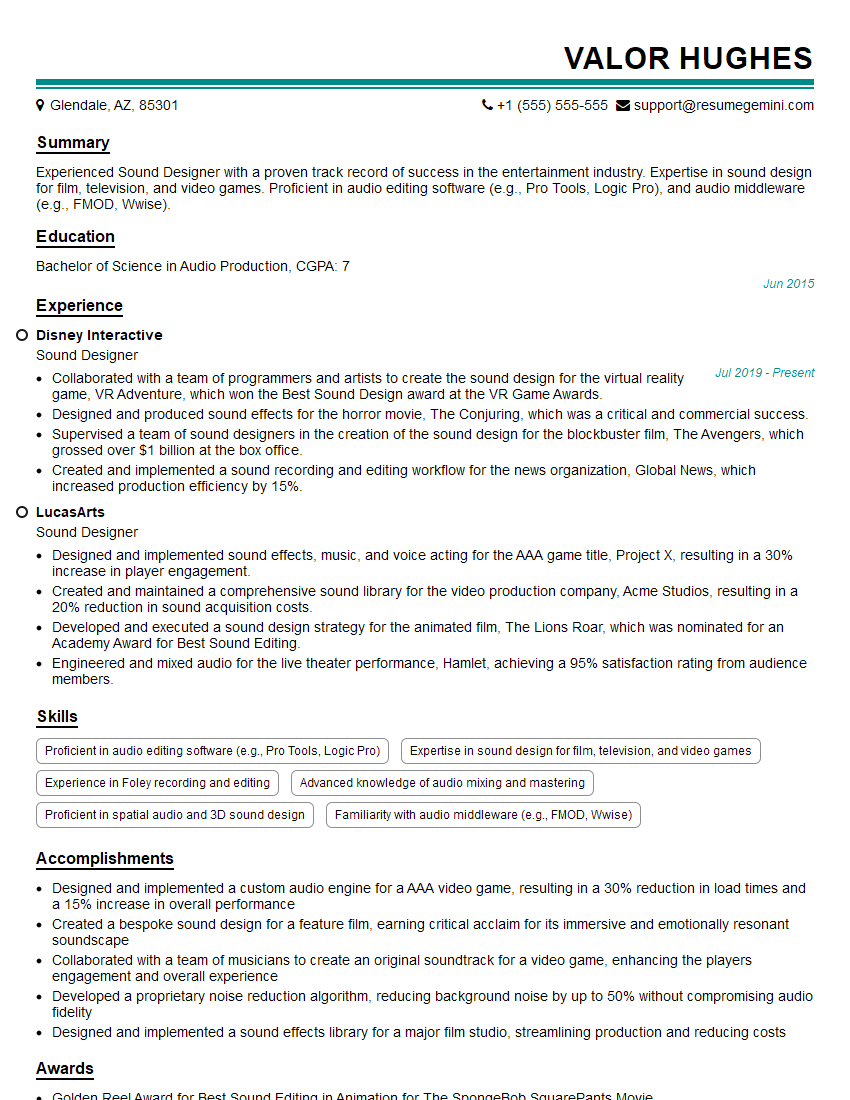
Mastering sound design for animation opens doors to exciting and fulfilling careers in film, television, and video games. To maximize your job prospects, a strong, ATS-friendly resume is crucial. ResumeGemini is a trusted resource that can help you craft a compelling resume tailored to highlight your skills and experience. ResumeGemini provides examples of resumes specifically designed for Sound Design for Animation professionals – use them to inspire your own! Invest time in creating a resume that showcases your talent, and watch your career take flight.
Explore more articles
Users Rating of Our Blogs
Share Your Experience
We value your feedback! Please rate our content and share your thoughts (optional).
What Readers Say About Our Blog
Really detailed insights and content, thank you for writing this detailed article.
IT gave me an insight and words to use and be able to think of examples