Interviews are opportunities to demonstrate your expertise, and this guide is here to help you shine. Explore the essential Stability and Control interview questions that employers frequently ask, paired with strategies for crafting responses that set you apart from the competition.
Questions Asked in Stability and Control Interview
Q 1. Explain the difference between static and dynamic stability.
Static stability refers to a system’s tendency to return to its equilibrium state after a small disturbance. Think of a ball resting in a bowl – if you nudge it, it rolls back to the bottom. Dynamic stability, on the other hand, describes how the system behaves *during* its return to equilibrium. It considers not just the final state, but also the path taken to get there. A dynamically stable system will return to equilibrium without oscillations or excessive overshoots. An example contrasting the two: a ball in a bowl is both statically and dynamically stable. However, a ball balanced on a perfectly flat surface is statically unstable (any slight disturbance will cause it to fall) but could be considered dynamically stable if some external force consistently returns it to its center.
In aircraft, static stability concerns the initial response to a disturbance (e.g., a gust of wind). If the aircraft naturally wants to return to its original flight path, it exhibits static stability. Dynamic stability addresses the subsequent oscillations or damping behavior; a dynamically stable aircraft will settle back to level flight without excessive or persistent oscillations.
Q 2. Describe the role of control surfaces in aircraft stability.
Control surfaces, such as ailerons, elevators, and rudder, are crucial for aircraft stability and control. They generate aerodynamic forces that counteract disturbances and allow pilots to maneuver the aircraft. Ailerons, located on the wings, control roll; elevators, on the tailplane, control pitch; and the rudder, on the vertical stabilizer, controls yaw. These surfaces work in conjunction with the inherent stability characteristics of the aircraft design. For example, if a gust of wind causes the aircraft to roll, the pilot uses the ailerons to correct the roll, restoring stability. Similarly, the elevators are used to control pitch changes to maintain a desired altitude.
The effectiveness of these control surfaces is heavily dependent on the aircraft’s design and its aerodynamic characteristics. Proper placement and sizing are critical for providing sufficient control authority while minimizing undesirable effects.
Q 3. What are the key components of a control system?
A basic control system comprises several key components:
- Sensor: Measures the system’s output or state variable (e.g., an altimeter measures altitude).
- Controller: Compares the measured output to a desired setpoint (reference input) and generates a control signal to reduce the error (e.g., an autopilot compares the measured altitude to the desired altitude and generates commands to adjust the elevators).
- Actuator: Takes the control signal and makes adjustments to the system (e.g., a servo motor moves the elevators based on the autopilot’s command).
- Plant (or Process): The system being controlled (e.g., the aircraft itself).
- Feedback Path: The connection from the sensor to the controller, enabling closed-loop control.
These components work together to maintain the desired system behavior. A well-designed control system ensures accuracy, stability, and robustness against disturbances.
Q 4. Explain the concept of feedback control and its importance.
Feedback control is a control strategy where the output of a system is measured and fed back to the controller to adjust the input accordingly. Think of a thermostat: it measures the room temperature (output), compares it to the setpoint (desired temperature), and turns the heater on or off (input) to maintain the desired temperature. The feedback loop continuously monitors the output and corrects deviations from the setpoint.
The importance of feedback control lies in its ability to compensate for disturbances and uncertainties. Without feedback, a control system would be highly susceptible to external influences and would struggle to maintain the desired output accurately. Feedback control improves accuracy, stability, and robustness. It is essential in most control applications, including aircraft flight control systems, industrial processes, and even biological systems.
Q 5. How do you analyze the stability of a linear system?
The stability of a linear system is analyzed using its transfer function or state-space representation. For a linear system, stability is determined by the location of the poles (roots of the characteristic equation) in the complex s-plane. A system is stable if all poles have negative real parts. If any pole has a positive real part, the system is unstable. Poles on the imaginary axis represent marginal stability (oscillations without decay or growth).
For example, consider a second-order system with the transfer function:
G(s) = 1/(s^2 + 2ζωns + ωn^2)where ζ is the damping ratio and ωn is the natural frequency. This system is stable if ζ > 0.
State-space analysis involves examining the eigenvalues of the system matrix. Similar to the poles in the transfer function approach, a stable system has eigenvalues with negative real parts.
Q 6. What are the different methods for determining system stability?
Several methods exist for determining system stability:
- Routh-Hurwitz Criterion: An algebraic method that analyzes the coefficients of the characteristic polynomial to determine the number of poles with positive real parts. It’s particularly useful for systems described by their characteristic equation.
- Root Locus Method: A graphical technique that shows how the closed-loop poles change as a system gain varies. It allows for visual assessment of stability margins.
- Bode Plots: Graphical representations of the magnitude and phase of the transfer function as a function of frequency. Used to assess gain and phase margins, indicating stability robustness.
- Nyquist Plot: A graphical representation of the frequency response in the complex plane. Used to determine stability based on encirclements of the -1 point.
- Eigenvalue Analysis (State-Space): Examination of the eigenvalues of the system matrix to ascertain stability, as described previously.
The choice of method depends on the system’s complexity and the desired level of detail in the analysis.
Q 7. Explain the concept of Bode plots and their use in stability analysis.
Bode plots are graphical representations of a system’s frequency response, showing the magnitude (in decibels) and phase (in degrees) of the transfer function as a function of frequency (typically in logarithmic scale). They’re invaluable tools in stability analysis because they reveal critical information about a system’s gain and phase margins.
The gain margin represents how much the system’s gain can be increased before it becomes unstable. It’s determined by finding the frequency at which the magnitude plot crosses 0 dB, and then determining the amount of additional gain at that frequency required to reach 0 dB. A larger gain margin implies better stability robustness.
The phase margin represents how much the system’s phase can be shifted before it becomes unstable. It’s the difference between the phase at the gain crossover frequency (frequency where magnitude is 0 dB) and -180 degrees. A larger phase margin implies better stability robustness.
By examining the Bode plots, engineers can quickly assess a system’s stability and make informed design choices to improve its robustness to variations in system parameters or external disturbances. A system with sufficient gain and phase margins is considered to be stable and robust.
Q 8. Describe the Nyquist stability criterion.
The Nyquist stability criterion is a graphical technique used to assess the stability of a closed-loop control system. It’s based on analyzing the frequency response of the open-loop transfer function. Imagine you’re walking a tightrope – if you sway too far in either direction, you’ll fall. Similarly, a system’s stability depends on how it responds to different frequencies of input. The Nyquist plot maps the open-loop transfer function’s frequency response in the complex plane. The criterion states that the number of clockwise encirclements of the -1 point by the Nyquist plot equals the number of unstable poles in the closed-loop system. No encirclements mean the closed-loop system is stable. If the Nyquist plot encircles the -1 point clockwise, it indicates the addition of unstable poles in the closed loop system. The number of encirclements equals the number of unstable poles added by closing the loop.
For example, if the open-loop system is stable (no poles in the right-half plane), and the Nyquist plot doesn’t encircle the -1 point, then the closed-loop system is guaranteed to be stable. Conversely, if it encircles the -1 point, the system will be unstable.
Q 9. What is the root locus method and how is it used?
The root locus method is a graphical technique for finding the locations of the closed-loop poles of a system as a gain parameter is varied. Imagine you’re tuning a radio – you adjust the knob (gain) to find the desired station (stable pole location). The root locus plot shows how the poles of the closed-loop transfer function move in the complex plane as a specific parameter (usually the gain) is varied from zero to infinity. This helps determine the stability and performance of the system for different gain values.
It’s used to design controllers by finding a gain value that places the closed-loop poles in a desirable region of the s-plane, ensuring stability and desired transient response. The rules for constructing the root locus are based on the characteristics of the open-loop transfer function, which enables a graphical interpretation of how changing parameters affect the closed-loop stability and response. For instance, you can analyze the effect of adding poles and zeros to the open loop system on the closed loop stability and response.
Q 10. Explain the concept of phase margin and gain margin.
Phase margin and gain margin are crucial stability indicators derived from the frequency response of a closed-loop system. They represent the system’s tolerance to variations in phase and gain, respectively. Think of them as safety buffers.
Gain Margin: This represents how much the system’s gain can be increased before instability occurs. A higher gain margin indicates a more robust system, less susceptible to gain variations. It’s measured in decibels (dB) at the frequency where the phase is -180 degrees. A gain margin greater than 0 dB ensures stability.
Phase Margin: This indicates how much the system’s phase can be delayed before instability occurs. A higher phase margin implies greater tolerance for delays or phase shifts, making the system more robust to unforeseen delays. It’s measured in degrees at the frequency where the gain is 0 dB (unity gain). A phase margin greater than 30 degrees typically indicates good stability.
Both margins provide insight into the system’s robustness to uncertainties and disturbances. A system with sufficient gain and phase margins is less likely to become unstable due to variations in its parameters or the presence of noise.
Q 11. How do you design a controller for a given system?
Designing a controller involves a systematic approach that combines theoretical understanding with practical considerations. The process typically involves these steps:
System Modeling: Accurately represent the system’s dynamics using mathematical models (transfer functions, state-space representations).
Specifications: Define desired performance characteristics like settling time, overshoot, steady-state error, and robustness.
Controller Selection: Choose an appropriate controller structure (PID, lead-lag, etc.) based on system characteristics and specifications.
Controller Design: Use techniques like root locus, Bode plots, or frequency response methods to determine controller parameters that satisfy specifications.
Simulation and Analysis: Simulate the closed-loop system to verify that specifications are met and assess robustness.
Implementation and Tuning: Implement the controller on the physical system and fine-tune parameters based on experimental results.
The choice of controller design method depends heavily on the complexity of the system and the desired performance metrics. For simpler systems, classical control methods may suffice, while more complex systems might require advanced control techniques like optimal control or robust control.
Q 12. What are PID controllers and how do they work?
PID controllers are ubiquitous in control systems because of their simplicity and effectiveness. They are three-term controllers that combine proportional, integral, and derivative control actions.
Proportional (P): The output is proportional to the error (difference between desired and actual values). It provides a rapid response but might result in steady-state error.
Integral (I): The output is proportional to the integral of the error over time. It eliminates steady-state error but can cause overshoot.
Derivative (D): The output is proportional to the derivative of the error. It anticipates future error, improving stability and reducing overshoot, but can amplify noise.
The PID controller adjusts its output based on the combination of these three terms, allowing for fine-tuning of the system’s response. The weighting of each term (Kp, Ki, Kd) is determined during the controller design process, often through experimentation or optimization techniques. For instance, a larger Kp results in faster response but may increase overshoot. A larger Ki reduces steady state error, but might make the system oscillate. A larger Kd reduces overshoot, but might increase sensitivity to noise.
Q 13. Explain the challenges in designing controllers for nonlinear systems.
Designing controllers for nonlinear systems presents significant challenges compared to linear systems. The primary difficulty stems from the fact that linear control techniques don’t directly apply to systems with nonlinear dynamics. Linearization techniques can be used but only work within a small operating range. Here are some key challenges:
Nonlinear Dynamics: The principles of superposition and homogeneity don’t hold, making analysis and design more complex.
Multiple Equilibrium Points: Nonlinear systems might have multiple operating points, each requiring different control strategies. A controller designed for one operating point may not work well for another.
Unpredictable Behavior: Nonlinear systems can exhibit complex behaviors like limit cycles, chaos, and bifurcations, making stability analysis and controller design significantly more difficult.
Lack of General Methods: There isn’t a single universally applicable method for designing controllers for all nonlinear systems. The choice of method often depends on the specific nonlinearity.
Techniques like feedback linearization, sliding mode control, and model predictive control are often employed to address these challenges. However, they often require sophisticated mathematical tools and can be computationally intensive.
Q 14. Describe different types of control strategies (e.g., feedforward, feedback).
Control strategies can be broadly classified as feedback and feedforward control. They can be used independently or in combination for optimal performance.
Feedback Control: This is the most common approach. It measures the system’s output and compares it to the desired setpoint. The difference (error) is then used to adjust the controller’s output to reduce the error and keep the system at the desired setpoint. Think of a thermostat controlling room temperature: it measures the current temperature, compares it to the set temperature, and adjusts the heating or cooling accordingly.
Feedforward Control: This approach uses knowledge of disturbances or inputs to predict the system’s response and adjust the controller’s output proactively. It’s often used in conjunction with feedback control to improve performance and reduce the impact of disturbances. Imagine a robotic arm picking up an object of known weight: The controller can anticipate the required force based on the object’s weight and adjust accordingly before the arm actually interacts with it, making the action smoother.
Other strategies include cascade control (multiple feedback loops), model predictive control (optimizes control actions over a prediction horizon), and adaptive control (adjusts controller parameters to account for changes in the system’s dynamics).
Q 15. What are some common stability issues in control systems?
Common stability issues in control systems often stem from the system’s inherent dynamics or the design of the controller itself. Imagine trying to balance a pencil on its tip – a tiny disturbance can easily lead to instability. Similarly, in control systems, instability manifests in several ways:
- Oscillations: The system output might oscillate continuously, never settling to a desired value. This is often due to insufficient damping in the system. Think of a poorly tuned car suspension bouncing endlessly.
- Divergence: The system output might grow unbounded, leading to catastrophic failure. This usually indicates that the system’s poles are located in the right-half of the complex s-plane. Picture an uncontrolled rocket launch heading off course uncontrollably.
- Limit Cycles: The system might exhibit sustained oscillations of a constant amplitude. This is a form of nonlinear instability, often seen in systems with saturation or nonlinearities.
- Sensitivity to Noise: Small disturbances or noise can cause large variations in the system output, making the system impractical.
Identifying and addressing these issues is crucial for creating robust and reliable control systems. Tools like root locus plots, Bode plots, and Nyquist plots help analyze system stability, and techniques like PID tuning or advanced control strategies are used to improve stability.
Career Expert Tips:
- Ace those interviews! Prepare effectively by reviewing the Top 50 Most Common Interview Questions on ResumeGemini.
- Navigate your job search with confidence! Explore a wide range of Career Tips on ResumeGemini. Learn about common challenges and recommendations to overcome them.
- Craft the perfect resume! Master the Art of Resume Writing with ResumeGemini’s guide. Showcase your unique qualifications and achievements effectively.
- Don’t miss out on holiday savings! Build your dream resume with ResumeGemini’s ATS optimized templates.
Q 16. How do you handle uncertainties and disturbances in control systems?
Handling uncertainties and disturbances is a cornerstone of robust control design. Real-world systems are never perfect models; they are subjected to unknown inputs, parameter variations, and environmental changes. We handle these using several methods:
- Robust Control Techniques: These methods explicitly consider uncertainties in the design process. H-infinity control, for instance, minimizes the effect of disturbances on the system output, even with model uncertainties. Think of a robot arm needing to pick up an object of unknown weight; H-infinity control would help ensure the robot doesn’t drop it.
- Adaptive Control: This approach modifies the controller’s parameters in real-time to compensate for changing system dynamics. Imagine a self-driving car adapting its control strategy based on changing road conditions like ice or rain.
- Feedback Control: This fundamental concept involves using sensors to measure the system’s output and adjust the control input accordingly. The feedback mechanism acts as a self-correcting mechanism, reducing the impact of disturbances. Think of a thermostat adjusting the heating based on the measured room temperature.
- Feedforward Control: This method anticipates disturbances and proactively adjusts the control input. Imagine a cruise control system on a car anticipating an incline and adjusting the throttle in advance.
The choice of method depends on the specific application and the nature of the uncertainties and disturbances. A combination of these techniques often yields the most robust solution.
Q 17. Describe your experience with simulation tools for stability and control analysis.
My experience with simulation tools for stability and control analysis is extensive. I’ve used various tools, including MATLAB/Simulink, which is industry-standard for control systems design. I’ve leveraged Simulink’s capabilities for modeling complex systems, performing linearization, analyzing frequency responses (Bode and Nyquist plots), and designing controllers (PID, LQR, etc.).
Beyond Simulink, I have experience with other tools like Python libraries such as control and scipy for numerical analysis and control system design, allowing for more customized analysis and flexible data handling. I’ve used these tools to create detailed simulations, verify the stability and performance of various control strategies, and conduct sensitivity analysis to evaluate the effects of parameter variations. For example, I once used Simulink to model a complex aircraft flight control system, performing extensive simulations to ensure its stability across a wide range of flight conditions.
Q 18. What software packages are you familiar with for control system design?
I am proficient in several software packages for control system design. My primary expertise lies in MATLAB and its accompanying toolboxes (Control System Toolbox, Simulink, etc.). I’m also familiar with Python libraries such as control, scipy, and numpy, providing flexibility and open-source alternatives. I have experience using these tools to design, simulate, and analyze various types of control systems, including linear and nonlinear systems, and have utilized these tools in various industrial and research projects.
Q 19. Explain your understanding of state-space representation of systems.
State-space representation provides a powerful and versatile way to model dynamic systems. Unlike transfer function representations, state-space models explicitly represent the system’s internal states. This is particularly useful for systems with multiple inputs and outputs, and for handling systems with nonlinearities or time-varying parameters.
A general state-space model is represented as:
ẋ = Ax + Bu
y = Cx + Du
where:
xis the state vector representing the internal variables of the system.uis the input vector.yis the output vector.Ais the system matrix describing the dynamics of the system.Bis the input matrix linking the inputs to the states.Cis the output matrix relating the states to the outputs.Dis the direct transmission matrix (often zero).
The advantage of state-space is its ability to handle complex systems and its applicability to various control design techniques such as Linear Quadratic Regulator (LQR) and Kalman filtering. For instance, I used state-space modeling to design a controller for a robotic manipulator, considering its multiple joints and their interactions.
Q 20. How do you deal with system nonlinearities in control design?
Dealing with system nonlinearities requires a different approach than linear control methods. Nonlinearities, such as saturation, friction, or dead zones, can significantly impact system performance and stability. Here are some strategies:
- Linearization: For small deviations around an operating point, we can linearize the nonlinear system using techniques like Taylor series expansion. This allows us to apply linear control techniques, but the resulting controller’s performance might degrade far from the operating point.
- Nonlinear Control Techniques: Methods like feedback linearization, sliding mode control, and backstepping design directly address the nonlinearities. These techniques often require more sophisticated mathematical tools and offer better performance than linearization for larger deviations.
- Gain Scheduling: This approach uses multiple linear controllers, each designed for a different operating point. The controller is switched or interpolated between these operating points based on system state.
- Simulation and Testing: Extensive simulation and experimental testing are crucial to validate the controller’s performance in the presence of nonlinearities. This helps reveal limitations and refine the control strategy.
For example, I once worked on a project involving a nonlinear chemical process where gain scheduling was employed to effectively manage the system’s behavior across varying operating conditions.
Q 21. Describe your experience with model-based design.
Model-based design is a crucial part of my workflow. It’s a systematic approach to control system design that utilizes mathematical models to simulate, analyze, and verify the system’s behavior before physical implementation. This reduces risks, cost and development time. My experience encompasses the entire model-based design lifecycle:
- Modeling: Developing accurate and comprehensive mathematical models of the system using tools like Simulink.
- Simulation: Running simulations to evaluate the system’s response to various inputs and disturbances.
- Verification and Validation: Comparing simulation results with experimental data to ensure model accuracy and controller effectiveness.
- Code Generation: Generating code from the models to deploy the controller on the physical system (e.g., using Simulink Coder).
Model-based design greatly improves the quality and reliability of control systems. For example, I used model-based design to develop a controller for a complex industrial robot, significantly reducing the development time and ensuring robustness before physical deployment.
Q 22. How do you validate and verify a control system?
Validating and verifying a control system is crucial to ensure it meets its design specifications and operates safely and reliably. Validation confirms that the system meets the user needs and requirements, while verification confirms that the system is implemented correctly according to its design.
Validation typically involves testing the entire system in its operational environment. This might include:
- System-level testing: Testing the entire system to ensure it meets performance requirements, such as rise time, settling time, and overshoot.
- Integration testing: Testing the interaction between different components of the system.
- User acceptance testing (UAT): Testing with end-users to ensure the system meets their expectations and is user-friendly.
Verification focuses on the internal consistency and correctness of the system’s design and implementation. Methods include:
- Code reviews: Examining the source code to ensure adherence to coding standards and proper functionality.
- Unit testing: Testing individual modules or components of the system in isolation.
- Simulation: Using models to test the system’s behavior under various conditions before physical implementation.
- Formal methods: Applying mathematical techniques to prove the correctness of the system’s design.
For instance, in designing a flight control system, validation might involve flight tests to ensure the aircraft meets stability and maneuverability requirements. Verification would involve rigorous simulations and unit tests of individual control algorithms to guarantee their correct implementation and interaction.
Q 23. What are some common performance metrics for control systems?
Common performance metrics for control systems depend heavily on the application, but some key indicators include:
- Rise time: The time it takes for the system’s output to reach a certain percentage (e.g., 90%) of its final value after a step input.
- Settling time: The time it takes for the system’s output to remain within a specified tolerance band of its final value.
- Overshoot: The amount by which the system’s output exceeds its final value before settling.
- Steady-state error: The difference between the system’s output and the desired value after it has settled.
- Bandwidth: The range of frequencies over which the system can effectively track a signal.
- Gain margin and phase margin: Measures of stability robustness, indicating how much the system’s gain or phase can change before becoming unstable.
Consider a temperature control system. We might aim for a fast rise time to quickly reach the set temperature, a minimal overshoot to avoid exceeding the desired temperature, and a small steady-state error to ensure the temperature remains stable at the setpoint. In a robotic arm controller, bandwidth becomes critical; a higher bandwidth ensures quicker and more precise movements.
Q 24. Explain your experience with different types of sensors and actuators.
My experience encompasses a wide range of sensors and actuators, including:
- Sensors: I’ve worked with accelerometers, gyroscopes, GPS, pressure sensors, temperature sensors, and optical encoders. Understanding sensor noise characteristics and calibration techniques is vital for accurate control.
- Actuators: My experience includes DC motors, servo motors, stepper motors, pneumatic actuators, and hydraulic actuators. Each actuator type requires a different control strategy to achieve optimal performance.
For example, in a self-driving car project, I worked with lidar sensors to detect obstacles, GPS for localization, and accelerometers/gyroscopes for inertial measurements. The actuator side involved precise control of electric motors in the steering and braking systems. Proper sensor fusion and actuator selection were crucial for safe and reliable autonomous navigation.
Dealing with sensor noise and actuator limitations is a routine challenge. For instance, using Kalman filters to fuse data from multiple sensors to reduce uncertainty or designing robust controllers that compensate for actuator saturation are common techniques.
Q 25. How do you handle robustness issues in control system design?
Robustness in control system design addresses the ability of the system to perform well despite uncertainties and disturbances. These uncertainties can stem from variations in plant parameters, external disturbances, or sensor noise.
Several techniques are employed to enhance robustness:
- Robust control design methods: H-infinity control and L1 adaptive control are used to design controllers that explicitly account for uncertainties in the plant model.
- Gain scheduling: Adjusting the controller parameters based on operating conditions to maintain performance across a range of scenarios.
- Feedback linearization: Transforming a nonlinear system into a linear form that can be controlled using linear control techniques.
- Adaptive control: Continuously adjusting controller parameters to compensate for changes in the plant.
In a real-world example, consider a robotic arm operating in an unpredictable environment. Robust control design would be crucial to ensure that the arm can still perform its task even if it encounters unexpected forces or if the arm’s physical characteristics change slightly due to wear and tear.
Q 26. What is your experience with adaptive control systems?
I have extensive experience with adaptive control systems, which are designed to automatically adjust their parameters in response to changes in the controlled system or environment. These changes might be due to parameter variations, external disturbances, or even changes in the system’s structure.
Different types of adaptive control exist:
- Model reference adaptive control (MRAC): The controller aims to match the system’s behavior to a desired model.
- Self-tuning regulators (STR): The controller estimates the system’s parameters online and adjusts its parameters accordingly.
- Indirect adaptive control: The controller explicitly estimates the system’s parameters and then designs the control law based on the estimates.
A project I worked on involved controlling the flight of an unmanned aerial vehicle (UAV) in unpredictable wind conditions. An adaptive control system was essential because the wind gusts significantly affected the UAV’s dynamics. The adaptive controller continually adjusted its parameters based on measurements of the wind speed and direction, enabling stable and precise flight even in turbulent conditions.
Q 27. Explain your understanding of Lyapunov stability.
Lyapunov stability is a powerful concept for analyzing the stability of nonlinear systems. Instead of directly solving the system’s equations, it examines the system’s energy-like function (Lyapunov function) to determine if the system converges to an equilibrium point. A Lyapunov function, V(x), is a scalar function of the system’s state variables, x, that must satisfy these conditions:
- V(0) = 0 (The function is zero at the equilibrium point).
- V(x) > 0 for all x ≠ 0 (The function is positive definite).
- dV(x)/dt ≤ 0 for all x (The derivative of the function along the system’s trajectories is negative semi-definite).
If such a Lyapunov function can be found, it proves the stability of the equilibrium point. If dV(x)/dt < 0, it proves asymptotic stability, meaning the system will converge to the equilibrium point. Think of it like a ball rolling down a hill; the height of the ball is the Lyapunov function, and as it rolls downhill (dV/dt < 0), it eventually comes to rest at the bottom (equilibrium point).
Lyapunov stability is critical in many applications, particularly for complex nonlinear systems where direct solutions are intractable. In robotics, for instance, it’s used to analyze the stability of walking robots and to design stabilizing controllers.
Q 28. Describe a challenging stability and control problem you faced and how you solved it.
One challenging stability and control problem I faced involved designing a controller for a highly flexible robotic arm. The arm’s flexibility introduced significant vibrations and resonant modes that made precise positioning extremely difficult. Standard PID controllers were insufficient because they couldn’t effectively damp the oscillations.
My solution involved a multi-pronged approach:
- Detailed modeling: I developed a high-fidelity model of the flexible arm, capturing its dynamic behavior including its flexible modes.
- Advanced control design: I implemented a Linear Quadratic Gaussian (LQG) controller, which is adept at handling stochastic disturbances and multiple input/multiple output (MIMO) systems such as this.
- Vibration damping: I incorporated a feedforward term to predict and compensate for the expected vibrations, minimizing the error before it manifested.
- Experimentation and tuning: Extensive simulations and real-world experiments were essential to fine-tune the controller’s parameters and validate its performance.
This approach significantly reduced the arm’s vibrations and increased its positioning accuracy. The key was moving beyond simple PID control to a more sophisticated control strategy that explicitly addressed the complex dynamics of the flexible arm. The project highlighted the importance of detailed modeling, advanced control techniques, and rigorous validation when dealing with systems that exhibit complex dynamics.
Key Topics to Learn for Stability and Control Interview
- Aircraft Longitudinal Stability: Understand concepts like static margin, center of gravity, and the influence of aerodynamic forces on pitch stability. Explore methods for analyzing longitudinal stability derivatives.
- Aircraft Lateral-Directional Stability: Grasp the relationship between yaw, roll, and sideslip. Study dihedral effect, keel effect, and the impact of aerodynamic control surfaces on directional stability. Practice analyzing lateral-directional stability derivatives.
- Control System Design: Learn about different control system architectures (e.g., classical, modern) and their application to flight control. Explore techniques for designing controllers that ensure stable and responsive aircraft behavior.
- Flight Dynamics Modeling: Familiarize yourself with the equations of motion for aircraft and the methods used to simulate aircraft behavior. Understand linearization techniques and their importance in control system design.
- Handling Qualities: Learn the metrics and standards used to assess the handling qualities of aircraft. Understand the importance of pilot workload and the relationship between control system design and handling qualities.
- Nonlinear Flight Dynamics: Explore the complexities introduced by nonlinear effects and their implications for stability and control. Gain understanding of advanced analysis techniques.
- Practical Application: Consider case studies involving aircraft design, flight testing, and control system implementation. Be prepared to discuss real-world challenges and solutions.
- Problem-Solving Approach: Practice solving stability and control problems using analytical and numerical methods. Develop your ability to identify key parameters, formulate models, and interpret results.
Next Steps
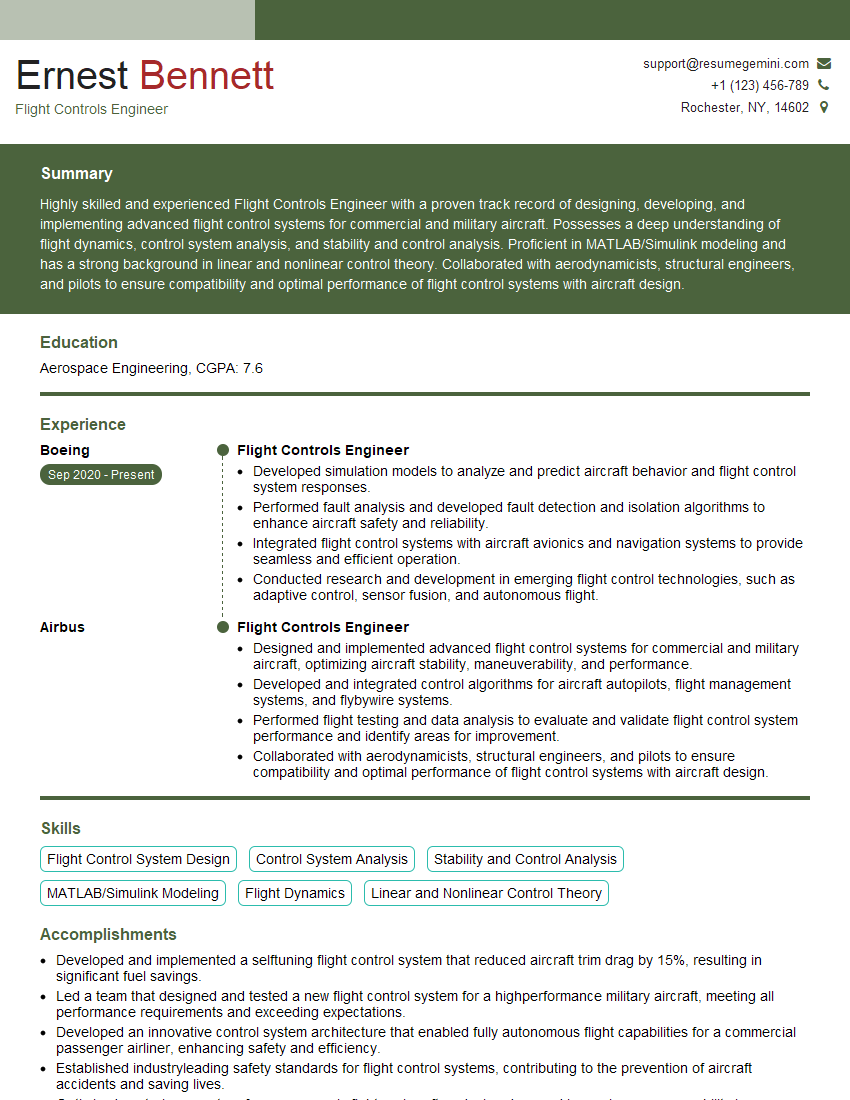
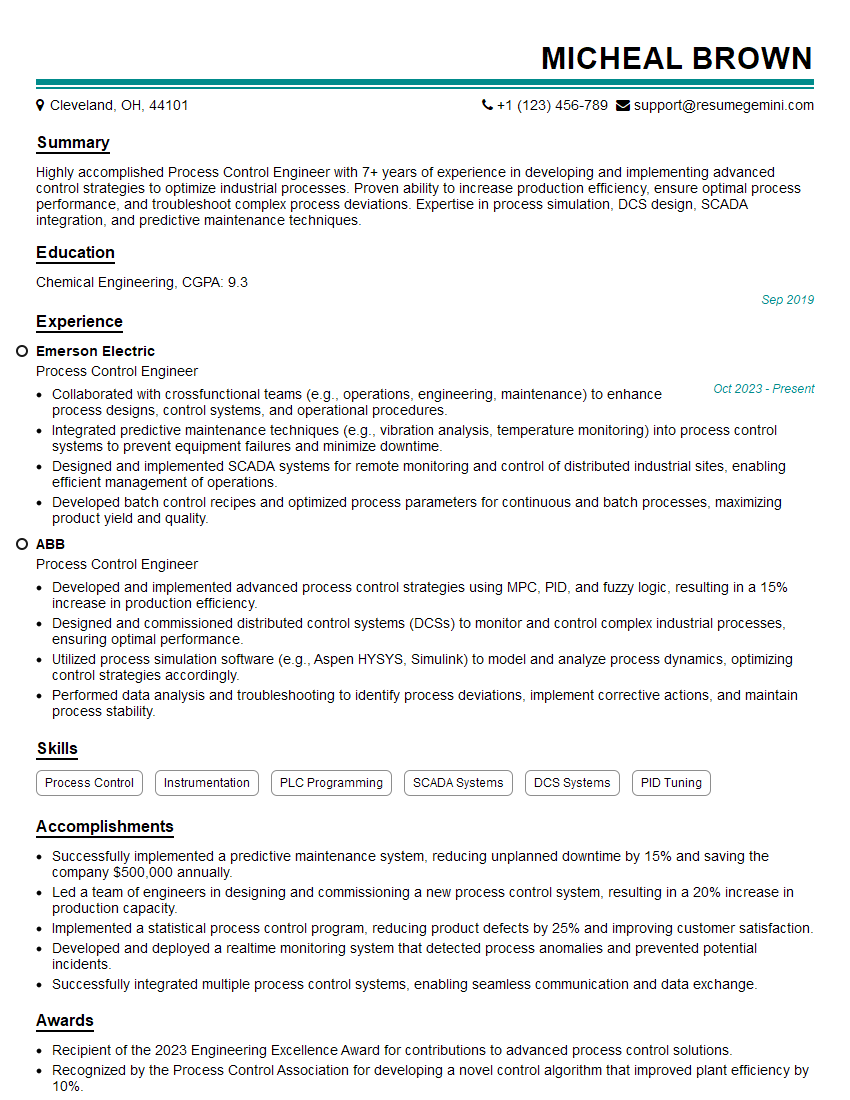
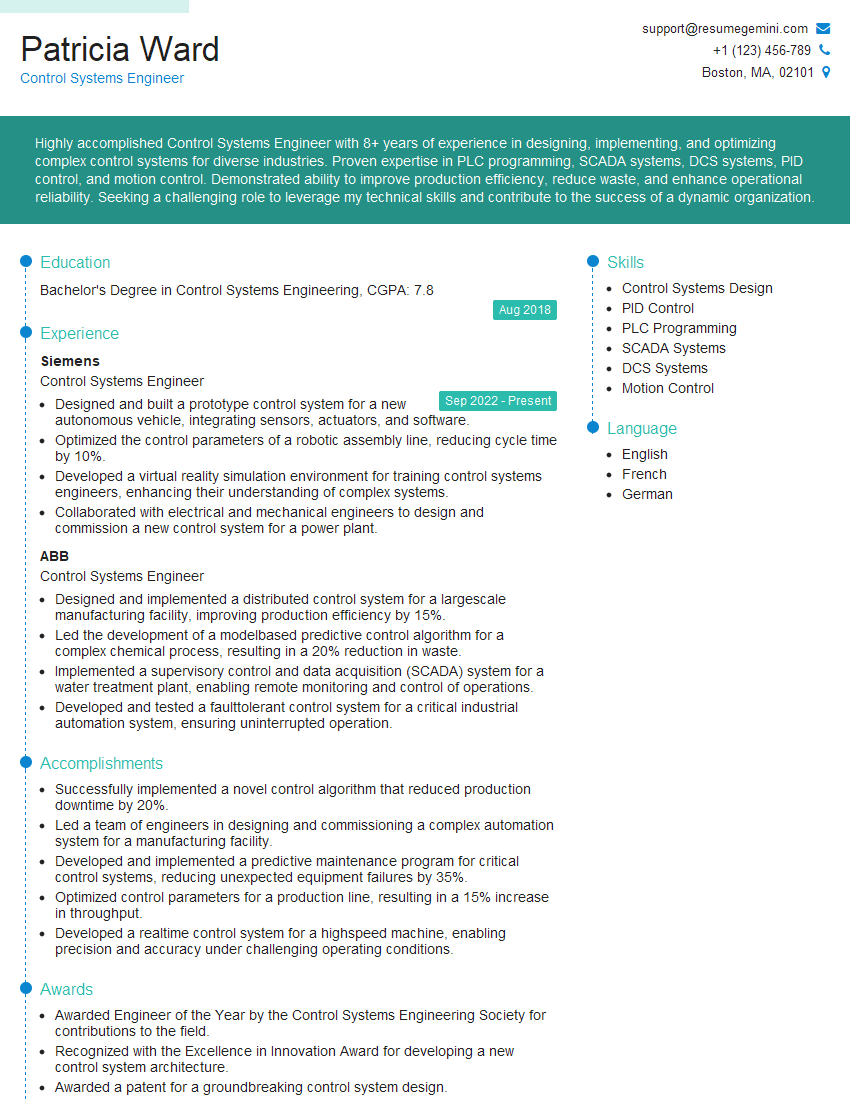
Mastering Stability and Control is crucial for advancing your career in aerospace engineering, providing a strong foundation for roles in aircraft design, flight control systems, and research. To significantly improve your job prospects, create an ATS-friendly resume that highlights your skills and experience effectively. ResumeGemini is a trusted resource that can help you build a professional and impactful resume tailored to the aerospace industry. Examples of resumes specifically designed for candidates in Stability and Control are available to help you craft your perfect application.
Explore more articles
Users Rating of Our Blogs
Share Your Experience
We value your feedback! Please rate our content and share your thoughts (optional).
What Readers Say About Our Blog
Really detailed insights and content, thank you for writing this detailed article.
IT gave me an insight and words to use and be able to think of examples