Every successful interview starts with knowing what to expect. In this blog, we’ll take you through the top Strong network in the cotton industry interview questions, breaking them down with expert tips to help you deliver impactful answers. Step into your next interview fully prepared and ready to succeed.
Questions Asked in Strong network in the cotton industry Interview
Q 1. Explain the current global cotton market trends.
The global cotton market is dynamic, influenced by several interconnected factors. Currently, we’re seeing a complex interplay of supply and demand. Production levels fluctuate due to weather patterns – a drought in a major cotton-producing region can significantly impact global supply and drive prices up. Conversely, favorable weather can lead to surpluses and lower prices. Consumer demand, particularly from the textile industry, is another key driver. Changes in fashion trends, economic growth in major consuming countries, and the rise of sustainable and ethically sourced cotton all influence demand.
Another important trend is the growing focus on sustainability. Consumers are increasingly demanding sustainably produced cotton, leading to a rise in organic and recycled cotton production. This shift requires farmers to adopt sustainable farming practices, which can impact both production costs and the overall market price. Finally, geopolitical events and trade policies can significantly disrupt the market, creating uncertainty and price volatility. For instance, trade wars or sanctions can impact the flow of cotton between countries.
Q 2. Describe the different types of cotton and their properties.
Cotton is categorized into several types, primarily based on fiber length, strength, and fineness. The most common types include:
- Upland Cotton (Gossypium hirsutum): This is the most widely grown type globally, known for its adaptability to various climates and its relatively high yield. Its fibers are moderately long and strong, making it suitable for a wide range of textile applications.
- Extra-Long Staple (ELS) Cotton: This variety features exceptionally long and fine fibers, resulting in luxurious, high-quality fabrics. Examples include Pima and Egyptian cotton, prized for their softness, strength, and lustrous appearance. They command higher prices due to their superior quality.
- American Pima: A type of ELS cotton known for its extra-long, strong, and silky fibers, giving it superior strength and softness compared to Upland cotton.
- Egyptian Giza: Another type of ELS, this variety is known for its exceptionally long, fine, and strong fibers, resulting in luxuriously soft and durable fabrics.
The properties of each type influence its end-use. For example, ELS cotton is ideal for premium apparel, while Upland cotton is better suited for everyday garments and industrial applications. The fiber length dictates the yarn’s strength and fineness, impacting the overall fabric quality.
Q 3. What are the key factors influencing cotton prices?
Cotton prices are subject to complex interplay of several factors. Supply and demand are fundamental. A bumper crop leads to lower prices, while a poor harvest drives prices higher. Weather conditions during the growing season are crucial, as droughts or excessive rainfall can severely impact yields. Global economic conditions also play a significant role. Strong economic growth in major textile-producing countries boosts demand and thus prices. Conversely, economic downturns reduce demand and put downward pressure on prices. Government policies, including subsidies, trade tariffs, and quotas, can impact cotton production and trade, influencing prices. Finally, speculative trading on commodity markets can introduce volatility into cotton prices.
For example, a severe drought in India, a major cotton producer, could drastically reduce the global supply, leading to a significant price surge. Conversely, a large cotton harvest in the United States, the world’s largest exporter, could depress prices globally.
Q 4. Explain the process of cotton ginning.
Cotton ginning is the process of separating cotton fibers from the seeds. Historically, this was a labor-intensive task, but modern ginning employs sophisticated machinery. The process typically involves several steps:
- Cleaning: Raw cotton is cleaned to remove dirt, leaves, and other debris.
- Seed Extraction: The cotton is fed into a ginning machine, which uses saws or rollers to separate the fibers from the seeds. Saw gins use rotating saws to pull the fibers through a grid, leaving the seeds behind. Roller gins use rollers to compress the cotton, separating the fibers from the seeds.
- Cleaning (Post-Ginning): The separated fibers undergo further cleaning to remove any remaining seeds, motes (small pieces of seed coat), and other impurities.
- Baling: The clean cotton is compressed into bales for easy storage and transportation. These bales are typically wrapped in burlap or other protective material.
Efficient ginning is crucial for maintaining the quality and value of the cotton. Damage during ginning can reduce fiber length and strength, affecting the quality of the final textile product.
Q 5. Describe the various methods of cotton storage and handling.
Proper cotton storage and handling are vital to preserving its quality and value. Methods vary depending on the scale and duration of storage.
- Warehousing: Large-scale storage typically involves climate-controlled warehouses to maintain optimal humidity and temperature levels. This prevents degradation of the fiber, which can be caused by excessive moisture or dryness.
- Bale Stacking: Bales are carefully stacked to ensure proper airflow and prevent damage. Proper ventilation minimizes the risk of mold and insect infestation.
- Protection from Pests: Warehouses are often fumigated to prevent insect infestations, which can significantly damage the cotton fibers. Regular pest monitoring and control measures are essential.
- Moisture Control: Maintaining optimal moisture content is crucial. Excessive moisture can promote mold growth, while excessively dry cotton can become brittle and prone to damage.
For smaller-scale storage, such as on farms, simple measures such as storing bales under cover and ensuring good airflow can prevent damage.
Q 6. What are the common quality parameters assessed in cotton?
Several quality parameters are assessed to determine the value and suitability of cotton for specific applications. These include:
- Fiber Length: Longer fibers generally yield stronger and finer yarns.
- Fiber Strength: This indicates the yarn’s tensile strength and durability.
- Fiber Fineness: Finer fibers create softer and more luxurious fabrics.
- Fiber Maturity: Mature fibers are thicker-walled and stronger than immature fibers.
- Micronaire: This measures the fiber’s diameter and maturity, influencing the yarn’s spinning properties.
- Color: Whiter cotton is generally preferred, as it allows for easier dyeing and brighter colors in the final product.
- Impurities: The presence of foreign matter, such as leaf fragments and seeds, reduces the quality of the cotton.
These parameters are typically measured using sophisticated instruments in laboratories, allowing for precise quantification of cotton quality.
Q 7. How do you ensure the traceability of cotton throughout the supply chain?
Ensuring cotton traceability throughout the supply chain is crucial for building consumer trust and meeting increasing demands for transparency and sustainability. Several methods contribute to effective traceability:
- Blockchain Technology: This technology allows for secure and transparent recording of cotton’s journey from farm to finished product. Each step in the process, from planting to manufacturing, can be recorded on the blockchain, making it readily auditable.
- RFID Tagging: Radio-frequency identification (RFID) tags can be attached to cotton bales, allowing for real-time tracking of their location and movement throughout the supply chain.
- GPS Tracking: GPS tracking can monitor the transportation of cotton, ensuring its secure and timely delivery.
- Digital Documentation: Detailed records of each stage of the supply chain, including farm information, processing details, and transportation logs, are essential.
- Third-Party Certification: Certifications from reputable organizations, such as those focused on sustainability and ethical sourcing, can provide independent verification of cotton’s origin and processing.
A comprehensive traceability system requires collaboration among all stakeholders in the supply chain, from farmers to retailers. This collaborative approach ensures accurate data collection and transparent reporting.
Q 8. Explain the role of sustainable cotton farming practices.
Sustainable cotton farming practices are crucial for the long-term health of the environment and the economic viability of the cotton industry. They focus on minimizing the negative impacts of cotton production while maximizing its positive contributions. This involves a holistic approach encompassing several key areas.
- Reduced Water Usage: Implementing drip irrigation, using drought-resistant cotton varieties, and improving water management techniques significantly lessen water consumption, a major concern in many cotton-growing regions.
- Minimized Pesticide and Fertilizer Use: Integrated Pest Management (IPM) strategies, employing biological control agents and precision application techniques, reduce reliance on harmful chemicals, protecting soil health and biodiversity. Similarly, optimized fertilizer application ensures efficient nutrient uptake and prevents environmental pollution.
- Soil Health Improvement: Practices like crop rotation, cover cropping, and no-till farming improve soil structure, fertility, and water retention, reducing the need for synthetic inputs and enhancing carbon sequestration.
- Biodiversity Conservation: Creating habitats for beneficial insects and pollinators, avoiding monoculture practices, and preserving natural ecosystems within and around cotton fields promote biodiversity and resilience.
- Fair Labor Practices: Ensuring fair wages, safe working conditions, and worker empowerment throughout the supply chain is fundamental to sustainable cotton production. This often involves traceability and certification programs.
For instance, a farmer adopting sustainable practices might switch from flood irrigation to drip irrigation, reducing water usage by 50% and simultaneously lowering energy costs. This not only benefits the environment but also improves the farmer’s bottom line.
Q 9. What are the challenges faced by the cotton industry in terms of sustainability?
The cotton industry faces numerous sustainability challenges, many interconnected and complex. These include:
- Water scarcity: Cotton is a thirsty crop, and water stress is a growing concern in many production areas, leading to conflicts over water resources.
- Pesticide and fertilizer overuse: The excessive use of these inputs can contaminate water sources, harm biodiversity, and pose health risks to farmworkers.
- Soil degradation: Intensive cotton farming can deplete soil nutrients and lead to erosion, reducing long-term productivity.
- Greenhouse gas emissions: Cotton production contributes to greenhouse gas emissions through fertilizer use, machinery operation, and transportation.
- Lack of transparency and traceability: It’s difficult to track cotton from farm to final product, making it challenging to verify sustainable practices throughout the supply chain. This also makes it harder to identify and address unethical labor practices.
- Consumer demand and price pressures: The pressure to produce cotton at low cost can incentivize unsustainable practices, making it challenging for farmers to adopt more environmentally friendly methods.
Addressing these challenges requires a collaborative effort from farmers, brands, retailers, and consumers, fostering innovation and promoting transparency.
Q 10. Discuss the impact of climate change on cotton production.
Climate change poses significant threats to cotton production globally. Rising temperatures, altered rainfall patterns, and increased frequency of extreme weather events (droughts, floods, heatwaves) all negatively impact yields and quality.
- Heat stress: High temperatures can damage cotton plants, reducing boll (seed pod) set and fiber quality.
- Water scarcity: Changes in rainfall patterns, including increased droughts, can severely limit water availability for irrigation, directly affecting crop yields.
- Pest and disease outbreaks: Warmer temperatures and altered humidity levels can increase the prevalence of pests and diseases, requiring greater pesticide use and potentially leading to crop losses.
- Extreme weather events: Floods and droughts can devastate cotton crops, causing significant economic losses for farmers.
Adaptation strategies are crucial. This includes developing drought-resistant cotton varieties, implementing water-efficient irrigation techniques, and adopting climate-smart agricultural practices to build resilience to climate change impacts. For example, some research focuses on genetically modifying cotton to withstand higher temperatures and drought conditions.
Q 11. What are the different types of cotton contracts?
Cotton contracts vary depending on the specific needs and agreements between buyers and sellers. Some common types include:
- Spot Contracts: These are for immediate delivery of cotton at an agreed-upon price. They are useful for smaller transactions or immediate needs.
- Futures Contracts: These are agreements to buy or sell a specified quantity of cotton at a future date at a predetermined price. They are traded on commodity exchanges and provide price risk management for both buyers and sellers.
- Forward Contracts: Similar to futures, but they are privately negotiated between two parties and are not traded on an exchange.
- Options Contracts: These give the buyer the right, but not the obligation, to buy or sell cotton at a specific price on or before a certain date. They offer flexibility in price risk management.
The choice of contract depends on factors such as the quantity of cotton involved, the time horizon, and the level of price risk the buyer and seller are willing to accept.
Q 12. Explain the role of a cotton broker.
A cotton broker acts as an intermediary between buyers and sellers of cotton. They facilitate transactions, providing expertise in market analysis, price negotiation, and contract management.
- Market Information: Brokers possess extensive knowledge of market conditions, supply and demand dynamics, and price trends, providing valuable insights to their clients.
- Price Negotiation: They skillfully negotiate prices on behalf of their clients, striving for optimal deals in a competitive market.
- Contract Management: Brokers ensure that contracts are properly drafted and executed, minimizing potential disputes and ensuring compliance with regulations.
- Logistics and Transportation: They may assist in arranging transportation and logistics, ensuring efficient and timely delivery of cotton.
- Risk Management: Brokers can help clients manage price risk through hedging strategies, using futures and options contracts.
Imagine a farmer with a large cotton harvest. A broker can help them find the best buyers and secure the most favorable prices, saving them time and effort while maximizing their returns.
Q 13. How do you manage risk in the cotton market?
Managing risk in the volatile cotton market is crucial for both producers and buyers. Several strategies are employed:
- Hedging: This involves using futures or options contracts to offset potential price losses. By locking in a price for future delivery, producers can protect themselves against price declines.
- Diversification: Producing a variety of crops or investing in different assets can reduce the overall risk associated with cotton price fluctuations.
- Insurance: Crop insurance can protect against losses due to unforeseen events such as adverse weather, pests, or diseases.
- Forward Contracts: Negotiating forward contracts with buyers can provide price certainty for a portion of the crop, reducing price risk.
- Careful Production Planning: Efficient farming practices, including optimizing input use and managing water resources, can mitigate some of the risks associated with production.
For example, a cotton farmer might sell a portion of their expected harvest through futures contracts to lock in a price, protecting against potential price drops before harvest. This strategy doesn’t eliminate all risk but significantly reduces exposure to market volatility.
Q 14. Describe the various methods of cotton transportation.
Cotton transportation methods vary based on factors such as distance, volume, and cost considerations. Common methods include:
- Truck Transportation: This is frequently used for shorter distances, offering flexibility and relatively quick delivery times.
- Rail Transportation: Cost-effective for large volumes over longer distances, rail transport is well-suited for moving cotton bales to processing facilities or ports.
- Sea Transportation: For international trade, sea transport is essential, using container ships to move large quantities of cotton across oceans.
- Air Transportation: While more expensive, air freight is used for urgent shipments of smaller quantities or high-value cotton.
The choice of transportation method often involves considering the balance between cost, speed, and reliability. For instance, a large cotton exporter might use rail to move cotton from inland farms to a port, followed by sea freight for international delivery.
Q 15. What are the key considerations when sourcing cotton globally?
Sourcing cotton globally involves navigating a complex web of factors. It’s not just about finding the cheapest cotton; it’s about securing consistent quality, ethical sourcing, and supply chain resilience. Key considerations include:
- Geographic Location and Climate: Different regions produce cotton with varying fiber properties. For instance, extra-long staple cotton from Egypt differs significantly from Upland cotton grown in the US. Understanding the climate’s impact on fiber length, strength, and micronaire is crucial.
- Fiber Quality: This is paramount. We need to specify the desired fiber characteristics – length, strength, micronaire, uniformity, and color – to ensure the final product meets the required standards. Detailed quality specifications are essential in contracts.
- Supply Chain Reliability: Building relationships with reliable suppliers is key. This includes assessing their production capacity, processing capabilities, and adherence to delivery schedules. Political stability and infrastructure in the sourcing region are also important factors.
- Sustainability and Ethical Sourcing: Increasingly, brands and consumers demand sustainably produced cotton. This means considering certifications like the Better Cotton Initiative (BCI) or organic cotton standards, which ensure environmentally and socially responsible practices.
- Pricing and Market Fluctuations: Cotton prices are volatile, affected by weather patterns, global demand, and geopolitical events. Risk management strategies, including hedging and diversified sourcing, are vital to mitigate price volatility.
- Regulatory Compliance: Navigating import/export regulations, tariffs, and trade agreements is crucial for legal and efficient sourcing. Different countries have different labeling requirements and standards.
For example, when sourcing from India, we meticulously assess the monsoon season’s impact on crop yields, while sourcing from West Africa involves close scrutiny of farm practices to ensure fair labor conditions.
Career Expert Tips:
- Ace those interviews! Prepare effectively by reviewing the Top 50 Most Common Interview Questions on ResumeGemini.
- Navigate your job search with confidence! Explore a wide range of Career Tips on ResumeGemini. Learn about common challenges and recommendations to overcome them.
- Craft the perfect resume! Master the Art of Resume Writing with ResumeGemini’s guide. Showcase your unique qualifications and achievements effectively.
- Don’t miss out on holiday savings! Build your dream resume with ResumeGemini’s ATS optimized templates.
Q 16. Explain the importance of cotton quality control.
Cotton quality control is essential throughout the entire supply chain, from the field to the finished fabric. It determines the quality of the final product and its market value. Poor quality cotton can lead to manufacturing problems, reduced yield, inferior product quality, and ultimately, significant financial losses. The importance lies in:
- Maintaining Consistency: Ensuring consistent fiber characteristics across batches is crucial for consistent yarn and fabric quality. Inconsistencies lead to uneven dyeing, reduced strength, and other defects.
- Meeting Customer Specifications: Quality control ensures that the cotton meets the specific requirements of the end customer, whether it’s a high-end apparel brand or a textile manufacturer.
- Reducing Waste: Identifying and addressing quality issues early in the process minimizes waste during spinning, weaving, and finishing.
- Protecting Brand Reputation: Maintaining high-quality standards protects the brand’s reputation and builds trust with consumers.
- Compliance with Standards: Adherence to industry standards and certifications (e.g., BCI) is essential for meeting regulatory requirements and market expectations.
Imagine a scenario where a batch of cotton has high trash content. This would clog machinery, increasing production costs and lowering output. Rigorous quality control prevents such issues.
Q 17. How do you identify and address quality issues in cotton?
Identifying and addressing quality issues requires a multi-pronged approach. It starts with:
- Sampling and Testing: Regular sampling at various stages – from the bale to the finished yarn – allows for timely identification of problems. Testing involves assessing fiber properties (length, strength, micronaire, etc.) and the presence of impurities (trash, leaf, etc.).
- Visual Inspection: Experienced personnel visually inspect cotton bales for obvious defects such as discoloration, excessive trash, or foreign material.
- Laboratory Analysis: Sophisticated laboratory instruments provide accurate measurements of fiber properties. This includes High Volume Instrument (HVI) testing for precise characterization of fiber quality.
- Traceability: A robust traceability system allows us to pinpoint the source of quality issues, enabling corrective action at the farm level or with specific suppliers.
- Corrective Actions: Depending on the nature and extent of the issue, actions may include rejecting substandard bales, negotiating price adjustments with suppliers, or implementing improvements in the farming or ginning process.
For example, if high trash content is detected, we trace it back to the ginning process and work with the supplier to improve their cleaning methods. Similarly, if fiber length is inconsistent, we investigate farming practices and potentially adjust our sourcing strategy.
Q 18. Describe your experience with cotton testing and analysis.
My experience encompasses a wide range of cotton testing and analysis techniques. I’m proficient in using HVI systems, AFIS (Advanced Fiber Information System) for detailed fiber property analysis, and various manual testing methods. I’ve worked extensively with different cotton varieties, understanding their unique properties and susceptibility to specific quality issues. I’ve also overseen the implementation of quality control protocols in various settings, from raw cotton receiving to finished yarn inspection. My expertise extends to interpreting test results, identifying patterns, and recommending corrective actions. For instance, I’ve successfully resolved several instances of low fiber strength by collaborating with suppliers to improve irrigation practices and fertilizer management on their farms.
Q 19. What are the different types of cotton processing technologies?
Cotton processing technologies have evolved significantly. Key steps and technologies include:
- Ginning: Separating the cotton fibers from the seeds. Modern gins utilize high-speed machinery for efficient processing.
- Cleaning: Removing impurities like leaf, trash, and motes. This can involve various technologies, such as saw gins, lint cleaners, and trash extraction systems.
- Carding: Opening, cleaning, and aligning fibers to form a continuous web. This is crucial for yarn quality.
- Combing: (for higher quality yarns) Removes short fibers and improves parallel alignment for finer yarns.
- Spinning: Twisting fibers into yarn. This can involve ring spinning, rotor spinning, or air-jet spinning, each offering different properties and cost efficiencies.
- Weaving/Knitting: Converting yarns into fabrics.
- Finishing: Treating fabrics to enhance properties like softness, colorfastness, and wrinkle resistance.
The choice of technology depends on factors like the type of cotton, the desired yarn quality, and the cost constraints. For example, extra-long staple cotton might require combing for premium yarns, while shorter staple cotton can be processed using rotor spinning for cost-effective applications.
Q 20. Explain your understanding of cotton certification schemes (e.g., BCI).
Cotton certification schemes, such as the Better Cotton Initiative (BCI), aim to improve cotton production practices and address social and environmental concerns. BCI, for example, promotes sustainable cotton farming practices that minimize the environmental impact and improve the livelihoods of cotton farmers. These schemes involve:
- Sustainable Farming Practices: Promoting practices like water-efficient irrigation, reduced pesticide use, and soil health management.
- Social Responsibility: Ensuring fair labor practices, including safe working conditions and fair wages for farmworkers.
- Environmental Protection: Reducing the environmental footprint of cotton production through responsible water and pesticide use.
- Traceability: Tracking the cotton’s journey from the farm to the final product to ensure authenticity and transparency.
Understanding these schemes is crucial for sourcing responsibly and meeting growing consumer demands for ethically produced cotton. We use BCI cotton frequently in our production, and its traceability system gives us confidence in the quality and ethical practices of our suppliers.
Q 21. How do you handle disputes related to cotton quality or contracts?
Handling disputes related to cotton quality or contracts requires a systematic approach. The first step is clear communication and documentation. Our contracts clearly specify the quality parameters, delivery schedules, and dispute resolution mechanisms. If a dispute arises, we follow these steps:
- Review Contractual Obligations: Carefully examine the contract to identify the specific clauses related to the dispute.
- Gather Evidence: Collect all relevant documentation, including test results, inspection reports, and communication records.
- Negotiation and Mediation: Attempt to resolve the dispute through amicable negotiation or mediation with the supplier. This often involves technical discussions about the quality issues and exploring mutually acceptable solutions.
- Arbitration or Litigation: If negotiation fails, we may resort to arbitration or litigation, according to the terms of the contract. This involves presenting evidence to an independent arbitrator or court.
- Relationship Management: Maintaining strong relationships with suppliers is crucial for preventing disputes and managing them effectively. Open communication and collaborative problem-solving are essential.
For example, a recent dispute over fiber strength was resolved through mediation, where we jointly analyzed the test results and agreed on a price adjustment based on the deviation from the specified quality standards. The focus remained on maintaining a positive business relationship while addressing the quality issue.
Q 22. Describe your experience with cotton inventory management.
Effective cotton inventory management is crucial for profitability in the industry. It involves a multifaceted approach encompassing accurate tracking, efficient storage, and strategic planning to meet fluctuating market demands. My experience includes utilizing sophisticated inventory management systems (IMS) to monitor stock levels in real-time, from raw cotton bales to finished goods. This includes tracking various cotton grades and qualities, each with unique characteristics and market values. For example, I’ve used systems that integrate data from various sources like ginning facilities, warehouses, and spinning mills to provide a holistic view of inventory. We also implement robust quality control measures throughout the supply chain, ensuring that the cotton maintains its integrity and meets customer specifications. Minimizing waste through efficient storage and preventing spoilage are critical components, requiring careful monitoring of environmental conditions like temperature and humidity. Furthermore, forecasting demand and aligning inventory levels accordingly allows for proactive purchasing and avoids costly stockouts or overstocking.
Q 23. How do you manage relationships with cotton farmers or suppliers?
Building and maintaining strong relationships with cotton farmers and suppliers is paramount to securing a consistent supply of high-quality cotton. I approach these relationships with a focus on transparency, fairness, and mutual benefit. This includes establishing clear contracts that outline pricing, quality standards, and delivery schedules. I also prioritize regular communication and on-site visits to the farms to understand their challenges and needs. Building trust is key, and this is achieved by being reliable and paying promptly. I’ve found that fostering collaboration allows us to address problems proactively, such as finding solutions for unexpected weather events affecting crop yields or changes in market prices. For example, during a recent drought, I worked closely with our farmers to implement water conservation strategies and secured alternative sources of cotton to meet our production needs, ensuring both our business and the farmers’ viability.
Q 24. What are your strategies for negotiating favorable cotton prices?
Negotiating favorable cotton prices requires a thorough understanding of market dynamics, supply and demand, and the specific qualities of the cotton being purchased. My strategy involves comprehensive market research, leveraging industry reports, futures contracts, and analyzing historical price trends. This helps me understand the current market price range for different grades and qualities of cotton. I also negotiate based on the cotton’s quality attributes, such as fiber length, strength, and micronaire, which impact its value in the market. Furthermore, I develop strong relationships with suppliers to establish trust and build long-term partnerships, which often lead to more favorable pricing and preferential terms. Negotiation is a skill that requires understanding the seller’s perspective and finding mutually beneficial solutions. For instance, I might offer volume commitments in exchange for price discounts or negotiate flexible delivery schedules to minimize risk for both parties.
Q 25. Explain your experience with cotton market forecasting.
Cotton market forecasting is essential for strategic decision-making in the industry. My experience involves utilizing a combination of quantitative and qualitative methods. Quantitative methods include analyzing historical price data, using statistical models, and incorporating macroeconomic indicators such as interest rates and currency exchange rates. Qualitative methods involve assessing factors like weather patterns, global supply chain dynamics, and geopolitical events that can influence cotton prices. For instance, I might use time series analysis to predict future prices based on past trends, incorporating seasonality and cyclical patterns. I also consider external factors such as potential changes in government policies, technological advancements in cotton production, or emerging consumer trends. Combining these quantitative and qualitative approaches provides a more nuanced and accurate forecast, allowing for better inventory management and strategic purchasing decisions.
Q 26. How do you stay updated on the latest developments in the cotton industry?
Staying updated on the latest developments in the cotton industry is crucial for maintaining a competitive edge. I utilize a multi-pronged approach to ensure I’m well-informed. This includes subscribing to industry publications and journals, attending industry conferences and trade shows, and actively participating in professional organizations. I regularly monitor market news and reports from reputable sources, including government agencies, commodity exchanges, and international cotton organizations. I also maintain a network of contacts within the industry, sharing insights and staying abreast of emerging trends. Utilizing online resources and databases provides access to a wealth of information, including data on production, consumption, and pricing. By combining these methods, I ensure I have a comprehensive understanding of the current industry landscape and future prospects.
Q 27. What are your strengths and weaknesses in relation to the cotton industry?
My strengths lie in my deep understanding of cotton market dynamics, my ability to build and maintain strong relationships with suppliers and farmers, and my proficiency in utilizing data-driven approaches to inventory management and market forecasting. I’m adept at navigating complex negotiations and finding win-win solutions. However, like anyone, I have areas for continuous improvement. One area I’m actively working on is enhancing my knowledge of emerging technologies within the cotton industry, such as precision agriculture and sustainable farming practices. I believe continuously learning and adapting to new technologies is crucial for staying ahead in a constantly evolving industry.
Q 28. Describe your long-term career goals within the cotton industry.
My long-term career goals involve assuming a leadership role within the cotton industry, potentially managing a larger cotton trading operation or contributing to the development of sustainable and innovative practices. I aim to become a respected expert in the field, contributing to the industry’s overall growth and sustainability. This includes staying at the forefront of technological advancements and promoting responsible and ethical practices throughout the cotton supply chain. Ultimately, I envision myself as a leader who can make a significant contribution to the industry’s future by fostering collaboration, driving innovation, and ensuring a stable and profitable future for all stakeholders.
Key Topics to Learn for Strong Network in the Cotton Industry Interview
- Cotton Production & Supply Chains: Understanding global cotton production, trade routes, and the key players involved. This includes exploring different farming practices, harvesting techniques, and the impact of climate change.
- Fiber Quality & Testing: Familiarize yourself with methods for assessing cotton fiber quality (e.g., length, strength, micronaire), and the importance of these metrics for different textile applications. Practical application includes understanding how quality impacts pricing and end-product performance.
- Ginning & Processing: Gain a comprehensive understanding of the ginning process, including cleaning, separating, and pressing cotton. Explore the different types of ginning machinery and their impact on fiber quality.
- Global Cotton Markets & Pricing: Learn about the factors that influence cotton prices, including supply and demand, government policies, and speculation. Understand how to analyze market trends and their implications for businesses in the industry.
- Sustainability & Ethical Sourcing: Explore the growing importance of sustainable cotton production, including organic cotton, fair trade practices, and water conservation. Be prepared to discuss the challenges and opportunities in this area.
- Technology & Innovation: Understand how technology is transforming the cotton industry, from precision agriculture and automated harvesting to advanced textile manufacturing processes. Consider the role of data analytics and supply chain management software.
- Risk Management & Logistics: Discuss potential risks within the cotton industry (e.g., price volatility, natural disasters, geopolitical instability) and strategies for mitigating those risks. Understand the complexities of global cotton logistics and transportation.
Next Steps
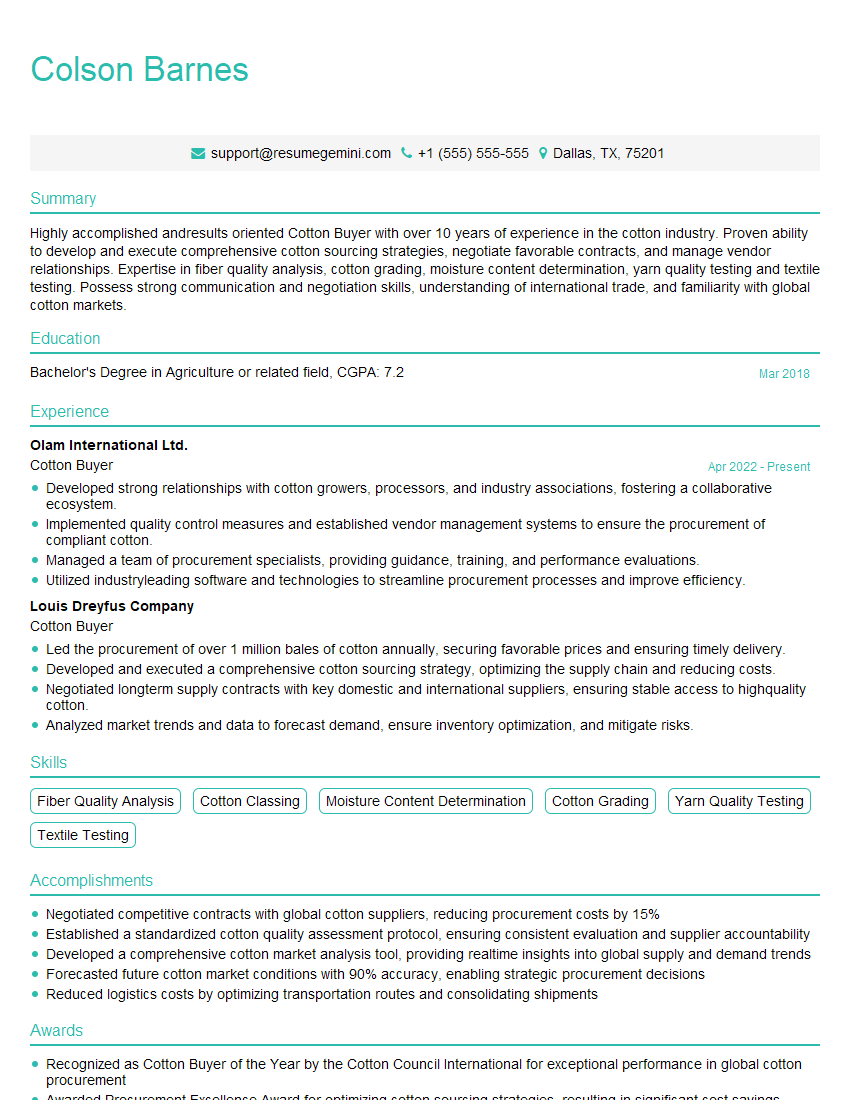
Mastering the complexities of the cotton industry’s strong network is crucial for career advancement. A deep understanding of these topics will significantly improve your interview performance and showcase your expertise. To further enhance your job prospects, creating an ATS-friendly resume is essential. ResumeGemini is a trusted resource that can help you build a professional and impactful resume, maximizing your chances of landing your dream role. Examples of resumes tailored to the cotton industry are available to guide you through the process.

Explore more articles
Users Rating of Our Blogs
Share Your Experience
We value your feedback! Please rate our content and share your thoughts (optional).
What Readers Say About Our Blog
Really detailed insights and content, thank you for writing this detailed article.
IT gave me an insight and words to use and be able to think of examples