The right preparation can turn an interview into an opportunity to showcase your expertise. This guide to Structural Design and Analysis interview questions is your ultimate resource, providing key insights and tips to help you ace your responses and stand out as a top candidate.
Questions Asked in Structural Design and Analysis Interview
Q 1. Explain the difference between static and dynamic analysis.
Static analysis assumes loads are applied slowly and don’t change with time, leading to a steady-state condition. Think of a building under its own weight and the weight of furniture – the loads are constant. Dynamic analysis, on the other hand, considers loads that vary with time, such as wind gusts, earthquakes, or moving vehicles. This variation introduces inertia effects, significantly impacting the structure’s response.
For example, designing a bridge for static loads involves calculating stresses due to the weight of the bridge and expected traffic. Dynamic analysis would be critical for the same bridge during an earthquake, considering the rapid, fluctuating forces.
The key difference lies in whether time-dependent effects are included. Static analysis is simpler and computationally cheaper, suitable for many everyday structures. Dynamic analysis, while more complex and computationally intensive, is crucial for structures subjected to significant time-varying forces.
Q 2. Describe various types of structural loads and their impact on design.
Structural loads are forces or pressures acting on a structure. They are broadly classified into:
- Dead Loads: The self-weight of the structural members (beams, columns, slabs) and any permanently attached elements (walls, finishes).
- Live Loads: Movable loads like people, furniture, equipment, vehicles, or snow accumulation. These are variable and require careful consideration in design.
- Wind Loads: Forces exerted by wind on the structure, varying in magnitude and direction. Tall buildings and bridges are particularly susceptible.
- Seismic Loads: Forces induced by earthquakes. These are dynamic loads causing significant vibrations and stresses.
- Thermal Loads: Changes in temperature cause expansion and contraction, creating stresses in the structure. Consider this for long spans or structures with materials with high coefficients of thermal expansion.
- Environmental Loads: Include rain, snow, ice, and earth pressure. Design must account for the accumulated weight and potential sliding forces.
The impact on design involves selecting appropriate materials, dimensions, and detailing to ensure the structure can safely withstand these loads without exceeding its capacity. Ignoring any load type can lead to catastrophic failures. For example, not accounting for wind loads in a tall building could lead to collapse, while neglecting seismic loads in an earthquake-prone region could be disastrous.
Q 3. How do you determine the appropriate safety factors for structural design?
Safety factors account for uncertainties in material properties, load estimation, analysis methods, and construction quality. They’re crucial for ensuring the structure’s reliability and longevity. The determination of appropriate safety factors is a multifaceted process that often involves:
- Building Codes and Standards: Codes like ASCE 7 (for US structures) provide guidelines and prescriptive safety factors based on load type and material properties. These factors are often expressed as load factors and resistance factors.
- Material Properties: The inherent variability of material strength is addressed through material safety factors that incorporate the likelihood of lower-than-expected strength in the actual structure. Concrete, for example, has significant variability.
- Load Estimation: Live loads are often probabilistic in nature, so load factors increase the design loads to account for the potential exceeding of the predicted loads.
- Analysis Method: Simplifications in analysis often necessitate increased safety factors to account for any conservatism in the design.
- Consequence of Failure: The severity of a potential failure influences the safety factor. Structures with high occupancy or critical function (hospitals, bridges) may require larger safety factors.
In practice, a combination of these factors dictates the appropriate safety factor. For example, a bridge design will have higher safety factors compared to a small residential building due to the higher consequence of failure. Engineering judgment plays a significant role in this decision-making process.
Q 4. What are the different methods used for analyzing indeterminate structures?
Indeterminate structures have more reactions than can be determined using static equilibrium equations alone. Several methods are used for their analysis:
- Force Method (Flexibility Method): This involves selecting redundant forces (forces beyond the minimum needed for static equilibrium). Compatibility equations are developed and solved to determine the redundant forces, then the remaining reactions and internal forces are calculated using static equilibrium.
- Displacement Method (Stiffness Method): This is more commonly used in computer-based analysis. It involves analyzing the structure’s stiffness matrix, relating displacement at each node to the applied forces. This leads to a system of equations solved to determine nodal displacements, from which member forces are obtained.
- Matrix Methods: A general approach that includes the stiffness and flexibility methods. These use matrices and computers to solve the complex system of equations that arise in the analysis of large indeterminate structures.
- Moment Distribution Method: This is an iterative method to determine member end moments in indeterminate beams and frames. It’s useful for simpler structures but becomes tedious for larger systems.
The choice of method depends on the complexity of the structure and available computational tools. For complex structures, computer-based matrix methods are preferred for efficiency and accuracy.
Q 5. Explain the concept of moment distribution method.
The moment distribution method is an iterative process for analyzing indeterminate beams and frames. It’s based on the concept of distributing fixed-end moments at joints until equilibrium is achieved.
It involves the following steps:
- Determine Fixed-End Moments (FEMs): Calculate the moments at each end of the members if they were fixed at both ends. These are initial moments.
- Calculate Distribution Factors (DFs): These factors determine the proportion of moment distributed from a joint to each member connected to it. The DF for a member is its stiffness relative to the sum of the stiffnesses of all members connected at the joint.
- Distribute Moments: Iteratively distribute the unbalanced moments at each joint to the connected members based on their DFs. This process continues until the unbalanced moments become negligible.
- Carry-Over Moments: A portion of the distributed moment is carried over to the far end of the member.
- Final Moments: After convergence, the final moments at the ends of each member are obtained. These moments are used to compute shear forces and reactions.
The method is a powerful tool for analyzing statically indeterminate structures, though it can become tedious for larger structures. The concept of distributing unbalanced moments to achieve equilibrium is central to its operation.
Q 6. What is finite element analysis (FEA) and how is it applied in structural design?
Finite Element Analysis (FEA) is a powerful numerical method for analyzing complex structures by dividing them into smaller, simpler elements (finite elements). Each element is governed by simple equations relating forces and displacements. These equations are assembled into a global system of equations solved to determine the overall behavior of the structure.
In structural design, FEA is used to:
- Determine stresses and strains: Precisely predict the stress distribution within the structure under various loading conditions.
- Analyze complex geometries: Handle intricate shapes and details not easily addressed by traditional methods.
- Model material nonlinearities: Account for complex material behavior like plasticity and creep.
- Simulate dynamic events: Analyze responses to seismic events, impacts, and vibrations.
- Optimize designs: Iteratively modify designs to improve performance, reduce weight, and minimize costs.
FEA software utilizes sophisticated algorithms and numerical techniques to solve the resulting equations, producing detailed results visualized through various graphical representations.
Q 7. What are the advantages and disadvantages of using FEA?
FEA offers several advantages:
- Accuracy: Provides highly accurate results for complex structures and loading scenarios.
- Versatility: Applicable to a wide range of materials, geometries, and load conditions.
- Efficiency: Can analyze large and complex structures more efficiently than manual methods.
- Visualization: Provides clear graphical visualizations of stress, strain, and displacement.
However, there are some limitations:
- Computational cost: Can be computationally expensive for very large or complex models.
- Model dependence: Accuracy is dependent on the quality and accuracy of the finite element model, requiring expertise in mesh generation and element selection.
- Software expertise: Requires specialized knowledge and software to perform FEA effectively.
- Interpretation: Interpreting FEA results correctly requires engineering judgment and experience.
Despite its limitations, FEA remains an invaluable tool for modern structural design, providing insights that improve safety, efficiency, and performance.
Q 8. Describe different types of structural elements (beams, columns, etc.) and their behavior under load.
Structural elements are the building blocks of any structure. They each behave differently under load. Let’s explore some common types:
- Beams: These are horizontal members designed primarily to resist bending moments and shear forces caused by transverse loads (loads applied perpendicular to their axis). Imagine a wooden plank bridging a gap – that’s a beam. Under load, a beam bends, experiencing both tensile stresses (stretching) on one side and compressive stresses (squashing) on the other.
- Columns: These are vertical members primarily designed to resist axial compressive loads (loads applied along their axis). Think of the pillars supporting a porch roof. Under load, a column primarily shortens, experiencing compressive stress throughout its length. Long columns are susceptible to buckling (more on that later).
- Walls: These act as both beams (resisting lateral loads) and columns (resisting gravity loads). They’re often made of masonry, concrete, or framed construction. Their behavior under load is complex, often analyzed using finite element methods.
- Girders: These are large, main beams often used to support smaller beams or floors. They act similarly to beams but handle larger loads and spans.
- Trusses: These are structures composed of interconnected members forming a triangulated system. They are extremely efficient in transferring loads and are frequently used in bridges and roofs. Each member in a truss is subjected to either tension or compression.
Understanding the behavior of each element under load is crucial for safe and efficient structural design. We use analysis techniques to determine the stresses and deflections in these elements and ensure they remain within acceptable limits.
Q 9. How do you account for seismic loads in structural design?
Seismic loads, caused by earthquakes, are dynamic and unpredictable. Accounting for them is critical for ensuring structural safety in seismically active regions. This involves several key steps:
- Seismic Hazard Analysis: Determining the likelihood and intensity of earthquakes at the site. This relies on geological data and historical earthquake records.
- Structural Analysis: Performing dynamic analysis to assess the structure’s response to ground motions. This often involves sophisticated computer modeling and simulations that account for the structure’s mass, stiffness, and damping properties.
- Design for Ductility: Designing the structure to withstand significant deformations without collapsing. This usually involves the use of ductile materials like reinforced concrete or structural steel, allowing for controlled energy dissipation during an earthquake.
- Seismic Load Combination: Combining seismic loads with other loads (dead, live, wind) according to relevant building codes. Building codes provide detailed procedures and factors of safety for seismic design.
- Detailing for Seismic Resistance: Careful detailing of connections between structural elements is essential to ensure that they behave as intended during seismic events. This includes using strong, flexible connections that can absorb energy without premature failure.
For instance, base isolation systems or damping devices are employed in critical structures to further reduce seismic effects. The goal is not necessarily to prevent damage entirely but to design for a specific level of acceptable performance during an earthquake, ensuring the safety of occupants.
Q 10. Explain the concept of buckling and how to prevent it.
Buckling is a sudden and catastrophic failure mode that occurs in slender compression members. Imagine a drinking straw: if you push on it hard enough, it doesn’t simply crush, it buckles—it bends sideways and collapses. This is because the compressive stress exceeds the member’s critical buckling stress.
Several factors influence buckling:
- Slenderness Ratio: The ratio of the member’s length to its cross-sectional dimension. Longer and thinner members are more susceptible to buckling.
- Material Properties: The material’s modulus of elasticity (E) plays a significant role. Higher E means higher resistance to buckling.
- End Conditions: How the member is supported at its ends significantly affects its buckling resistance. Fixed ends provide higher resistance than pinned ends.
Preventing buckling involves:
- Increasing the member’s cross-sectional area: A larger cross-section increases the moment of inertia, making it more resistant to buckling.
- Reducing the member’s length: Shorter members are less susceptible to buckling.
- Using bracing or lateral supports: These restrain the member’s lateral movement, preventing buckling.
- Using high-strength materials: Materials with higher yield strength and modulus of elasticity offer improved buckling resistance.
Engineers use various equations and design charts, based on Euler’s buckling formula and modifications thereof, to determine the critical buckling load for different scenarios and ensure the design is safe.
Q 11. What are the common failure modes in structural components?
Structural components can fail in several ways, depending on the material, loading, and design. Here are some common failure modes:
- Yielding: The material undergoes permanent deformation after exceeding its yield strength. Imagine bending a paperclip – once it’s bent, it stays bent. This is a ductile failure.
- Fracture: The material breaks completely, often exhibiting brittle behavior with little to no prior deformation. Think of a glass breaking. This is a brittle failure.
- Buckling: As discussed earlier, this involves lateral instability and sudden collapse of slender compression members.
- Fatigue: Failure due to repeated cyclic loading. This happens gradually and even relatively small loads can cause failure if repeated many times. Think of a metal component repeatedly vibrating.
- Creep: Slow, time-dependent deformation of a material under sustained load, particularly at high temperatures. This is a common concern in some materials used in high-temperature environments.
- Shear Failure: Failure due to shear stresses that exceed the material’s shear strength. Imagine cutting a piece of wood with a saw, where failure occurs along the plane of the shear force.
Understanding these failure modes is crucial for proper material selection, design, and construction practices to prevent structural collapse.
Q 12. Describe various methods used for designing reinforced concrete structures.
Designing reinforced concrete structures involves several methods, all aiming to ensure adequate strength, serviceability, and durability:
- Working Stress Method: A traditional method that designs based on allowable stresses for both concrete and steel. It’s relatively simple but less accurate than modern methods.
- Ultimate Strength Method (Limit State Design): The most common modern method, designing to resist ultimate loads before failure. It employs load factors and resistance factors to account for uncertainties in loads and material properties. This ensures a safety margin is built into the design.
- Strength Reduction Factor Design: A variant of the ultimate strength method that uses specific reduction factors (φ-factors) to account for material variability and construction uncertainties. This method is widely adopted in many building codes.
- Finite Element Analysis (FEA): This sophisticated computational method allows for detailed analysis of complex structures, considering non-linear material behavior and load distribution. This is particularly valuable for complex geometries and unusual loading conditions.
Regardless of the chosen method, proper detailing of reinforcement placement and concrete cover is critical. This ensures the concrete protects the steel from corrosion and provides effective composite action between the two materials. Ensuring proper concrete quality control is also very important to avoid strength deficiencies.
Q 13. How do you select appropriate materials for structural design?
Material selection for structural design is a crucial decision based on several factors:
- Strength and Stiffness: The material’s capacity to resist stresses and deformations under load. Steel is stronger than wood, for instance.
- Durability and Serviceability: The material’s resistance to environmental factors like corrosion or decay and its ability to maintain functionality over time. Stainless steel offers better corrosion resistance than carbon steel.
- Cost and Availability: Balancing the performance requirements with budget and material availability in the region.
- Sustainability: Considering the environmental impact of material production and disposal. Using recycled materials or those with lower embodied carbon emissions is becoming increasingly important.
- Fire Resistance: The material’s ability to withstand fire without losing structural integrity. Concrete and certain types of steel offer good fire resistance.
For example, in areas prone to earthquakes, ductile materials like reinforced concrete and high-strength steel are preferred. For high-rise buildings, high-strength steel might be favored for its strength-to-weight ratio. In coastal regions, materials with high corrosion resistance might be chosen. The choice always involves a careful balance of these factors.
Q 14. Explain the concept of stress and strain.
Stress and strain are fundamental concepts in structural mechanics. They describe how a material responds to an applied load.
- Stress (σ): Stress is the intensity of the internal forces within a material caused by an external load. It’s defined as force per unit area (σ = F/A). Units are typically Pascals (Pa) or pounds per square inch (psi). Imagine pushing on a balloon—the pressure you exert creates stress in the balloon’s rubber.
- Strain (ε): Strain is the measure of the deformation caused by stress. It’s the ratio of the change in length to the original length (ε = ΔL/L). It’s a dimensionless quantity. In the balloon analogy, the stretching of the balloon’s rubber is strain.
The relationship between stress and strain is described by the material’s constitutive law (e.g., Hooke’s Law for linear elastic materials). Hooke’s Law states that stress is proportional to strain within the elastic limit (σ = Eε, where E is Young’s modulus).
Understanding stress and strain is crucial in structural analysis. Engineers use stress-strain relationships to predict how a material will behave under various loading conditions and to design structures that will safely resist the applied loads.
Q 15. What are the different types of stress (tensile, compressive, shear)?
Stress is the internal force that resists deformation within a material. It’s essentially how much the material is being ‘pushed’ or ‘pulled’ internally. There are three main types:
- Tensile Stress: This occurs when a material is pulled or stretched apart. Think of a rubber band being stretched – the rubber experiences tensile stress. In structural engineering, we see this in elements like cables, tendons, and some parts of beams under bending.
- Compressive Stress: This is the opposite of tensile stress. It happens when a material is squeezed or compressed. Imagine stacking bricks – each brick experiences compressive stress from the weight of the bricks above. Columns in buildings primarily experience compressive stress.
- Shear Stress: This occurs when forces act parallel to a surface, causing parts of the material to slide past each other. Imagine cutting a piece of paper with scissors – the paper experiences shear stress along the cutting line. Rivets and welds in structures are subjected to shear stresses.
Understanding these stress types is crucial for designing safe and efficient structures. We use different materials and design strategies based on whether the material is strong in tension, compression, or shear.
Career Expert Tips:
- Ace those interviews! Prepare effectively by reviewing the Top 50 Most Common Interview Questions on ResumeGemini.
- Navigate your job search with confidence! Explore a wide range of Career Tips on ResumeGemini. Learn about common challenges and recommendations to overcome them.
- Craft the perfect resume! Master the Art of Resume Writing with ResumeGemini’s guide. Showcase your unique qualifications and achievements effectively.
- Don’t miss out on holiday savings! Build your dream resume with ResumeGemini’s ATS optimized templates.
Q 16. How do you account for soil-structure interaction in your analysis?
Soil-structure interaction (SSI) accounts for the influence of the ground on the structural behavior of a building or other structure. Ignoring SSI can lead to inaccurate predictions of the structural response. We account for SSI in our analysis through several methods:
- Spring-Mass System: We can model the soil as a series of springs with specific stiffness values (based on soil type and properties) connected to the structure’s foundation. This simplified model captures the soil’s ability to deflect and transfer forces.
- Finite Element Analysis (FEA): For more complex scenarios, we use FEA software like ABAQUS or ANSYS to model both the soil and the structure as interconnected elements. This allows us to capture more detailed interactions and non-linear soil behavior.
- Substructuring: This technique divides the problem into two substructures: the soil and the structure. The interaction between them is then solved using appropriate boundary conditions.
The choice of method depends on the complexity of the project and the desired accuracy. For example, a simple building on relatively uniform soil might be adequately analyzed using a spring-mass model, whereas a large dam or a high-rise building near a fault line would demand a sophisticated FEA approach.
Q 17. Explain the concept of deflection and its limitations.
Deflection refers to the displacement or deformation of a structural member under load. Imagine a diving board bending when someone stands on it – that bend is deflection. It’s essential for ensuring structural safety and serviceability.
However, deflection has limitations. Excessive deflection can cause:
- Aesthetic Issues: Excessive deflection can make a structure look unsightly or unfunctional. For example, a floor sagging too much can be visually displeasing.
- Functional Problems: Excessive deflection can impede the intended use of the structure. A significantly deflected floor might be unsafe to walk on.
- Cracking: Large deflections can cause cracking in non-structural elements such as finishes, partitions, and cladding.
- Structural Damage: In extreme cases, large deflections can lead to structural failure.
Design codes typically specify allowable deflection limits to prevent these problems. We use analysis techniques to ensure the calculated deflections remain within acceptable ranges.
Q 18. What are the key design considerations for high-rise buildings?
Designing high-rise buildings presents unique challenges requiring careful consideration of several factors:
- Wind Loads: High-rise buildings are significantly impacted by wind. The design must account for wind pressure, vortex shedding, and wind-induced vibrations.
- Seismic Loads: High-rise buildings are vulnerable to earthquakes. The structure must be designed to withstand seismic forces and prevent collapse.
- Material Selection: Choosing appropriate materials with high strength-to-weight ratios is crucial to minimize the weight of the structure and manage material costs.
- Structural System: The choice of structural system (e.g., braced frames, shear walls, outrigger systems) significantly impacts the building’s ability to withstand loads. The selection is often optimized for specific site conditions and building configurations.
- Foundation Design: High-rise buildings require robust foundations capable of transferring the significant weight and loads to the underlying soil.
- Serviceability: Ensuring that the building remains functional and comfortable for occupants during normal use is critical, including considerations for drift (lateral movement), vibrations, and deflection.
High-rise design involves complex interactions between various structural elements and environmental factors. Experienced engineers and advanced analysis techniques are crucial for ensuring structural integrity and safety.
Q 19. How do you handle wind loads in structural design?
Handling wind loads in structural design is critical, especially for tall buildings. We typically use these approaches:
- Wind Load Calculations: We use design codes and wind engineering standards (e.g., ASCE 7) to determine the wind pressures and forces acting on the building based on location, building height, and shape. This involves considering factors such as wind speed profiles, terrain roughness, and building’s aerodynamic characteristics.
- Aerodynamic Modeling: For complex building shapes, wind tunnel testing is employed to determine the wind pressures and forces more accurately. This experimental data is then used to refine the structural design.
- Structural Design: The calculated wind loads are used to design the structure’s elements, ensuring sufficient strength and stiffness to resist the wind forces. This often involves incorporating features like wind bracing, shear walls, or tuned mass dampers to mitigate wind-induced vibrations.
- Dynamic Analysis: For taller buildings, dynamic analysis (which accounts for the structure’s natural frequencies and response to fluctuating wind loads) is performed to prevent resonance and excessive vibrations.
The goal is to design a structure that can safely withstand the expected wind loads without experiencing unacceptable deflections or vibrations.
Q 20. Describe your experience with different structural analysis software (e.g., SAP2000, ETABS, ABAQUS).
I have extensive experience using various structural analysis software packages. My proficiency includes:
- SAP2000: I use SAP2000 extensively for the analysis and design of various structures, including buildings, bridges, and industrial facilities. It excels in static and dynamic analysis, offering a user-friendly interface with robust capabilities.
- ETABS: Similar to SAP2000, ETABS is a powerful tool for building analysis and design, particularly for high-rise structures. Its features for seismic analysis and pushover analysis are particularly useful.
- ABAQUS: For more complex and non-linear analyses, I utilize ABAQUS. Its finite element capabilities are invaluable when dealing with intricate geometries, material nonlinearities, and soil-structure interaction.
My expertise with these software packages enables me to select the most appropriate tool for each project, ensuring efficient and accurate analysis.
Q 21. Explain your approach to solving a complex structural design problem.
My approach to solving complex structural design problems involves a systematic and iterative process:
- Problem Definition: Clearly define the project’s objectives, constraints, and requirements. This includes understanding the intended use, environmental conditions, and regulatory guidelines.
- Preliminary Design: Develop an initial structural concept based on experience and best practices. Consider different structural systems and material options.
- Analysis and Modeling: Use appropriate software to create a detailed structural model and perform analysis to evaluate the structure’s response under various loading conditions. This involves selecting the right analysis method, applying loads appropriately, and ensuring accuracy of the model.
- Design Optimization: Refine the design based on the analysis results. This may involve adjusting member sizes, changing materials, or modifying the structural layout to meet design requirements and minimize costs.
- Code Compliance: Ensure the design meets all relevant building codes and standards. This involves checking for compliance with requirements for strength, serviceability, and stability.
- Detailing and Documentation: Prepare detailed construction drawings and specifications. This ensures that the structure is built as intended and that all necessary information is available for construction.
- Review and Iteration: Continuously review the design throughout the process, making adjustments and iterations as needed. This iterative approach enhances design quality and ensures a robust final product.
Throughout this process, communication and collaboration with other members of the design team are essential to ensure a successful project.
Q 22. What is the importance of code compliance in structural design?
Code compliance in structural design is paramount for ensuring public safety and the structural integrity of buildings. It’s essentially a set of rules and regulations designed to minimize risks and prevent failures. These codes, such as the International Building Code (IBC) and the American Concrete Institute (ACI) code, specify minimum acceptable standards for materials, design procedures, construction methods, and safety factors. Non-compliance can lead to serious legal ramifications, financial losses, and, most importantly, potential loss of life.
Think of it like a recipe for a building: the code provides the essential ingredients and instructions to ensure a structurally sound and safe outcome. Deviation from the recipe could lead to a disastrous result.
Q 23. Describe your experience working with building codes (e.g., IBC, ACI).
I’ve extensively worked with various building codes, including the IBC and ACI 318, throughout my career. My experience involves not only understanding the code requirements but also applying them effectively in the design process. For instance, in a recent high-rise project, I used the IBC’s wind load provisions to determine the appropriate design loads for the structure, ensuring it could withstand extreme weather conditions. Similarly, when designing reinforced concrete columns for a multi-story building, I meticulously followed ACI 318’s detailed stipulations on concrete strength, reinforcement detailing, and spacing. This involved using software like ETABS or SAP2000 to perform the necessary analyses and ensure compliance with all relevant sections of the code.
My experience also includes navigating code interpretations and resolving ambiguities, something that frequently arises in complex projects. I am comfortable researching and interpreting the code to address specific situations, often by consulting authoritative references and collaborating with other engineers and code officials.
Q 24. How do you manage and prioritize multiple structural design projects?
Managing multiple projects requires a structured approach. I utilize project management software to track deadlines, tasks, and resources. I prioritize projects based on urgency, deadlines, and client requirements. This often involves a combination of techniques like the MoSCoW method (Must have, Should have, Could have, Won’t have) to prioritize features and tasks within each project. I also regularly communicate with clients and team members to ensure everyone is informed and aligned on progress and any changes. Delegating tasks effectively to team members is also crucial, while still maintaining oversight and quality control.
For example, I might focus on a project with an impending deadline, while concurrently managing tasks for a less urgent project in parallel. This balanced approach helps to maintain efficiency without compromising on the quality of work across all projects.
Q 25. How do you ensure the accuracy and efficiency of your structural analyses?
Accuracy and efficiency in structural analysis are paramount. I ensure accuracy through a multi-pronged approach: first, careful modeling of the structure in finite element analysis software like ETABS or SAP2000. This includes detailed consideration of geometry, material properties, boundary conditions, and load combinations. Secondly, I meticulously review the results of the analysis, focusing on stress, deflection, and other critical parameters to identify any potential issues or inconsistencies. Peer reviews of models and analysis results from colleagues are also essential.
Efficiency is achieved through optimized modeling techniques, efficient use of software features, and automation where possible. For instance, I develop and utilize custom scripts or macros to automate repetitive tasks, minimizing manual input and potential errors. Utilizing parametric modeling techniques allows me to quickly assess various design alternatives and optimize the design for efficiency and cost-effectiveness.
Q 26. Explain your experience with structural detailing and documentation.
My experience in structural detailing and documentation involves producing clear, concise, and accurate drawings and specifications. I use AutoCAD and other specialized drafting software to create detailed shop drawings, including reinforcement details, connection details, and foundation plans. These drawings are essential for the construction team to understand and build the structure as intended. The documentation process includes preparing detailed specifications for materials, construction methods, and quality control measures.
Maintaining consistent and accurate documentation is critical to avoid ambiguities and potential errors during construction. I employ standardized detailing practices and utilize a robust quality control process, including internal reviews and checks, to ensure the accuracy and completeness of all documentation.
Q 27. Describe your knowledge of different construction methods and their impact on structural design.
Understanding various construction methods is crucial for effective structural design. Different methods, such as cast-in-place concrete, precast concrete, steel framing, and timber framing, have unique characteristics that impact the design process. For example, the design of a steel frame structure will differ significantly from a reinforced concrete structure in terms of load paths, member sizes, and connection details. Precast concrete elements require careful consideration of transportation and erection procedures during the design phase. Similarly, timber structures need to account for the unique behavior of wood under load, considering factors like creep and shrinkage.
In practice, I assess each project’s constraints and advantages to recommend the most suitable construction method. This involves considering factors like cost, schedule, constructability, and the availability of skilled labor.
Q 28. How do you handle unexpected challenges or problems during a project?
Handling unexpected challenges requires a proactive and systematic approach. I begin by thoroughly assessing the nature and scope of the problem. This may involve site visits, consultations with other engineers, and a review of available data. Once the problem is understood, I develop a range of potential solutions, carefully evaluating their feasibility, cost-effectiveness, and impact on the overall project. This involves creative problem-solving and leveraging my experience to find innovative approaches. Finally, the solution is implemented and closely monitored, incorporating lessons learned into future projects to prevent similar problems.
For example, if unforeseen soil conditions are encountered during excavation, I may collaborate with a geotechnical engineer to modify the foundation design to accommodate the new circumstances, ensuring the stability and safety of the structure. Effective communication with clients and the construction team is crucial throughout this process to manage expectations and maintain transparency.
Key Topics to Learn for Structural Design and Analysis Interview
- Statics and Equilibrium: Understanding forces, moments, and reactions in structural systems. Practical application: Analyzing loads on a simple beam.
- Stress and Strain Analysis: Comprehending stress-strain relationships, material properties (e.g., Young’s modulus, Poisson’s ratio), and failure theories. Practical application: Determining the stress distribution in a pressure vessel.
- Structural Analysis Methods: Mastering techniques like method of joints, method of sections, influence lines, and matrix methods. Practical application: Analyzing a truss bridge for maximum load capacity.
- Beam Theory: Understanding bending moments, shear forces, deflection, and beam design considerations. Practical application: Designing a simply supported beam for a specific load.
- Column Design: Knowledge of buckling, critical loads, and column design codes. Practical application: Selecting appropriate columns for a multi-story building.
- Finite Element Analysis (FEA): Familiarity with FEA software and its application in structural analysis. Practical application: Modeling and analyzing complex structural systems.
- Material Selection: Understanding the properties of various construction materials (steel, concrete, timber) and their suitability for different applications. Practical application: Choosing the right material for a specific structural element.
- Building Codes and Standards: Knowledge of relevant building codes and design standards (e.g., ACI, AISC). Practical application: Ensuring designs meet safety and regulatory requirements.
- Structural Dynamics: Understanding dynamic loads, vibrations, and seismic analysis. Practical application: Designing structures to withstand earthquake forces.
Next Steps
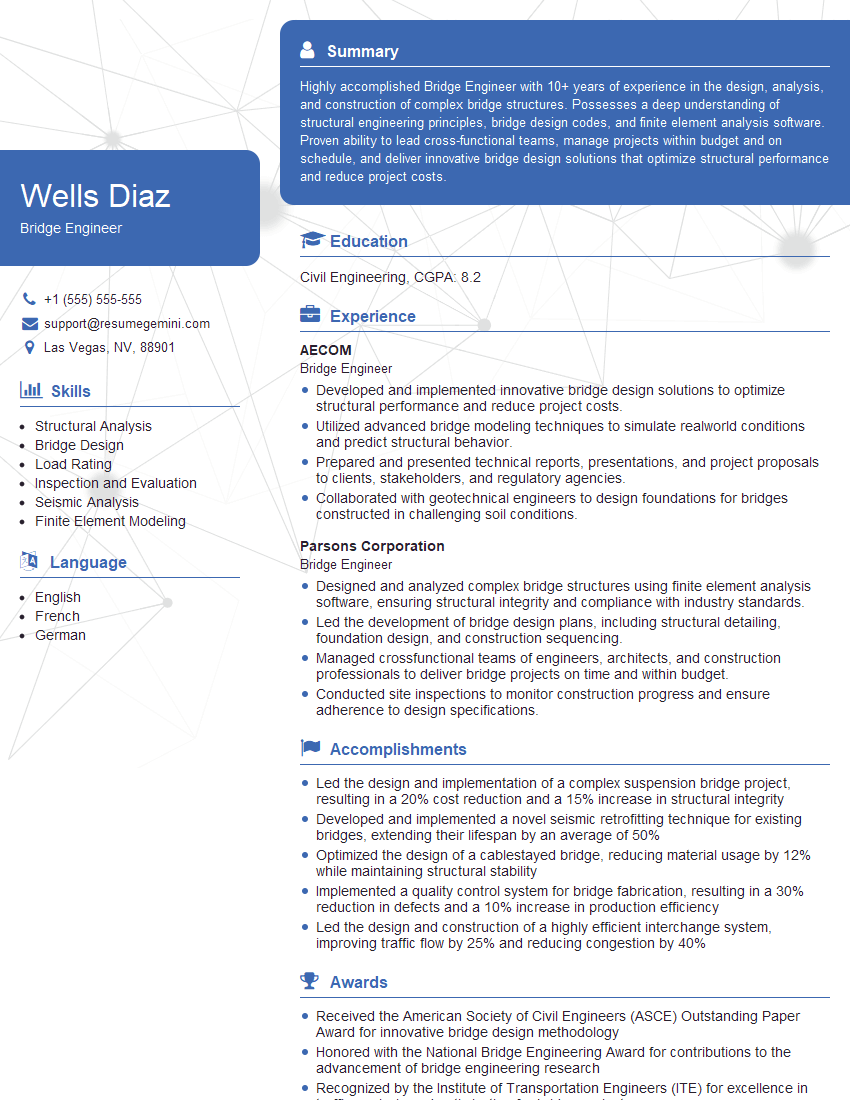
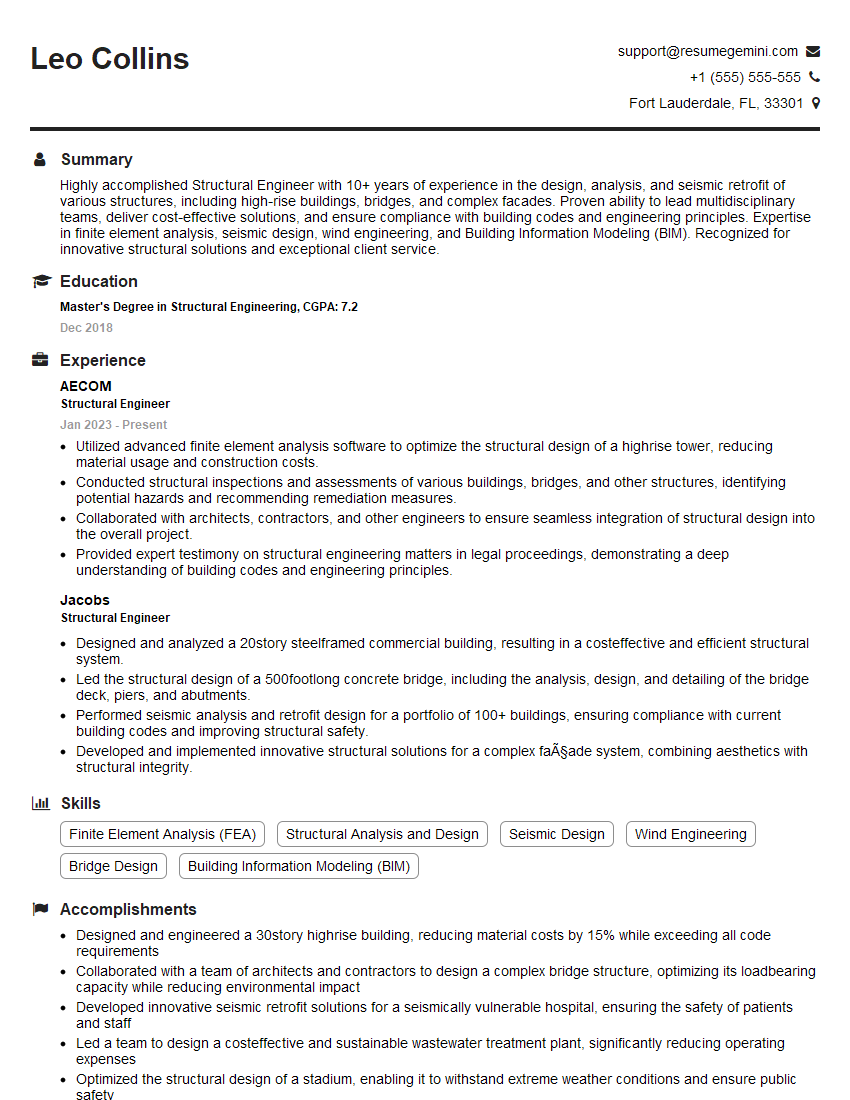
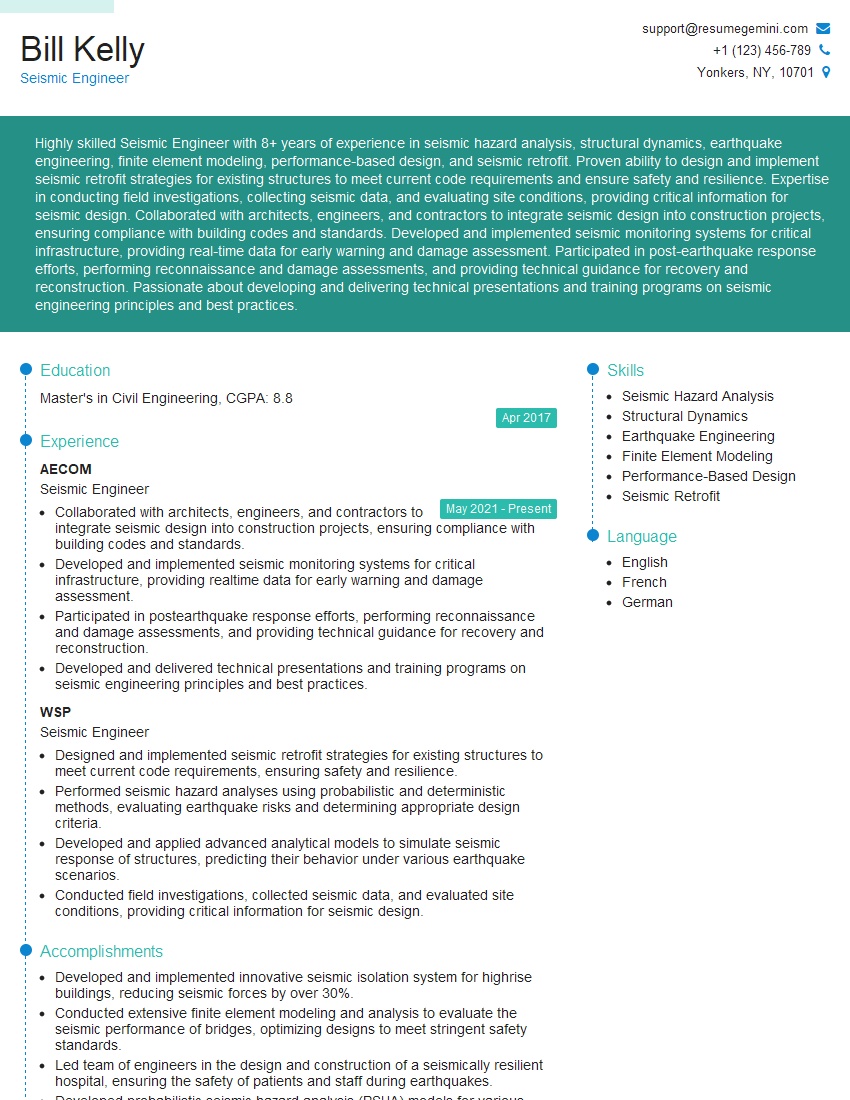
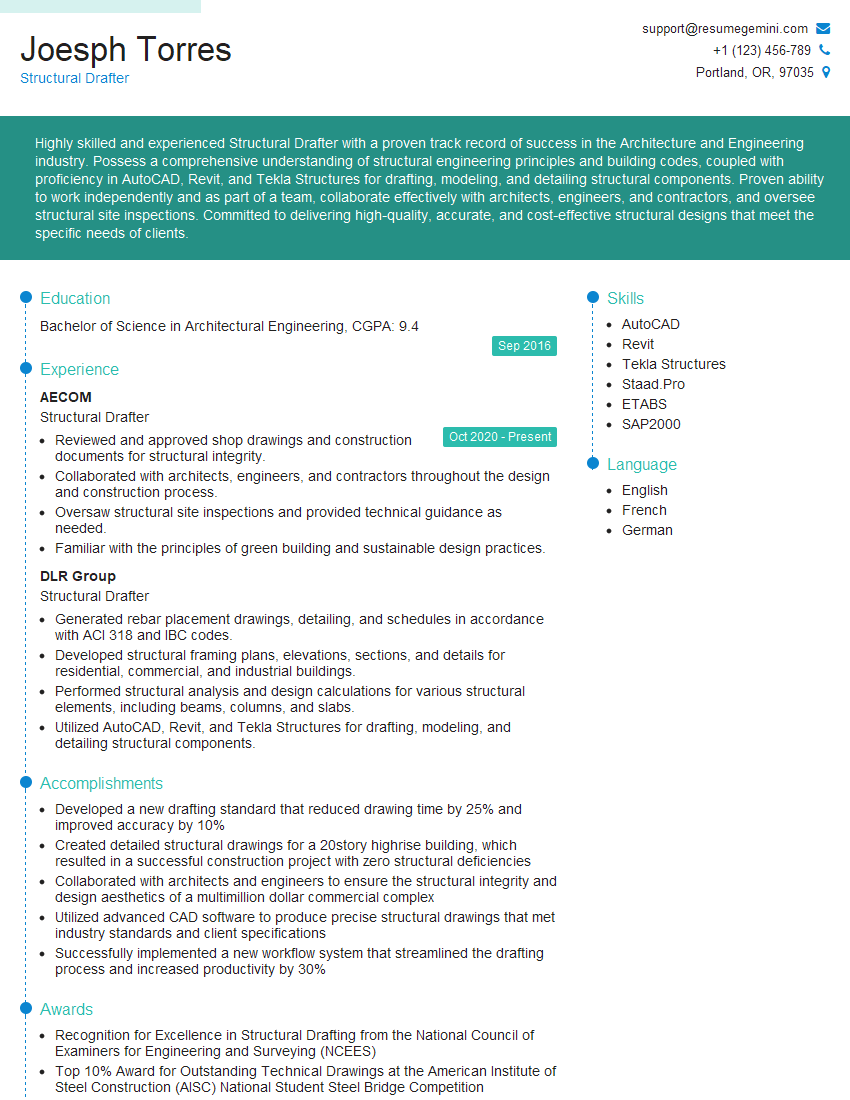
Mastering Structural Design and Analysis is crucial for a successful and rewarding career in engineering. It opens doors to diverse and challenging projects, allowing you to contribute to the design and construction of vital infrastructure. To maximize your job prospects, create an ATS-friendly resume that showcases your skills and experience effectively. ResumeGemini is a trusted resource that can help you build a professional and impactful resume. We provide examples of resumes tailored to Structural Design and Analysis to guide you through the process. Invest time in crafting a strong resume—it’s your first impression on potential employers.
Explore more articles
Users Rating of Our Blogs
Share Your Experience
We value your feedback! Please rate our content and share your thoughts (optional).
What Readers Say About Our Blog
Really detailed insights and content, thank you for writing this detailed article.
IT gave me an insight and words to use and be able to think of examples