Preparation is the key to success in any interview. In this post, we’ll explore crucial Surveying Best Practices interview questions and equip you with strategies to craft impactful answers. Whether you’re a beginner or a pro, these tips will elevate your preparation.
Questions Asked in Surveying Best Practices Interview
Q 1. Explain the difference between a traverse and a triangulation survey.
Both traversing and triangulation are fundamental surveying techniques used to determine the relative positions of points, but they differ significantly in their approach. Think of it like this: traversing is like walking a path, measuring each step and its direction carefully, while triangulation is like using a network of carefully measured triangles to pinpoint locations.
Traversing involves measuring a series of lines (legs) and their angles to determine the positions of points. We start at a known point, measure the distance and direction to the next point, and continue this process. It’s like following a connected path. Accuracy depends heavily on the precision of both distance and angle measurements. Closing errors are a crucial consideration; a traverse should ideally close back on itself to ensure the measurements are accurate. This closure is checked using mathematical calculations.
Triangulation, on the other hand, relies on measuring angles within a network of triangles. If you know the length of one side of a triangle (a baseline), you can calculate the lengths of all other sides and the coordinates of all vertices using trigonometry. It’s inherently less susceptible to accumulated errors than traversing, particularly over long distances, because errors in angle measurement don’t accumulate in the same way.
In practice, traversing is often used for smaller-scale surveys, such as property boundary surveys, while triangulation is frequently employed for large-scale projects like control surveys for mapping large areas. Sometimes, a combination of both methods is used for optimal results.
Q 2. Describe your experience with various surveying equipment (e.g., total stations, GPS receivers).
Throughout my career, I’ve extensively used a range of surveying equipment, ensuring proficiency in their operation and data interpretation. My experience includes:
- Total Stations: I’m proficient in operating various brands of total stations, performing tasks such as setting up instruments, measuring distances and angles accurately, and conducting both horizontal and vertical control surveys. I have experience with data collection using both robotic and conventional total stations, including data transfer and processing.
- GPS Receivers: I have extensive experience with both static and kinematic GPS surveying techniques using various receivers. I understand the principles of differential GPS (DGPS) and Real-Time Kinematic (RTK) GPS, and I’m capable of setting up base stations, rover units, and processing the collected data using specialized software such as Leica Geo Office or Trimble Business Center. My experience covers post-processing techniques for improved accuracy, and I’m aware of the limitations and potential errors associated with different GPS techniques.
- Leveling Instruments and Rods: I’m adept at performing precise leveling surveys, understanding the importance of instrument setup, leveling procedures, and reading level rods accurately. I’m comfortable with both traditional optical levels and digital levels.
- Data Collectors: I’m familiar with various data collectors and their integration with total stations and GPS receivers, enabling efficient data logging and transfer. I am proficient in using their software interface to ensure data integrity.
My skills extend to performing routine maintenance and calibration checks on these instruments to ensure accuracy.
Q 3. How do you ensure accuracy and precision in your surveying work?
Ensuring accuracy and precision in surveying is paramount. My approach is multifaceted and incorporates several key strategies:
- Meticulous Instrument Calibration: Before each survey, I carefully calibrate all instruments to ensure their readings are within acceptable tolerances. This includes checking the level, collimation, and other relevant parameters for total stations and levels.
- Rigorous Field Procedures: I follow established surveying protocols, meticulously documenting all measurements and observations. This includes using appropriate field books and data collectors to minimize transcription errors.
- Redundant Measurements: Whenever possible, I employ redundant measurements, repeating critical observations to detect and account for blunders. For example, I might measure a distance multiple times and compare the readings.
- Proper Data Processing: Post-processing of the collected data is vital. I use sophisticated software packages to analyze the data, detect and adjust for systematic errors, and calculate the final coordinates with high precision. Statistical analysis is used to assess the quality of the results.
- Quality Control Checks: I regularly conduct quality control checks during and after the survey to identify and rectify any discrepancies or potential errors. This might involve comparing measurements to existing data, or performing independent checks using different methods.
Furthermore, I am always cognizant of environmental factors that may affect accuracy, such as temperature and atmospheric pressure, and account for them in my measurements and calculations.
Q 4. What are the common sources of error in surveying, and how do you mitigate them?
Numerous sources of error can affect surveying accuracy. Understanding these errors and implementing appropriate mitigation strategies is crucial.
- Instrumental Errors: These arise from imperfections in the surveying instruments themselves (e.g., misalignment of a total station). Regular calibration and maintenance minimize this.
- Personal Errors: These are errors introduced by the surveyor (e.g., incorrect reading of a measuring tape). Careful observation techniques, double-checking measurements, and using assistants where necessary help mitigate these.
- Natural Errors: These result from environmental conditions (e.g., refraction of light affecting measurements). Considering atmospheric conditions and performing surveys under favorable conditions can help.
- Systematic Errors: These are consistent errors that affect all measurements in a similar way (e.g., improperly leveled instrument). Careful instrument setup and rigorous field procedures are essential.
- Random Errors: These are unpredictable and unavoidable small errors. Reducing them requires careful measurement techniques and using statistical methods to analyze and reduce their impact.
Mitigation strategies involve a combination of careful planning, proper instrument handling, redundant measurements, thorough data processing with error adjustment, and quality control checks at every stage of the survey. For instance, if I suspect systematic error due to instrument maladjustment, recalibration or replacement of the instrument is the solution. If random errors are excessive, more measurements might be needed.
Q 5. Explain your understanding of coordinate systems (e.g., UTM, State Plane).
Coordinate systems are essential for representing locations on the Earth’s surface. Understanding them is fundamental to surveying. Two commonly used systems are:
- UTM (Universal Transverse Mercator): This system divides the Earth into 60 longitudinal zones, each spanning 6 degrees of longitude. Within each zone, a transverse Mercator projection is used to create a Cartesian coordinate system. The coordinates are represented as Easting (x) and Northing (y), along with the zone number. It’s a widely used system for large-scale mapping and geographic information systems (GIS).
- State Plane Coordinate Systems (SPCS): These systems are designed for specific states or regions within the US. They utilize various map projections (such as Lambert conformal conic or transverse Mercator) tailored to minimize distortion within each state’s boundaries. Coordinates are given as Easting and Northing. They offer higher accuracy within a smaller geographical area than UTM.
Choosing the appropriate coordinate system is critical for accuracy. The choice depends on the project’s size and location. For instance, if I’m surveying a large area spanning multiple states, UTM would be suitable. However, for a small-scale survey within a single state, State Plane coordinates would often be preferred for superior accuracy.
Understanding datum transformations is also critical because different coordinate systems reference different datums (models of the Earth). Accurate transformations are crucial when working with data from different sources.
Q 6. How do you handle conflicting survey data?
Conflicting survey data is a challenge that requires careful investigation and resolution. My approach involves a structured process:
- Data Verification: I begin by carefully verifying the source and quality of the conflicting data. This includes checking the date of the surveys, the methods used, and the accuracy of the measurements. Who created the data? What equipment did they use? What are their stated accuracies?
- Field Investigation: If the discrepancies are significant, I might conduct a field investigation to gather additional data and identify the source of the conflict. This could involve re-establishing control points or making additional measurements.
- Data Reconciliation: Using appropriate software and techniques, I analyze the conflicting data, taking into account the relative accuracy and reliability of each dataset. If possible, I search for common control points to facilitate comparison.
- Resolution Strategy: Based on my findings, I develop a resolution strategy. This might involve accepting one dataset as more reliable, combining data through adjustment techniques, or rejecting unreliable data based on supporting evidence. I document the rationales clearly.
- Documentation: The entire process, including the data analysis and resolution strategy, is thoroughly documented. This is essential for transparency and accountability. It might lead to further investigation or refinement of procedures in the future.
Often, a professional judgment is involved in resolving conflicts, balancing accuracy, reliability, and the potential legal implications of the decision. The final reconciled data must be justified, well-documented, and defensible.
Q 7. Describe your experience with data processing and adjustment techniques.
Data processing and adjustment techniques are essential for transforming raw survey data into precise, reliable coordinates. My experience encompasses:
- Least Squares Adjustment: This is a powerful statistical method used to adjust survey data to minimize the overall errors. It accounts for the inherent uncertainties in measurements and produces the most probable coordinates. I’m proficient in using software packages that implement least squares adjustments.
- Traverse Computations: I’m adept at performing traverse computations, calculating coordinates and checking for closure errors. This involves applying trigonometry and coordinate geometry to determine the positions of points within a traverse network.
- Coordinate Transformations: I’m familiar with coordinate transformation techniques, which are used to convert coordinates from one coordinate system to another (e.g., UTM to State Plane). I’m skilled in applying Helmert transformations and other relevant methods.
- Error Analysis: A critical aspect of data processing is analyzing the errors in the data. I perform statistical analyses to determine the accuracy and precision of the survey results and identify potential sources of error.
- Software Proficiency: I’m proficient in using various software packages such as AutoCAD Civil 3D, Leica Geo Office, Trimble Business Center, and other relevant GIS software for data processing and analysis.
Data processing is iterative; the results are often checked and adjusted to ensure the final outputs meet the required accuracy standards. This iterative process requires attention to detail and a thorough understanding of the data’s strengths and weaknesses.
Q 8. What software are you proficient in (e.g., AutoCAD Civil 3D, ArcGIS)?
My proficiency in surveying software is extensive. I’m highly skilled in AutoCAD Civil 3D, utilizing its features for design, drafting, and data management in various surveying projects. This includes creating surface models, performing volume calculations, and generating detailed plans and profiles. I also have considerable experience with ArcGIS, specifically in geoprocessing, spatial analysis, and creating maps for visualization and data presentation. I’m comfortable importing and exporting data between these platforms, ensuring seamless workflows. Furthermore, I’m familiar with other relevant software like Trimble Business Center for post-processing GPS data and various total station data processing software. This breadth of software experience allows me to adapt to various project requirements and optimize efficiency.
Q 9. Explain your understanding of surveying legal principles and regulations.
Understanding surveying legal principles and regulations is paramount. This includes a thorough knowledge of land tenure systems, property boundaries, easements, and rights-of-way. I understand the importance of accurate boundary surveys and the legal ramifications of errors. I am familiar with relevant legislation and case law pertinent to surveying practices within my region, and I always adhere to the highest ethical standards and professional codes of conduct. For example, I meticulously document all survey procedures and data, ensuring complete transparency and traceability. Proper adherence to local and national regulations ensures legal compliance and protects clients’ interests. My experience includes working with legal professionals to resolve boundary disputes and provide expert testimony when required. This careful approach minimizes risk and guarantees projects are executed legally and ethically.
Q 10. How do you manage a surveying project from start to finish?
Managing a surveying project involves a structured, multi-stage process. It begins with a thorough review of project specifications, including scope, deliverables, and timelines. Next, I develop a detailed project plan, outlining tasks, responsibilities, and resource allocation. This includes procuring necessary equipment, coordinating with clients and other stakeholders, and establishing clear communication channels. On-site fieldwork follows, adhering to strict quality control protocols. Post-processing includes data analysis, error detection, and report generation. Finally, deliverables are reviewed and submitted to the client. Throughout the entire process, effective communication and risk management are crucial. For instance, on a recent large-scale topographic survey, a proactive risk assessment identified potential delays due to weather. Implementing contingency plans involving alternative surveying techniques ensured project completion on schedule. This organized approach guarantees project success and client satisfaction.
Q 11. Describe your experience with different types of surveys (e.g., boundary, topographic, construction).
My experience encompasses a wide range of survey types. Boundary surveys are a cornerstone of my practice, where I’ve utilized GPS, total stations, and deed research to establish accurate property lines. I’ve completed numerous topographic surveys, employing various techniques to generate detailed contour maps and digital terrain models (DTMs) for construction planning, site development, and environmental studies. Construction surveying is another area of expertise; I regularly provide layout services for buildings, roads, and utilities, ensuring precise placement and alignment. I’ve also conducted as-built surveys, verifying the construction’s accuracy against the design plans. Each survey type requires specialized techniques and equipment selection, and my adaptability allows me to handle diverse projects effectively. For example, while conducting a large-scale subdivision boundary survey, we faced challenges with difficult terrain. We adapted our methodology using RTK GPS to efficiently navigate challenging areas, ensuring accuracy and completing the project on time.
Q 12. How do you ensure the safety of yourself and your crew on a surveying site?
Safety is my top priority on every surveying site. This begins with a thorough site-specific risk assessment, identifying potential hazards like traffic, uneven terrain, overhead power lines, and environmental factors. I ensure all crew members receive proper safety training and use appropriate personal protective equipment (PPE), including high-visibility clothing, safety helmets, and eye protection. Regular safety briefings are conducted before and during fieldwork, highlighting specific hazards and safe work practices. Clear communication protocols and emergency procedures are established. I also utilize appropriate signage and traffic control measures in public areas. Furthermore, I’m familiar with emergency response protocols and have experience working with emergency services if required. A culture of safety is actively promoted, empowering team members to identify and report any unsafe conditions.
Q 13. What is your experience with using RTK GPS?
I have extensive experience using Real-Time Kinematic (RTK) GPS systems. I’m proficient in operating and maintaining various RTK GPS receivers and base stations, including data collection, post-processing, and quality control. This includes understanding the principles of differential GPS (DGPS) and how to optimize the accuracy of RTK measurements. I’m also experienced in managing RTK networks and troubleshooting potential issues, such as signal interference and antenna configuration. RTK GPS has significantly improved the efficiency and accuracy of my work, especially in large-scale projects. For example, on a recent linear infrastructure project, RTK GPS allowed us to accurately establish control points and collect data significantly faster than traditional methods, resulting in significant time and cost savings.
Q 14. Explain your knowledge of different types of leveling techniques.
Leveling is fundamental to surveying, and I’m well-versed in various techniques. This includes using traditional leveling instruments like automatic levels and leveling rods to establish benchmark elevations and create level lines. I understand the importance of proper instrument setup, reading techniques, and error correction. Moreover, I have experience with trigonometric leveling and other specialized techniques for challenging terrain. Understanding the principles of differential leveling, including calculating height differences and error propagation, is crucial. For example, on a recent project involving precise grading for a large-scale construction site, precise leveling was critical. We used a combination of automatic leveling and RTK GPS to establish a highly accurate network of benchmarks across the site, ensuring the grading met the required specifications.
Q 15. How do you handle difficult terrain during a survey?
Surveying challenging terrain requires a multi-pronged approach, prioritizing safety and accuracy. We adapt our methods based on the specific challenges. For instance, steep slopes might necessitate the use of specialized equipment like robotic total stations or even employing techniques like traversing instead of direct line of sight measurements. Dense vegetation demands careful clearing and precise instrument positioning, potentially involving GPS-RTK for improved accuracy in areas where traditional methods are unreliable. Rough or unstable ground might require the use of specialized tripods and careful consideration of instrument stability. In all cases, meticulous planning, including a thorough site reconnaissance before commencing the survey, is crucial. For example, during a recent project involving a mountainous area, we used drones for aerial photography, generating a high-resolution digital terrain model (DTM), which significantly aided in planning our ground survey and reducing the time spent in the field.
Safety is paramount. We always employ appropriate safety measures, including harnesses and safety lines in hazardous areas, adhering strictly to safety regulations and company protocols. Proper communication and teamwork are essential in navigating complex terrain, ensuring all team members understand the plan and potential hazards. We use a combination of ground control points and GPS techniques for maximum accuracy and redundancy.
Career Expert Tips:
- Ace those interviews! Prepare effectively by reviewing the Top 50 Most Common Interview Questions on ResumeGemini.
- Navigate your job search with confidence! Explore a wide range of Career Tips on ResumeGemini. Learn about common challenges and recommendations to overcome them.
- Craft the perfect resume! Master the Art of Resume Writing with ResumeGemini’s guide. Showcase your unique qualifications and achievements effectively.
- Don’t miss out on holiday savings! Build your dream resume with ResumeGemini’s ATS optimized templates.
Q 16. Describe your understanding of control surveys and their importance.
Control surveys establish a network of precisely located points (control points) which serve as a framework for all subsequent surveys. They form the backbone of any larger surveying project, ensuring accuracy and consistency across the entire area. Think of them as the foundation of a building – you wouldn’t start constructing without a solid base. These points are measured with extreme precision using high-accuracy GPS equipment, total stations, and rigorous adjustment techniques. Their positions are defined in a known coordinate system, allowing all other measurements to be referenced accurately.
The importance of control surveys cannot be overstated. They are vital for:
- Accuracy: Providing a reliable reference frame minimizes error propagation throughout the project.
- Consistency: Ensures all measurements relate to a common datum, preventing discrepancies.
- Scale and Orientation: Allows for accurate mapping and plotting of features.
- Data Integration: Facilitates the seamless integration of data from different surveying methods and sources.
For instance, in a large-scale cadastral survey, a robust control network would minimize errors and ensure the boundaries are accurately determined. Failure to establish a suitable control network can lead to significant errors and expensive rework.
Q 17. How do you communicate effectively with clients and other stakeholders?
Effective communication is vital for successful surveying projects. I prioritize clear, concise, and timely communication with clients and stakeholders. This includes regular updates on progress, proactive problem-solving, and open dialogue to address concerns. I adapt my communication style to suit the audience; using technical language where appropriate with engineers and simpler terms with clients who may lack technical expertise. I believe in establishing a strong rapport based on trust and transparency.
I typically start by clearly defining project objectives and expectations with clients during initial consultations. I then provide regular progress reports, often with visual aids like maps or 3D models generated using GIS software, to maintain transparency. We use various communication channels, including email, phone calls, and in-person meetings, depending on the situation and client preferences. During the project, if unforeseen challenges arise, I immediately contact the client to discuss potential solutions, avoiding surprises and ensuring everyone is on the same page. A recent project involved frequent site visits and direct communication with the construction manager, enabling immediate adjustments based on field conditions.
Q 18. Explain your experience with using GIS software for data analysis and visualization.
I am proficient in using various GIS software packages, including ArcGIS and QGIS, for data analysis and visualization. My experience encompasses data import, geoprocessing, spatial analysis, and cartographic production. I regularly use GIS to process survey data, create thematic maps, perform spatial analysis tasks (such as proximity analysis or overlay analysis), and generate 3D models. For example, I might use ArcGIS to analyze the proximity of a proposed pipeline to environmentally sensitive areas, generating reports and maps to aid decision-making.
Example: Using Python scripting within ArcGIS to automate the process of converting survey data into a usable GIS format and generating contour lines.
Beyond the technical aspects, understanding the spatial relationships and patterns within data is crucial. GIS allows me to extract meaningful information from complex datasets, visualizing trends and patterns to support informed decisions. For example, in a land-use planning project, GIS analysis helped identify areas suitable for development while minimizing environmental impact.
Q 19. How do you manage and organize surveying data efficiently?
Efficient data management is crucial for any surveying project. My approach involves a structured system that combines field data collection with digital organization and archiving. In the field, I ensure all data is clearly labeled and metadata is meticulously recorded, including date, time, location, and instrument settings. Back in the office, this data is systematically processed, checked for errors, and stored in a structured database. I often use cloud-based solutions for data storage and backup, ensuring data security and accessibility.
I employ a standardized naming convention for all files, using a combination of project name, date, and file type. This ensures easy retrieval and organization. We also use quality control checks at every stage, from field data acquisition to final report generation, to guarantee accuracy and consistency. Software like AutoCAD Civil 3D plays a significant role in organizing and processing data efficiently, allowing for seamless integration between field data and design models.
Q 20. Describe your experience with using photogrammetry or LiDAR data.
I have considerable experience with photogrammetry and LiDAR data acquisition and processing. Photogrammetry involves using overlapping photographs to create 3D models and orthorectified images, while LiDAR uses laser pulses to measure distances and generate highly accurate point clouds. These technologies offer efficient and accurate data collection, especially in challenging terrains where traditional methods are difficult or impractical. I’m proficient in using software packages like Pix4D and Agisoft Metashape for photogrammetry processing and various LiDAR processing software packages.
For example, in a recent project to create a topographic model of a large quarry, we used LiDAR to efficiently and accurately capture the terrain data. The resulting point cloud was processed to generate a high-resolution digital elevation model (DEM), crucial for planning future mining operations. Photogrammetry has been instrumental in creating highly detailed 3D models for heritage sites and archaeological surveys, enabling detailed visual documentation and analysis without physical contact with delicate features. This method is also proving invaluable in generating high resolution 3D models for various applications such as construction progress monitoring and volume calculations.
Q 21. What are your strategies for meeting project deadlines and budgets?
Meeting project deadlines and budgets requires meticulous planning and efficient execution. My approach involves developing a detailed project plan that includes a clear scope of work, timelines, resource allocation, and budget breakdown. This plan is regularly reviewed and updated to account for any unforeseen challenges or changes. I carefully assess the required resources, including personnel, equipment, and software, and optimize the workflow to ensure efficient project delivery.
We employ tools like project management software (like MS Project or similar) to track progress and identify potential delays. Proactive communication with clients and stakeholders is critical to address issues promptly and prevent cost overruns or schedule slippages. We consistently evaluate our processes, seeking improvements and innovations to boost efficiency and reduce costs. For instance, using drones for data acquisition can significantly reduce field time and expenses, while efficient data processing using automated techniques ensures timely project completion without compromising accuracy.
Q 22. How do you deal with unexpected problems or challenges during a survey?
Unexpected problems are par for the course in surveying. My approach is methodical and prioritizes safety and data integrity. First, I assess the situation: Is it a minor setback or a significant obstacle? For example, if it’s a minor equipment malfunction (like a low battery), I have backup equipment and address it immediately. If it’s something more significant, like encountering unforeseen underground utilities not marked on plans, I halt the work, contact the relevant authorities (e.g., utility companies), and document everything thoroughly. This includes taking photos, making detailed notes, and potentially adjusting the survey plan. Communication is key; I promptly inform my clients and team of the issue and the proposed solution. I always prioritize safety – if there’s a risk, we stop work until it is mitigated. My experience dealing with varied site conditions, including challenging terrain, weather impacts and unexpected obstacles, has taught me adaptability and problem-solving skills. I’m always prepared for unforeseen circumstances, ensuring I have contingency plans to maintain project timelines and deliverables.
Q 23. Describe your experience with survey calculations and adjustments.
Survey calculations and adjustments are fundamental to my work. I’m proficient in various techniques, including least squares adjustment, coordinate geometry calculations, and traverse calculations. My experience spans various software packages such as AutoCAD Civil 3D, and Trimble Business Center. I’m adept at error detection and correction, a crucial skill to ensure accuracy in deliverables. For example, I recently worked on a large-scale land subdivision project where I had to perform extensive coordinate transformations and adjustments to integrate data from multiple surveys into a single, coherent dataset. This involved using least squares adjustment to minimize errors and ensure that the final coordinates were consistent and reliable. I’m comfortable dealing with different coordinate systems and datums, always maintaining a rigorous approach to ensure high-precision results. I also rigorously document my calculations and adjustments to ensure they are auditable and transparent.
Q 24. Explain your understanding of surveying ethics and professional conduct.
Surveying ethics and professional conduct are paramount. I adhere strictly to the highest standards of accuracy, honesty, and integrity. This means meticulously documenting all my work, maintaining client confidentiality, and adhering to relevant professional codes of conduct. I believe in transparency with my clients, clearly explaining survey limitations and potential sources of error. For instance, I would never misrepresent data or make assumptions to meet deadlines. I strive for objective and unbiased surveying practices, even if it means challenging existing assumptions or perspectives. The accuracy and reliability of survey data are critical for many aspects of our society, and I take my responsibility to uphold professional standards very seriously. Furthermore, I consistently stay updated on relevant legislation and regulations to ensure compliance.
Q 25. How do you stay up-to-date with the latest surveying technologies and techniques?
The surveying field is constantly evolving, so continuous learning is essential. I actively participate in professional development activities, attending conferences and workshops (like those offered by the American Congress on Surveying and Mapping), and pursuing relevant online courses and webinars on new technologies. I also subscribe to industry publications and actively participate in online professional communities to stay abreast of emerging techniques and best practices. I regularly evaluate new surveying software and hardware solutions to identify ways to improve efficiency and accuracy. For instance, I recently completed a course on drone surveying techniques, enabling me to offer clients a wider range of services and enhanced data acquisition methods. Keeping up to date ensures I provide my clients with the most efficient and accurate services possible.
Q 26. What are your salary expectations for this role?
My salary expectations for this role are commensurate with my experience and skills, and in line with industry standards for a professional with my qualifications and background. I’m open to discussing a competitive compensation package that reflects the scope of responsibilities and the value I bring to your organization. I am also open to discussing performance-based incentives and benefits.
Q 27. Describe a time you had to troubleshoot a surveying equipment malfunction.
During a recent boundary survey, our total station experienced an unexpected malfunction – it would not properly track the prism. My first step was to systematically troubleshoot the problem. I checked the battery levels, the connection between the total station and prism, and ensured the instrument was properly leveled. After confirming these basic aspects weren’t the issue, I consulted the instrument’s manual and contacted the equipment manufacturer’s technical support. Through this process, we discovered the internal angle encoder was faulty. As a temporary fix, and given the critical timeline, I switched to a backup total station. Following the completion of the survey using the backup equipment, we sent the malfunctioning equipment for repair, documenting the problem and maintenance. This experience highlighted the importance of having backup equipment and robust troubleshooting strategies to minimize delays.
Q 28. How would you explain a complex surveying concept to a non-technical client?
Explaining complex surveying concepts to non-technical clients requires clear, concise communication and relatable analogies. For example, if explaining a boundary survey, I might say: “Imagine your property is like a piece of cake. A boundary survey is like carefully defining the edges of that cake, so everyone knows exactly where their slice begins and ends. We use precise measurements and technology to create a legal description of your property’s boundaries.” I would then use simpler terms instead of technical jargon, avoiding terms like “geodetic coordinates” or “traverse closure.” Using visual aids like maps and diagrams is also incredibly helpful in conveying complex information in an accessible way. It’s about translating technical details into understandable language, ensuring the client understands the process and the outcome without feeling overwhelmed.
Key Topics to Learn for Surveying Best Practices Interview
- Data Acquisition and Processing: Understanding various surveying techniques (GPS, Total Station, Leveling), data collection procedures, and data processing using software like AutoCAD Civil 3D or similar.
- Accuracy and Precision: Analyzing sources of error in surveying measurements, implementing quality control measures, and understanding the importance of precision in different surveying applications (e.g., construction, land development).
- Legal and Ethical Considerations: Familiarity with surveying regulations, boundary laws, professional codes of conduct, and ethical responsibilities in data handling and reporting.
- Coordinate Systems and Projections: Knowledge of different coordinate systems (e.g., UTM, State Plane), map projections, and their impact on surveying calculations and accuracy.
- Surveying Instruments and Equipment: Practical understanding of the operation, maintenance, and limitations of common surveying instruments, including their calibration and error detection.
- Cartography and Mapping: Ability to interpret and create maps, understand map scales, and apply cartographic principles in presenting survey data.
- Problem-Solving and Decision-Making: Demonstrating the ability to analyze survey data, identify inconsistencies, troubleshoot equipment problems, and propose solutions to challenges in the field.
- Health and Safety: Understanding and adhering to safety regulations and procedures in the field, including risk assessment and mitigation.
- Specific Applications (choose relevant based on the job description): Depending on the target role, focus on specific areas like construction surveying, topographic surveying, cadastral surveying, or geospatial analysis.
Next Steps
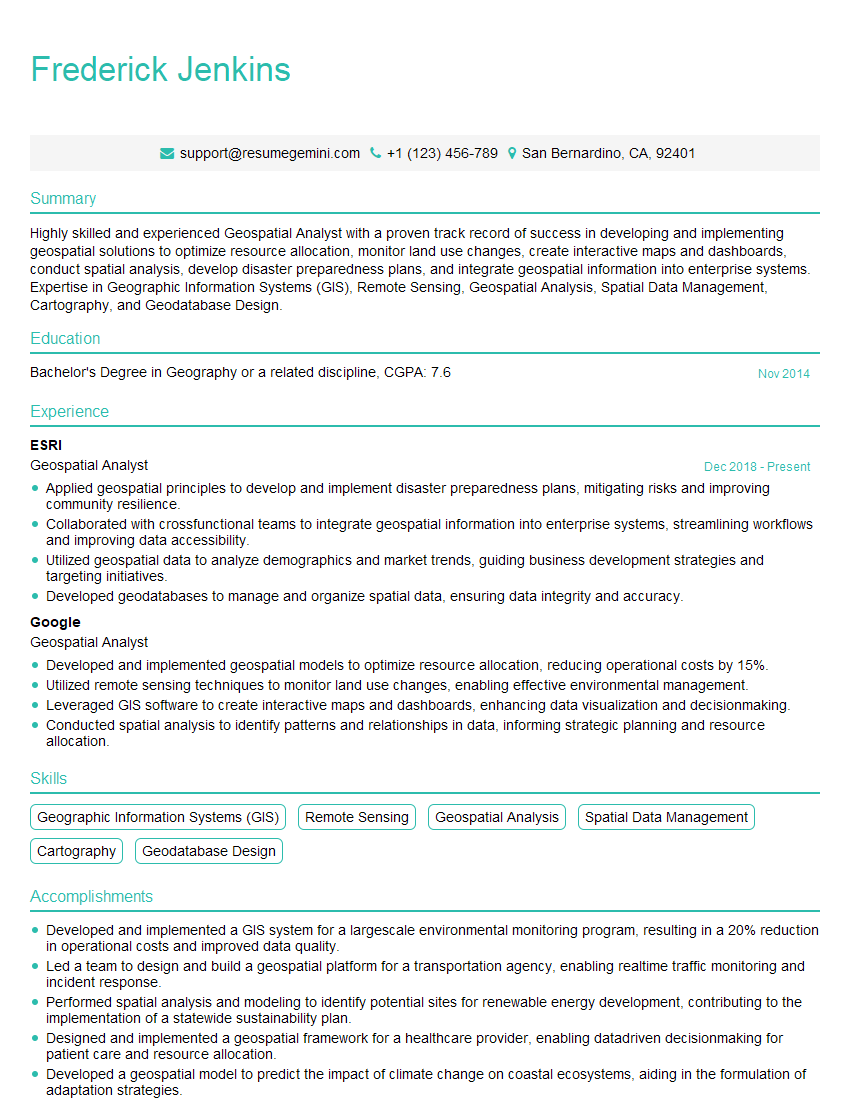
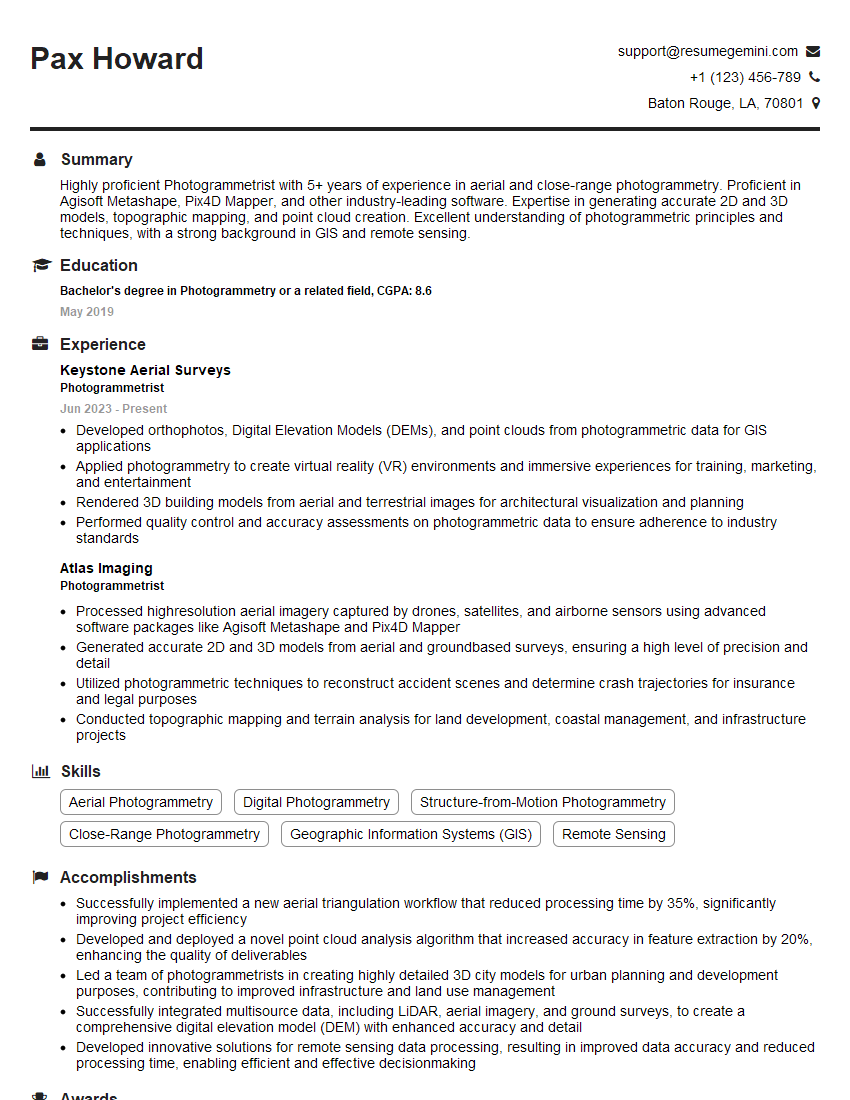
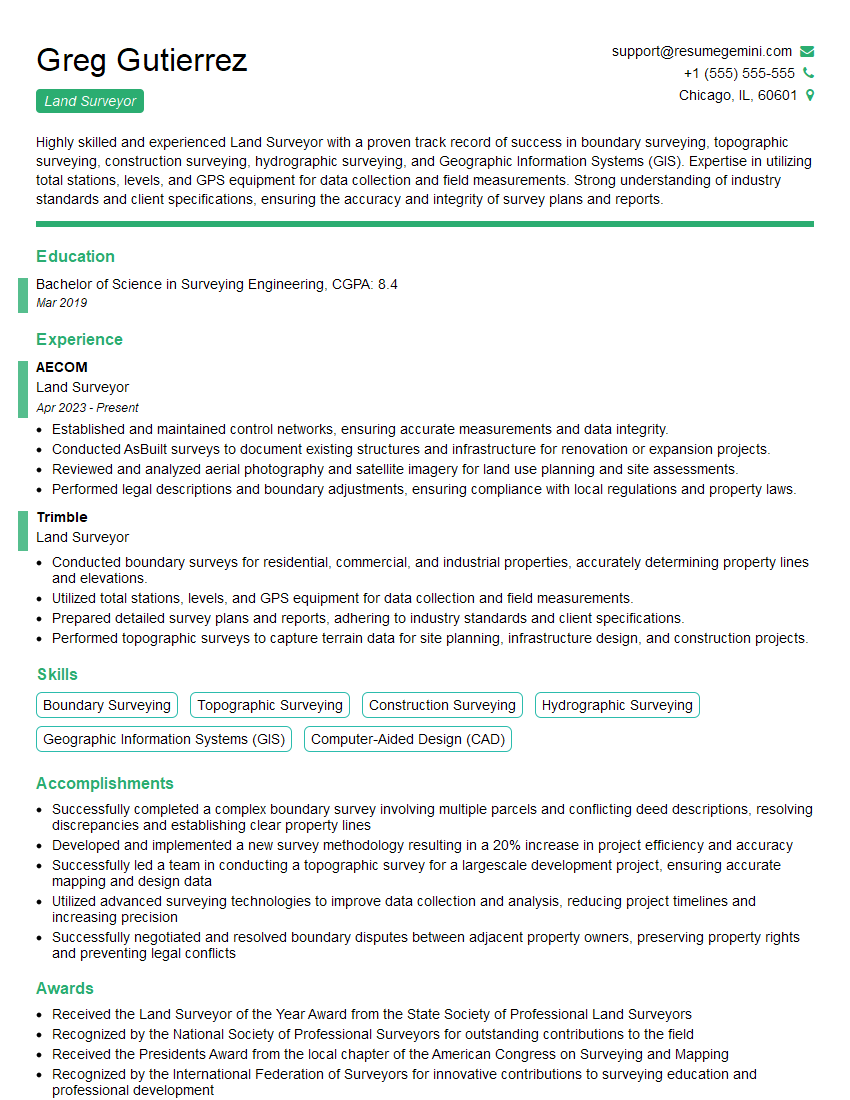
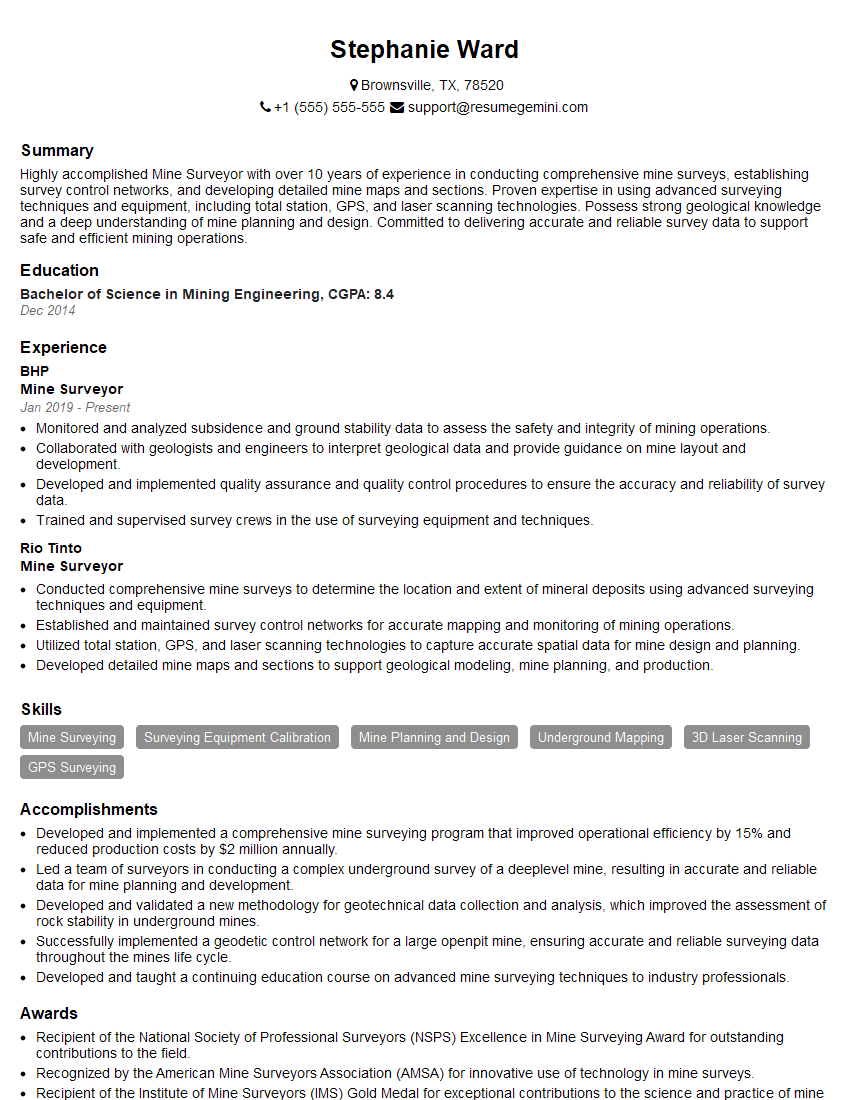
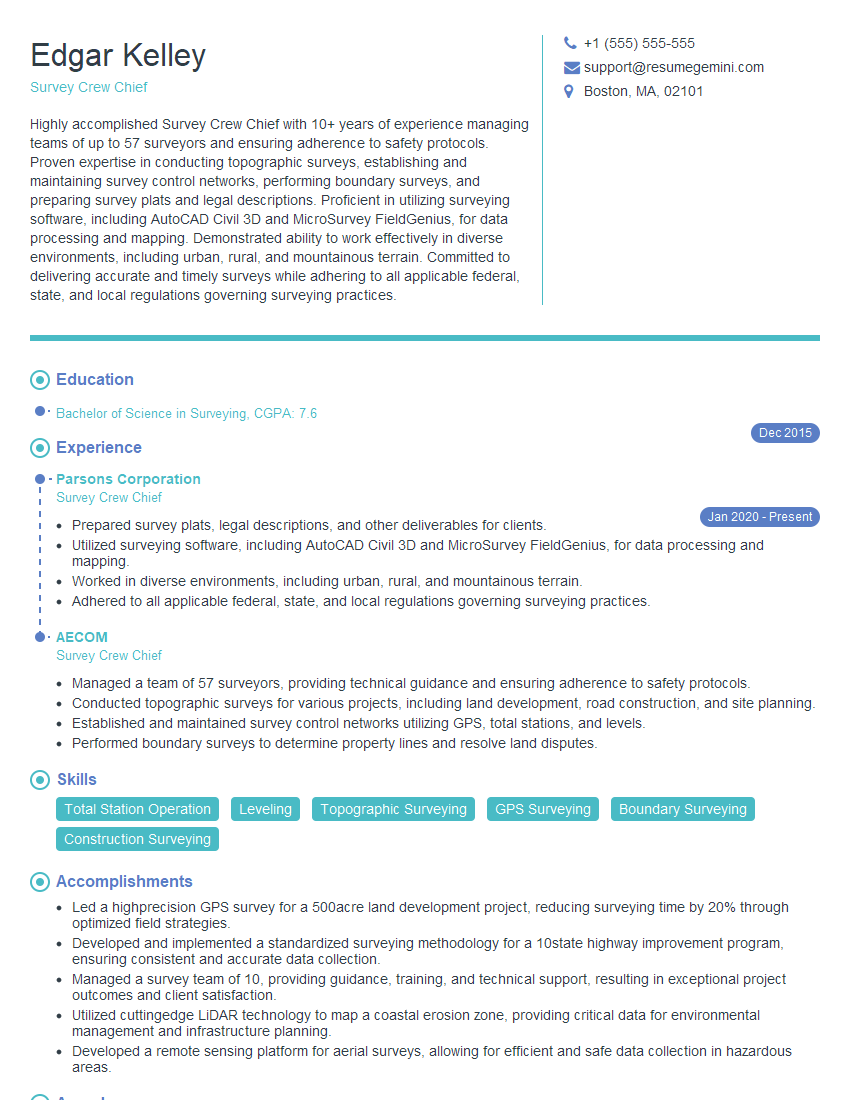
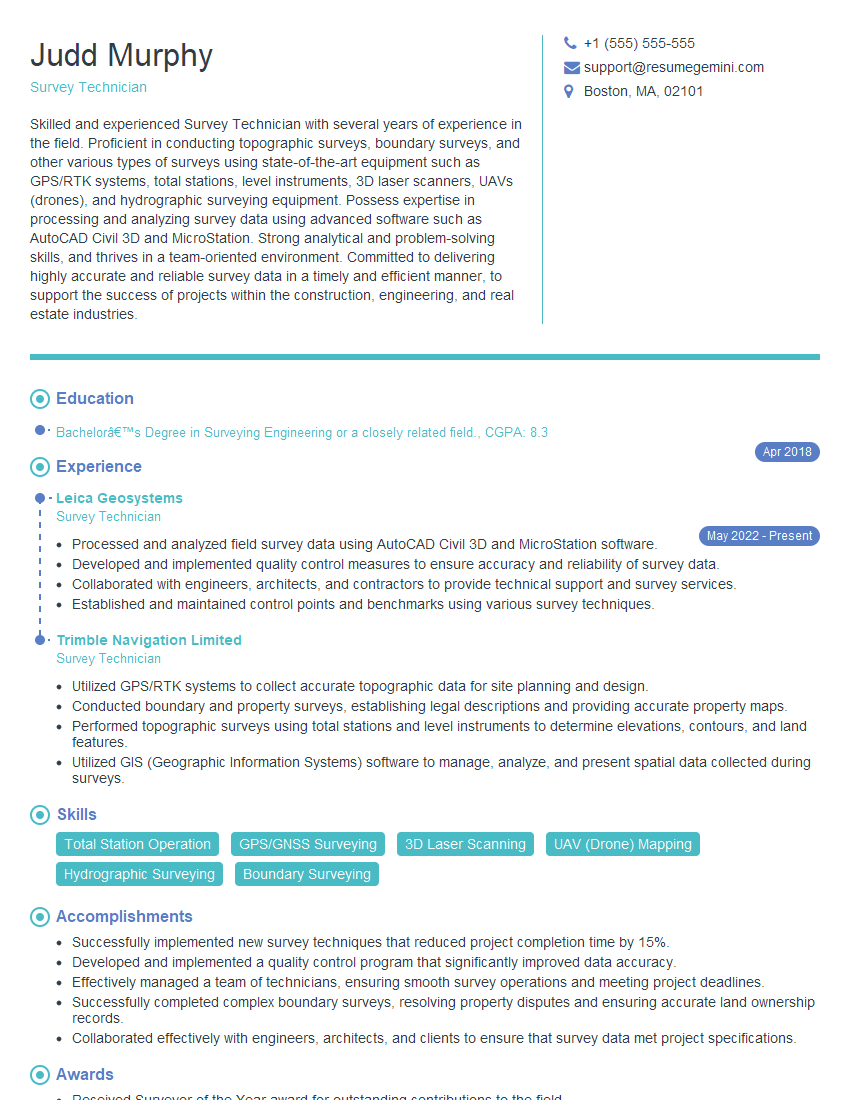
Mastering Surveying Best Practices is crucial for career advancement in this dynamic field. A strong understanding of these concepts demonstrates your expertise and commitment to accuracy and professionalism, opening doors to higher-level positions and greater responsibilities. To increase your job prospects, it’s essential to create a compelling, ATS-friendly resume that highlights your skills and experience effectively. ResumeGemini is a trusted resource that can help you build a professional resume tailored to the demands of the surveying industry. Examples of resumes tailored to Surveying Best Practices are available to help guide your resume creation.

Explore more articles
Users Rating of Our Blogs
Share Your Experience
We value your feedback! Please rate our content and share your thoughts (optional).
What Readers Say About Our Blog
Really detailed insights and content, thank you for writing this detailed article.
IT gave me an insight and words to use and be able to think of examples