Are you ready to stand out in your next interview? Understanding and preparing for Surveying Boundary Determination interview questions is a game-changer. In this blog, we’ve compiled key questions and expert advice to help you showcase your skills with confidence and precision. Let’s get started on your journey to acing the interview.
Questions Asked in Surveying Boundary Determination Interview
Q 1. Explain the process of establishing a boundary using metes and bounds description.
Establishing a boundary using metes and bounds involves meticulously following a written legal description that details the boundary’s perimeter. Think of it like following a treasure map, but instead of buried gold, you’re defining property lines. The description uses directions (courses) and distances (distances) to define each segment of the boundary. For example, ‘North 100 feet, then East 50 feet, then South 100 feet, then West 50 feet’ would describe a square.
The process begins with a thorough review of the metes and bounds description. This involves identifying monuments (physical markers like iron pins, rocks, or trees) mentioned in the description. We then use surveying equipment, like total stations or GPS, to locate these monuments and measure the distances and directions between them. If monuments are missing or ambiguous, we may need to use other evidence, such as old deeds, surveys, or even witness testimony, to reconstruct the boundary. Once all points are located and measured, the boundary is plotted on a map, which becomes a visual representation of the legal description. It’s crucial to understand that discrepancies can arise, necessitating careful analysis and often professional judgment.
Example: Imagine a description stating, ‘Beginning at the iron pin at the NW corner of the John Smith property; thence North 200 feet; thence East 150 feet to the oak tree; thence South 200 feet; thence West 150 feet to the point of beginning.’ Our job would be to find the iron pin, the oak tree, and measure those distances and directions to precisely define the property’s boundary.
Q 2. Describe the different types of boundary evidence and their relative reliability.
Boundary evidence comes in various forms, each with its own level of reliability. Think of it as a courtroom case – some evidence is stronger than others.
- Monuments: These are physical markers like iron pins, stones, or trees mentioned in deeds or surveys. They are generally considered the most reliable evidence because they represent the original intent of the boundary’s establishment. However, monuments can be lost, moved, or damaged over time.
- Fences and other improvements: These are often good indicators, but aren’t conclusive evidence of a boundary. A fence might be newer and not reflect the actual legal boundary.
- Deeds and other written descriptions: These provide legal descriptions and may reference monuments. Their reliability depends on their accuracy and age.
- Surveys: Professional surveys are valuable but their accuracy depends on the methods used and the surveyor’s competence.
- Witness testimony: This can be useful but is often the least reliable type of evidence. Memories can fade, and accounts may differ.
Reliability generally decreases as you go down the list. A monument found in place precisely as described in a decades-old survey is far more reliable than someone’s recollection of a fence line.
Q 3. How do you handle conflicting boundary evidence?
Conflicting boundary evidence is common in land surveying. Resolving these conflicts requires a systematic approach. It’s like being a detective, weighing all the evidence and finding the most probable truth.
- Gather and analyze all available evidence: This includes reviewing deeds, conducting field work to locate and assess monuments, and investigating all relevant historical records.
- Prioritize evidence based on reliability: Give greater weight to evidence like original monuments and accurately conducted surveys over newer, less precise evidence.
- Consider the principles of boundary law: Rules of priority and interpretation of conflicting evidence must be followed to make a reasoned judgement.
- Consult relevant legal professionals: If the conflict is complex or involves significant financial implications, it may be necessary to seek legal advice.
- Document the process meticulously: Keep records of all evidence gathered, analyses performed, and conclusions reached to support the boundary determination.
Sometimes, a compromise may be needed, especially when dealing with long-standing discrepancies or unclear evidence. This may involve legal negotiation or boundary line adjustment procedures.
Q 4. What are the legal implications of incorrect boundary determination?
Incorrect boundary determination can have serious legal and financial implications. It’s a matter that can deeply impact property ownership and value.
- Property disputes: Incorrect boundaries can lead to costly and time-consuming legal battles between neighboring landowners.
- Encroachments: An incorrectly determined boundary could result in structures or improvements being built on another’s property, leading to legal action and potentially demolition.
- Loss of property value: An error in boundary determination can significantly impact the market value of a property, especially if a portion of the land is mistakenly assigned to a neighbor.
- Liability for damages: Incorrect boundary determination can make property owners liable for damages resulting from mistaken occupation or development of disputed areas.
- Surveyor’s liability: A surveyor providing a flawed determination could face legal action for negligence or professional malpractice.
Professional surveyors should always exercise due diligence to minimize these risks.
Q 5. Explain the principles of GPS surveying in boundary determination.
GPS (Global Positioning System) surveying plays a vital role in modern boundary determination. GPS uses a constellation of satellites to determine the precise location of a point on Earth. It’s incredibly efficient for establishing control points and marking boundaries across large areas.
The principles involve receiving signals from multiple satellites. These signals contain information about the satellite’s position and the time the signal was transmitted. By comparing the time of transmission and the time of reception, along with the known satellite position, the receiver can calculate its own position (latitude, longitude, and altitude). This process is known as trilateration. In boundary determination, multiple GPS observations are taken at different points to establish accurate coordinates for boundary markers, thereby defining the boundary line.
Differentail GPS (DGPS) and Real Time Kinematic (RTK) GPS techniques increase accuracy by compensating for atmospheric errors and other sources of inaccuracy.
Q 6. Describe the sources of error in GPS surveying and how to mitigate them.
Several sources of error can affect the accuracy of GPS surveying. It’s like trying to hit a target with a slingshot – wind and other factors can throw off your aim.
- Atmospheric effects: Ionospheric and tropospheric delays can affect the speed of the satellite signal, leading to positioning errors.
- Satellite geometry: The geometry of satellites visible at any given time influences the accuracy of the position calculation. Poor geometry leads to lower precision.
- Multipath errors: Signals can bounce off obstacles before reaching the receiver, causing errors in the calculated position.
- Receiver noise: Random errors in the receiver can affect the accuracy of the measurement.
- Cycle slips: Interruptions in the satellite signal can lead to loss of lock, causing jumps in the position data.
Mitigation involves using advanced techniques like DGPS, RTK GPS, and careful post-processing. DGPS uses a reference station to correct for atmospheric delays and improve accuracy, while RTK offers real-time centimeter-level precision. Careful planning of fieldwork, including selecting optimal observation times and avoiding signal obstructions, is also crucial.
Q 7. How do you account for variations in elevation when determining boundaries?
Elevation variations are crucial in boundary determination, especially in hilly or mountainous terrain. Ignoring elevation can lead to significant errors in boundary location, particularly when dealing with property lines that follow contours.
We use techniques like 3D surveying using total stations or GPS to capture accurate elevation data. This allows us to accurately plot boundaries in three dimensions (X, Y, and Z coordinates). The boundary is then projected onto the desired horizontal plane (usually mean sea level) to create a 2D representation for mapping and legal purposes. This ensures that the horizontal position of the boundary is correct, accounting for the slope of the land. For example, a property line described as ‘along the ridge’ must accurately account for the changing elevations along that ridge line to properly define the boundary.
In some cases, boundaries may be defined as following a specific contour line, in which case the elevation becomes a critical element of the boundary definition itself. Accurate elevation models, created through surveying techniques, are fundamental in such scenarios. Failure to consider elevation differences can result in substantial discrepancies and even legal disputes.
Q 8. What are the key differences between plane surveying and geodetic surveying in boundary determination?
The core difference between plane surveying and geodetic surveying lies in how they handle the Earth’s curvature. Plane surveying assumes the Earth is flat within the survey area, a reasonable simplification for smaller projects. This simplifies calculations considerably. Geodetic surveying, on the other hand, accounts for the Earth’s curvature using an ellipsoidal model. This is crucial for larger projects spanning significant distances, where ignoring the curvature would introduce unacceptable errors in boundary determination.
Plane Surveying: Used for smaller areas where the Earth’s curvature is negligible. Think of surveying a typical residential lot; the curvature is insignificant and won’t affect the accuracy of the boundary determination within acceptable tolerances. Calculations use simple trigonometry and plane geometry.
Geodetic Surveying: Essential for larger areas where the Earth’s curvature must be considered. Imagine surveying a large national park or a section of a state boundary; ignoring the Earth’s curvature would lead to significant errors. Calculations use geodetic coordinates and more complex mathematical models that account for the ellipsoid.
In boundary determination, choosing the appropriate method is vital for accuracy. Using plane surveying for a large project would result in inaccurate boundaries, while using geodetic surveying for a small project may be unnecessarily complex and expensive.
Q 9. Explain the role of riparian boundaries and how they are determined.
Riparian boundaries define the limits of land ownership adjacent to a body of water, such as a river or lake. Determining these boundaries can be complex and often involves legal interpretations as well as surveying techniques. The exact location depends on several factors, most importantly the type of water body and applicable laws.
Common methods for determining riparian boundaries include:
- Accretion: Gradual addition of land by natural processes like sedimentation. The boundary generally follows the new waterline, unless the changes are sudden and dramatic.
- Avulsion: Sudden and violent changes to the waterline (e.g., a flood dramatically altering the riverbank). The boundary usually remains at the original location, despite the shift in the watercourse.
- Erosion: Gradual loss of land due to water action. The boundary typically adjusts to the new waterline.
- Legal Descriptions and Deeds: Original property descriptions often mention water boundaries, which provide valuable information for locating the riparian boundary. The interpretation of these descriptions often requires legal expertise.
- High Water Mark (HWM): This is frequently used as a marker for the boundary. Identifying the HWM involves examining evidence such as vegetation lines, scour marks, and changes in soil composition. Precise identification of HWM requires experienced judgment.
Determining riparian boundaries requires a thorough understanding of both legal precedents and surveying principles. It’s often necessary to consult legal counsel and utilize specialized surveying techniques to accurately establish the property line.
Q 10. How do you use legal descriptions to locate boundaries on the ground?
Legal descriptions are written descriptions of a property’s boundaries, found in deeds and other legal documents. They are the cornerstone of boundary location. These descriptions use various methods, including metes and bounds, lot and block, and government rectangular survey (GRS). Locating boundaries using legal descriptions is a multi-step process.
Steps involved:
- Interpret the description: Carefully read and understand the legal description. Identify the starting point (point of beginning or PO B) and subsequent calls (measurements and directions). This often requires familiarity with surveying terminology.
- Research supporting documents: Deeds and plats often contain additional clues or sketches that can assist in clarifying ambiguities in the description. Older documents might need interpretation given the state of surveying technology at that time.
- Locate the Point of Beginning (POB): This is the most critical step. The POB might be referenced to existing monuments (iron pins, stones) or physical features (large trees, buildings). It is important to positively identify the POB. If the original monument is lost, its location needs to be restored based on the other evidence available.
- Traverse the boundary: Using surveying equipment (total station, GPS), measure each call of the description, carefully following bearings and distances. This step involves establishing accurate angles and distances to define the boundary lines.
- Verify the boundary: Compare the surveyed boundary with existing improvements (fences, buildings) and check for inconsistencies. This is where evidence of long-standing occupation or physical evidence of prior surveying can be extremely important.
Successfully locating boundaries from legal descriptions requires detailed knowledge of surveying practices, legal principles, and meticulous fieldwork. Challenges can arise when the description is unclear, monuments are missing, or the original survey was of poor quality.
Q 11. Explain the use of deed research in boundary determination.
Deed research is an essential component of boundary determination. A deed is a legal document that conveys ownership of a property. It usually contains a legal description of the property’s boundaries and information about previous owners. Examining the chain of title—the history of ownership— through a series of deeds, allows surveyors to trace the evolution of the boundary over time.
The importance of deed research:
- Identifying discrepancies: Deed research can reveal discrepancies between different descriptions, possibly highlighting boundary disputes that need resolution.
- Tracing boundary changes: Deeds may document boundary adjustments, subdivisions, or other changes over time, providing critical information for locating the current boundary.
- Understanding historical context: Reviewing old deeds helps understand how the boundary was originally defined and any subsequent changes. This helps clarify the current boundary’s position, especially when physical evidence is scarce.
- Establishing ownership: Deed research confirms the current owner’s legal claim to the property and its boundaries.
Effective deed research requires a systematic approach: starting with the most recent deed and working backward, examining each deed carefully for its boundary description and any relevant information. Accessing and interpreting historical records often requires knowledge of local and county record keeping systems.
Q 12. What are the common types of boundary disputes and how are they resolved?
Boundary disputes are unfortunately common. They arise from various causes, often involving ambiguities in legal descriptions, conflicting interpretations of historical evidence, or encroachment by neighboring properties.
Common types of boundary disputes:
- Encroachment: When a structure or improvement extends onto a neighboring property.
- Missing or obliterated monuments: When original boundary markers are lost or destroyed.
- Conflicting legal descriptions: When different deeds provide conflicting accounts of the boundary.
- Riparian boundary disputes: Disputes over boundaries adjacent to water bodies.
Resolving boundary disputes:
Resolution typically involves a combination of methods:
- Negotiation: The simplest approach; neighboring property owners work together to reach a mutually agreeable solution.
- Mediation: A neutral third party facilitates communication and assists in finding a compromise.
- Arbitration: A neutral party hears evidence and makes a binding decision.
- Litigation: As a last resort, a court case may be necessary to legally determine the boundary.
- Professional Survey: A crucial step in most disputes. A licensed surveyor establishes the boundary using accepted surveying methods and documents their findings. The survey evidence plays a vital role in any negotiation, mediation, arbitration, or court process.
Successfully resolving boundary disputes requires careful consideration of legal rights, historical evidence, surveying data, and effective communication between parties.
Q 13. Describe your experience with using various surveying equipment (e.g., total stations, GPS receivers).
Throughout my career, I’ve extensively used various surveying instruments to ensure accurate boundary determination. My experience includes:
- Total Stations: I’ve regularly used total stations for precise measurements of angles and distances. I’m proficient in setting up, leveling, and operating total stations for traversing, detailing features, and creating topographic maps. For example, in a recent project involving a complex property line with multiple boundaries, the total station enabled me to rapidly and accurately capture the measurements needed to define the boundaries with millimeter-level precision.
- GPS Receivers: I have significant experience using GPS receivers, both real-time kinematic (RTK) and post-processed kinematic (PPK) systems, for boundary surveys. RTK provides real-time positioning, excellent for efficient field work; while PPK offers high accuracy after post-processing, useful for projects requiring the utmost accuracy. In a recent land subdivision project, using a RTK GPS system significantly reduced fieldwork time while still delivering precise results that met the legal requirements for the creation of new property boundaries.
- Leveling Instruments: Accurate leveling is essential for establishing benchmarks and elevations. I have extensive experience with automatic levels and digital levels for determining elevations necessary to accurately define boundaries, especially where there are significant changes in topography.
- Data Collectors and Field Software: I’m experienced using various data collectors and field software to record and manage survey data efficiently. This ensures data integrity and simplifies the post-processing.
My proficiency with these instruments allows me to select the most appropriate tools for a given project, maximizing efficiency and accuracy while meeting the project’s specific needs.
Q 14. How do you ensure the accuracy and precision of your boundary surveys?
Ensuring accuracy and precision in boundary surveys is paramount. My approach involves a multi-faceted strategy that covers all phases of the project:
- Thorough Planning: Careful planning precedes all fieldwork. This includes a review of all relevant documents, site reconnaissance, and the development of a detailed survey plan that specifies instrument selection, measurement techniques, and quality control measures.
- Proper Instrument Calibration and Maintenance: All surveying equipment is regularly calibrated to meet manufacturer’s specifications and industry standards. This guarantees accuracy in the measured data.
- Redundant Measurements: I always perform redundant measurements, verifying distances and angles using different methods, to detect and minimize errors. For example, I may traverse a boundary line in both directions to identify any discrepancies.
- Quality Control Checks: I employ various quality control procedures during and after fieldwork to identify any potential errors. These include mathematical checks of traverse closures, analysis of coordinate discrepancies and reviewing the data for consistency.
- Use of Appropriate Surveying Techniques: The chosen surveying techniques are tailored to the project and the specific challenges posed by the site conditions. This might involve selecting precise positioning methods for critical points and using appropriate adjustments for error correction.
- Data Processing and Analysis: All collected data is processed using industry-standard software to ensure accuracy. This includes coordinate transformations, error analysis, and the creation of precise boundary maps and legal descriptions.
- Adherence to Professional Standards: I strictly adhere to the guidelines and standards set by relevant professional organizations, ensuring ethical and reliable boundary determination practices.
This comprehensive approach ensures high accuracy and precision in boundary surveys, leading to reliable and defensible results for clients.
Q 15. Explain your proficiency in using GIS software for boundary determination.
My proficiency in GIS software for boundary determination is extensive. I’m highly skilled in using software like ArcGIS, AutoCAD Map 3D, and QGIS to manage, analyze, and visualize spatial data related to property boundaries. This includes importing and georeferencing various data sources such as deeds, surveys, aerial photography, and GPS data. I routinely use these tools for tasks like creating and editing polygon features representing parcels, conducting spatial analysis to identify potential boundary conflicts or overlaps, and generating high-quality boundary maps and reports. For instance, I recently used ArcGIS to analyze overlapping property claims in a complex riparian area, successfully resolving the discrepancies by accurately aligning deed descriptions with the physical features on the ground using high-resolution imagery and on-site measurements.
Beyond basic data manipulation, my expertise extends to advanced techniques such as spatial interpolation to estimate boundary positions where data is sparse, and the creation and management of geodatabases to ensure data integrity and consistency across multiple projects. I’m also proficient in using various coordinate systems and projections, understanding the implications of data transformations on accuracy and precision. The efficiency and accuracy afforded by GIS are invaluable for complex boundary determinations.
Career Expert Tips:
- Ace those interviews! Prepare effectively by reviewing the Top 50 Most Common Interview Questions on ResumeGemini.
- Navigate your job search with confidence! Explore a wide range of Career Tips on ResumeGemini. Learn about common challenges and recommendations to overcome them.
- Craft the perfect resume! Master the Art of Resume Writing with ResumeGemini’s guide. Showcase your unique qualifications and achievements effectively.
- Don’t miss out on holiday savings! Build your dream resume with ResumeGemini’s ATS optimized templates.
Q 16. Describe your experience with preparing boundary survey maps and reports.
Preparing boundary survey maps and reports is a core component of my work. I’ve produced hundreds of such documents, adhering to strict professional standards and relevant legal requirements. My reports clearly present all relevant data, including a comprehensive description of the methodology employed, a detailed analysis of evidence, a clear illustration of the determined boundary, and a statement of any limitations or uncertainties. I use industry-standard cartographic practices to create visually clear and informative maps, including accurate representations of property lines, monuments, easements, and other relevant features. I meticulously maintain a record of all data sources and calculations within the report to ensure transparency and facilitate review by clients and other professionals.
For example, in a recent project involving a boundary dispute between neighboring landowners, I compiled data from multiple deed records, previous surveys, and field measurements. My resulting report included a detailed analysis of each data source, clearly highlighting inconsistencies and explaining how these were resolved. The final map accurately depicted the determined boundary, along with supporting evidence such as monument locations and bearing and distances. This level of detail significantly aided the resolution of the dispute.
Q 17. How do you handle situations involving unclear or conflicting property lines?
Unclear or conflicting property lines present significant challenges but are routinely handled through a systematic approach. I begin by meticulously gathering all available evidence, including deeds, prior surveys, titles, tax assessments, and any relevant historical documentation. I then thoroughly investigate the physical evidence on the ground, searching for existing monuments and other markers. Where discrepancies exist, I analyze the evidence to determine the most reliable and legally defensible interpretation. This often involves interpreting historical documents, considering the principles of boundary law, and evaluating the relative strengths and weaknesses of different pieces of evidence.
If conflicting evidence persists, I might employ advanced surveying techniques, such as GPS measurements with high-precision equipment, to accurately define property corners and lines. In some cases, legal advice and potentially mediation or arbitration may be required to resolve disagreements. Consider the case of a property with an ambiguous deed description referring to an unrecoverable landmark. By using GIS analysis alongside historical maps and witness testimony, I was able to determine a highly probable location for the missing corner, providing a reliable boundary determination that satisfied all stakeholders.
Q 18. What are your strategies for communicating complex technical information to non-technical audiences?
Communicating complex technical information to non-technical audiences requires a clear and concise approach. I avoid jargon and technical terms whenever possible, opting for plain language and simple analogies. I use visuals extensively, including maps, diagrams, and charts, to illustrate key points and make complex data more accessible. I also tailor my communication style to the specific audience, adjusting the level of detail and the complexity of the language to their understanding.
For example, when explaining a complex boundary adjustment to a client without a surveying background, I would first present a simplified map highlighting the key changes. Then, I would explain the changes in plain English, avoiding technical jargon. I would also be prepared to answer questions patiently and thoroughly, ensuring that the client fully understands the implications of the changes.
Q 19. Describe your experience working with clients and stakeholders.
I have extensive experience working with clients and stakeholders across diverse projects. This includes effectively managing expectations, addressing concerns, and ensuring that all parties are kept informed throughout the process. I believe in fostering open communication, regularly updating clients on project progress, and promptly addressing any questions or concerns. My collaborative approach ensures that clients feel heard and valued, fostering trust and mutual understanding. I proactively solicit feedback and tailor my communication to ensure clarity and accessibility for each individual stakeholder.
A recent project involved working with multiple landowners in a developing area with overlapping property claims. Through clear, consistent communication, and a collaborative approach, I successfully guided them through the process of resolving the discrepancies, ultimately contributing to a smooth development process. By carefully listening to their concerns, responding promptly to their questions, and always maintaining professionalism, I managed to maintain positive working relationships with all involved.
Q 20. How do you maintain professional ethics and standards in boundary determination?
Maintaining professional ethics and standards is paramount in boundary determination. I adhere strictly to the relevant professional codes of conduct, ensuring that all my work is accurate, objective, and unbiased. I am committed to complete transparency and data integrity, clearly documenting all sources of information, methodologies used, and any limitations of the analysis. I am also committed to continuing professional development, staying up-to-date with the latest technologies, legal standards, and best practices.
For example, if I encounter a conflict of interest, I would immediately disclose it to the relevant parties and take appropriate steps to ensure impartiality. This commitment to ethical practice builds trust and confidence with clients and stakeholders, thereby strengthening the overall integrity of my work. Furthermore, I ensure to maintain the confidentiality of all sensitive client information.
Q 21. What are your skills in data analysis and interpretation in the context of boundary surveying?
Data analysis and interpretation are critical for accurate boundary determination. My skills encompass analyzing various data sources, including deed descriptions, survey records, and field measurements, to identify inconsistencies, potential errors, and conflicting information. I’m adept at identifying patterns and trends in data, using statistical methods to assess data quality and reliability. This includes evaluating measurement errors, assessing the precision of different data sources, and employing appropriate techniques to handle uncertainty and variability in data. In essence, I translate raw data into actionable insights, supporting informed decisions regarding boundary location and resolution of disputes.
For instance, in a project involving a large-scale subdivision, I analyzed hundreds of survey data points to identify systematic errors and outliers that could skew the final boundary calculations. By employing statistical analysis and error propagation techniques, I effectively identified and corrected the problematic data, resulting in a more accurate and reliable boundary determination for all the subdivided parcels.
Q 22. How familiar are you with relevant surveying standards and regulations?
I possess a comprehensive understanding of surveying standards and regulations, including those set by organizations like the American Congress on Surveying and Mapping (ACSM) and relevant state and local authorities. My familiarity extends to various standards related to data accuracy, boundary monumentation, legal descriptions, and the use of Geographic Information Systems (GIS) in boundary determination. For instance, I am proficient in applying the National Spatial Reference System (NSRS) and understanding the implications of different datums and projections on boundary coordinates. I routinely consult and adhere to these standards to ensure the accuracy and legal defensibility of my work, prioritizing best practices for data collection, processing, and reporting.
- Accuracy Standards: I am meticulous about meeting specified accuracy standards for different types of surveys, ranging from boundary surveys to construction staking, understanding the tolerance levels applicable to various situations.
- Monumentation Standards: I am thoroughly familiar with proper monumentation techniques, ensuring that boundary markers are durable, properly located, and accurately described in accordance with relevant regulations.
- Legal Description Interpretation: I am skilled in interpreting and analyzing legal descriptions of properties, understanding the nuances of metes and bounds, lot and block, and government survey systems.
Q 23. Describe your experience in dealing with encroachments or boundary trespass.
Encroachments and boundary trespass are common issues I address. My approach involves a systematic process beginning with a thorough investigation. This includes reviewing existing deeds, plats, and survey records to establish the legal boundary. I then conduct a field survey to accurately locate existing improvements and fences. If an encroachment is identified, I carefully document its extent and prepare a detailed report outlining the findings. This report forms the basis for negotiations between the affected parties or, if necessary, legal proceedings. I strive to find amicable solutions whenever possible while ensuring that the legal rights of all parties are protected.
For example, I recently worked on a case where a neighbor’s shed encroached onto a client’s property by approximately two feet. Through careful measurement and record review, I demonstrated the encroachment clearly. The parties were able to negotiate a mutually agreeable solution, avoiding costly litigation. In other instances, more contentious situations may require formal legal action. My expertise extends to providing expert witness testimony in such cases, presenting clear and concise evidence in court.
Q 24. How do you use different coordinate systems in your boundary determination work?
Coordinate systems are fundamental to boundary determination. I routinely utilize different systems based on the project’s location, requirements, and the available data. Common systems include the State Plane Coordinate System (SPCS), the Universal Transverse Mercator (UTM) system, and latitude/longitude coordinates based on a specific datum (e.g., NAD83, NAD27). The choice of coordinate system significantly affects the accuracy and consistency of boundary measurements. For example, using the wrong datum can lead to significant errors in location. My expertise lies in understanding the transformations between different coordinate systems, ensuring seamless integration of data from various sources.
In practice, I often convert between different coordinate systems using specialized software. For instance, I may receive data in UTM coordinates, but the client’s existing records may use SPCS. I use appropriate software and transformation parameters to ensure all data are in a consistent coordinate system for accurate analysis and presentation. Understanding these transformations is critical for avoiding errors and ensuring a precise boundary determination.
Q 25. Explain your understanding of the legal principles governing boundary determination.
Legal principles governing boundary determination are complex and vary by jurisdiction. However, some core principles are consistent. These include:
- Original Monumentation: Original monuments, such as iron pins or stones set at the time of the original survey, generally take precedence in establishing boundaries.
- Adverse Possession: If a party has openly, notoriously, and continuously occupied a portion of land for a specific period (defined by statute), they may acquire legal title to that land.
- Agreed Boundaries: If neighboring landowners have agreed upon a boundary for a significant period, that agreement may become legally binding.
- Proportionate Measurement: If original monuments are lost or unclear, proportionate measurements from remaining evidence are often used to reconstruct the boundary.
- Rules of Construction: Courts use established rules to interpret ambiguous legal descriptions to clarify boundary locations.
A thorough understanding of these legal principles ensures that boundary determinations are not only accurate but also legally defensible. My experience allows me to navigate these complexities effectively.
Q 26. What are your experiences with various types of land ownership and associated boundary considerations?
My experience encompasses a wide range of land ownership types, each with unique boundary considerations. These include:
- Fee Simple Ownership: This is the most common type, granting the owner full rights to the land. Boundary determination typically focuses on defining the precise limits of the property.
- Condominiums: Boundaries are defined by the unit’s interior walls and the shared elements of the building and grounds. Establishing vertical and horizontal boundaries is crucial.
- Easements: These are rights granted to one party to use another party’s land for a specific purpose. Boundary determination must accurately define the location and extent of the easement.
- Government Land: Boundary determination on government land often involves complex legal procedures and may require coordination with multiple agencies.
- Riparian Rights: These rights relate to ownership of land adjacent to water bodies. Boundaries are often defined by the water’s edge, which can shift over time, adding complexity.
Understanding these diverse ownership types and their implications on boundary definition is essential to provide accurate and legally compliant survey work.
Q 27. Describe a challenging boundary determination project you worked on and how you overcame the challenges.
One particularly challenging project involved a boundary dispute on a rural property with conflicting deed descriptions and missing monuments. The property had been subdivided several times over the past century, with each subdivision relying on imprecise descriptions and potentially inaccurate surveys. Furthermore, significant vegetation growth and erosion had obscured any remaining physical evidence of the original boundaries.
To overcome these challenges, I employed a multi-faceted approach:
- Historical Research: I conducted exhaustive research into historical records, including early deeds, maps, and court documents, to piece together the fragmented history of the property boundaries.
- Advanced Surveying Techniques: I used GPS technology and advanced data processing techniques to obtain high-precision measurements, helping to overcome the lack of visible monuments.
- Expert Consultation: I consulted with legal experts and historians to clarify ambiguous legal descriptions and historical contexts.
- On-site Investigation and Analysis: I meticulously examined the terrain to identify any subtle clues or residual evidence of old boundaries.
Through this rigorous investigation, I was able to reconcile the conflicting evidence, develop a defensible boundary determination, and present a clear and persuasive report to the parties involved, leading to a successful resolution of the dispute. This project highlighted the importance of combining historical research, advanced technology, and a nuanced understanding of legal principles in complex boundary disputes.
Q 28. How do you stay current with the latest technologies and advancements in surveying boundary determination?
Keeping current with advancements in surveying technology and legal updates is crucial. I achieve this through several methods:
- Professional Development Courses: I regularly attend continuing education courses and workshops on new surveying techniques, software applications, and legal updates related to boundary determination.
- Industry Publications and Journals: I subscribe to professional journals and publications focusing on surveying and land management, staying abreast of the latest research and best practices.
- Professional Organizations: Active participation in professional organizations like ACSM allows for networking with peers and access to cutting-edge information.
- Software Updates and Training: I ensure that my software is always up-to-date and participate in training sessions offered by software vendors.
- Networking and Collaboration: Collaborating with other professionals in the field allows for shared knowledge and exposure to diverse approaches to problem-solving.
This continuous learning is essential for maintaining a high level of competence and delivering high-quality, legally compliant surveying services.
Key Topics to Learn for Surveying Boundary Determination Interview
- Legal Descriptions and Deeds: Understanding how to interpret legal descriptions, plat maps, and deeds to accurately define property boundaries.
- Boundary Evidence: Analyzing various types of boundary evidence, including monuments, fences, improvements, and occupation evidence, and assessing their reliability and weight.
- Survey Methods and Technologies: Familiarity with different surveying techniques (e.g., GPS, total station, traditional compass and tape) used in boundary determination and their applications.
- Error Analysis and Adjustment: Understanding sources of error in surveying measurements and applying appropriate methods for error analysis and adjustment in boundary calculations.
- Boundary Disputes and Resolution: Knowledge of common boundary disputes and the processes involved in their resolution, including negotiation, mediation, and arbitration.
- State and Local Regulations: Familiarity with relevant state and local regulations and laws governing boundary surveys and land surveying practices.
- Practical Application: Applying theoretical knowledge to real-world scenarios, such as conducting a boundary survey, preparing a boundary plat, and writing a concise and accurate survey report.
- Problem-Solving: Developing effective problem-solving skills to analyze complex boundary situations, identify potential conflicts, and propose solutions.
- Ethical Considerations: Understanding the ethical responsibilities of land surveyors in boundary determination, including objectivity, accuracy, and client confidentiality.
Next Steps
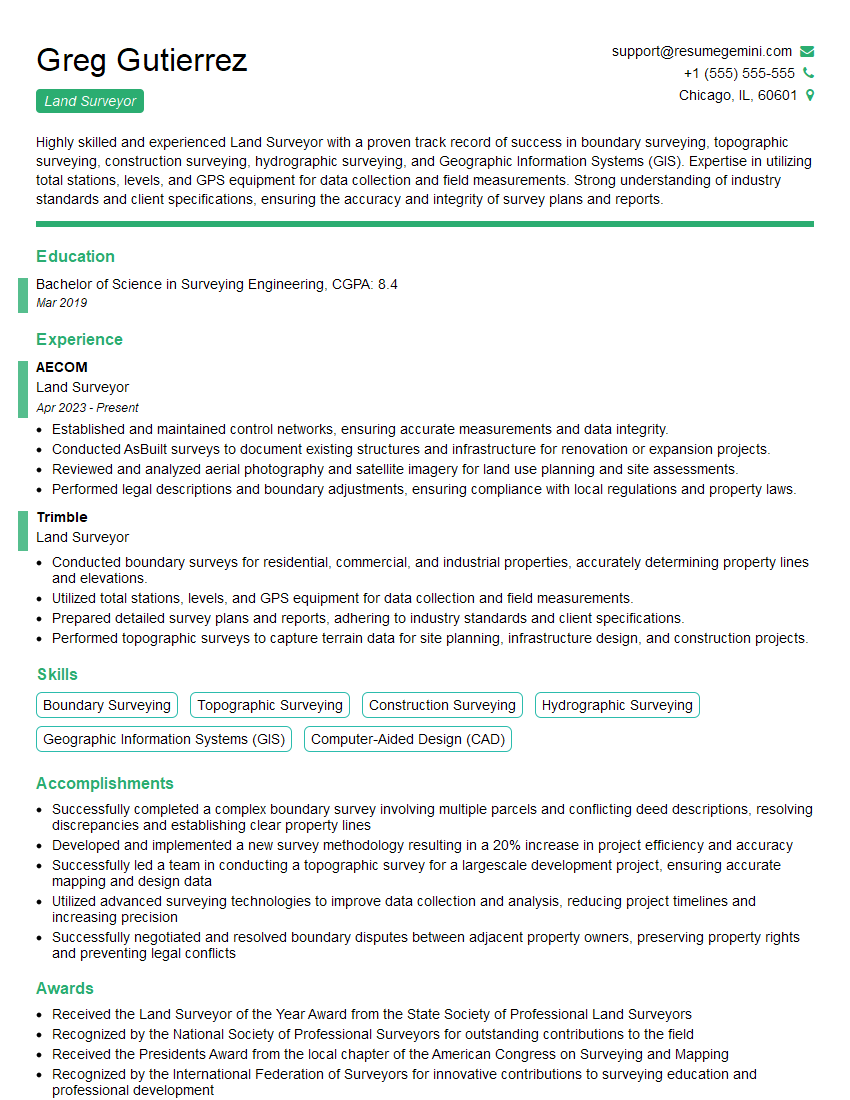
Mastering Surveying Boundary Determination is crucial for career advancement in the land surveying field, opening doors to specialized roles and higher earning potential. A strong understanding of these concepts will significantly enhance your interview performance and demonstrate your expertise to potential employers. To maximize your job prospects, it’s vital to create an ATS-friendly resume that effectively highlights your skills and experience. ResumeGemini is a trusted resource that can help you build a professional and impactful resume. Examples of resumes tailored to Surveying Boundary Determination are available to guide you through the process.
Explore more articles
Users Rating of Our Blogs
Share Your Experience
We value your feedback! Please rate our content and share your thoughts (optional).
What Readers Say About Our Blog
Really detailed insights and content, thank you for writing this detailed article.
IT gave me an insight and words to use and be able to think of examples