Feeling uncertain about what to expect in your upcoming interview? We’ve got you covered! This blog highlights the most important Surveying Land Development interview questions and provides actionable advice to help you stand out as the ideal candidate. Let’s pave the way for your success.
Questions Asked in Surveying Land Development Interview
Q 1. Explain the different types of land surveys.
Land surveying encompasses various types, each serving a specific purpose. Think of it like a toolbox – different tools for different jobs. Here are some key types:
- Boundary Surveys: These define property lines, crucial for legal descriptions and property transactions. Imagine settling a neighborly dispute – a boundary survey is the definitive answer. They involve researching historical records, identifying monuments (markers indicating property corners), and precisely measuring the boundaries.
- Topographic Surveys: These map the Earth’s surface, showing natural and man-made features like elevations, contours, trees, and buildings. Think of a detailed blueprint of a construction site before building begins. This helps in planning roads, utilities, and building placement.
- Construction Surveys: These guide construction projects by providing precise measurements and locations for buildings, roads, and other structures. This is like the construction worker’s instruction manual, ensuring everything is built accurately and to the correct specifications.
- As-Built Surveys: These document the final construction of a project, comparing it to the original design plans. It’s the final check to make sure what was built matches the plan. This is vital for future maintenance and record-keeping.
- Route Surveys: These are used for planning and designing transportation routes, such as highways and railways. They map terrain, determine optimal routes, and account for factors such as slopes and curves.
- Hydrographic Surveys: These map the physical features of bodies of water, including depths, currents, and underwater obstacles. This is critical for navigation, dredging projects, and environmental studies.
Q 2. Describe your experience with GPS surveying techniques.
My experience with GPS surveying is extensive. I’ve used various GPS techniques, including RTK (Real-Time Kinematic) and PPK (Post-Processed Kinematic) surveying on numerous projects. RTK involves using a base station and rover to obtain centimeter-level accuracy in real-time. Imagine it like having a super-accurate map displayed instantly on your device. This is fantastic for stakeout work, where we precisely mark out points for construction. PPK, on the other hand, requires post-processing the data for high accuracy, offering advantages in challenging environments or when RTK signals are unreliable. I’ve utilized both methods for tasks like creating digital terrain models (DTMs), mapping pipelines, and establishing control points for large-scale projects. For example, on a recent highway project, RTK GPS allowed us to accurately stake out the centerline, ensuring efficient and precise construction.
Q 3. How do you ensure accuracy in surveying measurements?
Accuracy is paramount in surveying. We employ several methods to ensure precise measurements. First, we use calibrated instruments regularly checked for accuracy. Second, we employ multiple measurement techniques to cross-check results; it’s like double-checking your work. Third, we always take into account environmental factors like temperature and atmospheric pressure, which can slightly affect measurements. We also utilize precise control networks, which are strategically placed points with known coordinates, to provide reference points for all measurements. Imagine these points as anchors for your measurements ensuring everything stays perfectly in place. This allows for the detection and correction of any systematic errors. Finally, thorough data processing and quality control procedures are crucial to filter out random errors and identify potential outliers.
Q 4. What are the common sources of error in surveying and how do you mitigate them?
Several sources of error can impact surveying accuracy. These can be broadly categorized as:
- Instrumental Errors: These stem from imperfections in surveying equipment such as miscalibration of levels, total stations or GPS receivers.
- Natural Errors: These include factors like atmospheric refraction, temperature changes, and earth curvature.
- Personal Errors: These are human errors, such as inaccurate readings, mistakes in recording data, or improper instrument handling.
- Systematic Errors: These are consistent errors that follow a predictable pattern. For example, an improperly leveled instrument will cause consistent errors in elevation readings.
- Random Errors: These are unpredictable errors that occur randomly and are often smaller in magnitude than systematic errors. For example, a slight misreading of a measurement.
Mitigation involves using calibrated equipment, employing proper surveying techniques, careful data recording, and rigorous quality control checks. Multiple measurements and independent checks are vital in identifying and minimizing errors. Statistical analysis helps separate random errors from systematic ones, allowing for better correction and data refinement.
Q 5. Explain your experience with various surveying instruments (e.g., total stations, levels, GPS receivers).
My experience spans a wide range of surveying instruments. I am proficient in using total stations for precise angle and distance measurements; imagine them as high-tech theodolites with electronic distance measurement capabilities, significantly speeding up the data acquisition process. I’m skilled in operating levels for determining elevations and establishing benchmarks. Levels are like precise measuring tools for vertical accuracy. And, as discussed previously, I am experienced with various GPS receivers, using both RTK and PPK techniques. Additionally, I’m familiar with other instruments such as EDM (Electronic Distance Meters), which are used in conjunction with theodolites or total stations to determine distances, and data collectors to record the vast amount of data we gather.
Q 6. How do you handle discrepancies between field data and design plans?
Discrepancies between field data and design plans necessitate a thorough investigation. The first step is to meticulously review all field measurements and data processing to eliminate any calculation or transcription errors. Next, I would compare the field data with the design plans to identify the source of the discrepancy. If the discrepancy is minor, a simple adjustment might be sufficient. However, significant discrepancies require further investigation to ascertain whether the problem lies in the field measurements, the design plans, or both. This may involve additional site visits, re-measurements, and consultation with the design team. In some cases, site conditions might differ from those assumed during the design phase, necessitating revisions to the design plans or construction methods. Documenting the process of discrepancy resolution is critical, ensuring all parties are aware of the situation, and any necessary corrections are clearly communicated and documented.
Q 7. Describe your experience with using surveying software (e.g., AutoCAD Civil 3D, ArcGIS).
I’m proficient in various surveying software packages, including AutoCAD Civil 3D and ArcGIS. AutoCAD Civil 3D is my primary tool for processing and analyzing survey data, creating design plans, and generating construction drawings. Think of it as the digital drafting board for civil engineering projects. I use it to create surface models, design alignments for roads and utilities, and prepare detailed construction drawings. ArcGIS, on the other hand, is crucial for managing and visualizing geospatial data. It’s particularly helpful for tasks such as creating maps, analyzing spatial relationships, and integrating survey data with other geographic information. For instance, I’ve used ArcGIS to integrate survey data with aerial photography to create detailed site plans and visualize terrain features. Both software packages are indispensable for efficient and effective land development projects.
Q 8. How do you interpret legal descriptions and property boundaries?
Interpreting legal descriptions and property boundaries is fundamental to surveying. Legal descriptions, often found in deeds, use metes and bounds, lot and block, or government rectangular survey systems to define a property’s perimeter. Metes and bounds uses distances and directions (bearings) to trace the boundary lines. Lot and block references a plat map showing subdivided parcels. Government rectangular survey uses principal meridians and base lines to create a grid system of townships and ranges.
My process involves:
- Careful reading and analysis: I meticulously examine the legal description, identifying all calls (measurements and directions) and monuments (physical markers like iron pins or trees).
- Research and investigation: I research historical records, including previous surveys and maps, to understand any ambiguities or discrepancies. For example, a missing monument might require research to determine its original location.
- Field verification: I conduct a field survey to locate existing monuments and verify the described boundaries on the ground. This often involves using GPS technology and total station instruments for precise measurements.
- Interpretation and reconciliation: If discrepancies exist, I analyze the evidence to determine the most probable location of the boundary. This may involve consulting with other surveyors, legal professionals, or historical experts.
For instance, I once worked on a property with a vague legal description referencing an old oak tree that was no longer present. Through research in county archives, I found an old photograph showing the tree’s approximate location, which allowed me to accurately establish the boundary.
Q 9. Explain your understanding of coordinate systems and datums.
Coordinate systems and datums are crucial for accurately locating points on the earth’s surface. A coordinate system defines how we represent the location of points using coordinates (e.g., latitude and longitude, or state plane coordinates). A datum is a reference surface used for defining the coordinate system; it’s essentially a model of the earth’s shape. Different datums exist because the earth isn’t a perfect sphere.
Common coordinate systems include:
- Geographic Coordinate System (GCS): Uses latitude and longitude, based on a spherical or ellipsoidal model of the earth.
- Projected Coordinate System (PCS): Projects the curved earth onto a flat surface, using various map projections (e.g., UTM, State Plane). This is essential for engineering and construction work.
Understanding datums is critical because different datums can result in positional shifts of several meters. For example, NAD83 and NAD27 are two common North American datums; using them interchangeably could lead to significant errors in a construction project. I ensure consistent datum usage across all projects by always specifying the datum used and performing necessary coordinate transformations when needed. This might involve using coordinate transformation software or mathematical formulas.
Q 10. How do you prepare a survey report?
Preparing a survey report is the culmination of the surveying process. It’s a formal document communicating the findings of a survey. A well-written report is clear, concise, and unambiguous. It provides a complete record of the survey work and its results.
My typical report includes:
- Introduction and purpose: States the objective and scope of the survey.
- Methods and equipment: Details the surveying techniques and equipment used.
- Data collected: Presents the raw survey data, often in tabular form.
- Analysis and calculations: Shows the calculations and adjustments made to the data. This might include computations of distances, angles, areas and coordinates.
- Maps and plats: Includes clear and accurate maps showing the surveyed area and its features.
- Conclusions and recommendations: Summarizes the findings and makes any relevant recommendations.
- Appendices: Contains supporting documents, such as field notes, data sheets, and relevant permits.
I always ensure the report is visually appealing and easy to understand, using clear labels, legends, and scales on all maps. Accuracy and precision are paramount; any uncertainties or limitations of the survey are clearly stated.
Q 11. What is your experience with topographic surveys?
Topographic surveys create a detailed representation of the earth’s surface, including natural and man-made features. These surveys are essential for site planning, construction, and environmental studies. My experience encompasses various techniques for conducting topographic surveys, including:
- Conventional methods: Using total stations and levels to collect elevation data and establish control points.
- GPS surveying: Employing GPS receivers to determine the three-dimensional coordinates of points, allowing for efficient data collection over larger areas.
- LiDAR (Light Detection and Ranging): Utilizing laser scanning technology for high-density point clouds that capture a very detailed topographic model.
I have used these techniques on diverse projects, ranging from small residential sites to large-scale infrastructure projects. A recent project involved creating a topographic model for a new highway alignment. We used a combination of LiDAR and ground-based surveys to achieve high accuracy and capture both the terrain and existing vegetation.
Q 12. How familiar are you with construction staking?
Construction staking is a crucial part of the construction process, translating design plans into physical markings on the ground. It guides the placement of buildings, roads, utilities, and other structures. I’m highly proficient in construction staking, covering various aspects like:
- Setting control points: Establishing accurate control points using GPS or conventional methods.
- Layout of buildings: Defining the corners and boundaries of structures.
- Road and utility alignments: Staking the centerlines and offsets of roads, pipelines, and other utilities.
- Grading and excavation: Marking the elevations for earthwork.
Safety is always a top priority during construction staking. I ensure clear communication with contractors and implement measures to protect the staking points from damage. Accurate and timely staking minimizes costly errors and ensures the project proceeds smoothly. I recall a project where precise staking of underground utilities prevented the accidental damage of a crucial water main during excavation.
Q 13. Describe your experience with boundary surveys and resolving boundary disputes.
Boundary surveys determine and mark the legal limits of a property. Resolving boundary disputes is often a complex process requiring a thorough understanding of land laws, survey techniques, and evidence interpretation. My experience includes:
- Researching historical records: Examining deeds, maps, and other documents to trace the history of the property boundary.
- Locating and evaluating evidence: Identifying and analyzing existing monuments, fences, and other physical evidence.
- Analyzing conflicting evidence: When discrepancies exist, I evaluate all evidence to determine the most probable boundary location, often involving legal interpretation and negotiation.
- Preparing boundary plats: Creating accurate maps showing the determined boundary lines.
- Testifying in court (if necessary): Providing expert witness testimony to support my findings.
I’ve successfully resolved numerous boundary disputes, using my knowledge of legal principles and careful analysis to reach mutually acceptable solutions. One memorable case involved a dispute over a fence line; through careful research of old deeds and field investigation, I was able to identify a previously unnoticed monument that clearly established the correct boundary, resolving a long-standing conflict between neighbours.
Q 14. How do you ensure the safety of your surveying crew?
Ensuring the safety of my surveying crew is paramount. My safety protocols are comprehensive and are implemented on every project. Key aspects include:
- Pre-job planning: Thoroughly assessing the site for potential hazards, including environmental conditions, traffic, and proximity to utilities. I develop a site-specific safety plan that addresses potential hazards.
- Proper training and equipment: Ensuring crew members receive adequate training on safe surveying practices, equipment operation, and emergency procedures. Providing appropriate safety equipment, including hard hats, high-visibility clothing, safety glasses, and appropriate PPE for specific hazards.
- Communication and coordination: Maintaining clear communication with all crew members and other site personnel. Using two-way radios or other communication systems for effective coordination, especially in challenging environments.
- Site awareness and vigilance: Maintaining constant awareness of surroundings, including traffic, overhead hazards, and potential environmental risks. Implementing traffic control measures when necessary.
- Emergency response plan: Having a clearly defined emergency response plan that includes procedures for accidents, injuries, or emergencies. Providing access to first-aid kits and ensuring access to emergency medical services.
Regular safety meetings and training sessions are also crucial. I foster a safety-first culture where everyone feels empowered to raise concerns and take necessary precautions. Proactive safety measures not only protect lives but also improve efficiency and productivity by minimizing accidents and delays.
Q 15. Explain your understanding of relevant surveying standards and regulations.
Surveying standards and regulations are crucial for ensuring accuracy, consistency, and legal compliance in land development projects. These standards dictate the methods, instruments, and procedures used, aiming to minimize errors and produce reliable data. Key players include organizations like the American Society of Civil Engineers (ASCE) and the National Society of Professional Surveyors (NSPS), which publish guidelines and best practices. For example, the ASCE publishes standards for surveying and mapping, covering everything from horizontal and vertical control to geodetic surveying. Regulations vary by location; local and state governments frequently set additional rules on things like boundary surveys, which often involve legal aspects of property ownership. Compliance is vital; failing to adhere to standards can lead to costly legal disputes, project delays, and even safety hazards.
In my work, I ensure compliance through meticulous documentation, utilizing appropriate survey equipment, and adhering to relevant codes of practice. A project’s success is directly tied to this adherence. For instance, during a recent subdivision project, we had to comply with very strict local ordinances regarding boundary marker placement and precision. Strict adherence to these standards prevented costly errors and delays.
Career Expert Tips:
- Ace those interviews! Prepare effectively by reviewing the Top 50 Most Common Interview Questions on ResumeGemini.
- Navigate your job search with confidence! Explore a wide range of Career Tips on ResumeGemini. Learn about common challenges and recommendations to overcome them.
- Craft the perfect resume! Master the Art of Resume Writing with ResumeGemini’s guide. Showcase your unique qualifications and achievements effectively.
- Don’t miss out on holiday savings! Build your dream resume with ResumeGemini’s ATS optimized templates.
Q 16. How do you manage large datasets obtained from surveying?
Managing large surveying datasets effectively requires a multi-pronged approach. The sheer volume of data generated from modern surveying techniques, particularly with LiDAR and UAVs, necessitates robust data management strategies. I typically use Geographic Information Systems (GIS) software such as ArcGIS or QGIS, along with specialized surveying software, to handle these datasets. These tools allow for efficient data organization, storage, and analysis. Crucially, this involves creating a clear file naming convention and a well-structured database to facilitate easy retrieval and prevent data loss or corruption. In addition, cloud storage solutions can be useful for large datasets, providing accessibility and collaboration opportunities.
For example, on a recent highway construction project involving extensive LiDAR data, we used a cloud-based storage system coupled with ArcGIS to manage the massive point cloud and derive various terrain parameters efficiently. Data processing was distributed among team members and involved sophisticated tools for error correction and data cleaning. Efficient data management ensured the timely completion of the project.
Q 17. Describe your experience with volumetric calculations from survey data.
Volumetric calculations from survey data are essential for various applications in land development, including earthwork estimations, reservoir capacity assessments, and stockpile quantity calculations. I frequently perform these calculations using both software and manual methods, depending on the project’s complexity and data quantity. Software packages like AutoCAD Civil 3D, and specialized surveying software offer sophisticated tools to automatically generate volumes from digital terrain models (DTMs) and cross-sections. Manual methods involve calculating areas of cross-sections and applying appropriate formulas to determine volumes; this is usually only practical for smaller-scale projects.
A recent example involves calculating the earthwork required for a large-scale housing development. Using AutoCAD Civil 3D, we imported the survey data (point cloud and boundary lines) to create a DTM and then used the software’s built-in tools to calculate cut and fill volumes. This ensured accurate cost estimation and efficient project planning. The precision of these calculations was critical to accurately price the earthworks to the client. Accuracy here is paramount; underestimating earthwork can result in project cost overruns, while overestimation may lead to unnecessary expenses.
Q 18. How do you integrate survey data with GIS data?
Integrating survey data with GIS data is a fundamental aspect of modern surveying and land development. Survey data provides precise location information and elevation details, while GIS provides a framework for spatial analysis, visualization, and management. The integration process typically involves converting survey data into a GIS-compatible format (such as shapefiles or geodatabases), followed by importing and georeferencing the data. Georeferencing ensures that the survey data is correctly aligned with the GIS coordinate system. Once integrated, both datasets can be used together for various applications including analyzing terrain, designing infrastructure, and creating detailed maps.
For example, during a project involving the design of a new drainage system, we integrated survey data (topographic contours and spot elevations) with existing GIS data (roads, buildings, and property boundaries) in ArcGIS. This integration allowed us to design a system that considered existing infrastructure and minimized land disruption, resulting in a more efficient and cost-effective solution. This integration enabled better visualization of potential design impacts and optimized the route selection.
Q 19. What is your experience with hydrographic surveying?
My experience with hydrographic surveying involves collecting and processing data related to water bodies. This includes bathymetric surveys (measuring water depth), shoreline mapping, and the identification of underwater features. I’m proficient in using various technologies like single-beam and multi-beam echosounders, and I’m familiar with processing the resultant data to create detailed bathymetric maps and three-dimensional models of underwater terrain. Data processing typically involves correcting for sound velocity variations and tidal effects to ensure accuracy. This type of surveying is critical for projects involving marine construction, dredging, and pipeline installations.
In one instance, I worked on a project assessing the navigability of a harbor entrance. Using a multibeam echosounder, we created a high-resolution bathymetric map that clearly depicted the seabed topography, identifying shallow areas and potential obstructions. This information was crucial for navigating safely in the harbor. Accurate depth data is essential for safe navigation and for preventing damage to vessels.
Q 20. Explain your understanding of different types of surveying errors (systematic, random).
Understanding surveying errors is critical for ensuring the quality and reliability of survey data. Systematic errors are consistent and repeatable errors that result from a flaw in the instrument or methodology used. They are often predictable and can be corrected if identified. Examples include instrument miscalibration (e.g., a poorly calibrated total station), or consistently incorrect measurement techniques. Random errors are unpredictable variations that occur due to many uncontrollable factors, such as human error, atmospheric conditions, or limitations of the equipment. They follow a statistical distribution, and their impact can be minimized through redundancy and statistical analysis.
Consider this: a systematic error might be caused by a consistently loose tripod leg on your total station, leading to a consistent error in each measurement. A random error could be caused by a slight misreading of the instrument’s display during measurement. Dealing with systematic errors requires identifying and correcting the root cause, while random errors are addressed through repeated measurements and statistical methods to find the most probable value.
Q 21. How do you perform quality control checks on survey data?
Quality control (QC) checks are essential to ensure the accuracy and reliability of survey data. My QC procedures involve a multi-step process, starting with instrument calibration and verification before commencing fieldwork. During fieldwork, I routinely perform checks such as instrument leveling and backsighting to minimize errors. After data collection, I meticulously review the data for outliers and inconsistencies, often using statistical analysis. This may include examining standard deviations and error ellipses. Data discrepancies are investigated thoroughly, and any necessary corrections or adjustments are made. Finally, the final data product is checked against known control points and other existing data to verify its accuracy and consistency. Documentation of all QC procedures is crucial for ensuring traceability and accountability.
For example, during a recent boundary survey, we used multiple methods (GPS, total station) to measure the same points, creating redundancy. Statistical analysis was employed to identify any outliers, ensuring the final coordinates were highly reliable. This multiple check system is crucial to identify and eliminate errors before they impact the client’s project.
Q 22. Describe your experience with using different mapping projections.
Mapping projections are crucial in surveying because the Earth’s curved surface must be represented on a flat map. Different projections distort distances, areas, and shapes in varying ways. My experience encompasses working with several common projections, each suited to different needs.
- Universal Transverse Mercator (UTM): I’ve extensively used UTM for large-scale projects requiring accurate distance measurements, such as highway alignments or pipeline surveys. UTM divides the Earth into zones, minimizing distortion within each zone.
- State Plane Coordinate System (SPCS): For state-level projects, the SPCS is often preferred as it offers high accuracy within a particular state. I’ve used this system frequently in boundary surveys, ensuring precise property line definition.
- Lambert Conformal Conic: This projection is ideal for areas with greater east-west extent than north-south, as it minimizes distortion in those directions. I employed this projection during a project mapping a large, relatively flat agricultural region.
Choosing the right projection depends heavily on the project’s scale, area, and intended use. I always carefully consider the type of distortion acceptable for the specific task and select the projection that minimizes the most critical distortion for that application. For instance, if area calculations are paramount, an equal-area projection is vital. If precise distances are critical, conformal projections are favored.
Q 23. How do you handle challenging terrain during surveying?
Challenging terrain presents unique hurdles in surveying, requiring adaptability and specialized techniques. My approach is multifaceted and begins with thorough planning.
- Pre-survey planning: This includes studying topographical maps and aerial imagery to identify potential obstacles and plan optimal survey routes. This helps minimize time spent navigating difficult terrain and reduces safety risks.
- Specialized equipment: In steep or heavily vegetated areas, robotic total stations and GPS equipment with RTK (Real-Time Kinematic) capabilities are essential. These technologies provide accurate measurements even in locations inaccessible to traditional methods.
- Differential leveling techniques: For elevation measurements on uneven ground, I employ precise differential leveling techniques, using multiple setups to overcome sight limitations caused by obstacles.
- Safety precautions: Safety is paramount when working on challenging terrain. This involves using appropriate personal protective equipment (PPE), such as harnesses and helmets, and ensuring the team is aware of potential hazards such as unstable slopes or wildlife.
For example, during a recent project involving a mountainous region, we employed drones equipped with high-resolution cameras to capture aerial imagery, supplementing ground-based surveying. This allowed us to overcome access limitations and significantly accelerated data acquisition.
Q 24. Explain your understanding of legal aspects of land surveying.
A thorough understanding of legal aspects is fundamental to land surveying. It’s not just about measuring distances and angles; it’s about ensuring accurate and legally defensible property descriptions. My expertise covers several key areas:
- Boundary law: I’m well-versed in the principles of boundary law, including riparian rights (related to water boundaries), accretion (gradual land addition by water), and avulsion (sudden land change by water).
- Property descriptions: I’m proficient in interpreting and creating legal descriptions of properties, using metes and bounds, lot and block, or government rectangular survey systems. Precision and unambiguous language are paramount here.
- Adverse possession: I understand the legal concepts of adverse possession, where someone might claim ownership of land through long-term, open, and continuous use.
- Easements and rights-of-way: I’m knowledgeable about easements (the right to use someone else’s land) and rights-of-way, ensuring these are accurately documented and surveyed.
- Professional ethics and liability: I understand the professional responsibilities and ethical considerations governing land surveying, including minimizing errors and adhering to professional standards to avoid legal liability.
Any error in a survey can have significant legal and financial implications for landowners. Therefore, meticulous work and a strong understanding of the relevant laws are critical to protect both clients and myself.
Q 25. How do you communicate technical information to non-technical audiences?
Communicating technical information clearly to non-technical audiences is crucial. My approach relies on simplifying complex concepts without sacrificing accuracy.
- Visual aids: I use maps, diagrams, and 3D models to visually represent data. A picture is indeed worth a thousand words, especially when explaining complex spatial relationships.
- Analogies and metaphors: I relate technical concepts to everyday examples. For instance, explaining coordinate systems using the analogy of a grid on a city map helps non-technical clients understand the concepts.
- Plain language: I avoid jargon and technical terms as much as possible, defining those that are unavoidable in simple terms.
- Active listening and feedback: I actively encourage questions and feedback to gauge the audience’s understanding and adjust my communication accordingly.
For example, when explaining a boundary survey to a client unfamiliar with surveying principles, I would use a simple map showcasing the property boundaries and highlight key features. This visual representation alongside plain-language explanations ensures comprehension.
Q 26. Describe a time you had to solve a complex surveying problem.
During a large-scale subdivision project, we encountered significant challenges due to discrepancies between historical survey data and the ground conditions. The existing records indicated a straight boundary line, but our initial survey revealed a significant curve.
Our initial approach was to meticulously re-survey the area using high-precision GPS equipment and ground control points. However, this data still conflicted with the historical records. This discrepancy potentially impacted several property lines, creating legal and financial implications.
To resolve the conflict, we conducted a thorough title search and reviewed historical maps and deeds. We discovered that a previous survey, though imperfect, had noted anomalies that were ignored in subsequent records. We employed advanced data analysis techniques to reconcile the conflicting data, identifying and explaining the historical errors. This involved a combination of field measurements, archival research, and sophisticated computer modeling to create a coherent and legally sound final boundary.
Ultimately, the solution required a combination of rigorous fieldwork, historical research, and careful interpretation of data. It highlighted the importance of thorough due diligence and a detailed understanding of historical context when dealing with complex land surveys.
Q 27. How do you stay up-to-date with the latest surveying technologies and techniques?
Staying current in land surveying requires ongoing professional development. I actively pursue this through several avenues:
- Professional organizations: I’m an active member of professional organizations such as the [insert relevant professional organization], which provides access to conferences, workshops, and publications on the latest technologies and techniques.
- Continuing education courses: I regularly participate in continuing education courses to remain updated on new surveying software, hardware, and legal developments.
- Industry publications and journals: I consistently read relevant industry publications and journals to stay abreast of innovations in the field.
- Online resources and webinars: I utilize online resources and webinars to learn about new technologies and best practices.
- Networking: Attending industry events and networking with colleagues helps me learn about practical applications and challenges faced by others in the field.
For instance, I recently completed a training course on the use of LiDAR technology for high-density point cloud data acquisition and processing, significantly improving my capability for complex terrain analysis.
Q 28. What are your salary expectations?
My salary expectations are commensurate with my experience and expertise in land surveying, as well as the specific requirements and compensation structure of the position. I am open to discussing this further once I have a better understanding of the full scope of responsibilities and benefits package offered.
Key Topics to Learn for Surveying Land Development Interview
- Basic Surveying Principles: Understanding fundamental concepts like distance measurement, angle measurement, leveling, and coordinate systems is crucial. This forms the bedrock of all land development surveying.
- Land Surveying Instruments & Technologies: Familiarize yourself with the operation and applications of various surveying instruments (Total Stations, GPS receivers, levels) and relevant software (CAD, GIS). Be prepared to discuss practical experience using these tools.
- Legal Aspects of Land Surveying: Understanding property boundaries, easements, right-of-ways, and relevant legal regulations is vital for accurate and legally sound surveying practices. This ensures compliance and avoids potential disputes.
- Mapping and Data Representation: Mastering the creation and interpretation of maps, plans, and digital terrain models (DTMs) is essential. Discuss experience with various map projections and data formats.
- Land Subdivision and Development: Gain a strong understanding of the surveying processes involved in creating subdivisions, including lot layout, boundary determination, and the preparation of legal descriptions.
- Construction Surveying: Know the role of surveying in construction projects, including setting out, monitoring progress, and volume calculations. This demonstrates practical application of surveying in real-world scenarios.
- Data Analysis and Adjustment: Understand the methods for error analysis, data adjustment, and quality control in surveying data. This highlights your ability to handle uncertainties and maintain accuracy.
- Topographic Surveying and Contouring: Develop a firm grasp of techniques for creating topographic maps and contour lines. Be able to discuss different contouring methods and their applications.
- Problem-Solving and Critical Thinking: Interviewers assess your ability to analyze complex surveying problems, develop solutions, and explain your reasoning clearly. Prepare examples from your experience demonstrating this.
Next Steps
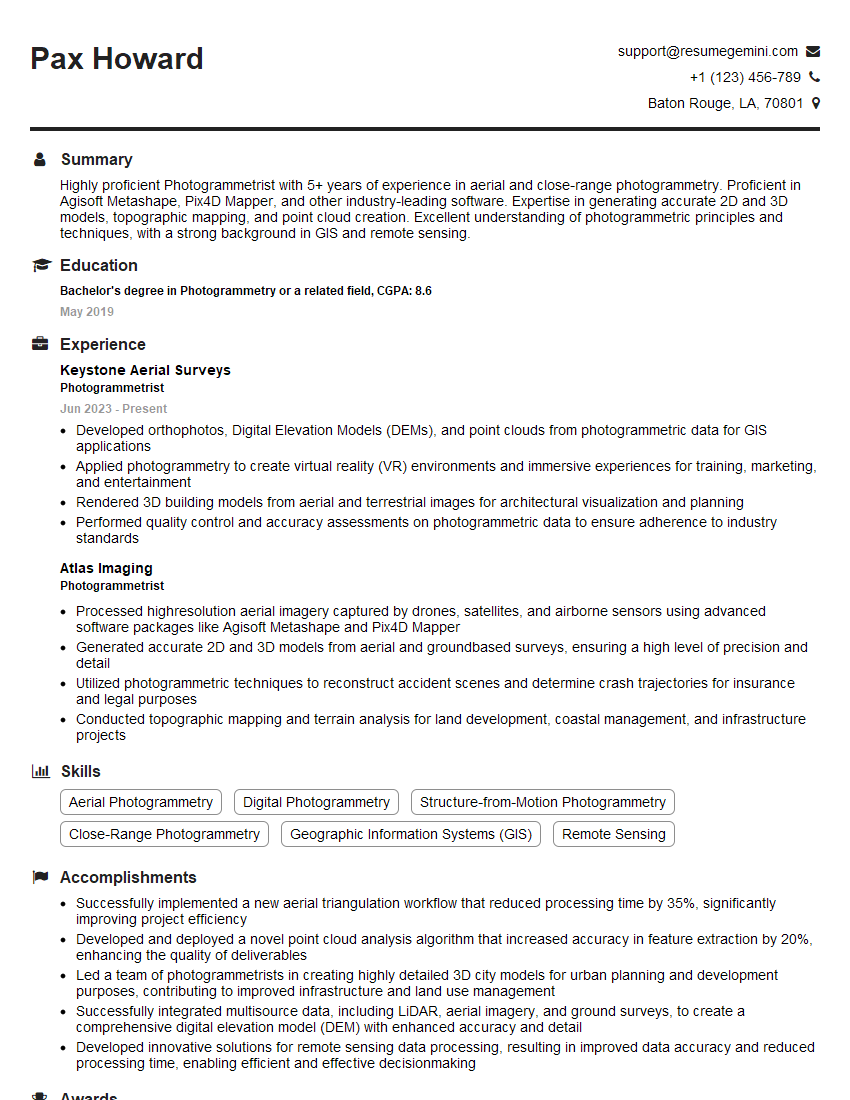
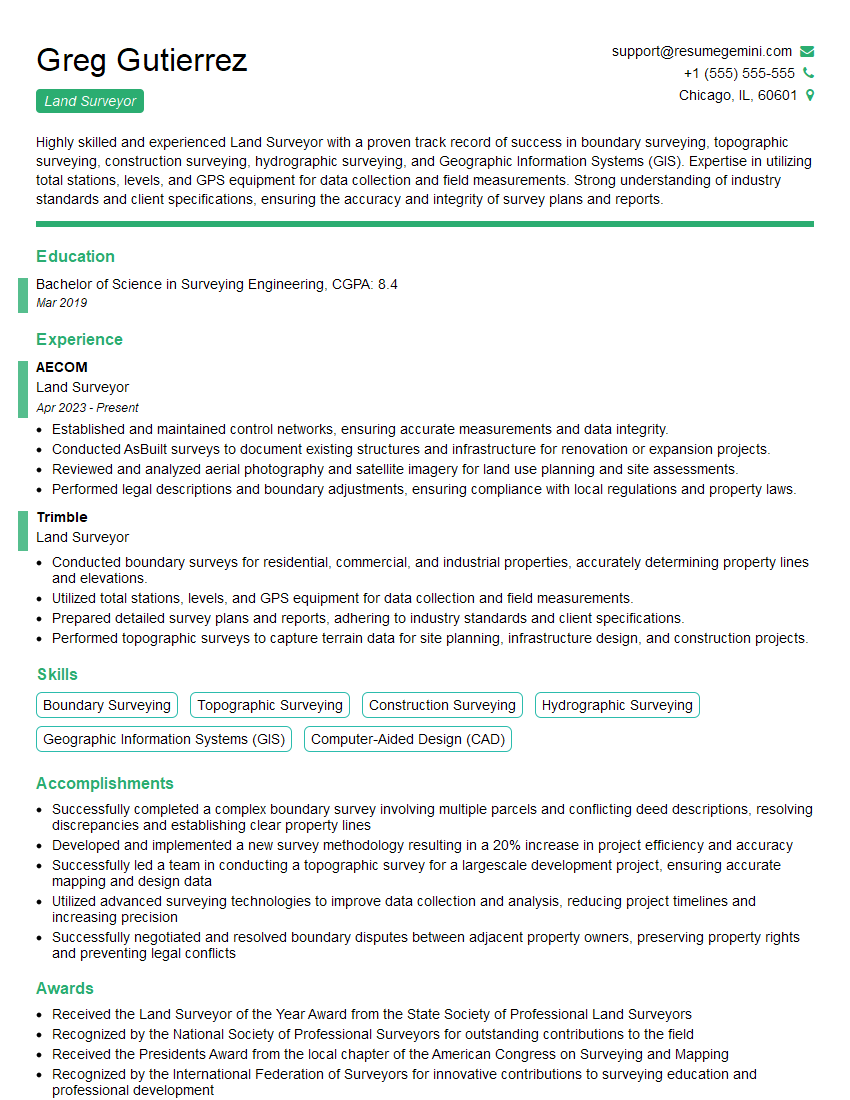
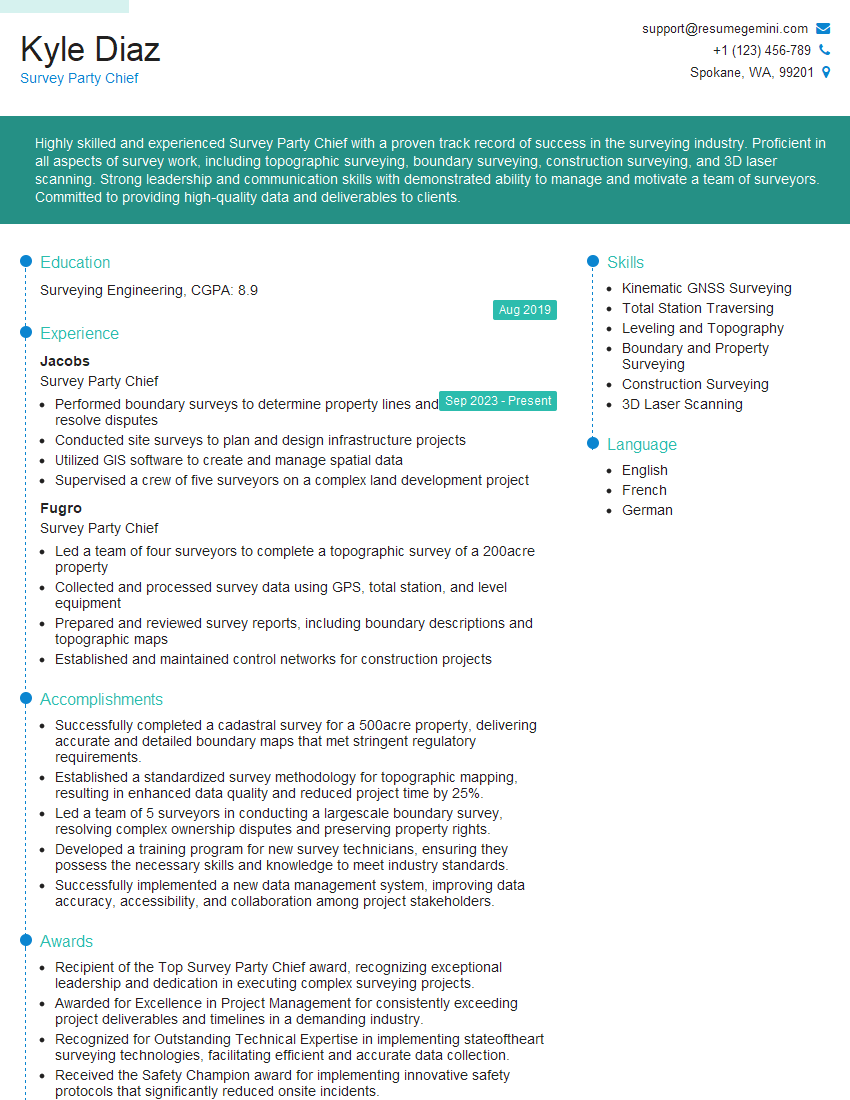
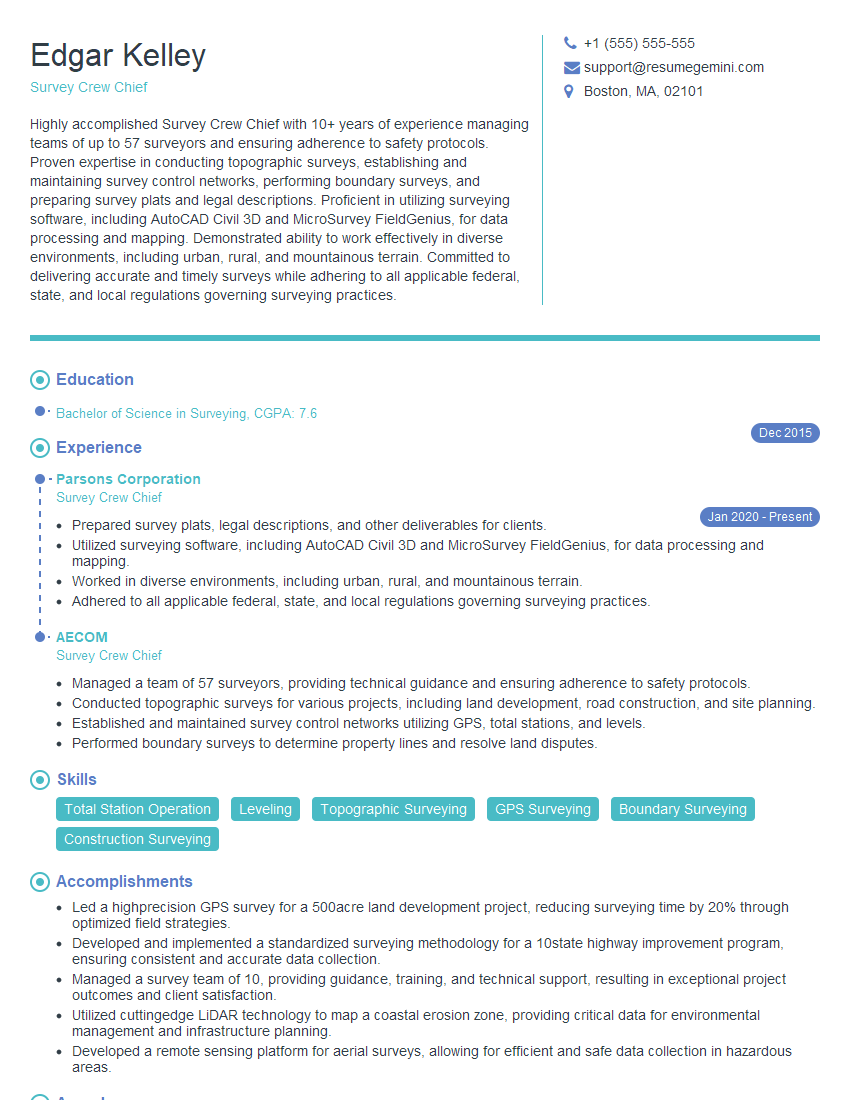
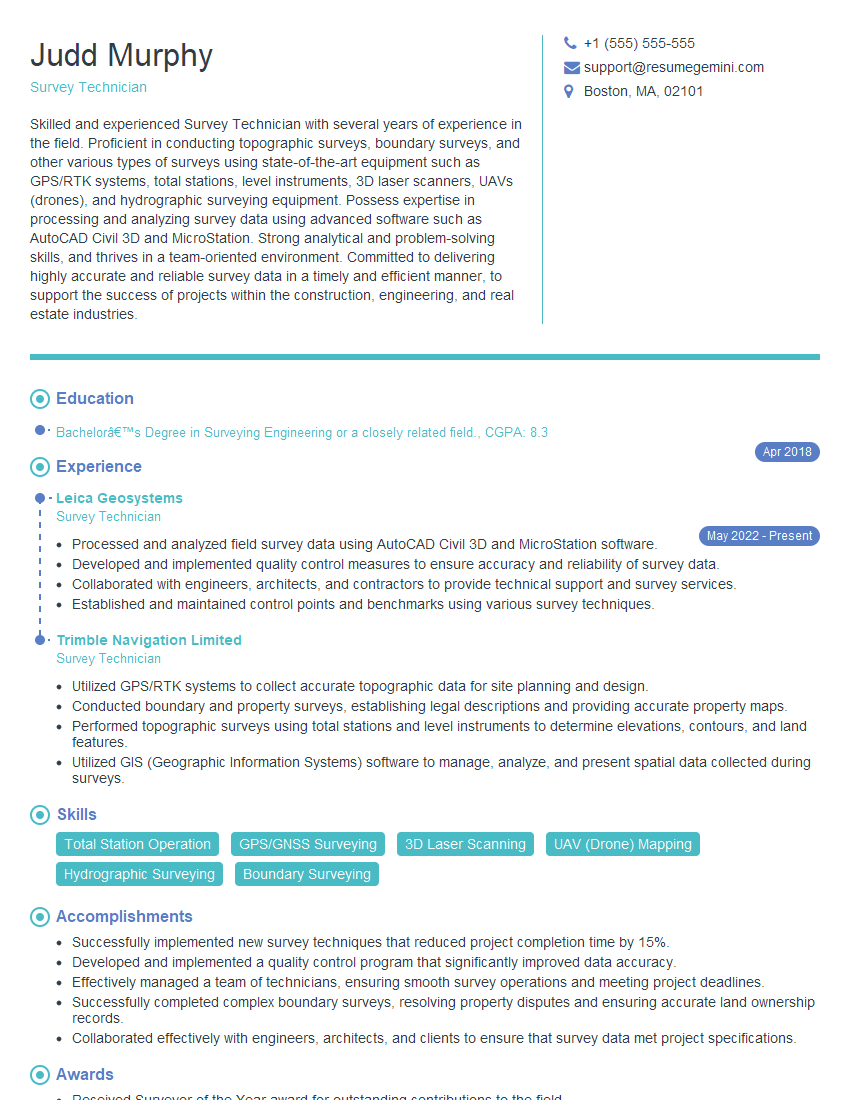
Mastering Surveying Land Development significantly enhances your career prospects, opening doors to exciting opportunities in construction, engineering, and environmental management. To maximize your job search success, create a powerful, ATS-friendly resume that highlights your skills and experience effectively. ResumeGemini is a trusted resource that can help you build a professional resume optimized for applicant tracking systems. Examples of resumes tailored to Surveying Land Development are available, providing valuable guidance in showcasing your qualifications.

Explore more articles
Users Rating of Our Blogs
Share Your Experience
We value your feedback! Please rate our content and share your thoughts (optional).
What Readers Say About Our Blog
Really detailed insights and content, thank you for writing this detailed article.
IT gave me an insight and words to use and be able to think of examples