Preparation is the key to success in any interview. In this post, we’ll explore crucial Surveying Mapping interview questions and equip you with strategies to craft impactful answers. Whether you’re a beginner or a pro, these tips will elevate your preparation.
Questions Asked in Surveying Mapping Interview
Q 1. Explain the difference between plane surveying and geodetic surveying.
The key difference between plane surveying and geodetic surveying lies in how they handle the Earth’s curvature. Plane surveying assumes the Earth is flat within the project area, simplifying calculations. This is suitable for smaller projects where the Earth’s curvature has negligible impact on accuracy. Geodetic surveying, on the other hand, explicitly accounts for the Earth’s curvature using an ellipsoidal model. This is crucial for large-scale projects spanning significant distances where ignoring curvature would introduce unacceptable errors. Imagine surveying a small town versus surveying a large state; the former might use plane surveying, while the latter demands geodetic surveying.
For example, when laying out a building foundation, plane surveying’s simplifications are perfectly acceptable. However, when establishing a national geodetic control network, geodetic surveying’s precision is essential.
Q 2. What are the various types of surveying equipment you are familiar with?
Throughout my career, I’ve extensively used a wide range of surveying equipment. This includes:
- Total Stations: These highly accurate electronic instruments measure distances, angles, and elevations simultaneously, significantly boosting efficiency. They are my workhorse for most projects.
- Global Navigation Satellite Systems (GNSS) Receivers: These are indispensable for GPS and other satellite-based positioning techniques. I’ve worked with both single-frequency and dual-frequency receivers, the latter providing greater precision.
- Leveling Instruments: These precise instruments determine elevations through the principle of creating a horizontal line of sight. They’re crucial for establishing benchmarks and creating contour maps.
- Electronic Distance Measurement (EDM) Devices: While often integrated into total stations, EDM devices can operate independently to measure distances using infrared or laser light. I’ve used them in situations where a total station was impractical.
- Data Collectors: These ruggedized handheld computers streamline data recording and management, minimizing errors and time spent on manual data entry.
- Auto Levels and Theodolites: These are older technologies but are still valuable and used in specific applications.
My familiarity extends to utilizing the latest software integrated with this equipment for data processing and analysis.
Q 3. Describe your experience with GPS surveying techniques.
My experience with GPS surveying techniques is extensive. I’m proficient in various GPS methods including static, rapid static, and kinematic surveying. I understand the intricacies of different satellite systems like GPS, GLONASS, Galileo, and BeiDou, and how their combined use enhances accuracy and reliability.
For instance, I’ve used static GPS techniques for establishing high-precision control points, requiring several hours of observation to achieve millimeter-level accuracy. Rapid static techniques offer faster results, suitable for projects where high accuracy is still needed but time constraints exist. Kinematic surveying, on the other hand, is perfect for real-time applications like mapping utility lines or creating as-built surveys.
I’m also experienced in post-processing techniques to correct for atmospheric and other errors, which significantly improve the overall accuracy of the GPS data. I frequently utilize software such as Leica Geo Office, Trimble Business Center, and other similar industry standards to process and analyze the data.
Q 4. How do you ensure accuracy and precision in your surveying measurements?
Accuracy and precision are paramount in surveying. My approach is multi-faceted:
- Calibration and Maintenance: Regularly calibrating all equipment, especially total stations and levels, ensures their accuracy. I also perform routine maintenance to keep them in top condition. This is like regularly tuning a musical instrument to ensure it produces the correct notes.
- Proper Techniques: Using correct surveying procedures and techniques is essential. This includes proper instrument setup, careful centering over points, and employing appropriate error reduction methods.
- Redundant Measurements: I always take multiple measurements of each point and compare the results. This helps to identify outliers and calculate means for greater accuracy.
- Environmental Considerations: I account for environmental factors such as temperature, atmospheric pressure, and refraction. These can introduce significant errors if not carefully considered.
- Data Quality Control: After data collection, I rigorously check and clean the data. This involves identifying and correcting or removing outliers or inconsistencies.
- Software Analysis: Using specialized surveying software, I perform data processing, coordinate transformations, and error analysis to assess and optimize accuracy.
This combination of meticulous fieldwork, careful data management, and robust quality checks guarantees highly accurate and reliable results.
Q 5. Explain the concept of coordinate systems and datums.
Coordinate systems and datums are fundamental to surveying. A coordinate system is a framework for defining the location of points on the Earth’s surface. Common systems include the Universal Transverse Mercator (UTM) and the State Plane Coordinate System (SPCS). These systems use coordinates (x, y) to specify location.
A datum, on the other hand, is a reference surface used to define the coordinate system. It defines the shape and orientation of the Earth and the origin of the coordinate system. Popular datums include NAD83 (North American Datum of 1983) and WGS84 (World Geodetic System 1984). Think of it as a precise starting point for our measurements. Choosing the right datum is crucial for ensuring consistency and accuracy, particularly in large-scale projects.
Imagine mapping a city. We would use a coordinate system to uniquely identify each building, street, and landmark, and a datum would provide the precise reference surface relative to the earth’s shape to avoid errors caused by earth’s curvature. Choosing the incorrect coordinate system or datum could lead to significant positional errors.
Q 6. How do you handle surveying challenges like obstructed sightlines or difficult terrain?
Obstructed sightlines and difficult terrain are common challenges in surveying. I employ several strategies to overcome these:
- Traversing: When sightlines are blocked, I use traversing techniques to establish points indirectly. This involves measuring angles and distances between a series of points to connect them.
- Trigonometric Leveling: This method can overcome elevation differences and obstructed sightlines by using angles and distances to calculate elevations.
- GPS Techniques: GPS is particularly useful in difficult terrain, allowing for the determination of coordinates even when direct lines of sight are unavailable.
- Remote Sensing: In certain situations, incorporating techniques like LiDAR or photogrammetry can help to overcome obstacles and create accurate 3D models of the terrain.
- Reconnaissance: Thorough planning and site reconnaissance before commencing fieldwork helps identify potential challenges and allow for planning of appropriate strategies.
For instance, when surveying a heavily wooded area, I might combine traversing with GPS to accurately establish the position of boundary points. The choice of technique depends on the specific obstacles and the level of accuracy required.
Q 7. Describe your experience with data processing and analysis in surveying projects.
Data processing and analysis are integral parts of any surveying project. My experience includes:
- Data Cleaning and Adjustment: I meticulously clean and adjust raw data to eliminate errors and inconsistencies. This often involves using least squares adjustment techniques to minimize discrepancies between multiple observations.
- Coordinate Transformations: Transforming coordinates between different coordinate systems and datums is frequently needed and I’m proficient in these operations.
- Error Analysis: I carefully analyze data for potential sources of error, calculating standard deviations and assessing the overall precision of the measurements.
- Data Visualization: I create maps, profiles, and cross-sections using CAD software and GIS tools to present the survey data clearly and effectively.
- Volume Calculations: I routinely perform earthwork volume calculations for projects like road construction or site development.
I use a variety of software packages, including AutoCAD Civil 3D, ArcGIS, and specialized surveying software, to carry out these tasks. I’m also adept at utilizing programming languages such as Python for automation and analysis of large datasets. A recent project involved generating a 3D model of a large-scale infrastructure project using point cloud data from LiDAR, requiring proficiency in several of these steps. The processed data was then used to optimize the design and minimize material costs.
Q 8. What software programs are you proficient in for surveying and mapping?
My proficiency in surveying and mapping software is extensive. I’m highly skilled in using industry-standard packages such as AutoCAD Civil 3D, which I use daily for design, drafting, and data management. I’m also proficient in ArcGIS for spatial analysis, data visualization, and creating various map products. For data collection and processing, I’m adept at using Trimble Business Center and Leica GeoMos software. Furthermore, I have experience with cloud-based platforms like TerraScan and other specialized software depending on the project needs. For example, on a recent large-scale infrastructure project, AutoCAD Civil 3D was crucial for designing road alignments and drainage systems, while ArcGIS facilitated the analysis of spatial relationships between the proposed infrastructure and existing land use.
Q 9. Explain your understanding of error propagation in surveying calculations.
Error propagation in surveying refers to how uncertainties in individual measurements accumulate and affect the accuracy of final calculated values. Think of it like compounding interest – small errors in individual measurements can significantly impact the overall result. For instance, if you have a small error in measuring the length of one side of a triangle, this error will propagate into the calculated area and other derived values like angles. We use statistical methods, primarily least squares adjustment, to minimize the impact of these errors. This method determines the most probable values for unknowns based on the measured data, considering the uncertainties. Understanding and quantifying error propagation is paramount for ensuring the reliability of survey results and complying with project specifications. A specific example is in calculating the coordinates of a point using several measured distances and angles. Each measurement has its own uncertainty, and these uncertainties are propagated through the coordinate calculations to yield an uncertainty for the final coordinate position.
Q 10. How do you ensure the legal compliance of surveying projects?
Legal compliance in surveying is crucial and varies based on location. I meticulously ensure adherence to all relevant regulations and standards, including those defined by the state’s land surveying board. This includes proper licensing, accurate documentation of survey procedures, and clear adherence to boundary descriptions as defined by deeds and other legal instruments. I always obtain necessary permits before commencing any work and ensure that all survey markers and monuments are properly set and documented according to local standards. Furthermore, I always strive for accuracy and precision in my measurements to avoid any legal disputes arising from ambiguous or inaccurate data. I’m particularly careful to thoroughly research the legal history of a property to ensure that my survey reflects the current legal boundaries. A key aspect of this is diligent archival research of historical records.
Q 11. Describe your experience with boundary surveys and property line determination.
I possess significant experience in boundary surveys and property line determination. This involves interpreting legal descriptions found in deeds, reviewing historical records, conducting field surveys to locate existing monuments and evidence of property lines, and preparing legal descriptions and plats for clients. A recent project involved resolving a boundary dispute between two neighboring landowners. Using historical records, plats, and on-site evidence, I accurately determined the property lines, resolving the dispute and avoiding costly litigation. The process includes meticulous research, precise measurements, and careful analysis of all available evidence. It’s critical to be familiar with different types of evidence, including deed descriptions, fences, improvements, and natural features, to reconstruct the property boundary correctly. It often requires a thorough understanding of legal principles, such as adverse possession and riparian rights.
Q 12. What is your experience with topographic surveying?
My experience in topographic surveying is broad, encompassing various methods and technologies. This includes using conventional methods like level and transit surveying as well as modern techniques such as total station and GPS surveying. I’m proficient in collecting elevation data and creating contour maps that represent the terrain’s shape. A notable project was creating a topographic survey for a large-scale construction project. Precise elevation data was critical for the design and construction phases, ensuring proper grading, drainage, and foundation design. Topographic surveying often involves using specialized software for data processing and analysis to create detailed contour maps, which are essential for planning infrastructure, land development, and environmental studies. The accuracy and detail of the topographic survey directly influence the quality and safety of the subsequent construction. Data acquisition includes techniques like differential leveling and trigonometric leveling depending on the project needs and terrain.
Q 13. How familiar are you with different types of maps (e.g., topographic, cadastral)?
I’m highly familiar with various map types. Topographic maps, showing terrain features like elevation contours, are essential for land development and engineering projects. Cadastral maps illustrate property boundaries, ownership information, and related land parcels, critical for land administration and legal purposes. Other map types I’m familiar with include thematic maps depicting specific data like soil types or land use, planimetric maps showing horizontal positions of features, and orthophotos, aerial photographs rectified to remove distortion and allow for accurate measurements. Understanding the purpose and characteristics of each map type is essential for selecting the appropriate tools and techniques for specific tasks. Each type is used for different purposes, requiring different data acquisition and processing methods.
Q 14. Explain the process of creating a digital terrain model (DTM).
Creating a Digital Terrain Model (DTM) involves several steps. First, elevation data is acquired. This can be done through various methods, including LiDAR, photogrammetry, or traditional surveying techniques such as leveling. This data forms a point cloud representing the terrain’s surface. This point cloud then undergoes processing steps such as filtering and cleaning to remove noise and outliers. Next, the processed data is used to create a surface model – this could be a TIN (Triangulated Irregular Network) or a grid model. Finally, the DTM is generated, providing a digital representation of the Earth’s surface. Software packages like ArcGIS and AutoCAD Civil 3D are often used for this process. The accuracy and resolution of the DTM depend heavily on the quality and density of the input data. DTMs are fundamental in many applications, including flood modeling, earthwork calculations, and urban planning.
Q 15. How do you manage large datasets in surveying projects?
Managing large datasets in surveying is crucial for efficient project completion. It involves a multi-pronged approach combining robust data management software, efficient data processing techniques, and careful data organization.
Firstly, we leverage Geographic Information Systems (GIS) software such as ArcGIS or QGIS. These platforms allow for efficient storage, retrieval, and analysis of massive point clouds, raster data, and vector data. We often employ database management systems (DBMS) like PostGIS to enhance data querying and spatial analysis capabilities.
Secondly, efficient processing relies on techniques such as cloud computing. Platforms like AWS or Azure allow us to distribute processing tasks across multiple servers, significantly reducing processing time for large datasets. This is especially helpful when dealing with point clouds from LiDAR surveys or high-resolution imagery from drone surveys.
Thirdly, a well-defined data structure is essential. We use clear naming conventions, metadata tagging, and project-specific folders to maintain organized data. This significantly reduces the risk of data loss or confusion during analysis. For example, a project might have separate folders for raw data, processed data, intermediate files, and final deliverables.
Finally, regular data backups are vital to mitigate data loss risks. We typically maintain multiple backups across different storage locations, both locally and remotely.
Career Expert Tips:
- Ace those interviews! Prepare effectively by reviewing the Top 50 Most Common Interview Questions on ResumeGemini.
- Navigate your job search with confidence! Explore a wide range of Career Tips on ResumeGemini. Learn about common challenges and recommendations to overcome them.
- Craft the perfect resume! Master the Art of Resume Writing with ResumeGemini’s guide. Showcase your unique qualifications and achievements effectively.
- Don’t miss out on holiday savings! Build your dream resume with ResumeGemini’s ATS optimized templates.
Q 16. Describe your experience with photogrammetry and its applications in surveying.
Photogrammetry, the science of making measurements from photographs, is an invaluable tool in modern surveying. My experience spans various applications, from creating detailed 3D models of sites to generating accurate orthomosaics for mapping purposes.
I’ve extensively used Structure-from-Motion (SfM) software such as Pix4D and Agisoft Metashape. These packages automate the process of generating 3D models from overlapping images. For instance, in a recent project involving a historical building, we used drone imagery processed through SfM to create a precise 3D model, allowing for detailed measurements and documentation impossible to achieve with traditional methods. This significantly reduced on-site time and mitigated safety risks.
Furthermore, photogrammetry is beneficial for inaccessible areas. For example, creating a topographic map of a steep cliff face can be dangerous and time-consuming using conventional surveying methods, but drone-based photogrammetry provides a safe and efficient alternative.
Orthomosaics, created from photogrammetric processing, are essential for accurate mapping and visualization. They provide a georeferenced mosaic of images, correcting for geometric distortions. I have used these orthomosaics for various applications including creating base maps for GIS projects and providing high-resolution imagery for environmental assessments.
Q 17. What is your understanding of LiDAR technology and its use in mapping?
LiDAR (Light Detection and Ranging) technology is a powerful remote sensing method employing laser pulses to measure distances to the Earth’s surface. It generates highly accurate point clouds representing the terrain’s three-dimensional structure.
My experience includes processing and analyzing LiDAR data for various applications such as creating high-resolution Digital Terrain Models (DTMs), Digital Surface Models (DSMs), and extracting features like vegetation and buildings. The data’s high density allows for detailed analysis, significantly improving precision over traditional methods.
For example, in a recent highway project, LiDAR data was crucial for accurately determining terrain elevation. This precise data allowed for efficient road design, minimizing earthworks and optimizing drainage solutions. The high point density allowed the automated extraction of vegetation features, which helped identify areas needing tree removal or other considerations before construction.
LiDAR data’s ability to penetrate vegetation makes it ideal for applications like forest inventory and flood plain mapping. The accuracy and detail afforded by LiDAR significantly enhance the quality of mapping products and inform decision-making in various engineering and environmental projects.
Q 18. How do you perform quality control and quality assurance checks in your work?
Quality control (QC) and quality assurance (QA) are paramount in surveying. Our processes involve multiple checks at every stage of a project, from data acquisition to final deliverables.
During data acquisition, we conduct instrument calibrations and checks following manufacturer’s guidelines. We also employ redundancy techniques, such as taking multiple measurements at each point. We utilize statistical analysis to identify outliers and inconsistencies.
Data processing involves rigorous checks for errors and inconsistencies in coordinate systems, transformations, and elevations. We use software-based checks and visual inspections of point clouds and digital models to identify and correct errors. For example, we would perform a root mean square error (RMSE) analysis to evaluate the accuracy of our measurements.
Finally, we rigorously check the final deliverables for accuracy, completeness, and consistency with project specifications. This includes reviewing maps, reports, and other documentation for errors and omissions before final client submission. Regular internal audits also contribute to maintaining high QA/QC standards.
Q 19. Describe a situation where you had to troubleshoot a surveying problem.
During a land surveying project involving a dense urban environment, we encountered significant challenges with multipath errors affecting GPS measurements. Multipath occurs when GPS signals bounce off buildings and other structures before reaching the receiver, causing inaccurate positioning.
Our initial GPS data showed inconsistencies and large discrepancies in the coordinates. To troubleshoot this, we implemented several strategies. Firstly, we carefully reviewed the data, identifying areas with the most significant errors. Then, we employed Real-Time Kinematic (RTK) GPS, a technique that uses a base station and rover to significantly reduce multipath errors.
Further, we incorporated traditional surveying techniques, such as total station measurements, in areas with severe multipath issues. Combining RTK GPS data with total station measurements provided a robust and accurate dataset. This allowed us to create a complete and reliable survey of the area, successfully overcoming the initial challenge.
Q 20. What is your experience with working with various surveying and mapping standards?
I have extensive experience working with various surveying and mapping standards, including those established by the National Spatial Reference System (NSRS), the American Society of Civil Engineers (ASCE), and the American Congress on Surveying and Mapping (ACSM).
Understanding these standards is crucial for ensuring the accuracy, consistency, and interoperability of survey data. We strictly adhere to relevant standards when selecting coordinate systems, defining datums, and establishing accuracy specifications. For example, using the correct geodetic datum (like NAD83) and projection is critical for accurate positioning and map creation.
My experience includes applying these standards in various projects, ranging from large-scale infrastructure projects to smaller-scale land surveys. Adherence to these standards ensures that our work meets industry best practices and is compatible with data from other sources.
Q 21. How do you collaborate effectively within a surveying team?
Effective collaboration is vital in surveying. Our team thrives on open communication, clear roles, and mutual respect. We use project management software to assign tasks, track progress, and ensure everyone is aligned on project goals and deadlines. We hold regular team meetings to discuss progress, challenges, and potential solutions.
Open communication is facilitated through daily stand-up meetings where each member provides updates on their tasks and any roadblocks encountered. We use collaborative platforms to share data and documents, ensuring everyone has access to the latest information. This allows for real-time feedback and efficient problem-solving.
Clear roles and responsibilities are defined at the start of each project, outlining individual contributions. This helps to avoid duplication of efforts and ensures that tasks are completed efficiently. We actively encourage knowledge sharing within the team, promoting continuous learning and professional development. This creates a positive and supportive work environment leading to higher-quality work and improved team efficiency.
Q 22. Explain your experience with different types of survey calculations.
Survey calculations are the backbone of any surveying project, transforming raw field measurements into meaningful spatial information. My experience encompasses a wide range, from basic trigonometric calculations for distance and angle determination to more complex geodetic computations involving ellipsoidal models and coordinate transformations.
Traverse Calculations: I’m proficient in closing traverses, adjusting for errors using methods like least squares, and computing coordinates for points along a survey line. For example, in a recent project involving a boundary survey, I used a closed traverse to accurately determine the property corners, ensuring precise area calculations and minimizing discrepancies.
Leveling Calculations: I have extensive experience with different leveling techniques, including differential leveling and trigonometric leveling, to determine elevations. This involves meticulous error checking and adjustment to ensure the accuracy of height measurements, crucial for construction projects and topographic mapping.
Coordinate Transformations: I’m adept at transforming coordinates between different datums and coordinate systems (e.g., UTM to State Plane). This is critical when integrating data from different sources, ensuring seamless compatibility. For instance, during a large-scale infrastructure project, I successfully integrated data from multiple survey teams using precise coordinate transformation techniques.
Volume Calculations: I’m skilled in computing volumes of earthworks, using methods such as cross-sections and mass-haul diagrams. This is vital for accurate estimations in construction projects and resource management.
Q 23. Describe your experience in using GIS software for spatial data analysis.
GIS software is an indispensable tool in my workflow, allowing me to manage, analyze, and visualize spatial data effectively. My experience includes extensive use of ArcGIS and QGIS. I’m comfortable performing a variety of tasks, including:
Data Import and Geoprocessing: I routinely import survey data (points, lines, polygons) from various formats (e.g., DXF, SHP, CSV) into GIS software and then perform geoprocessing operations such as spatial overlays, buffering, and clipping to extract meaningful information.
Spatial Analysis: I use GIS for various spatial analyses, including proximity analysis (determining distances to features), network analysis (optimizing routes), and terrain analysis (creating slope maps and contours). For example, I once used network analysis to optimize the placement of utility lines in a new housing development, minimizing environmental impact and cost.
Data Visualization and Mapping: I create professional-quality maps and visualizations to communicate survey results effectively to clients and stakeholders. This includes creating thematic maps, 3D models, and interactive web maps using various GIS tools.
Database Management: I use GIS software’s database capabilities to manage and query survey data, ensuring efficient data storage and retrieval.
Q 24. How do you manage and interpret survey data?
Managing and interpreting survey data is a multi-step process that demands precision and attention to detail. My approach involves:
Data Collection and Organization: I ensure that data is collected systematically and accurately in the field, using appropriate equipment and techniques. This includes documenting all measurements, metadata, and any potential sources of error. I then organize the data in a structured format, often using spreadsheets or databases.
Data Processing and Adjustment: Raw survey data often contains errors. I use appropriate techniques (e.g., least squares adjustment) to identify and correct these errors, ensuring the data’s accuracy and reliability.
Data Analysis and Interpretation: After processing, I analyze the data using statistical methods and GIS software to extract meaningful information. This involves identifying trends, patterns, and anomalies in the data to answer the specific questions of the survey project.
Quality Control: Throughout the entire process, I maintain rigorous quality control procedures to ensure the accuracy and reliability of the final results. This includes cross-checking data, performing independent calculations, and regularly reviewing all steps for potential issues.
For example, I recently managed a large-scale topographic survey. I implemented a strict quality control process, which involved regular data checks and comparisons between different survey methods to ensure the accuracy of the digital elevation model (DEM) produced.
Q 25. How familiar are you with remote sensing techniques?
I have a working familiarity with several remote sensing techniques and their applications in surveying and mapping. While I don’t operate the equipment myself, I understand how to interpret and integrate data from these sources into my projects:
LiDAR (Light Detection and Ranging): I understand how LiDAR data provides high-density point clouds for creating detailed 3D models and extracting elevation data. This is especially valuable for creating accurate Digital Terrain Models (DTMs) in challenging terrains.
Aerial Photography: I can interpret aerial photographs to extract planimetric information, identify features, and support ground surveys. Understanding photogrammetry principles is important for interpreting the data and evaluating its accuracy.
Satellite Imagery: I know how to access and use satellite imagery (e.g., from Landsat, Sentinel) for various purposes, such as base mapping, change detection, and large-scale land cover analysis. This is particularly useful for preliminary site assessments and large-area mapping projects.
In a recent project, we integrated LiDAR data with our ground surveys to create a highly accurate and detailed 3D model of a proposed infrastructure development. The combination of both data sources significantly improved the accuracy and efficiency of the project.
Q 26. Explain the concept of ground control points (GCPs).
Ground Control Points (GCPs) are points of known coordinates on the ground that are used to georeference remotely sensed data (like aerial photos or LiDAR point clouds). Essentially, they act as anchors, linking the image data to the real-world coordinate system.
Think of it like placing pins on a map to accurately locate a specific area. These ‘pins’ are the GCPs. We use very precise surveying techniques (like GPS or total station) to measure the coordinates of these points. Then, these measured coordinates are used in image processing software to align and rectify the remotely sensed data, ensuring that it is accurately positioned on the map.
The accuracy of the georeferencing directly depends on the number and distribution of GCPs. More GCPs, strategically located, improve the accuracy and minimize distortion in the final georeferenced product. The selection of GCPs is crucial – they need to be easily identifiable in both the imagery and on the ground.
Q 27. How do you ensure the safety of yourself and your crew during field work?
Safety is paramount in surveying fieldwork. My approach is proactive, encompassing planning, training, and adherence to strict protocols.
Pre-Field Planning: Before any fieldwork, I thoroughly plan the survey, assessing potential hazards (e.g., traffic, uneven terrain, weather conditions). I develop a detailed safety plan that addresses all potential risks and provides mitigation strategies.
Crew Training and Communication: I ensure that all crew members are adequately trained in safe working practices and emergency procedures. Clear communication and teamwork are critical to minimize risks and maintain situational awareness on the job site.
Equipment Safety: I ensure all equipment is properly maintained and calibrated, and that crew members are trained on the safe operation of each piece of equipment. This includes regular checks of safety features and protective gear.
Site Safety Practices: On-site, I enforce strict safety protocols, including the use of high-visibility clothing, appropriate personal protective equipment (PPE), and adherence to traffic laws. We use warning signs and flags to alert others to our presence. In areas with environmental hazards, we follow stringent procedures to protect ourselves and the environment.
Emergency Procedures: I ensure that everyone is familiar with emergency procedures, including communication protocols and first-aid responses. We always have a well-stocked first-aid kit on site.
Q 28. Describe your understanding of the legal and ethical responsibilities of a surveyor.
A surveyor carries significant legal and ethical responsibilities, impacting public safety and property rights.
Legal Compliance: I’m aware of and adhere to all relevant laws and regulations governing surveying practices in my jurisdiction. This includes licensing requirements, professional standards, and adherence to legal frameworks related to boundary disputes and land ownership.
Accuracy and Precision: My ethical obligation is to deliver accurate and precise survey data. This requires meticulous attention to detail, appropriate techniques, and adherence to professional standards. Misrepresentation or negligence can have serious consequences.
Confidentiality: I maintain the confidentiality of client data and information. Survey data often contains sensitive information, and its protection is essential.
Objectivity and Impartiality: I conduct surveys with objectivity and impartiality, providing unbiased results regardless of potential conflicts of interest. My primary concern is the accuracy and integrity of the survey data.
Professional Development: I’m committed to continuous professional development, keeping up-to-date with advancements in surveying technology and best practices. This ensures I provide the highest quality of service to my clients.
For instance, a recent boundary dispute case highlighted the importance of clear documentation and adherence to legal procedures. The accuracy of our survey and our thorough documentation were instrumental in resolving the conflict fairly and efficiently.
Key Topics to Learn for Surveying Mapping Interview
- Geospatial Data Acquisition: Understanding various surveying techniques (e.g., GPS, Total Stations, LiDAR) and their applications in different environments.
- Data Processing and Analysis: Familiarize yourself with software used for data processing, coordinate transformations, and error analysis. Practical experience with software like AutoCAD Civil 3D or ArcGIS is highly beneficial.
- Cartography and Map Production: Mastering map projections, symbolization, and the creation of accurate and visually appealing maps for various purposes.
- Surveying Calculations and Adjustments: Develop a strong understanding of trigonometric principles and their application in distance, angle, and elevation calculations. Practice solving adjustment problems to ensure accuracy.
- Legal Aspects of Surveying: Familiarize yourself with property boundaries, land surveying regulations, and legal implications related to surveying practices.
- Remote Sensing and GIS Integration: Understanding how remote sensing data integrates with surveying data to create comprehensive spatial information systems.
- 3D Modeling and Point Cloud Processing: Explore techniques for generating 3D models from point cloud data acquired through LiDAR or other technologies.
- Problem-Solving and Critical Thinking: Be prepared to discuss how you approach challenges in data acquisition, processing, and analysis, emphasizing accuracy and efficiency.
Next Steps
Mastering Surveying Mapping opens doors to a rewarding career with diverse opportunities in construction, infrastructure development, environmental management, and urban planning. To maximize your job prospects, focus on crafting a strong, ATS-friendly resume that effectively showcases your skills and experience. ResumeGemini is a trusted resource that can help you build a professional resume that stands out. We provide examples of resumes tailored to Surveying Mapping to guide you through the process. Invest the time to create a compelling resume – it’s your first impression to potential employers.
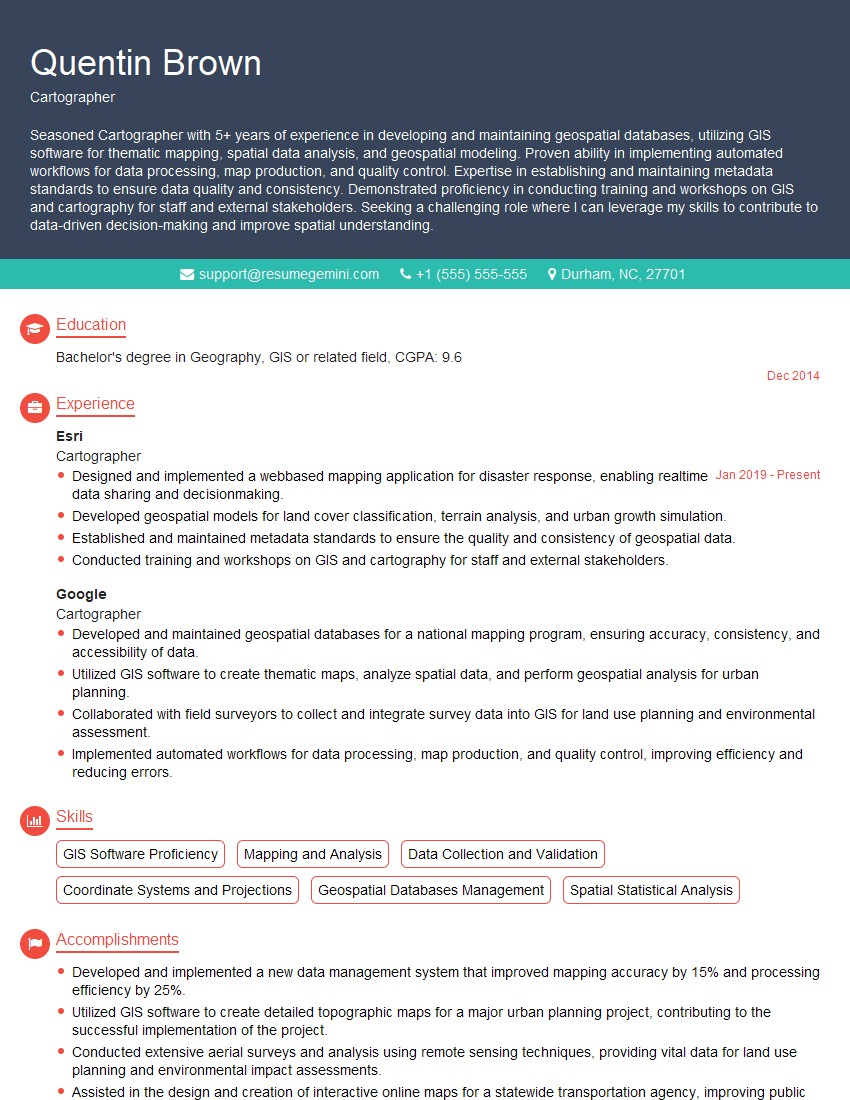
Cartographer Resume Sample

Photogrammetrist Resume Sample
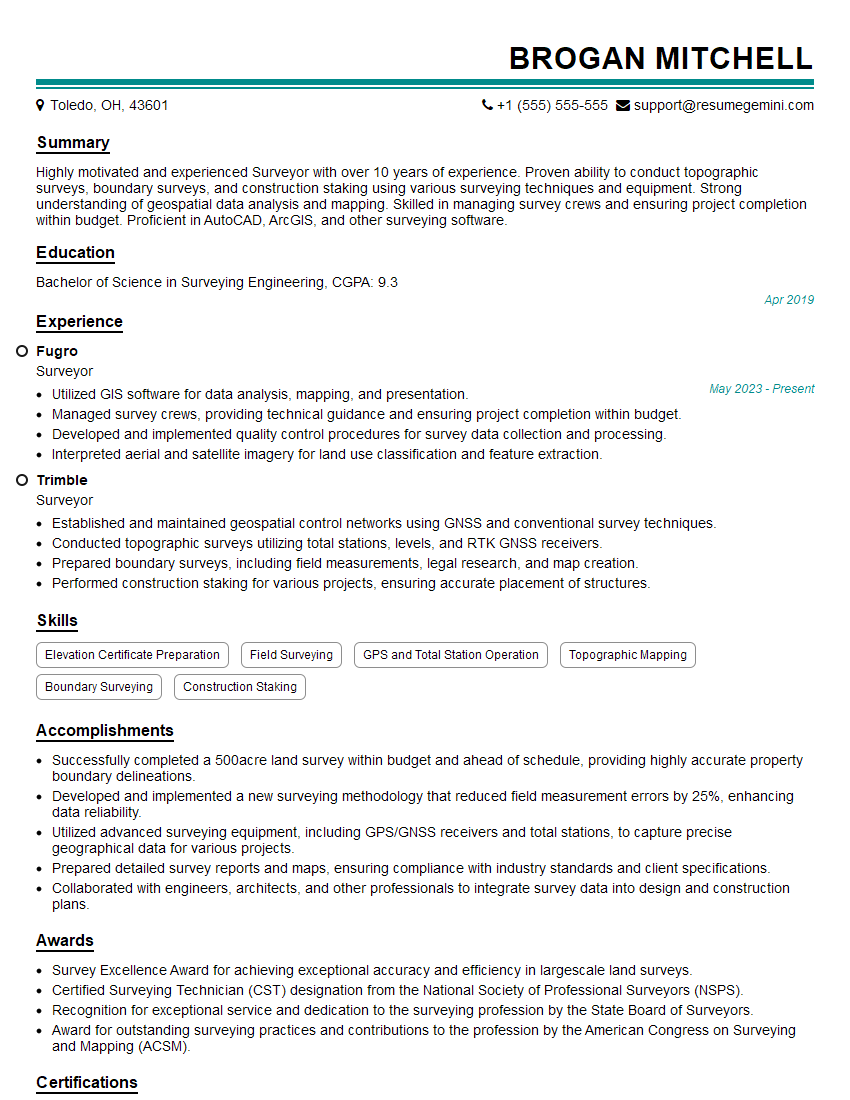
Surveyor Resume Sample
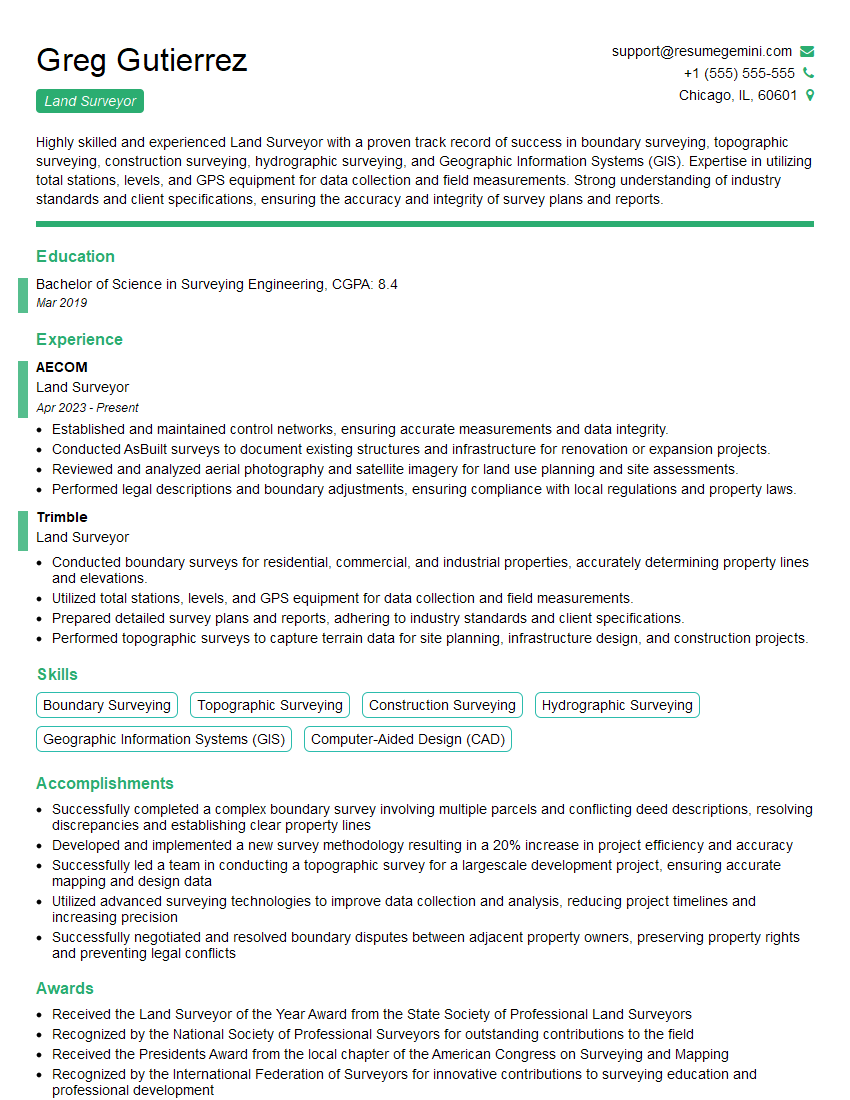
Land Surveyor Resume Sample
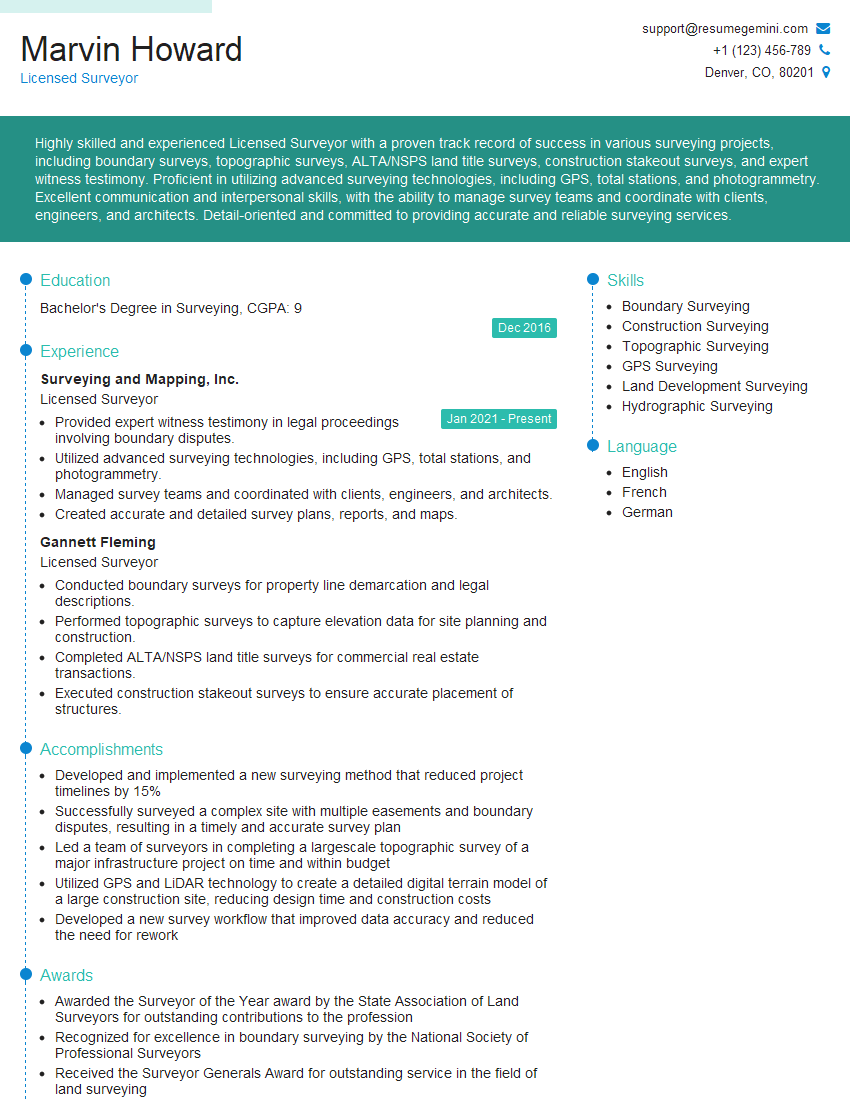
Licensed Surveyor Resume Sample

Project Surveyor Resume Sample
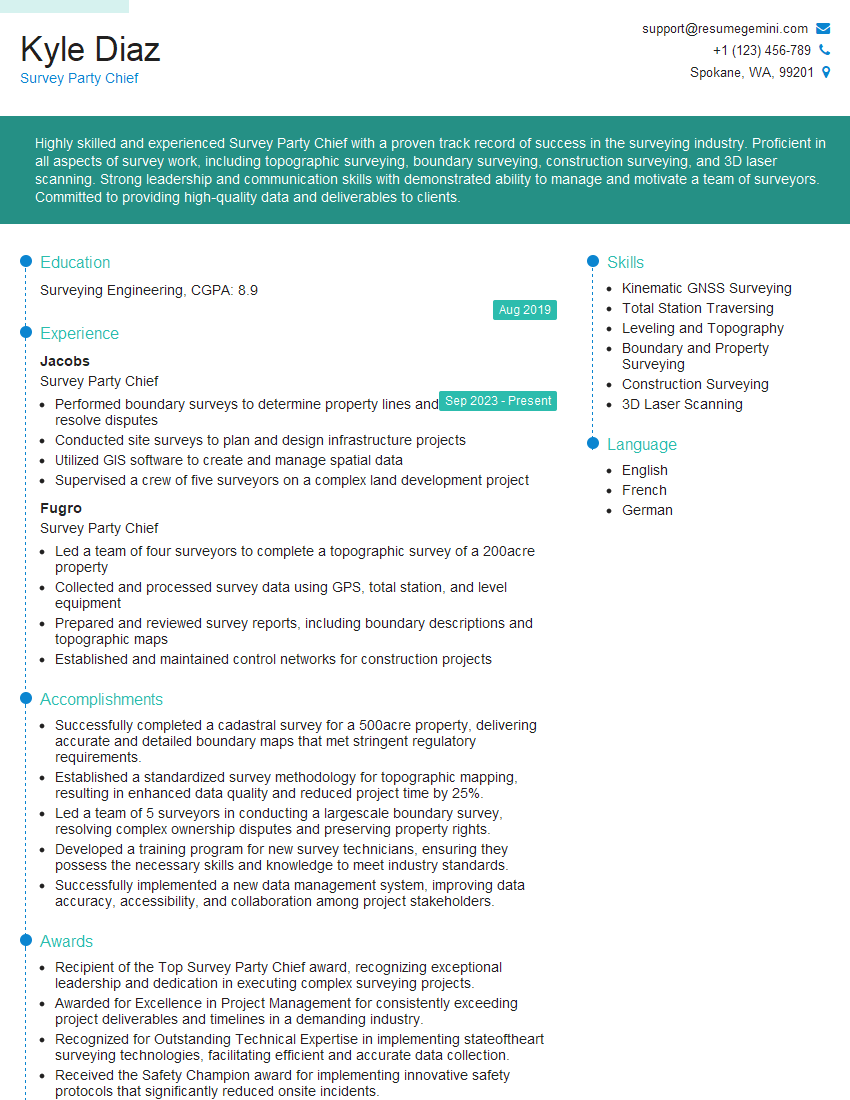
Survey Party Chief Resume Sample
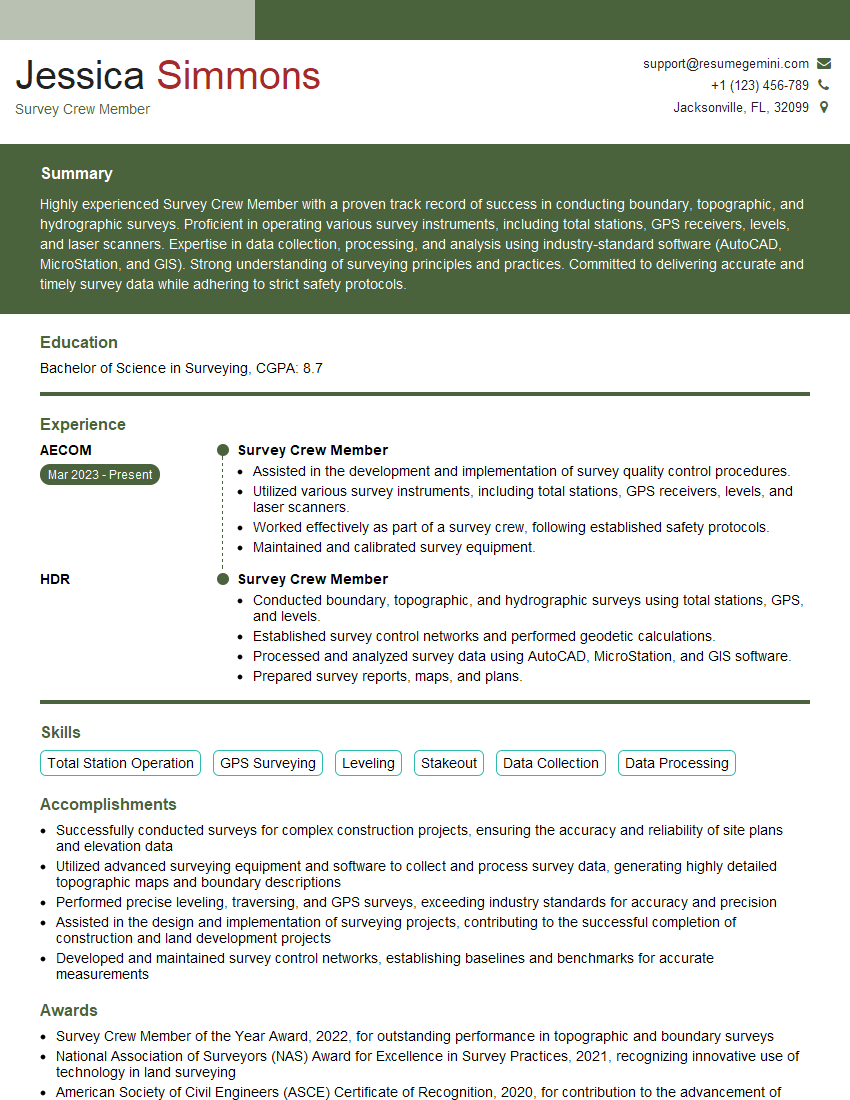
Survey Crew Member Resume Sample
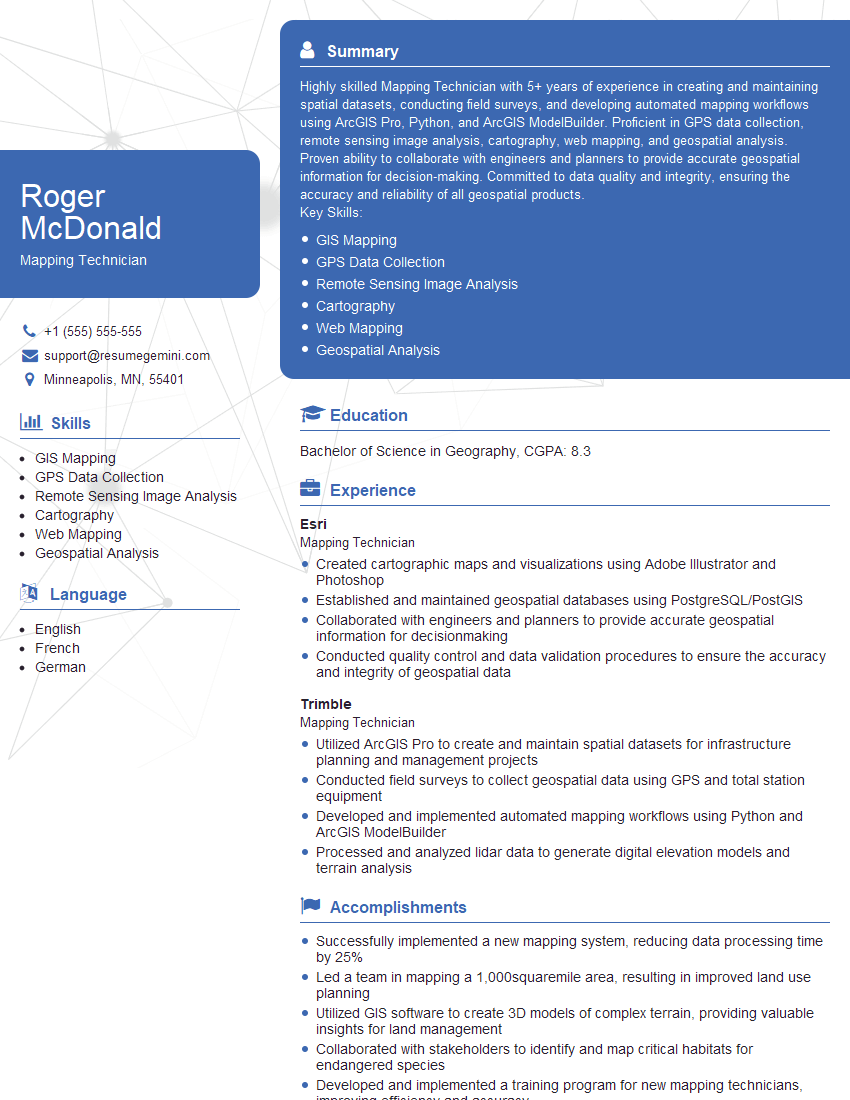
Mapping Technician Resume Sample

Remote Sensing Specialist Resume Sample
Explore more articles
Users Rating of Our Blogs
Share Your Experience
We value your feedback! Please rate our content and share your thoughts (optional).
What Readers Say About Our Blog
Really detailed insights and content, thank you for writing this detailed article.
IT gave me an insight and words to use and be able to think of examples