The thought of an interview can be nerve-wracking, but the right preparation can make all the difference. Explore this comprehensive guide to Tank Farm Operations interview questions and gain the confidence you need to showcase your abilities and secure the role.
Questions Asked in Tank Farm Operations Interview
Q 1. Explain the process of tank gauging and inventory management.
Tank gauging and inventory management are crucial for efficient and safe tank farm operations. Gauging determines the precise volume of liquid stored in each tank, while inventory management tracks the inflow, outflow, and current levels of all stored products. This involves a multi-step process.
- Data Acquisition: This is done using various methods, including manual dipstick measurements, automated tank gauging systems (ATG) utilizing radar, ultrasonic, or hydrostatic principles, and even drone-based technologies. ATGs provide real-time data, offering greater accuracy and frequency than manual methods.
- Data Validation: Data from gauging systems is often checked for consistency and accuracy. This may involve comparing readings from multiple sensors, verifying against previous readings, and identifying potential anomalies. Discrepancies need investigation and correction.
- Inventory Calculation: This involves converting the gauged volume into a usable quantity, often accounting for temperature effects on liquid density. Specific gravity readings are frequently used here. The system should also track product movements in and out of the tanks, adjusting the inventory accordingly.
- Reporting and Analysis: The inventory management system generates reports providing real-time inventory levels, product movement history, and potentially alerts for low levels, potential leaks, or other critical conditions. These reports are essential for efficient planning of shipments and operational decision-making.
For example, in a large crude oil storage facility, accurate inventory management is paramount for timely delivery to refineries, preventing shortages, and minimizing financial losses due to inaccurate calculations. Real-time monitoring through ATGs helps to optimize operations and prevent costly delays.
Q 2. Describe your experience with tank farm safety procedures and regulations.
My experience with tank farm safety procedures and regulations is extensive, spanning over [Number] years. I’ve worked in facilities adhering to strict standards like OSHA (in the US) and [mention other relevant regulations, e.g., Canadian equivalents, etc.], ensuring compliance with all relevant regulations. Safety is never compromised.
- Permit-to-work systems: I have a thorough understanding of and experience implementing permit-to-work systems for all hot work, entry into confined spaces, and other high-risk activities. This involves clear documentation, risk assessments, and ensuring all safety measures are in place before work begins.
- Emergency response planning: I have participated in and led emergency drills and response planning, including spill response procedures and fire prevention measures. This involves establishing clear communication protocols and ensuring access to necessary equipment.
- Personal Protective Equipment (PPE): Strict enforcement of PPE use is crucial. This includes providing appropriate safety equipment such as respirators, flame-resistant clothing, and safety footwear, ensuring proper training and monitoring of use.
- Regular inspections and maintenance: I’m experienced in conducting regular inspections of tank farm infrastructure to identify and address potential hazards proactively. This includes tank integrity checks, monitoring of safety systems, and regular maintenance of equipment.
In one instance, a thorough pre-job safety briefing prevented a potential incident during a tank repair. Identifying a missing safety component during the briefing allowed us to rectify the situation before any work began, highlighting the importance of meticulous planning and adherence to safety protocols.
Q 3. How do you handle leak detection and prevention in a tank farm environment?
Leak detection and prevention are vital aspects of tank farm safety and environmental protection. My approach combines proactive measures with responsive detection systems.
- Regular Inspections: Visual inspections of tanks, pipelines, and associated equipment are conducted routinely to identify any signs of leaks, such as staining, discoloration, or unusual odors.
- Leak Detection Systems: We employ various leak detection technologies including automated tank gauging systems (ATGs) that monitor liquid levels for unexpected changes, and secondary containment systems that collect any spills. Vapor monitoring systems can also detect leaks of volatile substances.
- Automated Alarm Systems: Alarm systems are integrated into our leak detection systems to provide immediate alerts in case of a leak, allowing for a quick response.
- Soil Monitoring: Regular soil sampling around tanks can help detect subsurface leaks. This proactive measure is especially crucial for older tanks.
- Preventive Maintenance: Regular maintenance of tanks, valves, pumps, and pipelines is essential to minimize the risk of leaks. This involves routine inspections, repairs, and replacements as needed.
For instance, implementing a new leak detection system in a facility resulted in the early detection of a small leak in an underground pipeline. This allowed us to address the issue promptly, preventing a significant environmental incident and potential financial losses.
Q 4. What are your experiences with different types of tank farm storage tanks?
My experience encompasses a variety of tank storage technologies. The choice of tank type depends on factors such as stored product properties (viscosity, volatility, corrosiveness), storage capacity, and environmental conditions.
- Aboveground Storage Tanks (ASTs): These are commonly used for various liquids and are made of steel, fiberglass reinforced plastic (FRP), or other suitable materials. I’ve managed both fixed-roof and floating-roof tanks, each with its own advantages and disadvantages regarding vapor emissions.
- Underground Storage Tanks (USTs): I have experience overseeing the operation and maintenance of USTs, particularly focusing on leak detection and prevention, given the challenges posed by their location. Regulations for USTs tend to be stricter than for ASTs.
- Specialized Tanks: My experience includes working with specialized tanks designed for cryogenic liquids (requiring special insulation and pressure-relief systems) and tanks for highly corrosive materials (requiring specific corrosion-resistant materials).
For example, I was involved in the upgrade of a facility’s older ASTs with improved corrosion protection and secondary containment systems to improve safety and prolong tank lifespan. Understanding the specific characteristics of each tank type ensures its safe and efficient operation.
Q 5. Describe your knowledge of relevant environmental regulations for tank farms.
I possess a strong understanding of environmental regulations impacting tank farm operations. These regulations are stringent and aim to prevent environmental contamination from spills or leaks.
- Clean Air Act (or equivalent): Understanding regulations related to volatile organic compound (VOC) emissions from tanks and associated equipment, often necessitating vapor recovery systems or other emission control measures.
- Clean Water Act (or equivalent): Strict adherence to regulations concerning the prevention of water pollution from spills or leaks, requiring secondary containment, emergency response plans, and spill prevention control and countermeasure (SPCC) plans.
- Resource Conservation and Recovery Act (RCRA) (or equivalent): Compliance with regulations for the storage and handling of hazardous materials, including proper labeling, safety data sheets, and emergency response plans.
- Spill Prevention, Control, and Countermeasure (SPCC) Plans: Development and implementation of SPCC plans are crucial to minimize the risk and impact of oil spills. These plans should outline procedures for preventing spills, controlling them if they occur, and responding effectively.
For example, in one instance, we implemented a vapor recovery system to minimize VOC emissions from a tank farm, bringing it into compliance with stricter environmental standards and reducing our environmental footprint.
Q 6. How do you maintain accurate records and documentation in tank farm operations?
Maintaining accurate records and documentation is paramount in tank farm operations for regulatory compliance, operational efficiency, and safety. We utilize a combination of manual and automated systems to ensure data accuracy and integrity.
- Tank Gauging Data: Automated Tank Gauging (ATG) systems provide real-time data, which is automatically logged and stored in a database. Manual gauging data is entered into the system, always double-checked for accuracy.
- Inventory Management System: We utilize robust inventory management software to track product movements, reconcile inventory, and generate reports. This system is essential for identifying discrepancies and investigating anomalies.
- Maintenance Records: Detailed records of all maintenance activities are kept, including inspections, repairs, and equipment replacements. This is crucial for scheduling preventative maintenance and ensuring compliance with safety standards.
- Calibration Logs: Regular calibration of all measuring instruments (including ATGs and level gauges) is essential and thoroughly documented.
- Regulatory Compliance Documentation: All permits, licenses, and other regulatory documents are meticulously maintained. This allows us to demonstrate compliance and avoid potential penalties.
A well-maintained record-keeping system provides a complete history of tank farm operations, facilitates efficient decision-making, and serves as a valuable resource during audits and inspections.
Q 7. Explain your experience with tank farm maintenance and repair procedures.
Tank farm maintenance and repair procedures are critical for ensuring safe and efficient operations. A proactive maintenance strategy, encompassing preventative and corrective maintenance, is essential.
- Preventative Maintenance: This involves routine inspections, cleaning, and lubrication of equipment, including pumps, valves, and pipelines. This extends the lifespan of equipment, reducing the likelihood of breakdowns and unexpected repairs.
- Corrective Maintenance: This involves addressing malfunctions and failures as they occur. This requires a rapid response to minimize downtime and prevent further damage.
- Tank Inspections: Regular internal and external inspections of tanks are conducted to detect corrosion, leaks, or other damage. This may involve specialized inspection techniques such as ultrasonic testing or magnetic particle inspection.
- Painting and Coating: Periodic repainting and recoating of tanks help prevent corrosion and extend their service life. The type of coating is chosen based on the stored product and environmental conditions.
- Emergency Repairs: We have procedures in place for dealing with emergency situations such as leaks or equipment failures, prioritizing safety and minimizing environmental impact.
For example, a proactive preventative maintenance program helped us avoid a costly tank failure. Regular inspections revealed signs of corrosion, allowing us to schedule timely repairs before the tank became compromised, preventing a potential environmental hazard and significant downtime.
Q 8. Describe your familiarity with various tank farm equipment and instrumentation.
My familiarity with tank farm equipment and instrumentation is extensive, encompassing both the mechanical components and the sophisticated control systems. I’ve worked with a wide range of tanks, including fixed-roof, floating-roof, and dome-roof tanks, each requiring specific monitoring and safety measures.
- Tanks: I understand the construction, capacity, and operational characteristics of various tank types. This includes understanding their structural integrity, potential for corrosion, and appropriate material selection for different liquids.
- Pumps: I’m proficient with centrifugal, positive displacement, and other types of pumps used for liquid transfer, including their operation, maintenance, and troubleshooting. For instance, I’ve diagnosed and resolved issues with pump cavitation by adjusting suction pressure and checking for leaks.
- Level Gauges: I have experience with various level gauging technologies, including radar, ultrasonic, and hydrostatic level measurement systems, along with their calibration and maintenance. Understanding their limitations and selecting the appropriate gauge for the specific liquid is crucial.
- Flow Meters: I’m skilled in the operation and maintenance of various flow meters, such as orifice plates, turbine meters, and Coriolis flow meters. Accurate flow measurement is critical for inventory control and efficient operations.
- Safety and Control Systems: This includes emergency shutdown systems (ESD), fire and gas detection systems, and high-level alarms, all crucial for ensuring safe operations.
My experience also covers instrumentation such as pressure transmitters, temperature sensors, and analyzers used for continuous monitoring of tank contents and environmental conditions.
Q 9. What are your troubleshooting skills related to tank farm equipment malfunctions?
Troubleshooting tank farm equipment malfunctions requires a systematic approach. I use a combination of practical experience, diagnostic tools, and a deep understanding of the equipment’s operational principles.
My troubleshooting process typically involves:
- Safety First: Always prioritize safety by isolating the affected equipment and ensuring personnel are clear of any hazards.
- Gather Information: Collect data from various sources including alarms, logs, operator reports, and instrument readings. For example, a sudden drop in tank pressure might indicate a leak, while a high-level alarm might point to a malfunctioning level sensor.
- Visual Inspection: Perform a thorough visual inspection of the equipment for any obvious signs of damage, leaks, or corrosion.
- Systematic Diagnostics: Utilize diagnostic tools like pressure gauges, temperature sensors, and flow meters to isolate the problem. For instance, a low flow rate might point to a pump problem or a clogged pipe.
- Corrective Action: Implement the necessary corrective actions, such as repairing leaks, replacing faulty components, or recalibrating instruments. Documentation is crucial at every step.
- Verification and Preventative Measures: Verify the effectiveness of the corrective action and implement preventive measures to avoid future occurrences. This might include scheduled maintenance, operator training, or process improvements.
For example, I once diagnosed a recurring pump failure in a tank farm by systematically checking for issues like cavitation (using pressure readings) and ultimately traced the problem to a worn impeller. Replacing the impeller solved the issue permanently.
Q 10. How do you ensure the safe handling and transfer of liquids in a tank farm?
Safe handling and transfer of liquids in a tank farm is paramount. It’s achieved through a combination of robust procedures, equipment, and operator training.
- Pre-Transfer Checks: Before any transfer begins, I rigorously check the compatibility of the liquids, the integrity of the piping and valves, the proper functioning of safety systems (ESD, level switches, etc.), and the receiving tank’s capacity and pressure limits. This includes verifying all permits and approvals are in place.
- Proper Piping and Valves: The use of appropriate materials in the piping system is crucial to avoid corrosion or reactions with the liquids. Valves must be correctly sized and maintained for reliable operation. Clear labeling and proper isolation procedures prevent cross-contamination.
- Grounding and Bonding: Preventing static electricity buildup is critical, especially with flammable liquids. Grounding and bonding procedures must be meticulously followed during all transfer operations.
- Overfill Prevention: High-level alarms, overfill prevention systems, and emergency shut-down procedures are critical for preventing spills and other hazards. Regular testing and calibration of these systems is crucial.
- Emergency Shutdown Procedures: Clearly defined emergency shutdown procedures are practiced regularly. Personnel must be well-trained to respond to leaks, spills, or equipment failures.
- Environmental Monitoring: Continuous monitoring of the environment for leaks and vapor release is key. Regular inspections and soil sampling help maintain environmental compliance.
Think of it like this: handling liquids in a tank farm is similar to handling delicate chemicals in a laboratory – precision, safety, and rigorous adherence to protocols are non-negotiable.
Q 11. Explain your understanding of pressure and vacuum relief systems in tanks.
Pressure and vacuum relief systems are vital safety devices in tanks, designed to prevent over-pressurization or vacuum conditions that could lead to tank rupture, spills, or equipment damage.
- Pressure Relief Valves (PRVs): These valves automatically open when the tank pressure exceeds a pre-set limit, releasing the excess pressure to the atmosphere or a flare system. Regular testing and maintenance, including inspections for leaks and proper operation, are essential. Different PRV types are selected based on liquid properties and pressure requirements.
- Vacuum Relief Valves (VRVs): These valves open when the tank pressure drops below a pre-set level, preventing the formation of a vacuum that could collapse the tank. VRVs protect the tank integrity and prevent the ingress of air or contaminants.
- Flame Arresters: In systems handling flammable liquids, flame arresters are integrated with pressure and vacuum relief valves to prevent the propagation of flames into the tank or from the tank to the atmosphere.
- Rupture Discs: These are a secondary safety device that are designed to burst at a specific pressure, offering a final level of protection in case the PRVs fail.
Understanding the sizing and selection criteria for these systems, along with their regular inspection and testing, is crucial for maintaining tank integrity and safety. Improperly functioning PRVs or VRVs can lead to serious accidents.
Q 12. Describe your experience with automated tank farm control systems.
I possess significant experience with automated tank farm control systems, including SCADA (Supervisory Control and Data Acquisition) systems and DCS (Distributed Control Systems). These systems enhance operational efficiency, safety, and data management.
- SCADA/DCS Operation: I’m proficient in operating and monitoring these systems, including reviewing real-time data on tank levels, pressures, temperatures, and flow rates. This allows for proactive adjustments and minimizes manual intervention.
- Data Analysis: I can use data from SCADA/DCS systems for trend analysis, performance monitoring, and optimization of tank farm operations. This can identify potential issues before they escalate into major problems.
- Troubleshooting: I can effectively utilize the diagnostic capabilities of these systems to pinpoint malfunctions or inefficiencies in the tank farm equipment and processes. The ability to interpret alarms and identify root causes is key.
- System Configuration: I have experience working with different SCADA/DCS platforms and configuring the systems to meet specific operational requirements. This involves programming, setting parameters, and configuring alarms.
For example, in a previous role, I helped implement a new SCADA system that reduced manual errors during tank transfers and significantly improved inventory accuracy. The automated system allowed for real-time monitoring and control, minimizing the risk of spills and improving overall efficiency.
Q 13. How do you manage tank farm operations during inclement weather?
Managing tank farm operations during inclement weather requires careful planning and adherence to strict safety protocols. The primary goal is to minimize risks to personnel and the environment.
- Pre-Storm Preparation: Before a storm hits, we review weather forecasts and prepare by securing loose equipment, ensuring drainage systems are clear, and checking the integrity of tank roofs and seals. Critical equipment may be shut down.
- Reduced Operations: Depending on the severity of the weather, operations may be reduced or completely halted. Non-essential work is postponed.
- Personnel Safety: Personnel are instructed on safety procedures and emergency response plans. They may be evacuated from the tank farm if the situation warrants it.
- Monitoring and Response: During the storm, continuous monitoring of tank levels, pressures, and environmental conditions is crucial. Emergency response teams are on standby to address any incidents.
- Post-Storm Assessment: Following the storm, a thorough inspection of the tank farm is carried out to assess any damage, including checking for leaks, corrosion, or structural damage. Repair and remediation actions are prioritized based on risk levels.
Inclement weather, particularly heavy rain, high winds, or lightning strikes, presents a heightened risk of leaks, flooding, and equipment damage. A proactive approach and careful planning are crucial to mitigating these risks.
Q 14. What is your experience with emergency response procedures in a tank farm?
My experience with emergency response procedures in a tank farm is extensive. I’ve participated in numerous drills and real-life incidents, ensuring I’m well-versed in handling a variety of emergencies.
- Emergency Response Plan: I’m familiar with developing, reviewing, and implementing comprehensive emergency response plans that are compliant with all applicable regulations. These plans clearly define roles and responsibilities, emergency contacts, and procedures for handling specific types of incidents.
- Spill Response: I have experience in managing and containing spills using appropriate containment methods and equipment, including booms, absorbents, and specialized cleanup crews. Understanding the properties of different liquids is essential in selecting the correct response method.
- Fire Suppression: I’m familiar with various fire suppression systems and procedures, including using fire extinguishers, fire hydrants, and foam systems, in accordance with appropriate safety guidelines. Knowing the location of fire suppression equipment is crucial.
- Evacuation Procedures: I’m proficient in executing evacuation procedures, ensuring the safe and efficient evacuation of personnel from the tank farm in the event of an emergency. This involves coordinating with emergency response teams and local authorities.
- Post-Incident Investigation: After an incident, I participate in post-incident investigations to determine the root cause of the event, implement corrective actions, and enhance procedures to prevent similar occurrences in the future.
Emergency response in a tank farm requires quick thinking, decisive action, and a strong emphasis on safety. Regular drills and training are vital for maintaining preparedness.
Q 15. Describe your knowledge of tank farm cleaning and maintenance processes.
Tank farm cleaning and maintenance are crucial for safety, environmental compliance, and product quality. The process typically involves several stages, beginning with a thorough risk assessment to identify potential hazards like flammable vapors or residue toxicity. Next comes the actual cleaning, which can range from simple draining and flushing for less-contaminated tanks to more complex methods for heavily soiled or contaminated ones. This might include employing specialized cleaning agents, high-pressure water jets, or even manual cleaning for hard-to-reach areas.
Maintenance involves regular inspections of tank integrity, including checking for corrosion, leaks, and structural damage. Valves, pumps, and other equipment are also inspected and maintained to prevent failures. We also conduct regular gauging checks to ensure accurate inventory measurements. For instance, in a previous role, we implemented a preventative maintenance schedule based on predictive analytics, using sensor data to anticipate potential issues before they escalated, reducing downtime by 15%. This included regular inspections using non-destructive testing methods to assess tank wall thickness and detect potential corrosion issues before they developed into significant problems.
- Pre-Cleaning Safety Procedures: Isolating the tank, purging any flammable or toxic vapors, and ensuring proper personal protective equipment (PPE) is utilized.
- Cleaning Methods: Selecting the appropriate cleaning agents and methods based on the product previously stored (e.g., water washing, chemical cleaning, vapor degreasing).
- Post-Cleaning Inspection: Verifying the cleanliness of the tank through visual inspections and residue analysis, followed by a thorough documentation.
- Maintenance Procedures: Implementing a scheduled maintenance program for all related equipment, such as pumps, valves, and instrumentation.
Career Expert Tips:
- Ace those interviews! Prepare effectively by reviewing the Top 50 Most Common Interview Questions on ResumeGemini.
- Navigate your job search with confidence! Explore a wide range of Career Tips on ResumeGemini. Learn about common challenges and recommendations to overcome them.
- Craft the perfect resume! Master the Art of Resume Writing with ResumeGemini’s guide. Showcase your unique qualifications and achievements effectively.
- Don’t miss out on holiday savings! Build your dream resume with ResumeGemini’s ATS optimized templates.
Q 16. How do you manage inventory levels and prevent stockouts in a tank farm?
Effective inventory management in a tank farm is critical to avoid stockouts and overstocking, both of which can have significant financial and operational consequences. We use a combination of techniques, including:
- Real-time Monitoring: Implementing automated tank gauging systems providing continuous inventory data. This data is crucial for accurate tracking and forecasting.
- Inventory Management System (IMS): Utilizing a sophisticated IMS software to track incoming and outgoing flows, predict future demand, and optimize tank allocation. For example, in my previous role, implementing a new IMS reduced our inventory carrying costs by 8%.
- Demand Forecasting: Employing statistical models to predict future demand based on historical data, seasonality, and market trends. This allows us to proactively adjust our inventory levels.
- Regular Reconciliation: Performing frequent reconciliation between physical inventory and accounting records to identify and correct discrepancies. This minimizes potential errors and ensures accurate inventory tracking.
A common scenario is anticipating seasonal spikes in demand. By accurately forecasting these peaks, we can proactively increase inventory levels, preventing stockouts and maintaining a smooth supply chain. Conversely, during periods of low demand, we can adjust our orders to avoid overstocking.
Q 17. How do you comply with regulatory requirements for liquid storage and handling?
Compliance with regulatory requirements is paramount in tank farm operations. This involves adhering to both federal and local regulations related to environmental protection, safety, and security. We achieve this through several key strategies:
- Permitting and Licensing: Maintaining up-to-date permits and licenses for all operations, ensuring all necessary documentation is current and compliant.
- Spill Prevention, Control, and Countermeasure (SPCC) Plan: Implementing and regularly reviewing a comprehensive SPCC plan to prevent and respond to potential spills. This involves regular inspections and drills.
- Environmental Monitoring: Conducting regular environmental monitoring to detect and mitigate any potential pollution. This includes soil and groundwater monitoring, as well as air quality testing.
- Safety Management System (SMS): Implementing a comprehensive SMS, which encompasses hazard identification, risk assessment, and control measures to safeguard personnel and the environment. Regular safety training and drills are also key components.
- Record Keeping: Maintaining meticulous records of all operations, including maintenance logs, inspection reports, and emergency response actions. These records are vital for demonstrating compliance during audits.
For instance, we recently underwent a comprehensive environmental audit, and our meticulous record-keeping and adherence to environmental protocols ensured a successful outcome. We continuously adapt our practices to reflect changes in regulations and best practices.
Q 18. What are your experiences with tank farm inspections and audits?
Tank farm inspections and audits are critical for ensuring operational safety, environmental compliance, and regulatory adherence. My experience includes both internal and external audits, covering various aspects of tank farm operation. Internal inspections focus on proactive identification of potential issues through regular checks of tanks, piping, instrumentation, and safety systems. External audits, often conducted by regulatory agencies, are more comprehensive and scrutinize our compliance with all applicable regulations and standards.
During inspections, we meticulously document all findings, including any non-conformances, and develop corrective action plans (CAPs) to address these issues. We then track the implementation of CAPs to ensure that the problems are rectified and preventative measures are taken to avoid recurrences. I have personally led numerous internal inspections and successfully guided the company through several external audits, maintaining a consistently high level of compliance.
For example, during one external audit, a minor discrepancy in our documentation was identified. We immediately addressed the issue, updated our processes to prevent recurrence, and demonstrated our commitment to transparency and continuous improvement.
Q 19. Explain your familiarity with pipeline operations related to tank farms.
Pipeline operations are intrinsically linked to tank farm operations, as pipelines serve as the arteries for transporting liquids to and from the tank farm. My experience encompasses all aspects of this integration, from understanding the pipeline’s specifications and capacity to managing the interface between the pipeline and the storage tanks.
This includes coordinating the loading and unloading of products through the pipeline, ensuring the compatibility of products with the pipeline material, and implementing effective pressure and flow control measures. Safety is paramount in this aspect, and we rigorously adhere to procedures to prevent leaks and spills. Furthermore, pipeline integrity monitoring is critical, and we use sophisticated tools to detect and respond to potential pipeline problems, minimizing environmental risks and operational disruptions. I have managed multiple projects involving pipeline integration with our tank farm, optimizing flows and minimizing downtime. For instance, I successfully implemented a remote monitoring system for pipeline pressure and flow, significantly enhancing our ability to anticipate and respond to potential issues.
Q 20. Describe your experience with tank farm commissioning and start-up procedures.
Tank farm commissioning and start-up procedures are complex and critical processes, requiring careful planning and execution. It begins with a thorough review of design specifications, ensuring all equipment and systems are installed as per design. Pre-commissioning involves individual testing of each component, verifying functionality and identifying potential problems early on. Next comes the commissioning phase, where all systems are integrated and tested as a whole, followed by a detailed system performance testing.
The start-up phase requires a phased approach, beginning with initial filling of the tanks, followed by gradual increase in throughput to test the entire system under operational conditions. Throughout the process, rigorous documentation and record-keeping are maintained to track progress and ensure compliance with safety and environmental regulations. During the start-up of a new farm, we successfully used a phased approach, testing each component individually before full integration to minimize potential issues.
For instance, in one project, we employed a checklist-based system that rigorously tracked each step, preventing any oversight in the pre-commissioning and start-up phases. This resulted in a successful and timely launch, without any major issues.
Q 21. How do you use technology to improve efficiency and safety in a tank farm?
Technology plays a vital role in enhancing efficiency and safety in modern tank farm operations. We leverage several technological advancements to optimize our processes:
- Automated Tank Gauging Systems: These systems provide real-time inventory data, eliminating manual gauging and improving accuracy.
- SCADA (Supervisory Control and Data Acquisition) Systems: SCADA systems centralize monitoring and control of various aspects of the tank farm, enabling remote operation and improved response to operational anomalies.
- Leak Detection Systems: Advanced leak detection systems utilizing sensors and data analytics identify potential leaks quickly, minimizing environmental impact.
- Predictive Maintenance Systems: Using sensor data and machine learning algorithms to predict equipment failures and schedule maintenance proactively, reducing downtime and improving operational efficiency.
- Drone Technology: Drones equipped with high-resolution cameras are used for regular inspections of tank exteriors, reducing the need for manual inspections and improving safety.
- GIS (Geographic Information Systems): GIS provides a visual representation of the tank farm layout, facilitating efficient planning and management of resources.
The implementation of a SCADA system, for example, has improved our response time to operational issues significantly. Our predictive maintenance program, based on machine learning, has reduced unscheduled downtime by 10% in the last year.
Q 22. What is your experience with tank farm design and layout considerations?
Tank farm design and layout are critical for safety, efficiency, and environmental protection. My experience encompasses designing layouts optimized for various factors, including minimizing spill risks, maximizing throughput, and facilitating efficient maintenance. This involves considering:
- Product compatibility: Grouping incompatible products (e.g., reactive chemicals) in separate zones with physical barriers and dedicated piping.
- Fire protection: Strategically placing firewalls, water hydrants, and foam systems based on prevailing winds and potential fire spread.
- Accessibility: Ensuring sufficient space for tank trucks, emergency vehicles, and maintenance equipment to maneuver easily. This includes clear access roads and adequate turning radii.
- Environmental considerations: Incorporating features like secondary containment, spill collection systems, and soil monitoring to minimize environmental impact.
- Expansion planning: Designing layouts with room for future tank additions, new pipelines, or upgraded facilities. This reduces disruption and cost in the long term.
For example, in a recent project, we implemented a segregated zone for highly flammable materials, separated from other storage tanks by a substantial berm and equipped with a dedicated foam deluge system, significantly reducing the risk of a catastrophic event.
Q 23. How do you manage the risk of spills and releases in a tank farm?
Managing spill risks involves a multi-layered approach combining prevention, detection, and response. My strategies include:
- Regular inspections: Implementing a robust inspection program, including visual inspections, leak detection testing, and structural assessments of tanks and piping.
- Preventative maintenance: Scheduling and performing routine maintenance on all equipment, including valves, pumps, and piping, to minimize equipment failure.
- Secondary containment: Utilizing secondary containment structures (dikes, berms, sumps) to capture spills before they reach the environment. The design of these structures needs to account for rainfall and volume of potential spills.
- Spill response plan: Developing and regularly practicing a comprehensive spill response plan that details procedures for containment, cleanup, and emergency notifications. This involves training personnel and having the necessary equipment readily available.
- Emergency shutdown systems: Installing and testing automated emergency shutdown systems to immediately stop product flow in case of a leak or other emergency.
In one project, we implemented a sophisticated leak detection system using fiber optic sensors embedded in the tank walls and piping. This enabled early detection of leaks, minimizing environmental impact and preventing larger spills.
Q 24. Explain your understanding of vapor recovery systems and their importance.
Vapor recovery systems are crucial for minimizing air emissions from tank farms. They capture hydrocarbons released during loading, unloading, and tank breathing, preventing the release of volatile organic compounds (VOCs) into the atmosphere. These systems are essential for compliance with environmental regulations and improve air quality.
My experience includes working with various vapor recovery technologies, such as:
- Vapor balancing systems: These systems route vapors from one tank to another during transfer operations, minimizing emissions.
- Vapor combustion units: These units incinerate captured vapors, converting them into harmless combustion products.
- Vapor recovery units (VRUs): These units condense vapors and recover them as liquid product, increasing efficiency and reducing emissions.
The selection of a suitable vapor recovery system depends on factors like the type of stored liquids, the volume of transfer operations, and the relevant environmental regulations.
For example, I helped implement a VRU system that reduced VOC emissions by over 90% in a large petroleum storage facility, significantly reducing environmental impact and demonstrating a commitment to sustainability.
Q 25. Describe your experience with different types of tank farm piping systems.
Tank farm piping systems are critical for safe and efficient product transfer. My experience includes working with various types, including:
- Carbon steel piping: Commonly used for many petroleum products due to its strength and cost-effectiveness.
- Stainless steel piping: Used for corrosive products or high-purity applications.
- Fiberglass reinforced plastic (FRP) piping: Used for corrosive or chemically aggressive products, offering superior corrosion resistance.
The design of piping systems is crucial and involves considerations for:
- Material selection: Choosing appropriate pipe materials based on the stored product and environmental conditions.
- Pressure ratings: Ensuring that the piping system can withstand the operating pressures.
- Flow rates: Designing the system for efficient product transfer at required flow rates.
- Expansion loops: Incorporating expansion loops to accommodate thermal expansion and contraction of the pipes.
- Valves and fittings: Selecting appropriate valves and fittings for controlling and regulating product flow.
In one instance, we replaced aging carbon steel pipelines with FRP pipelines to mitigate corrosion issues and improve safety in a chemical storage facility.
Q 26. How do you monitor and control the temperature of stored liquids in a tank farm?
Temperature control in a tank farm is critical for product quality, safety, and operational efficiency. Different products have different temperature sensitivity; some might require heating or cooling to prevent degradation or phase changes.
Temperature monitoring and control methods include:
- Temperature sensors: Using thermocouples or resistance temperature detectors (RTDs) to continuously monitor tank temperatures. Data is often logged for analysis and trend identification.
- Heating systems: Employing steam coils, electric heaters, or other heating methods to maintain minimum temperatures, particularly in cold climates.
- Cooling systems: Using refrigeration units, water sprays, or other cooling methods to prevent overheating, especially for temperature-sensitive products. This may involve evaporative cooling or other specialized techniques.
- Insulation: Employing insulation to minimize heat loss or gain and maintain desired temperatures, reducing the energy needed for temperature control.
Sophisticated control systems often employ Programmable Logic Controllers (PLCs) to automatically regulate temperatures, adjusting heating or cooling based on set points and real-time data. These systems also provide alerts for temperature deviations from set ranges.
For example, a project I oversaw involved implementing a comprehensive temperature control system for a liquefied natural gas (LNG) storage tank, using advanced cryogenic insulation and refrigeration to maintain extremely low temperatures and prevent vaporization.
Q 27. What are your experiences with tank farm upgrades and modernization projects?
I have extensive experience in tank farm upgrades and modernization projects. This often involves integrating new technologies to enhance safety, efficiency, and environmental performance. Typical upgrades include:
- Automated monitoring systems: Implementing advanced sensor networks and data acquisition systems for real-time monitoring of tank levels, temperatures, pressures, and other parameters.
- Improved leak detection systems: Upgrading to more sensitive leak detection technologies to ensure early detection and prevention of spills.
- Enhanced safety systems: Installing or upgrading fire suppression systems, emergency shutdown systems, and other safety measures.
- Environmental upgrades: Implementing vapor recovery systems, improved secondary containment, and other measures to minimize environmental impact.
- Digital twin technology: Using digital modeling to simulate and optimize the tank farm operation, predict maintenance needs and make informed decisions about upgrades.
In one project, we modernized an aging tank farm by implementing a fully automated control system, improving efficiency and safety significantly. The upgrade reduced operational costs, improved reliability and enhanced real-time monitoring capabilities.
Q 28. Describe your familiarity with different types of tank farm security measures.
Tank farm security is paramount to protect against theft, vandalism, and terrorism. My experience includes implementing various security measures, including:
- Perimeter fencing: Installing robust perimeter fencing with access control points to restrict unauthorized entry.
- Surveillance systems: Utilizing CCTV cameras, motion detectors, and other surveillance technologies to monitor the tank farm and deter unauthorized activity.
- Access control systems: Implementing access control systems to restrict access to sensitive areas and equipment. This may involve biometric access, keycard systems or other sophisticated access control methods.
- Alarm systems: Installing alarm systems to detect intrusions, leaks, or other emergencies.
- Lighting systems: Employing adequate lighting to improve visibility and deter criminal activity. This is particularly crucial during nighttime operations.
- Physical barriers: Using bollards, barriers, or other physical obstacles to prevent vehicles from accessing restricted areas.
Security measures are often integrated into a comprehensive security management system, with protocols for regular inspections, security training, and emergency response. I always focus on a layered approach combining physical, electronic and procedural security to guarantee a high level of protection.
Key Topics to Learn for Tank Farm Operations Interview
- Safety Procedures and Regulations: Understanding and applying industry-standard safety protocols, including emergency response procedures and hazard identification.
- Tank Inventory Management: Practical application of inventory control systems, including reconciliation methods and addressing discrepancies. This includes understanding the impact of temperature and vapor pressure on inventory calculations.
- Fluid Transfer Operations: Mastering the safe and efficient transfer of liquids between tanks, pipelines, and other equipment. This involves understanding pump operation, flow measurement, and pressure control.
- Tank Gauging and Level Measurement: Understanding various gauging technologies (e.g., radar, ultrasonic, dip tapes) and their accuracy, as well as interpreting gauging data for inventory management.
- Maintenance and Inspection: Knowledge of routine maintenance procedures for tanks, pumps, and pipelines, and understanding inspection techniques to identify potential issues before they become major problems.
- Environmental Compliance: Familiarity with environmental regulations related to storage and handling of liquids, including spill prevention and response.
- Process Automation and Control Systems: Understanding the role of SCADA systems and other automation technologies in tank farm operations, and their contribution to efficiency and safety.
- Troubleshooting and Problem-Solving: Developing skills in diagnosing and resolving operational issues, demonstrating a methodical approach to problem-solving.
- Quality Control: Understanding the importance of maintaining product quality throughout the storage and handling process.
Next Steps
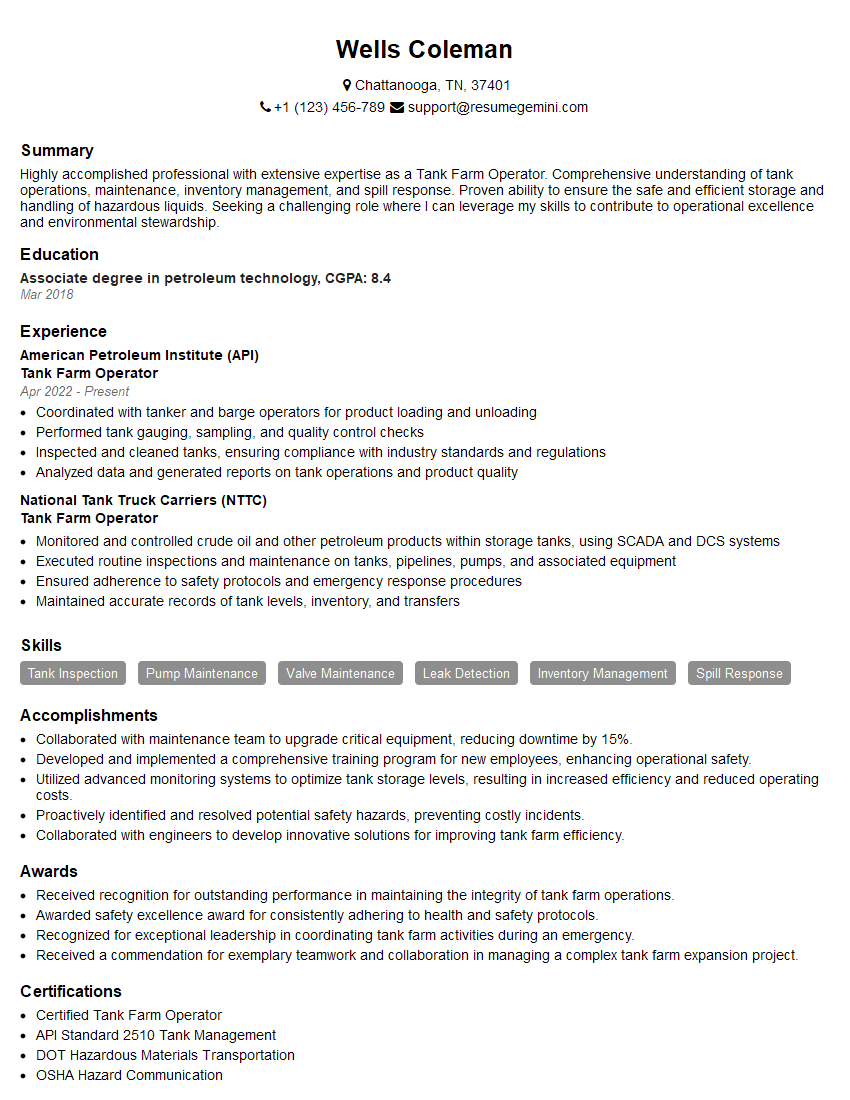
Mastering Tank Farm Operations opens doors to exciting career advancements, offering opportunities for specialization and increased responsibility. To maximize your job prospects, it’s crucial to present your skills effectively. An ATS-friendly resume is key to getting your application noticed. ResumeGemini is a trusted resource for building a professional, impactful resume that highlights your qualifications. ResumeGemini provides examples of resumes specifically tailored to Tank Farm Operations, helping you showcase your expertise and land your dream job. Invest the time to create a compelling resume—it’s your first impression.
Explore more articles
Users Rating of Our Blogs
Share Your Experience
We value your feedback! Please rate our content and share your thoughts (optional).
What Readers Say About Our Blog
Really detailed insights and content, thank you for writing this detailed article.
IT gave me an insight and words to use and be able to think of examples