Interviews are more than just a Q&A session—they’re a chance to prove your worth. This blog dives into essential Test Implementation interview questions and expert tips to help you align your answers with what hiring managers are looking for. Start preparing to shine!
Questions Asked in Test Implementation Interview
Q 1. Explain your experience with different test methodologies (Agile, Waterfall).
My experience spans both Agile and Waterfall methodologies, and I’ve found that the best approach depends heavily on the project’s nature and client needs. In Waterfall, testing is typically a distinct phase following development. This structured approach lends itself well to projects with clearly defined requirements and minimal expected changes. I’ve worked on several Waterfall projects, where we meticulously planned test cases based on detailed specifications, executed them systematically, and documented results comprehensively. This methodical approach is excellent for ensuring thorough coverage but can be less adaptable to late-stage changes.
In contrast, Agile emphasizes iterative development and continuous testing. I’ve been actively involved in several Agile projects employing Scrum and Kanban frameworks. Here, testing is integrated throughout the development lifecycle, with frequent feedback loops and shorter development cycles. This allows for rapid adaptation to changing requirements and quicker detection of issues. In this environment, test automation plays a vital role in ensuring the rapid feedback loops necessary for success. I’ve leveraged my skills in building automated regression test suites that allowed us to rapidly test new features while maintaining the overall stability of the product.
Q 2. Describe your experience with test case design techniques (e.g., equivalence partitioning, boundary value analysis).
I’m proficient in various test case design techniques. Equivalence Partitioning involves dividing input data into groups (partitions) that are expected to be processed similarly. For instance, testing a field accepting ages, I’d create partitions for negative numbers, numbers between 0-120, and numbers above 120. Each partition would only need one test case representative. Boundary Value Analysis focuses on testing values at the edges of valid input ranges and just outside those ranges. Using the age example, I’d test values like 0, 1, 119, 120, and -1, 121. This helps to catch errors related to boundary conditions.
I also use other techniques like Decision Table Testing (especially useful for complex logic), State Transition Testing (ideal for systems with different states and transitions), and Error Guessing, a valuable technique using my experience to anticipate potential issues. The choice of technique depends on the specific requirements and complexity of the system under test.
Q 3. How do you prioritize test cases for limited time?
Prioritizing test cases with limited time requires a strategic approach. I generally prioritize based on risk. I first identify the most critical functionalities—those that are core to the system’s purpose and have the highest impact on users. Test cases covering these functionalities are prioritized first. Then, I consider the probability of failure; test cases for functionalities with a higher likelihood of failure are given a higher priority. The severity of failure is also taken into account, with cases that could lead to major system failures having precedence. I also use a risk matrix which visually displays this to help me and my team collectively prioritize what needs the most attention. This approach ensures that the most crucial areas are thoroughly tested even with time constraints.
Additionally, I use techniques like risk-based testing and use a combination of exploratory testing and scripted test cases based on the time constraints of the project.
Q 4. Explain your experience with test automation frameworks (e.g., Selenium, Cypress, Appium).
I have extensive experience with several test automation frameworks, including Selenium, Cypress, and Appium. Selenium is my go-to for web application testing; its versatility and broad community support are invaluable. I’ve built robust and maintainable Selenium test suites using Java and TestNG. I prefer this combination due to the maturity of the tools and the ability to integrate seamlessly with CI/CD pipelines.
Cypress shines in its ease of use and its ability to provide excellent debugging capabilities. It’s particularly suitable for projects where rapid development and quick feedback are prioritized. I’ve used Cypress for front-end testing on several projects where the speed of feedback during development is crucial. For mobile application testing, Appium is my preferred choice. I’ve utilized Appium to automate tests on both Android and iOS platforms, ensuring consistent quality across multiple devices.
Q 5. What are the key differences between black-box and white-box testing?
The key difference between black-box and white-box testing lies in the tester’s knowledge of the system’s internal workings. In black-box testing, the tester treats the system as a ‘black box,’ focusing solely on the inputs and outputs without considering the internal structure or code. This is analogous to using a TV remote – you know what buttons do what without understanding the internal electronics. This approach is beneficial for uncovering functional defects and usability issues, and is excellent for revealing defects users may encounter.
In white-box testing, the tester has access to the system’s internal structure, code, and design. This allows for a deeper level of testing, targeting specific code paths and logic. It’s like having the schematics for the TV remote; you could check the circuitry for potential problems. White-box techniques such as code coverage analysis help ensure comprehensive testing of the codebase. While powerful, it requires specialized programming knowledge. I regularly employ both techniques in my testing strategy to achieve comprehensive test coverage.
Q 6. How do you handle test data management in your projects?
Test data management is crucial for effective testing. Poor test data can lead to inaccurate test results and wasted effort. My approach involves a combination of strategies. I often work with a dedicated test data management team that creates and manages realistic test data sets. They focus on ensuring data security and privacy compliance while maintaining data quality and diversity. We use tools that generate synthetic data to create massive datasets with the correct statistics or even leverage existing data (making sure to anonymize or mask any sensitive information). In cases where real data is necessary, we obtain it through careful processes to meet privacy guidelines, often working with database administrators and ensuring compliance.
Furthermore, I use techniques like data masking (replacing sensitive data with placeholders) and data subsetting (using only a representative sample of the data) to maintain confidentiality. We maintain meticulous documentation of the data used for testing and its origin, enabling traceability and repeatability. This structured approach ensures that test data is accurate, relevant, and handles data privacy and security concerns.
Q 7. Describe your experience with defect tracking and management tools (e.g., Jira, Bugzilla).
I have significant experience with defect tracking and management tools, primarily Jira and Bugzilla. Jira, with its flexibility and integration with Agile methodologies, is my preferred choice for most projects. I’m proficient in creating and managing issues, assigning them to developers, tracking their progress, and ensuring resolution. I utilize Jira’s workflow capabilities to streamline the defect reporting process, creating custom workflows to meet our specific needs.
I’ve also used Bugzilla on projects where it was already the established system. It’s a powerful tool, but often less agile in nature than Jira. Regardless of the tool, my approach involves clear and concise defect reporting, providing sufficient detail, steps to reproduce, expected and actual results, and screenshots or log files for effective troubleshooting. I emphasize clear communication with developers throughout the defect lifecycle to ensure timely resolution and prevent future occurrences.
Q 8. Explain your experience with performance testing tools (e.g., JMeter, LoadRunner).
My experience with performance testing tools is extensive, encompassing both open-source options like JMeter and commercial solutions such as LoadRunner. I’ve utilized JMeter extensively for its flexibility and scripting capabilities, particularly for simulating various user load scenarios and analyzing response times. For instance, in a recent project involving an e-commerce website, I used JMeter to simulate thousands of concurrent users placing orders, identifying bottlenecks in the database and application server. This allowed us to optimize the system’s architecture for peak performance during promotional periods. With LoadRunner, I’ve appreciated its robust features for advanced performance testing, especially its capabilities in creating complex load patterns and generating detailed performance reports. A key project leveraged LoadRunner’s integrated monitoring tools to identify memory leaks in a critical banking application, leading to significant performance improvements and increased system stability.
My proficiency extends beyond just tool usage; I understand the underlying performance testing methodologies, including load testing, stress testing, endurance testing, and spike testing. I can effectively design and execute tests based on specific requirements and goals, meticulously analyzing results to pinpoint areas for optimization. I’m also adept at interpreting performance metrics, such as response times, throughput, and resource utilization, to provide actionable insights to development teams.
Q 9. How do you ensure test coverage?
Ensuring comprehensive test coverage is crucial for delivering high-quality software. My approach involves a multi-faceted strategy. Firstly, I use requirement traceability matrices (RTM) to map test cases to specific requirements, guaranteeing that all functional aspects are covered. Secondly, I employ various testing techniques, including equivalence partitioning, boundary value analysis, and decision table testing to efficiently cover a wide range of input values and scenarios. Imagine testing a login form: equivalence partitioning would divide inputs into valid usernames/passwords, invalid usernames, and invalid passwords. Boundary value analysis would test the edge cases, such as maximum length of the username or password.
Thirdly, I leverage code coverage tools, which measure the percentage of code executed during testing. While code coverage doesn’t guarantee functional correctness, it provides valuable insight into the extent of testing at the code level. Finally, I regularly review test cases with the development team to identify potential gaps and enhance the overall test coverage. This collaborative approach is key to identifying blind spots and ensuring the release of high-quality software.
Q 10. Describe your process for creating a test plan.
Creating a robust test plan is fundamental to a successful testing process. My approach involves a structured methodology. First, I meticulously gather requirements and define the scope of testing, clarifying which features will be tested and the level of detail required. Next, I identify the different testing types necessary (unit, integration, system, acceptance) and allocate resources accordingly, considering time constraints, budget, and personnel availability. I also determine the test environment setup including hardware, software, and data requirements.
The plan then outlines the testing schedule, including milestones and deadlines. This schedule isn’t rigid, it’s a living document that evolves as the project progresses and new information becomes available. Crucially, the plan defines the entry and exit criteria, establishing clear conditions that must be met before and after each testing phase. For example, a key exit criterion for integration testing might be that all critical interfaces between modules function correctly. Finally, I document the risk assessment and mitigation strategies, acknowledging potential challenges and outlining plans to address them proactively. The completed plan is then reviewed and approved by relevant stakeholders, ensuring alignment and commitment.
Q 11. Explain your experience with risk-based testing.
Risk-based testing is a crucial part of my testing strategy. It prioritizes the testing of high-risk areas of the application, ensuring that the most critical features are thoroughly tested first. I begin by identifying potential risks through various methods, including brainstorming sessions with developers and stakeholders, reviewing historical data, and analyzing the application’s architecture. Risks can be categorized by severity and probability of occurrence. For example, a critical risk might be a database connectivity issue, which could severely impact the application’s functionality.
Once risks are identified, I prioritize testing efforts based on their impact and likelihood. High-risk areas receive the most comprehensive testing, while lower-risk areas may receive less extensive testing. This allows for the efficient allocation of testing resources, focusing on the parts of the system that pose the greatest threat. Throughout this process, documentation is critical; I maintain a clear record of identified risks, associated testing strategies, and the results of testing these areas. This documentation aids in decision-making and ensures that risks are proactively mitigated.
Q 12. How do you measure the effectiveness of your testing efforts?
Measuring the effectiveness of testing efforts is crucial for continuous improvement. Several key metrics help assess effectiveness. One primary metric is the number of defects found and fixed during different testing phases. A high number of defects found early on, especially during unit testing, indicates effective early testing. Another critical metric is the defect leakage rate – the number of defects that escape to later stages like production. A low defect leakage rate indicates efficient testing throughout the development lifecycle. Additionally, I track test coverage metrics, such as the percentage of requirements covered by test cases and the percentage of code covered by unit tests.
Beyond quantitative metrics, I also consider qualitative factors like stakeholder satisfaction, feedback from users, and the overall quality of the released product. Regular reviews of these metrics, combined with post-release analysis, provide valuable insights into the effectiveness of testing processes, highlighting areas for improvement and contributing to higher quality releases.
Q 13. Describe your experience with different types of testing (unit, integration, system, acceptance).
My experience encompasses all levels of software testing: unit, integration, system, and acceptance testing. Unit testing involves verifying the functionality of individual components or modules, often done by developers. I collaborate with developers to ensure sufficient unit tests are in place, using techniques like test-driven development (TDD) where applicable. Integration testing focuses on verifying the interaction between different modules or components. I often use integration testing frameworks to automate and simplify this process. System testing is a comprehensive end-to-end testing phase where I verify the functionality and performance of the whole system as a unit.
Finally, acceptance testing validates the system against user requirements, ensuring it meets the client’s expectations. Different forms of acceptance testing exist, including user acceptance testing (UAT) and alpha/beta testing. Each testing type is important for different stages of software development and I understand when to utilize each method effectively. This holistic approach to testing ensures a high level of quality and reduced risk.
Q 14. How do you handle conflicting priorities in testing?
Handling conflicting priorities in testing is a common challenge. My approach involves a structured process. First, I clearly understand all the competing priorities, documenting them and their associated risks. Then, I work with stakeholders to prioritize testing efforts based on risk assessment and business impact. High-impact, high-risk areas receive top priority. For instance, if a critical security vulnerability is discovered, it might supersede other testing tasks.
Effective communication and negotiation are essential. I explain the trade-offs associated with each prioritization decision, clearly communicating the potential consequences of delaying or reducing testing efforts in certain areas. Using risk matrices and documented rationales ensures transparency and agreement among stakeholders. In some cases, compromises might be necessary, perhaps by reducing the scope of less critical testing or adjusting timelines. The goal is to find a balanced solution that addresses the most critical risks while maintaining the project schedule as much as possible.
Q 15. Explain your approach to reporting test results.
My approach to reporting test results emphasizes clarity, accuracy, and actionable insights. I believe in a multi-faceted approach, catering to different stakeholders’ needs.
Firstly, I prioritize conciseness. My reports avoid technical jargon wherever possible, using plain language to convey critical findings to both technical and non-technical audiences. I use clear and consistent terminology throughout the report.
Secondly, I structure my reports logically. I typically follow a standard format: an executive summary highlighting key findings, a detailed section outlining test execution, a section dedicated to defects found (with severity and priority clearly labeled), and finally, a conclusion suggesting next steps. I often include visual aids like charts and graphs to illustrate trends in defect density or test coverage.
Thirdly, I leverage reporting tools to automate and enhance the process. Tools like TestRail, Jira, or Azure DevOps enable streamlined reporting, automated dashboards, and customizable report generation, allowing for efficiency and accuracy.
For instance, in a recent project involving a mobile application, my report clearly showcased the percentage of test cases passed, the number of critical bugs found, and their impact on user experience. The charts presented visual representations of these statistics, facilitating easy understanding for all stakeholders. This led to immediate prioritization of bug fixes and a faster release cycle.
Career Expert Tips:
- Ace those interviews! Prepare effectively by reviewing the Top 50 Most Common Interview Questions on ResumeGemini.
- Navigate your job search with confidence! Explore a wide range of Career Tips on ResumeGemini. Learn about common challenges and recommendations to overcome them.
- Craft the perfect resume! Master the Art of Resume Writing with ResumeGemini’s guide. Showcase your unique qualifications and achievements effectively.
- Don’t miss out on holiday savings! Build your dream resume with ResumeGemini’s ATS optimized templates.
Q 16. How do you stay updated on the latest testing tools and technologies?
Keeping up-to-date with testing tools and technologies is crucial for any successful QA professional. I employ a multi-pronged strategy:
- Active participation in online communities: I’m a member of several online forums, communities (like Stack Overflow, Reddit’s r/testing subs), and professional organizations (like ISTQB) where experts share insights and discuss the latest trends.
- Following industry blogs and publications: Regularly reading articles and publications from recognized sources such as Software Testing Help, Ministry of Testing, and others keeps me abreast of the latest advancements.
- Attending webinars and conferences: Participating in online and in-person events provides invaluable opportunities to learn from leading experts and network with peers.
- Hands-on experimentation: I actively try out new tools and technologies on personal projects or by exploring their free trials to gain practical experience. This allows for a deeper understanding of capabilities and limitations.
- Certifications and online courses: Pursuing relevant certifications (like ISTQB certifications) and taking online courses on platforms like Udemy or Coursera further enhances my knowledge and skillset.
For example, recently I explored the capabilities of Cypress for end-to-end testing and found it significantly enhanced my testing efficiency compared to Selenium for certain aspects of my current project.
Q 17. Describe a time you had to debug a complex test failure.
During a recent project involving an e-commerce platform, a complex test failure emerged during the checkout process. The error message was generic, offering little insight into the root cause.
My debugging process involved a systematic approach:
- Reproduce the error consistently: First, I meticulously documented the exact steps to reproduce the error. This ensured consistency in my investigation.
- Isolate the problem: I used logging and debugging tools to analyze the system’s behavior during the checkout process. This helped narrow down the potential problem areas.
- Inspect logs and database: I examined server logs and database transactions to pinpoint any anomalies or unexpected behavior. This revealed a subtle discrepancy in the database schema, causing data type mismatch during transaction processing.
- Employ debugging techniques: I set breakpoints in the relevant code sections to step through the execution flow, examine variable values, and identify the precise point of failure.
- Consult team members: When I couldn’t resolve the issue independently, I collaborated with developers and database administrators, sharing the collected data and logs for joint investigation. This collaborative approach led to the quickest resolution.
Ultimately, the root cause was traced back to a recently implemented database migration script that had inadvertently altered a data type. Once the script was corrected and redeployed, the test failure was resolved.
Q 18. What is your experience with CI/CD pipelines and their integration with testing?
I have extensive experience integrating testing into CI/CD pipelines. A well-integrated CI/CD pipeline streamlines the software development lifecycle, accelerating delivery and improving quality. This typically involves automating various testing phases, including unit, integration, and end-to-end testing.
In my previous role, we employed Jenkins for CI/CD, coupled with tools like Selenium for UI testing and JUnit for unit testing. We integrated these tools into our pipeline, triggering automated tests upon each code commit. This enabled early detection of defects and continuous feedback loops.
The specific implementation often varies depending on project needs and infrastructure. Here’s a typical integration process:
- Automated Test Execution: Tests are automatically triggered upon code commits, using tools like Jenkins, GitLab CI, or Azure DevOps.
- Test Result Reporting: Test results are automatically collated and presented in dashboards, allowing for real-time monitoring of the build’s health.
- Failure Notifications: Upon test failures, automated notifications are sent to the relevant teams, allowing for quick resolution.
- Artifact Management: Successful builds and test artifacts are automatically managed and stored, improving traceability and auditability.
The key to successful CI/CD integration is proper planning, selecting appropriate tools, and establishing a robust testing strategy to ensure comprehensive test coverage and efficient feedback cycles.
Q 19. How do you ensure test environments accurately reflect production?
Ensuring test environments accurately reflect production is paramount for reliable testing. Inconsistencies between environments can lead to inaccurate test results and ultimately, production issues.
My approach involves several key strategies:
- Infrastructure as Code (IaC): Utilizing tools like Terraform or Ansible allows for consistent and repeatable environment provisioning, reducing the risk of manual configuration errors.
- Configuration Management: Tools like Chef or Puppet maintain consistent configuration across environments, minimizing discrepancies.
- Data Management: Employing techniques like data masking or creating synthetic datasets ensures that sensitive data in production is protected while test environments retain realistic data volumes and structures.
- Environment Monitoring: Continuously monitoring test environments for performance and resource usage ensures early detection and resolution of any deviations from production.
- Regular Audits: Periodic comparisons of the test and production environments’ configurations and data to identify and address any inconsistencies.
For example, in a recent project, we utilized Terraform to automate the provisioning of our testing environment, ensuring it mirrored the production infrastructure in terms of hardware specifications, software versions, and network configuration. This resulted in more accurate testing and reduced the risk of environment-related failures.
Q 20. Describe your experience with test environment setup and configuration.
My experience with test environment setup and configuration involves a comprehensive understanding of both physical and virtual infrastructure. I’m proficient in configuring various operating systems, installing necessary software, and managing databases.
My typical process includes:
- Requirements Gathering: Thorough understanding of the application’s needs and dependencies to determine the necessary hardware and software components.
- Infrastructure Provisioning: Setting up the infrastructure, either using cloud-based solutions (AWS, Azure, GCP) or on-premise servers, ensuring sufficient resources and capacity.
- Software Installation and Configuration: Installing and configuring the required software (databases, web servers, application servers) according to the specified configurations.
- Data Setup: Populating the environment with relevant data, using techniques like data masking or creating synthetic datasets.
- Network Configuration: Configuring network settings, firewalls, and other security measures to replicate production network conditions.
- Environment Monitoring: Implementing monitoring tools to track performance and resource utilization, enabling proactive troubleshooting.
I’m adept at utilizing automation tools like Ansible or Chef to automate repetitive tasks, ensuring consistency and reducing manual errors. In past projects, I’ve successfully configured and managed test environments for various applications, including web applications, mobile apps, and embedded systems. My experience spans diverse technologies and cloud platforms, guaranteeing adaptability and efficiency.
Q 21. How do you incorporate security testing into your test strategy?
Incorporating security testing is not an afterthought, but a critical component integrated throughout the entire software development lifecycle. It’s not simply about finding vulnerabilities but preventing them from ever reaching production.
My approach emphasizes a layered security testing strategy:
- Static Application Security Testing (SAST): Utilizing tools that analyze the source code to identify potential vulnerabilities before runtime.
- Dynamic Application Security Testing (DAST): Employing tools that scan the running application to identify runtime vulnerabilities.
- Interactive Application Security Testing (IAST): Integrating security testing within the application, providing real-time feedback and detailed vulnerability information.
- Penetration Testing: Simulating real-world attacks to identify vulnerabilities that automated tools might miss.
- Security Code Reviews: Conducting code reviews to ensure that security best practices are followed.
- Vulnerability Management: Establishing processes for tracking, prioritizing, and remediating identified vulnerabilities.
I collaborate closely with security experts to ensure a comprehensive security testing program. For example, in one project, we implemented SAST and DAST tools into our CI/CD pipeline, automatically scanning the codebase and running application for vulnerabilities with every build. This proactive approach ensured that security issues were addressed early in the development cycle.
Q 22. What experience do you have with different types of testing documentation?
Throughout my career, I’ve worked extensively with various testing documentation, ensuring clarity and traceability throughout the software development lifecycle. This includes:
- Test Plans: These documents outline the scope, objectives, approach, resources, and schedule for testing activities. For example, a recent project involved a detailed test plan specifying the different test environments, entry and exit criteria, and risk mitigation strategies for a complex e-commerce platform.
- Test Cases: These meticulously detail individual test steps, expected results, and input data. I’ve employed a structured approach, using templates that ensure consistency and ease of execution across various projects, particularly useful when managing a large team.
- Test Scripts: These are automated test cases, often written in languages like Python or Java using frameworks like Selenium or JUnit. I’ve actively participated in designing and maintaining these, significantly improving the efficiency and repeatability of regression testing.
- Test Data: Managing and creating realistic and representative test data is crucial. I’ve used various techniques, from generating synthetic data to utilizing data masking to protect sensitive information, adapting the approach depending on the project’s needs.
- Defect Reports (Bug Reports): I have extensive experience in documenting defects accurately and concisely, following a standardized format that includes steps to reproduce, expected vs. actual results, severity, and priority levels. The use of clear and concise language and the inclusion of relevant screenshots or videos are vital for quick resolution.
- Test Summary Reports: These reports summarize the overall testing process, highlighting key findings, defect metrics, and overall test coverage. I’ve consistently used these reports to communicate testing status to stakeholders and provide insights into the software’s quality.
My experience spans different methodologies, from agile to waterfall, adapting my documentation practices to the specific needs of each project.
Q 23. Explain your understanding of different testing levels (unit, integration, system, user acceptance).
Testing levels represent a hierarchical approach to software testing, ensuring thorough verification at various stages of development. They are:
- Unit Testing: This focuses on individual components or modules of the software. Developers typically perform this, verifying the functionality of each unit in isolation. Think of it as testing the individual bricks before building the wall. I often review unit test coverage metrics to ensure sufficient testing at this level.
- Integration Testing: This checks the interaction between different units or modules after they’ve been individually tested. It’s like checking if the bricks fit together to form a solid wall section. I’ve used various integration testing strategies like top-down, bottom-up, and big-bang, selecting the most appropriate based on the system’s architecture.
- System Testing: This tests the entire integrated system as a whole, ensuring all components work together correctly. It’s like testing the entire wall structure for stability and functionality. I frequently employ black-box testing techniques during this phase, focusing on functional and non-functional requirements.
- User Acceptance Testing (UAT): This involves end-users testing the system to validate that it meets their requirements and is usable. This is the final check, ensuring the ‘house’ is built to the client’s specifications. I work closely with stakeholders during UAT to gather feedback and address any issues before release.
Understanding these levels helps in planning efficient testing strategies and identifying defects early in the development cycle, saving time and resources.
Q 24. How do you handle regression testing?
Regression testing is crucial for ensuring that new code changes or bug fixes haven’t introduced unintended side effects or broken existing functionality. My approach to regression testing is multifaceted:
- Prioritization: I prioritize regression tests based on the risk associated with changes. Changes impacting core functionality or frequently used features receive higher priority.
- Test Selection: I strategically select tests that are relevant to the changed areas. This could involve re-running all tests or focusing on a subset of relevant tests to optimize efficiency.
- Automation: Automation is key for efficient regression testing. I leverage automated test scripts and frameworks to run tests quickly and repeatedly. For example, I’ve integrated automated tests into CI/CD pipelines to ensure that regression testing is part of each build process.
- Test Data Management: Maintaining up-to-date and relevant test data is essential for accurate regression testing results. We often use test data management tools to manage and refresh test data sets.
- Continuous Monitoring: Even after release, continuous monitoring and feedback loops help identify any regressions in production and aid in proactive issue management.
The goal is to minimize the risk of regressions while maintaining a balance between thoroughness and efficiency.
Q 25. How do you collaborate with developers and other stakeholders?
Effective collaboration is fundamental to successful testing. I actively engage with developers, business analysts, and end-users throughout the testing process:
- Daily Stand-ups (Agile): Participating in daily stand-ups helps ensure open communication and timely resolution of roadblocks.
- Defect Triage Meetings: I collaborate with developers during defect triage meetings to understand the root cause of defects and agree on resolutions. Clear and concise communication is key here.
- Requirement Clarification: I proactively clarify any ambiguities in requirements with business analysts to ensure a shared understanding before testing begins.
- UAT Sessions: I work closely with end-users during UAT, gathering feedback and addressing their concerns. These sessions are valuable for identifying usability issues and ensuring the software meets user needs.
- Knowledge Sharing: I consistently share testing knowledge and best practices with developers and other stakeholders, fostering a culture of quality throughout the organization.
Using collaborative tools like Jira, Confluence, and communication platforms like Slack ensures transparent and efficient communication.
Q 26. Describe your experience with using a test management tool.
I have extensive experience using various test management tools, including TestRail, Jira, and Zephyr. These tools have significantly improved the efficiency and organization of my testing efforts. For instance, with TestRail, I have been able to:
- Centralized Test Case Management: Organize and manage test cases, requirements traceability, and test runs in a centralized location.
- Test Execution Tracking: Monitor test execution progress and identify bottlenecks using real-time dashboards.
- Defect Tracking and Reporting: Integrate with defect tracking systems like Jira to manage and track defects throughout their lifecycle.
- Reporting and Analytics: Generate comprehensive reports on test coverage, defect density, and other key metrics.
- Collaboration and Communication: Enable collaboration amongst team members by sharing test results and status updates.
My ability to quickly adapt to new tools and leverage their functionalities ensures efficient and effective test management, especially in complex projects.
Q 27. What metrics do you use to track testing progress and success?
Tracking testing progress and success requires careful monitoring of various metrics. Some key metrics I regularly use include:
- Test Case Execution Rate: The number of test cases executed versus the total number of planned test cases. This indicates the overall progress of the testing effort.
- Defect Density: The number of defects found per lines of code or per test case. This metric provides insights into the software’s quality.
- Defect Severity and Priority: Categorizing defects by severity and priority helps prioritize fixes and manage risks. Critical bugs naturally receive higher attention.
- Test Coverage: The percentage of requirements or code covered by test cases. This ensures comprehensive testing of all critical aspects of the software.
- Test Cycle Time: The time taken to complete a testing cycle. This metric helps identify areas for improvement in the testing process.
- Defect Resolution Rate: This metric tracks the rate at which identified defects are resolved and helps determine team efficiency.
Regular reporting on these metrics allows for proactive issue identification and the implementation of necessary improvements to the testing process.
Q 28. How do you handle changes in requirements during the testing phase?
Handling changes in requirements during the testing phase requires a structured and flexible approach. My strategy typically involves:
- Impact Assessment: Determine the impact of the change request on existing test cases and the overall test plan.
- Risk Analysis: Assess the risks associated with implementing the changes, considering time constraints and potential impact on the release date.
- Prioritization: Prioritize changes based on their criticality and impact on the system.
- Test Case Updates: Update or create new test cases to address the changes in requirements. This could involve adding new tests or modifying existing ones.
- Communication: Clearly communicate the impact of the change to all relevant stakeholders, including developers and end-users.
- Regression Testing: Conduct thorough regression testing to ensure the changes haven’t introduced new bugs or broken existing functionality.
- Documentation: Update all relevant documentation, including test plans, test cases, and defect reports, to reflect the changes.
Using a flexible test management system and embracing agile principles is essential for successfully managing changing requirements. Prioritization and clear communication are key to minimizing disruptions and delivering quality software despite these changes.
Key Topics to Learn for Test Implementation Interview
- Test Strategy & Planning: Understanding the different testing strategies (e.g., Waterfall, Agile), creating effective test plans, and defining test objectives and scope.
- Test Environment Setup: Setting up and configuring testing environments, including hardware, software, and network configurations, and managing dependencies.
- Test Data Management: Creating and managing test data, including data masking and anonymization techniques to ensure data security and privacy.
- Test Execution & Reporting: Executing test cases, documenting results, identifying and reporting defects, and using test management tools effectively.
- Test Automation Frameworks: Familiarity with various automation frameworks (e.g., Selenium, Appium) and their implementation in different testing scenarios.
- Defect Tracking & Management: Using defect tracking systems (e.g., Jira, Bugzilla) to log, track, and manage defects throughout the software development lifecycle.
- Performance Testing Basics: Understanding load testing, stress testing, and performance bottlenecks. Knowing how to interpret performance testing results.
- Risk Management in Testing: Identifying potential risks and developing mitigation strategies to ensure timely and effective test implementation.
- Test Closure & Reporting: Summarizing test results, identifying lessons learned, and producing comprehensive test reports for stakeholders.
Next Steps
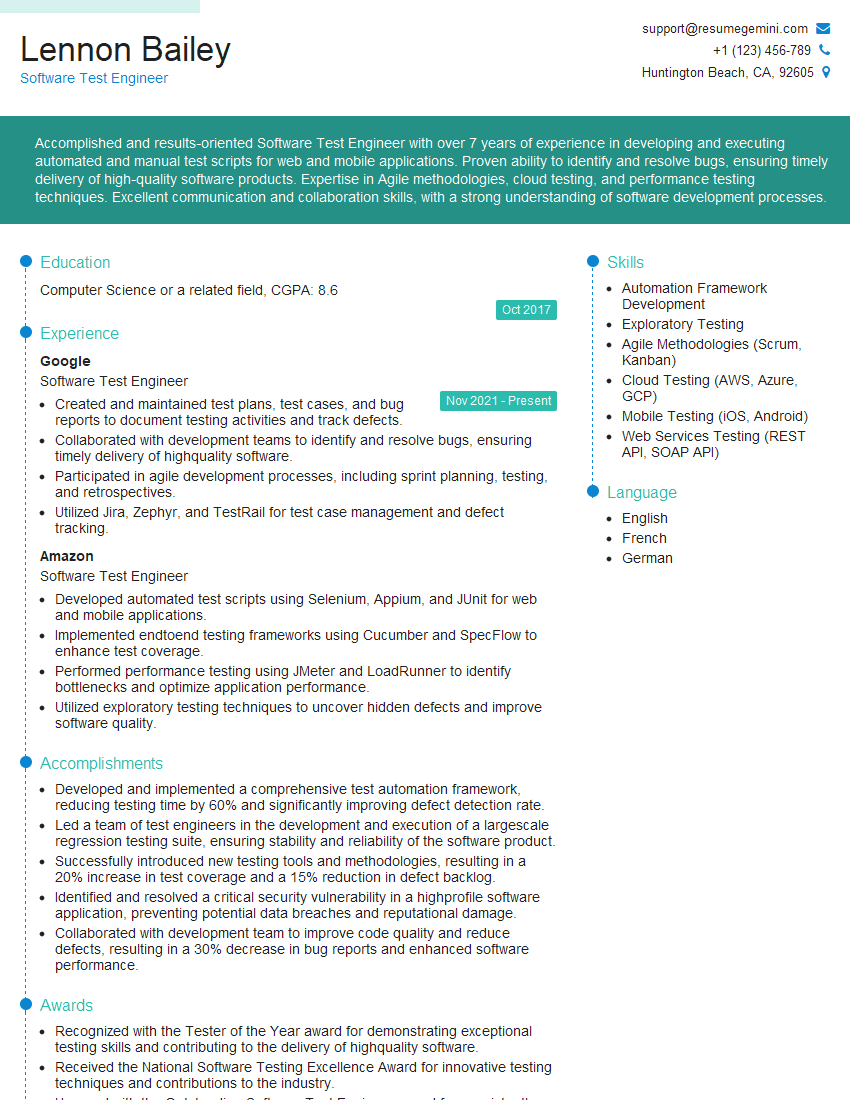
Mastering Test Implementation is crucial for advancing your career in software quality assurance. It demonstrates a deep understanding of the software development lifecycle and your ability to contribute significantly to successful product launches. To maximize your job prospects, creating a strong, ATS-friendly resume is essential. ResumeGemini is a trusted resource that can help you build a professional and impactful resume tailored to the Test Implementation field. Examples of resumes specifically designed for Test Implementation roles are available through ResumeGemini to guide your efforts. Take the next step towards your dream job today!
Explore more articles
Users Rating of Our Blogs
Share Your Experience
We value your feedback! Please rate our content and share your thoughts (optional).
What Readers Say About Our Blog
Really detailed insights and content, thank you for writing this detailed article.
IT gave me an insight and words to use and be able to think of examples