Interviews are more than just a Q&A session—they’re a chance to prove your worth. This blog dives into essential Traditional Illustration interview questions and expert tips to help you align your answers with what hiring managers are looking for. Start preparing to shine!
Questions Asked in Traditional Illustration Interview
Q 1. What are your preferred traditional illustration mediums and why?
My preferred traditional illustration mediums are watercolor, gouache, and colored pencil. Each offers a unique aesthetic and allows for different expressive techniques.
- Watercolor: I love its luminosity and the way it allows for beautiful, unpredictable washes and blends. The transparency and layering possibilities are endlessly fascinating. Think of the soft, ethereal quality in many botanical illustrations – that’s often achieved through watercolor.
- Gouache: Gouache is watercolor’s opaque cousin. It provides a vibrant, matte finish that’s perfect for bold colors and detailed work. I appreciate its ability to cover previous layers completely, which is useful for precise linework and vibrant color blocking. Think of the illustrative style seen in vintage children’s book illustrations – many of those used gouache for its vividness.
- Colored Pencil: Colored pencils offer amazing control and precision. I use them for intricate details, fine lines, and creating a range of textures, from smooth blends to sharp, scratchy marks. The layering capabilities allow for subtle color shifts and depth, which is ideal for realistic rendering of textures like fur or feathers.
Ultimately, my choice depends on the project’s demands. A delicate botanical print might call for watercolor’s transparency, while a whimsical children’s illustration might benefit from gouache’s boldness, and a realistic portrait might utilize the precision of colored pencils.
Q 2. Describe your process for creating a traditional illustration, from concept to final artwork.
My process is iterative and involves several key stages:
- Concept & Sketching: I begin by brainstorming ideas, often sketching thumbnails to explore different compositions and visual approaches. This initial phase helps to solidify the narrative and aesthetic direction. I might even use a combination of mediums here – sketching with pencil and adding in some colour with crayons to visualise the concept.
- Refined Sketch: Once I have a strong concept, I create a more detailed pencil sketch on the chosen paper. This step focuses on refining the composition, proportions, and details. I ensure the perspective is correct, and everything is positioned thoughtfully in the space.
- Underpainting (optional): For some pieces, particularly watercolor or gouache, I’ll apply a light underpainting – a thin wash of color that establishes the overall tonal values and provides a base for subsequent layers.
- Color Layering & Detailing: This is where the chosen medium takes center stage. I build up the colors and details gradually, layering washes of watercolor, applying opaque gouache strokes, or meticulously blending colored pencils. Each layer adds depth, richness, and complexity. This is also where I concentrate on adding texture using a variety of techniques, that I’ll discuss in detail later.
- Final Touches & Editing: Once the painting is complete, I step back and assess the piece. I might make small adjustments to refine details, balance colors, or correct any minor imperfections.
Throughout the entire process, I constantly evaluate the artwork, making sure it aligns with the initial vision and conveys the desired mood and message effectively.
Q 3. How do you approach color mixing and application in your work?
Color mixing and application are crucial aspects of my work. I approach them with both a technical and intuitive understanding.
- Understanding Color Theory: I have a strong foundation in color theory, understanding the relationships between primary, secondary, and tertiary colors, as well as warm and cool tones. This allows me to create harmonious and balanced palettes.
- Mixing Techniques: Depending on the medium, I use different mixing techniques. In watercolor, I often mix colors directly on the paper, allowing the water to create beautiful, unpredictable gradients. With gouache, I mix colors on a palette, achieving a more controlled and precise application.
- Layering: Layering colors is key to creating depth and richness. Transparent layers allow light to pass through, creating luminosity, while opaque layers add intensity and vibrancy. I think of it as building a colour story.
- Color Application: My application techniques vary depending on the desired effect. I might use fine brushes for delicate details, broader brushes for washes, or even my fingers for a more textured look.
Experimentation is a vital part of my process. I frequently test different color combinations and applications, often creating color charts as a reference point.
Q 4. Explain your understanding of composition and its importance in traditional illustration.
Composition is the art of arranging elements within an illustration to create a visually pleasing and effective image. It’s the foundation upon which the entire illustration is built.
- Rule of Thirds: I frequently use the rule of thirds, placing key elements off-center to create a more dynamic and engaging composition. It avoids a static, centered image.
- Leading Lines: Leading lines, such as roads, rivers, or fences, can guide the viewer’s eye through the illustration, creating a sense of movement and depth.
- Focal Point: A strong focal point is essential. This is the element that immediately grabs the viewer’s attention. I achieve this through contrast, size, color, or placement.
- Balance and Symmetry: Balance refers to the visual weight of elements within the composition. A symmetrical composition can feel harmonious, while an asymmetrical one can be more dynamic.
- Negative Space: The space around the main elements is just as important. Negative space can create visual breathing room and emphasize the focal point.
A well-composed illustration is not only aesthetically pleasing but also conveys the intended message more effectively. It guides the viewer’s gaze and creates a cohesive and meaningful narrative.
Q 5. How do you handle revisions and feedback on your traditional artwork?
Handling revisions and feedback is a crucial part of the illustration process. I approach it collaboratively, viewing feedback as an opportunity to improve the work.
- Clear Communication: I maintain open communication with clients throughout the process, ensuring a shared understanding of the project’s goals and expectations. This minimizes misunderstandings and potential conflicts.
- Organized Process: I track all revisions and feedback using a well-organized system, usually a digital document. This allows for easy reference and ensures that all changes are addressed.
- Iterative Approach: I often incorporate feedback iteratively, implementing changes in stages to allow for adjustments and refinements along the way. This ensures that the final product meets the client’s satisfaction while maintaining artistic integrity.
- Professionalism: I respond to feedback professionally and constructively, even if it requires significant adjustments. I approach each revision as a chance to learn and grow.
My aim is to deliver a final product that exceeds expectations, combining artistic vision with client needs and feedback.
Q 6. What techniques do you use to achieve different textures and effects in your illustrations?
Achieving varied textures and effects in traditional illustration involves skillful manipulation of the mediums and tools.
- Watercolor Techniques: Lifting wet paint, dry brushing, blotting, and salt techniques can create a range of textures from delicate washes to rough, expressive marks in watercolor.
- Gouache Techniques: Impasto (thick application), stippling (tiny dots), and dry brushing create diverse textures in gouache, ranging from smooth surfaces to heavily textured impasto effects.
- Colored Pencil Techniques: Layering, blending, hatching, cross-hatching, and scribbling create diverse textures with colored pencils, allowing for fine details as well as broader textured areas. Burnishing techniques can create smooth, polished surfaces.
- Surface Texture Manipulation: Applying mediums like masking fluid or textured paper can create underlying textures that influence the final look. Using textured paper itself can add subtle or pronounced texture to the finished piece, depending on the paper used.
- Tool Variation: Varying brush sizes, types of brushes (e.g., round, flat, fan), and even using unconventional tools like sponges or palette knives can drastically alter the texture of the finished work.
Understanding how each medium responds to different techniques and tools is essential for creating the desired visual effects. This comes with lots of practice and experimentation.
Q 7. Describe your experience with different paper types and their suitability for various mediums.
The choice of paper significantly impacts the final outcome of a traditional illustration. Different paper types possess unique characteristics that suit specific mediums and techniques.
- Watercolor Paper: Watercolor paper is essential for watercolor painting. It’s heavier and more absorbent than other paper types, preventing buckling and allowing for layering. Cold-pressed watercolor paper is ideal for detailed work, while hot-pressed paper is smoother, and rough paper offers a more textured effect.
- Drawing Paper: Drawing paper comes in various weights and surface textures. Smooth drawing paper is suitable for detailed pencil sketches and ink work, while textured paper creates interesting marks and provides a unique visual quality.
- Gouache Paper: Gouache paper should be sturdy enough to withstand the heavier pigment concentration in gouache paints. It can be similar to watercolor paper, but a slightly heavier weight is generally preferred. Smooth or lightly textured surfaces work best to allow for vibrant and clean colour application.
- Mixed Media Paper: Mixed media paper can handle a variety of mediums, including watercolor, gouache, ink, and colored pencils. It’s a versatile option for illustrations that incorporate multiple techniques.
I typically choose paper based on the medium, the desired texture, and the level of detail required in the illustration. Experimentation with different paper types is crucial to understanding their unique properties and finding the best match for each project.
Q 8. How do you manage your time effectively when working on multiple illustration projects?
Effective time management is crucial when juggling multiple illustration projects. I utilize a project management system, often a combination of digital tools and a physical planner. This allows me to clearly outline deadlines, allocate specific time blocks for each project, and prioritize tasks based on urgency and importance. For example, if I have a high-priority deadline for a children’s book illustration, that will take precedence over a less urgent commission. I break down large projects into smaller, manageable steps, each with its own mini-deadline. This prevents feeling overwhelmed and allows for a sense of accomplishment as each step is completed. Regularly reviewing my schedule and adjusting as needed is essential to maintain flexibility and avoid burnout.
- Prioritization: Using methods like the Eisenhower Matrix (Urgent/Important) helps determine task order.
- Time Blocking: Allocating specific time slots for specific tasks (e.g., 2 hours for sketching, 3 hours for inking).
- Task Breakdown: Dividing large projects into smaller, achievable milestones.
- Regular Review: Daily or weekly reviews to adjust the schedule based on progress and unexpected delays.
Q 9. What are your strategies for overcoming creative blocks?
Creative blocks are a common challenge for illustrators. My strategies focus on breaking the cycle and reigniting inspiration. Firstly, I step away from the project entirely. A walk in nature, listening to music, or engaging in a completely unrelated activity can clear my head. Secondly, I actively seek inspiration. This might involve visiting museums, browsing art books, studying the work of other artists, or even exploring different mediums. Thirdly, I experiment. Trying a different approach, a new technique, or a different material can often unlock fresh ideas. Sometimes, I’ll even start sketching spontaneously, without a specific goal in mind – just letting my hand move and see where it leads. This free-flowing process can unexpectedly lead to breakthroughs. Finally, collaborating with others can provide a fresh perspective and spark new ideas.
- Step Away: Take a break to clear your mind and reduce pressure.
- Seek Inspiration: Look at other art, nature, or anything outside your current project.
- Experiment: Try new techniques or materials.
- Collaboration: Discuss the project with other creatives.
Q 10. Discuss your knowledge of perspective and its role in creating believable illustrations.
Perspective is fundamental to creating believable and engaging illustrations. It’s the art of representing three-dimensional objects on a two-dimensional surface, creating the illusion of depth and space. Understanding one-point, two-point, and three-point perspective is crucial. One-point perspective uses a single vanishing point on the horizon line, suitable for depicting scenes with a strong central focus, like a road stretching towards the horizon. Two-point perspective utilizes two vanishing points, creating a sense of depth and recession from two different angles, perfect for illustrating buildings or cityscapes. Three-point perspective adds a third vanishing point, either above or below the horizon, often used for extreme angles, like looking up at a skyscraper or down from a high vantage point. Mastering these techniques ensures that objects maintain accurate proportions and relationships in the illustration, making the scene feel realistic and immersive. Incorrect perspective can make an illustration appear distorted and unconvincing.
- One-point perspective: One vanishing point; ideal for straightforward scenes.
- Two-point perspective: Two vanishing points; excellent for creating depth and recession.
- Three-point perspective: Three vanishing points; used for extreme angles and dramatic effects.
Q 11. How do you maintain the quality of your work throughout the entire illustration process?
Maintaining quality throughout the illustration process requires a meticulous approach. I begin with thorough planning and sketching, ensuring the composition and concept are solid before proceeding to the next stage. Throughout the process, I regularly review my work, looking for inconsistencies in line weight, value, and color. I utilize various techniques like layering to build depth and complexity in my work, ensuring that each layer contributes meaningfully to the overall image. I frequently step back from my work to evaluate it with fresh eyes, ensuring that the final product aligns with my initial vision and maintains the intended artistic quality. Additionally, I always work at a high resolution to avoid issues with pixelation or loss of detail during the digital editing phase.
- Thorough Planning: Detailed sketches and composition studies before starting the final piece.
- Regular Reviews: Checking for inconsistencies in line weight, value and color throughout the process.
- Layering: Building complexity by working in layers.
- Fresh Eyes: Stepping back from the work to evaluate with a fresh perspective.
- High Resolution: Working at a resolution high enough to accommodate for potential resizing or editing.
Q 12. Explain your experience with different types of drawing tools (pencils, brushes, inks, etc.)
My experience with drawing tools spans a wide range, from traditional pencils and brushes to specialized inks. Pencils, ranging from H2 for light sketching to 8B for deep blacks, allow for versatility in creating different values and textures. I use various brushes – synthetic and natural hair – for different effects, from fine lines to broad strokes, depending on the medium (watercolor, gouache, acrylics). I’m comfortable using a variety of inks, including India ink for precise lines and washes, and fountain pen inks for more delicate and varied strokes. I’m also proficient in using dip pens, allowing for controlled line weight variation, and technical pens for precise and consistent lines in technical illustrations. Each tool offers unique capabilities, and I select them based on the desired aesthetic and the demands of the project. The feel and responsiveness of the tool contribute significantly to the final artwork’s character.
- Pencils: H2 to 8B grades for varied line weights and tones.
- Brushes: Natural and synthetic for different mediums and effects.
- Inks: India ink, fountain pen inks, and dip pens for controlled line weight and detail.
- Technical Pens: For precise, consistent lines.
Q 13. How do you incorporate storytelling elements into your illustrations?
Storytelling is integral to my illustrations; I aim to communicate a narrative through visual elements. I use composition, character design, and symbolic imagery to convey a story’s mood, plot points, and character development. For instance, the placement of characters within a scene, their body language, and their interaction with their environment all contribute to the narrative. Color palettes and lighting play a crucial role in setting the tone – a warm palette might suggest happiness, while a cool palette could evoke melancholy. Symbolic imagery, such as recurring motifs or objects with specific meanings, can add layers of meaning and deepen the narrative. Even the style of illustration can contribute to the storytelling; a whimsical style might be suitable for a lighthearted story, whereas a realistic style could enhance a more dramatic narrative.
- Composition: Strategic placement of elements to guide the viewer’s eye and create focal points.
- Character Design: Communicating personality and emotional state through physical attributes and poses.
- Symbolic Imagery: Using recurring motifs or objects with specific meanings to enhance the narrative.
- Color Palette and Lighting: Setting the mood and tone of the story.
- Illustration Style: Matching the style to the overall tone and genre of the narrative.
Q 14. Describe your process for scanning and editing traditional artwork digitally.
Scanning and digitally editing traditional artwork involves careful attention to detail to maintain image quality. I use a high-resolution flatbed scanner, ensuring the artwork is properly illuminated and free from shadows or distortions. The resolution should be at least 300 DPI (dots per inch) for print quality. After scanning, I open the image in image editing software like Photoshop. The initial step involves color correction to adjust brightness, contrast, and color balance, ensuring accuracy to the original artwork. I then might use tools to clean up any minor imperfections or dust spots, but I always aim to preserve the texture and character of the original media. Finally, I save the image in a high-quality format, like TIFF or PSD, to maintain the integrity of the artwork during further editing or printing.
- High-Resolution Scanning: Using a flatbed scanner at 300 DPI or higher.
- Color Correction: Adjusting brightness, contrast, and color balance in image editing software.
- Minor Cleaning: Removing dust spots or minor imperfections.
- High-Quality Saving: Saving the image in a lossless format like TIFF or PSD.
Q 15. What are some of your favorite traditional artists and what inspires you about their work?
My artistic influences are vast and varied, drawing from masters across different eras. I deeply admire the meticulous detail and emotive power in the work of Albrecht Dürer, whose mastery of line and understanding of human anatomy continue to inspire my figure studies. His woodcuts, particularly the series of The Apocalypse, are breathtaking in their expressive use of light and shadow. Another artist who profoundly impacts my work is Winslow Homer, whose ability to capture the raw energy and beauty of nature is simply stunning. His watercolors, especially those depicting seascapes, are a testament to his remarkable observation skills and his evocative use of color. Finally, I’m captivated by the surreal and dreamlike quality of the work of Gustav Klimt. His use of gold leaf and intricate patterns in his paintings is a masterclass in decorative artistry and pushes me to explore new textural elements in my own pieces.
These artists inspire me not just through their technical skill but also through their ability to convey profound emotions and narratives through their art. They remind me of the power of traditional media to communicate something deeply personal and universal.
Career Expert Tips:
- Ace those interviews! Prepare effectively by reviewing the Top 50 Most Common Interview Questions on ResumeGemini.
- Navigate your job search with confidence! Explore a wide range of Career Tips on ResumeGemini. Learn about common challenges and recommendations to overcome them.
- Craft the perfect resume! Master the Art of Resume Writing with ResumeGemini’s guide. Showcase your unique qualifications and achievements effectively.
- Don’t miss out on holiday savings! Build your dream resume with ResumeGemini’s ATS optimized templates.
Q 16. How do you adapt your style to suit the specific needs of a client or project?
Adaptability is key in illustration. I always begin by having a thorough discussion with the client to fully understand their vision, target audience, and the overall purpose of the illustration. This involves asking clarifying questions about tone, style preferences (e.g., realistic, whimsical, abstract), and any specific branding guidelines. For example, if a client wants a children’s book illustration, I’ll adopt a more playful, vibrant, and perhaps slightly simplified style compared to a piece for a high-end fashion magazine, where sophistication and realism might be paramount.
I frequently use mood boards – collecting images and colors that represent the client’s vision – as a collaborative tool. This allows the client to visualize the direction and gives me a roadmap to follow. I also present sketches and revisions throughout the process to ensure alignment and offer creative solutions. My process is iterative; I’m open to feedback and embrace changes to ensure the final product perfectly meets the project’s needs.
Q 17. Describe your experience with creating illustrations for different printing methods.
My experience spans various printing methods, each demanding a different approach to artwork creation. For offset lithography, high-resolution scans and meticulous attention to color management are crucial. I’ve worked extensively with CMYK color profiles, understanding how they translate from my original artwork onto the printed page. The nuances of halftone screens and potential color shifts during the printing process need careful consideration. For example, I might adjust my color palette to account for the inherent limitations of the printing process, ensuring the final printed piece remains true to the original design.
With screen printing, I appreciate the bold, graphic nature of the medium. I’ve learned to simplify my illustrations to best utilize the technique’s limitations, often opting for strong, solid colors and clean lines. Digital printing offers more flexibility in terms of color accuracy and detail, but I still employ my knowledge of color profiles and file resolution to ensure optimal results. My experience across these methods allows me to produce illustrations that effectively transfer across different printing processes, maintaining visual consistency.
Q 18. How do you maintain the integrity of your original artwork while creating reproductions?
Maintaining the integrity of original artwork during reproduction is paramount. I use high-resolution scanning techniques to capture the finest details and textures of the original piece. I carefully calibrate my scanner settings to preserve color accuracy and avoid distortion. For archival purposes, I often keep digital masters in a lossless format such as TIFF to ensure quality is preserved for future use. When dealing with clients, I always provide them with clear guidelines for reproduction. These include specifying the appropriate resolution, color profiles, and file formats, depending on the intended use (print, web, etc.). I also advise on suitable printing methods to best retain the integrity of my illustrations. This careful process ensures that reproductions faithfully reflect the original art.
Q 19. How familiar are you with art history and its influence on illustration?
My understanding of art history is foundational to my practice. I believe a strong grasp of historical styles and movements—from Renaissance painting to Art Nouveau and beyond—provides a rich context for contemporary illustration. For instance, understanding the use of perspective in Renaissance art informs my ability to create realistic and believable environments in my own work. Studying the symbolic language and compositional techniques of different periods expands my vocabulary as an artist, allowing me to approach projects with a broader range of possibilities. I see art history not as a static body of knowledge but as a dynamic dialogue that informs and enriches my own creative process.
Q 20. Explain your understanding of color theory and its application in traditional illustration.
Color theory is fundamental to my work. I understand the relationships between colors on the color wheel—primary, secondary, and tertiary colors—and how they interact to create different moods and effects. I’m proficient in using complementary colors to achieve vibrancy, analogous colors for harmony, and triadic colors for visual interest. I also understand the impact of color temperature (warm vs. cool) and value (lightness vs. darkness) on the overall composition. For example, I might use warm colors to convey feelings of warmth and intimacy, while cool colors might evoke a sense of calmness or distance. I often create color studies before embarking on a final illustration to explore different palettes and their psychological impact on the viewer.
Q 21. Describe your experience with different types of paints (watercolor, gouache, acrylic, oil).
My experience with different paints is extensive. Watercolors offer beautiful transparency and luminosity; I use them for delicate washes and atmospheric effects. Gouache, with its opaque quality, is excellent for creating bold, vibrant colors and sharp details. I frequently use it for illustrations that require a clean, crisp look. Acrylics, for their versatility and quick drying time, are my go-to for projects requiring speed and detail. I find them useful in creating a variety of textures, from smooth blends to impasto effects. Finally, oils, with their richness and depth of color, allow for subtle blending and layering, enabling me to achieve a remarkable level of realism.
Each paint type has its unique characteristics, and my choice depends on the project’s needs and desired aesthetic. I often combine mediums to achieve specific effects, layering watercolors under acrylics, for instance, to create interesting textures and depth.
Q 22. How do you approach creating detailed illustrations?
Creating detailed illustrations is a meticulous process that hinges on planning and a layered approach. I begin with thorough sketches, focusing on composition and overall structure. Think of it like building a house – you wouldn’t start with the roof! I establish the basic shapes and forms, ensuring correct proportions and perspective. Then, I gradually add detail, layer by layer, much like applying washes in watercolor. This prevents overwhelming myself with minutiae early on and allows for adjustments throughout the process. For example, when illustrating a fantastical creature, I might start with basic geometric shapes to define its posture, then refine the musculature, add scales or fur, and finally incorporate intricate details like individual claws or feathers. This systematic approach ensures that the illustration remains cohesive and doesn’t become overly cluttered.
I also employ various techniques depending on the medium. With pen and ink, I might use varying line weights to create depth and texture. In colored pencils or pastels, I utilize layering and blending to achieve smooth gradations and rich color saturation. Each layer adds depth and complexity, enriching the overall image.
Q 23. How do you ensure the accuracy of anatomical details in your illustrations (if applicable)?
Accuracy in anatomical details is paramount, especially when illustrating human figures or animals. My approach involves extensive research and reference gathering. I frequently consult anatomical charts, photographs, and even three-dimensional models. For instance, if I’m illustrating a specific muscle group, I’ll carefully study its origin, insertion, and function to ensure its accurate depiction. I also utilize life drawing sessions to observe and understand the subtleties of human and animal anatomy in motion.
Cross-referencing various sources is crucial to avoid inconsistencies. I pay close attention to proportions, bone structure, and muscle placement to maintain realism. If the illustration is for a client, I always clarify their expectations regarding the level of anatomical detail required. Ultimately, accuracy in anatomy enhances believability and elevates the overall quality of the illustration.
Q 24. Describe your problem-solving approach when faced with technical challenges in traditional illustration.
Problem-solving in traditional illustration often involves creative experimentation and adaptability. My approach is methodical: I start by clearly defining the problem. Is it a technical issue with the medium, a compositional challenge, or a problem with achieving a specific effect? Once identified, I explore potential solutions through research, experimentation, and seeking feedback.
For example, if I’m struggling to blend colors smoothly in watercolor, I might try different brush techniques, adjust the water-to-paint ratio, or experiment with layering different washes. If a composition feels unbalanced, I might re-sketch, trying different arrangements of elements. I also value seeking advice from fellow artists or mentors; a fresh perspective can often unlock a solution that I hadn’t considered. A classic example would be using masking fluid to protect areas of a watercolor painting while applying washes over other sections. Documenting each step and the outcomes helps to learn from both successes and failures, improving future approaches.
Q 25. What software do you use to enhance or edit your scanned artwork?
After completing a traditional illustration, I scan it using a high-resolution scanner to create a digital file. I then utilize Adobe Photoshop for enhancements and edits. This is where I can adjust brightness, contrast, color balance, and sharpness. I may also use Photoshop’s retouching tools to correct minor imperfections or to subtly enhance details. However, I always strive to maintain the integrity of the original artwork; digital enhancement should complement, not replace, the craftsmanship of the traditional piece. Photoshop allows for minor corrections and enhancements without significantly altering the original artistic style. For example, I might carefully remove a small smudge that is not visible to the naked eye without impacting the overall quality of the illustration.
Q 26. How do you price your traditional illustration work?
Pricing traditional illustration work involves several factors, including project complexity, size, detail, medium, client’s requirements, and my experience. I typically use a combination of hourly rates and project-based fees. For complex projects, an hourly rate allows for flexibility and accounts for unexpected challenges. For simpler projects with clearly defined scopes, a project-based fee is more appropriate.
I always provide a detailed breakdown of the pricing structure to the client, clearly outlining the included services and any additional charges. This ensures transparency and prevents misunderstandings. Factors like the urgency of the project and the number of revisions also influence the pricing. I regularly research market rates for similar work to ensure my pricing is competitive yet fairly reflects the time, skill, and materials involved.
Q 27. Explain your understanding of copyright and intellectual property rights related to your work.
I understand copyright and intellectual property rights to be fundamental aspects of my professional practice. As the creator of the artwork, I own the copyright upon its creation, unless a work-for-hire agreement explicitly states otherwise. This means I have exclusive rights to reproduce, distribute, display, and create derivative works from my illustrations.
When working with clients, I clearly define ownership rights in contracts. This typically involves granting the client a specific license to use the artwork for their intended purposes, while maintaining my copyright. I am meticulous in ensuring that the usage rights are explicitly outlined, including any restrictions or limitations. Understanding copyright law protects both my creative work and my clients’ interests. Infringement of copyright can result in legal action and damage reputation. Thorough documentation and clear communication are essential to avoid such issues.
Q 28. Describe your portfolio and highlight your most significant accomplishments.
My portfolio showcases a diverse range of traditional illustration styles and techniques, spanning various mediums like watercolor, pen and ink, colored pencil, and pastel. It includes character designs, landscape illustrations, book illustrations, and commissioned pieces for various clients. I strive to present a cohesive body of work that highlights my versatility and attention to detail.
One of my most significant accomplishments was illustrating a children’s book that received positive critical acclaim and went on to win a regional award. The project involved creating over fifty detailed illustrations in watercolor, requiring extensive research into the book’s themes and careful attention to the character designs. This project demonstrated my ability to execute a large-scale project within a tight deadline while maintaining consistent quality throughout. Another notable achievement was a commissioned piece for a museum, where I created a large-scale mural using a mixed-media approach. This highlighted my ability to adapt my skills to a non-traditional setting and work on a large scale.
Key Topics to Learn for Traditional Illustration Interview
- Medium Mastery: Understanding the properties and limitations of various mediums (e.g., pencils, charcoal, inks, watercolors, paints) and their application in different illustrative styles.
- Composition and Design Principles: Applying principles like rule of thirds, leading lines, positive/negative space, color theory, and visual hierarchy to create compelling and effective illustrations.
- Figure Drawing and Anatomy: Demonstrating a strong understanding of human and animal anatomy, including gesture drawing, proportion, and form, to create believable and dynamic figures.
- Perspective and Spatial Relationships: Accurately depicting three-dimensional space and objects on a two-dimensional surface, creating depth and realism in illustrations.
- Style and Storytelling: Developing a unique illustrative style and effectively communicating narratives or ideas through visual means; understanding the power of visual metaphors and symbolism.
- Process and Workflow: Articulating your creative process, from initial sketches and concept development to final rendering, demonstrating efficiency and problem-solving skills.
- Practical Application: Showcasing a portfolio that reflects diverse projects, highlighting your skill in adapting your style to different briefs and client needs.
- Technical Proficiency: Demonstrating a deep understanding of your chosen mediums and techniques; being able to discuss challenges faced and solutions implemented during the creation process.
Next Steps
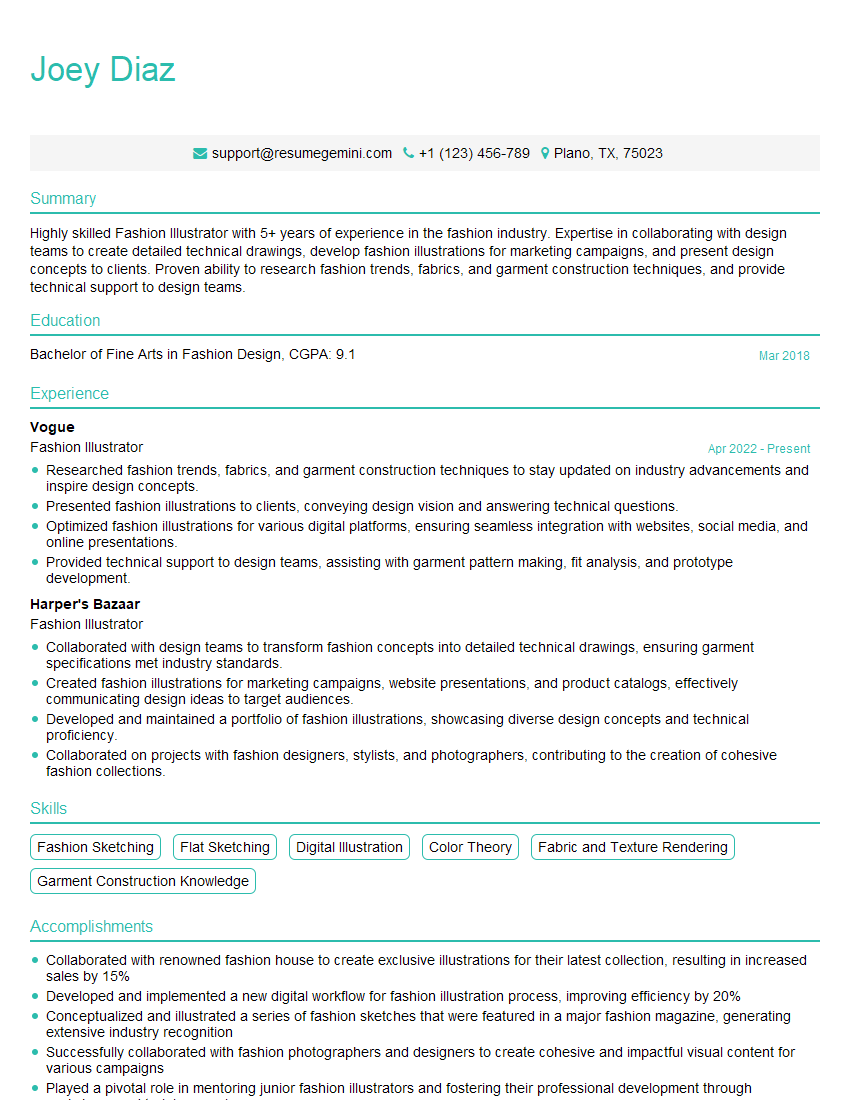
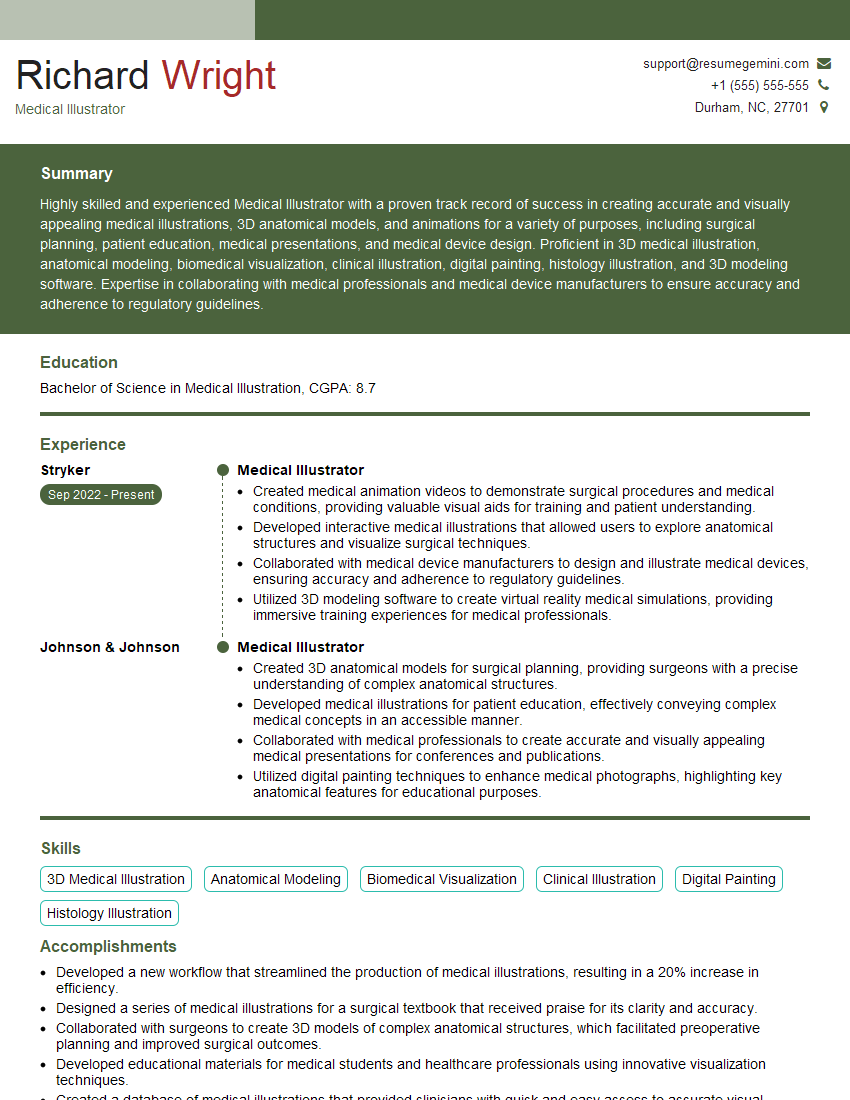
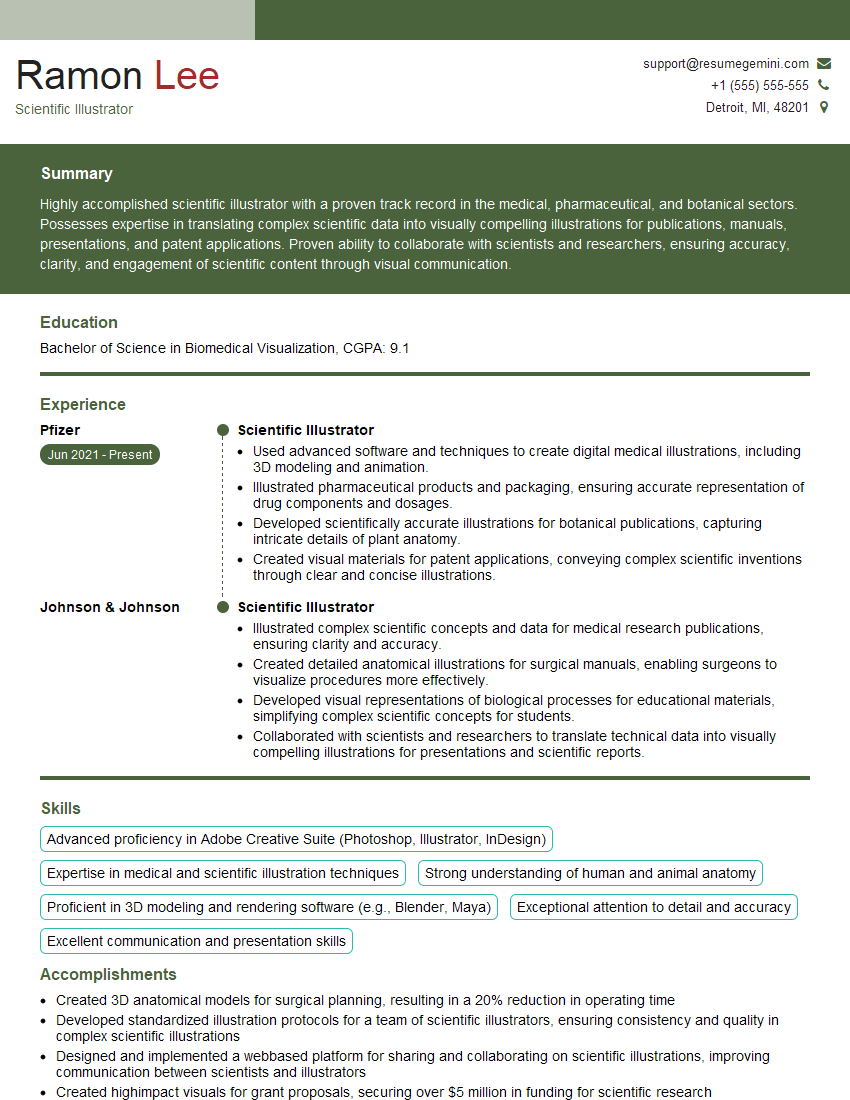
Mastering Traditional Illustration opens doors to exciting career paths in publishing, advertising, animation, game design, and more. To maximize your job prospects, crafting a strong, ATS-friendly resume is crucial. ResumeGemini is a trusted resource to help you build a professional and impactful resume that highlights your unique skills and experience. We offer examples of resumes tailored to Traditional Illustration to help you get started. Take the next step in your career journey and build a resume that gets noticed!
Explore more articles
Users Rating of Our Blogs
Share Your Experience
We value your feedback! Please rate our content and share your thoughts (optional).
What Readers Say About Our Blog
Really detailed insights and content, thank you for writing this detailed article.
IT gave me an insight and words to use and be able to think of examples