Are you ready to stand out in your next interview? Understanding and preparing for Traditional Painting Techniques interview questions is a game-changer. In this blog, we’ve compiled key questions and expert advice to help you showcase your skills with confidence and precision. Let’s get started on your journey to acing the interview.
Questions Asked in Traditional Painting Techniques Interview
Q 1. Explain the differences between oil, acrylic, and watercolor painting.
Oil, acrylic, and watercolor paints differ significantly in their composition, drying time, and application techniques. Think of it like choosing the right tool for the job – each medium has its strengths and weaknesses.
- Oil paints: These are pigment suspended in drying oil, typically linseed oil. They offer incredible richness of color, slow drying time allowing for extensive blending and manipulation, and a luminous quality once dry. The downside is the long drying time – days or even weeks – and the need for solvents for cleanup.
- Acrylic paints: These are pigment suspended in a water-based acrylic polymer emulsion. They offer the versatility of water-based paints with a fast drying time, allowing for quick layering and minimal cleanup. They are also relatively durable and can mimic the effects of both oils and watercolors, depending on application techniques.
- Watercolor paints: These are pigment suspended in a gum arabic binder, which makes them water-soluble. Watercolor is known for its transparency and luminous quality, achieved by layering washes of color. However, it offers less control once applied and mistakes are harder to correct.
In essence, oil paints offer maximum blending and richness; acrylics offer versatility and speed; and watercolors offer transparency and luminosity.
Q 2. Describe your preferred method for preparing a canvas for oil painting.
Preparing a canvas for oil painting is crucial for optimal paint adhesion and longevity. I usually employ a multi-step process.
- Sizing: First, I apply a sizing solution, such as rabbit skin glue or acrylic gesso, to seal the canvas and prevent the oil paint from absorbing into the fabric. This creates a smooth surface for painting.
- Priming: After the sizing dries, I apply several layers of oil-based primer, typically a titanium white primer. Each layer is sanded lightly after drying to create a very smooth surface. This ensures the paint will adhere well and prevents the canvas weave from showing through.
- Optional: Toned Ground: For certain paintings, I might add a colored ground by mixing a small amount of pigment into the final layer of primer. This provides a base color that can affect the overall feel of the finished painting and make mixing colors easier.
This careful preparation creates a foundation that supports the longevity and vibrancy of the oil paint layers.
Q 3. What are the various techniques for blending colors in traditional painting?
Blending colors is the heart of painting. In traditional painting, several techniques achieve this.
- Wet-on-wet blending: This involves applying wet paint to wet paint, allowing colors to merge smoothly. Think of it like watercolor washes, where colors effortlessly melt together. It’s a great method for creating soft transitions and atmospheric effects.
- Wet-on-dry blending: Applying wet paint to dry paint results in a more distinct separation between colors. It’s useful for creating crisper lines and less diffused transitions. This method is frequently used in oil painting for glazing.
- Dry brushing: Using a dry brush with a small amount of paint creates a textured, scratchy effect with little blending, allowing for more visible brush strokes.
- Scumbling: This technique involves lightly scrubbing a semi-dry brush loaded with a contrasting color over a dried underpainting. It adds a textured, broken color effect; often used to suggest light, shadows, and atmospheric perspective.
- Glazing: Applying thin transparent layers of paint over dried layers. It’s particularly effective with oil paint to build up depth and luminosity, similar to layering colored cellophane.
The choice of blending technique depends entirely on the desired outcome and the medium used.
Q 4. How do you achieve different textural effects using traditional painting techniques?
Achieving textural effects in traditional painting is about understanding the properties of the paint and the tools used.
- Impasto: Applying thick layers of paint with a palette knife or brush creates a three-dimensional texture. The paint literally stands out from the canvas. Think of Van Gogh’s thick brushstrokes.
- Sgraffito: Scratching through a layer of wet or dry paint to reveal an underlying layer creates interesting textural contrast. It’s like revealing a hidden layer, like archaeology for the canvas.
- Sponge painting: Using a sponge to apply paint generates unique textures depending on the type of sponge and technique. It’s wonderful for creating organic forms or cloudy effects.
- Using different tools: Palette knives, rags, and even fingers can be used to create varied textural effects, creating a very personal touch.
- Adding mediums: Oil painting mediums, like Liquin, can influence the texture of the paint, creating more fluid or thicker applications.
Experimentation is key to mastering textural effects. I often encourage my students to try different tools and techniques to find what works best for them.
Q 5. Explain the process of creating a layered painting.
Layered painting is a fundamental technique used to build depth, complexity, and richness in a painting. It’s like building a house, one layer at a time.
- Underpainting: This is often a monochrome or tonal layer that establishes the overall composition and values. It’s the foundation. Think of it as a sketch translated into paint.
- Mid-tones and colors: Subsequent layers introduce color and mid-tones, refining the forms and relationships between elements. This is where I build up the body of the painting.
- Highlights and details: Finally, the lightest values and the most detailed elements are added, bringing the painting to its full resolution. It’s like applying the finishing touches.
The key to successful layered painting is patience and allowing each layer to dry completely before applying the next. This prevents mixing or smudging of colors, maintaining the integrity of each stage.
Q 6. How do you manage the drying time of different paint types?
Managing drying time is essential for controlling the blending and layering process.
- Oil paints: These dry slowly, and I sometimes use mediums like linseed oil or Liquin to accelerate or decelerate the drying process. I can also use slower-drying solvents to keep the paints workable for longer periods.
- Acrylic paints: Acrylics dry quickly, requiring faster work. Retarders can be added to slow drying time, while glazes or thin washes can be used to avoid long drying periods.
- Watercolors: Watercolor dries quickly. I use multiple small washes to create layers instead of trying to work with large, slow-drying areas. I might also use a spray bottle to rewet the paint.
Understanding the characteristics of each medium and employing appropriate techniques is crucial for effective drying time management.
Q 7. Describe your process for creating realistic shadows and highlights.
Creating realistic shadows and highlights is paramount for achieving depth and three-dimensionality.
- Value Studies: Before painting, I often create a value study – a monochrome drawing showing the light and shadow relationships – to establish where the darkest and lightest parts of the painting should be. This is my guide.
- Understanding light sources: The position and intensity of the light source directly influence the shadows and highlights. I determine the direction, color, and intensity of the light source to create realistic shadows and highlights.
- Gradations: I use gradual transitions between values to create a soft, believable effect. Sharp edges are often reserved for the boundaries of objects, while soft edges are used in the transitions from light to dark.
- Color Temperature: Shadows aren’t simply dark; they often have a cool color cast, while highlights tend to be warmer. I adjust the color temperature of my shadows and highlights accordingly.
- Reflected light: I often incorporate reflected light into my shadows – a bit of light bouncing off surrounding surfaces – to add realism and depth.
Mastering the interplay between values, color, and light creates believable and three-dimensional forms. Observational skill is crucial for this aspect.
Q 8. What are the advantages and disadvantages of using natural pigments?
Natural pigments, derived from minerals, plants, or insects, offer a unique luminosity and depth that synthetic pigments often struggle to match. Think of the vibrant, earthy reds of ochre or the luminous blues of ultramarine – colors with a history stretching back millennia. However, they come with their own set of challenges.
- Advantages: Superior lightfastness (resistance to fading) in many cases; unique textural qualities; historical significance and connection to artistic traditions; often more environmentally friendly than synthetic alternatives (depending on sourcing and processing).
- Disadvantages: Higher cost; limited color range compared to synthetics; variability in pigment quality and consistency from batch to batch; more demanding preparation and grinding processes; some can be toxic (e.g., lead-based pigments).
For instance, I once worked on a project requiring a specific shade of Venetian red. Finding a consistent batch of natural pigment was a challenge, and I had to test numerous samples to ensure color uniformity throughout the piece.
Q 9. How do you choose the appropriate brushes and mediums for a specific painting technique?
Brush and medium selection is crucial. It’s like choosing the right tool for the job – a fine-tipped brush for delicate details wouldn’t be suitable for broad, impasto strokes.
The choice depends on the painting technique, desired texture, and the nature of the pigment. For example:
- Oil painting: Hog bristle brushes are ideal for blending and applying thick paint, while sable brushes are preferred for fine details. Linseed oil is a common medium, offering flexibility and drying time control. A thicker medium like alkyd resin can be used for faster drying.
- Watercolor: Sable or synthetic squirrel brushes are excellent for watercolor’s delicate washes. The medium is simply water, but additives like gum arabic can be used to modify paint consistency and flow.
- Acrylic painting: Synthetic brushes are generally preferred for acrylics because they are durable and clean easily. Water is the primary medium, but gels or retarders can be added to control the drying time and consistency.
For a recent landscape painting using oil paints, I employed a combination of large hog bristle brushes for the sky and foliage, then switched to fine sable brushes for details like tree bark and distant mountains.
Q 10. Explain your understanding of color theory and its application in painting.
Color theory is fundamental. It’s the understanding of how colors interact to create visual effects. It’s not just about mixing pretty hues; it’s about achieving harmony, balance, and creating emotional impact.
- Color wheel: The color wheel illustrates primary (red, yellow, blue), secondary (green, orange, violet), and tertiary colors, showing their relationships.
- Complementary colors: Colors opposite each other on the wheel (e.g., red and green) create high contrast and visual excitement.
- Analogous colors: Colors next to each other on the wheel (e.g., blue, blue-green, green) create a harmonious and peaceful effect.
- Warm and cool colors: Warm colors (reds, oranges, yellows) advance, appearing closer to the viewer; cool colors (blues, greens, violets) recede.
In my still life paintings, I often use complementary colors to create a focal point, such as a vibrant red apple against a cool green background. The contrast draws the eye and enhances the visual interest.
Q 11. Describe your approach to composition and perspective in your artwork.
Composition and perspective are the architecture of a painting. They determine how the viewer interacts with the artwork and guides their eye through the scene.
- Composition: This involves arranging elements within the frame to create visual interest and balance. I often use the rule of thirds, placing key elements off-center to create a more dynamic composition. Leading lines, shapes, and negative space also play vital roles in guiding the viewer’s eye.
- Perspective: This creates the illusion of depth and space on a flat surface. Linear perspective, where parallel lines converge at a vanishing point, is a common technique. Atmospheric perspective uses changes in color and detail to suggest depth (e.g., mountains fading into a hazy blue in the distance).
In a recent cityscape painting, I used linear perspective to create a sense of depth, with the buildings receding towards a vanishing point on the horizon. The rule of thirds helped me balance the composition, avoiding a static, centered arrangement.
Q 12. How do you handle unexpected issues or challenges during the painting process?
Painting is a process of continuous problem-solving. Unexpected issues are inevitable. My approach is one of observation, adaptability, and embracing the unexpected.
- Color issues: If a color isn’t quite right, I might adjust it by glazing or layering. Sometimes, an unexpected color combination leads to a serendipitous discovery.
- Composition problems: If the composition feels unbalanced, I might rework elements by adding or subtracting details, or repositioning key elements.
- Technical challenges: If a section of paint cracks or becomes too thick, I might carefully scrape it away and start again.
I remember once a crack appeared in the dried gesso layer of a large canvas. Instead of panicking, I incorporated the crack into the composition, using it as a visual element in the final piece.
Q 13. How do you clean and maintain your brushes and other painting tools?
Proper brush and tool maintenance is essential to preserve their longevity and maintain the quality of your work. It’s a habit that pays off in the long run.
- Oil paints: Clean brushes immediately with odorless mineral spirits, followed by a wash with soap and water. Allow brushes to dry completely before storing them.
- Acrylic paints: Clean brushes immediately with water, and remove all traces of paint before the acrylic dries.
- Watercolor paints: Rinse brushes thoroughly with water after each use. A gentle soap can be used occasionally.
- Palettes: Clean palettes after each painting session to prevent paint from hardening.
I regularly condition my sable brushes with a specialized brush soap to keep the bristles supple and prevent damage. Investing in quality tools and taking care of them ensures they serve me well for years to come.
Q 14. Explain your experience with different types of painting supports (canvas, wood panel, paper).
The choice of support impacts the painting’s texture, longevity, and overall effect. Each has its own unique properties.
- Canvas: Offers a flexible, textured surface suitable for various painting techniques. The texture can range from fine to coarse, depending on the weave of the fabric. Priming is essential for optimum paint adhesion.
- Wood panels: Provide a rigid, stable surface that minimizes warping. Wood panels offer a smooth or textured surface depending on the type of wood and preparation. They are ideal for detailed work and techniques requiring a firm surface.
- Paper: A versatile support, particularly for watercolor and gouache. Paper’s texture, weight, and sizing influence the paint’s absorption and flow. Different paper types suit different painting styles and techniques.
For a recent series of portraits, I chose wood panels for their stability and smooth surface, enabling me to achieve fine details. However, for my watercolor sketches, I prefer a cold-pressed watercolor paper for its slightly textured surface.
Q 15. Describe your understanding of different painting styles (e.g., Impressionism, Realism).
Different painting styles reflect distinct artistic approaches and philosophies. Realism, for example, strives for accurate representation of the visible world, prioritizing detail and verisimilitude. Think of the meticulous detail in the works of Gustave Courbet. In contrast, Impressionism emphasizes capturing fleeting moments and subjective perceptions of light and color. Instead of precise detail, Impressionist painters, like Claude Monet, use short, visible brushstrokes and broken color to create a vibrant, almost ethereal effect. Other styles, such as Romanticism, focus on emotional expression and dramatic narratives, while Abstract Expressionism prioritizes non-representational forms and spontaneous gestures. Each style offers a unique lens through which to view and interpret the world.
- Realism: Focuses on accurate depiction of form, light, and shadow.
- Impressionism: Emphasizes capturing the ephemeral effects of light and color.
- Romanticism: Prioritizes emotion and dramatic narratives.
- Abstract Expressionism: Rejects representational forms in favor of abstract expression.
Career Expert Tips:
- Ace those interviews! Prepare effectively by reviewing the Top 50 Most Common Interview Questions on ResumeGemini.
- Navigate your job search with confidence! Explore a wide range of Career Tips on ResumeGemini. Learn about common challenges and recommendations to overcome them.
- Craft the perfect resume! Master the Art of Resume Writing with ResumeGemini’s guide. Showcase your unique qualifications and achievements effectively.
- Don’t miss out on holiday savings! Build your dream resume with ResumeGemini’s ATS optimized templates.
Q 16. How do you approach the creation of a detailed portrait?
Creating a detailed portrait is a layered process that begins long before the first brushstroke. I start with a strong drawing, meticulously observing the subject’s features – the subtle curves of the lips, the unique shape of the eyes, the fall of the light across the face. I use a variety of drawing materials, from charcoal sketches to refined graphite studies, to capture the essence of my subject. Once I’m satisfied with the drawing, I transfer it to the canvas or panel. Then, I employ a gradual layering technique, beginning with underpainting to establish values and color relationships. I work from the darker tones to the lighter ones, building up the layers incrementally, always refining and adjusting. This careful approach allows me to achieve a level of detail and realism that is both captivating and believable. I might also use techniques like sfumato (smoky blending) for creating soft transitions and achieving a lifelike quality.
For example, in a recent portrait, I used thin layers of transparent oil glazes over an underpainting to build the luminosity of the skin. This approach was crucial in representing the complex interplay of light and shadow on the subject’s face, producing a result that was more than just a copy of the image, but rather a true representation of the person’s character and essence.
Q 17. How do you create a sense of depth and atmosphere in a landscape painting?
Creating depth and atmosphere in a landscape painting involves manipulating several key elements. First, I utilize atmospheric perspective, where objects in the distance appear lighter, less detailed, and bluer due to the scattering of light particles in the air. This effect naturally creates a sense of recession into space. Second, I employ linear perspective, using converging lines to guide the viewer’s eye towards a vanishing point on the horizon. Third, I pay close attention to value and color contrast, using warmer colors in the foreground and cooler colors in the background to enhance depth. Finally, I carefully consider the composition, arranging elements in a way that directs the viewer’s gaze through the landscape. For instance, a winding path or a row of trees can lead the eye into the distance, creating a compelling sense of depth and exploration. I might also add elements of light and shadow, or use techniques like layering transparent glazes to enhance the feeling of atmosphere and space.
Imagine painting a mountain range. The peaks closest to the viewer would be rendered with sharp detail and rich, warm colors, while those further away would be paler, more muted in color, and less sharply defined. This interplay of color, detail, and perspective contributes greatly to establishing a realistic sense of depth and atmospheric space.
Q 18. Explain your process for creating a still life composition.
My approach to still life composition begins with careful selection and arrangement of objects. I consider not only the visual appeal of individual items but also their interplay with each other – their shapes, colors, textures, and how they relate in terms of light and shadow. I aim for a balanced composition, often utilizing the rule of thirds or other compositional guidelines. Once the arrangement is finalized, I make detailed sketches and studies, capturing subtle nuances of light and form. This careful planning informs my approach to color and value, ensuring a harmonious and visually appealing result. Then, I transfer the composition to my chosen support and start painting, again using a layering approach to build depth and complexity. I often start with the underpainting to establish the basic shapes and values and gradually add more detail, adjusting colors and values until I’m satisfied with the result. The process is iterative, with constant adjustments and refinement.
For example, in a still life featuring fruit, I might use a warm, golden light source to highlight the textures and colors of the fruit, while cooler shadows emphasize their volume and form. The interplay of light and shadow, coupled with careful consideration of color harmony, helps create a captivating and dynamic composition.
Q 19. What are your preferred methods for varnish and protecting finished paintings?
Protecting finished paintings is crucial for their longevity. I typically use a high-quality, archival-grade varnish, applied several months after the painting is completed to allow the paint to fully cure. This protects the painting from dust, UV light damage, and environmental factors. The type of varnish chosen depends on the painting’s medium and desired finish. For oil paintings, I often choose a damar varnish or a synthetic alternative that offers good protection and clarity. The application process is crucial; I apply the varnish in thin, even coats, using a soft brush and ensuring a dust-free environment. Beyond varnishing, I advocate for proper storage in a climate-controlled environment, away from direct sunlight and extreme temperature fluctuations. Regular, careful cleaning using specialized art cleaning materials can also help preserve the painting’s beauty for generations.
Q 20. Describe your approach to color mixing for skin tones.
Mixing realistic skin tones is a complex process that requires a deep understanding of color theory. I avoid using pure colors, instead relying on subtle combinations of a variety of hues to achieve natural-looking skin. A common starting point is a base of warm earth tones – such as burnt umber, raw sienna, and yellow ochre – mixed with a touch of white. Then, I subtly introduce other colors to modify the base depending on the subject’s complexion and the ambient light. For example, a touch of alizarin crimson or cadmium red can add warmth, while a hint of ultramarine or cobalt blue can introduce cool undertones. The key is to be gradual and subtle, continuously adjusting the mixture until I achieve a realistic and nuanced color. Remember that skin tones are never uniform and vary depending on the underlying color of the skin, the quality of the lighting, and the subject’s age. Creating a realistic skin tone requires a sensitive approach and continuous adjustment of pigment ratios.
Q 21. How do you utilize underpainting techniques?
Underpainting is a fundamental technique that lays the groundwork for a successful painting. It’s a preliminary layer of paint, usually in monochrome or limited colors, that establishes the basic values, composition, and overall color harmony of the piece. This can be in a variety of mediums from a very thin wash to a more opaque layer. This layer helps define the light source, establish the shadow masses, and provide a solid base for subsequent layers. It saves time and helps to prevent overworked sections of paint, achieving a more fluid and vibrant painting. The choice of underpainting color often depends on the final color scheme. A warm underpainting can make a painting feel warmer, while a cool one can create a cool tone. For example, if I am painting a portrait with a warm palette, I might use a warm toned umber-based underpainting to create a foundation for the warmth. Underpainting allows me to address the larger compositional and tonal issues before committing to the final details, greatly improving the flow and efficiency of my process.
Q 22. How do you achieve a smooth, even finish in your paintings?
Achieving a smooth, even finish in traditional painting is a culmination of careful preparation and meticulous technique. It’s less about a single step and more about a process. Think of it like baking a cake – you wouldn’t expect a perfect result without properly measuring ingredients and following the recipe!
Firstly, preparing your canvas or panel is crucial. For example, with a linen canvas, I’ll usually apply several layers of gesso, sanding lightly between each coat to create a perfectly smooth surface. This creates a stable, even base for the paint to adhere to. Think of it as providing a foundation for a skyscraper – it needs to be strong and level.
Secondly, the application of paint itself requires a delicate touch. Thinning your paints appropriately is vital. Using too much medium can result in cracking, while paint that’s too thick will leave visible brushstrokes. I often employ glazing techniques – applying thin, transparent layers of color that gradually build up depth and richness. This helps blend colors seamlessly, eliminating harsh lines and achieving that coveted smooth finish. I’ll often use different brushes depending on the stage of the painting. A large, soft brush for initial layers, and smaller, finer brushes for detailed work and highlights.
Finally, patience is key. Allowing each layer to dry completely before applying the next prevents muddiness and allows for even blending. Rushing the process almost always leads to visible imperfections.
Q 23. What are some common mistakes to avoid in traditional painting?
Common mistakes in traditional painting often stem from impatience and a lack of foundational understanding. One frequent error is neglecting the preparation stage. A poorly prepared canvas or panel can lead to cracking, uneven paint application, and overall unsatisfactory results. Imagine trying to build a house on unstable ground!
Another common pitfall is using paints that are too thick or not properly thinned. This results in a heavy, textured surface that lacks the delicate nuances of a well-executed painting. Think of it like trying to write calligraphy with a thick marker instead of a fine nib pen.
Overworking a painting is another frequent problem. Excessive blending or layering can lead to a muddy, lifeless appearance. Less is often more in traditional painting. Knowing when to stop is as important as knowing when to begin.
Finally, ignoring proper cleaning techniques can damage brushes and lead to contamination of colors. Always clean your brushes thoroughly after each use, using appropriate solvents.
Q 24. Discuss your experience with working from life and photographs.
Working from life and photographs both offer unique advantages and challenges. Painting from life, also known as ‘en plein air’ or studio work with a live model, offers an unparalleled understanding of light, form, and color. The experience is direct and immediate, fostering a deeper connection with the subject and allowing for spontaneous observation of subtle shifts in light and shadow. For instance, painting a portrait from life allows you to capture the fleeting expressions and the unique qualities of the sitter that a photograph simply can’t convey. However, it requires discipline, as you’re constrained by time and the changing light.
Photographs, on the other hand, provide a convenient and accessible way to study subjects at your leisure. They are a valuable tool for capturing details and planning compositions. However, relying solely on photographs can lead to a lack of understanding of the underlying forms and subtle variations in light that would be apparent during a live session. A photograph, while a powerful tool, can sometimes flatten the three-dimensionality of a scene.
In my practice, I often combine both approaches. I might use photographs as a reference for certain details or to capture a specific moment, but I prioritize working from life whenever possible to achieve a greater depth and understanding of the subject matter. This synergistic approach allows me to harness the strengths of each method, resulting in more compelling and lifelike paintings.
Q 25. How do you manage your time effectively when working on a large painting project?
Managing time effectively on a large painting project requires a strategic approach. I start by breaking the project down into smaller, manageable stages. For example, a large landscape might be divided into sections: the sky, the foreground, the mid-ground, etc. This makes the project less overwhelming and allows for incremental progress.
I also create a detailed plan outlining the steps involved and the estimated time needed for each stage. This helps me stay organized and track my progress. Realistic time estimations are crucial. I’ve learned from experience not to underestimate the time certain tasks will take.
Consistent work habits are also vital. I allocate specific times each day or week dedicated solely to working on the painting, creating a routine that fosters productivity. Taking short breaks is important too, preventing burnout and allowing for fresh perspective.
Finally, I regularly assess my progress, adjusting my plan as needed. Flexibility is key – unexpected challenges might arise, and being able to adapt is crucial to staying on schedule.
Q 26. How do you maintain your artistic inspiration and continue learning?
Maintaining artistic inspiration and continuing to learn is a lifelong pursuit. I regularly visit museums and galleries to experience the work of master artists, both historical and contemporary. This exposes me to new ideas, techniques, and perspectives. Observing the work of others helps me refine my own artistic vision.
I also seek inspiration from nature, people, and everyday life. Paying attention to light, color, and form in my surroundings keeps my creative senses sharp. I maintain a sketchbook where I jot down ideas, make quick sketches, and experiment with different techniques.
Continuing to learn is an integral part of my artistic growth. I participate in workshops, take online courses, and read books on art history and painting techniques. This continuous learning keeps my skills honed and expands my artistic vocabulary.
Moreover, engaging with fellow artists, either through online communities or in-person gatherings, provides valuable feedback and creates a supportive environment for artistic growth. The exchange of ideas and constructive criticism is invaluable.
Q 27. Explain your understanding of the historical context of traditional painting techniques.
Understanding the historical context of traditional painting techniques is vital for any serious artist. These techniques aren’t simply methods; they’re products of their time, reflecting the materials available, the artistic styles prevalent, and the societal values of the era. For example, the development of oil painting in the 15th century revolutionized the art world. The slow-drying nature of oil paints allowed for unprecedented layering and blending, leading to the rich depth and detail seen in Renaissance masterpieces.
The techniques used by Old Masters like Leonardo da Vinci or Rembrandt weren’t merely random choices; they were deliberate strategies informed by their understanding of materials and the effects they desired. Understanding their methods – from the preparation of pigments and mediums to the specific brushstrokes used – helps us appreciate the artistry involved and allows us to use these techniques in creative ways. For example, understanding the ‘sfumato’ technique of Leonardo da Vinci allows us to approach atmospheric perspective and the blending of colours in a way that enhances the illusion of depth and realism.
Studying art history helps us avoid reinventing the wheel. We can learn from the successes and failures of past artists, refine our understanding of artistic principles, and build upon the legacy of established techniques. It’s like having access to a vast library of knowledge that guides and informs our creative practice. It connects us to a rich and continuous artistic tradition.
Key Topics to Learn for Traditional Painting Techniques Interview
- Color Theory and Mixing: Understanding color relationships (primary, secondary, tertiary), color harmonies, and achieving specific hues through pigment mixing. Practical application includes demonstrating your understanding through examples in your portfolio and verbally explaining your color choices.
- Brushwork and Technique: Mastering various brushstrokes (impasto, glazing, scumbling, etc.) for different effects and painting styles. This includes demonstrating proficiency in handling various brushes and mediums, and understanding their impact on the final piece.
- Mediums and Their Properties: A deep understanding of oil paints, acrylics, watercolors, tempera, etc., including their drying times, blending characteristics, and archival qualities. Be prepared to discuss the advantages and disadvantages of each medium for specific applications.
- Composition and Design Principles: Applying principles of balance, emphasis, rhythm, and unity to create visually compelling paintings. Demonstrate your ability to analyze and discuss compositional choices in your own work and that of masters.
- Historical Context and Influences: Familiarity with significant movements and artists throughout history and how they impacted painting techniques. This shows your broad knowledge and appreciation for the art form’s evolution.
- Surface Preparation and Preservation: Understanding different canvas preparation techniques (priming, sizing) and appropriate methods for protecting and preserving finished artwork. This demonstrates attention to detail and professional practices.
- Problem-solving in Painting: Discussing your approach to overcoming challenges such as unexpected color shifts, texture issues, or correcting mistakes during the painting process. Highlight your adaptability and resourcefulness.
Next Steps
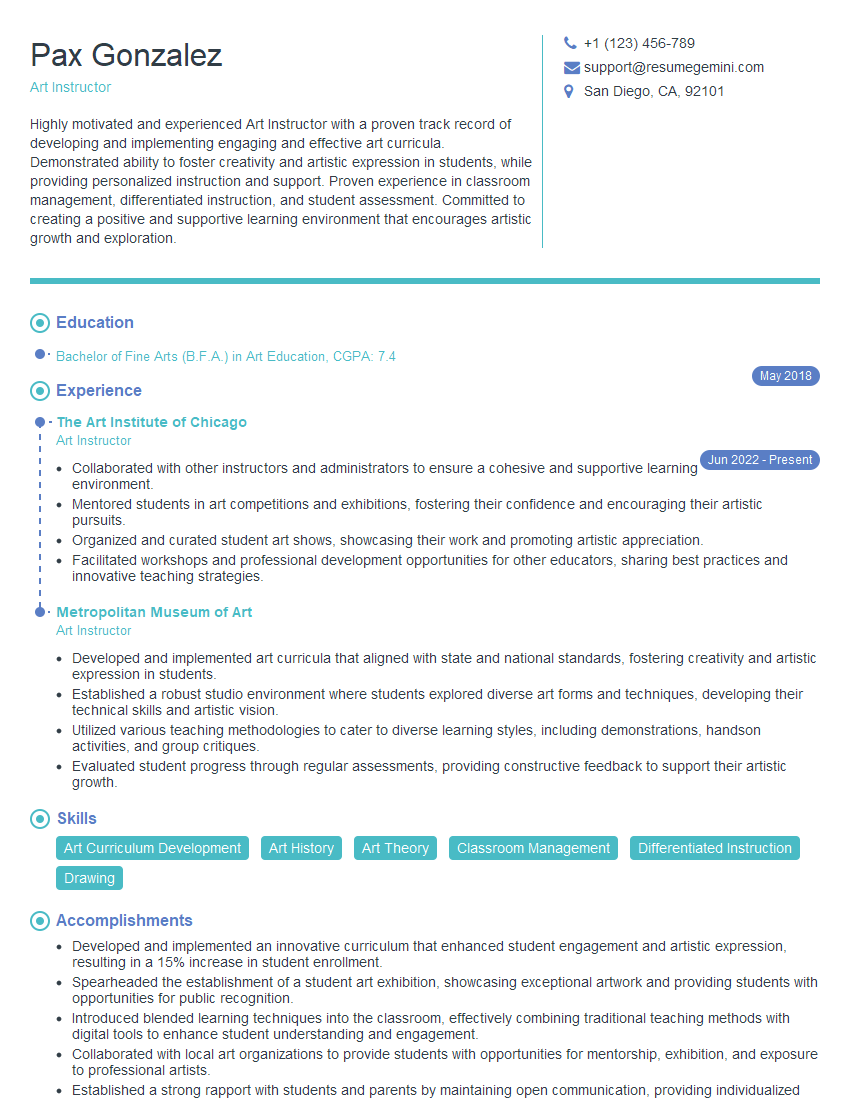
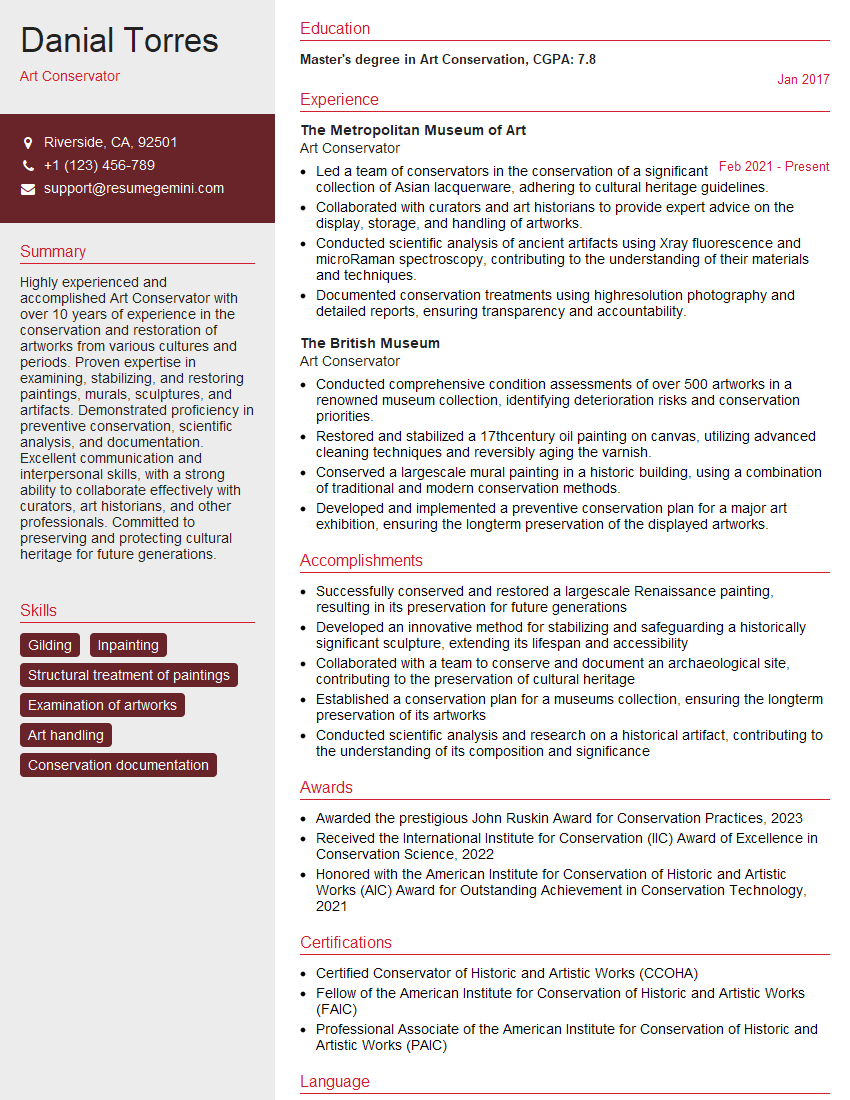
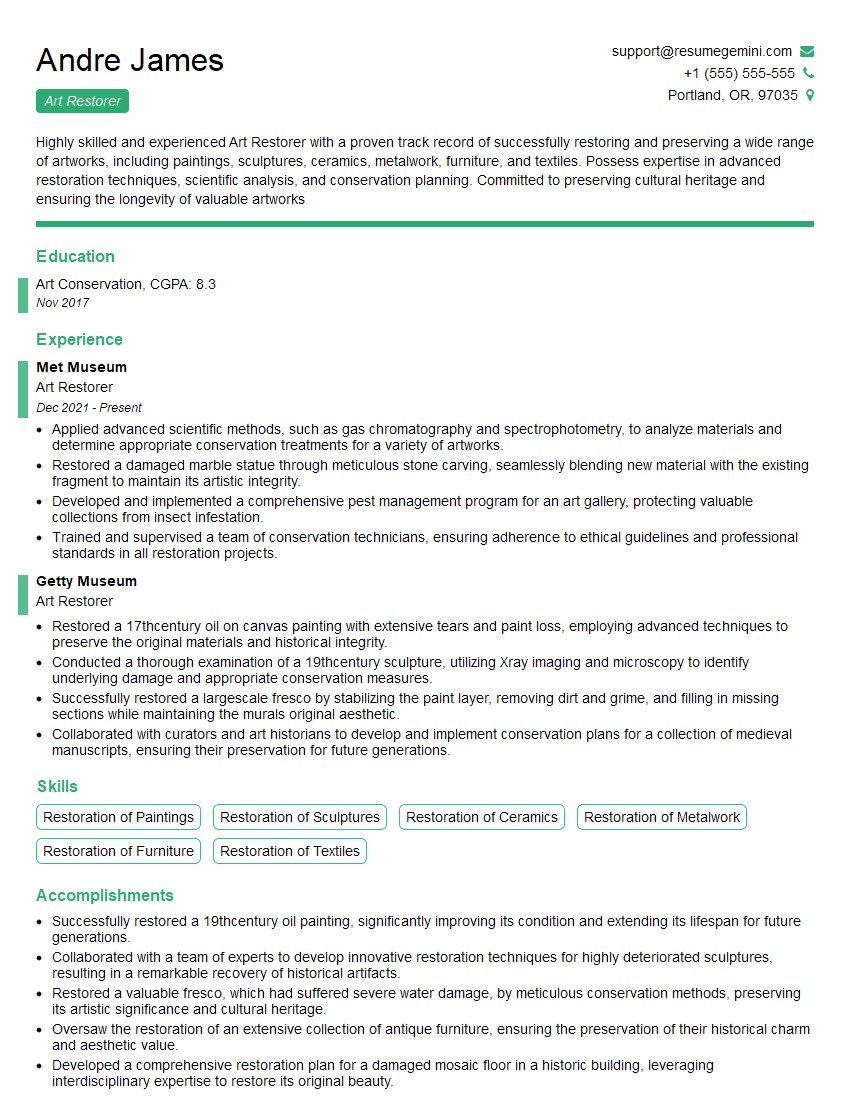
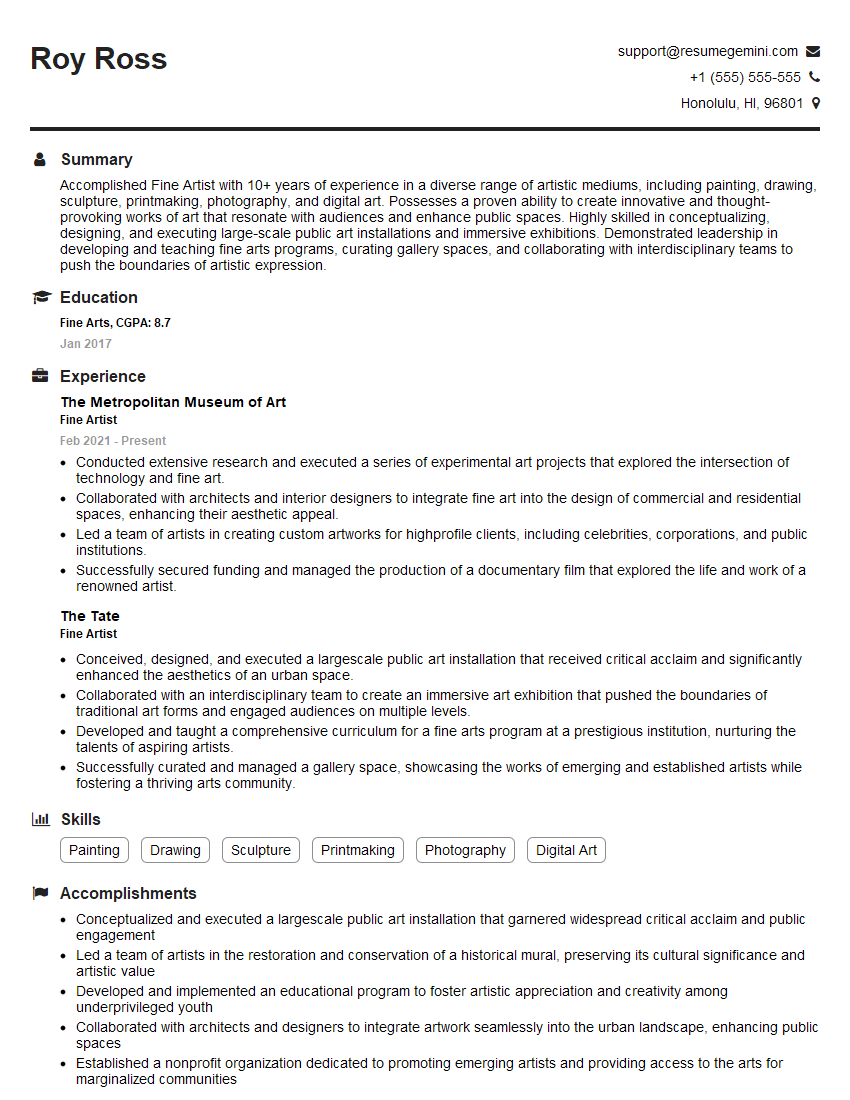
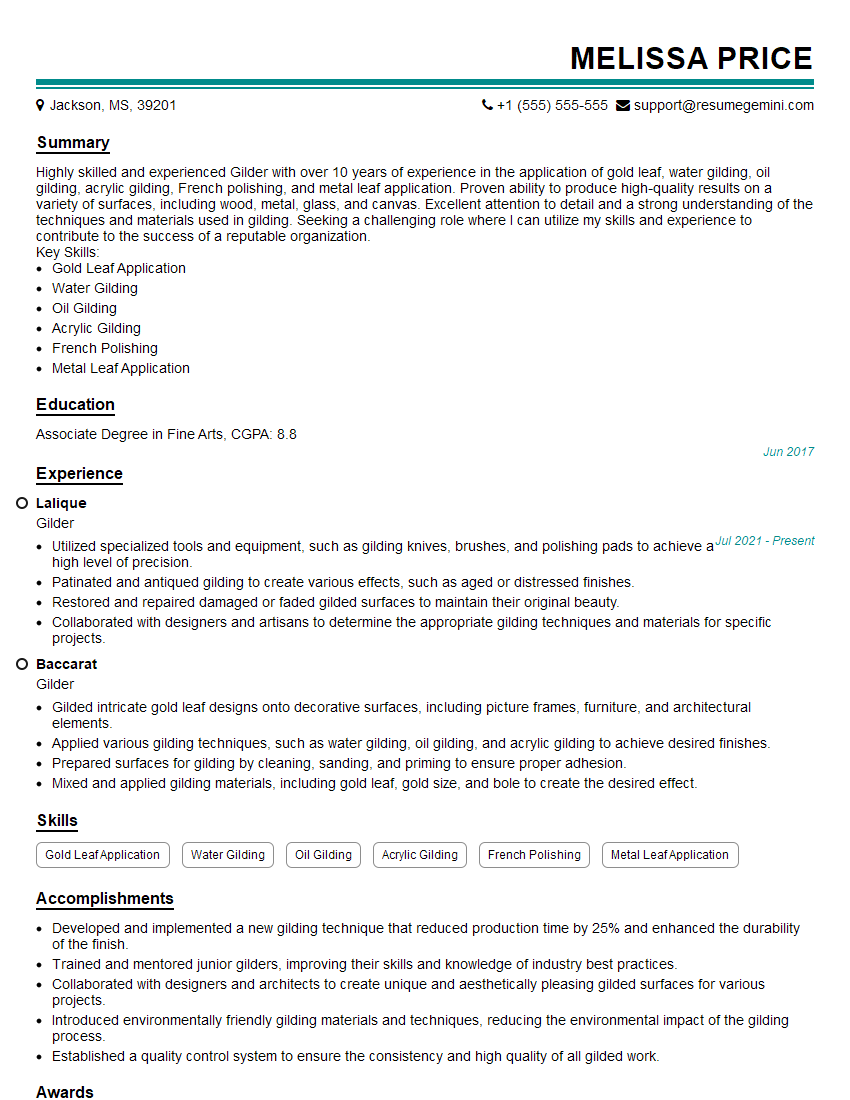
Mastering traditional painting techniques is crucial for career advancement in the competitive art world. A strong understanding of these techniques showcases your skill, dedication, and artistic vision to potential employers. To stand out, create an ATS-friendly resume that effectively highlights your abilities and experience. ResumeGemini is a trusted resource to help you build a professional resume that captures the attention of recruiters. They provide examples of resumes tailored to Traditional Painting Techniques, ensuring yours is impactful and showcases your unique skills.
Explore more articles
Users Rating of Our Blogs
Share Your Experience
We value your feedback! Please rate our content and share your thoughts (optional).
What Readers Say About Our Blog
Really detailed insights and content, thank you for writing this detailed article.
IT gave me an insight and words to use and be able to think of examples