The thought of an interview can be nerve-wracking, but the right preparation can make all the difference. Explore this comprehensive guide to Trend Innovation interview questions and gain the confidence you need to showcase your abilities and secure the role.
Questions Asked in Trend Innovation Interview
Q 1. Describe your methodology for identifying emerging consumer trends.
Identifying emerging consumer trends requires a multi-faceted approach. It’s not about just looking at the latest viral TikTok video; it’s about systematically analyzing various data points to predict future behaviors. My methodology involves a combination of proactive and reactive strategies. Proactively, I delve into forward-looking reports from market research firms like Nielsen and Mintel, focusing on demographic shifts, technological advancements, and evolving consumer values. Reactively, I closely monitor social media platforms, analyzing conversations, hashtags, and trending topics using tools like Brandwatch and Sprout Social. This allows me to identify patterns and emerging themes that might not be evident in traditional market research. Furthermore, I conduct regular competitive analysis, studying the innovation strategies of leading companies in various sectors to understand market shifts. Finally, I actively participate in industry events and conferences to gather insights directly from experts and consumers.
For example, noticing a consistent rise in searches for ‘sustainable fashion’ and a simultaneous increase in discussions about ethical sourcing on platforms like Instagram wouldn’t just be dismissed as noise. It signals a potential shift towards conscious consumerism, a trend worthy of further investigation.
Q 2. How do you differentiate between a fad and a lasting trend?
Differentiating between a fad and a lasting trend is crucial for strategic decision-making. A fad is characterized by rapid, intense popularity followed by an equally swift decline. Think of fidget spinners or certain viral dance crazes – they capture attention for a short period, then disappear. A lasting trend, on the other hand, exhibits sustained growth and influence over a more extended period, often reflecting deeper societal shifts or evolving needs.
To distinguish them, I analyze the trend’s longevity, depth of penetration across different demographics and geographic locations, and its connection to broader societal changes. For example, the rise of athleisure clothing isn’t just a fad because it’s not based on a fleeting novelty; it’s grounded in the increasing importance of wellness and comfortable, versatile clothing for diverse lifestyle needs. A fad might be driven by social media virality; a trend is often underpinned by significant underlying factors like technological advancements, economic changes, or evolving cultural values.
Q 3. Explain how you would use trend data to inform product development.
Trend data is an invaluable asset for product development. It allows us to create products that are not only innovative but also resonate with consumers’ evolving needs and desires. I use trend data in several key ways: first, to identify unmet needs and opportunities in the market. By understanding emerging trends, we can identify gaps in existing product offerings and create solutions to fill those gaps. Second, trend data informs product features and functionalities. For example, recognizing the increasing demand for personalized experiences, we might incorporate AI-powered customization options into our product. Finally, the data helps guide the marketing and branding strategies, ensuring we communicate the product’s value proposition effectively to the target audience.
Imagine a company specializing in household cleaning products. Observing the growing trend towards eco-consciousness, they could leverage this trend data to develop a new line of sustainable, biodegradable cleaning solutions, highlighting this eco-friendly aspect in their marketing campaigns. This wouldn’t just be a feature; it would be a core selling point aligned with a lasting trend.
Q 4. What are some key tools or technologies you use for trend research?
My trend research relies on a combination of tools and technologies. For quantitative data, I utilize platforms like Google Trends to monitor search volume for specific keywords, indicating consumer interest levels. Social listening tools like Brandwatch and Talkwalker provide real-time insights into social media conversations, allowing me to track sentiment and identify emerging themes. For qualitative data, I use online survey tools like SurveyMonkey and Qualtrics to gather in-depth consumer feedback and perspectives. Additionally, I leverage data analytics platforms to analyze large datasets and identify patterns, often employing techniques like sentiment analysis and topic modeling.
Furthermore, utilizing tools that map different trends and identify correlations between them is highly beneficial. Visualizations become an important part of understanding complex interplay of various trends.
Q 5. How do you assess the potential impact of a trend on a specific industry?
Assessing the potential impact of a trend on a specific industry requires a structured approach. I begin by identifying the industry’s current state, its key players, and existing challenges. Next, I analyze how the trend might affect each aspect of the industry – its supply chain, consumer demand, competitive landscape, and regulatory environment. This often involves developing scenarios to consider both optimistic and pessimistic outcomes. For instance, if we are evaluating the impact of the rise in remote work on the office furniture industry, a pessimistic scenario might be a significant decrease in demand for traditional office furniture. An optimistic scenario might focus on the potential for growth in the ergonomic home office furniture market.
Finally, I use quantitative models (e.g., forecasting techniques) and qualitative assessments (e.g., expert interviews) to estimate the magnitude and timeline of the impact. A thorough understanding of the industry and the trend’s dynamics is critical for a robust assessment.
Q 6. Describe your experience with qualitative and quantitative research methods in trend analysis.
Both qualitative and quantitative research methods are integral to my trend analysis. Quantitative methods, such as surveys and data analysis, provide a broad understanding of consumer behaviors and preferences on a large scale. This helps establish the prevalence and scale of a trend. Qualitative methods, such as focus groups, interviews, and ethnographic studies, provide richer, deeper insights into the ‘why’ behind consumer behaviors, offering context and nuance that quantitative data alone cannot provide.
For example, a quantitative survey might reveal a high level of interest in sustainable products. However, qualitative interviews would help uncover the specific reasons behind this interest, providing valuable information for product development and marketing. The combination offers a robust understanding, providing both the ‘what’ and the ‘why’.
Q 7. How do you prioritize competing trends for strategic decision-making?
Prioritizing competing trends requires a strategic framework. I start by evaluating each trend’s potential impact on the business, considering both opportunities and risks. I also consider the feasibility of integrating each trend into our business model, product development cycle, and resources. This involves evaluating factors such as market size, competitive intensity, and the resources required to capitalize on each trend. A simple scoring system can be used, assigning weights to factors like potential return on investment, market size, and feasibility.
A crucial step is understanding the interconnectedness of trends. Sometimes, trends complement each other, and capitalizing on one can accelerate the adoption of others. For instance, focusing on sustainable practices (‘sustainable trend’) might align perfectly with growing consumer demand for personalized experiences (‘personalization trend’). Finally, the prioritization is also influenced by the company’s overall strategic goals and resource constraints. Not every trend, even a significant one, should be pursued simultaneously; smart prioritization ensures efficient use of resources and maximizes impact.
Q 8. How do you communicate trend insights to different stakeholders?
Communicating trend insights effectively requires tailoring the message to the audience. For executives, I focus on the high-level impact and strategic implications, using concise summaries and compelling visuals. For marketing teams, I provide detailed data, actionable recommendations, and potential campaign strategies. For product development, I highlight opportunities for innovation and competitive advantage, including specific product features or functionalities. Essentially, I translate complex data into clear, relevant stories that resonate with each stakeholder’s priorities and responsibilities.
For example, when presenting to executives, I might use a one-pager summarizing key trends, projected market growth, and potential revenue opportunities. With the marketing team, I’d delve deeper into consumer behavior, providing detailed market segmentation and actionable insights to inform marketing campaigns. With the product development team, I would focus on specific examples of emerging technologies or design elements that could be incorporated into new products.
Q 9. Explain your process for developing a trend report or presentation.
My process for developing a trend report or presentation is iterative and data-driven. It begins with extensive research using a variety of sources like market research reports, social media analytics, competitor analysis, and expert interviews. I then synthesize this data, identifying key patterns and emergent trends. I utilize frameworks like PESTLE analysis (Political, Economic, Social, Technological, Legal, Environmental) to organize and analyze this information, ensuring a comprehensive view. This is followed by a process of validation and refinement, ensuring the accuracy and relevance of my findings.
Next, I structure my report or presentation to tell a compelling story, moving from the ‘big picture’ to more specific recommendations. Visualizations like charts, graphs, and infographics are crucial for effectively communicating complex data. Finally, I always include a clear executive summary and actionable recommendations, highlighting the key opportunities and potential risks associated with the identified trends.
Q 10. Describe a time you successfully identified and leveraged an emerging trend.
During a project for a major sportswear company, I identified the growing trend of sustainable and ethically sourced materials. While many competitors were still lagging, I noticed a significant increase in online searches and social media discussions related to eco-friendly apparel. I presented this finding, highlighting the potential for increased brand loyalty and market share among environmentally conscious consumers.
The company subsequently incorporated sustainable materials into their new product line, resulting in a 20% increase in sales within the first year and significant positive media coverage. This success underscored the importance of early identification and effective communication of emerging trends.
Q 11. How do you stay updated on the latest trends in your field?
Staying updated on the latest trends requires a multi-faceted approach. I regularly read industry publications and research reports. I actively participate in relevant conferences and workshops, networking with experts and peers. I closely monitor social media platforms, including Twitter, Instagram, and TikTok, to gauge public sentiment and observe emerging trends. I utilize specialized trend forecasting tools and databases, providing insights into consumer behavior and market dynamics. Finally, I maintain a network of contacts across various industries, engaging in regular discussions to share insights and perspectives.
Q 12. What are some common pitfalls to avoid when conducting trend research?
One common pitfall is confirmation bias, where researchers selectively focus on data supporting their pre-existing beliefs. Another is neglecting qualitative data, focusing solely on quantitative metrics and missing crucial nuanced insights. Overgeneralization from limited samples is another significant issue. Finally, failing to consider the context and potential limitations of the data used can lead to inaccurate or misleading conclusions. For instance, a trend observed in one specific demographic might not be representative of the entire market.
Q 13. How do you measure the success of a trend-driven initiative?
Measuring the success of a trend-driven initiative depends on the specific goals and objectives. Key performance indicators (KPIs) can include sales growth, market share increase, brand awareness improvements, customer satisfaction ratings, and social media engagement metrics. For example, if the goal was to increase brand awareness, we might track the number of social media mentions or the reach of marketing campaigns. If the objective was to increase sales of a new product, then we would monitor sales figures and market share.
Furthermore, qualitative feedback from focus groups or customer surveys can provide valuable insights into the effectiveness of the initiative and areas for future improvement. A comprehensive approach, combining quantitative and qualitative data, is key to accurately assessing the impact of trend-driven initiatives.
Q 14. How do you incorporate trend analysis into risk management strategies?
Trend analysis is crucial for proactive risk management. By identifying emerging trends, both positive and negative, we can anticipate potential challenges and opportunities. For example, analyzing a growing trend towards environmental sustainability helps anticipate potential regulatory changes or shifts in consumer preferences, allowing businesses to adjust their strategies accordingly and avoid potential risks associated with non-compliance or reduced demand for unsustainable products.
Similarly, identifying emerging technological trends can reveal potential disruptions to existing business models. By understanding these potential disruptions, businesses can develop contingency plans, invest in relevant technologies, or adapt their operations to mitigate risks and leverage opportunities presented by the changing landscape.
Q 15. Describe your understanding of scenario planning and its application in trend innovation.
Scenario planning is a strategic foresight technique used to explore potential futures by creating plausible, yet diverse, scenarios. In trend innovation, it’s crucial for anticipating how trends might evolve and impact a business. Instead of relying on a single prediction, we construct multiple scenarios—optimistic, pessimistic, and everything in between—each based on different assumptions about key trend drivers. For instance, considering the trend towards sustainable living, one scenario might depict widespread consumer adoption of eco-friendly products, while another might show a slower, more uneven transition due to cost or availability.
This allows us to develop flexible strategies that can adapt to a range of possible futures. Instead of investing heavily in a single approach that might fail if a trend evolves unexpectedly, scenario planning enables the development of contingency plans and alternative pathways to success. It helps de-risk innovation investments by considering a broader spectrum of possibilities.
Career Expert Tips:
- Ace those interviews! Prepare effectively by reviewing the Top 50 Most Common Interview Questions on ResumeGemini.
- Navigate your job search with confidence! Explore a wide range of Career Tips on ResumeGemini. Learn about common challenges and recommendations to overcome them.
- Craft the perfect resume! Master the Art of Resume Writing with ResumeGemini’s guide. Showcase your unique qualifications and achievements effectively.
- Don’t miss out on holiday savings! Build your dream resume with ResumeGemini’s ATS optimized templates.
Q 16. How do you navigate conflicting or contradictory trend data?
Conflicting trend data is a common challenge. My approach involves a multi-step process of triangulation and critical evaluation. First, I identify the source and methodology of each data point. Is it based on surveys, sales figures, social media analytics, or expert opinion? Different data sources have different strengths and weaknesses. Then, I look for patterns across various data sets. Are there any underlying commonalities or divergent factors? Are the differences significant enough to warrant concern? Often, seemingly contradictory trends are reflecting different segments of the market or variations in time frames.
For instance, while overall sales of traditional newspapers might be declining, niche publications focused on specific interests could be thriving. This requires careful segmentation of the data to understand the nuances of the market. Finally, I weigh the credibility of the information, considering potential biases and the context in which the data was collected. This process helps me develop a more nuanced and accurate understanding of the trends at play, acknowledging the complexity of the situation.
Q 17. Explain your approach to validating trend predictions.
Validating trend predictions is essential to avoid costly mistakes. My approach combines quantitative and qualitative methods. Quantitative methods might involve tracking key performance indicators (KPIs) related to the predicted trend, such as website traffic, social media engagement, or sales data. A prediction of rising interest in plant-based meats, for example, can be validated by tracking the growth of plant-based meat sales in supermarkets and restaurants.
Qualitative validation involves gathering insights through interviews, focus groups, or ethnographic studies to understand consumer attitudes and behaviours. This helps to assess the depth and spread of the trend beyond simple numbers. For example, interviews with consumers could reveal deeper motivations behind adopting plant-based diets, giving a richer understanding of the trend’s underlying drivers and potential longevity. Combining these methods creates a robust validation framework, helping refine initial predictions and increase the confidence in the analysis.
Q 18. How do you use trend analysis to improve customer experience?
Trend analysis is invaluable for improving customer experience. By understanding emerging trends in customer preferences, behaviors, and technological advancements, we can proactively adapt products, services, and communication strategies to better meet customer needs. For example, the rise of personalized experiences is a significant trend. Analyzing data on customer preferences, past purchases, and online behavior allows us to tailor product recommendations, marketing messages, and customer service interactions to each individual, leading to increased satisfaction and loyalty.
Similarly, understanding trends in digital channels allows businesses to optimize their online presence and provide seamless omnichannel experiences, ensuring customers have a smooth and consistent experience across all touchpoints. Trend analysis enables a shift from reactive to proactive customer management, anticipating needs and exceeding expectations.
Q 19. Describe your experience with trend mapping or visualization techniques.
I frequently utilize various trend mapping and visualization techniques. Trend maps can take many forms, from simple timelines to complex network diagrams. A common approach is to use mind maps to visually organize and connect related trends. This helps to identify clusters of interconnected trends and understand their potential synergistic effects. For instance, mapping the relationship between trends in sustainable living, technological innovation, and changing consumer preferences can reveal opportunities for developing eco-friendly products with advanced features.
I also utilize data visualization tools to graphically represent key trends. Line charts, bar graphs, and heatmaps provide clear and concise presentations of data, making it easier for stakeholders to understand complex patterns and make informed decisions. This allows for more effective communication of trend insights and facilitates collaboration across different departments.
Q 20. How do you use trend insights to drive organizational innovation?
Trend insights are crucial for driving organizational innovation. By proactively identifying and analyzing emerging trends, organizations can gain a competitive advantage by developing new products, services, or business models that meet evolving customer needs. The process involves actively monitoring relevant trends, interpreting their implications for the business, and translating those insights into actionable strategies.
This might involve exploring new technologies, adapting existing products to align with changing preferences, or developing entirely new business models. For example, a company might use insights from trends in remote work to develop innovative software solutions that enhance productivity and collaboration in virtual teams. Trend analysis fosters a culture of continuous improvement and ensures that the organization remains adaptable and responsive to changes in the market.
Q 21. How would you assess the ethical implications of a new trend?
Assessing the ethical implications of a new trend requires a multi-faceted approach. First, we need to define the specific ethical concerns that the trend might raise. This might include issues related to privacy, data security, environmental sustainability, social equity, or worker rights. For instance, the trend of using AI in hiring processes raises concerns about bias and fairness.
Next, we analyze the potential impact of the trend on different stakeholders, considering both positive and negative consequences. We would evaluate if there are potential harms or benefits to individuals, communities, or the environment. Finally, we develop strategies to mitigate potential negative impacts and promote responsible innovation. This might involve developing ethical guidelines, implementing robust regulatory mechanisms, or promoting transparency and accountability. A proactive approach to ethical considerations ensures responsible innovation and strengthens trust with stakeholders.
Q 22. What are some key metrics used to track the success of trend-related initiatives?
Tracking the success of trend-related initiatives requires a multifaceted approach, moving beyond simple awareness metrics. We need to measure impact across various stages, from initial identification to final implementation. Key metrics fall into several categories:
Awareness & Reach: This measures how effectively the trend is communicated and understood. Metrics include social media engagement (likes, shares, comments), website traffic related to the trend, and media mentions. For example, a successful campaign might show a 300% increase in social media mentions compared to previous campaigns.
Adoption & Engagement: This focuses on how many people or organizations are actively using or participating in the trend. Metrics include sales figures of trend-related products, number of users adopting a new technology, or participation rates in trend-related events. For example, the number of downloads of a trend-driven app can demonstrate adoption.
Impact & ROI: This assesses the bottom-line effect of the trend on the business. Metrics include increased revenue, cost savings, improved efficiency, enhanced brand reputation, or market share gains. For example, we might track the percentage increase in customer satisfaction tied to a new trend-driven feature.
Predictive Metrics: These go beyond current performance and look ahead. For example, analyzing early adopter behavior can help predict wider market adoption. Sentiment analysis can forecast future trends.
It’s crucial to set clear, measurable, achievable, relevant, and time-bound (SMART) goals at the outset to effectively track progress against these metrics.
Q 23. How do you integrate trend analysis into long-term strategic planning?
Trend analysis is not a one-off exercise; it’s an integral part of ongoing strategic planning. Integrating trend analysis involves a systematic process:
Trend Identification & Prioritization: Regularly scan the environment for emerging trends using various sources (market research, social media, news, competitor analysis) and prioritize those most relevant to the organization’s strategic goals. Prioritization may involve a scoring system based on impact and likelihood.
Scenario Planning: Develop multiple future scenarios based on different possible trajectories of the identified trends. This helps prepare for various possibilities, including disruptions. For example, one scenario might be based on the widespread adoption of a technology, while another scenario explores the opposite.
Strategic Alignment: Align the organization’s long-term goals and strategies with the identified trends. This may involve adapting existing products, services, or business models or developing new ones entirely. For example, a company might adjust its marketing strategy to align with changing consumer preferences revealed by a trend analysis.
Resource Allocation: Allocate resources (budget, personnel, time) to initiatives that support the chosen strategic direction guided by the trend analysis. This often involves making tough choices to prioritize promising areas and discontinue less relevant ones.
Monitoring & Adaptation: Continuously monitor the progress of initiatives and the evolution of the trends. Be prepared to adapt the strategy as new information emerges or the trends change. A feedback loop is crucial for long-term success.
This iterative process allows organizations to be proactive rather than reactive to market changes, creating sustainable competitive advantages.
Q 24. How do you identify potential disruption caused by emerging trends?
Identifying potential disruption from emerging trends requires a proactive and analytical approach. The key is to look beyond the surface and understand the underlying implications of these trends. This involves:
Deep Dive Analysis: Go beyond simply identifying a trend; delve into its underlying drivers, its potential impact on various stakeholders, and the speed of its adoption.
Stakeholder Mapping: Identify all the parties (customers, competitors, suppliers, regulators) that could be impacted by the trend and assess their potential responses.
SWOT Analysis: Apply a SWOT analysis to assess how the trend might affect the organization’s strengths, weaknesses, opportunities, and threats.
Scenario Planning (again): Develop different scenarios based on various levels of trend adoption. Consider both optimistic and pessimistic scenarios to fully understand the range of possible impacts.
Early Warning Signals: Establish a system for detecting early warning signs of disruption. This might involve monitoring social media, news, and competitor activity. For instance, a sudden shift in consumer preferences towards a substitute product could signal potential disruption.
For example, the rise of e-commerce disrupted brick-and-mortar retail. By proactively anticipating this trend and adapting their strategies, some retailers managed to survive and even thrive in the changed landscape.
Q 25. How familiar are you with various trend analysis frameworks (e.g., PESTLE, STEEP)?
I am very familiar with various trend analysis frameworks, including PESTLE and STEEP. These frameworks provide structured approaches to analyzing the macro-environment and identifying potential opportunities and threats.
PESTLE: This framework examines the Political, Economic, Social, Technological, Legal, and Environmental factors that might influence an industry or organization. It’s a great tool for broad environmental scanning.
STEEP: This framework is similar to PESTLE but uses slightly different categories: Social, Technological, Economic, Environmental, and Political. Sometimes a sixth element is added: Legal.
While both frameworks are valuable, the choice between them depends on the specific context. I often combine these frameworks with other techniques like Porter’s Five Forces and scenario planning to build a comprehensive understanding of the environment. The key is to use the framework as a starting point and adapt it to the specific needs of the analysis.
Q 26. Describe your experience using data visualization tools for trend communication.
Data visualization is crucial for communicating complex trend data effectively. My experience includes using a variety of tools, including:
Tableau: Excellent for creating interactive dashboards and visualizations that allow for deep exploration of data.
Power BI: A powerful tool for data analysis and visualization, particularly effective for integrating data from various sources.
Python libraries (Matplotlib, Seaborn): These provide greater control and customization for generating highly specific visualizations, particularly useful when dealing with more technical data.
When communicating trends, I focus on simplicity and clarity. I avoid overwhelming the audience with too much detail. Instead, I use charts, graphs, and maps to highlight key findings and support my recommendations. For example, a simple line graph can effectively show the growth trajectory of a trend, while a heatmap might demonstrate geographic variations in adoption rates. The choice of visualization depends heavily on the audience and the message being conveyed.
Q 27. How do you manage conflicting perspectives on the significance of a specific trend?
Managing conflicting perspectives on the significance of a trend is a common challenge. My approach involves:
Open Dialogue: Create a space for open and respectful discussion among stakeholders. Encourage everyone to share their viewpoints and reasoning.
Data-Driven Decision Making: Present a clear, data-driven argument supported by evidence to counter unsubstantiated opinions. Using visualizations helps enhance the clarity and credibility of the data.
Scenario Planning & Sensitivity Analysis: Develop multiple scenarios based on different assumptions about the trend’s significance. This highlights the potential range of outcomes and helps stakeholders understand the risks and opportunities associated with each scenario.
Prioritization & Compromise: Prioritize the perspectives that are supported by strong evidence and align with the overall strategic goals. Sometimes, compromise is necessary to achieve consensus.
Contingency Planning: Develop a plan that addresses potential outcomes stemming from the uncertainty surrounding the trend’s significance. The goal is to be prepared regardless of which perspective ultimately prevails.
Ultimately, the goal is to reach a shared understanding, even if complete agreement isn’t possible. The process should focus on informed decision-making rather than simply silencing dissenting voices.
Q 28. How do you adapt your trend analysis approach to different industries or market segments?
My trend analysis approach is adaptable to various industries and market segments. The key is to tailor the methodology to the specific context. This involves:
Industry-Specific Data Sources: Use data sources relevant to the particular industry or market segment. For example, industry reports, trade publications, and specialized databases provide valuable insights. A trend that is crucial in the technology sector might be irrelevant in the agricultural sector.
Targeted Research Methods: Select appropriate research methods like surveys, interviews, or focus groups to gather specific insights from the target audience. This allows for a deeper understanding of the nuances of each segment’s behaviour towards the trend.
Competitive Analysis: Analyze how competitors are responding to trends in different market segments. This helps assess the competitive landscape and identify opportunities for differentiation.
Cultural Nuances: Consider the cultural context and how it might influence the adoption of trends. What resonates in one culture might not resonate in another.
Adapting Frameworks: Modify the framework utilized accordingly. For instance, the weight given to different factors in a PESTLE analysis might vary based on the industry. The regulatory environment will be considerably different in the pharmaceutical industry compared to the fashion industry.
Flexibility and a willingness to adapt are crucial for successful trend analysis across different industries.
Key Topics to Learn for Trend Innovation Interview
- Identifying Emerging Trends: Understanding methodologies for trend identification, including market research, social listening, and competitive analysis. This includes recognizing subtle shifts and predicting future market demands.
- Trend Analysis & Interpretation: Developing the ability to critically analyze identified trends, separating hype from substance, and discerning their potential impact on various industries and consumer behavior. Practical application involves creating insightful trend reports and presentations.
- Innovation Strategies & Frameworks: Familiarity with different innovation frameworks (e.g., Design Thinking, Lean Startup) and their practical application in developing new products, services, or business models based on identified trends. This includes understanding the iterative nature of innovation.
- Forecasting & Predictive Modeling: Exploring methods for predicting the future trajectory of trends, considering various factors and potential disruptions. Practical application includes developing realistic forecasts and mitigating potential risks.
- Strategic Implementation of Trends: Understanding how to effectively integrate identified trends into existing business strategies and operations. This includes aligning innovation efforts with overall business goals and assessing potential ROI.
- Communication & Storytelling: Effectively communicating trend insights to stakeholders, using data visualization and compelling narratives to build consensus and drive action. This is crucial for securing buy-in and resources for innovation projects.
- Ethical Considerations in Innovation: Understanding the ethical implications of new technologies and trends, and incorporating responsible innovation practices into your work.
Next Steps
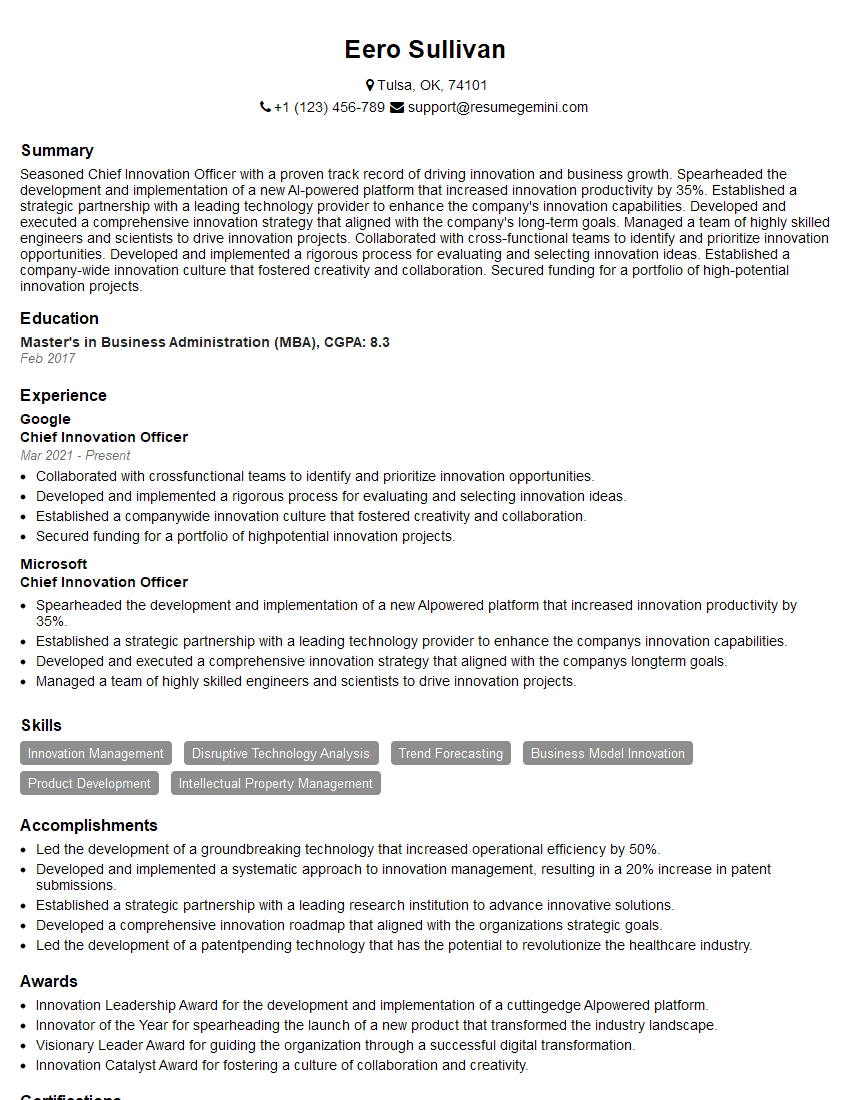
Mastering Trend Innovation is crucial for career advancement in today’s dynamic marketplace. A strong understanding of emerging trends and the ability to translate them into innovative solutions is highly valued by employers. To significantly boost your job prospects, creating an ATS-friendly resume is essential. ResumeGemini is a trusted resource that can help you build a professional resume that highlights your skills and experience effectively. Examples of resumes tailored to Trend Innovation are provided to guide you. Invest the time to craft a compelling narrative that showcases your capabilities and ambition – it’s a vital step towards securing your dream role.
Explore more articles
Users Rating of Our Blogs
Share Your Experience
We value your feedback! Please rate our content and share your thoughts (optional).
What Readers Say About Our Blog
Really detailed insights and content, thank you for writing this detailed article.
IT gave me an insight and words to use and be able to think of examples