Feeling uncertain about what to expect in your upcoming interview? We’ve got you covered! This blog highlights the most important Troubleshoot and Repair Refrigeration Equipment interview questions and provides actionable advice to help you stand out as the ideal candidate. Let’s pave the way for your success.
Questions Asked in Troubleshoot and Repair Refrigeration Equipment Interview
Q 1. Explain the refrigeration cycle.
The refrigeration cycle is a thermodynamic process that moves heat from a cold space to a warmer space, thereby cooling the cold space. Think of it like a heat pump in reverse. It’s a continuous loop involving four key components: the compressor, condenser, expansion valve (or capillary tube), and evaporator.
Compressor: This is the heart of the system. It compresses the refrigerant gas, increasing its pressure and temperature.
Condenser: The high-pressure, high-temperature refrigerant gas flows through the condenser, releasing heat to the surrounding environment (usually air or water). This causes the refrigerant to condense into a high-pressure liquid.
Expansion Valve (or Capillary Tube): The high-pressure liquid refrigerant passes through the expansion valve, which drastically reduces its pressure. This causes a significant drop in temperature, turning the liquid into a low-pressure, low-temperature mixture of liquid and vapor.
Evaporator: The low-pressure, low-temperature refrigerant in the evaporator absorbs heat from the space being cooled (e.g., inside a refrigerator). This causes the refrigerant to evaporate, becoming a low-pressure gas, and the cycle starts again.
Imagine boiling water on a stove. The heat from the stove is analogous to the heat being removed from the cooled space. The water vapor is like the refrigerant gas. The refrigeration cycle essentially reverses this process, moving the ‘heat’ from inside the refrigerator to the outside.
Q 2. Describe different types of refrigerants and their properties.
Refrigerants are substances used in refrigeration systems to transfer heat. They have specific properties that make them suitable for this purpose. Different types exist, each with advantages and disadvantages. Some examples include:
R-134a (Tetrafluoroethane): A common refrigerant, relatively environmentally friendly compared to older options like R-12, but still has a Global Warming Potential (GWP).
R-410A (a blend of difluoromethane and pentafluoroethane): A widely used HFC refrigerant, known for its efficiency in air conditioning systems, but also has a GWP.
R-32 (Difluoromethane): A single-component HFC refrigerant with a lower GWP than R-410A, becoming increasingly popular in air conditioners.
Natural Refrigerants: These include ammonia (NH3), carbon dioxide (CO2), propane (R-290), and isobutane (R-600a). They are environmentally friendly with very low or zero ODP (Ozone Depletion Potential) and often better energy efficiency, but may have safety concerns (flammability, toxicity) requiring specialized handling.
The choice of refrigerant depends on factors such as efficiency, safety, environmental impact, and application. Regulations regarding refrigerant use are constantly evolving, pushing the industry towards more environmentally friendly options.
Q 3. How do you troubleshoot a compressor that isn’t running?
A compressor not running is a common problem. Troubleshooting involves a systematic approach:
Check the power supply: Ensure the unit is plugged in, the circuit breaker isn’t tripped, and there are no blown fuses.
Inspect the motor capacitor (if applicable): A faulty capacitor can prevent the motor from starting. Use a capacitor tester to check its capacitance.
Check the compressor overload protector: This safety device will cut power to the compressor if it overheats. Reset the protector (if it’s resettable), but if it keeps tripping, there’s an underlying problem requiring further investigation.
Listen for unusual sounds: A grinding or squealing sound indicates mechanical issues within the compressor, requiring professional repair or replacement.
Check the starting relay (if present): The starting relay helps the compressor motor start. A faulty relay prevents the motor from starting. Test the relay with a multimeter.
Check the high and low pressure switches: If pressures are outside the normal operating range, these switches may shut down the compressor to prevent damage. Check pressure readings.
Verify refrigerant charge: Low refrigerant levels can cause the compressor to stop to prevent damage, and this could be an indicator of leakage in the system. A qualified technician is needed to check the refrigerant level and address any leaks.
If none of these steps solve the problem, you likely need to call a qualified refrigeration technician. Working with refrigeration systems involves working with high pressures and potentially hazardous refrigerants, and safety should always be the top priority.
Q 4. What are the common causes of a refrigeration system leak?
Refrigeration system leaks can be caused by several factors:
Corrosion: Over time, components like copper tubing can corrode, leading to pinhole leaks.
Vibration: Vibrations from the compressor or other components can cause tubing or fittings to loosen or crack, leading to leaks.
Physical damage: Accidental damage during installation, maintenance, or operation can puncture tubing or damage components.
Improper brazing or soldering: Poor workmanship during installation can result in weak joints that leak.
Component failure: Worn seals or gaskets in compressors, expansion valves, or other components can lead to leaks.
Manufacturing defects: Rarely, there might be manufacturing defects in components leading to leaks.
Finding the leak often requires using leak detection tools like electronic leak detectors or dye tracing. Repairing the leak may involve brazing, soldering, or replacing damaged components. Always remember to follow safety precautions when dealing with refrigerants.
Q 5. Explain how to identify and repair a faulty expansion valve.
Identifying a faulty expansion valve can involve checking for several things: insufficient cooling, icing on the evaporator coil, or inconsistent temperature.
To diagnose, first check the system’s pressures. A faulty expansion valve can lead to low suction pressure or high head pressure, depending on the nature of the failure. Then, observe the evaporator coil’s frost pattern. Uneven frosting suggests a problem with the expansion valve’s distribution of refrigerant.
Repairing a faulty expansion valve usually requires replacing it. This is a relatively advanced procedure involving the evacuation and recovery of the refrigerant and precise brazing or joining techniques. A technician must be carefully trained and well-equipped to safely and correctly replace the valve. It’s vital to ensure proper charging of the system with the correct amount and type of refrigerant after the repair.
Q 6. How do you diagnose and fix a high-pressure problem in a refrigeration system?
High pressure in a refrigeration system can be caused by various issues, primarily:
Overcharge of refrigerant: Too much refrigerant leads to higher pressures, and this might also lead to compressor overheating.
Restricted condenser airflow: If the condenser’s fins are dirty or blocked, it reduces the heat transfer efficiency, leading to high discharge pressure.
Faulty condenser fan motor: A malfunctioning fan motor reduces airflow through the condenser, causing a pressure buildup.
Restricted liquid line: Obstructions in the liquid line restrict refrigerant flow to the expansion valve, increasing the pressure on the high side.
Faulty expansion valve: A malfunctioning expansion valve might not adequately reduce the refrigerant pressure, leading to high head pressure.
Troubleshooting involves checking refrigerant charge, condenser cleanliness and airflow, fan motor operation, and liquid line restrictions. Correcting these issues should resolve the high-pressure problem. Always consult pressure-temperature charts for your specific refrigerant to assess if the pressure is truly excessive before proceeding with repairs.
Q 7. How do you diagnose and fix a low-pressure problem in a refrigeration system?
Low pressure in a refrigeration system points towards a few potential culprits:
Low refrigerant charge: This is the most common cause. Leaks in the system result in the loss of refrigerant, leading to low suction pressure.
Restricted suction line: An obstruction in the suction line restricts the flow of refrigerant back to the compressor, causing low suction pressure.
Faulty compressor: A faulty compressor may not effectively pump refrigerant, resulting in low suction pressure.
Faulty expansion valve: Depending on the type of malfunction, an expansion valve can cause low refrigerant flow into the evaporator, leading to low suction pressure.
Troubleshooting involves leak detection (using a leak detector), checking for suction line restrictions, and assessing compressor and expansion valve performance. The refrigerant charge needs to be carefully measured and topped up or the faulty components must be replaced as needed. A vacuum pump should be used to remove air and moisture from the system before recharging the refrigerant.
Q 8. What safety precautions are essential when working with refrigerants?
Working with refrigerants demands strict adherence to safety protocols. Refrigerants, depending on their type, can be toxic, flammable, or both. Exposure can lead to serious health problems, from mild irritation to severe organ damage or even death. Therefore, proper ventilation is paramount. Always work in well-ventilated areas to prevent the buildup of refrigerant vapors.
- Personal Protective Equipment (PPE): Always wear safety glasses, gloves (nitrile or neoprene are suitable), and appropriate respiratory protection, especially when handling refrigerants under pressure or in confined spaces. A full-face respirator might be necessary in certain situations.
- Leak Detection: Use a proper refrigerant leak detector to identify leaks swiftly and accurately. Never rely on your sense of smell, as some refrigerants are odorless.
- Proper Handling and Storage: Refrigerant cylinders must be stored upright and secured to prevent accidental tipping or damage. Always follow manufacturer instructions for handling and storage.
- Emergency Procedures: Be familiar with emergency procedures in case of a refrigerant leak or exposure. This includes knowing how to evacuate the area and contacting emergency services.
- Training and Certification: Always prioritize professional training and certifications before working with refrigerants. This ensures you understand the risks and have the necessary knowledge to handle them safely.
For instance, I once responded to a service call where a technician had improperly handled refrigerant, resulting in a minor leak. Had they followed proper safety procedures, this could have been avoided entirely. The added cost of repairing the damage emphasized the importance of safety compliance.
Q 9. Explain the different types of refrigeration systems (e.g., vapor-compression, absorption).
Refrigeration systems employ various methods to achieve cooling. The two most common are vapor-compression and absorption systems.
- Vapor-Compression Refrigeration: This is the most prevalent type found in household refrigerators and air conditioners. It operates on a thermodynamic cycle involving four main components: a compressor, condenser, expansion valve (or capillary tube), and evaporator. The refrigerant changes phases (liquid to vapor and back) to absorb and reject heat. Think of it like a heat pump that moves heat from a cold place (inside your fridge) to a warm place (outside).
- Absorption Refrigeration: This system uses heat as the primary energy source instead of electricity. A solution, typically water and lithium bromide, is used to absorb and release refrigerant. These systems are often used in applications where electricity is scarce or expensive, such as solar-powered cooling.
Other types include thermoelectric and magnetic refrigeration, but they are less common in everyday applications.
Q 10. Describe the function of a condenser in a refrigeration system.
The condenser’s role is crucial: it rejects the heat absorbed by the refrigerant from the refrigerated space. In the vapor-compression cycle, the high-pressure, high-temperature refrigerant vapor enters the condenser. Here, heat is transferred from the refrigerant to a cooler medium, typically air or water, causing the refrigerant to condense back into a high-pressure liquid.
Think of it as a radiator in a car. Just as the radiator cools down the engine’s coolant, the condenser cools down the refrigerant, preparing it for the next stage of the refrigeration cycle.
Q 11. What is the role of an evaporator in a refrigeration system?
The evaporator is where the magic happens: it absorbs heat from the space being cooled. The high-pressure liquid refrigerant enters the expansion valve, where its pressure and temperature dramatically decrease. This low-pressure, low-temperature refrigerant then flows into the evaporator. Here, it absorbs heat from the surroundings (e.g., inside a refrigerator), causing it to evaporate into a low-pressure vapor. This vapor then cycles back to the compressor.
Imagine it like a sponge soaking up water. The evaporator absorbs the heat from the refrigerated space, much like a sponge absorbs water.
Q 12. How do you test the amperage draw of a compressor?
Measuring compressor amperage is essential for diagnosing problems. Using a clamp-on ammeter is the safest and most accurate way.
- Safety First: Ensure the power to the refrigeration system is disconnected before making any measurements.
- Clamp the Ammeter: Carefully clamp the ammeter around one of the compressor’s power leads, ensuring it’s a good, firm connection.
- Restore Power: Carefully restore the power to the system and observe the ammeter reading. The reading will show the current draw of the compressor in amps.
- Compare to Nameplate: Compare the measured amperage to the nameplate rating of the compressor. A significant difference could indicate a problem with the compressor, motor windings, or other components.
For example, if the nameplate indicates 8 amps and you measure 12 amps, it suggests an issue requiring further investigation. This could be due to a faulty compressor, high head pressure, or low suction pressure.
Q 13. Explain the process of charging a refrigeration system with refrigerant.
Refrigerant charging is a critical step and requires precision. Improper charging can damage the system and render it inefficient. The process usually involves:
- Evacuation: Before adding refrigerant, the system needs to be thoroughly evacuated to remove air and moisture. This is done using a vacuum pump. A deep vacuum (typically below 500 microns) ensures that the system is clean.
- Refrigerant Type and Amount: The specific type and amount of refrigerant are determined by the system’s design and specifications. Always refer to the manufacturer’s guidelines.
- Charging Method: Refrigerant can be charged using various methods, including weight charging (most accurate), subcooling, and superheat methods. Each method requires specialized equipment and knowledge.
- Monitoring: Throughout the charging process, it is essential to monitor pressures and temperatures using gauges connected to the system. This helps ensure the refrigerant is being added correctly.
- Leak Check: After charging, conduct a thorough leak check to prevent future issues.
Incorrect charging could lead to reduced cooling capacity, compressor damage, or other problems. For example, overcharging can increase pressure significantly, leading to dangerous situations and system failure.
Q 14. How do you troubleshoot a refrigeration system that is not cooling properly?
Troubleshooting a refrigeration system that’s not cooling properly requires a systematic approach. I start by checking the obvious:
- Check the Power Supply: Ensure the system is properly plugged in and receiving power.
- Inspect for Obstructions: Ensure airflow isn’t blocked around the condenser coils (outside unit). Dust or debris can restrict airflow, leading to overheating.
- Check Temperatures and Pressures: Using gauges, verify suction and discharge pressures are within the manufacturer’s specified range. Also, check the refrigerant temperature at various points in the system for signs of overheating or low refrigerant levels.
- Inspect the Condenser: Look for dirt, debris, or damage that might hinder heat dissipation.
- Inspect the Evaporator: Make sure the evaporator coils are clean and free from ice buildup (which could indicate restricted airflow or low refrigerant charge).
- Check Compressor Operation: Listen for unusual sounds from the compressor (e.g., knocking, squealing), and measure the amperage draw. High amperage suggests a problem.
- Check Expansion Valve or Capillary Tube: Restrictions in these components can hinder refrigerant flow and reduce cooling capacity.
By methodically working through this checklist, the issue can usually be identified. For example, in one case, a faulty compressor capacitor caused a complete failure; only a simple replacement was needed for full operation.
Q 15. What are the common causes of frosting or icing on an evaporator coil?
Frost or ice buildup on an evaporator coil is a common refrigeration problem, usually indicating a malfunction affecting the system’s ability to efficiently remove heat. This often stems from issues with airflow, refrigerant charge, or defrost cycle functionality.
- Insufficient Airflow: A dirty coil restricts airflow, causing the coil temperature to drop below freezing for extended periods, leading to excessive frost. Think of it like trying to cool a room with a blocked vent – the air can’t circulate properly. This is often due to dust, debris, or even a blocked air return.
- Low Refrigerant Charge: Insufficient refrigerant means less heat absorption, resulting in lower evaporator temperatures and subsequent frosting. Imagine your refrigerator’s coolant as the blood in your body – a shortage will affect how effectively it does its job. The evaporator struggles to absorb heat from the surrounding air, so it freezes instead.
- Defrost Cycle Malfunction: The defrost cycle (in refrigerators with automatic defrost) is crucial for melting frost buildup. A faulty defrost timer, heater, thermostat, or drain system prevents proper melting, leading to excessive frost. This is like a clogged drainpipe – the melting ice has no place to go, so it builds up.
- Faulty Airflow Switch: In some systems, an airflow switch ensures the compressor runs only when proper airflow is present. If this switch is faulty, the compressor may run even with blocked airflow, leading to icing.
Troubleshooting involves checking airflow, refrigerant levels (using pressure gauges), and testing the defrost components (timer, heater, thermostat, drain). Cleaning the coil is often the first step, followed by checking electrical continuity of defrost components and finally checking the refrigerant charge.
Career Expert Tips:
- Ace those interviews! Prepare effectively by reviewing the Top 50 Most Common Interview Questions on ResumeGemini.
- Navigate your job search with confidence! Explore a wide range of Career Tips on ResumeGemini. Learn about common challenges and recommendations to overcome them.
- Craft the perfect resume! Master the Art of Resume Writing with ResumeGemini’s guide. Showcase your unique qualifications and achievements effectively.
- Don’t miss out on holiday savings! Build your dream resume with ResumeGemini’s ATS optimized templates.
Q 16. How do you identify and repair a faulty condenser fan motor?
A faulty condenser fan motor hinders heat dissipation from the condenser, leading to high head pressure, reduced efficiency, and potential compressor damage. Identifying a faulty motor involves visual inspection, checking for continuity, and measuring voltage and current.
- Visual Inspection: Look for obvious signs of damage like burnt wires, loose connections, or seized bearings. A simple visual inspection often reveals obvious problems like broken blades or damaged wiring.
- Continuity Test: Use a multimeter to check for continuity in the motor windings. A lack of continuity indicates an open circuit, pointing to a motor failure. This is where electrical safety is crucial, ensure the power is disconnected before checking.
- Voltage and Current Measurement: With the motor running, measure the voltage applied to the motor and the current drawn. Significant deviations from the manufacturer’s specifications indicate a problem, likely within the motor windings.
Repair typically involves replacing the faulty motor. Ensure the replacement motor matches the original in terms of voltage, amperage, and RPM. Proper installation and electrical connections are paramount to prevent further damage. After replacement, always double-check the connections to prevent future failures due to loose wiring and ensure the fan rotates freely.
Q 17. Describe different types of refrigeration controls and their functions.
Refrigeration controls regulate various aspects of the system, ensuring efficient and safe operation. They range from simple mechanical devices to sophisticated electronic controllers.
- Thermostats: These sense the temperature and control the compressor’s on/off cycle. Think of them as the system’s ‘brain’ controlling the temperature. They can be mechanical or electronic, with electronic offering more precision.
- Pressure Switches: They monitor the high- and low-side pressures and prevent the compressor from running under unsafe conditions (like high pressure or low suction pressure). They are like the ‘safety valves’ preventing overpressure or damage to the compressor due to insufficient refrigerant.
- Solenoid Valves: Electrically controlled valves that regulate the refrigerant flow. They are like the ‘gates’ controlling the flow of the refrigerant into the evaporator and condenser.
- Defrost Controls: These timers and thermostats control the defrost cycle in refrigerators and freezers with automatic defrost. These control the heating element that melts the frost on the evaporator coil.
- Electronic Controllers: Modern systems often use microprocessor-based controllers that monitor and control various parameters, providing diagnostics and advanced features.
The selection of controls depends on the system’s size, complexity, and desired features. Understanding their functions is crucial for troubleshooting and maintaining optimal performance.
Q 18. Explain the principles of heat transfer in refrigeration.
Refrigeration relies on the principles of heat transfer: absorption, rejection, and the phase change of refrigerant. The system moves heat from a cold space (the freezer compartment) to a warmer space (the room), thereby cooling the cold space.
- Heat Absorption (Evaporation): The refrigerant absorbs heat from the evaporator coil, changing from a low-temperature, low-pressure liquid to a low-temperature, low-pressure gas. This is like sweating; as sweat evaporates, it cools your skin.
- Heat Rejection (Condensation): The refrigerant releases heat to the surroundings at the condenser coil, changing from a high-temperature, high-pressure gas to a high-temperature, high-pressure liquid. This is the reverse of the evaporation process.
- Phase Change: The refrigerant undergoes a phase change (liquid to gas and gas to liquid) during the refrigeration cycle. This phase change is crucial for efficient heat transfer. The change between gas and liquid is what enables the cooling process.
Understanding these principles is essential for diagnosing problems. For instance, if the condenser isn’t rejecting heat effectively (due to a faulty fan or dirty coils), the system will struggle to cool.
Q 19. How do you interpret a refrigeration system pressure chart?
A refrigeration system pressure chart shows the relationship between the refrigerant pressure and temperature. By knowing the ambient temperature and reading the system’s high- and low-side pressures using gauges, technicians can ascertain the refrigerant charge and identify potential problems.
Interpretation: A typical chart will show pressure-temperature curves for the specific refrigerant used. By comparing the measured pressures to the chart’s values at the ambient temperature, you can determine if the refrigerant charge is adequate. Low pressures might indicate a refrigerant leak, while high pressures could signify a blockage or overcharge.
- Low-Side Pressure: Indicates the pressure in the evaporator, suction line. Too low might signify low charge, leaks, or restrictions in the low side.
- High-Side Pressure: Indicates the pressure in the condenser, discharge line. Too high might indicate a blockage in the condenser, insufficient airflow over the condenser, or a restriction in the high-side.
The chart is a critical diagnostic tool, helping pinpoint issues like refrigerant leaks, blockages, or compressor problems. It’s vital for understanding the system’s state and diagnosing potential issues. Always compare the read pressures to the manufacturer’s specified range for the particular refrigerant and application.
Q 20. What are the common causes of compressor failure?
Compressor failure is a serious issue in refrigeration systems, often resulting in complete system shutdown. Several factors contribute to compressor failure:
- Liquid Slugging: The compressor ingesting liquid refrigerant instead of vapor can cause severe damage. Imagine trying to run an engine on water instead of gasoline – the results are catastrophic.
- Overheating: Insufficient airflow, high head pressure, or dirty condenser coils lead to overheating, damaging the compressor motor windings. The analogy here is a car’s engine – when it’s not cooled effectively, it may overheat and suffer severe damage.
- Electrical Issues: Voltage surges, faulty wiring, or a short circuit can damage the compressor’s motor windings.
- Lack of Lubrication: Insufficient oil can lead to internal friction and component wear, causing eventual compressor failure.
- Wear and Tear: Normal wear and tear over time eventually leads to compressor failure, particularly after many years of consistent operation.
Preventive maintenance, including regular inspections, cleaning, and oil checks, can extend compressor lifespan and reduce the risk of premature failure. Always consult manufacturer guidelines and follow safety procedures when dealing with refrigeration equipment.
Q 21. Describe the procedure for evacuating a refrigeration system.
Evacuating a refrigeration system removes air, moisture, and non-condensables from the system before charging it with refrigerant. This process is crucial for optimal system performance and preventing corrosion and reduced efficiency.
The procedure typically involves these steps:
- Isolate the System: Close all valves to isolate the system from external sources.
- Connect Vacuum Pump: Connect a properly sized vacuum pump to the system’s service port using appropriate connections and hoses. This ensures air is properly removed and prevents contamination.
- Evacuation: Start the vacuum pump and monitor the vacuum gauge. The system should be evacuated to a deep vacuum (typically below 500 microns) to ensure effective removal of contaminants.
- Hold Vacuum: After reaching the desired vacuum, hold it for a specified time (usually 30-60 minutes) to ensure all trapped air and moisture has time to evaporate.
- Charge the System: Once the hold time is complete, carefully charge the system with the correct amount and type of refrigerant as indicated by the equipment specifications.
Proper evacuation is crucial. Failure to do so can lead to reduced efficiency, compressor damage, and premature system failure. This step ensures the system is pure, with no contamination, leading to optimal performance and longevity of the system.
Q 22. How do you properly braze copper tubing in a refrigeration system?
Brazing copper tubing is a crucial skill in refrigeration, requiring precision and safety. It involves joining two copper pipes using a filler metal (brazing rod) with a higher melting point than the base metal. The process relies on capillary action to draw the molten filler metal into the joint.
Here’s a step-by-step process:
- Preparation: Clean the tubing ends thoroughly using a wire brush, sandpaper, or specialized tubing cleaner to remove any dirt, oil, or oxides. A clean surface is paramount for a strong braze.
- Flux Application: Apply a refrigeration-grade flux to the cleaned surfaces. Flux cleans and protects the copper from oxidation during heating, ensuring a good braze.
- Joint Fitting: Carefully fit the tubing ends together, ensuring proper alignment and a consistent gap. Avoid excessive gaps, which can lead to weak joints. For larger diameter tubing, use a brazing fitting.
- Heating: Use an oxy-acetylene or propane torch to heat the joint evenly. Avoid overheating, as this can damage the tubing or weaken the braze. The goal is to heat the tubing, not the filler metal directly.
- Filler Metal Application: Once the tubing is sufficiently heated (the flux will become active and shiny), feed the brazing rod into the joint. Capillary action will draw the molten filler metal into the gap.
- Cooling: Allow the joint to cool naturally. Avoid quenching the joint with water, as this can cause stress and cracking. A properly brazed joint should be smooth and free of voids.
- Inspection: After cooling, inspect the joint carefully for any defects. Check for leaks using soap and water. Repair as necessary.
Example: In one instance, I was repairing a walk-in cooler with a leaky braze joint. Following this procedure, I ensured a strong, leak-free repair, avoiding costly downtime for the client.
Q 23. What are the different types of refrigerant leaks and how are they detected?
Refrigerant leaks can be categorized in several ways. They can be small, slow leaks that are hard to detect, or large, obvious leaks. Their location also varies, occurring at joints, valves, or even through tiny pinholes in the tubing. Detection methods vary depending on the severity and location of the leak.
- Visual Inspection: Often the simplest method, especially for large leaks. Look for signs of oil or refrigerant residue.
- Electronic Leak Detectors: These devices use sensors to detect refrigerant vapor. They are essential for finding small leaks that might be invisible to the naked eye.
- Ultrasonic Leak Detectors: These detect the high-frequency sound waves produced by escaping refrigerant, particularly useful in noisy environments. These are especially good for finding very small leaks.
- Dye Injection: Adding UV dye to the refrigerant allows for detection of leaks with a UV light. The dye makes even small leaks easy to find.
- Pressure Testing: This involves pressurizing the system with nitrogen or another inert gas to locate leaks. This is especially useful in large, complex systems.
Example: In a recent case, a walk-in freezer was experiencing a slow refrigerant leak. A visual inspection yielded nothing. However, using an electronic leak detector, we pinpointed a tiny crack in a valve, which we then repaired.
Q 24. Explain the importance of proper refrigerant recovery and recycling.
Proper refrigerant recovery and recycling are essential for environmental and legal reasons. Refrigerants are potent greenhouse gases, and their release into the atmosphere contributes to climate change. Recycling also extends the lifespan of refrigerants, saving money and resources. The process ensures refrigerants are handled responsibly and safely.
Refrigerant recovery involves removing the refrigerant from the system and storing it in a recovery cylinder. Recycling takes the recovered refrigerant and cleans it to original specifications for reuse. The importance includes:
- Environmental Protection: Minimizes the release of harmful greenhouse gases into the atmosphere.
- Legal Compliance: Adherence to local, national, and international regulations on refrigerant handling.
- Cost Savings: Recycled refrigerant is significantly cheaper than new refrigerant.
- Resource Conservation: Extends the lifespan of refrigerants, reducing the need for new production.
Example: I always ensure I use certified recovery and recycling equipment for all refrigeration work, following all EPA regulations and best practices. This protects the environment and ensures my clients comply with all the legal requirements.
Q 25. How do you troubleshoot a refrigeration system with a noisy compressor?
A noisy compressor indicates a problem requiring immediate attention. The noise could be due to several factors. The first step is to pinpoint the type of noise – a rattling sound, a grinding sound, a high-pitched squeal, etc. This helps narrow down the possible causes.
- Insufficient Lubrication: Lack of oil can cause friction and wear, leading to knocking or rattling sounds. Check the oil level and consider an oil change if necessary.
- Worn Bearings: Worn or damaged bearings create grinding, rumbling, or clicking sounds. This often requires compressor replacement.
- Internal Mechanical Issues: Bent connecting rods or other internal damage can result in various knocking or banging noises. This generally requires replacement.
- Loose Mounting Bolts: The compressor may be vibrating excessively due to loose mounting bolts, causing rattling. Tighten the bolts to resolve this.
- Electrical Issues: Problems with the motor windings or capacitor can lead to unusual humming or buzzing sounds. Check the motor and capacitor.
Troubleshooting steps:
- Listen carefully: Identify the type and location of the noise.
- Inspect the compressor: Check for loose bolts, visible damage, or leaks.
- Check the oil level: Ensure sufficient lubrication.
- Measure the amperage draw: High amperage draw can indicate mechanical problems.
- Consult manufacturer’s specifications: For detailed troubleshooting guides and parts information.
Example: I once dealt with a refrigeration system where a loud rattling noise indicated a failing bearing within the compressor. Replacement of the compressor resolved the issue and restored proper functionality.
Q 26. Describe the function and troubleshooting of a defrost system.
The defrost system in a refrigeration system is crucial for preventing ice buildup on the evaporator coil. Ice buildup reduces cooling efficiency and can eventually lead to system failure. The system typically employs either a hot gas defrost or an electric defrost method.
Hot Gas Defrost: Hot refrigerant gas is directed across the evaporator coil to melt the frost.
Electric Defrost: Electric heating elements are mounted on or near the evaporator coil, providing heat to melt the frost.
Troubleshooting:
- No Defrost Cycle: Check the defrost timer, thermostat, and heater elements for proper operation. Examine wiring and connections for issues. A faulty defrost control board is a common cause.
- Insufficient Defrosting: Check the duration of the defrost cycle. Inspect the heating elements and ensure they are producing enough heat. Blocked drain lines can also prevent proper defrosting.
- Excessive Defrosting: This might indicate a faulty thermostat or defrost timer. An issue with the defrost termination switch can prevent the cycle from ending.
Example: A walk-in freezer failed to defrost properly. By checking the defrost timer and verifying the heating element, we found a burnt-out element, which we replaced. The system immediately returned to normal operation.
Q 27. What are the common causes of a refrigeration system overheating?
Refrigeration system overheating can stem from various issues, all impacting the system’s ability to dissipate heat effectively. Common causes include:
- Insufficient Refrigerant: Low refrigerant levels prevent proper heat absorption and transfer, leading to overheating. Check for leaks and recharge accordingly.
- Dirty Condenser Coil: Dust and debris on the condenser coil impede heat dissipation, causing the system to overheat. Clean the coils regularly.
- Clogged Condenser Fins: Bent or damaged fins restrict airflow, reducing heat transfer efficiency. Repair or replace damaged fins.
- Faulty Compressor: A malfunctioning compressor struggles to maintain sufficient cooling, leading to overheating. Diagnose compressor performance.
- Blocked Airflow: Obstructions around the condenser unit, like furniture or boxes, reduce airflow and increase the temperature.
- Ambient Temperature: Excessively high ambient temperatures reduce the condenser’s ability to reject heat. Ensure proper ventilation of the area.
Example: A reach-in cooler was constantly overheating. Cleaning the condenser coils and ensuring sufficient airflow significantly improved its performance, effectively resolving the overheating issue.
Q 28. What is your experience with different types of refrigeration equipment (e.g., walk-in coolers, ice machines)?
Throughout my career, I’ve worked extensively with various refrigeration equipment types, ranging from smaller units to large commercial systems. My experience spans:
- Walk-in Coolers and Freezers: I’ve serviced and repaired numerous walk-in units, troubleshooting issues such as refrigerant leaks, compressor failures, and defrost system malfunctions. I am familiar with different types of doors, insulation, and refrigeration systems used in these units.
- Reach-in Refrigerators and Freezers: These units require similar troubleshooting and repair skills as walk-in units, with a focus on smaller components and internal issues.
- Ice Machines: I have experience diagnosing issues with ice production, water supply, and ice quality. Common problems include water leaks, compressor failures, and ice bin malfunctions.
- Display Cases: I’ve worked with refrigerated display cases of various sizes, focusing on maintaining proper temperature and appearance. This often involves dealing with issues related to lighting, glass defrosting, and compressor issues.
- Commercial Refrigeration Systems: I’ve worked with larger, more complex commercial systems, including those used in supermarkets and restaurants. This often involves ammonia refrigeration systems, which require specialized knowledge and safety precautions.
Example: In one project, I oversaw the complete overhaul of a supermarket’s refrigeration system, replacing compressors and components while ensuring minimal disruption to the store’s operation. This demanded a strong understanding of different unit types and operational requirements.
Key Topics to Learn for Troubleshoot and Repair Refrigeration Equipment Interview
- Refrigerant Systems: Understanding various refrigerant types (R-22, R-410A, etc.), their properties, and handling procedures. Practical application: Diagnosing refrigerant leaks and performing charging procedures.
- Compressor Operation and Troubleshooting: Knowing the different compressor types (reciprocating, scroll, screw), their operating principles, and common failure modes. Practical application: Identifying faulty compressors through sound analysis, pressure readings, and electrical testing.
- Electrical Controls and Safety: Understanding wiring diagrams, control circuits, safety devices (e.g., high-pressure switches, overload relays), and proper electrical safety procedures. Practical application: Troubleshooting electrical faults using multimeters and other diagnostic tools.
- Evaporators and Condensers: Understanding the function and design of evaporators and condensers, including common problems like frosting, fouling, and leaks. Practical application: Inspecting and cleaning evaporators and condensers, identifying and repairing leaks.
- Expansion Devices: Understanding the role of expansion devices (capillary tubes, TXV, etc.) in regulating refrigerant flow. Practical application: Diagnosing and replacing faulty expansion devices.
- Troubleshooting Techniques: Mastering systematic troubleshooting methods, using diagnostic tools effectively, and interpreting pressure-temperature charts. Practical application: Using a systematic approach to pinpoint the source of a refrigeration system malfunction.
- Environmental Regulations: Familiarity with EPA regulations regarding refrigerant handling and disposal. Practical application: Adhering to safe and environmentally responsible practices during repairs.
Next Steps
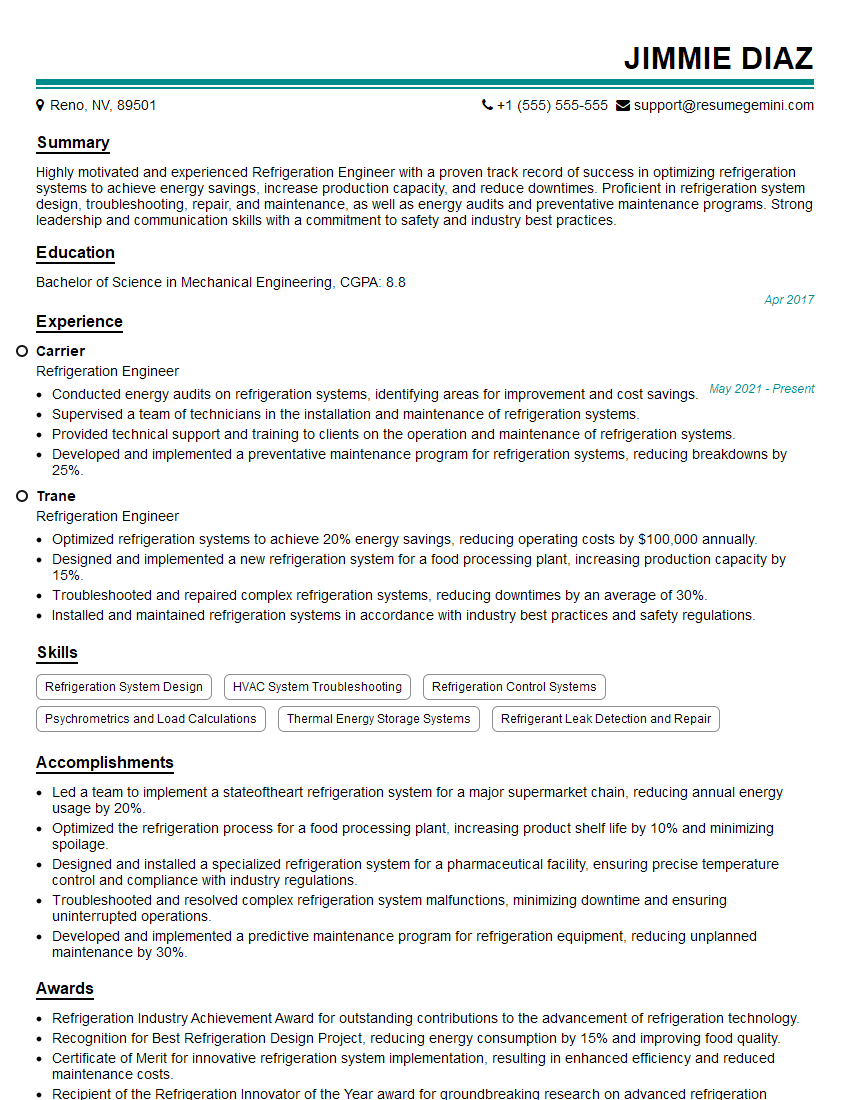
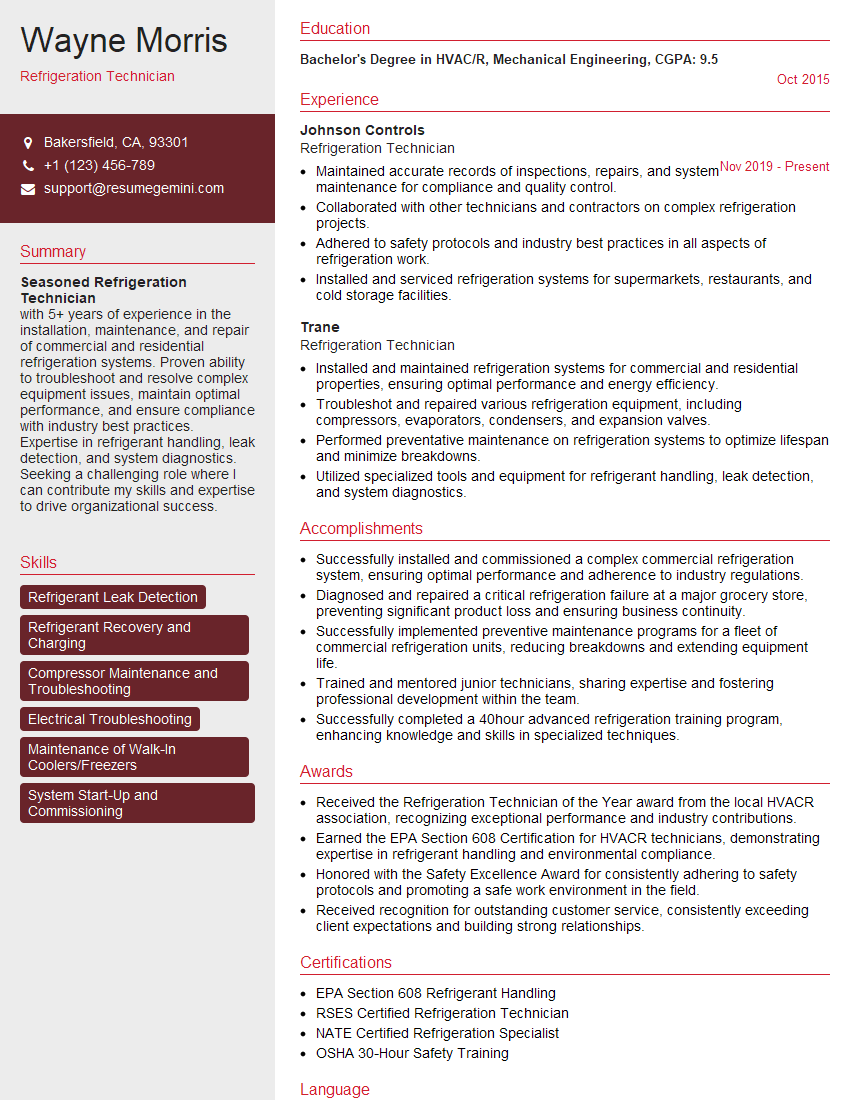
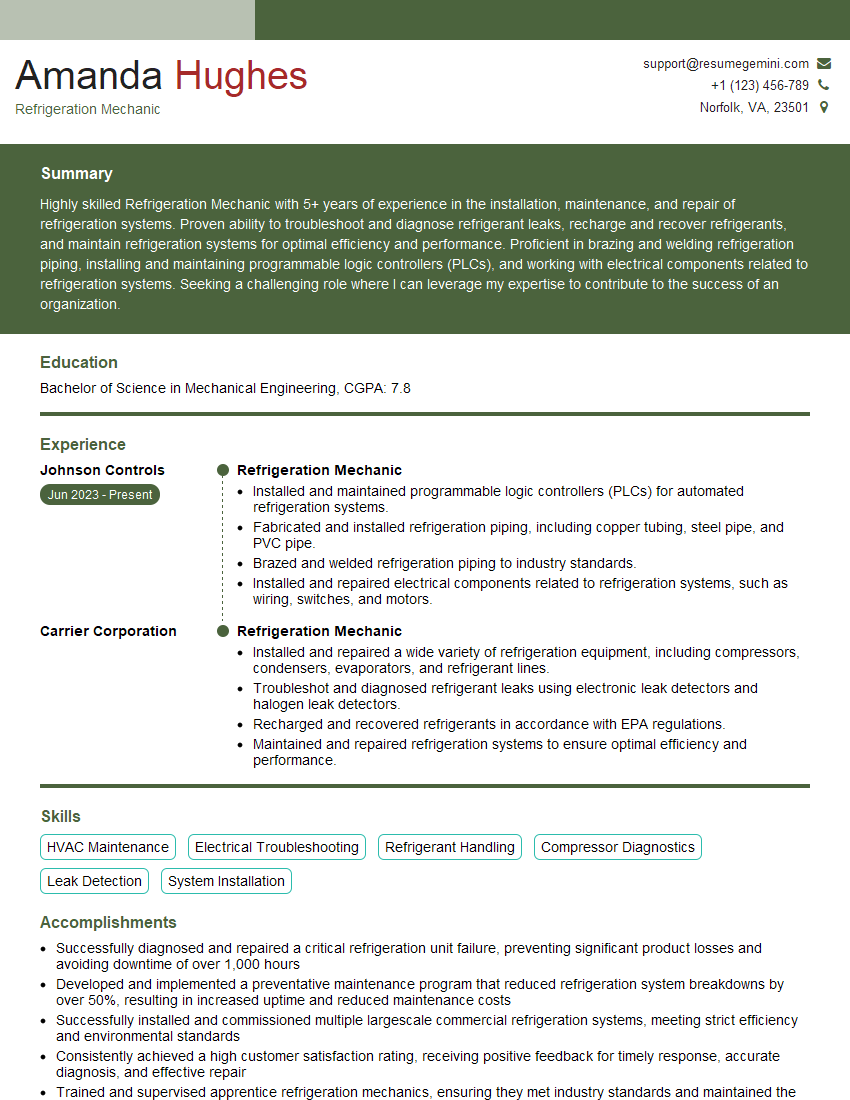
Mastering the art of troubleshooting and repairing refrigeration equipment is crucial for a successful and rewarding career in this field. It opens doors to diverse opportunities, higher earning potential, and professional growth. To significantly boost your job prospects, it’s essential to create a resume that highlights your skills and experience effectively, particularly for Applicant Tracking Systems (ATS). We strongly encourage you to leverage ResumeGemini to build a professional and ATS-friendly resume. ResumeGemini offers valuable tools and resources, including examples of resumes tailored to the Troubleshoot and Repair Refrigeration Equipment field, to help you stand out from the competition and land your dream job.
Explore more articles
Users Rating of Our Blogs
Share Your Experience
We value your feedback! Please rate our content and share your thoughts (optional).
What Readers Say About Our Blog
Really detailed insights and content, thank you for writing this detailed article.
IT gave me an insight and words to use and be able to think of examples