Feeling uncertain about what to expect in your upcoming interview? We’ve got you covered! This blog highlights the most important USDA Tobacco Grading interview questions and provides actionable advice to help you stand out as the ideal candidate. Let’s pave the way for your success.
Questions Asked in USDA Tobacco Grading Interview
Q 1. Describe the different USDA tobacco grades and their characteristics.
USDA tobacco grading categorizes leaves based on several factors, resulting in a complex system. While the specifics vary slightly by type (like flue-cured, Burley, etc.), grades generally reflect leaf quality and value. Think of it like wine grading – a higher grade means superior characteristics.
- Leaf Color: Grades often differentiate by color, ranging from light yellow to dark brown (depending on the type). Lighter colors often command higher prices in some types.
- Body and Texture: This refers to the leaf’s thickness and suppleness. A full body and pliable texture are desirable.
- Length and Width: Larger leaves generally fetch better prices.
- Damage: The presence of holes, tears, or other damage significantly impacts grade.
- Cleanliness: Leaves free from excessive stems or foreign material are better graded.
For instance, in flue-cured tobacco, you might see grades like ‘A,’ ‘B,’ ‘C,’ and lower grades indicating progressively poorer quality. Each grade has a specific range of characteristics defined by the USDA.
Q 2. Explain the significance of leaf color in tobacco grading.
Leaf color is a crucial factor in tobacco grading because it reflects the curing process and the overall maturity of the leaf. Different types of tobacco have different ideal color ranges. For example, in flue-cured tobacco, a bright, golden yellow is highly prized, indicating proper curing and high quality. A darker color might suggest over-curing or other issues. In Burley tobacco, a reddish-brown color is desirable. Think of it like judging the ripeness of a fruit; color is a visual cue to overall quality.
The color assessment is done under standardized lighting conditions to ensure consistency and avoid bias. Color charts and comparators are often used to assist in grading.
Q 3. How do you assess the body and texture of tobacco leaves?
Assessing body and texture involves a combination of visual and tactile examination. The grader carefully handles the leaf, feeling its thickness and flexibility. A leaf with good body will feel firm and substantial, not flimsy or thin. Texture refers to the leaf’s suppleness – a desirable leaf is pliable, not brittle or stiff. This is done through careful handling and experience – it’s something you develop over time.
Imagine comparing different fabrics. A high-quality tobacco leaf will have a similar feel to a fine, supple cloth, while a poor-quality leaf will feel more like a rough, coarse material. This tactile assessment is as crucial as visual inspection.
Q 4. What are the key factors influencing tobacco leaf quality?
Numerous factors influence tobacco leaf quality. These can be broadly categorized into:
- Genetics: The variety of tobacco planted greatly impacts leaf characteristics.
- Climate and Soil: Rainfall, temperature, and soil nutrients profoundly affect growth and leaf quality. Think of terroir in wine – the environment has a big impact.
- Cultural Practices: Proper fertilization, pest control, and harvesting techniques are crucial.
- Curing Methods: The curing process directly impacts color, body, and aroma. Different types of tobacco require specific curing approaches.
- Handling and Storage: Improper handling after harvest can cause damage and reduce quality.
For instance, a drought might lead to smaller, thinner leaves with poor color, while improper curing could result in leaves that are too dark or brittle.
Q 5. Explain the process of determining the grade of a tobacco sample.
Determining the grade of a tobacco sample involves a systematic process. First, a representative sample of leaves is selected. Then, the grader carefully examines each leaf for color, body, texture, length, width, and damage, comparing it against established USDA standards. The grader typically uses standardized lighting and tools such as color charts. A numerical grading system or descriptive terminology is used to classify the tobacco leaves based on the characteristics assessed.
The process is highly subjective, relying on the grader’s experience and judgment. However, adherence to USDA standards helps maintain consistency. Think of it as a skilled artisan evaluating a piece of art – it takes expertise and experience.
Q 6. How do you identify and handle damaged or inferior tobacco leaves?
Damaged or inferior leaves are identified during the grading process. Common damage includes holes, tears, stains, and excessive insect damage. Inferior leaves might be thin, brittle, or have poor color. These are usually separated from the higher-grade leaves. The extent of damage determines whether the leaf is entirely rejected or placed in a lower grade. In some instances, leaves with minor damage might be salvaged for different uses, like stemming or lower-value products.
Proper handling is crucial to minimize further damage and maintain the quality of the remaining leaves. It’s about maximizing the value of the good leaves and minimizing losses from damaged ones.
Q 7. Describe your experience with different tobacco types (e.g., Burley, flue-cured).
My experience encompasses both flue-cured and Burley tobacco, two of the most prominent types in the US. Flue-cured tobacco, known for its bright yellow to orange color, requires precise curing techniques to achieve optimal quality. I’ve worked extensively with this type, grading leaves from various growing regions, each exhibiting unique characteristics based on their terroir. I understand the importance of maintaining consistent bright color, good body, and minimal damage.
Burley tobacco, with its characteristic reddish-brown color, presents a different set of grading challenges. The assessment focuses on the rich color, full body, and aroma. My expertise includes evaluating the leaf’s texture and determining the impact of different curing methods on overall quality. Both types demand a deep understanding of their unique characteristics and growing conditions to accurately grade them.
Q 8. What are the common defects found in tobacco leaves, and how are they graded?
Tobacco leaf defects significantly impact grade and value. These defects can be broadly categorized into those affecting leaf appearance and those affecting leaf composition. Appearance defects include things like holes, stains, and damage from insects or weather. Compositional defects relate to the leaf’s physical characteristics, such as excessive stems, insufficient leaf body, or poor color.
- Holes: These can range from small punctures to large tears, reducing the leaf’s overall value. Grading considers the size, number, and location of the holes.
- Stains: Stains, often caused by fertilizers, chemicals, or fungal growth, reduce quality. The intensity, type, and extent of staining heavily influence grading.
- Insect Damage: Holes, discoloration, or webbing caused by insects are significant defects impacting the leaf’s grade and marketability.
- Stems: Excessive midrib (stem) in the leaf reduces usable leaf area, negatively impacting its grade. Graders assess the stem’s proportion to the leaf’s overall size.
- Color: The color and uniformity of color are crucial. Off-colors, uneven maturity, or excessive greening can lead to lower grades.
Grading is a visual process, and graders use standardized USDA guidelines to assess the severity and extent of these defects, assigning grades from prime quality to low-grade leaf. For instance, a leaf with several large holes might be classified as ‘damaged’, while a leaf with minor blemishes might still receive a relatively high grade. Each defect has a specified point deduction based on its size and impact, culminating in an overall grade.
Q 9. Explain the role of moisture content in tobacco grading.
Moisture content is paramount in tobacco grading for several reasons. It directly impacts the leaf’s handling, processing, and burning qualities. Leaves that are too dry become brittle and easily break, while those that are too wet are prone to molding and fermentation issues.
The USDA standards specify an acceptable moisture range for different types of tobacco. Graders use moisture meters, often electronic, to accurately determine the leaf’s moisture content. This measurement is critical because it influences how the other factors are assessed. A leaf with appropriate moisture content will generally present better color, texture, and burn characteristics, influencing its grade positively. A leaf that’s excessively dry might appear duller and more brittle, even if it would otherwise receive a higher grade, it could be penalized for its dryness. Conversely, a leaf that’s too wet might have issues with mold and fermentation and receive a lower grade.
Q 10. How do you ensure accurate and consistent grading results?
Accurate and consistent grading demands rigorous adherence to USDA standards, meticulous attention to detail, and standardized procedures. Here’s how we ensure this:
- Training and Certification: Graders undergo extensive training to understand USDA standards, learn to identify defects, and develop consistent grading practices. Regular calibration and proficiency tests are essential.
- Standardized Equipment: Using calibrated moisture meters and consistent lighting ensures that measurements are reliable and repeatable. Viewing samples under standardized lighting conditions removes subjective bias relating to ambient light.
- Sample Selection: A representative sample of the tobacco lot is carefully selected to avoid bias. Sufficient samples are reviewed to reflect the true quality of the entire lot. This reduces any error introduced from using only a small portion of the overall batch.
- Double-Checking and Peer Review: To minimize errors, graders often double-check their assessments, and peer review of grades helps identify and correct inconsistencies. Often, an internal review ensures compliance with best practices.
- Record Keeping: Detailed records of grading, including moisture content, defect notes, and final grades, are meticulously maintained for traceability and auditing. Comprehensive record keeping forms an important audit trail that allows for quick problem identification should issues arise.
Q 11. How familiar are you with the USDA Official Standards for Grades of Tobacco?
I am intimately familiar with the USDA Official Standards for Grades of Tobacco. I understand the nuances of the various grades, their definitions, and the criteria used to assign grades for different tobacco types. My expertise covers the different leaf grades and the corresponding quality characteristics, including the various quality factors used to determine the final grade of the tobacco leaves. This includes a detailed knowledge of the point deduction system for various defects and how these deductions influence final grading. My practical experience has reinforced my theoretical knowledge of these standards, allowing me to apply them consistently and accurately.
Q 12. Describe your experience using grading equipment and tools.
My experience with tobacco grading equipment and tools spans various technologies, from traditional hand tools to modern electronic instruments. I’m proficient in using moisture meters to accurately determine leaf moisture content. I’m also experienced in handling and inspecting tobacco leaves, assessing their characteristics by sight and touch, and documenting findings. I’m comfortable using various aids including light sources that meet USDA standards and maintaining cleanliness and calibration across these instruments. I’m adept at using the tools to ensure both consistent and accurate measurement. The systematic use of these tools contributes significantly to the quality and consistency of the grading process.
Q 13. What are the potential consequences of inaccurate tobacco grading?
Inaccurate tobacco grading has significant financial consequences for both producers and buyers. For producers, an incorrect grade may mean they receive less than the fair market value for their crop, impacting their livelihood. Conversely, buyers who receive an inaccurate grade may overpay for inferior tobacco, reducing their profit margins. Moreover, inaccurate grading can undermine trust in the market. In cases where this happens, it may lead to disputes, legal action, or difficulties in future transactions. The industry heavily relies on accurate grading for fair and efficient trade.
Q 14. How do you handle disagreements regarding tobacco grade assessments?
Disagreements regarding tobacco grade assessments are handled through established procedures. First, we review the grading process and the supporting documentation. We double-check the moisture measurements and carefully re-examine the leaf for any potential inconsistencies. If the disagreement persists, a senior grader or a panel of experts is consulted to provide an independent assessment. In some instances, a re-grading of the tobacco sample might be required, following the established procedures. Adherence to the USDA’s guidelines and the established dispute resolution process ensures transparency and fairness in resolving such disagreements. The aim is always to arrive at a fair and accurate assessment that upholds the integrity of the grading system.
Q 15. Describe your experience with record-keeping and documentation in tobacco grading.
Record-keeping in tobacco grading is paramount for traceability, quality control, and legal compliance. It’s not just about noting the grade; it’s about building a complete history of the tobacco from the field to the final sale. My experience involves meticulously documenting every step, starting with the farmer’s identification and the specific lot number. This is followed by detailed entries of the date, time, location of grading, environmental conditions (temperature and humidity), and, most importantly, the grade assigned according to the USDA standards. I use a combination of digital record-keeping systems and physical logbooks for redundancy and backup. For example, a digital database might track the grade, leaf characteristics (color, size, and texture), and any defects detected. Simultaneously, a physical logbook provides a verifiable paper trail. Any discrepancies or unusual observations are always flagged and explained with supporting evidence like photos of damaged leaves.
The precision of this documentation is crucial because it informs pricing, inventory management, and dispute resolution. Should a quality issue arise later in the process, the detailed records enable us to pinpoint the source of the problem and take corrective measures. This proactive approach reduces losses and safeguards the integrity of the entire supply chain.
Career Expert Tips:
- Ace those interviews! Prepare effectively by reviewing the Top 50 Most Common Interview Questions on ResumeGemini.
- Navigate your job search with confidence! Explore a wide range of Career Tips on ResumeGemini. Learn about common challenges and recommendations to overcome them.
- Craft the perfect resume! Master the Art of Resume Writing with ResumeGemini’s guide. Showcase your unique qualifications and achievements effectively.
- Don’t miss out on holiday savings! Build your dream resume with ResumeGemini’s ATS optimized templates.
Q 16. How do you stay current with changes in USDA tobacco grading standards?
Staying updated on changes in USDA tobacco grading standards is an ongoing process. I regularly consult the official USDA publications and websites. These resources provide detailed updates on any modifications to grading criteria, including changes in color classifications, size requirements, or defect tolerances. I also participate in professional development workshops and seminars organized by tobacco industry associations and government agencies. These events provide opportunities to learn from experienced graders and experts and to network with others in the field. Subscribing to relevant industry newsletters and journals keeps me abreast of any changes in regulatory requirements, research findings on tobacco quality, and best practices in the field. Furthermore, I actively engage with colleagues, sharing our experiences and insights to ensure that we’re all on the same page regarding the latest grading standards.
Q 17. Explain your understanding of the impact of environmental factors on tobacco quality.
Environmental factors significantly influence tobacco quality, impacting its grade and ultimately its value. Factors like temperature, rainfall, humidity, and sunlight exposure during the growing season play a crucial role. For instance, excessive rainfall can lead to increased disease incidence, such as black shank or blue mold, resulting in lower-grade tobacco. Conversely, prolonged periods of drought can cause the leaves to be smaller and thinner, affecting their overall quality. High temperatures can lead to premature ripening and affect the color and aroma of the leaves. Similarly, insufficient sunlight can result in pale leaves with a lower sugar content. I meticulously consider these environmental variables when assessing a sample. For example, if a batch shows signs of drought stress – small, thin leaves with a dull color – I’ll adjust my grading accordingly, understanding that these conditions aren’t indicative of poor farming practices but rather of challenging environmental circumstances.
My approach to understanding this impact involves examining the growth history of the tobacco along with the visual assessment. This holistic approach ensures fair and accurate grading.
Q 18. How would you handle a situation where a large batch of tobacco fails to meet grade standards?
If a large batch fails to meet grade standards, a systematic approach is essential. First, I’d thoroughly review the grading process to rule out any errors in assessment. This includes re-examining the samples and checking for consistency in my application of the USDA standards. Then, I would meticulously analyze the detailed records to identify any common thread connecting the failing lots. This might reveal a pattern linked to a particular farm, growing area, or specific environmental conditions. In some cases, the problem might stem from post-harvest handling issues such as improper curing or storage. If the issue is a result of environmental factors outside of the farmer’s control, it may be appropriate to have a conversation with the appropriate parties regarding a fair solution. If the cause is linked to a lack of proper farming practices, I will work with the farmer and provide feedback on improvements. If the issue is isolated and not systemic, separating the substandard leaves for alternative uses (like stemming or lower-grade products) can still salvage a portion of the batch. In other cases, the entire lot may be deemed unfit for the intended market and alternative strategies need to be employed. Thorough documentation throughout the process is crucial for transparency and potential dispute resolution.
Q 19. Describe your proficiency in identifying various tobacco diseases and their impact on grading.
Identifying tobacco diseases is crucial for accurate grading because they significantly affect leaf quality. My proficiency in this area involves recognizing the visual symptoms of various diseases, including common ones such as black shank, blue mold, bacterial wilt, and frogeye leaf spot. For example, black shank manifests as a dark lesion on the stem, leading to wilting and leaf discoloration; while blue mold creates a characteristic fuzzy growth on the leaves, often accompanied by yellowing. These diseases result in significant losses in both yield and quality. Leaves affected by these diseases will score lower on the quality scale because of structural damage, discoloration, and reduced market value. Early detection and proper documentation of disease incidence are important steps towards mitigating losses. I use a combination of visual inspection and sometimes microscopic analysis to ensure correct identification, ensuring accurate grading while also offering useful information to the farmer to improve their practices. My records are comprehensive, noting the type, severity, and extent of the disease, its impact on the grade, and any additional comments concerning potential preventative measures.
Q 20. How do you maintain impartiality and objectivity during the grading process?
Maintaining impartiality and objectivity is the cornerstone of ethical tobacco grading. I adhere strictly to the USDA grading standards, applying them consistently across all samples without bias. This requires a disciplined approach, free from personal preferences or external influences. I ensure that my assessments are solely based on observable characteristics of the tobacco – color, size, texture, and presence of defects – using standardized tools and procedures. To maintain objectivity, I regularly cross-check my grading results with those of other experienced graders, engaging in collaborative discussions to resolve any discrepancies. I also maintain a thorough system of documentation and traceability, making my grading process transparent and verifiable. Furthermore, I avoid any conflicts of interest that might compromise my objectivity, adhering to strict ethical guidelines. My commitment to impartiality is reinforced by continuous professional development and ongoing review of best practices in the field.
Q 21. Explain the importance of proper sample preparation in tobacco grading.
Proper sample preparation is essential for accurate and consistent grading because it ensures that the tobacco being evaluated is representative of the entire lot. This critical step involves selecting a representative sample from the larger batch, taking care to avoid bias toward specific parts of the batch. The sample must be carefully prepared to meet the standards for size, moisture content, and cleanliness to ensure that external factors don’t affect grading results. If leaves are too wet or too dry, their physical properties will be altered. Similarly, the presence of foreign materials can interfere with an accurate assessment. The process involves carefully weighing the sample, following USDA guidelines regarding sample size, and arranging it appropriately for grading, ensuring consistent lighting and viewing conditions. The detailed method of sample preparation is recorded so the process can be audited and is transparent to all parties.
In essence, proper sample preparation is crucial for eliminating inconsistencies and ensuring the reliability of the grading process, directly contributing to fair pricing and quality assurance throughout the supply chain.
Q 22. What is your experience with different tobacco curing methods and their effect on grading?
Tobacco curing methods significantly impact leaf quality and, consequently, the final grade. I’ve worked extensively with air-curing, flue-curing, and sun-curing, each producing distinct characteristics. Air-curing, a slower process, results in a darker, more flavorful leaf often prized for its aroma, leading to higher grades in certain markets. Flue-curing, using heat, produces a lighter, brighter leaf, better suited for certain blends and potentially commanding higher prices depending on the desired profile. Sun-curing, largely dependent on weather conditions, can result in variable quality, affecting grading consistency. For example, a leaf air-cured under optimal conditions might exhibit superior color and aroma, leading to a higher grade compared to a flue-cured leaf processed under suboptimal temperature control resulting in uneven curing. My experience allows me to identify the curing method used by examining leaf characteristics like color, texture, and aroma, ultimately refining the grading process.
Q 23. Describe your understanding of the legal and regulatory aspects of tobacco grading.
The legal and regulatory landscape of tobacco grading is complex and crucial for fair trade. The USDA’s standards are paramount, ensuring consistency and transparency across the industry. My understanding covers aspects like the Agricultural Marketing Act, which underpins these regulations. I am thoroughly familiar with the legal definitions of different grades and the penalties for misrepresentation. I also understand the importance of traceability, ensuring accurate record-keeping to satisfy regulatory requirements and maintain consumer confidence. For example, maintaining detailed records of each batch and adhering strictly to USDA grading standards are not just best practices; they’re legal obligations.
Q 24. How do you communicate grading results to buyers and growers?
Communicating grading results requires clarity, precision, and effective interpersonal skills. I use a multi-pronged approach. For buyers, I provide a detailed report including grade, quantity, and any relevant quality notes. I often include visual aids like photographs for specific characteristics. For growers, I explain the grading results in plain language, focusing on what the grade means for market value and suggesting improvements for future harvests. For example, if a grower’s crop receives a lower grade due to inconsistent curing, I explain why and offer guidance to rectify this in the next season. Open and transparent communication builds trust and fosters productive long-term relationships.
Q 25. Explain your experience with using different grading scales and systems.
My experience encompasses various grading scales and systems, including the USDA’s official standards for different tobacco types (burley, flue-cured, etc.). I’m proficient in using visual aids such as color charts and physical samples to ensure consistent grading. I understand the nuances of each scale, recognizing how subtle variations in leaf characteristics can significantly impact the final grade. For instance, the USDA’s grading system for burley emphasizes factors such as color, body, and aroma, while flue-cured tobacco grading places greater importance on leaf length and elasticity. Adaptability to different scales is critical for effective evaluation.
Q 26. How do you handle the physical demands of tobacco grading (lifting, handling)?
Tobacco grading involves significant physical demands, requiring me to handle and lift numerous leaves and bundles. To mitigate the risk of injury, I employ proper lifting techniques and utilize ergonomic tools when available. Regular breaks and stretching routines are essential to prevent strain and fatigue. Furthermore, I prioritize safe work practices to minimize the risk of accidents. Maintaining physical fitness is critical for sustaining long-term health in this physically demanding role.
Q 27. What are some common challenges faced in USDA tobacco grading, and how do you overcome them?
Challenges in USDA tobacco grading often involve inconsistencies in leaf quality due to weather, curing variations, or disease. Subjectivity in grading certain leaf characteristics also presents a challenge. I overcome these challenges through careful observation, meticulous documentation, and a rigorous adherence to the USDA standards. In cases of borderline grades, I utilize multiple samples and double-check my evaluation. Regular training and calibration sessions are crucial to ensure consistent grading practices among team members. Utilizing technology, like digital image analysis, can also assist in objectivity.
Q 28. Describe a situation where you had to make a difficult grading decision. What was your approach?
I once encountered a batch of burley tobacco with mixed characteristics. Some leaves exhibited superior color and aroma, while others showed signs of damage from insect infestation. The challenge was to assign a fair grade that accurately reflected the overall quality while adhering to USDA guidelines. My approach involved thoroughly inspecting the entire batch, separating affected and unaffected leaves, and documenting the prevalence of the damage. I then applied the USDA standards to each subset and calculated a weighted average, ensuring a fair grade that reflected the actual quality and accurately represented the condition of the batch to the buyer.
Key Topics to Learn for USDA Tobacco Grading Interview
- Tobacco Leaf Grades and Standards: Understanding the USDA’s official grading standards, including color, size, and texture classifications. This includes knowing the nuances between different grades and their market implications.
- Practical Application: Gain hands-on experience by practicing grading samples. This could involve working with images, real samples (if available), or using online grading simulators to develop your skills in visual assessment and accurate classification.
- Grading Procedures and Documentation: Familiarize yourself with the detailed procedures followed during the grading process. This includes proper sample handling, record-keeping, and adhering to USDA regulations and best practices. Understanding the importance of accurate and consistent documentation is crucial.
- Tobacco Types and Characteristics: Develop a comprehensive understanding of the various types of tobacco (e.g., flue-cured, burley, dark air-cured) and their distinct characteristics. This includes knowledge of how these differences affect grading and market value.
- Quality Factors Affecting Grading: Learn to identify factors that impact the quality of tobacco leaves, such as disease, insect damage, and curing methods. This requires a thorough understanding of the agricultural process and its influence on the final product.
- Problem-Solving and Decision-Making: Practice analyzing ambiguous or borderline cases. Develop your ability to justify your grading decisions based on established standards and your expertise.
- Industry Trends and Regulations: Stay updated on current industry trends, market demands, and any recent changes in USDA regulations related to tobacco grading.
Next Steps
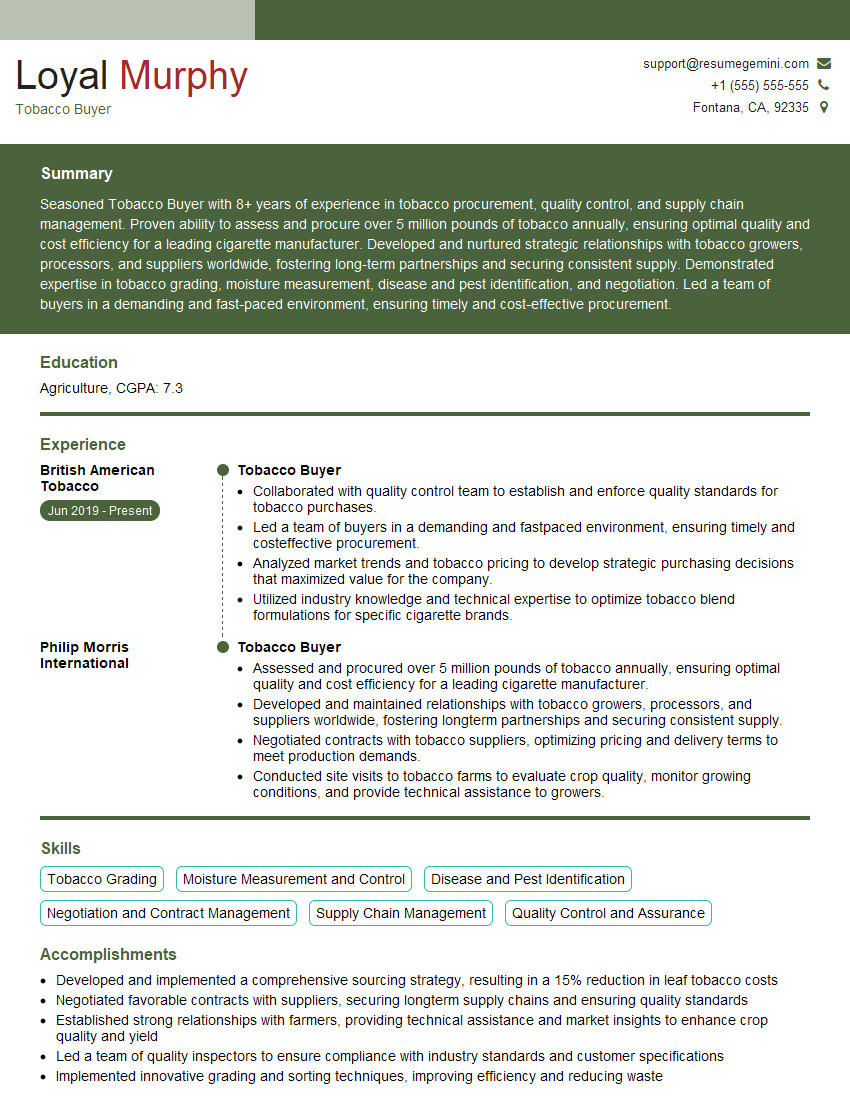
Mastering USDA Tobacco Grading opens doors to a specialized and rewarding career with excellent growth potential within the agricultural industry. To significantly increase your chances of landing your dream role, invest time in creating a strong, ATS-friendly resume that highlights your skills and experience effectively. ResumeGemini is a trusted resource that can help you craft a compelling resume tailored to the specific requirements of USDA Tobacco Grading positions. Examples of resumes tailored to this field are available to guide you through the process.
Explore more articles
Users Rating of Our Blogs
Share Your Experience
We value your feedback! Please rate our content and share your thoughts (optional).
What Readers Say About Our Blog
Really detailed insights and content, thank you for writing this detailed article.
IT gave me an insight and words to use and be able to think of examples