The thought of an interview can be nerve-wracking, but the right preparation can make all the difference. Explore this comprehensive guide to Welding Diagnostics interview questions and gain the confidence you need to showcase your abilities and secure the role.
Questions Asked in Welding Diagnostics Interview
Q 1. Explain the different types of welding defects and their causes.
Welding defects are imperfections that compromise the structural integrity and performance of a weld. They can range from minor cosmetic flaws to critical defects that necessitate repair or rejection of the welded component. These defects arise from various sources during the welding process.
- Porosity: Tiny holes within the weld metal caused by trapped gas during solidification. Think of it like bubbles in a cake – it weakens the structure. Causes include poor joint preparation, insufficient shielding gas, or contaminated base materials.
- Inclusion: Foreign materials like slag (from the welding process) or oxides embedded in the weld. Imagine tiny rocks in concrete – they create stress points. Causes include improper cleaning of the weld joint or insufficient heat input.
- Incomplete Penetration: The weld doesn’t fully fuse the base materials, creating a weak spot. It’s like gluing two pieces of wood together, but not spreading the glue fully. Causes include insufficient weld current, incorrect welding technique, or improper joint design.
- Undercutting: A groove melted into the base material at the edge of the weld. It’s like digging a ditch next to your foundation. Causes include excessive current, incorrect travel speed, or improper electrode angle.
- Cracks: Fractures in the weld metal that appear as lines. They can be caused by rapid cooling, residual stresses, or hydrogen embrittlement. Think of a crack in a glass – it drastically reduces strength. Causes include improper heat input, inappropriate pre/post-weld heat treatment, or the presence of hydrogen.
- Lack of Fusion: Failure of the weld metal to properly fuse with the base metal; similar to incomplete penetration but not necessarily at the root of the joint. This creates a weak boundary.
- Slag Inclusion: A more specific type of inclusion where slag, a byproduct of the welding process, becomes embedded in the weld metal.
Understanding the root cause is crucial for preventing defects in future welds. For example, if porosity is consistently an issue, the welder might need to adjust the shielding gas flow rate or improve joint preparation.
Q 2. Describe the various methods used for detecting welding defects.
Several methods are used to detect welding defects, each with its strengths and limitations. The choice depends on the type of defect anticipated, the material being welded, and the required level of sensitivity.
- Visual Inspection (VI): The simplest method, involving a visual examination of the weld for surface defects. While it’s quick and inexpensive, it only detects surface flaws.
- Radiographic Testing (RT): Uses X-rays or gamma rays to penetrate the weld and reveal internal defects like porosity, cracks, and inclusions. It’s effective for detecting volumetric flaws but can be expensive and requires specialized equipment and trained personnel.
- Ultrasonic Testing (UT): Employs high-frequency sound waves to detect internal flaws. It’s highly sensitive, portable, and can measure flaw size. However, it requires skilled operators and proper surface preparation.
- Magnetic Particle Testing (MT): Utilizes magnetic fields and ferromagnetic particles to detect surface and near-surface cracks in ferromagnetic materials (iron and steel). It’s relatively fast and inexpensive, but it can’t detect internal flaws.
- Liquid Penetrant Testing (PT): Uses a dye that penetrates surface-breaking cracks, followed by a developer that draws the dye out, making cracks visible. It’s excellent for detecting surface cracks, but it won’t find internal defects.
Often, a combination of methods (e.g., visual inspection followed by radiographic testing) is used for a thorough evaluation.
Q 3. What are the advantages and disadvantages of visual inspection in welding diagnostics?
Visual inspection is the most basic and often the first step in welding diagnostics.
- Advantages: It’s simple, fast, inexpensive, and requires minimal equipment. It can detect many surface defects readily visible to the naked eye, such as undercutting, cracks, and excessive spatter.
- Disadvantages: It’s limited to surface defects only; it can’t detect internal flaws such as porosity or lack of fusion. Its effectiveness heavily relies on the inspector’s experience and skill, introducing subjectivity. Lighting conditions and surface cleanliness also significantly impact the reliability of visual inspection.
Imagine trying to find a small crack in a large weld: visual inspection might miss it, especially if the lighting isn’t good. More advanced methods are needed to ensure complete inspection.
Q 4. Explain the principles of radiographic testing (RT) for welding inspections.
Radiographic testing (RT) uses penetrating radiation (X-rays or gamma rays) to create an image of the internal structure of a weld.
The principles are based on the differential absorption of radiation by the material. Denser areas, like the base metal, absorb more radiation, appearing lighter on the radiograph, while less dense areas, like defects (porosity, inclusions, cracks), absorb less radiation and appear darker. A film or digital detector is placed on the opposite side of the weld, capturing the transmitted radiation. The resulting image reveals internal inconsistencies and helps identify defects.
The choice between X-rays and gamma rays depends on several factors including the thickness of the material being inspected. Gamma rays are generally better suited for thicker materials. Analyzing the radiograph requires expertise to correctly identify defects and differentiate between acceptable variations and true flaws.
Q 5. How does ultrasonic testing (UT) work in detecting welding flaws?
Ultrasonic testing (UT) utilizes high-frequency sound waves (typically above the range of human hearing) to detect internal flaws in materials. A transducer emits ultrasonic waves, which propagate through the material. When the waves encounter a discontinuity (like a crack, inclusion, or lack of fusion), they are reflected back to the transducer.
The time it takes for the waves to return and the amplitude of the reflected signal are used to determine the location and size of the defect. Different techniques exist depending on the geometry of the weld and the type of defect suspected. For example, pulse-echo technique is commonly used, where the same transducer sends and receives the signals. The interpretation of UT results requires a skilled operator to distinguish between defects and other reflections.
UT is highly sensitive and can detect small flaws, making it a powerful tool for inspecting welds in various applications.
Q 6. Describe the process of magnetic particle testing (MT) for weld inspection.
Magnetic particle testing (MT) is a non-destructive testing method used to detect surface and near-surface flaws in ferromagnetic materials (those that can be magnetized, such as iron and steel).
The process involves magnetizing the weldment and then applying finely divided ferromagnetic particles (usually iron powder) to its surface. Any flaws present will disrupt the magnetic field, causing the particles to accumulate at the defect, making it visually detectable. The method of magnetization can be either using electromagnetic yokes (for localized inspection) or passing an electric current through the component (for more comprehensive inspection).
MT is effective for detecting surface cracks, but it’s limited by its inability to detect subsurface defects or flaws in non-ferromagnetic materials. The quality of magnetization is critical for successful inspection.
Q 7. What is liquid penetrant testing (PT) and its applications in welding?
Liquid penetrant testing (PT) is a widely used non-destructive testing method for detecting surface-breaking defects in various materials, including welds. It relies on the capillary action of a liquid dye to penetrate any surface cracks or discontinuities.
The process involves several steps: cleaning the surface to remove any contaminants; applying a liquid penetrant that seeps into the defects; removing excess penetrant; applying a developer that draws the penetrant out of the cracks, making them visible; and finally, inspecting the surface for indications of defects. Different penetrants and developers are available, each optimized for specific materials and types of flaws. PT is highly effective for finding surface cracks but cannot detect internal flaws.
Applications in welding include identifying cracks, porosity, and other surface imperfections after welding is complete. It’s a relatively inexpensive and simple method, commonly used as a preliminary inspection or in conjunction with other NDT methods.
Q 8. Explain the importance of weld metallography in diagnostics.
Weld metallography is crucial for diagnosing weld quality because it allows us to visually examine the microstructure of the weld metal and the heat-affected zone (HAZ). Think of it like taking a detailed ‘fingerprint’ of the weld. By preparing and examining a polished and etched cross-section under a microscope, we can identify various microstructural features that reveal critical information about the welding process and the weld’s properties.
For instance, we can detect the presence of undesirable phases, grain size variations, the extent of fusion, and the presence of cracking. These microstructural characteristics are directly related to the weld’s mechanical properties, such as strength, toughness, and ductility. Identifying problems early through metallography can prevent catastrophic failures down the line. A classic example is identifying incomplete fusion, where the weld metal hasn’t properly bonded to the base material – something easily spotted in a metallographic examination but potentially missed by other NDT methods.
Q 9. How do you interpret a weld radiograph?
Interpreting a weld radiograph involves systematically examining the image for any discontinuities or irregularities that indicate defects within the weld. Radiography uses X-rays or gamma rays to penetrate the weld and reveal internal flaws. The image, or radiograph, shows variations in density as different shades of gray. Denser areas appear lighter, while less dense areas appear darker.
The process begins with careful comparison to a known good radiograph. We then look for indications of porosity (small dark spots), inclusions (irregular dark shapes), cracks (thin, dark lines), lack of fusion (dark lines indicating incomplete bonding), and lack of penetration (dark areas showing insufficient weld depth). Each indication’s size, shape, location, and distribution are documented and then evaluated against relevant acceptance standards like ASME Section V or AWS D1.1 to determine whether the weld is acceptable or requires repair. Think of it like examining a medical X-ray – the trained eye picks up subtle differences in shading that indicate a problem.
Q 10. How do you interpret ultrasonic test results?
Ultrasonic testing (UT) uses high-frequency sound waves to detect internal flaws in welds. The interpretation of UT results involves analyzing the signals reflected back from discontinuities. These signals are displayed as waveforms (A-scans) or as images (B-scans, C-scans).
In an A-scan, the time delay and amplitude of the reflected signals reveal the distance and size of a discontinuity. A large, sharp reflection indicates a significant defect, while a small, diffuse reflection might suggest a minor irregularity. In B-scan or C-scan modes, we get a visual representation of the weld’s internal structure, making it easier to identify and characterize the location and size of defects. This requires a sound understanding of the instrument settings and the type of weld being inspected. Understanding the different types of wave modes (longitudinal, shear) used and their interaction with flaws is also critical for accurate interpretation.
For example, a large amplitude reflection with a short delay time might suggest a crack close to the surface, while a smaller reflection with a longer delay might point to a porosity deeper within the weld. Calibration is essential; we must know the velocity of the sound wave within the material to accurately determine the depth of any detected flaws.
Q 11. Describe the different types of weld discontinuities.
Weld discontinuities are imperfections in a weld that may or may not affect its structural integrity. They are categorized broadly into several types:
- Porosity: Small gas pockets within the weld metal. Think of it like tiny bubbles in a cake.
- Inclusions: Foreign material trapped in the weld metal, such as slag or tungsten (from TIG welding).
- Cracks: Breaks or separations in the weld metal, which are generally very serious defects.
- Lack of Fusion: Incomplete bonding between weld metal and base metal, or between weld beads.
- Lack of Penetration: Insufficient weld depth, failing to completely fuse the joint materials.
- Undercuts: Grooves along the weld toe (edge of weld), caused by excessive heat input or improper welding technique.
- Overlaps: Weld metal extending beyond the joint edges.
- Slag inclusions: Remnants of flux or shielding gas within the weld.
The severity of a discontinuity depends on its size, location, type, and orientation relative to the applied stress.
Q 12. What are the acceptance criteria for welding defects according to relevant codes (e.g., ASME, AWS)?
Acceptance criteria for welding defects vary depending on the application, welding code, and the type of weld. Codes like ASME Section IX and AWS D1.1 provide detailed acceptance standards. These standards typically specify allowable defect sizes, types, and locations based on factors such as weld joint design, material type, and the intended service conditions.
For instance, a small amount of porosity might be acceptable in a low-stress application, while the same amount in a critical weld joint would likely be unacceptable. Acceptance criteria often take the form of tables or charts that provide limits on the size and number of allowed defects. These limits are carefully defined to ensure the structural integrity and safety of the weldment. Furthermore, some standards might allow for repair of certain defects within specified limits, rather than total rejection of the weld. The specific acceptance criteria need to be clearly defined and communicated in project documentation prior to commencing any welding activity.
Q 13. Explain the concept of weld penetration and its importance.
Weld penetration refers to the depth of weld fusion into the base metal. It’s essentially how deeply the weld metal has penetrated and fused with the base materials being joined. Adequate penetration is critical for achieving a strong and reliable weld. Insufficient penetration weakens the joint, making it prone to failure under stress.
Imagine trying to glue two pieces of wood together without proper penetration; the bond would be weak and easily broken. Similarly, insufficient weld penetration creates a weak point in the welded joint. Proper penetration ensures complete fusion and a sound metallurgical bond. The required level of penetration is usually specified in the welding procedure specifications (WPS) or engineering drawings and is influenced by factors such as welding process, current, voltage, and the joint design. We assess penetration using various NDT methods such as radiography, ultrasonic testing, and visual inspection after sectioning and preparation. Full penetration is ideal for many applications, providing maximum strength and resistance to failure.
Q 14. How do you measure weld bead geometry?
Measuring weld bead geometry involves determining its various dimensions, including weld width, height (reinforcement), penetration depth, and the shape of the weld bead profile (convex, concave, or flat). This is crucial for evaluating weld quality and ensuring it meets the specifications.
Measurements can be taken directly using tools like calipers and rulers, especially for larger welds. For smaller welds or intricate shapes, optical measurement tools or even digital image analysis systems using cross-sectional images may be employed. Measuring devices are chosen based on accuracy, precision and the size/geometry of the weld. A very common tool for this is a micrometer which delivers precise measurement, while calipers offer versatility.
The measured data is then compared to the pre-defined specifications and acceptance criteria mentioned in the WPS. Deviations in bead geometry can indicate flaws in the welding process, such as incorrect settings, improper technique, or problems with the welding equipment. It also helps in making adjustments to the welding parameters to improve consistency and quality in future welds.
Q 15. What are the common causes of porosity in welds?
Porosity in welds refers to the presence of small, gas-filled holes within the weld metal. Think of it like Swiss cheese – undesirable and compromising to strength. These holes weaken the weld, making it susceptible to failure under stress. Several factors contribute to porosity.
- Trapped Gases: The most common cause is the entrapment of gases like hydrogen, nitrogen, and oxygen within the molten weld pool. These gases may originate from the base metal, the filler metal, or the shielding gas. For example, moisture in the welding environment can lead to hydrogen porosity.
- Poor Shielding: Inadequate shielding gas coverage allows atmospheric gases to contaminate the weld pool. This is particularly relevant in processes like Gas Metal Arc Welding (GMAW) or Gas Tungsten Arc Welding (GTAW), where a proper shielding gas flow is crucial.
- Excessive Moisture: Moisture in the base metal or filler material can decompose during welding, releasing hydrogen gas, which forms pores.
- Improper Cleaning: Surface contaminants like oil, grease, or rust can release gases during welding, creating porosity.
Identifying and preventing porosity involves careful attention to these factors: pre-weld cleaning, proper shielding gas coverage, using dry filler materials and base metals, and controlling welding parameters to minimize gas entrapment.
Career Expert Tips:
- Ace those interviews! Prepare effectively by reviewing the Top 50 Most Common Interview Questions on ResumeGemini.
- Navigate your job search with confidence! Explore a wide range of Career Tips on ResumeGemini. Learn about common challenges and recommendations to overcome them.
- Craft the perfect resume! Master the Art of Resume Writing with ResumeGemini’s guide. Showcase your unique qualifications and achievements effectively.
- Don’t miss out on holiday savings! Build your dream resume with ResumeGemini’s ATS optimized templates.
Q 16. What are the common causes of cracking in welds?
Cracking in welds, another significant defect, is the formation of fissures or breaks within the weld metal or the Heat Affected Zone (HAZ). These cracks dramatically reduce the weld’s strength and can lead to catastrophic failures. The causes of cracking are diverse and often interrelated.
- Hydrogen Cracking: Hydrogen atoms, often present in the weld, diffuse into the weld metal and HAZ, causing cracks, particularly at lower temperatures (this is called ‘delayed cracking’). It’s like tiny, wedge-shaped intruders splitting the weld apart.
- Solidification Cracking: This occurs during the cooling of the weld as the metal solidifies. If the weld metal is too brittle or lacks sufficient ductility, stresses created during cooling can lead to cracking. Think of a rapidly cooling glass – too much stress causes breakage.
- Stress Cracking: Residual stresses generated during welding, coupled with tensile stress from external loading, can cause cracks in the weld or HAZ. This is often seen in welds with high restraint.
- Lack of Fusion: If the weld metal doesn’t fully fuse with the base metal, it creates a weak point, which can lead to cracking under load.
Preventing cracking requires controlling hydrogen levels in the welding process (preheating can help reduce the risk of hydrogen cracking), optimizing the welding procedure to minimize residual stresses, and selecting materials with good weldability characteristics.
Q 17. How do you assess the mechanical properties of a weld?
Assessing the mechanical properties of a weld involves a range of tests designed to evaluate its strength, ductility, and toughness. These tests are vital for ensuring that the weld meets the required specifications for the application.
- Tensile Testing: This determines the ultimate tensile strength (UTS) and yield strength of the weld. A specimen is pulled until it breaks, measuring the force required and the elongation before failure.
- Bend Testing: This evaluates the ductility of the weld by bending a specimen to a specific angle or radius. This helps reveal cracks or other defects that might not be visible otherwise.
- Impact Testing (Charpy or Izod): Impact tests measure the weld’s toughness – its resistance to brittle fracture under impact loading. This is crucial in applications subjected to shocks or vibrations.
- Hardness Testing: This determines the hardness of the weld and HAZ, providing information about the heat treatment and microstructure.
- Fatigue Testing: In applications with cyclical loading, fatigue tests assess the weld’s resistance to failure under repeated stress cycles.
The choice of test depends on the specific requirements of the application and the type of weld. Results are compared to relevant standards and specifications to ensure the weld meets the necessary quality criteria.
Q 18. What is the role of heat input in welding quality?
Heat input in welding refers to the amount of heat energy delivered to the weld per unit length. It plays a crucial role in determining the weld’s microstructure, mechanical properties, and overall quality. Think of it like cooking – too little heat and it won’t cook, too much heat and it burns!
High Heat Input: Leads to a wider, deeper weld bead with a coarser grain structure. This can improve penetration but also reduce tensile strength and ductility due to larger grains. It can increase the size of the HAZ, potentially leading to cracking or embrittlement.
Low Heat Input: Results in a narrower, shallower weld bead with a finer grain structure. It enhances tensile strength and ductility but may lead to insufficient penetration or difficulties in welding thicker materials. It can also increase the risk of solidification cracking.
Optimizing heat input is vital for achieving the desired weld quality. Factors such as welding current, welding speed, and electrode diameter influence heat input, and these must be carefully controlled to achieve the optimal balance of penetration and mechanical properties.
Q 19. Explain the impact of pre and post-weld heat treatments on weld properties.
Pre- and post-weld heat treatments are crucial in controlling the microstructure and thus the mechanical properties of the weld and HAZ. They are like carefully planned temperature adjustments to fine-tune the material’s properties.
Pre-weld Heat Treatment: This treatment typically involves heating the base metal to a specific temperature before welding. This can reduce residual stresses, improve weldability (especially for crack-sensitive materials), and ensure a more uniform heat distribution during welding. For example, preheating is often used to prevent hydrogen cracking.
Post-weld Heat Treatment (PWHT): This treatment, typically involving slow cooling after welding, helps to relieve residual stresses, improve toughness, and enhance the overall microstructure. Stress relieving PWHT can prevent cracking and reduce distortion. Normalizing or tempering PWHTs can refine grain size and improve mechanical properties. The specific parameters (temperature, time, and cooling rate) depend on the material and the application requirements.
Careful selection and execution of pre- and post-weld heat treatments are essential to ensuring the structural integrity and longevity of the welded joint.
Q 20. How do you identify and resolve issues related to incomplete fusion?
Incomplete fusion is a serious weld defect where the weld metal does not fully fuse with the base metal, leaving unfused areas. It creates a weak point, reducing the strength and structural integrity of the weld. It’s like a poorly constructed brick wall – some bricks aren’t properly connected.
Identification: Incomplete fusion is often detected visually using methods like dye penetrant testing (for surface cracks) and radiographic testing (for internal defects). Ultrasonic testing can also help detect internal unfused areas.
Resolution: The best approach is prevention – ensuring proper welding parameters (e.g., sufficient heat input, appropriate welding speed), meticulous joint preparation (ensuring clean, tight fitting joint) and correct welding techniques are crucial. If incomplete fusion occurs, the affected weld must be removed and re-welded, adhering to correct procedures and inspecting the repaired weld to ensure the defect has been fully corrected.
Q 21. Describe your experience with different welding processes and their associated diagnostics.
My experience encompasses a wide range of welding processes, and I’m proficient in the diagnostics associated with each.
- GMAW (Gas Metal Arc Welding): I’ve extensively used GMAW for various applications and possess expertise in diagnosing problems like porosity (often linked to shielding gas issues), spatter (related to welding parameters or gas flow), and lack of fusion (often due to improper travel speed or wire feed speed).
- GTAW (Gas Tungsten Arc Welding): My experience includes GTAW, particularly for high-quality welds requiring precise control. I am adept at diagnosing problems specific to this process, such as tungsten inclusions (from incorrect tungsten handling), incomplete penetration (due to improper current or travel speed), and undercut (resulting from excessive travel speed or incorrect electrode angle).
- SMAW (Shielded Metal Arc Welding): I have significant experience with SMAW and troubleshooting issues like slag inclusions (due to insufficient slag removal), undercut, and excessive spatter.
- Resistance Welding: My background includes resistance welding diagnostics, concentrating on issues such as improper weld strength (due to insufficient current or pressure), electrode wear, and inconsistent welds (related to machine settings).
In each process, I utilize a combination of visual inspection, non-destructive testing methods, and process parameter analysis to identify and resolve weld defects. I am particularly skilled in interpreting radiographic and ultrasonic test results to assess the internal quality of welds. My approach emphasizes preventative measures to minimize defects and ensure consistent, high-quality welds.
Q 22. How do you document and report welding inspection findings?
Documenting welding inspection findings is crucial for maintaining a record of the weld quality and ensuring traceability. My approach involves a multi-step process starting with a thorough visual inspection, followed by the application of appropriate Non-Destructive Testing (NDT) methods if needed. All observations are meticulously recorded using standardized forms or digital reporting systems.
My reports include detailed descriptions of the weld location, type, dimensions, and any identified defects. I use clear, concise language and include high-resolution photographs or videos to document the findings. For each defect, I specify its type (e.g., porosity, cracks, lack of fusion), size (length, width, depth), location, and orientation. A numerical rating system based on relevant welding codes (e.g., AWS D1.1) is utilized to assess the severity of the defects. This ensures consistency and allows for easy comparison across multiple inspections. Finally, I provide recommendations for corrective actions or repairs, if necessary, ensuring they align with applicable codes and standards. I always include my name, date, and credentials on the report to maintain accountability.
For example, when inspecting a pipeline weld, a report would detail the pipe diameter, wall thickness, weld type (e.g., fillet weld), and then describe any discovered imperfections such as slag inclusions, undercuts, or incomplete penetration. These imperfections would be meticulously documented with measurements, locations, and corresponding photographs.
Q 23. How do you ensure the accuracy and reliability of your welding diagnostic results?
Ensuring the accuracy and reliability of my welding diagnostic results relies on a combination of factors. First and foremost, it requires rigorous adherence to established standards and procedures. This includes proper calibration and validation of all NDT equipment according to manufacturer’s instructions and relevant industry standards, such as ISO 9001. Regular equipment maintenance and operator certification/qualification are non-negotiable for maintaining consistent results. Secondly, I always perform multiple inspections using different techniques whenever possible to verify findings. For example, I may use both visual inspection and radiographic testing to assess the same weld. This cross-validation significantly reduces the chance of overlooking potential issues or misinterpreting findings.
Furthermore, I carefully consider the influence of external factors, like environmental conditions, that can impact the inspection process. Proper documentation of these environmental conditions within the report is vital. Finally, I maintain a rigorous system of quality control by regularly reviewing my own work and participating in internal audits. This continuous improvement approach ensures consistent, reliable results that stakeholders can trust.
Q 24. Describe your experience with different NDT techniques.
My experience encompasses a broad range of NDT techniques, including visual inspection (VT), magnetic particle testing (MT), liquid penetrant testing (PT), ultrasonic testing (UT), and radiographic testing (RT). Visual inspection is the fundamental technique, forming the basis for all subsequent assessments. It allows for the identification of readily apparent surface defects like cracks, porosity, or incomplete penetration. MT and PT are excellent for detecting surface and near-surface discontinuities in ferromagnetic and non-ferromagnetic materials, respectively. UT is particularly useful for detecting internal flaws through the use of ultrasonic waves, providing detailed information on flaw depth and size. Finally, RT uses X-rays or gamma rays to create images of the internal structure of the weld, providing an accurate representation of the weld’s internal integrity.
For example, during the inspection of a pressure vessel weld, I might initially use VT to identify any obvious surface defects. Then, I would employ UT to assess the internal integrity of the weld for indications such as lack of fusion or cracks. Finally, RT would be used to confirm the UT findings and to get a detailed visual representation of the weld’s internal structure. The choice of NDT method always depends on the specific application, material, and type of weld.
Q 25. Explain how to interpret weld symbols.
Weld symbols are a standardized way of communicating detailed welding requirements on engineering drawings. They provide concise information about the type of weld, its location, dimensions, and other specifications. Understanding weld symbols is crucial for welders and inspectors alike. A typical weld symbol comprises several parts: the reference line, the arrow, the basic weld symbol, the supplementary symbols, and the dimensions. The arrow indicates the location of the weld relative to the joint. The basic weld symbol identifies the weld type (e.g., fillet weld, groove weld). Supplementary symbols specify additional details such as the type of weld preparation or the type of joint.
For example, a symbol with a triangular basic weld symbol pointing down on the reference line indicates a fillet weld on the bottom side of the joint. A square symbol indicates a square groove weld, while a circular symbol indicates a plug or slot weld. Dimensions such as weld leg size, throat thickness, or weld penetration are placed near the symbol. Detailed understanding of the AWS standard is crucial for effective interpretation of these symbols and ensuring welds meet design requirements.
Understanding weld symbols is like understanding a shorthand language for welders and engineers. It allows for efficient communication of complex information in a clear and concise way. Improper interpretation could lead to mismatched welds and potentially dangerous structural issues.
Q 26. How do you address non-conformances found during welding inspections?
Addressing non-conformances found during welding inspections is a systematic process. The first step involves documenting the findings accurately and completely, as previously described. Next, a thorough assessment of the severity of the non-conformances is conducted, usually according to the relevant welding code standards. This helps determine whether the defect is acceptable or requires repair. If repair is needed, the decision involves collaborative discussion with engineers, welders, and other stakeholders, to determine the most appropriate corrective action. This may include grinding, filling, or even complete weld removal and re-welding. The repair process should adhere to strict quality control measures. After repair, the weld is reinspected to verify that the corrective action has been effective.
For example, if a critical crack is found in a pressure vessel weld, the defective weld section would be removed, and the weld would be entirely re-welded following the same or upgraded welding procedures. Each step of the repair process, including verification steps, should be meticulously documented and approved by authorized personnel.
If the non-conformances are deemed to be within acceptable limits, they are reported as such, and appropriate documentation is maintained. If the non-conformances are deemed unacceptable, a detailed report is provided including suggested corrective actions, along with recommendations to prevent similar issues in the future.
Q 27. What safety precautions do you take during welding diagnostics?
Safety is paramount during welding diagnostics. My safety precautions start with a thorough site assessment before commencing any work to identify potential hazards. This includes assessing the presence of flammable materials, electrical hazards, and confined spaces. I always use appropriate Personal Protective Equipment (PPE), including safety glasses, gloves, hearing protection, and respiratory protection, as needed. When using radiation-based NDT techniques like RT, I strictly adhere to radiation safety protocols, ensuring safe handling and storage of radioactive materials and employing appropriate shielding. I also implement strict lockout/tagout procedures when working near energized equipment. Finally, I make sure to maintain awareness of my surroundings, paying close attention to potential hazards during inspection activities, including falling debris and moving equipment. Working with a buddy system is sometimes preferred, particularly during high-risk inspections.
For example, when performing radiographic testing, I would meticulously plan the testing setup, ensuring sufficient shielding to protect myself and others from radiation exposure. The area would be cordoned off, and authorized personnel only would be allowed access. Proper monitoring of radiation levels is always ensured.
Q 28. Describe your experience with using welding diagnostic software or tools.
I have extensive experience using various welding diagnostic software and tools. This includes software for analyzing UT data, processing RT images, and generating comprehensive inspection reports. I am proficient in using specialized software to analyze ultrasonic signals, identifying and characterizing defects, and measuring their size and location. This software allows for precise quantitative analysis, improving the accuracy and consistency of inspections. I have also used software for creating 3D models of welds from RT data, enhancing the visualization and interpretation of complex weld geometries. In addition, I’m familiar with various data acquisition and analysis tools for MT and PT, including advanced image processing techniques. My experience with these tools has significantly improved the efficiency and accuracy of my work, leading to improved weld quality and safety. I am also proficient in using various handheld devices for data logging and reporting.
For example, I have used UT software to identify and characterize subtle flaws in welds that were undetectable using traditional manual techniques. Using the software’s advanced algorithms, I could precisely quantify these defects and create detailed reports, enabling effective assessment of weld integrity. This software dramatically increased the accuracy and efficiency of our inspection process compared to manual interpretation.
Key Topics to Learn for a Welding Diagnostics Interview
- Welding Processes & Defects: Understanding common welding processes (e.g., MIG, TIG, SMAW) and their associated defects (porosity, cracking, inclusions) is fundamental. Be prepared to discuss the visual identification and root causes of these defects.
- Non-Destructive Testing (NDT) Methods: Mastering NDT techniques like visual inspection, radiography, ultrasonic testing, and liquid penetrant testing is crucial. Focus on understanding the principles, applications, and limitations of each method in identifying weld flaws.
- Weld Metallurgy & Material Science: A strong understanding of the metallurgical changes during welding and how they relate to weld properties (strength, toughness, ductility) is essential. Be ready to discuss the influence of different base metals and filler materials.
- Welding Codes & Standards: Familiarity with relevant welding codes and standards (e.g., AWS D1.1) demonstrates your commitment to safety and quality. Practice interpreting code requirements and their application in real-world scenarios.
- Troubleshooting & Problem-Solving: Develop your ability to systematically troubleshoot welding problems. Practice identifying the source of defects and proposing effective solutions based on your understanding of welding principles and NDT results.
- Data Analysis & Reporting: Many diagnostics roles involve analyzing data from NDT inspections and creating comprehensive reports. Practice summarizing findings clearly and concisely.
Next Steps
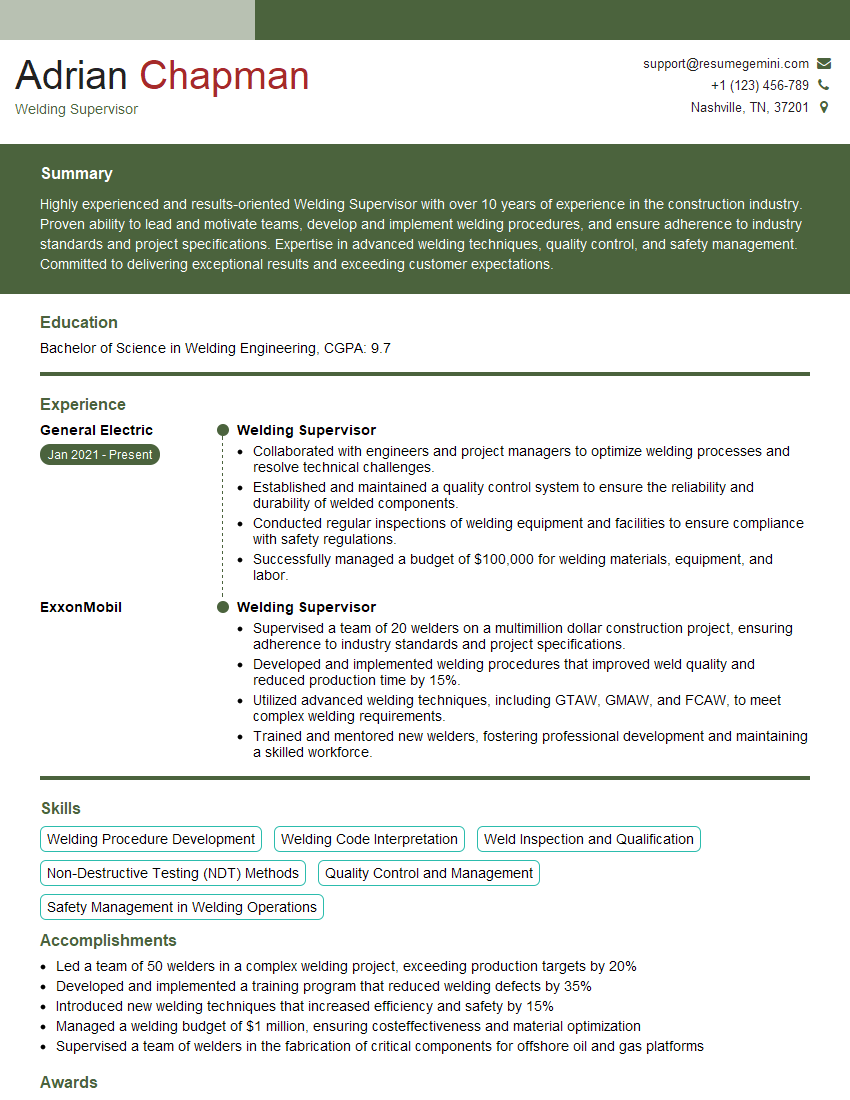
Mastering Welding Diagnostics opens doors to exciting career advancements, leading to higher-paying roles with increased responsibility and opportunities for professional growth. To maximize your job prospects, it’s vital to present your skills effectively. Creating an ATS-friendly resume is crucial for getting noticed by potential employers. We strongly recommend using ResumeGemini to craft a compelling and effective resume that highlights your expertise in Welding Diagnostics. ResumeGemini provides tools and examples specifically tailored to this field to help you stand out from the competition. Examples of resumes tailored to Welding Diagnostics are available for your review.




Explore more articles
Users Rating of Our Blogs
Share Your Experience
We value your feedback! Please rate our content and share your thoughts (optional).
What Readers Say About Our Blog
Really detailed insights and content, thank you for writing this detailed article.
IT gave me an insight and words to use and be able to think of examples