Interviews are more than just a Q&A session—they’re a chance to prove your worth. This blog dives into essential Welding Prevention interview questions and expert tips to help you align your answers with what hiring managers are looking for. Start preparing to shine!
Questions Asked in Welding Prevention Interview
Q 1. What are the most common welding hazards?
Welding, while a crucial process in many industries, presents a multitude of hazards. These can be broadly categorized into:
- Arc Eye: Exposure to intense ultraviolet (UV) and infrared (IR) radiation from the welding arc can cause painful and temporary or permanent damage to the eyes, similar to a severe sunburn. Imagine staring directly at the sun – the effect is comparable.
- Burns: Contact with hot metal, sparks, or the arc itself can result in severe burns. This can range from minor skin irritation to deep tissue damage, requiring medical attention.
- Electric Shock: Working with electricity inherent in many welding processes significantly increases the risk of electric shock, potentially leading to severe injury or fatality. Think of the power running through the welding machine; a simple mistake can be devastating.
- Fumes and Gases: Welding produces fumes and gases containing harmful substances like ozone, carbon monoxide, and metal oxides. Inhaling these can lead to respiratory problems, metal fume fever, or even long-term health issues like lung cancer. It’s like breathing in tiny particles of the metal being welded, each one potentially causing damage.
- Fire and Explosion: Flammable materials near the welding area can easily ignite, leading to fires and explosions. This risk is amplified when working with fuels or in confined spaces.
- Noise: The constant sounds of welding can lead to hearing loss over time if proper hearing protection isn’t used.
Understanding these common hazards is the first step towards effective welding prevention.
Q 2. Describe the different types of welding-related injuries.
Welding-related injuries are diverse, ranging in severity from minor to life-threatening. They can be broadly classified as:
- Eye Injuries: Arc eye, corneal burns, and retinal damage from UV and IR radiation.
- Skin Burns: Flash burns from sparks and spatter, contact burns from hot metal, and radiation burns.
- Respiratory Problems: Metal fume fever (a flu-like illness), bronchitis, lung cancer, and other respiratory illnesses due to fume inhalation.
- Electrical Injuries: Shocks, burns, and even death from electrical contact.
- Musculoskeletal Injuries: Strains, sprains, and other injuries from awkward postures and repetitive movements.
- Burns from Flammable Gases or Liquids: Injuries resulting from fire or explosion in the work environment.
- Hearing Loss: Damage to hearing from prolonged exposure to loud welding noises.
The severity of these injuries is often dependent on factors like the type of welding process, the adequacy of safety precautions, and the individual’s level of preparedness.
Q 3. Explain the importance of pre-weld inspection.
Pre-weld inspection is crucial for preventing accidents and ensuring the quality of the weld. It’s like a thorough pre-flight check for an airplane; it identifies potential issues before they become major problems. A proper inspection involves:
- Checking the materials: Verifying the type, thickness, and condition of the materials to be welded. Are they clean? Are there any defects?
- Assessing the environment: Identifying potential hazards such as flammable materials, obstructions, or unstable ground. Is the area properly ventilated?
- Inspecting the equipment: Ensuring that the welding machine, electrodes, and other equipment are in good working order and properly calibrated. Are all safety mechanisms functioning correctly?
- Verifying safety precautions: Confirming the presence and proper use of personal protective equipment (PPE) and the establishment of appropriate safety barriers.
By addressing potential issues before welding commences, pre-weld inspection significantly reduces the risk of accidents and improves the overall quality and safety of the welding process.
Q 4. What are the key elements of a welding safety program?
A comprehensive welding safety program requires a multi-faceted approach. Key elements include:
- Hazard Identification and Risk Assessment: A systematic process to identify potential hazards and evaluate their risks. This involves reviewing past incidents, observing current practices, and researching potential problems.
- Safety Training and Education: Regular training programs for welders covering safe practices, hazard recognition, and the proper use of PPE. Training must be updated as technology changes.
- Standard Operating Procedures (SOPs): Detailed procedures for various welding tasks, ensuring consistency and adherence to safety guidelines.
- Personal Protective Equipment (PPE): Providing and enforcing the use of appropriate PPE, including welding helmets, gloves, clothing, and respiratory protection.
- Emergency Response Plan: Developing and practicing an emergency response plan to handle accidents and injuries, including first-aid procedures and emergency contact information.
- Regular Inspections and Maintenance: Frequent inspections of welding equipment and the work environment to identify and address potential hazards.
- Record Keeping: Maintaining accurate records of training, inspections, incidents, and corrective actions. This data is crucial for continuous improvement.
Implementing these elements creates a safety-conscious culture and minimizes the potential for accidents.
Q 5. How do you identify and mitigate welding fumes?
Welding fumes are a significant hazard, and their mitigation requires a multi-pronged approach:
- Local Exhaust Ventilation (LEV): Using extraction systems to capture fumes at their source, preventing them from reaching the welder’s breathing zone. Imagine a giant vacuum cleaner sucking the fumes away.
- General Ventilation: Providing adequate ventilation in the welding area to dilute and disperse fumes. This involves opening windows or using fans.
- Respiratory Protection: Providing welders with appropriate respirators, such as air-purifying respirators (APRs) or supplied-air respirators (SARs), to filter out harmful particles and gases.
- Good Housekeeping: Maintaining a clean and organized work environment to minimize the generation and spread of fumes.
- Process Selection: Choosing welding processes that generate less fume, if possible.
- Regular Monitoring: Monitoring air quality in the welding area to ensure that fume levels remain below permissible limits. This might involve air sampling and analysis.
The effectiveness of fume control depends on a combination of these strategies, tailored to the specific welding operation and environment.
Q 6. What are the regulations and standards for welding safety in your area?
Welding safety regulations and standards vary depending on location. However, many jurisdictions adopt or adapt international standards such as those from organizations like OSHA (Occupational Safety and Health Administration) in the US, or equivalent bodies in other countries. These standards cover aspects like:
- Workplace safety regulations: General safety requirements for workplaces, including those involving welding.
- Specific welding safety standards: Standards that address the specific hazards associated with welding, such as those related to electrical safety, respiratory protection, and fire prevention.
- Permit-to-work systems: Procedures for authorizing hazardous work, including hot work such as welding.
- Hazard Communication: Requirements for communicating welding hazards to workers through safety data sheets (SDS) and training.
- Personal Protective Equipment (PPE): Regulations specifying minimum requirements for PPE, including welding helmets, gloves, and clothing.
Staying updated on the relevant regulations in your area is crucial for ensuring compliance and worker safety. It’s best to consult official government resources and professional organizations for the most up-to-date information.
Q 7. Describe your experience with Personal Protective Equipment (PPE) for welding.
My experience with PPE for welding is extensive. I’ve worked with and overseen the selection, use, and maintenance of a wide range of PPE, including:
- Welding Helmets: Selecting helmets with appropriate shade numbers for different welding processes and ensuring they are properly fitted and maintained. A well-maintained helmet is vital for preventing arc eye.
- Welding Gloves: Choosing gloves made from heat-resistant materials like leather or specialized fabrics to protect hands from burns and sparks. Proper glove fit is crucial for dexterity and safety.
- Welding Clothing: Selecting flame-resistant clothing to protect the body from burns and sparks. This often involves FR jackets, pants, and sleeves.
- Respiratory Protection: Supervising the use of respirators, both air-purifying and supplied-air, to protect welders from harmful fumes and gases. Proper respirator fit testing is a crucial part of the process.
- Safety Footwear: Ensuring welders wear steel-toe safety boots to protect their feet from falling objects and potential electric shock.
Beyond selection, I’ve also focused on training welders in the proper use, care, and maintenance of their PPE. Properly fitted and maintained PPE is far more effective than ill-fitting or neglected equipment.
Q 8. Explain the process of conducting a welding risk assessment.
A welding risk assessment is a systematic process to identify hazards associated with welding activities and implement control measures to mitigate risks. It’s crucial for ensuring worker safety and preventing accidents. Think of it like a pre-flight checklist for a welder – making sure everything is in order before starting.
- Identify Hazards: This involves listing all potential hazards, such as arc flash, fire, fumes, ultraviolet radiation, and electrical shock. Consider the specific welding process, materials used, environment, and nearby equipment.
- Assess Risks: For each hazard, assess the likelihood and severity of an incident occurring. This often involves a risk matrix, considering factors like frequency of exposure and potential consequences.
- Implement Controls: Based on the risk assessment, implement control measures to reduce or eliminate hazards. This could include using personal protective equipment (PPE), engineering controls (like ventilation), administrative controls (like training and procedures), and safe work practices.
- Document and Review: The entire process must be documented. This includes the identified hazards, risk levels, implemented controls, and responsibilities. Regular reviews are essential to adapt to changing conditions and technology.
Example: In a confined space welding operation, a risk assessment would highlight the increased risk of fume inhalation and oxygen deficiency. The control measures would include mandatory respiratory protection, proper ventilation, and atmospheric monitoring.
Q 9. How do you ensure proper ventilation during welding operations?
Proper ventilation is paramount in welding to remove hazardous fumes, gases, and particulate matter created during the process. These byproducts can cause serious health issues, including respiratory problems and metal fume fever. We need to think about both general and local exhaust ventilation.
- General Ventilation: This involves ensuring adequate airflow in the workspace to dilute airborne contaminants. This might involve opening windows, using fans, or having a well-ventilated building.
- Local Exhaust Ventilation (LEV): This is a more effective method, focusing on capturing contaminants at their source. LEVs are specifically designed for welding operations, often involving extraction hoods or arms positioned close to the welding arc. These systems draw the fumes directly away from the welder.
Practical Application: In a large workshop, general ventilation might suffice for low-intensity welding. However, for confined space or high-intensity operations, a properly designed and maintained LEV system is crucial. Regular inspection and maintenance of LEV systems is key to their effectiveness.
Q 10. How do you handle emergencies related to welding accidents?
Handling welding emergencies requires a rapid and coordinated response. Preparation is key. We need established procedures, trained personnel, and readily available equipment.
- Immediate Actions: In case of a fire, immediately evacuate the area, call emergency services, and use the appropriate fire extinguisher (see Question 4). For electrical shocks, turn off the power source immediately (lockout/tagout procedures are crucial here). For injuries, provide first aid as necessary and transport to medical care.
- Emergency Response Plan: A well-defined plan includes designated emergency contact numbers, assembly points, evacuation routes, and roles for different personnel. Regular drills are vital to ensure everyone knows what to do in an emergency.
- Post-Incident Investigation: After an accident, a thorough investigation is mandatory to determine the root cause and prevent future occurrences. This involves reviewing the safety procedures, identifying weaknesses, and implementing corrective actions.
Example: If a welder sustains an arc flash, the immediate response would involve turning off the power, providing first aid for burns, and contacting emergency medical services. The subsequent investigation would examine the PPE used, the adequacy of safety precautions, and the welder’s training.
Q 11. What are the different types of fire extinguishers used in welding areas and their applications?
Several types of fire extinguishers are suitable for welding areas, each designed for specific types of fires. Choosing the right extinguisher is vital for effective fire suppression.
- Class A: For ordinary combustibles like wood and paper. Water-based extinguishers are commonly used.
- Class B: For flammable liquids like oil and grease. Carbon dioxide (CO2) or dry chemical extinguishers are suitable.
- Class C: For electrical fires. CO2 or dry chemical extinguishers are preferred due to their non-conductive nature.
- Class D: For combustible metals. Specialized extinguishers are needed for these fires, as common extinguishers can worsen the situation.
Application: In welding areas, a combination of Class B and Class C extinguishers is generally recommended. Dry chemical extinguishers are versatile and effective against both flammable liquids and electrical fires. Remember, training on proper extinguisher usage is paramount.
Q 12. How do you ensure the safe storage and handling of welding gases?
Safe storage and handling of welding gases are crucial to prevent leaks, fires, and explosions. These gases are under high pressure and can be highly flammable or toxic.
- Storage Area: Welding gases should be stored in a well-ventilated, dry area away from ignition sources and incompatible materials. Cylinders must be secured upright to prevent them from falling over.
- Handling: Always use a regulator and appropriate equipment when handling gas cylinders. Never drop or strike cylinders. Always use cylinder trolleys for movement.
- Leak Detection: Regularly inspect cylinders and connections for leaks using soapy water. A hissing sound or bubbling indicates a leak.
- Incompatible Gases: Avoid storing oxidizing gases (like oxygen) near flammable gases (like acetylene). This prevents accidental mixing which can lead to dangerous reactions.
Example: Oxygen cylinders should be stored separately from acetylene cylinders, and both should be secured in a designated storage area away from heat and sunlight. Regular leak checks are essential.
Q 13. What is your experience with lockout/tagout procedures in welding?
Lockout/Tagout (LOTO) procedures are critical for safety when working with welding equipment and machinery. LOTO ensures that energy sources are isolated and prevented from being accidentally reactivated while maintenance or repair is being conducted. This prevents serious injuries and fatalities.
- Procedure: Before any work begins on welding equipment, the power source must be completely de-energized. This involves shutting off breakers, disconnecting plugs, and isolating the power supply. A lockout device (like a padlock) and a tag clearly identifying the worker are then attached to the power source control mechanism to prevent accidental activation.
- Verification: After the lockout/tagout is complete, the equipment needs to be tested to verify that it is indeed de-energized. This might involve using a voltage tester.
- Release: Only the person who applied the lockout/tagout can remove the devices after completing the work and verifying the equipment’s safety.
Practical Application: Before maintenance on a welding machine, a qualified person must follow the LOTO procedure, ensuring the power supply is completely de-energized, locked out, and tagged out. This prevents any accidental restarts, protecting those working on the equipment.
Q 14. Describe your understanding of different welding processes and their associated hazards.
Different welding processes carry different hazards. Understanding these hazards is crucial for implementing appropriate safety measures.
- Shielded Metal Arc Welding (SMAW): This process produces hazardous fumes, spatter, and ultraviolet radiation. Appropriate respiratory protection, eye protection, and clothing are essential.
- Gas Metal Arc Welding (GMAW): Similar hazards to SMAW, but the addition of shielding gas requires attention to gas cylinder handling and ventilation to prevent asphyxiation.
- Gas Tungsten Arc Welding (GTAW): Produces less spatter than other methods, but still requires eye and hand protection against ultraviolet radiation and intense light.
- Oxy-fuel Welding: Involves highly flammable gases, requiring careful handling of cylinders and avoidance of ignition sources. The intense heat necessitates protective clothing and shielding.
Example: Oxy-fuel welding requires extra precautions due to the flammability of the gases. The work area must be clear of combustible materials, and precautions must be taken to prevent gas leaks and ignition.
Q 15. Explain your experience with welding safety training and education.
My welding safety training and education spans over 15 years, encompassing both theoretical knowledge and extensive hands-on experience. I started with foundational courses covering OSHA regulations, hazard identification, and personal protective equipment (PPE) selection. This was followed by specialized training in various welding processes, including SMAW, GMAW, and GTAW, each with its unique safety considerations. I’ve also completed advanced courses focusing on confined space welding, hot work permits, and emergency response procedures. Beyond formal training, I actively participate in industry safety conferences and workshops to stay updated on best practices and emerging technologies. A significant part of my learning has come from practical experience overseeing and participating in numerous welding projects, constantly refining my understanding of risk assessment and mitigation strategies.
Career Expert Tips:
- Ace those interviews! Prepare effectively by reviewing the Top 50 Most Common Interview Questions on ResumeGemini.
- Navigate your job search with confidence! Explore a wide range of Career Tips on ResumeGemini. Learn about common challenges and recommendations to overcome them.
- Craft the perfect resume! Master the Art of Resume Writing with ResumeGemini’s guide. Showcase your unique qualifications and achievements effectively.
- Don’t miss out on holiday savings! Build your dream resume with ResumeGemini’s ATS optimized templates.
Q 16. How do you conduct a post-weld inspection?
A post-weld inspection is crucial to ensure the structural integrity and quality of the weld. My approach is systematic and follows a checklist. First, I visually inspect the weld for surface imperfections like cracks, porosity, undercuts, or overlaps. Then, I use appropriate non-destructive testing (NDT) methods, such as magnetic particle inspection (MPI) or dye penetrant testing (DPT), depending on the weld material and application. These methods help detect subsurface flaws. For critical welds, I might also employ radiographic testing (RT) or ultrasonic testing (UT) for deeper inspection. Documentation is key; I thoroughly record all findings, including photos and measurements, in a detailed report, which highlights any deviations from the welding procedure specification (WPS) and recommends corrective actions if necessary. For instance, if I find a crack, I’d immediately halt further work, investigate the root cause, and possibly re-weld the section following a revised procedure.
Q 17. What are the common causes of welding defects?
Welding defects can stem from various sources. Improper preparation of the base metal is a significant contributor, leading to poor fusion or incomplete penetration. Think of trying to weld two rusty pieces of metal – the rust will act as a barrier and hinder a proper weld. Incorrect welding parameters, such as inappropriate amperage, voltage, or travel speed, can also cause problems like porosity (gas bubbles) or incomplete fusion. Poor operator technique, such as inconsistent weld bead deposition or lack of attention to the heat input, is another common factor. Environmental conditions, including excessive wind or humidity, can affect the weld pool and result in defects. Finally, the quality of welding consumables, such as electrodes or filler wire, plays a vital role. Using damaged or inappropriate consumables can lead to numerous defects.
Q 18. How do you manage and prevent welding-related fatigue?
Welding is physically demanding, and managing welder fatigue is paramount for safety and quality. My approach includes promoting regular breaks, especially during long shifts. This prevents excessive heat exposure and helps maintain focus. I advocate for proper ergonomic design of workspaces to minimize awkward postures and reduce strain. We also use mechanical lifting devices wherever possible to reduce manual handling of heavy materials. Training welders on proper lifting techniques is also crucial. Additionally, I promote a culture of open communication where welders can report fatigue without fear of repercussions. Early identification allows for proactive measures, such as assigning lighter tasks or providing rest periods.
Q 19. What are the signs and symptoms of heat stress in welders?
Heat stress in welders manifests in various ways, ranging from mild discomfort to serious medical emergencies. Early signs include excessive sweating, dizziness, nausea, and headache. As the condition worsens, welders may experience muscle cramps, weakness, and confusion. In severe cases, heat stroke can occur, characterized by high body temperature, rapid pulse, and loss of consciousness. Recognizing these signs is critical. We provide welders with hydration guidelines and encourage them to take frequent breaks in shaded areas. Providing access to cool water and electrolyte drinks is vital, and we use readily available heat index monitoring tools to gauge the risk level.
Q 20. What is your experience with implementing and monitoring welding safety protocols?
Implementing and monitoring welding safety protocols requires a multi-faceted approach. It begins with a thorough risk assessment, identifying potential hazards specific to each project. This assessment informs the development of comprehensive safety procedures, including PPE requirements, confined space entry procedures, and emergency response plans. These procedures are documented and readily available to all welders. I regularly conduct site inspections to ensure adherence to established protocols and identify potential improvement areas. Data tracking plays a critical role; we monitor incident rates, near-miss reports, and the effectiveness of implemented safety measures. Regular safety meetings and training sessions reinforce procedures and keep workers informed of any updates or changes. I also actively participate in safety audits and regulatory inspections.
Q 21. How do you communicate welding safety procedures to workers?
Effective communication is the cornerstone of a strong welding safety program. I utilize a multi-pronged approach. Firstly, I ensure that safety procedures are presented in clear, concise language, avoiding technical jargon as much as possible, and using visual aids like diagrams and videos. Secondly, we conduct regular safety training sessions using a variety of teaching methods—lectures, hands-on demonstrations, and interactive exercises—to cater to different learning styles. Thirdly, we encourage open dialogue and feedback; workers are encouraged to raise safety concerns without hesitation. Finally, we leverage various communication channels, including toolbox talks, posters, and email updates, to reinforce key messages consistently. A real-world example would be a short video demonstrating proper electrode handling techniques, followed by a hands-on practice session and a written test to ensure understanding.
Q 22. Explain your experience in documenting welding safety incidents.
Documenting welding safety incidents is crucial for preventing future occurrences and improving safety protocols. My process involves a detailed, multi-step approach. First, I ensure immediate medical attention is provided if necessary. Then, I secure the scene to prevent further incidents. I meticulously document every detail using photographs, sketches, and written statements from witnesses. This includes the type of welding process, equipment used, PPE worn, environmental conditions, and a step-by-step account leading to the incident. Finally, I analyze the root causes using a systematic approach like a fishbone diagram or 5 Whys, identifying contributing factors such as human error, equipment malfunction, or inadequate safety procedures. This comprehensive documentation serves as a foundation for corrective actions and informs future safety training programs.
For instance, I once investigated an incident where a welder sustained a minor burn due to a faulty welding cable. My report included photos of the damaged cable, welder’s statement, safety checklist review, and recommendations for improved cable inspection procedures and employee training on cable safety.
Q 23. How familiar are you with different welding codes and standards (e.g., AWS D1.1)?
I’m very familiar with various welding codes and standards, including AWS D1.1 (Structural Welding Code—Steel), ASME Section IX (Welding and Brazing Qualifications), and relevant OSHA regulations. AWS D1.1, for example, specifies requirements for welding procedures, welder qualification, and inspection of steel structures. Understanding these codes is essential for ensuring the structural integrity and safety of welded components. I use these standards regularly to review welding procedures, qualify welders, inspect welds, and ensure compliance with project specifications. My experience includes interpreting the codes to address specific project requirements, adapting them when necessary, and providing expert guidance on their application.
For example, I’ve often had to interpret specific requirements within AWS D1.1 regarding preheat temperatures for certain steel grades and thicknesses to ensure weld quality and prevent cracking.
Q 24. What are some common causes of welding arc flash incidents?
Welding arc flash incidents, which are intense bursts of light and heat, are primarily caused by unintentional contact with energized electrical components. Some common causes include:
- Improperly insulated or damaged cables
- Faulty electrical connections
- Lack of proper personal protective equipment (PPE), such as arc flash suits and face shields
- Failure to de-energize circuits before welding near electrical equipment
- Inadequate lockout/tagout procedures
- Improper grounding and bonding techniques
Think of it like this: welding creates a powerful electrical arc. If there’s any fault in the system, this arc can jump to a nearby conductor, causing a dangerous flash. Preventing this requires meticulous attention to electrical safety and adherence to strict procedures.
Q 25. How do you ensure compliance with relevant OSHA regulations for welding?
Ensuring compliance with OSHA regulations for welding requires a multi-faceted approach. This begins with a thorough understanding of the relevant OSHA standards, such as 1910.252 (Welding and Cutting). This involves implementing a comprehensive safety program that addresses:
- Employee training: Regular training on safe welding practices, hazard recognition, and PPE use is crucial. Training should cover specific hazards associated with different welding processes.
- PPE provision and enforcement: Providing and ensuring the proper use of PPE, including welding helmets, gloves, jackets, and footwear, is non-negotiable.
- Ventilation and fire prevention: Adequate ventilation is essential to remove hazardous fumes and gases. Fire prevention measures, such as having fire extinguishers readily available and designated fire watch personnel, are paramount.
- Electrical safety: Implementing lockout/tagout procedures, regular inspections of electrical equipment, and proper grounding and bonding techniques are critical to prevent electrical hazards.
- Housekeeping: Maintaining a clean and organized work area reduces the risk of tripping hazards and fire.
Regular audits and inspections ensure continuous compliance. I’ve successfully implemented and maintained OSHA compliant welding safety programs in several workplaces through proactive training and regular safety meetings.
Q 26. Describe your experience with non-destructive testing (NDT) methods for welding inspections.
My experience with non-destructive testing (NDT) methods for welding inspections is extensive. I’m proficient in various techniques, including:
- Visual inspection (VT): The most basic method, involving visual examination for surface defects.
- Radiographic testing (RT): Using X-rays or gamma rays to detect internal flaws.
- Ultrasonic testing (UT): Utilizing high-frequency sound waves to detect internal and surface defects.
- Magnetic particle testing (MT): Detecting surface and near-surface cracks in ferromagnetic materials.
- Liquid penetrant testing (PT): Detecting surface cracks in non-porous materials.
Each method has its strengths and limitations, and the selection depends on the specific application and type of weld. Interpreting the results requires specialized knowledge and certification. I use these methods to assess the quality of welds, identify potential defects, and ensure the structural integrity of welded components, reducing the risk of failure.
For instance, in a recent project involving a critical pressure vessel, we used a combination of RT and UT to ensure there were no internal flaws that could compromise its integrity.
Q 27. How do you manage and dispose of welding waste materials safely?
Safe management and disposal of welding waste materials are essential for environmental protection and worker safety. My approach involves several key steps:
- Segregation: Different types of welding waste (e.g., slag, metal scraps, used electrodes, cleaning solvents) are segregated according to their composition and hazard class.
- Proper containers: Waste is stored in appropriate containers, clearly labeled with hazard warnings.
- Regular collection: Regular and timely collection of waste prevents accumulation and reduces risks.
- Recycling and disposal: Metal scraps are recycled whenever possible. Other wastes are disposed of through licensed hazardous waste disposal companies, following all applicable environmental regulations.
- Documentation: Detailed records of waste generation, storage, collection, and disposal are maintained for traceability and compliance.
Failing to handle welding waste properly can lead to environmental contamination, fire hazards, and worker exposure to harmful substances. My experience ensures that all procedures are compliant with local, regional, and national regulations.
Q 28. What strategies do you employ to promote a positive safety culture within a welding environment?
Promoting a positive safety culture in a welding environment involves a proactive and multifaceted approach. It starts with leadership commitment to safety as a core value, not just a requirement. Key strategies include:
- Leading by example: Managers and supervisors must consistently demonstrate safe practices.
- Open communication: Creating an environment where employees feel comfortable reporting safety concerns without fear of reprisal is crucial.
- Regular safety training: This shouldn’t be a one-time event but an ongoing process, covering new technologies and reinforcing best practices.
- Incentivizing safe behavior: Recognizing and rewarding safe work practices boosts morale and reinforces positive safety culture.
- Regular safety meetings: These provide opportunities for feedback, discussions of recent incidents, and brainstorming of solutions.
- Safety committees: Employee involvement in safety planning and decision-making is essential.
- Promoting teamwork and accountability: A strong team spirit where everyone looks out for each other promotes a safer environment.
Think of it as building a safety net, layer by layer. Each strategy reinforces the others to create a robust and effective system that prioritizes safety and prevents incidents.
Key Topics to Learn for Welding Prevention Interview
- Welding Safety Regulations and Standards: Understanding OSHA, ANSI, and other relevant codes and regulations is crucial. This includes knowing the specific requirements for personal protective equipment (PPE) and safe work practices.
- Fire Prevention and Control in Welding: Learn about fire hazards associated with welding, including ignition sources, flammable materials, and appropriate fire suppression techniques. Practical application involves knowing how to assess a worksite for fire risks and implement preventative measures.
- Hazard Identification and Risk Assessment: Master the process of identifying potential hazards related to welding (e.g., electrical shock, burns, fumes) and conducting thorough risk assessments to mitigate these risks. This includes understanding different risk control hierarchies.
- Welding Fume Control and Respiratory Protection: Explore the health risks associated with welding fumes and the various methods for controlling exposure, such as local exhaust ventilation (LEV) and appropriate respiratory protection selection and use.
- Electrical Safety in Welding: Understand the electrical hazards associated with welding equipment, including arc flash, and the preventative measures to ensure worker safety. This includes proper grounding techniques and lockout/tagout procedures.
- Emergency Response Procedures: Be prepared to discuss emergency procedures in case of fire, electrical shock, or other welding-related incidents. This involves knowing how to use fire extinguishers, first aid procedures, and emergency contact information.
- Welding Process Specific Hazards: Gain a strong understanding of the specific hazards associated with different welding processes (e.g., GMAW, SMAW, GTAW) and the best practices for preventing accidents related to each process.
- Personal Protective Equipment (PPE): Demonstrate a thorough knowledge of appropriate PPE for welding and its correct use and maintenance. This includes safety glasses, welding helmets, gloves, and protective clothing.
Next Steps
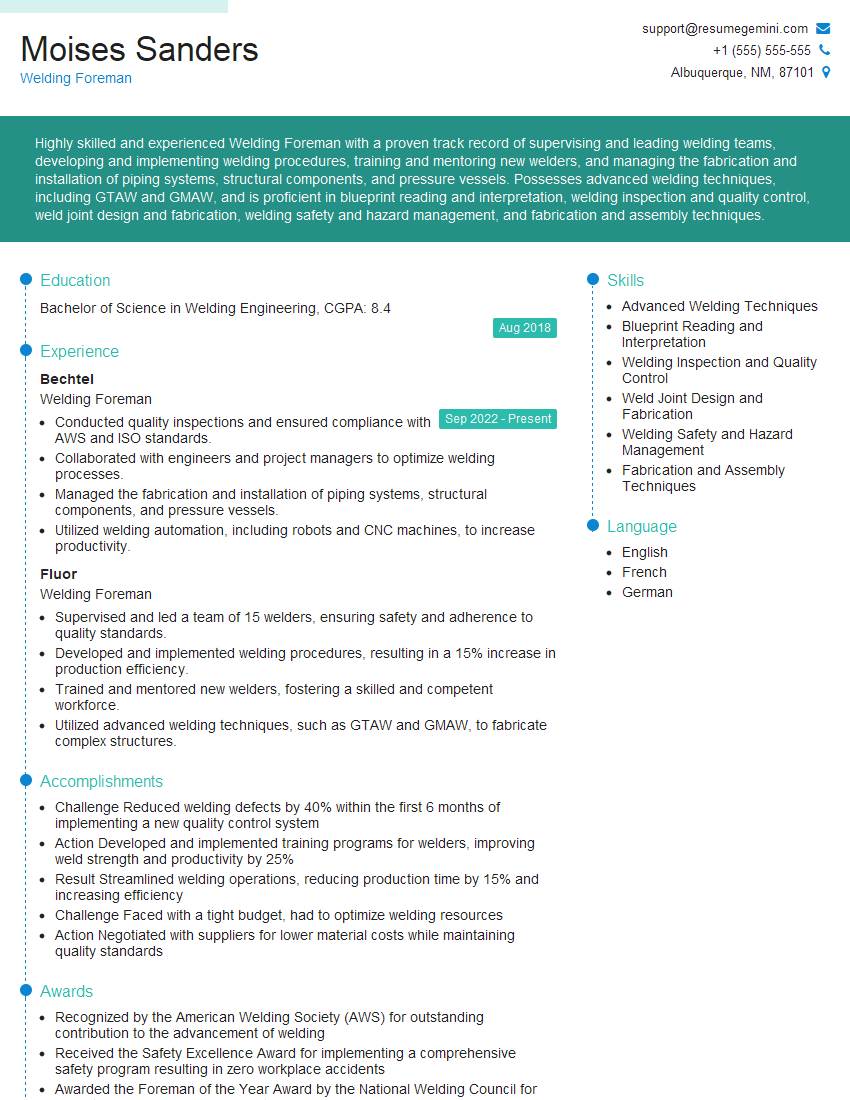
Mastering Welding Prevention is vital for career advancement in this field. A strong understanding of safety regulations and practical applications will significantly improve your job prospects. Creating an ATS-friendly resume is crucial for getting your application noticed by potential employers. To help you build a powerful and effective resume, we recommend using ResumeGemini. ResumeGemini provides a user-friendly platform for creating professional resumes and offers examples tailored to various roles, including Welding Prevention. Take advantage of these resources to showcase your skills and expertise and boost your chances of landing your dream job.
Explore more articles
Users Rating of Our Blogs
Share Your Experience
We value your feedback! Please rate our content and share your thoughts (optional).
What Readers Say About Our Blog
Really detailed insights and content, thank you for writing this detailed article.
IT gave me an insight and words to use and be able to think of examples