Cracking a skill-specific interview, like one for Welding Process Control, requires understanding the nuances of the role. In this blog, we present the questions you’re most likely to encounter, along with insights into how to answer them effectively. Let’s ensure you’re ready to make a strong impression.
Questions Asked in Welding Process Control Interview
Q 1. Explain the different types of welding processes and their applications.
Welding processes are broadly categorized based on the heat source used to melt and join the base materials. Understanding the distinctions is crucial for selecting the right process for a specific application.
- Gas Metal Arc Welding (GMAW) / MIG Welding: Uses a continuously fed wire electrode as both filler material and electrode. Commonly used in automotive manufacturing, shipbuilding, and pipeline construction due to its high deposition rate and versatility.
- Gas Tungsten Arc Welding (GTAW) / TIG Welding: Employs a non-consumable tungsten electrode to create the arc. Known for its precision and excellent weld quality, making it ideal for applications requiring high integrity, like aerospace and medical device manufacturing. Requires more skill and is slower than GMAW.
- Shielded Metal Arc Welding (SMAW) / Stick Welding: Uses a consumable coated electrode to shield the weld from atmospheric contamination. Simple and portable, it’s often used in field applications, construction, and maintenance work. However, it’s relatively slower and requires more post-weld cleaning.
- Arc Welding with Covered Electrodes (SAW): Uses a continuous wire electrode under a blanket of flux. Excellent for high deposition rates and automation, commonly seen in heavy industrial applications such as building bridges and large pressure vessels.
- Resistance Welding: Uses heat generated by electrical resistance at the joint to fuse materials. Common in automotive body production due to its speed and ability to create spot welds.
- Laser Beam Welding (LBW): Uses a high-powered laser beam to melt and fuse materials. Offers high precision and narrow weld beads, crucial in applications like microelectronics and aerospace.
The choice of process depends on factors such as material thickness, joint design, required weld quality, production speed, and available equipment.
Q 2. Describe the principles of Gas Metal Arc Welding (GMAW).
GMAW, or Gas Metal Arc Welding (also known as MIG welding), relies on the heat generated from an electric arc between a continuously fed consumable wire electrode and the workpiece. A shielding gas, usually Argon or a mixture of Argon and Carbon Dioxide, protects the molten weld pool from atmospheric contamination, preventing oxidation and porosity. The wire electrode acts as both the filler metal and the electrode, delivering material to create the weld. The process uses a constant current power source which helps control the heat input and molten pool dynamics. A constant voltage power source is used for thinner materials to maintain arc stability.
Think of it like this: the wire is continuously fed into the molten pool, like pouring liquid metal, while the shielding gas creates a protective bubble around the weld. The current melts the wire and the base material, creating a strong fusion.
The parameters like voltage, current, wire feed speed, and gas flow rate can be adjusted to control penetration, weld bead geometry, and overall quality. For instance, higher current leads to deeper penetration, while a higher wire feed speed increases deposition rate.
Q 3. What are the common defects found in welds and their causes?
Weld defects can significantly compromise the integrity of a weldment. Identifying their causes is critical for corrective actions. Common weld defects include:
- Porosity: Small, gas-filled holes in the weld metal, often caused by moisture in the consumables, insufficient shielding gas coverage, or contamination of the base metal.
- Inclusion: Foreign material trapped within the weld metal, such as slag or tungsten inclusions from TIG welding, leading to localized weakness.
- Undercut: A groove melted into the base metal adjacent to the weld, reducing the weld’s effective cross-sectional area, usually stemming from excessive current or travel speed.
- Lack of Fusion: Incomplete melting or bonding between the weld metal and the base metal, potentially leading to cracking or brittle failure, often due to insufficient heat input or improper joint preparation.
- Cracking: Formation of cracks in the weld metal, either during solidification (hot cracking) or after cooling (cold cracking), often due to improper heat input, hydrogen embrittlement, or high stresses.
- Overlapping: Excess weld metal extending beyond the intended joint, usually a result of incorrect travel speed or excessive filler metal.
Understanding the root cause of a defect allows for targeted adjustments to the welding parameters, process, or material handling to prevent its recurrence.
Q 4. How do you ensure weld quality using non-destructive testing methods?
Non-destructive testing (NDT) methods are crucial for ensuring weld quality without damaging the weldment. Several techniques are employed:
- Visual Inspection (VT): The simplest method, involving visual examination for surface defects like cracks, porosity, or undercut. Often the first step in any NDT process.
- Radiographic Testing (RT): Uses X-rays or gamma rays to detect internal defects such as porosity, cracks, and inclusions. Provides a permanent record of the weld’s internal structure.
- Ultrasonic Testing (UT): Employs high-frequency sound waves to detect internal flaws. Offers excellent sensitivity and is particularly effective for detecting cracks and lack of fusion.
- Magnetic Particle Testing (MT): Suitable for ferromagnetic materials, this method uses magnetic fields and ferromagnetic particles to detect surface and near-surface cracks.
- Liquid Penetrant Testing (PT): Uses a dye penetrant to reveal surface-breaking defects. Sensitive and easy to use, it’s ideal for detecting cracks in complex geometries.
The selection of appropriate NDT methods depends on the specific application, material type, and weld geometry. A combination of techniques is often employed to achieve comprehensive quality assurance.
Q 5. Explain the importance of pre-weld preparation and cleaning.
Pre-weld preparation and cleaning are paramount for achieving high-quality welds. Improper preparation can lead to various defects, compromising the weld’s structural integrity.
Preparation includes:
- Surface Cleaning: Removing dirt, grease, paint, rust, and other contaminants from the joint surfaces to ensure proper fusion. Methods include grinding, wire brushing, and chemical cleaning.
- Joint Design and Fit-up: Correct joint design and accurate fit-up ensure proper alignment and gap control, reducing the likelihood of defects like lack of fusion or porosity.
- Edge Preparation: Beveling or shaping the edges of the base material to create appropriate joint geometry, promoting proper penetration and fusion.
Imagine trying to glue two pieces of wood together with dirt and paint on them; the bond would be weak and unreliable. Similarly, contaminants prevent the base material from properly fusing, leading to weak welds. Thorough preparation is like creating a clean canvas for a strong and durable weld.
Q 6. What are the different types of welding consumables and their selection criteria?
Welding consumables are the materials consumed during the welding process, primarily electrodes and shielding gases. Their selection depends on the base metal, desired weld properties, and the welding process.
- Electrodes: Different types of electrodes are available, each with specific chemical compositions optimized for particular materials. For example, mild steel electrodes are different from stainless steel or aluminum electrodes.
- Shielding Gases: Gases like Argon, Carbon Dioxide, Helium, and their mixtures protect the weld pool from atmospheric contamination. The choice depends on the process (GMAW, GTAW) and base metal. Argon is commonly used for aluminum, while a mix of Argon and CO2 is often used for steel in GMAW.
- Fluxes: Used in some processes like SAW, fluxes protect the weld pool and contribute to slag formation, influencing the weld’s chemistry and properties.
Choosing the correct consumables ensures optimal weld quality, minimizing defects and achieving the desired mechanical properties. Incorrect selection can lead to poor weld fusion, cracking, or excessive porosity. Selecting consumables is a crucial decision impacting the reliability and lifespan of the welded structure. Consider material compatibility, strength requirements, and corrosion resistance when making your selection.
Q 7. Describe your experience with welding process parameters and their effect on weld quality.
Welding process parameters are crucial in controlling the weld’s quality, mechanical properties, and appearance. My experience encompasses the optimization of these parameters in various welding processes. I’ve extensively worked with GMAW and GTAW processes, using data acquisition and analysis to adjust parameters for optimal weld bead geometry and penetration.
For instance, in GMAW, increasing the voltage generally increases penetration, while increasing the wire feed speed increases deposition rate. However, excessively high current can cause undercut and excessive spatter. Similarly, in GTAW, the amperage controls penetration, while the travel speed influences the bead width. Optimizing these parameters requires understanding the interaction between the process, the materials being welded, and the desired outcome.
In my experience, I’ve often found that a systematic approach, including preliminary test welds and subsequent analysis using techniques like metallographic examination and mechanical testing, are essential for defining the optimum parameter set. This approach has consistently yielded high-quality, repeatable welds in diverse applications, including the welding of stainless steel components in a chemical processing plant and the joining of aluminum alloys in aerospace components. Continuous monitoring and adjustment of parameters during the process is also key to maintaining high quality throughout a lengthy production run.
Q 8. How do you control weld penetration and bead geometry?
Controlling weld penetration and bead geometry is crucial for ensuring the structural integrity and quality of a weld. It’s like baking a cake – you need the right ingredients and baking time for the perfect result. In welding, we achieve this by carefully managing several parameters.
- Current (Amperage): Higher amperage generally leads to deeper penetration and wider beads. Think of it as increasing the heat input.
- Voltage: Higher voltage increases arc length, affecting penetration. A longer arc generally results in shallower penetration.
- Travel Speed: Slower travel speed allows more heat input at a single point, increasing penetration. It’s like holding a soldering iron longer on one spot.
- Electrode Stickout (GMAW/SMAW): The length of the electrode protruding from the contact tip (GMAW) or the electrode holder (SMAW) affects the arc length and heat transfer.
- Joint Design and Fit-up: Proper joint preparation (e.g., beveling) ensures consistent penetration. A poor fit-up leads to inconsistent heat distribution and potentially incomplete fusion.
- Welding Process: Different processes (GMAW, SMAW, GTAW) inherently produce different bead geometries and penetration levels. Each process has its own set of parameters to control these characteristics.
For example, in Gas Metal Arc Welding (GMAW), using a pulsed current can provide deeper penetration with a narrower bead compared to a constant current setting. In Shielded Metal Arc Welding (SMAW), manipulating the angle of the electrode and travel speed allows for fine-tuning of the bead geometry.
Q 9. Explain the role of shielding gas in GMAW and its selection criteria.
Shielding gas in Gas Metal Arc Welding (GMAW) plays a vital role in protecting the weld pool from atmospheric contamination, especially oxygen and nitrogen. These contaminants can cause weld defects like porosity (tiny holes) and embrittlement (reduced toughness).
The selection criteria for shielding gas depends on factors such as the base metal, the welding position, and the desired weld properties. Common shielding gases include:
- 100% CO2: Relatively inexpensive, good penetration, but can produce more spatter and a less aesthetically pleasing weld.
- Argon (Ar): Produces a cleaner weld with less spatter, but has lower penetration compared to CO2. Often used with active metals.
- Argon-CO2 Mixtures: Offer a compromise between penetration, spatter, and weld quality. The specific mix is chosen based on application needs.
- Argon-Oxygen-CO2 (Tri-Mix): Used for specific applications requiring improved arc stability and weld bead appearance.
Choosing the right shielding gas is like choosing the right paint for a project – you wouldn’t use the same paint for a fine art piece as you would for a fence.
For instance, welding aluminum usually requires 100% Argon due to its high reactivity with oxygen and CO2. Steel welding may utilize a mix of Argon and CO2, balancing the need for good penetration and weld quality.
Q 10. Describe the different types of joint designs and their suitability for welding.
Joint design is the way two pieces of metal are positioned before welding. The choice of joint design significantly impacts the weld’s strength, ease of welding, and overall quality. Think of it as the foundation of a house – a strong foundation is essential for a sturdy structure.
- Butt Joint: Simplest joint, where the edges of the two pieces are butted together. Suitable for thin materials but can be challenging for thicker materials.
- Lap Joint: One piece overlaps the other. Simple to weld but may be less structurally sound than other joints.
- T-Joint: One piece is perpendicular to the other. Widely used, but the weld access can be limited, affecting penetration.
- Corner Joint: Two pieces are joined at a corner. Used for framework and structural applications.
- Edge Joint: Two edges are joined. Commonly used for thin sheets.
The choice of joint depends on the specific application and material. For example, a butt joint is suitable for joining two steel plates in a structural setting, but a lap joint might be better for sheet metal applications where ease of fabrication is crucial. Proper joint preparation, including beveling and edge preparation, is necessary to ensure proper weld penetration and fusion regardless of the joint type.
Q 11. How do you interpret welding symbols and specifications?
Welding symbols and specifications are the blueprints for welding, conveying critical information about weld preparation, type, size, and location. Understanding these symbols is crucial for welders to execute the job correctly. They are a form of visual communication, much like a map guides you to a destination.
Welding symbols typically include:
- Reference Line: A horizontal line separating the arrow side (the side being welded) and the other side.
- Arrow Side: Indicates the side of the joint where the welding symbol is placed.
- Other Side: The opposite side of the joint. Symbols on this side often indicate different weld requirements.
- Weld Type: Symbols indicate different types of welds (e.g., fillet weld, groove weld).
- Weld Size: Indicates the weld size, usually in millimeters or inches.
- Weld Length: The required length of the weld.
- Finishing Symbols: Specify if any post-weld finishing is required (e.g., grinding).
For example, a symbol showing a triangle pointing towards the arrow side with a number indicates a fillet weld on the arrow side with the indicated leg size. The absence of a symbol on the other side generally means that no welding is required on that side. Standards like AWS D1.1 provide a comprehensive guide to interpreting these symbols.
Q 12. What are the safety precautions necessary during welding operations?
Welding safety is paramount. Neglecting safety protocols can lead to severe injuries. It’s like driving a car – always follow the rules of the road to ensure your safety and that of others.
- Personal Protective Equipment (PPE): This is mandatory and includes welding helmets with appropriate shade lenses, welding gloves, flame-resistant clothing, safety shoes, and respiratory protection (especially for confined spaces).
- Fire Safety: Welding produces sparks and molten metal, so always have a fire extinguisher nearby and ensure a fire-safe environment. Clear flammable materials from the work area.
- Eye and Skin Protection: UV radiation from the welding arc can cause severe eye damage (welder’s flash burn) and skin burns. Always use proper PPE.
- Ventilation: Welding fumes can be toxic. Ensure adequate ventilation, especially in confined spaces. Using extraction systems can help remove harmful fumes.
- Electrical Safety: Welding involves high currents. Check electrical equipment for damage, ensure proper grounding, and never work with wet hands or in wet conditions.
- Confined Space Entry: If welding in a confined space, follow specific entry procedures and have a safety observer present. Ensure adequate ventilation and gas monitoring.
Regular safety training and adherence to safety protocols are crucial for mitigating risks associated with welding operations.
Q 13. Explain your experience with different types of welding power sources.
My experience encompasses various welding power sources, each with its unique characteristics and applications. Choosing the right power source is like selecting the right tool for a job – a hammer wouldn’t be suitable for screwing in a screw.
- Constant Current (CC) Power Sources: Maintain a consistent current regardless of arc length fluctuations. Ideal for SMAW and some GMAW applications. They offer better arc stability and penetration control.
- Constant Voltage (CV) Power Sources: Maintain a constant voltage, allowing the current to adjust based on arc length. Commonly used in GMAW, providing good versatility and adaptability to different welding positions and materials.
- Pulsed Current Power Sources: Deliver current in pulses, providing better control over bead geometry, penetration, and spatter reduction in GMAW. This technology enhances the efficiency and quality of the weld.
- DC Power Sources: Utilize direct current, typically used with SMAW and GTAW. They provide excellent arc stability and penetration.
- AC Power Sources: Utilize alternating current, typically used with GTAW for welding aluminum and other non-ferrous metals. They help prevent tungsten contamination.
In my experience, understanding the characteristics of each power source, and its applicability to different welding processes and materials, is essential for optimal welding performance and quality control.
Q 14. How do you handle weld discontinuities and repairs?
Weld discontinuities, or imperfections, are unavoidable in some degree, but excessive discontinuities compromise weld integrity. Handling them effectively is essential for ensuring structural soundness. It’s like finding a crack in a building’s foundation – you need to address it immediately and properly.
The approach to handling weld discontinuities depends on the type and severity of the defect:
- Assessment: First, identify and assess the type and severity of the discontinuity (e.g., porosity, cracks, incomplete fusion). Visual inspection, radiographic testing (RT), ultrasonic testing (UT), and other non-destructive testing (NDT) methods are employed.
- Acceptance Criteria: Consult relevant welding codes and standards (e.g., ASME Section IX) to determine acceptable limits for different types of defects. If the defects exceed the acceptable limits, repair is necessary.
- Repair Techniques: Repair methods depend on the defect. Options include grinding, chipping out the defective area, and re-welding with appropriate procedures. Proper preheating and post-weld heat treatment may be required.
- Re-inspection: After repair, the weld must be re-inspected to ensure the defect has been successfully removed and the repair weld meets the required quality standards.
For example, minor porosity might be acceptable depending on the application, but a crack would necessitate repair. The repair process might involve grinding away the defective area, cleaning the surface, and then re-welding using a suitable procedure. Documentation of the repair process is also crucial.
Q 15. What are the common causes of weld porosity and cracking?
Weld porosity and cracking are significant weld defects stemming from various sources. Porosity, the presence of small gas holes within the weld, often results from:
- Trapped gases: Moisture in the base material, filler metal, or shielding gas can vaporize during welding and become trapped, forming pores. Think of it like trying to bake a cake with wet ingredients – the moisture turns to steam, leaving holes.
- Insufficient shielding gas coverage: Inadequate shielding gas prevents atmospheric contamination, allowing oxygen and nitrogen to dissolve into the weld pool. This is like trying to prevent rust on a car without properly using paint.
- Improper cleaning: Oxides, grease, or other contaminants on the base metal can release gases during welding. Proper cleaning is paramount, just like preparing the surface before painting.
- Incorrect welding parameters: Excessive heat input can lead to porosity by allowing more gas to be absorbed, and too low of heat can leave the weld pool unable to outgas properly.
Cracking, on the other hand, manifests as fractures in the weld metal or heat-affected zone (HAZ), commonly caused by:
- Hydrogen embrittlement: Hydrogen absorbed during welding can diffuse into the weld metal, making it brittle and prone to cracking, especially under stress. This is akin to a crack in a dried-out piece of wood.
- High residual stresses: Rapid cooling after welding can create high tensile stresses within the weld, leading to cracking. This is like putting too much force on a fragile material.
- Solidification cracking: This occurs during solidification of the weld, often due to low ductility in the weld metal and is strongly affected by chemical composition.
- Improper preheat or post-weld heat treatment: These processes can significantly influence the residual stresses and reduce the likelihood of cracking.
Identifying the root cause requires careful analysis of the weld parameters, material properties, and welding environment.
Career Expert Tips:
- Ace those interviews! Prepare effectively by reviewing the Top 50 Most Common Interview Questions on ResumeGemini.
- Navigate your job search with confidence! Explore a wide range of Career Tips on ResumeGemini. Learn about common challenges and recommendations to overcome them.
- Craft the perfect resume! Master the Art of Resume Writing with ResumeGemini’s guide. Showcase your unique qualifications and achievements effectively.
- Don’t miss out on holiday savings! Build your dream resume with ResumeGemini’s ATS optimized templates.
Q 16. How do you measure and control weld bead width and height?
Controlling weld bead geometry, particularly width and height, is crucial for ensuring consistent weld strength and appearance. Measurement is typically done using:
- Direct measurement: Using a calibrated ruler or caliper on the solidified weld. Simple, but may not be very precise, particularly for complex weld geometries.
- Optical profilometry: This non-contact technique uses a laser or light source to create a 3D profile of the weld bead, giving precise measurements of height and width. This offers higher precision than direct methods and can handle complex shapes.
- Automated image analysis: Images of the weld bead are captured and analyzed using software to automatically determine dimensions. This is suitable for high-throughput applications and quality control.
Controlling weld bead geometry involves careful manipulation of welding parameters. These include:
- Welding current: Higher current generally leads to a wider bead.
- Welding voltage: Higher voltage usually results in a higher bead.
- Travel speed: Slower speed creates wider and taller beads while faster speed gives narrower and shorter ones.
- Electrode angle and distance: Changing the angle and distance can alter the heat distribution.
- Filler metal type and size: Larger diameter filler rods can generate a wider bead.
Real-time monitoring systems and feedback loops are crucial for precise control in automated welding. In manual welding, experience and skilled manipulation of the welding torch is key to consistent bead geometry.
Q 17. Describe your experience with statistical process control (SPC) in welding.
Statistical Process Control (SPC) is a powerful tool in achieving consistent weld quality. My experience involves implementing and utilizing Control Charts, specifically X-bar and R charts, to monitor weld parameters such as current, voltage, and travel speed. We’d track these parameters continuously during the welding process and monitor the mean (X-bar) and range (R) of the measurements on a control chart.
For example, in a project involving MIG welding stainless steel, we used X-bar and R charts to monitor the weld penetration depth. By establishing control limits based on historical data, we could quickly identify any significant deviations from the process average, indicating potential problems that needed immediate attention.
Furthermore, we integrated SPC data with other quality control measures, including visual inspection and destructive testing (tensile, bend tests), to create a comprehensive quality management system. Using SPC allowed for early detection of issues before they escalated into significant defects, dramatically improving weld quality and reducing waste.
Using software such as Minitab, we would analyze the data and identify trends, which would allow us to adjust the process parameters proactively.
Q 18. Explain how you would troubleshoot a welding process issue.
Troubleshooting a welding process issue requires a systematic approach. I use a structured methodology which includes:
- Identify the problem: Clearly define the issue, whether it’s porosity, cracking, inconsistent bead geometry, or other defects. Document observations with pictures and measurements.
- Gather data: Collect information about the welding parameters (current, voltage, travel speed, etc.), filler metal, base material, and environmental conditions. Review any available logs from the equipment.
- Analyze the data: Identify trends and patterns. Are the defects consistent? Are they clustered in specific areas? Comparing the data to the pre-defined process parameters is key here.
- Formulate hypotheses: Based on the data analysis, develop potential explanations for the problem. Consider the factors mentioned in step 2, such as insufficient shielding gas coverage, improper cleaning, incorrect settings, etc.
- Test hypotheses: Implement controlled experiments to test each hypothesis. For example, if you suspect a shielding gas issue, test with a different flow rate and observe the results. If you suspect a preheating issue, test that next.
- Implement corrective actions: Once the root cause is identified, take the necessary steps to correct the issue. This might involve adjusting welding parameters, changing filler metal, improving cleaning procedures, or replacing faulty equipment.
- Monitor the results: After implementing corrections, closely monitor the welding process to ensure the problem is resolved and the weld quality is consistently within acceptable parameters.
This process helps pinpoint issues, reducing downtime and maintaining high quality welds.
Q 19. Describe your experience with welding automation and robotics.
My experience with welding automation and robotics includes programming and operating various robotic welding systems, including those utilizing arc welding (MIG, TIG), and resistance spot welding processes. I’ve worked with Fanuc and ABB robots, and have experience with various teach pendants and programming software. This experience extends to both spot welding and continuous seam welding applications.
In one project, I was responsible for programming a robotic system to perform automated MIG welding on automotive parts. This involved creating weld paths, setting welding parameters, and integrating the robot with other automated systems such as material handling and quality control. We used offline programming software to simulate and optimize the weld program and reduced cycle time by 15% after implementation.
Key aspects of my robotic welding experience include:
- Path planning and programming: Creating efficient and accurate weld paths to achieve desired weld geometry and quality.
- Parameter optimization: Fine-tuning welding parameters for optimal weld strength and appearance.
- Sensor integration: Working with various sensors (e.g., arc sensors, seam tracking sensors) for adaptive welding.
- Troubleshooting and maintenance: Diagnosing and resolving issues related to the robot, welding equipment, and peripheral systems.
My experience with robotic welding allows us to achieve increased precision, consistency, and productivity compared to manual welding, while enhancing workplace safety.
Q 20. How do you maintain welding equipment and ensure its proper operation?
Maintaining welding equipment is critical for safety, productivity, and weld quality. My routine includes:
- Daily inspection: Checking for any visible damage, loose connections, leaks, or unusual wear on components such as the welding torch, cables, and gas lines.
- Regular cleaning: Removing spatter and debris from the welding equipment to prevent build-up that can affect performance.
- Scheduled maintenance: Following manufacturer’s recommendations for routine maintenance, including lubrication, adjustments, and part replacements. This is often tracked using a computerized maintenance management system (CMMS).
- Gas purity checks: Ensuring the shielding gas meets the required purity levels for the specific welding process.
- Safety checks: Verifying that safety systems such as grounding and ventilation are functioning correctly. Regular gas leak detection tests are essential.
- Calibration: Periodically calibrating welding equipment to ensure the parameters are accurate, particularly current, voltage, and wire feed speed.
By following a structured maintenance program, problems are identified and addressed early, minimizing costly downtime and ensuring the consistent production of high-quality welds. For instance, neglecting regular cleaning of a MIG welder’s wire feeder can lead to jams and malfunctions.
Q 21. What is your experience with different types of filler metals?
My experience encompasses a wide range of filler metals, including various types of steel (low carbon, stainless steel, high-strength low alloy), aluminum, and nickel alloys. The selection of the filler metal is crucial as it directly affects the weld’s mechanical properties, corrosion resistance, and appearance.
For instance, when welding stainless steel, I’d use a filler metal with a similar chromium and nickel content to maintain the material’s corrosion resistance. Selecting the wrong filler metal can lead to poor corrosion resistance, weakening the weld and potentially causing failure.
When choosing a filler metal, I consider factors such as:
- Base material compatibility: The filler metal must be compatible with the base material’s chemical composition to ensure good metallurgical bonding and prevent cracking.
- Required mechanical properties: The filler metal should provide the necessary strength, toughness, and ductility for the intended application.
- Weldability: Some filler metals are easier to weld than others, and the choice depends on the welding process.
- Corrosion resistance: For applications exposed to corrosive environments, filler metals offering enhanced corrosion protection are vital.
Over the years, my experience has allowed me to identify the correct filler metals for different applications, ensuring consistently high-quality, reliable welds.
Q 22. Explain the importance of proper heat input in welding.
Proper heat input in welding is crucial for achieving a sound, high-quality weld. Heat input, measured in joules per unit length (J/mm or kJ/cm), represents the amount of heat energy applied to the weld joint during the welding process. It directly influences the weld’s microstructure, mechanical properties, and overall quality.
Too low a heat input can lead to insufficient melting and fusion, resulting in incomplete penetration, porosity, and cracking. Think of it like trying to melt butter with a weak flame – it won’t fully melt and will likely leave lumps.
Too high a heat input, on the other hand, can cause excessive heat-affected zones (HAZ), which can weaken the base material and increase the risk of distortion and cracking. Imagine using a blowtorch on the butter – it’ll melt completely but likely burn and splatter.
Optimizing heat input requires careful consideration of factors like welding current, welding speed, and electrode type. For example, a higher welding current will lead to higher heat input, while a faster welding speed will decrease it. Choosing the correct filler metal is also critical as it influences how easily the material melts and solidifies at specific temperatures.
Precise control ensures the weld meets the required mechanical properties (strength, toughness, ductility) and dimensional tolerances. Monitoring heat input during welding using sophisticated equipment like data acquisition systems allows for real-time adjustments and ensures consistent weld quality across multiple projects.
Q 23. How do you ensure the traceability and certification of welding materials?
Traceability and certification of welding materials are paramount to guarantee the integrity and reliability of the welds. This is achieved through a meticulous system of documentation and verification from the raw material stage to the final weld.
- Material Certificates (Mill Certificates): Every batch of welding consumables (electrodes, filler wires, etc.) comes with a certificate that details the chemical composition, mechanical properties, and any specific certifications (e.g., ASME, AWS) it meets.
- Inventory Management: A robust inventory management system is needed to track each batch of materials, ensuring that their certificates are easily accessible and linked to specific welding jobs. This includes barcoding or other identification methods.
- Welding Procedure Specifications (WPS): The WPS outlines the welding parameters (current, voltage, etc.) and the specific materials that are approved for use in a particular welding process. This documentation ensures consistency and traceability.
- Welding Procedure Qualification Record (WPQR): This document serves as proof that the specified WPS produces welds that meet the required standards. It’s created through rigorous testing and analysis.
- Non-Destructive Testing (NDT): NDT methods such as radiographic testing (RT), ultrasonic testing (UT), and visual inspection are employed to verify the quality of the completed welds. This provides an independent check on the weld quality and the traceability of the materials used.
By meticulously adhering to these steps, we ensure complete traceability. If a problem arises, we can quickly trace back the origin of any faulty materials and take corrective actions. This is vital for safety-critical applications like pipelines, bridges, and pressure vessels.
Q 24. Describe your experience with different types of welding fixtures and jigs.
My experience encompasses a wide range of welding fixtures and jigs, designed to hold and position components during the welding process. The choice of fixture depends heavily on the geometry of the parts, the welding process, and the production volume.
- Simple Clamps and Vise: These are suitable for small, simple parts requiring minimal positioning. I’ve extensively used these for smaller repair jobs and prototyping.
- Magnetic Fixtures: Ideal for quick and easy positioning of ferrous materials. These were particularly handy in situations where welding access was limited or parts needed frequent repositioning.
- Custom-designed Jigs: For complex geometries and high-volume production, custom jigs are essential. I’ve been involved in designing and implementing jigs for automotive parts and structural steel components. These jigs typically incorporate features like precise locating pins, clamping mechanisms, and adjustable supports to ensure consistent weld quality and reduce distortion.
- Automated Welding Systems: In some projects, automated welding systems are employed. These incorporate specialized fixturing systems for seamless integration and precise positioning of parts, optimizing efficiency and repeatability.
Selecting the right fixture is crucial for minimizing distortion, ensuring consistent weld quality, and enhancing productivity. A poorly designed fixture can lead to weld defects, production delays, and rework, highlighting the importance of careful planning and execution.
Q 25. What are the advantages and disadvantages of different welding processes?
Numerous welding processes exist, each with its own set of advantages and disadvantages. The optimal choice depends on factors like material type, thickness, joint design, and required weld quality.
Gas Metal Arc Welding (GMAW):
- Advantages: High deposition rates, good versatility, relatively easy to automate.
- Disadvantages: Susceptible to porosity, requires shielding gas, can be challenging in windy conditions.
Gas Tungsten Arc Welding (GTAW):
- Advantages: Excellent control over weld bead shape, high-quality welds, suitable for thin materials.
- Disadvantages: Lower deposition rates compared to GMAW, requires skilled welders, slower process.
Shielded Metal Arc Welding (SMAW):
- Advantages: Portable, relatively inexpensive equipment, suitable for outdoor use.
- Disadvantages: Lower weld quality compared to GTAW or GMAW, more spatter, slower deposition rates.
Resistance Welding (Spot, Seam):
- Advantages: High production rates, automated processes, no filler material required (for some applications).
- Disadvantages: Limited to conductive materials, weld quality can be affected by factors like surface cleanliness.
Choosing the right process involves careful evaluation of these trade-offs. For instance, GMAW is preferable for high-volume production of thick steel components, while GTAW might be chosen for welding thin aluminum sheets requiring high-quality welds.
Q 26. How do you manage and reduce welding costs?
Managing and reducing welding costs requires a multi-faceted approach that focuses on efficiency, material optimization, and preventative maintenance.
- Process Optimization: Implementing the most efficient welding process for the specific job. For example, using automated welding systems for high-volume production significantly reduces labor costs.
- Material Selection: Choosing cost-effective filler materials and base materials without compromising weld quality. Careful planning to minimize waste also contributes to cost savings.
- Pre-weld Preparation: Ensuring components are properly prepared before welding minimizes rework, saves time, and enhances weld quality.
- Preventative Maintenance: Regular maintenance of welding equipment minimizes downtime and extends its lifespan. This prevents costly repairs and replacements.
- Training and Skill Development: Well-trained welders produce fewer defects and work more efficiently, leading to reduced scrap and rework costs.
- Data Analysis: Monitoring welding parameters and tracking production costs allows for identifying areas for improvement and optimization.
By focusing on these areas, we can achieve significant cost reductions without sacrificing quality. For example, implementing a robust preventative maintenance schedule for our welding equipment reduced our downtime by 15% last year, leading to a significant increase in productivity.
Q 27. Explain the importance of proper training and certification of welders.
Proper training and certification of welders are non-negotiable for ensuring weld quality, safety, and compliance with industry standards. Inadequate training leads to poor welds, potential safety hazards, and project delays.
Training: Comprehensive training programs cover various aspects, including:
- Welding Techniques: Mastering the chosen welding process, including proper setup, parameter selection, and troubleshooting.
- Safety Procedures: Understanding and adhering to all safety regulations and protocols to prevent injuries and accidents.
- Code Compliance: Familiarity with relevant welding codes and standards (e.g., ASME Section IX, AWS D1.1) to ensure the welds meet the required specifications.
- Quality Control: Learning how to identify and correct weld defects.
Certification: Certification provides third-party validation of a welder’s skills and competence. It involves rigorous testing to demonstrate proficiency in specific welding processes and codes. Common certifications include AWS certifications and ASME certifications.
Regular recertification or skill assessments are crucial to maintain proficiency and keep up with advancements in welding technology and techniques. A company’s investment in a well-trained and certified workforce is a direct investment in the quality and safety of its products and projects.
Q 28. Describe your experience with welding process monitoring and data analysis.
My experience with welding process monitoring and data analysis involves utilizing various technologies and techniques to optimize welding parameters, improve weld quality, and reduce costs.
Data Acquisition Systems: I have extensive experience with data acquisition systems that monitor real-time parameters such as welding current, voltage, arc length, and travel speed. This data provides valuable insights into the welding process and helps identify potential problems. For instance, a sudden drop in voltage might indicate a problem with the power supply or electrode contact, allowing for prompt intervention.
Statistical Process Control (SPC): I use SPC techniques to analyze the collected data and identify trends or patterns that indicate potential variations in weld quality. Control charts are employed to monitor critical parameters, ensuring they remain within acceptable limits. This proactive approach significantly reduces the risk of producing non-conforming welds.
Software Analysis: I utilize specialized software for analyzing the collected data, creating reports, and identifying areas for process improvement. This software enables me to visualize welding parameters, identify trends, and make data-driven decisions to optimize the welding process.
Digital Twin technology: For advanced applications, we’re exploring how digital twins, virtual representations of the welding process, can be used for simulation and predictive modeling. This offers the possibility of anticipating problems and optimizing parameters before welding even begins.
Data analysis helps to move beyond reactive problem-solving to a more proactive, preventive approach to welding, ultimately resulting in higher quality, improved efficiency, and reduced costs.
Key Topics to Learn for Welding Process Control Interview
- Welding Processes: Understand the intricacies of various welding processes like GMAW, GTAW, SMAW, and resistance welding. Focus on their applications, advantages, and limitations.
- Joint Design and Preparation: Master the principles of proper joint design for different welding applications. Explore the impact of joint preparation on weld quality and mechanical properties.
- Process Parameters: Gain a deep understanding of the influence of parameters like voltage, amperage, travel speed, and shielding gas on weld quality. Learn how to optimize these parameters for different materials and applications.
- Weld Quality Assessment: Become proficient in various non-destructive testing (NDT) methods like visual inspection, radiography, and ultrasonic testing to evaluate weld integrity.
- Process Monitoring and Control Systems: Familiarize yourself with automated welding systems and the sensors and controllers used to monitor and maintain consistent weld quality. Explore feedback control loops and their role in achieving precise welds.
- Troubleshooting and Problem Solving: Develop your ability to diagnose and solve common welding problems, including weld defects, equipment malfunctions, and process inconsistencies. Practice identifying root causes and implementing corrective actions.
- Safety Procedures and Regulations: Demonstrate a thorough understanding of safety protocols and regulations related to welding operations, including PPE, hazard identification, and risk mitigation.
- Material Science and Metallurgy: Understand the impact of base metal properties on weldability and the metallurgical changes that occur during the welding process.
- Advanced Welding Techniques: Explore specialized welding techniques such as robotic welding, laser welding, and friction stir welding, depending on your target roles.
Next Steps
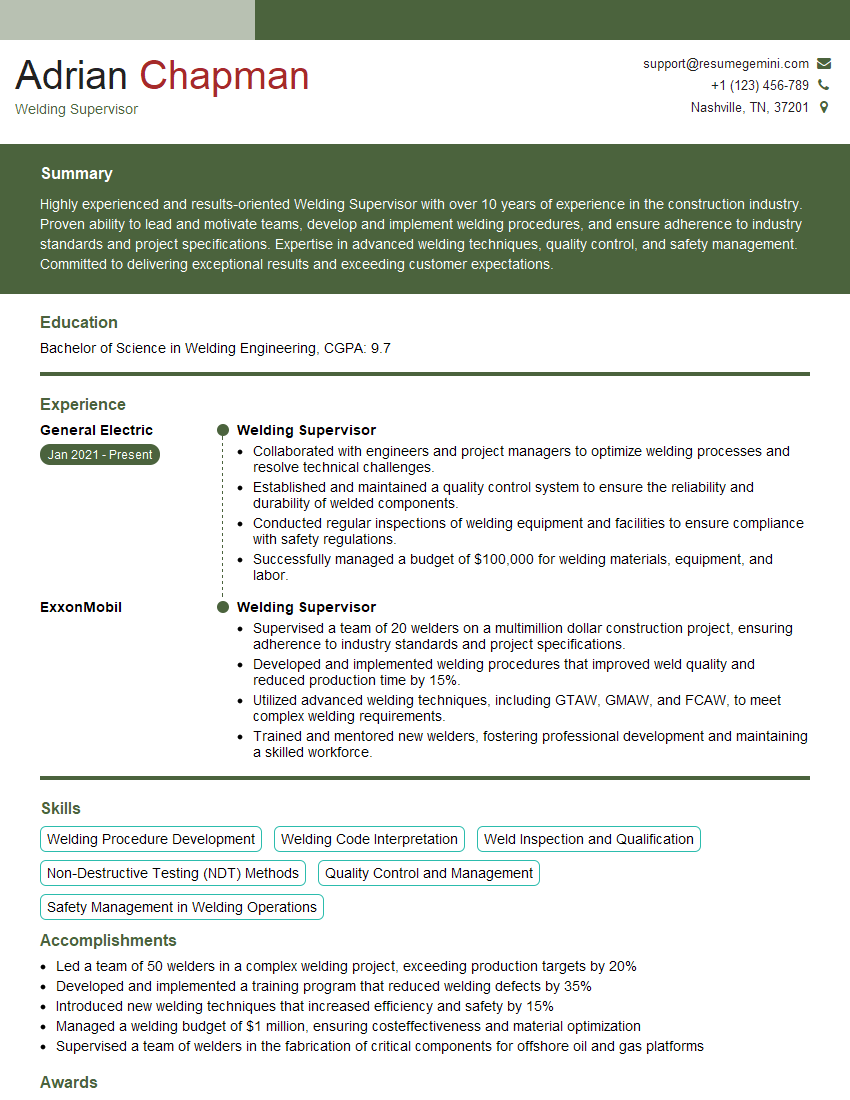
Mastering Welding Process Control is crucial for career advancement in this dynamic field. A strong understanding of these principles will open doors to higher-paying roles and greater responsibility. To increase your chances of landing your dream job, it’s essential to create an ATS-friendly resume that highlights your skills and experience effectively. ResumeGemini is a trusted resource that can help you build a professional and impactful resume tailored to the specific requirements of Welding Process Control positions. Examples of resumes tailored to this field are available to guide you.


Explore more articles
Users Rating of Our Blogs
Share Your Experience
We value your feedback! Please rate our content and share your thoughts (optional).
What Readers Say About Our Blog
Really detailed insights and content, thank you for writing this detailed article.
IT gave me an insight and words to use and be able to think of examples