The right preparation can turn an interview into an opportunity to showcase your expertise. This guide to Wind Tunnel Test interview questions is your ultimate resource, providing key insights and tips to help you ace your responses and stand out as a top candidate.
Questions Asked in Wind Tunnel Test Interview
Q 1. Explain the principles of wind tunnel testing.
Wind tunnel testing simulates airflow around an object to measure aerodynamic forces and moments. Imagine holding your hand out of a car window – the wind pushes and pulls on it. A wind tunnel does the same, but in a controlled environment. The principles are based on fluid mechanics, specifically the laws of conservation of mass and momentum. By carefully controlling the airflow (velocity, pressure, turbulence), we can replicate real-world conditions and accurately predict the aerodynamic behavior of aircraft, cars, buildings, and many other objects.
Essentially, we place a model of the object in a controlled airflow and measure the forces acting on it using load cells. These forces – lift, drag, side force, pitching moment, rolling moment, and yawing moment – are then analyzed to understand the object’s aerodynamic performance.
Q 2. Describe different types of wind tunnels and their applications.
Wind tunnels come in various types, each designed for specific applications:
- Subsonic wind tunnels: These are the most common type, used for testing at speeds below the speed of sound. They are crucial in aircraft design, automotive aerodynamics, and building design.
- Supersonic wind tunnels: Designed for testing at speeds exceeding the speed of sound, these are vital in the design of high-speed aircraft and missiles. They involve specialized techniques to manage shock waves.
- Transonic wind tunnels: These are used to test the transition region between subsonic and supersonic speeds (around Mach 0.8-1.2), where complex aerodynamic phenomena occur. This is a critical regime in aircraft design.
- Hypersonic wind tunnels: These are the most advanced, used to study airflow at extremely high speeds (Mach 5 and above), important for hypersonic vehicle development.
- Low-speed wind tunnels: These operate at low speeds, often ideal for testing large-scale models and focusing on effects like surface pressure and boundary layer flow separation.
The choice of wind tunnel depends on the speed regime and the specific aerodynamic characteristics being investigated. For example, designing a commercial airliner would primarily use a subsonic wind tunnel, while developing a spacecraft might require a hypersonic wind tunnel.
Q 3. How do you ensure accurate data acquisition in a wind tunnel test?
Accurate data acquisition in wind tunnel testing is critical. It involves a multi-faceted approach:
- Calibration: Before any test, the wind tunnel itself and all measuring instruments (load cells, pressure transducers, etc.) are carefully calibrated to ensure accuracy and traceability. This often involves using traceable standards and conducting regular checks.
- Instrumentation: High-quality sensors with low noise and high precision are essential. This includes using multiple sensors for redundancy and cross-validation.
- Data acquisition system: A sophisticated data acquisition system is needed to accurately capture and record data at high sampling rates. The system’s performance needs to be regularly verified.
- Environmental control: Maintaining consistent temperature and humidity in the test section is crucial as these factors can affect air density and flow properties. This often involves sophisticated climate control systems.
- Model preparation: The model’s surface needs to be smooth and free from imperfections. Even small imperfections can introduce significant errors in the measurements.
Data validation techniques, such as comparing measurements from multiple sensors and checking for consistency with theoretical predictions, are crucial to ensure data reliability.
Q 4. What are the common sources of error in wind tunnel testing, and how can they be mitigated?
Wind tunnel testing is prone to several sources of error:
- Wall interference: The presence of the wind tunnel walls can influence the airflow around the model, particularly in smaller tunnels. Corrections must be applied to compensate for this. Techniques like boundary layer suction are employed to minimize this effect.
- Model support interference: The method of holding the model in place can disrupt the airflow. Careful design and use of streamlined supports are needed to minimize this.
- Turbulence in the flow: Even small amounts of turbulence can significantly affect the results. Careful design of the wind tunnel contraction section and flow straighteners helps reduce turbulence.
- Instrumentation errors: Faulty sensors or incorrect calibration can lead to inaccurate measurements. Regular calibration and maintenance are therefore paramount.
- Model inaccuracies: Imperfections in the model’s surface or manufacturing errors can influence the results. High-quality manufacturing and surface finishing are essential.
Mitigating these errors involves careful experimental design, rigorous calibration, advanced flow control techniques, and robust data analysis methods. Often, multiple tests are run and results are compared to catch and identify potential systematic errors.
Q 5. Explain the importance of model scaling and similarity in wind tunnel testing.
Model scaling and similarity are essential for applying wind tunnel results to full-scale objects. It’s impractical to test full-size aircraft in a wind tunnel. Therefore, we build scaled-down models. However, simply reducing the size isn’t enough; we need to ensure dynamic similarity.
Dynamic similarity means that the flow around the model accurately represents the flow around the full-scale object. This is achieved by matching dimensionless parameters like the Reynolds number (Re) and Mach number (Ma). The Reynolds number relates inertial forces to viscous forces, while the Mach number relates the flow speed to the speed of sound.
For example, if we want to test a model of an aircraft, we need to select a wind tunnel speed and model size that result in the same Reynolds number as the full-scale aircraft. This ensures that viscous effects are properly scaled. Similarly, matching the Mach number ensures that compressibility effects are correctly represented.
Q 6. Describe your experience with different types of wind tunnel models.
My experience encompasses various model types, including:
- Solid models: These are typically made from materials like wood, aluminum, or composites, providing structural rigidity. These are the most common types, suitable for many aerodynamic investigations.
- Scale models: These are smaller replicas of the full-scale object, carefully constructed to maintain geometric similarity. Precision is crucial here.
- Flexible models: These are models designed to deform under aerodynamic loads, useful in studying aeroelastic phenomena.
- Instrumented models: Models embedded with sensors to measure surface pressure, temperature, or other parameters that provide invaluable insight into the flow field.
The choice of model type depends entirely on the nature of the study and the specific data required. For example, an instrumented model would be used when detailed pressure distributions are needed, whereas a simpler solid model might suffice for overall force and moment measurements. I’ve also worked with models incorporating moving parts (like flaps or control surfaces) to simulate real-world flight conditions more accurately.
Q 7. How do you interpret and analyze wind tunnel test data?
Interpreting and analyzing wind tunnel data involves several key steps:
- Data cleaning: The raw data often needs cleaning to remove outliers or noise resulting from measurement errors.
- Data reduction: Raw data (e.g., loads from load cells) needs to be converted into meaningful aerodynamic coefficients (e.g., lift coefficient, drag coefficient). This often involves accounting for the model’s surface area and the air density.
- Visualization: Data is often visualized using plots and graphs (e.g., coefficient of lift vs. angle of attack), providing a clear picture of aerodynamic performance across various conditions.
- Comparative analysis: Results are compared with theoretical predictions or data from computational fluid dynamics (CFD) simulations to validate the results and identify any discrepancies. This might involve developing empirical correlations to aid in analysis.
- Uncertainty analysis: Quantifying the uncertainty associated with the results is critical for understanding the reliability and confidence level of the findings. Methods for this range from simple statistical analysis to more complex uncertainty propagation techniques.
This entire process leads to a comprehensive understanding of the object’s aerodynamic behavior, paving the way for design improvements and performance optimization. Often, multiple iterations of testing and analysis are required before a complete picture emerges.
Q 8. What software and tools are you familiar with for wind tunnel data analysis?
My experience encompasses a wide range of software and tools used for wind tunnel data analysis. This includes industry-standard packages like Tecplot for visualization and post-processing of complex 3D flow fields, and MATLAB for advanced data manipulation, statistical analysis, and custom algorithm development. I’m also proficient in using ANSYS Fluent and Star-CCM+, which are Computational Fluid Dynamics (CFD) software packages often used in conjunction with wind tunnel testing to validate results and perform simulations. Furthermore, I’m familiar with various data acquisition systems and their associated software for managing raw data from pressure transducers, hot-wire anemometers, and force balances.
For example, in a recent project analyzing the aerodynamic performance of a novel aircraft wing design, I used Tecplot to create detailed visualizations of pressure contours and velocity vectors, providing crucial insights into the flow separation patterns. MATLAB was then instrumental in automating the process of extracting quantitative data, such as lift and drag coefficients, from these visualizations and performing statistical analysis on multiple test runs.
Q 9. Explain your experience with uncertainty analysis in wind tunnel testing.
Uncertainty analysis is critical in wind tunnel testing to ensure the reliability and validity of the results. My approach involves a comprehensive assessment of all sources of uncertainty, encompassing both systematic and random errors. Systematic errors, which consistently affect the measurements in the same direction, might arise from calibration errors in instruments or tunnel imperfections. Random errors, which vary unpredictably, can be due to turbulent fluctuations in the flow or limitations in data acquisition resolution. I utilize the Guide to the Expression of Uncertainty in Measurement (GUM) methodology to quantify and propagate these uncertainties through the entire measurement process.
For instance, in determining the uncertainty of a lift coefficient, I would consider uncertainties from the force balance calibration, the pressure measurements, the model’s surface area, and the wind tunnel’s speed. These individual uncertainties are then combined using appropriate statistical methods to obtain an overall uncertainty for the lift coefficient, typically expressed as a confidence interval. This rigorous approach ensures that the reported results accurately reflect the experimental uncertainty.
Q 10. How do you ensure the safety of personnel and equipment during wind tunnel testing?
Safety is paramount in wind tunnel testing. My experience includes implementing and enforcing strict safety protocols to mitigate risks associated with high-speed airflow, rotating machinery, and potentially hazardous experimental setups. This includes, but isn’t limited to, ensuring all personnel wear appropriate Personal Protective Equipment (PPE), such as safety glasses, ear protection, and in some cases, specialized protective clothing. Regular safety inspections are conducted to identify and address potential hazards, and comprehensive safety training is provided to all involved personnel.
Specific procedures for lockout/tagout during maintenance are strictly followed, ensuring that all power sources are isolated before any maintenance work begins. Emergency shut-off switches are readily accessible and prominently marked, and emergency response plans are established and regularly reviewed. Furthermore, I ensure the wind tunnel facility adheres to all relevant safety regulations and industry best practices.
Q 11. Describe your experience with troubleshooting problems in a wind tunnel test.
Troubleshooting in wind tunnel testing often involves a systematic approach. I begin by carefully examining the data for anomalies, considering potential sources of error in the instrumentation, the model setup, or the wind tunnel itself. This might involve reviewing calibration records, inspecting the model for damage or imperfections, and checking for any irregularities in the flow field within the test section.
For example, if unexpected oscillations are observed in force measurements, I would first verify the calibration of the force balance and check for any looseness in the model mounting. If the problem persists, I would investigate the possibility of flow instabilities within the test section by analyzing flow visualization data or performing flow field measurements. This process often involves a combination of systematic checks, data analysis, and potentially adjusting the test setup or parameters until the issue is resolved.
Q 12. How do you handle unexpected results or anomalies during a wind tunnel test?
Unexpected results or anomalies require a meticulous investigation to determine their root cause. I approach this by first carefully reviewing the experimental setup, the data acquisition process, and the data itself. This might involve scrutinizing the raw data for any inconsistencies, repeating the experiment under identical conditions, or conducting additional tests to isolate the source of the anomaly.
For instance, if the measured drag coefficient is significantly higher than expected, I would investigate several factors, such as potential model imperfections, unexpected flow separation, or problems with the force balance. I would also assess whether there are any discrepancies between the wind tunnel conditions and the assumed test conditions. If the issue cannot be readily explained, I may consult with colleagues or experts in the field to identify potential solutions.
Q 13. Explain your experience with wind tunnel instrumentation and calibration.
My experience with wind tunnel instrumentation and calibration is extensive. I’m proficient in the calibration and operation of various instruments, including force balances, pressure transducers, hot-wire anemometers, and particle image velocimetry (PIV) systems. Calibration is conducted according to established procedures, using traceable standards to ensure accuracy and reliability. This typically involves comparing the instrument’s readings to those of a known standard, creating a calibration curve to account for any systematic deviations.
For example, calibrating a pressure transducer involves applying known pressures and recording the corresponding transducer outputs. These data points are then used to fit a calibration curve, which is subsequently applied to correct the pressure measurements obtained during the wind tunnel test. Regular calibration checks are performed to maintain the accuracy of the instrumentation throughout the testing program.
Q 14. What are the limitations of wind tunnel testing?
While wind tunnel testing is a powerful tool, it does have limitations. One key limitation is the difficulty in perfectly replicating real-world flight conditions. Wind tunnels inherently create a confined flow field, which may differ from the unbounded flow experienced by an aircraft in flight. The effects of wind tunnel walls, support systems, and the test section geometry can all influence the results. Furthermore, certain phenomena, such as unsteady flows or complex aeroelastic effects, can be challenging to accurately replicate in a wind tunnel.
Another limitation is the scale effect. Testing on smaller scale models can lead to discrepancies with full-scale performance due to Reynolds number differences. Finally, the cost and time associated with wind tunnel testing can be significant, making it crucial to plan and execute tests efficiently.
Q 15. How does wind tunnel testing compare to Computational Fluid Dynamics (CFD)?
Wind tunnel testing and Computational Fluid Dynamics (CFD) are both crucial tools for aerodynamic analysis, but they offer distinct advantages and disadvantages. Think of them as two sides of the same coin. Wind tunnel testing is an experimental method, providing real-world data on how air interacts with an object. CFD, on the other hand, is a numerical method that uses computer simulations to model fluid flow.
Wind tunnel tests are invaluable for obtaining highly accurate data, especially for complex geometries where CFD simulations might struggle. However, they are expensive and time-consuming, requiring specialized facilities and skilled personnel. CFD, while potentially less accurate for complex flows, is significantly cheaper and faster, allowing for rapid prototyping and design iterations. It’s also easier to modify parameters and explore a wider range of conditions.
In practice, a combined approach is often optimal. CFD is used for initial design exploration and optimization, identifying promising designs which are then validated and refined through wind tunnel testing. For example, during the design of a new aircraft, CFD might be used to explore hundreds of wing designs, narrowing the field to a select few for wind tunnel testing to get precise lift, drag, and moment coefficients.
Career Expert Tips:
- Ace those interviews! Prepare effectively by reviewing the Top 50 Most Common Interview Questions on ResumeGemini.
- Navigate your job search with confidence! Explore a wide range of Career Tips on ResumeGemini. Learn about common challenges and recommendations to overcome them.
- Craft the perfect resume! Master the Art of Resume Writing with ResumeGemini’s guide. Showcase your unique qualifications and achievements effectively.
- Don’t miss out on holiday savings! Build your dream resume with ResumeGemini’s ATS optimized templates.
Q 16. Describe your experience with different types of flow visualization techniques.
My experience encompasses a wide range of flow visualization techniques, each with its strengths and weaknesses. These techniques are essential for understanding the complex flow patterns around an object.
- Surface oil flow visualization: This simple yet effective method uses oil or a similar substance applied to the model’s surface. The oil streaks reveal the direction of the airflow, highlighting separation points, vortices, and other flow features. It’s particularly useful for identifying regions of high shear stress.
- Tuft grids: Small tufts of yarn attached to the model surface visually indicate flow direction and separation. They are less precise than oil flow but more easily implemented and suitable for larger-scale models.
- Smoke visualization: Introducing smoke into the wind tunnel allows for observing flow patterns in the wake of the model. This provides a qualitative understanding of the three-dimensional flow structures, such as vortices and separation bubbles. It’s excellent for visualizing complex flows.
- Particle Image Velocimetry (PIV): This is a more sophisticated technique, providing quantitative data on velocity vectors throughout the flow field. Tiny particles are seeded into the airflow, and their movement is tracked using lasers and high-speed cameras. This allows for precise measurement of velocity and its gradients.
In one project involving the design of a streamlined bus, we utilized a combination of surface oil flow and smoke visualization to optimize the bus’s shape and minimize drag. The oil flow helped pinpoint separation zones on the rear of the bus, and the smoke visualization showed the complex vortex shedding, which we then addressed by refining the bus body’s shape.
Q 17. How do you select appropriate wind tunnel test conditions (speed, angle of attack, etc.)?
Selecting appropriate wind tunnel test conditions is crucial for obtaining meaningful and reliable results. It involves careful consideration of various factors and requires a good understanding of the specific aerodynamic problem. The selection process often begins with defining the objectives of the wind tunnel test.
Speed: The wind speed should cover the relevant operational range of the object. For an aircraft, this might encompass speeds from takeoff to cruise. The Reynolds number, a dimensionless quantity representing the ratio of inertial forces to viscous forces, should be matched to the real-world conditions as closely as possible.
Angle of attack (AoA): This is the angle between the object’s longitudinal axis and the incoming airflow. A range of AoAs is typically tested, including positive (nose-up) and negative (nose-down) angles, to capture the full aerodynamic behavior. The angle range is chosen based on the expected operational range and the likely occurrence of stall or other critical phenomena.
Other parameters: Additional factors to consider include turbulence intensity, atmospheric pressure, and temperature. These parameters influence the flow characteristics and can affect the results significantly. For instance, a higher turbulence intensity can lead to increased drag. Precise control and measurement of these parameters are essential to ensure test repeatability and accuracy.
For instance, while testing a racing car model, we needed to ensure the turbulence intensity in the wind tunnel matched the conditions the car would face on a race track. This required careful consideration of the wind tunnel’s design and the use of turbulence generators.
Q 18. Explain your experience with designing and building wind tunnel models.
My experience with wind tunnel model design and construction extends across various scales and complexities. The process begins with a thorough understanding of the test objectives and the required level of detail. It’s like creating a miniature, highly accurate representation of a larger object.
Design Considerations: The model’s geometry must accurately represent the full-scale object, respecting critical dimensional ratios. For instance, surface roughness must be precisely controlled as it influences aerodynamic performance. We frequently use Computer-Aided Design (CAD) software for creating highly accurate 3D models.
Material Selection: Materials must be chosen carefully, considering their stiffness, weight, surface finish, and resistance to the wind tunnel environment. Commonly used materials include wood, aluminum, and composite materials. We often use techniques like 3D printing for rapid prototyping and intricate models.
Construction Techniques: Techniques like machining, casting, and 3D printing are employed depending on the complexity and required precision. Accurate scale and surface finish are critical, with tolerances as low as +/- 0.1mm being common in high-precision applications. The model needs to be strong enough to withstand the wind forces.
For example, in a project involving a wind turbine blade, we used a composite material for its strength-to-weight ratio and precise surface finish. The model’s detailed geometry was critical in accurately capturing the aerodynamics of the blade, ensuring reliable test results.
Q 19. Describe your experience with data post-processing and reporting.
Data post-processing and reporting are critical steps that transform raw wind tunnel data into meaningful insights. This involves a careful and systematic approach to ensure the accuracy and reliability of the findings.
Data Acquisition: Data is acquired using various sensors and instrumentation, such as pressure transducers, load cells (for balances), and hot-wire anemometers. This data is often sampled at high frequencies and requires careful calibration.
Data Reduction and Analysis: The raw data undergoes rigorous processing, often using specialized software packages like LabVIEW or MATLAB. This involves calibrating the data, correcting for any biases or errors, and calculating relevant aerodynamic coefficients like lift, drag, and pitching moment.
Reporting: The final step involves presenting the findings clearly and concisely in a comprehensive report. This includes graphs, tables, and a detailed description of the testing methodology, data reduction techniques, and conclusions. The use of visualizations, such as streamline plots and pressure contours, can significantly enhance communication and aid in interpretation.
In one instance, we used advanced statistical analysis methods to identify subtle trends in the data which would have been missed with simpler analysis techniques. This detailed analysis was crucial in understanding the complex interactions of airflow and helping to improve the design.
Q 20. How do you ensure the quality of wind tunnel test results?
Ensuring the quality of wind tunnel test results requires meticulous attention to detail throughout the entire process. It’s all about minimizing errors and biases.
- Model Accuracy: The model must be an accurate representation of the full-scale object, with appropriate attention paid to surface finish and geometrical accuracy.
- Calibration and Validation: All instrumentation and sensors must be meticulously calibrated and their performance regularly validated. This includes wind tunnel speed calibration and balance calibration.
- Test Setup and Procedure: A well-defined test procedure must be followed consistently, and the test setup must be properly documented. This ensures repeatability and minimizes random errors.
- Data Quality Control: Rigorous data quality control checks must be implemented during data acquisition and post-processing to identify and address potential errors.
- Uncertainty Analysis: Uncertainty analysis is crucial for quantifying the uncertainty associated with the measurements and results. This provides a measure of the reliability of the findings.
For example, during a critical test, we implemented a blind test procedure where different engineers performed the same test independently. This helped identify any biases and verified the accuracy of the results.
Q 21. What is your experience with different types of wind tunnel balances?
My experience encompasses various types of wind tunnel balances, each designed for specific measurement needs. These devices are crucial for accurately measuring the forces and moments acting on the model.
- Internal balances: These are located inside the model and measure forces and moments directly. They are generally more accurate but require more complex model design and construction. They are best suited for smaller, detailed models.
- External balances: These are mounted outside the model and measure forces and moments through connecting struts. They are easier to install and can be used with larger models, though they might introduce interference effects.
- Six-component balances: These are the most common type, measuring three forces (lift, drag, and side force) and three moments (pitching, yawing, and rolling moments).
- Strain gauge balances: These utilize strain gauges to measure the deformation of the balance structure caused by the applied forces and moments. They provide high sensitivity and accuracy.
In a recent project involving a high-speed train model, we used an external six-component strain gauge balance to measure the aerodynamic forces and moments at different speeds and angles of attack. The high sensitivity of the balance was critical in capturing the subtle variations in aerodynamic loads at high speeds.
Q 22. Explain the importance of Reynolds number in wind tunnel testing.
The Reynolds number (Re) is a dimensionless quantity crucial in wind tunnel testing because it governs the flow regime – whether it’s laminar (smooth) or turbulent (chaotic). It’s the ratio of inertial forces to viscous forces within a fluid. A higher Reynolds number indicates a greater dominance of inertial forces, leading to turbulent flow, while a lower Reynolds number signifies laminar flow. This is critical because the aerodynamic characteristics of a body, like lift and drag, change significantly depending on whether the flow is laminar or turbulent.
For example, an airplane wing at a high speed (high Re) will experience turbulent flow over a significant portion of its surface, resulting in different drag and lift characteristics compared to the same wing at a much lower speed (low Re) where the flow might be predominantly laminar. In wind tunnel testing, we strive to match the Reynolds number of the full-scale aircraft or structure to ensure the test results are relevant. This often requires careful selection of wind speed, model scale, and sometimes the use of specialized techniques to increase the Reynolds number, like using a denser fluid or a larger model. Failing to match the Reynolds number can lead to inaccurate predictions of real-world performance.
Q 23. Describe your experience with boundary layer control techniques in wind tunnel testing.
Boundary layer control is essential for achieving accurate and reliable wind tunnel results, especially for high-Reynolds number flows. The boundary layer is the thin layer of fluid directly adjacent to the surface of a body, and its behavior significantly impacts the overall flow. My experience includes using several boundary layer control techniques:
- Suction: Removing slow-moving boundary layer fluid through strategically placed slots on the model surface reduces separation and delays transition to turbulence. This is commonly used in high-lift devices like flaps and slats.
- Blowing: Introducing high-velocity air into the boundary layer through slots or small jets can energize the flow, preventing separation and promoting laminar flow. This is often seen in applications such as airfoil design.
- Surface roughness manipulation: Strategically placing small roughness elements (riblets or trip wires) on the model’s surface can trigger earlier transition to turbulence, which in some cases can be beneficial in reducing drag. This is a common technique in aeronautical and automotive testing.
In one project, we used suction to control the boundary layer on a high-lift airfoil model, enabling us to accurately measure the maximum lift coefficient at high angles of attack. Without boundary layer control, the flow would have separated prematurely, leading to inaccurate lift measurements.
Q 24. How do you account for wind tunnel wall interference effects?
Wind tunnel walls inevitably influence the flow around the test model, leading to wall interference effects. These effects can distort the pressure distribution and velocity fields around the model, resulting in inaccurate measurements of lift, drag, and pitching moment. Several techniques are employed to minimize and correct for these effects:
- Open-jet wind tunnels: These tunnels have an open test section that reduces wall blockage effects compared to closed-section tunnels.
- Computational corrections: Sophisticated computational fluid dynamics (CFD) methods can be used to model the wall interference and correct the experimental data. This usually involves simulating the flow in a larger computational domain that extends beyond the wind tunnel walls.
- Wall interference corrections based on empirical formulas: Based on the tunnel geometry and model size, empirical correlations can be applied to adjust the measurements and mitigate the wall interference effects.
- Proper scaling of the model: Using a smaller model reduces blockage effects, but it also affects the Reynolds number. Careful consideration is given to the tradeoff between Reynolds number and blockage effects.
In a recent project involving a large-scale model, we employed CFD to correct for wall interference effects, achieving an accuracy of within 1% for lift and drag measurements. This level of accuracy was crucial for the project’s success.
Q 25. What is your experience with turbulence generation and control in a wind tunnel?
Turbulence generation and control are crucial in wind tunnel testing, particularly when simulating real-world atmospheric conditions or studying the effects of turbulence on aerodynamic performance. My experience encompasses several aspects of turbulence control:
- Turbulence generation grids: These grids, consisting of bars or screens placed upstream of the test section, create isotropic turbulence, which is uniform in all directions. This is important for simulating atmospheric turbulence encountered by aircraft in flight.
- Spatially varying turbulence: Techniques exist to generate non-uniform turbulence profiles, mirroring real-world scenarios like atmospheric boundary layers or wake turbulence from preceding aircraft.
- Active turbulence control: This emerging field utilizes actuators to manipulate the turbulent flow, for instance, to reduce drag or suppress flow separation. It’s a complex area but offers significant potential.
- Turbulence measurement techniques: I have experience with various methods to accurately measure turbulence intensity and integral length scales such as hot-wire anemometry and particle image velocimetry (PIV).
In one project involving wind turbine blade testing, we employed a turbulence generation grid to simulate the turbulent inflow conditions experienced by the turbine in a real-world wind farm. This ensured our test results reflected real-world performance more accurately.
Q 26. Describe your experience with testing complex geometries in a wind tunnel.
Testing complex geometries in a wind tunnel requires careful planning and execution. The challenges include model construction, instrumentation, and data analysis. My experience includes working with complex geometries such as:
- Complete aircraft models: These require sophisticated model design and manufacturing techniques, including the use of 3D printing and Computer Numerical Control (CNC) machining.
- High-rise buildings: Testing scale models requires detailed representation of architectural features while ensuring structural integrity during the test.
- Vehicles with complex appendages: Testing cars and trucks requires accurate representation of mirrors, spoilers, and other elements that significantly affect aerodynamic performance.
A significant challenge is ensuring proper support of the model without interfering with the flow. We often use sting mounts, which minimize interference and provide precise force and moment measurements. Data acquisition is also complex. A dense network of pressure taps and surface flow visualization techniques are employed to fully understand the flow field. We typically use automated data acquisition systems and custom software for post-processing.
Q 27. Explain your experience with integrating wind tunnel data with other engineering disciplines.
Wind tunnel data is rarely used in isolation. Effective integration with other engineering disciplines is essential for holistic design and analysis. My experience encompasses integration with:
- Structural engineering: Wind tunnel data provides the aerodynamic loads that are crucial input for structural analysis and design. This is especially important for high-rise buildings, bridges, and aircraft.
- Aeroelasticity: Wind tunnel tests provide data for coupled aeroelastic simulations, which are critical for predicting aircraft flutter and other aeroelastic phenomena.
- Computational fluid dynamics (CFD): Wind tunnel data is used for validation and calibration of CFD models. This improves the accuracy and reliability of CFD simulations, which are often used for detailed design optimization.
- Propulsion systems: For aircraft and other vehicles, wind tunnel data is integrated with propulsion system performance to obtain overall vehicle efficiency and performance.
In one project, we integrated wind tunnel data with finite element analysis (FEA) to assess the structural integrity of a wind turbine tower under extreme wind conditions. This collaborative approach ensured the design was both aerodynamically efficient and structurally sound.
Q 28. How do you manage time and resources effectively during a wind tunnel test program?
Managing time and resources effectively during a wind tunnel test program requires meticulous planning and execution. Key strategies include:
- Detailed test plan: A comprehensive plan outlining the objectives, test matrix, instrumentation, and data analysis procedures is essential. This helps optimize the use of wind tunnel time.
- Efficient model design and construction: Proper design and manufacturing methods ensure the model is ready on time and meets the required accuracy and quality.
- Automated data acquisition: Automated systems and data logging procedures increase efficiency and minimize human error.
- Pre- and post-test simulations: CFD simulations help anticipate results and optimize the experimental design. Post-test analysis is streamlined with automated data processing tools.
- Collaboration and communication: Clear communication among the engineering team ensures timely execution and smooth data exchange.
In a recent project with a tight deadline, we employed a robust test plan and automated data acquisition, reducing the overall test time by 20% while maintaining high data quality. Careful resource allocation and project management were essential to success.
Key Topics to Learn for Wind Tunnel Test Interview
- Fluid Dynamics Fundamentals: Understanding principles like Bernoulli’s equation, Reynolds number, and boundary layer theory is crucial. Focus on how these relate to airflow around objects.
- Wind Tunnel Types and Applications: Familiarize yourself with different wind tunnel designs (e.g., open-circuit, closed-circuit, subsonic, supersonic) and their respective applications in aerospace, automotive, and other industries.
- Data Acquisition and Analysis: Learn about the instrumentation used in wind tunnels (e.g., pressure sensors, hot-wire anemometers, force balances) and the techniques for acquiring and analyzing the resulting data. Practice interpreting graphs and charts.
- Experimental Design and Uncertainty Analysis: Understand how to design a wind tunnel experiment, including the selection of appropriate models and test conditions. Learn about sources of error and how to quantify uncertainty in experimental results.
- Computational Fluid Dynamics (CFD) and its Relation to Wind Tunnel Testing: Gain a basic understanding of CFD and its role in complementing and validating wind tunnel data. This shows a holistic understanding of aerodynamic analysis.
- Specific Applications: Explore applications relevant to your target role. This could involve aircraft design, vehicle aerodynamics, or wind engineering depending on the specific job.
- Troubleshooting and Problem Solving: Be prepared to discuss how you would approach common challenges encountered during wind tunnel testing, such as data inconsistencies or equipment malfunctions.
Next Steps
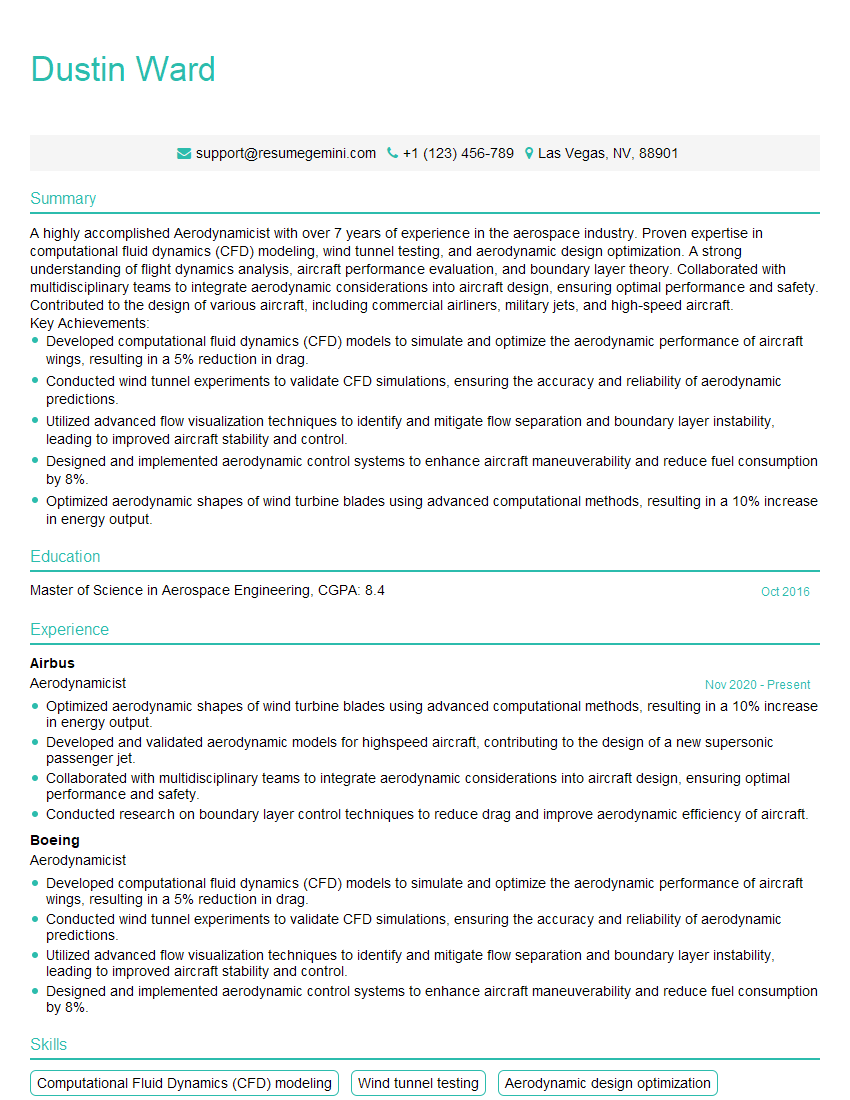
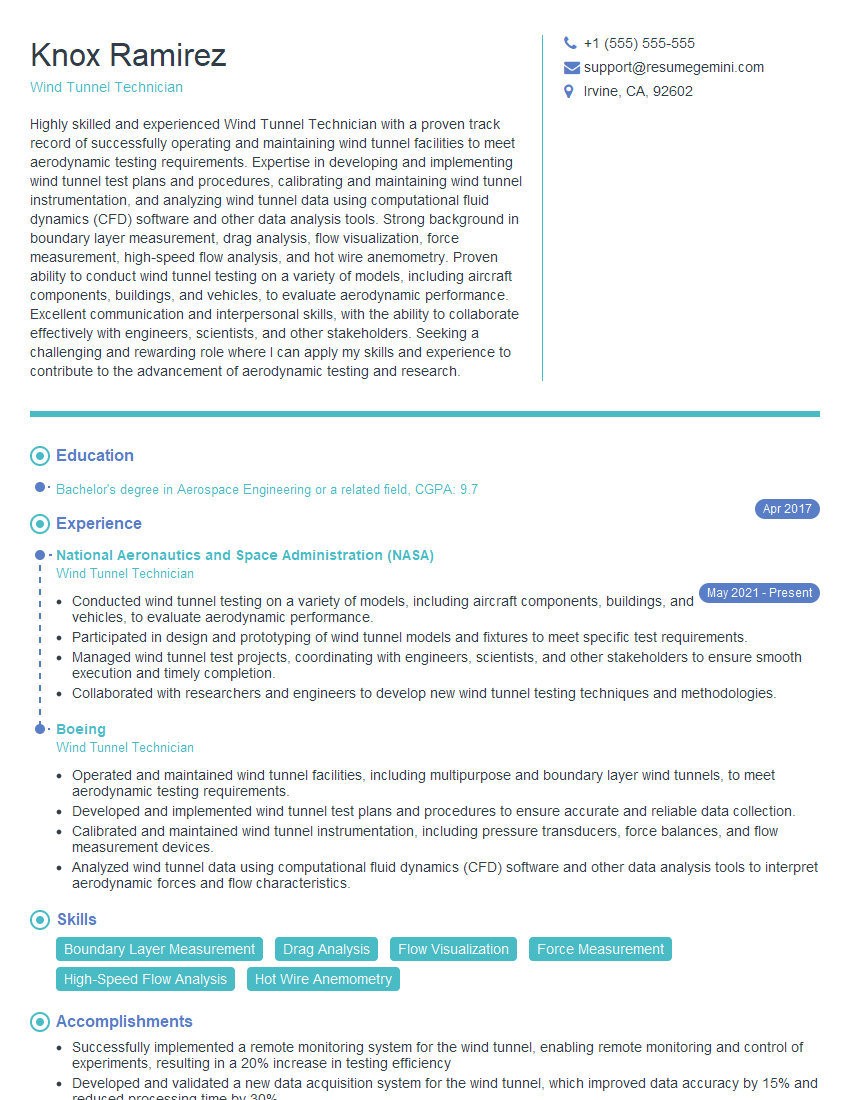
Mastering wind tunnel testing principles significantly enhances your career prospects in aerospace, automotive, and related fields, opening doors to exciting and challenging roles. A strong resume is crucial for showcasing your skills and experience effectively to potential employers. Creating an ATS-friendly resume is key to ensuring your application gets noticed. ResumeGemini is a trusted resource to help you build a professional and impactful resume. We provide examples of resumes tailored to Wind Tunnel Test positions to guide you in creating yours. Take the next step towards your dream career!
Explore more articles
Users Rating of Our Blogs
Share Your Experience
We value your feedback! Please rate our content and share your thoughts (optional).
What Readers Say About Our Blog
Really detailed insights and content, thank you for writing this detailed article.
IT gave me an insight and words to use and be able to think of examples