Unlock your full potential by mastering the most common Yield Analysis and Improvement interview questions. This blog offers a deep dive into the critical topics, ensuring you’re not only prepared to answer but to excel. With these insights, you’ll approach your interview with clarity and confidence.
Questions Asked in Yield Analysis and Improvement Interview
Q 1. Explain the difference between yield and throughput.
While often used interchangeably, yield and throughput represent distinct aspects of manufacturing efficiency. Yield refers to the ratio of good units produced to the total number of units started. It’s a measure of the effectiveness of the process in producing defect-free products. Think of it as the percentage of successfully completed products. For instance, if you start with 100 units and 90 are defect-free, your yield is 90%. Throughput, on the other hand, is the rate at which units are produced over a specific period. It focuses on the volume of output rather than the quality. If you produce 100 units per hour, your throughput is 100 units/hour. A high throughput doesn’t necessarily mean a high yield; you could be producing many units, but a significant portion might be defective.
In short: Yield is about quality (percentage of good units), while throughput is about quantity (number of units produced per unit time).
Q 2. Describe your experience with statistical process control (SPC).
Statistical Process Control (SPC) is integral to my work. I’ve extensively used control charts – particularly X-bar and R charts, and p-charts – to monitor process variation and identify potential issues before they lead to significant yield loss. In a previous role at a semiconductor manufacturing facility, we implemented SPC to track the critical dimensions of integrated circuits. By continuously monitoring the process using control charts, we were able to quickly detect shifts in the mean or increases in variability, allowing us to intervene proactively. For example, we identified a subtle drift in the etching process using the X-bar chart, leading us to adjust equipment settings and prevent a significant yield drop. This proactive approach saved us considerable time and resources, preventing large-scale production defects. I’m proficient in using software like Minitab and JMP to analyze data and generate control charts.
Q 3. How do you identify the root cause of low yield?
Pinpointing the root cause of low yield requires a systematic approach. I typically employ a structured problem-solving methodology, often using a fishbone diagram (Ishikawa diagram) to brainstorm potential causes. This involves categorizing potential causes into groups like materials, methods, manpower, machinery, measurements, and environment. Then, I use data analysis techniques such as Pareto charts to identify the most significant contributors to the problem. This helps prioritize investigations. For example, if a Pareto chart shows that 70% of defects are linked to a particular machine, I would focus my efforts on investigating that machine for malfunctions or miscalibration. Further investigation might involve analyzing process data, conducting failure analysis, or even performing experiments to isolate the root cause. The goal is to move from correlation to causation; identifying the ‘why’ behind the defects, not just the ‘what’.
Q 4. What are some common yield improvement methodologies you have used?
My experience encompasses a variety of yield improvement methodologies. I’ve successfully implemented Six Sigma methodologies, particularly DMAIC (Define, Measure, Analyze, Improve, Control), to systematically address yield issues. In one project, using DMAIC, we reduced defects in a packaging process by over 60%. Lean Manufacturing principles, such as eliminating waste (muda), have also been crucial. This involved streamlining processes, reducing lead times, and improving material flow to minimize defects and improve overall efficiency. Furthermore, I’ve leveraged techniques such as Kaizen (continuous improvement) to foster a culture of ongoing improvement and problem-solving within teams, leading to incremental yet significant yield enhancements over time. Each methodology has its strengths and is best applied based on the specific context of the yield challenge.
Q 5. Explain your experience with Design of Experiments (DOE).
Design of Experiments (DOE) is a powerful tool for optimizing processes and improving yield. I’ve used both full factorial and fractional factorial designs to systematically investigate the impact of multiple process parameters on yield. In a previous role, we used a DOE to optimize the parameters of a chemical reaction, resulting in a 15% increase in yield. The process involved carefully selecting the factors (e.g., temperature, pressure, reactant concentration) and levels to be tested, conducting the experiments, and then analyzing the results using statistical software to identify the optimal settings. Understanding the interactions between factors is critical, which DOE efficiently reveals. My experience encompasses both the design and analysis phases of DOE, ensuring effective experimental planning and accurate interpretation of results.
Q 6. How do you interpret a control chart?
Interpreting a control chart involves assessing whether the process is in statistical control. Control charts visually display process data over time, allowing us to monitor for trends, patterns, or points outside the control limits. Control limits, typically set at 3 standard deviations from the mean, represent the expected variation of the process when it’s stable. Points falling outside these limits suggest special cause variation – something unusual is affecting the process. Trends, such as consecutive points increasing or decreasing, also indicate potential problems. Within-control limits indicate common cause variation, which is inherent to the process. Only when a process is in statistical control can we accurately assess its capability and implement meaningful improvements. A process out of control needs investigation to identify and eliminate the root causes of the special cause variation before further analysis or improvement efforts are undertaken.
Q 7. Describe your experience with process capability analysis (Cpk, Ppk).
Process capability analysis, using Cpk and Ppk, is essential for determining whether a process is capable of meeting specified requirements. Cpk (process capability index) measures the capability of a process when it’s in statistical control, while Ppk (process performance index) assesses the capability based on the overall performance, regardless of statistical control. A higher Cpk/Ppk value indicates better capability. For example, a Cpk of 1.33 suggests that the process is capable of meeting specifications with a very low defect rate. Values below 1 indicate the process is not capable. I’ve used Cpk and Ppk analysis to evaluate the capability of numerous manufacturing processes, identifying areas for improvement and justifying investments in process upgrades. The interpretation of Cpk and Ppk values requires careful consideration of the specific process and the tolerance limits defined.
Q 8. How do you prioritize yield improvement projects?
Prioritizing yield improvement projects requires a strategic approach that balances potential impact with resource constraints. I typically use a multi-criteria decision analysis (MCDA) framework. This involves identifying potential projects, assessing their potential impact on yield (e.g., percentage increase), the cost of implementation, the time required for completion, and the associated risks. Each criterion is weighted according to its importance, and projects are scored based on their performance across all criteria. For instance, a project with a high potential yield increase but a low implementation cost might score higher than a project with a smaller potential impact but a high cost. I also consider the urgency of the project – addressing critical defects or bottlenecks often takes precedence over incremental improvements.
Example: Imagine we have three projects: Project A could increase yield by 15% but requires significant capital investment and time; Project B offers a 5% increase with minimal cost and quick implementation; Project C promises a 10% yield increase with moderate cost and time. Using an MCDA, we could weight potential yield increase (60%), cost (20%), time (10%), and risk (10%). We score each project based on these criteria, calculate a weighted score, and select the project with the highest score. This approach ensures a data-driven and transparent prioritization process.
Q 9. What are some common sources of yield loss in manufacturing?
Yield loss in manufacturing stems from various sources, often interlinked. These can be broadly categorized into:
- Material Defects: Raw material imperfections, contamination, or inconsistencies can lead to significant yield loss. For example, a batch of inconsistent raw materials may result in a higher failure rate during processing.
- Process Defects: Problems in the manufacturing process itself are a major contributor. This includes issues like machine malfunction, improper calibration, inconsistent process parameters, operator errors, and inadequate process controls. An example might be a faulty sensor that results in incorrect temperature settings during a crucial manufacturing step.
- Design Defects: Design flaws in the product itself can lead to high failure rates during manufacturing or in the field. This can be due to inadequate material selection, poor design tolerances, or insufficient testing during the design phase. A classic example would be a poorly designed component that is prone to breakage.
- Environmental Factors: External factors like temperature, humidity, and dust can negatively impact yield. For example, extreme temperature fluctuations may affect the integrity of sensitive components.
Identifying the root cause of yield loss requires a thorough investigation, often using root cause analysis techniques.
Q 10. Explain your experience with root cause analysis techniques (e.g., 5 Whys, Fishbone diagram).
I have extensive experience with several root cause analysis techniques, including the 5 Whys and Fishbone diagrams. The 5 Whys is a simple iterative questioning technique. You repeatedly ask “why” to drill down to the root cause of a problem. For example, if the yield is low (the effect), we’d ask why. The answer might be ‘due to high defect rates’. Why are the defect rates high? ‘Because of improper machine calibration’. Why was it improperly calibrated? ‘Because of lack of operator training’. Why was there a lack of training? ‘Because of insufficient budget allocation’. Why was the budget insufficient? ‘Because of poor project prioritization’. This final answer, poor project prioritization, is potentially a root cause.
The Fishbone diagram (Ishikawa diagram) provides a more structured approach to brainstorming possible causes. The effect (low yield) is placed on the right, and categories of potential causes (e.g., machines, materials, methods, manpower, measurement, environment) are branches from the spine. Each cause is then further broken down into sub-causes. The diagram helps visually map and systematically analyze the potential causes of a problem. This visual approach aids collaboration and identifying interdependencies. I have utilized both methods in numerous projects and choose the most appropriate technique based on the complexity and nature of the problem.
Q 11. How do you measure the effectiveness of yield improvement initiatives?
Measuring the effectiveness of yield improvement initiatives requires clear metrics and a baseline measurement before implementing any changes. Key metrics include:
- Yield Improvement Percentage: This quantifies the increase in the number of good units produced relative to the total number of units processed. For example, an increase from 80% yield to 85% is a 5% improvement.
- Defect Rate Reduction: Tracking the reduction in the number of defects per unit produced, indicating a reduction in process variations or defects.
- Cost Savings: Assessing the financial benefits from reduced material waste, scrap, and rework costs. Calculating the return on investment (ROI) for the improvement initiatives is crucial.
- Cycle Time Reduction: Measuring the improvement in throughput and speed of production – less time wasted on defective units leads to better efficiency.
To ensure accurate measurement, a control group or baseline data before the changes are necessary. We track the chosen metrics over time, comparing post-implementation data with pre-implementation baseline data to quantify improvement. Regular monitoring allows us to identify early warning signs if initiatives aren’t effective and make necessary adjustments.
Q 12. Describe your experience with data analysis tools (e.g., Minitab, JMP).
I have significant experience with data analysis tools like Minitab and JMP. Minitab is excellent for statistical process control (SPC), capability analysis, and design of experiments (DOE). I have used it extensively to monitor process stability, identify assignable causes of variation, and optimize process parameters. For example, using Minitab’s control charts, I’ve identified out-of-control points in a production process that indicated a specific machine malfunction. Similarly, DOE in Minitab helps systematically explore the effects of multiple factors on yield, aiding in identifying optimal settings for maximized yield.
JMP, with its powerful visualization capabilities and robust statistical features, is beneficial for exploratory data analysis and more advanced modeling. I’ve used JMP’s graphing and modeling tools to analyze large datasets to identify patterns and relationships between process parameters and yield. Its platform facilitates comprehensive analysis, allowing for deeper insights into the causes of yield variations. Both tools help ensure a data-driven and objective approach to yield improvement.
Q 13. How do you communicate complex yield data to non-technical audiences?
Communicating complex yield data to non-technical audiences requires translating technical jargon into clear, concise language and using effective visualizations. Instead of using statistical terms, I focus on using relatable analogies and visuals like charts and graphs to convey the message. For instance, instead of saying “the standard deviation of the yield increased by 1.5 units,” I might say “the yield is becoming more unpredictable; we’re seeing more variation in the results.”
I also emphasize the impact of yield improvements in terms that are easy to understand, such as cost savings, improved product quality, or increased customer satisfaction. Using storytelling techniques and highlighting the key takeaways from the data rather than overwhelming them with intricate details is crucial. Visual aids like bar charts showing percentage yield improvement or pie charts illustrating the distribution of defects are far more effective than complex tables of statistical data. I always ensure that my communication is tailored to the audience’s level of understanding and their interests.
Q 14. How do you handle conflicting priorities in yield improvement projects?
Handling conflicting priorities in yield improvement projects requires a well-defined prioritization framework and transparent communication. I would start by clearly defining all competing priorities and the rationale behind each. Then, I’d use the MCDA approach (mentioned earlier) to systematically assess each project’s potential impact, cost, time, and risk, assigning weights to these criteria based on strategic goals. This allows for an objective comparison of projects.
If irreconcilable conflicts still exist, I’d facilitate a discussion with stakeholders to reach a consensus. This involves presenting the weighted scores from the MCDA, outlining the trade-offs between different projects, and exploring alternative solutions. For instance, we might consider phasing projects, prioritizing the most impactful ones first, or reallocating resources to address high-priority issues. Open communication and a collaborative approach are crucial in navigating conflicting priorities and ensuring buy-in from all stakeholders. Documentation of the decision-making process, explaining the rationale behind the prioritization, adds transparency and accountability.
Q 15. Describe a time when you had to overcome a significant yield challenge.
One significant yield challenge I faced involved a semiconductor fabrication process where we experienced a drastic drop in wafer yield due to an unexplained increase in particle defects. Initially, we suspected issues with the cleanroom environment or the chemical dispensing system. However, after a thorough investigation using a combination of Design of Experiments (DOE) and Failure Mode and Effects Analysis (FMEA), we discovered the root cause was a subtle vibration issue in one specific piece of equipment, leading to microscopic particle generation during a critical etching step. This wasn’t readily apparent through standard monitoring. The solution involved a multi-pronged approach: damping the vibrations using specialized isolators, implementing stricter preventative maintenance protocols for that specific machine, and upgrading our particle monitoring system for more precise real-time detection.
This experience highlighted the importance of not prematurely jumping to conclusions when dealing with yield issues. A systematic, data-driven approach combined with advanced analytical techniques is critical for effective troubleshooting. The improvement in yield after implementing these changes was significant, resulting in millions of dollars saved annually.
Career Expert Tips:
- Ace those interviews! Prepare effectively by reviewing the Top 50 Most Common Interview Questions on ResumeGemini.
- Navigate your job search with confidence! Explore a wide range of Career Tips on ResumeGemini. Learn about common challenges and recommendations to overcome them.
- Craft the perfect resume! Master the Art of Resume Writing with ResumeGemini’s guide. Showcase your unique qualifications and achievements effectively.
- Don’t miss out on holiday savings! Build your dream resume with ResumeGemini’s ATS optimized templates.
Q 16. What are the key performance indicators (KPIs) you track for yield?
Key Performance Indicators (KPIs) for yield analysis are crucial for tracking progress and identifying areas for improvement. The specific KPIs will vary depending on the industry and process, but some common ones include:
- Overall Equipment Effectiveness (OEE): Measures the efficiency of equipment, factoring in availability, performance, and quality.
- Yield Rate: The percentage of good units produced compared to the total number of units processed (e.g., number of functional chips per wafer).
- Defect Rate: The percentage of defective units produced.
- First-Pass Yield (FPY): The percentage of units successfully completed without rework or scrap on the first attempt.
- Roll Throughput Yield (RTY): The cumulative yield considering multiple steps in a process, reflecting the overall effectiveness of the entire production line.
- Cost per Unit: Directly tied to yield; higher yield translates to lower manufacturing cost.
Tracking these KPIs provides a comprehensive overview of the yield performance and helps to pinpoint bottlenecks or areas requiring optimization.
Q 17. Explain your experience with failure analysis techniques.
My experience with failure analysis techniques is extensive. I’ve utilized various methods, ranging from simple visual inspection to advanced analytical tools. For example, in analyzing semiconductor failures, techniques like scanning electron microscopy (SEM), energy-dispersive X-ray spectroscopy (EDS), and focused ion beam (FIB) are frequently employed to identify physical defects and material composition issues at the microscopic level.
For more complex systems, I often utilize root cause analysis techniques like the ‘5 Whys’ method to systematically drill down to the underlying causes of failures. Statistical analysis methods, such as control charts and ANOVA (Analysis of Variance), help to identify significant variations and their impact on yield. Data mining and machine learning techniques are also increasingly valuable in identifying patterns and predicting failures.
In one instance, a seemingly random failure pattern was resolved by using advanced statistical methods that revealed a previously undetected correlation between specific environmental factors and equipment failures. This led to a targeted environmental control adjustment that drastically reduced failures.
Q 18. How do you ensure data accuracy and integrity in yield analysis?
Ensuring data accuracy and integrity in yield analysis is paramount. This is achieved through a combination of strategies:
- Automated Data Acquisition: Implementing automated data collection systems minimizes manual data entry errors.
- Data Validation and Cleaning: Implementing robust checks and data cleaning procedures to identify and correct anomalies, outliers, and missing data. This often involves scripting or using specialized software.
- Data Traceability: Establishing a clear chain of custody for all data collected, ensuring data origin and processing steps are documented.
- Regular Audits: Conducting periodic audits to verify the accuracy and consistency of data collection and analysis methods.
- Version Control: Maintaining version control for all data and analysis scripts, to allow for tracking of changes and reproducibility.
A robust data management system and rigorous quality control processes are essential to maintain data integrity throughout the entire yield analysis process.
Q 19. Describe your experience with Lean Six Sigma methodologies.
I have extensive experience applying Lean Six Sigma methodologies to improve yield. Lean principles, focused on eliminating waste and streamlining processes, are invaluable in identifying and removing bottlenecks in the production line that negatively impact yield. Six Sigma’s focus on reducing variation and improving process capability is crucial for achieving stable and high yields.
In a previous project, we employed DMAIC (Define, Measure, Analyze, Improve, Control) to improve the yield of a specific product. We defined the problem (low yield), measured the current performance, analyzed the root causes using statistical tools, implemented improvements based on our analysis (e.g., process parameter adjustments, equipment upgrades), and then established controls to sustain the gains. The project resulted in a significant improvement in yield and a considerable reduction in production costs.
Q 20. How do you incorporate automation into yield improvement strategies?
Incorporating automation into yield improvement strategies is crucial for achieving higher efficiency and reducing human error. Automation can be implemented at various stages of the process:
- Automated Data Acquisition and Analysis: Using sensors, automated testing systems, and data analysis software to collect and analyze yield data in real-time.
- Automated Process Control: Implementing closed-loop control systems to automatically adjust process parameters based on real-time data, minimizing variations and improving consistency.
- Automated Defect Detection: Utilizing machine vision systems and other automated inspection techniques to identify and classify defects early in the process.
- Robotics and Automation in Manufacturing: Employing robots and automated systems to perform repetitive tasks, increasing speed, precision, and consistency in manufacturing.
For instance, in a manufacturing setting, automated optical inspection systems can identify defects on a product much faster and more reliably than manual inspection, leading to immediate process adjustments and higher yield.
Q 21. What is your experience with predictive maintenance in relation to yield?
Predictive maintenance plays a crucial role in maintaining high yield by preventing equipment failures before they occur. By monitoring key equipment parameters and using machine learning algorithms, we can predict potential failures and schedule maintenance proactively, minimizing downtime and reducing scrap. This is especially important in complex manufacturing processes where equipment failures can significantly impact yield.
For example, by analyzing vibration data from a critical piece of equipment, we can identify patterns that indicate impending failure. This allows for preventative maintenance to be scheduled before the failure occurs, thereby avoiding costly downtime and maintaining consistent production and high yield.
Implementing a predictive maintenance program requires investing in appropriate sensor technologies, data analytics platforms, and skilled personnel capable of interpreting the data and implementing appropriate actions.
Q 22. How do you manage stakeholder expectations during a yield improvement project?
Managing stakeholder expectations in a yield improvement project is crucial for success. It’s about setting realistic goals, maintaining transparent communication, and fostering a collaborative environment. I begin by clearly defining project objectives, timelines, and potential challenges during the initial kickoff meeting. This includes establishing Key Performance Indicators (KPIs) that are measurable and understood by all stakeholders. For example, instead of vaguely stating ‘improve yield,’ we might target a specific percentage increase within a defined timeframe. Regular progress reports, presented in a clear and concise manner (perhaps using dashboards or visual aids), help maintain transparency and address concerns proactively. Active listening and addressing stakeholder feedback are essential; I encourage open communication channels to ensure that everyone feels heard and involved. Addressing setbacks honestly and transparently builds trust and demonstrates a commitment to accountability. Finally, celebrating milestones along the way helps maintain motivation and reinforces the shared success of the project.
Q 23. Explain your experience with capacity planning and its impact on yield.
Capacity planning plays a vital role in maximizing yield. It’s the process of determining the necessary resources – equipment, personnel, materials – to meet production demands efficiently. In my experience, insufficient capacity often leads to bottlenecks, increased error rates, and ultimately, lower yield. For instance, in a previous role at a semiconductor manufacturing plant, we identified a bottleneck in the wafer etching process. Capacity planning revealed that the etching equipment was operating at nearly 100% utilization, leaving no room for maintenance or unexpected downtime. This resulted in frequent production halts and significant yield losses. By strategically increasing etching capacity through a combination of equipment upgrades and optimized scheduling, we were able to improve the overall yield by 15% within six months. Effective capacity planning also involves forecasting demand accurately. Using historical data, market trends, and predictive modeling techniques, we can anticipate future needs and ensure sufficient capacity is available to meet those needs without compromising yield.
Q 24. What are some common challenges in implementing yield improvement initiatives?
Implementing yield improvement initiatives often faces various challenges. One common hurdle is resistance to change. Employees accustomed to existing processes may be hesitant to adopt new methods, even if those methods promise significant improvements. Another challenge lies in data collection and analysis. Accurate and reliable data are essential for identifying root causes of yield losses. Inconsistent data collection methods or incomplete data sets can hinder effective analysis. Furthermore, resource constraints, both financial and personnel-related, can limit the scope and effectiveness of initiatives. Finally, unforeseen technical difficulties or equipment failures can disrupt the project timeline and impact the overall yield improvement efforts. Overcoming these challenges requires a multi-faceted approach. This includes engaging employees through training and clear communication, investing in robust data management systems, securing sufficient resources, and developing contingency plans to mitigate risks.
Q 25. How do you stay up-to-date with the latest trends in yield analysis and improvement?
Staying abreast of the latest trends in yield analysis and improvement is critical for maintaining a competitive edge. I regularly attend industry conferences and workshops, such as those organized by SEMI or IEEE. These events provide valuable opportunities to learn about new technologies, methodologies, and best practices. I also subscribe to industry-specific journals and publications, like the ‘Journal of Quality Technology’, to stay informed about the latest research and advancements. Networking with colleagues and experts through professional organizations like ASQ is invaluable for exchanging knowledge and gaining insights into real-world applications. Online learning platforms and courses focused on data analytics, statistical process control (SPC), and design of experiments (DOE) are also crucial for my continuous professional development. Finally, actively participating in online forums and communities dedicated to yield improvement helps me stay updated on emerging trends and discuss challenges with other professionals.
Q 26. Describe your experience with different types of yield losses (e.g., material, process, inspection).
My experience encompasses various types of yield losses. Material losses can stem from defects in raw materials, inconsistent material properties, or improper handling. For example, in a pharmaceutical manufacturing setting, defects in raw materials could lead to the rejection of entire batches. Process losses arise from inefficiencies or errors in the manufacturing process itself. This could involve issues like equipment malfunctions, incorrect process parameters, or inadequate operator training. For instance, a slight variation in temperature during a chemical reaction could significantly reduce yield. Inspection losses occur when good products are incorrectly classified as defective due to limitations or errors in the inspection process. This could result from human error, inadequate inspection equipment, or poorly defined inspection criteria. Identifying the root cause of each type of loss requires different analytical approaches. For material losses, it might involve analyzing supplier data and material specifications. Process losses require investigation of the process parameters and equipment performance. For inspection losses, it is crucial to evaluate the accuracy and precision of the inspection methods.
Q 27. How would you approach a situation where a sudden drop in yield is observed?
A sudden drop in yield demands a rapid and systematic response. The first step is to immediately halt production to prevent further losses and ensure safety. Next, a thorough investigation is launched to pinpoint the root cause. This involves carefully reviewing process parameters, examining equipment logs, and analyzing the quality of raw materials. Statistical Process Control (SPC) charts can be invaluable in identifying trends and anomalies that might indicate the cause of the yield drop. For example, a sudden increase in the control chart’s standard deviation might point to a problem with equipment stability. A multidisciplinary team, comprising engineers, technicians, and quality control personnel, is usually assembled to conduct this investigation. Once the root cause is identified, corrective actions are implemented promptly. These might involve equipment repairs, process adjustments, or operator retraining. After the corrective actions, it is essential to closely monitor the yield to confirm the effectiveness of the interventions. Finally, a thorough post-mortem analysis is conducted to prevent similar events from occurring in the future. This analysis might involve process improvements, better preventive maintenance procedures, or improved operator training programs.
Key Topics to Learn for Yield Analysis and Improvement Interview
- Understanding Yield Metrics: Defining and interpreting key yield indicators like overall equipment effectiveness (OEE), process capability indices (Cp, Cpk), and defect rates. Practical application: Analyzing historical data to identify bottlenecks and areas for improvement.
- Root Cause Analysis Techniques: Mastering methods like 5 Whys, Fishbone diagrams, and Pareto analysis to pinpoint the underlying causes of yield loss. Practical application: Leading a root cause analysis investigation for a specific yield issue in a manufacturing setting.
- Process Improvement Methodologies: Familiarity with Lean Manufacturing principles (Kaizen, Value Stream Mapping), Six Sigma (DMAIC), and Design of Experiments (DOE). Practical application: Designing and implementing a Kaizen event to improve a specific process step.
- Data Analysis and Statistical Methods: Proficiency in statistical software (e.g., Minitab, JMP) for data analysis, hypothesis testing, and regression analysis. Practical application: Building a statistical model to predict yield based on key process parameters.
- Yield Improvement Strategies: Developing and implementing strategies for yield enhancement, including process optimization, equipment upgrades, and operator training. Practical application: Presenting a cost-benefit analysis of different yield improvement options.
- Communication and Collaboration: Effectively communicating findings and recommendations to stakeholders at all levels. Practical application: Presenting a yield improvement plan to management and securing buy-in.
Next Steps
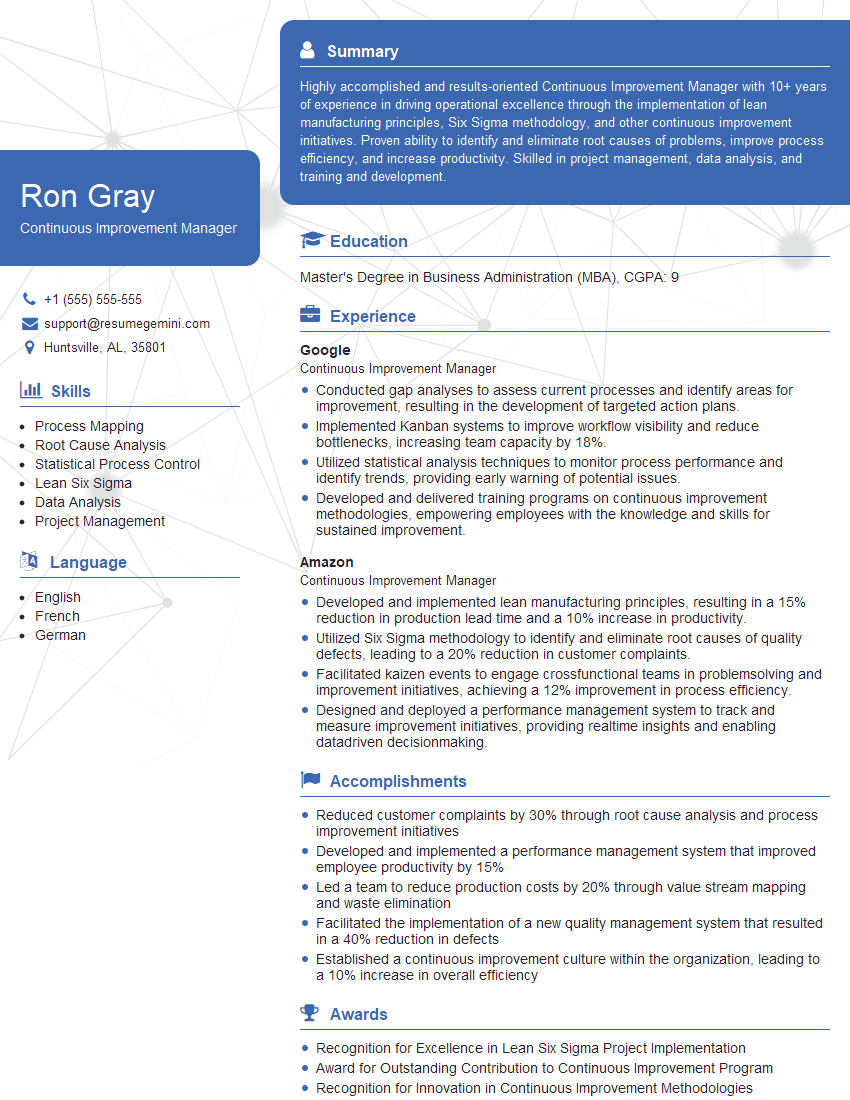
Mastering Yield Analysis and Improvement opens doors to exciting career opportunities with significant earning potential and leadership roles within manufacturing, engineering, and operations. To maximize your job prospects, crafting a compelling and ATS-friendly resume is crucial. ResumeGemini is a trusted resource to help you build a professional resume that highlights your skills and experience effectively. Examples of resumes tailored to Yield Analysis and Improvement roles are provided to guide you in creating your own exceptional resume. Take the next step towards your dream career today!


Explore more articles
Users Rating of Our Blogs
Share Your Experience
We value your feedback! Please rate our content and share your thoughts (optional).
What Readers Say About Our Blog
Really detailed insights and content, thank you for writing this detailed article.
IT gave me an insight and words to use and be able to think of examples