Cracking a skill-specific interview, like one for Tax Audit Assistance, requires understanding the nuances of the role. In this blog, we present the questions you’re most likely to encounter, along with insights into how to answer them effectively. Let’s ensure you’re ready to make a strong impression.
Questions Asked in Tax Audit Assistance Interview
Q 1. Explain the different types of tax audits.
Tax audits can be categorized in several ways, depending on the initiating entity and the scope of the review. Broadly, we can distinguish between internal audits and external audits.
- Internal Audits: These are conducted by a company’s own internal audit department or hired specialists. Their purpose is to ensure compliance with tax laws, identify areas for improvement in tax processes, and detect potential errors before they are flagged by external authorities. They often focus on specific areas or transactions.
- External Audits: These are performed by independent tax professionals or government agencies (e.g., the IRS in the US). They can range from routine reviews of tax returns to comprehensive investigations triggered by suspicion of fraud or significant discrepancies. The scope is often broader than internal audits and can result in penalties if non-compliance is discovered.
Further, audits can be classified by their focus:
- Financial Statement Audits: These audits examine the financial statements to ensure they accurately reflect the company’s financial position and that the tax returns are consistent with the financial statements.
- Tax Return Audits: These audits concentrate specifically on the accuracy and completeness of a company’s tax returns, focusing on calculations, deductions, and credits.
- Compliance Audits: These audits aim to determine if a company adheres to all relevant tax laws and regulations.
The type of audit significantly impacts the scope, methodology, and documentation required.
Q 2. Describe your experience with tax audit planning and execution.
My experience encompasses all aspects of tax audit planning and execution. I begin by understanding the client’s business and their specific risk profile. This involves reviewing their financial statements, tax returns from previous years, and key transactions. I then develop a comprehensive audit plan, outlining the scope, objectives, timelines, and resources required.
For example, when working with a manufacturing company, I might prioritize areas such as inventory valuation, depreciation calculations, and research and development tax credits, as these often present higher risk areas. The planning phase involves identifying potential areas of concern, defining the sampling methodology (if applicable), and creating a detailed checklist for the audit team.
During the execution phase, my focus is on meticulous data collection, thorough analysis, and the application of relevant tax laws and regulations. I leverage technology for data extraction and analysis, enabling efficient and comprehensive testing. Throughout the audit, I maintain clear and consistent documentation, ensuring traceability and supporting all findings and conclusions. Finally, I prepare a detailed audit report summarizing the findings, recommendations, and any required adjustments.
Q 3. How do you identify and assess tax risks?
Identifying and assessing tax risks is a crucial part of my role. I utilize a risk-based approach, considering both inherent and control risks. Inherent risk relates to the nature of the business and the transactions it undertakes. For instance, a company involved in international transactions will face higher inherent risks than a purely domestic business due to complexities in transfer pricing.
Control risk focuses on the effectiveness of the client’s internal controls. Weak internal controls increase the likelihood of errors or omissions. For example, a lack of segregation of duties in handling cash transactions can lead to misstatements and tax irregularities. I assess these risks using various techniques including:
- Review of prior-year audits and tax returns: Identifying recurring issues or trends.
- Analytical procedures: Comparing key financial ratios and metrics against industry benchmarks and prior periods.
- Industry-specific knowledge: Understanding common tax issues faced by similar businesses.
- Discussions with client management: Gaining insights into the client’s business processes and control environment.
Once the risks are identified and assessed, I prioritize areas requiring more detailed scrutiny, developing targeted audit procedures to address these risks effectively.
Q 4. What are your skills in using tax audit software and tools?
I am proficient in various tax audit software and tools, including specialized applications like CaseWare, ProSystem fx Tax, and Thomson Reuters UltraTax. I use these tools to streamline the audit process, facilitating efficient data analysis, document management, and report generation. My skills encompass data extraction, analytical procedures, and the preparation of comprehensive audit work papers in compliance with professional standards.
Beyond dedicated tax software, I am skilled in using data analytics tools such as Microsoft Excel and SQL to extract, clean, and analyze large datasets. This helps me identify anomalies and trends within financial information more effectively. I also utilize data visualization tools to present audit findings in a clear and concise manner.
Q 5. Explain your understanding of GAAP and its relevance in tax audits.
Generally Accepted Accounting Principles (GAAP) are crucial in tax audits because they provide a framework for consistently recording and reporting financial information. Understanding GAAP is vital because tax returns are based on the financial information prepared according to these principles. Consistency in applying GAAP ensures that the financial statements reflect the true financial position of the company, thus supporting the accuracy of the tax calculations.
For example, the method used for inventory valuation (FIFO, LIFO, weighted average) under GAAP will directly impact the cost of goods sold and, consequently, taxable income. Similarly, the method of depreciation used will affect the company’s tax liability. Discrepancies between the accounting methods used for financial reporting and those used for tax reporting are a common source of audit issues. My experience ensures I can identify and resolve such inconsistencies effectively.
Q 6. Describe your experience in reviewing financial statements for tax compliance.
My experience in reviewing financial statements for tax compliance is extensive. This involves a thorough examination of the balance sheet, income statement, statement of cash flows, and notes to the financial statements. I focus on areas such as revenue recognition, expense classification, asset valuation, and liability recognition, ensuring consistency with the tax returns and compliance with relevant tax laws.
For instance, I meticulously review revenue recognition policies to ensure compliance with GAAP and tax regulations, paying close attention to any unusual fluctuations or potential revenue mischaracterization. Similarly, I scrutinize expense classifications to ensure they align with tax-deductible expenses and identify any potential areas for disallowance. This often requires a detailed understanding of the specific industry in which the company operates.
Thorough documentation is critical during this review. I create detailed work papers outlining the analysis performed, the findings, and any adjustments proposed, ensuring complete traceability and supporting all conclusions.
Q 7. How do you handle discrepancies found during a tax audit?
Handling discrepancies discovered during a tax audit involves a systematic and methodical approach. The first step is to thoroughly document the discrepancy, noting the nature, amount, and supporting evidence. Next, I investigate the root cause of the discrepancy, potentially involving discussions with client personnel, review of additional documentation, or further data analysis. Depending on the nature and materiality of the discrepancy, different approaches are needed:
- Minor Discrepancies: These might be due to simple errors or omissions. Corrective entries can be proposed to resolve the discrepancies.
- Significant Discrepancies: These require more in-depth investigation to understand the underlying causes. This might involve consulting with tax specialists or legal counsel. Depending on the context, potential adjustments to the tax return might be necessary.
- Fraudulent Activities: In cases of suspected fraud, the appropriate authorities might need to be informed, and the audit findings will be reported accordingly.
Throughout the process, open communication with the client is crucial. I aim to work collaboratively with the client to resolve discrepancies efficiently and effectively while ensuring full compliance with tax laws and regulations. Transparency and clear communication are key to achieving a positive outcome.
Q 8. What is your approach to resolving tax audit findings?
Resolving tax audit findings requires a systematic approach. My strategy begins with a thorough understanding of the audit findings themselves. This involves carefully reviewing all documentation provided by the auditor, identifying the specific issues raised, and quantifying the potential financial impact. Then, I meticulously analyze the underlying transactions and supporting evidence.
For example, if an audit flags discrepancies in depreciation calculations, I’d examine the company’s asset register, depreciation schedules, and supporting documentation for the relevant assets. I might discover that an error was made in applying the correct depreciation method or that certain assets were improperly classified.
Once the root cause is identified, I develop a strategy to address it. This might involve preparing a detailed explanation and providing supporting documentation to the auditor, proposing adjustments to the tax return, or suggesting procedural changes to prevent similar issues in the future. The process is iterative; I often engage in back-and-forth discussions with the auditor to ensure clarity and reach a mutually agreeable resolution. My goal is always to achieve the most favorable outcome for my client while ensuring full compliance with tax regulations.
Q 9. How do you manage your time effectively during a complex tax audit?
Managing time effectively during a complex tax audit requires meticulous planning and prioritization. I typically begin by creating a detailed project plan that outlines all the tasks involved, assigning deadlines to each, and identifying potential bottlenecks. I utilize project management tools to track progress and manage resources.
For instance, if we’re dealing with a large volume of transactions, I might delegate tasks to junior team members, ensuring proper oversight and quality control. I regularly communicate with the client and the auditor to maintain transparency and to address any emerging issues promptly. Proactive communication helps avoid delays and unexpected complications. Time management isn’t just about working harder, it’s about working smarter. This includes focusing on high-impact tasks, delegating effectively, and consistently monitoring progress against the plan. Prioritization is key: I address the most critical findings first to minimize potential penalties or disruptions.
Q 10. How do you communicate audit findings to clients or management?
Communicating audit findings to clients or management is crucial and requires a clear, concise, and readily understandable approach. I avoid technical jargon and explain complex issues in plain language. I always start by summarizing the overall findings in a non-technical executive summary. Then I present the details, clearly explaining the nature of each finding, its potential impact, and the recommended course of action.
I often use visual aids like charts and graphs to simplify complex data and make the information easier to digest. For example, I might use a pie chart to illustrate the proportion of various tax adjustments. Following the presentation, I encourage a question-and-answer session to clarify any ambiguities and address concerns. The goal is to ensure that the client or management fully understands the findings and is comfortable with the proposed plan of action. I also provide written documentation summarizing the findings, the proposed solutions, and the next steps. This creates a lasting record of the process and our recommendations.
Q 11. Describe your experience with different tax audit methodologies.
Throughout my career, I’ve been exposed to various tax audit methodologies. I’m familiar with both the traditional compliance-based audits, which focus on verifying the accuracy of reported information, and more contemporary risk-based audits, which identify and assess areas of higher tax risk. I’m experienced in handling audits conducted by both internal audit teams and external tax authorities.
For instance, I’ve worked extensively with the Internal Revenue Service (IRS) audit procedures, including the use of their computer-assisted audit techniques (CAATs). I understand how these tools are used to analyze large datasets and identify anomalies. I’ve also navigated the complexities of international tax audits, requiring an understanding of both domestic and foreign tax regulations. My approach to each audit adapts to the specific methodology employed, ensuring that I can effectively respond to the auditor’s requests and present a robust defense of the client’s tax position.
Q 12. What is your experience with tax compliance issues relating to specific industries?
My experience encompasses various industries, each presenting unique tax compliance challenges. I have substantial experience with the intricacies of the financial services industry, including navigating complex regulations around investment income, capital gains, and derivatives. I’ve also assisted clients in the manufacturing sector, addressing issues concerning inventory valuation, depreciation, and research and development credits.
In the healthcare industry, I’ve worked extensively with issues related to Medicare and Medicaid reimbursements and compliance with the Affordable Care Act (ACA). This experience has provided me with a deep understanding of the specific industry-related regulations and best practices for minimizing tax liability while staying fully compliant. This specialized knowledge allows me to provide tailored advice and support to clients across diverse sectors.
Q 13. Explain your experience in preparing tax audit reports.
Preparing comprehensive and accurate tax audit reports is a critical aspect of my work. I ensure that each report provides a clear and concise summary of the audit findings, including a detailed description of the issues identified, the supporting evidence, and the proposed resolutions.
My reports are structured logically and follow a consistent format, making them easy to navigate and understand. I include relevant financial statements, supporting schedules, and other necessary documentation to support my conclusions. For example, if a finding relates to a specific transaction, I’ll include copies of the relevant invoices, contracts, and bank statements. Beyond simply presenting the facts, I offer my professional analysis and recommendations, clearly outlining the potential financial impact of each issue and suggesting strategies for mitigation or resolution. This ensures the report is not just a record of events but a valuable tool for the client to improve their tax compliance going forward. I always strive to ensure the report is clear, concise, and easily understood by both the client and the auditor.
Q 14. How do you ensure the accuracy and completeness of tax audit data?
Ensuring the accuracy and completeness of tax audit data is paramount. My approach involves a multi-layered quality control process. First, I carefully review all source documents to identify any inconsistencies or errors. I utilize data analytics tools to identify trends and anomalies that might indicate data inaccuracies.
For instance, I might use data analysis software to compare reported revenue with historical trends or industry benchmarks, flagging any significant deviations for further investigation. Second, I employ independent verification methods, such as reconciling data from multiple sources and performing cross-checks to ensure consistency. Finally, I conduct a thorough review of the entire data set before submitting it to the auditor or client. This meticulous approach minimizes the risk of errors and ensures the highest level of data integrity. By combining technological tools with traditional auditing techniques, I significantly enhance the accuracy and reliability of the data used in the audit process.
Q 15. Describe your experience with internal controls and their relevance to tax audits.
Internal controls are the processes and procedures a company puts in place to ensure the accuracy, reliability, and integrity of its financial reporting. In a tax audit, strong internal controls significantly reduce the risk of errors and omissions, making the audit process smoother and more efficient. Think of them as the guardrails on a highway – they keep things running smoothly and prevent accidents (like misstated tax liabilities).
My experience involves assessing the effectiveness of various internal controls, including those related to revenue recognition, expense tracking, inventory management, and fixed asset accounting. I utilize frameworks like COSO (Committee of Sponsoring Organizations of the Treadway Commission) to evaluate these controls and identify weaknesses. For example, I once worked with a client whose expense reporting lacked proper authorization and documentation. This led to inconsistencies and ultimately increased the audit risk. By implementing a new, more robust expense reporting system with clear approval workflows and digital documentation, we mitigated this risk and improved the accuracy of their tax filings.
- Example 1: Segregation of duties – ensuring no single person has complete control over a transaction to prevent fraud.
- Example 2: Regular bank reconciliations – comparing bank statements to internal records to detect discrepancies.
Career Expert Tips:
- Ace those interviews! Prepare effectively by reviewing the Top 50 Most Common Interview Questions on ResumeGemini.
- Navigate your job search with confidence! Explore a wide range of Career Tips on ResumeGemini. Learn about common challenges and recommendations to overcome them.
- Craft the perfect resume! Master the Art of Resume Writing with ResumeGemini’s guide. Showcase your unique qualifications and achievements effectively.
- Don’t miss out on holiday savings! Build your dream resume with ResumeGemini’s ATS optimized templates.
Q 16. What are your skills in data analysis and its application in tax audits?
Data analysis is crucial in modern tax audits. My skills encompass data extraction, cleaning, manipulation, and analysis using various tools like Excel, SQL, and specialized tax software. I use this skillset to identify trends, anomalies, and areas of potential risk within large datasets. This allows me to focus audit efforts on high-risk areas, ensuring efficiency and thoroughness.
For instance, I recently used data analysis to uncover a pattern of unusually high deductions claimed by a client for travel expenses. By analyzing the data, I identified inconsistencies in the supporting documentation which ultimately led to a correction of their tax return. Beyond simply identifying errors, I can also use data analysis to provide predictive modeling, helping clients proactively plan for future tax liabilities.
Example: Using SQL to query a database for all transactions exceeding a certain threshold to identify potential outliers.Q 17. How do you stay current with changes in tax laws and regulations?
Staying up-to-date on tax law changes is paramount in this field. I achieve this through a multi-pronged approach:
- Professional Development: Attending industry conferences, webinars, and continuing professional education (CPE) courses.
- Subscription Services: Utilizing reputable tax research databases and newsletters that provide timely updates on legislation and court decisions.
- Professional Organizations: Actively participating in professional organizations like the AICPA (American Institute of CPAs) and staying informed through their publications and resources.
- Networking: Engaging with colleagues and other tax professionals to share insights and best practices.
This ensures I’m always equipped with the latest knowledge and can provide clients with the most accurate and up-to-date advice. It’s like constantly updating a navigation system; without it, you risk getting lost (making costly errors).
Q 18. Describe a challenging tax audit situation and how you overcame it.
One challenging situation involved a client facing a complex audit related to international tax regulations. They had significant transactions across multiple jurisdictions, and the applicable tax treaties were intricate. The initial audit findings suggested substantial underpayment of taxes.
My approach was methodical: I first thoroughly analyzed all the relevant documentation, including contracts, invoices, and transfer pricing agreements. Then, I engaged with the client’s legal team to understand the nuances of the tax treaties involved. We carefully reconstructed the transactions, meticulously documenting our analysis and challenging the auditor’s initial assessment where applicable. Through this collaborative approach, we successfully negotiated a significant reduction in the proposed tax liability. The key to overcoming this challenge was meticulous attention to detail, a deep understanding of international tax law, and effective communication with all stakeholders.
Q 19. What are your skills in working with various stakeholders during a tax audit?
Effective communication and collaboration are vital during tax audits. I’m adept at working with a variety of stakeholders, including clients, internal teams, external auditors, and tax authorities. My approach focuses on building strong relationships based on trust and transparency.
I strive to explain complex tax issues in a clear, concise, and easily understandable manner. I actively listen to the concerns and perspectives of others, fostering a collaborative environment where we work together to resolve issues efficiently. This includes providing regular updates, proactively addressing questions, and presenting information in a way that is accessible and non-technical. A successful tax audit relies heavily on clear, open communication.
Q 20. How do you handle pressure and deadlines in a tax audit environment?
Tax audits often involve tight deadlines and high pressure. My approach to managing this involves meticulous planning and prioritization. I break down complex tasks into smaller, manageable steps, establishing clear milestones and deadlines for each. This allows me to track progress effectively and address any potential delays proactively.
I also prioritize effective time management techniques, such as using project management tools and delegating tasks when appropriate. Additionally, I maintain a calm and focused demeanor under pressure, recognizing that a clear head is crucial for making sound decisions and solving problems effectively. I also ensure that I take breaks and manage my workload to prevent burnout.
Q 21. Explain your understanding of tax laws related to depreciation and amortization.
Depreciation and amortization are methods used to allocate the cost of tangible and intangible assets over their useful lives. Depreciation applies to tangible assets (like machinery or buildings), while amortization applies to intangible assets (like patents or copyrights).
Tax laws governing depreciation and amortization vary depending on the country and the specific asset. Generally, they involve selecting an appropriate depreciation method (like straight-line or accelerated methods) and determining the asset’s useful life and salvage value. For example, in the U.S., the Modified Accelerated Cost Recovery System (MACRS) is commonly used for depreciation. Amortization methods typically involve spreading the cost of an intangible asset over its estimated useful life, often using the straight-line method. Understanding these rules, their complexities, and the impact on taxable income is critical for accurate tax reporting. Incorrect calculation can lead to significant tax liabilities or unwarranted refunds.
I have extensive experience in applying these principles to various scenarios, ensuring compliance with relevant tax regulations. I also stay abreast of any changes or updates in legislation impacting these areas.
Q 22. Describe your experience with transfer pricing audits.
Transfer pricing audits focus on verifying the prices charged between related entities (e.g., parent company and subsidiary) in different jurisdictions. My experience encompasses numerous such audits, ranging from small privately-held companies to multinational corporations. This involves a deep understanding of the OECD Transfer Pricing Guidelines, various comparable uncontrolled price (CUP) methods, cost-plus, and transactional net margin methods (TNMM). I’ve successfully defended clients against tax assessments by meticulously documenting their intercompany transactions, ensuring compliance with arm’s-length principle, and leveraging robust economic analyses. For instance, I recently assisted a technology firm in a transfer pricing audit by meticulously documenting its cost-sharing arrangement with its parent company, resulting in a successful reduction of the tax assessment.
A key aspect of my approach is proactive planning. Before a potential audit, we conduct thorough reviews of intercompany agreements and pricing policies to identify and mitigate potential risks. During an audit, I actively engage with the tax authorities, providing clear and concise explanations of the chosen transfer pricing methodology and its application. I’m proficient in using various software tools for benchmarking and comparative analysis to support our position and ensure a successful outcome.
Q 23. What is your experience with international tax compliance issues?
International tax compliance involves navigating the complexities of multiple tax jurisdictions, including different tax rates, regulations, and reporting requirements. My experience spans several years, assisting clients with navigating challenges such as foreign tax credits, permanent establishment (PE) determinations, and the implications of bilateral tax treaties. I’ve worked extensively on cross-border transactions, advising on structuring to minimize tax liabilities while remaining fully compliant with applicable laws. For example, I helped a client establish a tax efficient structure for its overseas operations by leveraging the Double Taxation Avoidance Agreement (DTAA) between two countries, ultimately saving them a significant sum in taxes.
I’m particularly adept at staying current with the ever-changing international tax landscape, including the BEPS (Base Erosion and Profit Shifting) initiative and its impact on multinational corporations. This includes understanding and applying the updated OECD guidelines, Country-by-Country (CbC) reporting, and other related initiatives aimed at improving international tax transparency and fairness. My work often involves close collaboration with foreign tax advisors and legal professionals to ensure a comprehensive and effective approach to international tax compliance.
Q 24. Explain your knowledge of various tax audit sampling methods.
Tax audit sampling methods are crucial for efficiently examining large datasets. Different methods offer varying degrees of precision and efficiency. My knowledge encompasses various techniques, including:
- Random Sampling: Every transaction has an equal chance of being selected, ensuring unbiased results. It’s simple to implement but may not always be efficient.
- Stratified Sampling: The population is divided into strata (e.g., transaction type, value range), and samples are drawn from each stratum proportionally. This improves accuracy by ensuring representation across different segments.
- Systematic Sampling: Every nth item is selected. It’s straightforward but can be biased if the underlying data has a pattern.
- Monetary Unit Sampling (MUS): This probability proportional to size (PPS) technique focuses on high-value transactions, increasing the likelihood of detecting material misstatements. It’s particularly useful for detecting fraud.
The selection of the optimal method depends on the audit’s objectives, data characteristics, and available resources. I frequently utilize MUS for high-risk areas and stratified sampling for a broader, more representative sample. Careful consideration of sampling error and confidence levels is critical to ensure the results are reliable and defensible.
Q 25. Describe your experience with using data analytics tools in tax audits.
Data analytics tools are invaluable in modern tax audits, significantly enhancing efficiency and accuracy. My experience includes using various tools such as Alteryx, Tableau, and ACL to analyze large datasets, identify anomalies, and assess tax risks. I leverage these tools to perform:
- Data Cleansing and Preparation: Removing inconsistencies and errors to ensure data reliability.
- Anomaly Detection: Identifying unusual transactions or patterns that may indicate errors or fraud.
- Benchmarking and Comparative Analysis: Comparing client data with industry standards to assess compliance.
- Trend Analysis: Tracking changes in tax positions over time to predict future risks.
For example, in a recent audit, I used ACL to analyze thousands of transactions, identifying a small percentage with potentially incorrect VAT codes. This allowed us to focus our attention on a specific area, minimizing unnecessary scrutiny and improving the efficiency of the audit process. Data analytics allows for a more proactive and data-driven approach, moving beyond traditional manual review methods.
Q 26. How do you handle conflicts of interest that may arise during a tax audit?
Conflicts of interest can arise in various ways, for example, if a client’s interests clash with those of another client or if personal interests could compromise professional judgment. My firm maintains strict policies and procedures for managing such conflicts. The first step involves proactively identifying potential conflicts during the client onboarding process. We then assess the significance of the conflict and implement appropriate mitigation strategies, which may include:
- Disclosure: Transparency is paramount. We openly discuss potential conflicts with all affected parties.
- Recusal: If a conflict cannot be mitigated effectively, the individual is recused from the engagement.
- Chinese Walls: Information barriers are established to prevent the flow of sensitive data between different teams working on potentially conflicting engagements.
Maintaining professional objectivity and adhering to ethical standards is paramount. I always prioritize the interests of my clients while upholding the highest ethical standards, ensuring that there is no compromise in the quality and independence of my work.
Q 27. What are your ethical considerations when conducting a tax audit?
Ethical considerations are central to my work. They underpin the integrity and credibility of my services. Key ethical principles guiding my conduct include:
- Independence and Objectivity: Maintaining an unbiased perspective throughout the audit process, ensuring that judgments are not influenced by personal relationships or external pressures.
- Confidentiality: Protecting the privacy of client information, adhering to relevant data protection laws and regulations.
- Competence and Due Professional Care: Performing audits with the necessary skill, care, and diligence, keeping abreast of latest developments in tax laws and regulations.
- Integrity: Maintaining honesty and transparency in all interactions with clients and tax authorities.
- Professional Behavior: Adhering to professional standards of conduct, avoiding conflicts of interest and upholding the reputation of the profession.
I always strive to act in the best interests of my clients while maintaining the highest level of ethical conduct.
Q 28. How do you ensure the confidentiality of sensitive client data during a tax audit?
Client confidentiality is paramount. We implement robust measures to safeguard sensitive data, complying with all relevant data protection regulations such as GDPR and CCPA. Our measures include:
- Secure Data Storage: Using encrypted storage solutions and access control systems to restrict access to authorized personnel only.
- Data Encryption: Employing encryption technologies to protect data both in transit and at rest.
- Data Minimization: Collecting and retaining only the necessary data for the audit process.
- Access Control: Implementing strict access controls, granting access only to authorized personnel on a need-to-know basis.
- Regular Security Audits: Conducting regular security assessments to identify and address vulnerabilities.
- Employee Training: Providing comprehensive training to our employees on data protection and confidentiality protocols.
We treat client data with the utmost care, recognizing the importance of maintaining trust and protecting sensitive information. We document our data protection practices rigorously and regularly review our procedures to adapt to the changing regulatory landscape and technological advancements.
Key Topics to Learn for Tax Audit Assistance Interview
- Understanding Tax Laws and Regulations: Grasp the fundamental principles of tax laws relevant to the specific area of audit assistance you’re targeting. This includes a strong understanding of relevant codes and regulations.
- Audit Procedures and Techniques: Familiarize yourself with the standard procedures used in tax audits, including data analysis, document review, and verification methods. Be prepared to discuss practical applications of these techniques.
- Tax Compliance and Risk Assessment: Learn how to identify and assess potential tax risks for businesses and individuals. Understanding compliance requirements is crucial.
- Data Analysis and Interpretation: Develop your skills in analyzing financial data, identifying discrepancies, and drawing meaningful conclusions to support audit findings. Practice using different data analysis tools.
- Communication and Reporting: Master the art of clearly and concisely communicating audit findings, both verbally and in writing, to clients and colleagues. Practice presenting complex information in a digestible manner.
- Problem-Solving and Critical Thinking: Develop your ability to identify and resolve complex tax issues. Practice approaching problems systematically and using critical thinking to arrive at effective solutions.
- Specific Software and Tools: Research and familiarize yourself with any specific software or tools commonly used in tax audit assistance within your target industry. This demonstrates proactive learning.
- Ethical Considerations in Tax Audit: Understand the ethical responsibilities involved in conducting tax audits, maintaining confidentiality, and adhering to professional standards.
Next Steps
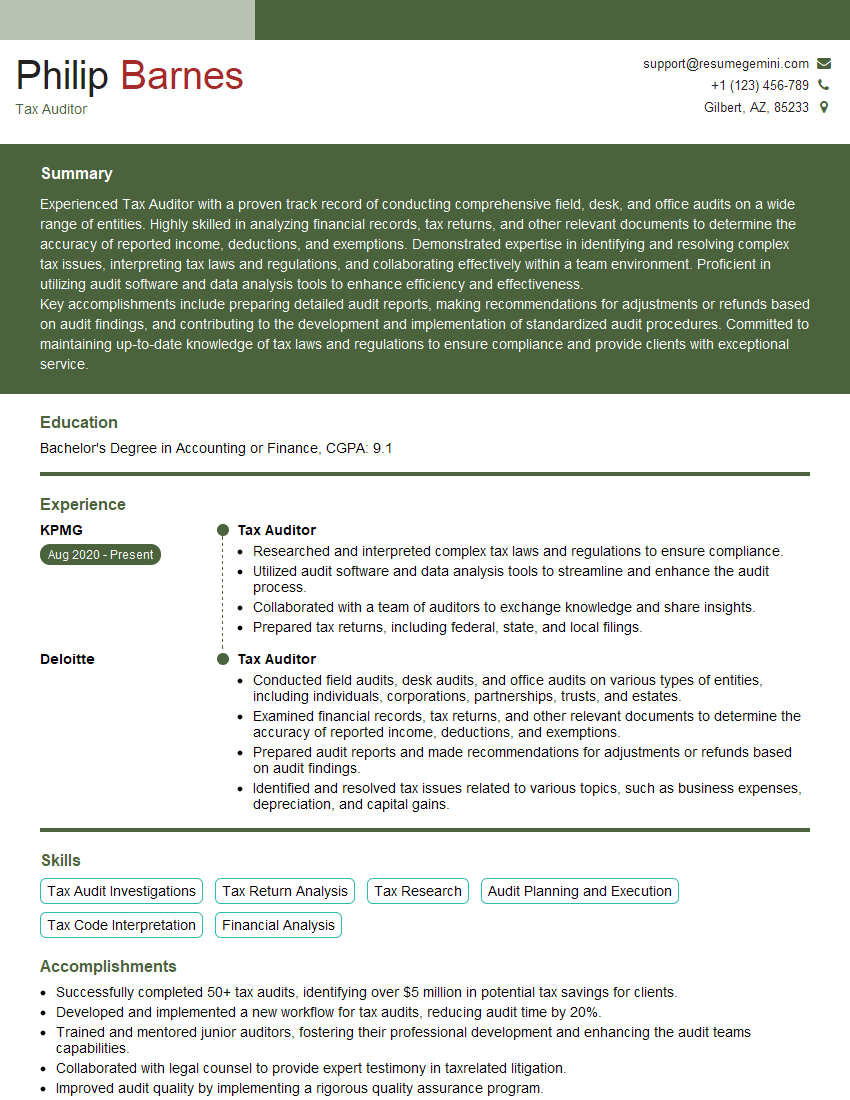
Mastering Tax Audit Assistance opens doors to a rewarding career with significant growth potential. You’ll be equipped to contribute meaningfully to a team, solve complex problems, and advance your expertise in a dynamic field. To maximize your job prospects, creating a compelling and ATS-friendly resume is essential. We strongly encourage you to leverage ResumeGemini, a trusted resource for crafting professional resumes. ResumeGemini provides examples of resumes specifically tailored to Tax Audit Assistance roles, helping you showcase your skills and experience effectively.
Explore more articles
Users Rating of Our Blogs
Share Your Experience
We value your feedback! Please rate our content and share your thoughts (optional).
What Readers Say About Our Blog
Really detailed insights and content, thank you for writing this detailed article.
IT gave me an insight and words to use and be able to think of examples