Feeling uncertain about what to expect in your upcoming interview? We’ve got you covered! This blog highlights the most important Sets up and operates drilling machines interview questions and provides actionable advice to help you stand out as the ideal candidate. Let’s pave the way for your success.
Questions Asked in Sets up and operates drilling machines Interview
Q 1. Describe your experience with different types of drilling machines.
My experience encompasses a wide range of drilling machines, from basic hand-held drills to sophisticated CNC (Computer Numerical Control) drilling machines. I’m proficient with:
- Sensitive Drilling Machines: These are ideal for precise, small-scale work, often used in watchmaking or electronics.
- Radial Drilling Machines: Excellent for larger workpieces where versatility in drilling angle and location is needed. I’ve used these extensively in fabrication shops.
- Upright Drilling Machines: These are workhorses for general-purpose drilling and are commonly found in workshops and factories. I’m highly experienced in their operation and maintenance.
- CNC Drilling Machines: My experience includes programming and operating CNC machines, allowing for high-precision, automated drilling of complex patterns. This greatly increases efficiency and repeatability.
- Gang Drilling Machines: I’ve worked with these machines for high-volume production, drilling multiple holes simultaneously. Understanding the setup and maintenance of these is crucial for optimizing output.
Each machine type has its own strengths and weaknesses. Selecting the right machine for the job is essential for efficiency and quality.
Q 2. Explain the process of setting up a drilling machine for a specific job.
Setting up a drilling machine involves a systematic approach. Let’s take the example of drilling a series of holes in a metal plate using an upright drilling machine.
- Selecting the correct drill bit: This depends on the material (steel, aluminum, wood, etc.), hole size, and desired finish. I’d select a high-speed steel (HSS) bit for most metals.
- Clamping the workpiece: Securely clamping the workpiece to the machine’s table is paramount to prevent movement during drilling and to ensure accuracy. I always use appropriate clamps and ensure the workpiece is level.
- Adjusting the drill height: The drill bit should be positioned to reach the desired depth, using the depth stop if available. This ensures consistent hole depth across multiple holes.
- Setting the speed and feed rate: These settings depend on the material and drill bit size. Incorrect settings can lead to broken bits or poor hole quality. (See answer to question 7 for details).
- Trial run: I always perform a test drill on a scrap piece of the same material to verify settings before drilling the actual workpiece. This avoids costly mistakes.
- Lubrication: Using appropriate cutting fluid or lubricant helps prevent overheating and improves hole quality, especially when drilling metals.
Following this process, ensures consistent, accurate results, minimizing errors and maximizing productivity.
Q 3. How do you ensure the accuracy and precision of drilled holes?
Accuracy and precision in drilling are crucial for the final product’s functionality and aesthetics. To ensure this, I focus on several key areas:
- Accurate Measurement and Marking: Using precise measuring tools like calipers and marking tools are fundamental. I carefully mark the workpiece before drilling to ensure the holes are in the correct location.
- Proper Machine Calibration and Maintenance: Regularly checking the machine’s alignment and ensuring all components are functioning correctly is critical for consistent accuracy. This includes checking for any play or looseness in the spindle or table.
- Appropriate Drill Bit Selection: Using sharp, correctly sized drill bits ensures clean, precise holes. Dull bits can cause inaccurate hole sizes and poor surface finish.
- Consistent Speed and Feed Rates: Using the correct speed and feed rate is vital for maintaining accuracy and preventing damage to the bit or workpiece. (See answer to question 7 for details).
- Using a Drill Guide or Jig: For multiple holes or very precise positioning, I use drill guides or jigs to maintain consistency. These ensure the bit stays aligned to the target location.
Combining these practices ensures high-precision results, and ultimately, a high-quality finished product.
Q 4. What safety precautions do you follow when operating a drilling machine?
Safety is paramount when operating drilling machines. My safety practices include:
- Proper Clothing: Always wearing safety glasses, hearing protection, and appropriate clothing (no loose clothing or jewelry).
- Machine Guarding: Ensuring all safety guards are in place and functioning correctly before operating the machine. Never operate a machine without the guards.
- Secure Workpiece Clamping: Properly clamping the workpiece to prevent it from moving during the drilling process. This is critical to prevent injury.
- Clear Work Area: Maintaining a clean and organized work area free of obstructions. This reduces tripping hazards.
- Emergency Stop Awareness: Knowing the location and operation of the emergency stop button. I conduct regular checks to ensure its responsiveness.
- Regular Maintenance: Performing regular maintenance checks on the machine to identify and correct any potential hazards, such as worn parts or loose connections.
By diligently following safety protocols, I maintain a safe working environment and prevent accidents.
Q 5. How do you identify and troubleshoot common problems with drilling machines?
Troubleshooting common drilling machine problems requires a systematic approach. I typically follow these steps:
- Identify the Problem: Accurately describe the issue. Is it a broken drill bit? Inaccurate holes? Unusual noises?
- Check the Obvious: Ensure the machine is properly plugged in, the power switch is on, and the chuck is securely tightened.
- Inspect the Drill Bit: Check for sharpness, wear, or damage. Replace dull or damaged bits.
- Verify Speed and Feed Settings: Ensure these are appropriate for the material and drill bit.
- Check Workpiece Clamping: Make sure the workpiece is securely clamped. Loose workpieces can cause inaccurate holes or damage.
- Inspect Machine Alignment: Check the alignment of the spindle and table for any play or misalignment.
- Lubrication: Check if the machine needs lubrication.
If the problem persists after these checks, more in-depth investigation, or professional assistance, may be required.
Q 6. What types of drill bits are you familiar with and when would you use each?
I’m familiar with a variety of drill bits, each suited for specific applications:
- High-Speed Steel (HSS) Drill Bits: Versatile and commonly used for drilling most metals. I use these for general-purpose drilling.
- Cobalt HSS Drill Bits: These are stronger and more durable than standard HSS bits, ideal for drilling tougher materials like stainless steel.
- Carbide Drill Bits: Extremely hard and durable, used for drilling hard materials such as hardened steel, ceramics, or composites. These are crucial for demanding applications.
- Titanium Nitride (TiN) Coated Drill Bits: These have a coating that improves durability, reduces friction, and provides a better surface finish. I use these when a high-quality finish is required.
- Wood Drill Bits: Specifically designed for drilling wood, these come in various types like twist bits, brad point bits (for cleaner entry holes), and Forstner bits (for flat-bottomed holes).
The choice of drill bit is dictated by the material being drilled, the required hole size, and the desired surface finish.
Q 7. Explain the importance of using the correct speed and feed rates.
Correct speed and feed rates are crucial for achieving efficient and accurate drilling. The speed (RPM – revolutions per minute) determines how fast the drill bit rotates, while the feed rate (IPM – inches per minute) determines how quickly the drill bit advances into the material.
Incorrect settings can lead to:
- Broken drill bits: Too high a speed or too slow a feed rate can cause excessive heat buildup, leading to bit breakage.
- Poor hole quality: Too low a speed or too high a feed rate can result in ragged holes, poor surface finish, or chipping of the workpiece.
- Overheating the workpiece: This can alter the material’s properties and damage the workpiece.
Determining the correct settings depends on several factors:
- Material being drilled: Harder materials generally require lower speeds and slower feed rates.
- Drill bit diameter: Larger drill bits generally require lower speeds.
- Drill bit material: Different materials have different optimal speed ranges.
I consult charts and manuals or use the machine’s built-in recommendations to determine the correct speed and feed rate for each specific job. Experience also plays a key role in making these crucial judgements.
Q 8. How do you select the appropriate cutting fluids for different materials?
Selecting the right cutting fluid is crucial for efficient and safe drilling. The choice depends heavily on the material being drilled and the desired outcome. Think of cutting fluids like lubricants for your drill bit – they reduce friction, heat, and wear, improving the quality of the hole and extending the life of the tool.
- Steel: For steel, a soluble oil-based fluid is commonly used. These emulsions provide excellent cooling and lubrication, preventing chip welding and improving surface finish. The concentration of the oil in the water needs to be carefully chosen based on the type of steel and drilling operation.
- Aluminum: Aluminum is a softer metal that tends to readily work-harden. Therefore, cutting fluids for aluminum are usually designed for excellent chip evacuation and minimal friction, often relying on synthetic fluids to avoid staining.
- Cast Iron: Cast iron can be brittle and prone to cracking. A light-duty cutting fluid, perhaps a water-based solution with added lubricity, is usually sufficient. Excessive lubrication can sometimes hinder chip removal and lead to issues.
- Plastics: Drilling plastics often requires very different cutting fluids. Sometimes, no cutting fluid is necessary, while other times, a specialized lubricant or even compressed air can be beneficial to reduce heat buildup and prevent melting or excessive friction.
In practice, I always consult material datasheets and the manufacturer’s recommendations for the drill bits being used to determine the most appropriate cutting fluid. It’s a balance of avoiding excessive wear and ensuring a clean, accurate hole.
Q 9. Describe your experience with CNC drilling machines.
I have extensive experience operating and programming CNC drilling machines, primarily using Fanuc and Siemens controls. My experience ranges from single-spindle machines to multi-spindle, high-speed units. I’m proficient in setting up the machines, including tool changes, workholding fixture design and implementation, and verifying the accuracy of the drilling process through rigorous measurements and inspection.
In one project, we needed to drill hundreds of precisely located holes in aluminum chassis for electronic components. Using a CNC machine allowed us to automate the process, ensuring consistent accuracy and significantly reducing production time compared to manual drilling. We used a high-speed drilling setup to minimize the cycle time and optimized the tool paths to improve tool life. The project success was directly tied to my expertise in operating and optimizing the CNC equipment.
Q 10. How do you program a CNC drilling machine?
Programming a CNC drilling machine involves creating a computer-aided design (CAD) model of the workpiece and then translating that model into a machine-readable program using Computer-Aided Manufacturing (CAM) software. This software generates a tool path that dictates the drill’s movements to accurately create the desired holes.
The process typically involves these steps:
- Import CAD model: The CAD model of the part is imported into the CAM software.
- Define tool parameters: The diameter, length, and type of drill bit are specified.
- Define drilling parameters: Parameters like feed rate (how fast the drill moves into the material), spindle speed (how fast the drill rotates), and depth of cut are defined. This ensures proper hole size and avoids damaging the bit or workpiece.
- Generate toolpath: The software generates the toolpath, a set of instructions telling the machine where to move the drill to create each hole.
- Post-processing: The toolpath is converted into a format the CNC machine’s control system can understand (e.g., ISO code or proprietary code).
- Machine Simulation: Before running the program, a simulation is performed to check for errors or collisions.
- Machine Execution: Finally, the program is uploaded to the CNC machine and executed.
Example G-code snippet (simplified): G90 G01 X10 Y10 Z-5 F50; (Move to position X10 Y10 and drill 5mm deep at feed 50mm/min)
The G-code above is a simplified example. Actual programs are much more complex, especially for intricate parts with multiple holes.
Q 11. How do you interpret engineering drawings and specifications for drilling operations?
Interpreting engineering drawings is fundamental to my job. I meticulously examine blueprints, schematics, and specifications to extract crucial information for drilling operations. This involves understanding dimensions, tolerances, material specifications, and any specific instructions for hole types (size, depth, position, surface finish).
For instance, a drawing might specify a 10mm diameter hole, 20mm deep, with a ±0.1mm tolerance. This tells me the precise hole size, depth, and acceptable range of variation. I would then select the appropriate drill bit, check the machine’s setup, and monitor the drilling process to ensure adherence to these specifications. I also pay close attention to annotations about surface finish and other requirements, which influence my choice of cutting fluid and drilling techniques.
Beyond the numbers, I look for details like hole locations relative to datum points or other features, and notes about drilling sequences, if any exist. Clear understanding of symbols and standards is critical for error-free work. I always cross-check information multiple times and never hesitate to clarify ambiguities with engineering personnel before starting the drilling operation.
Q 12. What is your experience with different drilling techniques (e.g., spot facing, counterboring)?
My experience encompasses a wide range of drilling techniques, going beyond simple through-hole drilling. I’m proficient in spot facing, counterboring, countersinking, and reaming.
- Spot Facing: This technique creates a flat, smooth surface around a hole’s entrance, often used to provide a level surface for bolt heads or other components. It involves using a special spot facing cutter to machine a small, shallow, concentric area around the existing hole.
- Counterboring: This technique enlarges a portion of an existing hole to a larger diameter, typically to accommodate a countersunk screw head or a washer. It creates a step in the hole.
- Countersinking: This creates a conical recess around a hole, typically to accommodate a countersunk screw head that sits flush with the surface. A countersinking tool is used to create this conical shape.
- Reaming: This process is used to create a precisely sized hole, improving the accuracy and surface finish. A reamer is used to enlarge an existing hole to very tight tolerances.
The choice of technique depends entirely on the design requirements and the intended use of the part. For example, I might use spot facing to provide a level surface for mounting an electronic component, or counterboring to recess a fastener head to reduce the risk of damage.
Q 13. Explain the process of maintaining and cleaning drilling machines.
Regular maintenance and cleaning are crucial for the longevity and accuracy of drilling machines. It’s not just about extending the machine’s lifespan; it’s about ensuring consistent performance and preventing accidents.
My maintenance routine typically includes:
- Daily Cleaning: Removing chips and debris from the machine bed, drill chuck, and surrounding areas. Compressed air is often used for this. I also wipe down the machine surfaces with a clean cloth to remove any oil or coolant.
- Weekly Inspection: Checking for wear and tear on the drill bits, chuck, and other components. Lubricating moving parts according to the manufacturer’s recommendations.
- Monthly Maintenance: More in-depth cleaning, including potentially removing coolant lines for cleaning and inspection. Checking coolant levels and quality.
- Periodic Overhaul: A scheduled overhaul involves a more thorough inspection of all components, including potential replacement of worn parts and lubrication of key bearings and moving parts.
Safety is paramount throughout the entire process. I always ensure the machine is switched off and locked out before undertaking any cleaning or maintenance task. I use appropriate safety equipment, such as eye protection and gloves, and dispose of waste coolant and chips according to safety regulations.
Q 14. How do you ensure the proper alignment of workpieces before drilling?
Ensuring proper workpiece alignment is critical for accurate drilling. An improperly aligned workpiece can lead to misaligned holes, potentially rendering the part unusable. I utilize a variety of techniques to guarantee precise alignment:
- Vices and Clamps: Securely clamping the workpiece in a vise is a common method for ensuring alignment in smaller parts. Clamps are used when vices may not be suitable.
- Jigs and Fixtures: For repetitive drilling operations, I frequently use jigs and fixtures. These custom-designed tools hold the workpiece in the precise position and orientation required for accurate drilling, dramatically improving consistency and speed.
- Alignment Pins and Bushings: These tools precisely guide the workpiece into the correct position, eliminating any chance of misalignment.
- Laser Alignment Systems: For highly accurate applications, I can utilize laser alignment systems to precisely position the workpiece. These systems provide visual guidance, allowing for very fine adjustments.
- Inspection Tools: Following drilling, I always inspect the drilled holes to ensure they meet the required specifications. This could include using dial indicators, height gauges, and other measurement tools to verify alignment and hole position.
The choice of alignment method depends on the part’s complexity, the required accuracy, and the production volume. However, careful attention to detail and the use of appropriate tools are paramount in all cases.
Q 15. How do you handle different types of materials during drilling operations?
Handling different materials during drilling requires understanding their properties. Harder materials like steel require specialized drill bits with a higher hardness rating and potentially different cutting geometries to prevent premature wear or breakage. Softer materials like aluminum or wood, on the other hand, might need less aggressive bits to prevent tearing or chipping. The speed and feed rate (how fast the drill bit rotates and how quickly it advances) must also be adjusted based on the material. For instance, drilling steel at a high feed rate could lead to bit breakage, while drilling wood at too low a speed could lead to burning. I always consult material-specific datasheets for optimal drilling parameters. For example, drilling stainless steel requires a significantly lower feed rate than drilling mild steel, to avoid excessive heat build-up and premature wear of the drill bit.
- Steel: High-speed steel (HSS) or carbide-tipped bits, lower feed rates, use of cutting fluids.
- Aluminum: HSS or carbide bits, higher speeds and feed rates, potentially less aggressive cutting angles to prevent tearing.
- Wood: Wood bits designed for different grain types, moderate speeds, avoiding excessive pressure.
Career Expert Tips:
- Ace those interviews! Prepare effectively by reviewing the Top 50 Most Common Interview Questions on ResumeGemini.
- Navigate your job search with confidence! Explore a wide range of Career Tips on ResumeGemini. Learn about common challenges and recommendations to overcome them.
- Craft the perfect resume! Master the Art of Resume Writing with ResumeGemini’s guide. Showcase your unique qualifications and achievements effectively.
- Don’t miss out on holiday savings! Build your dream resume with ResumeGemini’s ATS optimized templates.
Q 16. Describe your experience with measuring tools used in drilling operations (e.g., calipers, micrometers).
Accurate measurements are crucial in drilling. I’m proficient in using various tools like vernier calipers, micrometers, and dial indicators. Vernier calipers provide quick and accurate measurements for dimensions up to a few inches, ideal for checking hole diameters and workpiece dimensions before drilling. Micrometers offer even greater precision, useful for confirming drill bit sizes and checking the depth of holes to tight tolerances. Dial indicators are invaluable for checking the runout of the drill bit in the chuck, ensuring that the bit spins true and prevents inaccurate drilling. In one project involving the precise placement of multiple holes for a complex assembly, using a micrometer to verify the drill bit size before each hole ensured that we met the tight tolerance requirements of ±0.005 inches.
Q 17. How do you identify and address issues related to tool wear?
Regular inspection is key to identifying tool wear. I look for signs such as chipping, dulling, and excessive wear on the cutting edges of the drill bit. A dull bit leads to increased friction, generating heat, and potentially damaging the workpiece. The drill bit may also start to wander or vibrate excessively. If I notice these signs, I immediately replace the bit to prevent further issues and ensure accuracy. I also check for wear on the drill chuck, as a worn chuck can affect the accuracy of the hole position and the bit’s ability to spin concentrically. Keeping a detailed log of bit usage and replacement helps in tracking wear patterns and identifying potential issues with the drilling machine or the materials being drilled.
Q 18. What is your experience with jig and fixture setup for drilling?
Jig and fixture setup is essential for repeatable accuracy in drilling multiple holes. I have extensive experience designing and using jigs and fixtures, ranging from simple clamping systems to more complex setups involving multiple locating pins and bushings. A well-designed jig ensures that the workpiece is consistently positioned for precise hole placement. This is particularly important when producing multiple identical parts. For example, in one project involving drilling 1000 identical parts, a custom-built jig with precision locating pins and bushings ensured that all the drilled holes were consistently within a tolerance of ±0.002 inches.
I’m familiar with various jig and fixture designs including those using:
- Clamps
- Locating pins
- Bushings
- V-blocks
Q 19. Describe your troubleshooting process for broken drill bits or other malfunctions.
Troubleshooting broken drill bits or malfunctions involves a systematic approach. First, I assess the situation, checking for obvious causes like improper bit selection, excessive pressure, or incorrect speed/feed settings. If the bit breaks, I check the material’s hardness and my drilling parameters to see if they are compatible. A broken bit could indicate a need to use a more robust bit or to adjust the drilling parameters. For example, using a drill bit designed for wood on a steel workpiece will lead to a broken bit. If the machine malfunctions, I’ll check the motor, belts, and power supply. If the problem persists after checking these components, I’ll consult the machine’s manual or seek assistance from a qualified technician. Keeping a log of all malfunctions and their solutions helps to prevent similar problems in the future.
Q 20. What is your experience with different types of clamping systems?
I’m experienced with a variety of clamping systems, including:
- Vise-style clamps: Simple and effective for smaller workpieces.
- Quick-release clamps: Improve efficiency in high-volume production.
- Magnetic clamps: Useful for ferrous materials, offering secure and quick clamping.
- Workholding fixtures: Complex custom designs for intricate parts or high precision requirements.
The choice of clamping system depends on the size and shape of the workpiece, the required level of precision, and the production volume. For larger or oddly shaped workpieces, custom-designed workholding fixtures provide the most secure and accurate clamping. In one project, we designed a specialized fixture to hold a large, irregularly shaped component, ensuring that all holes were accurately drilled in the correct positions.
Q 21. How do you maintain accurate records of drilling operations?
Maintaining accurate records is crucial for traceability and quality control. I use a combination of digital and physical records. For each drilling operation, I document:
- Date and time: Provides context for tracking progress and identifying potential issues.
- Workpiece material and dimensions: Essential for understanding the drilling parameters used.
- Drill bit type and size: Allows tracking of tool wear and identifying optimal tools for specific materials.
- Drilling parameters (speed, feed rate): Crucial for reproducibility and quality control.
- Number of holes drilled: Helps with monitoring production rates.
- Inspection results: Confirmation of hole size, position, and surface quality.
- Any issues encountered and resolutions: Helps in identifying and preventing recurring problems.
This data is entered into a digital database and hard copies are kept in case of any system failure. This documentation provides a complete audit trail and is crucial for meeting quality standards and tracking performance.
Q 22. What is your understanding of different types of drilling machine maintenance?
Drilling machine maintenance is crucial for ensuring operational efficiency, safety, and longevity. It can be broadly categorized into preventative maintenance, corrective maintenance, and predictive maintenance.
- Preventative Maintenance: This involves regularly scheduled inspections and servicing to prevent potential problems before they occur. This includes tasks like lubricating moving parts, checking for wear and tear on components, and replacing worn-out parts proactively. Think of it like changing your car’s oil – you do it regularly to avoid engine damage.
- Corrective Maintenance: This is reactive maintenance performed after a malfunction occurs. For example, if a drill bit breaks during operation, replacing it would fall under corrective maintenance. It’s like fixing a flat tire; you address the problem after it arises.
- Predictive Maintenance: This utilizes technologies like vibration analysis or thermal imaging to predict potential failures before they happen. This allows for timely interventions, minimizing downtime and maximizing efficiency. This is like having a sophisticated car diagnostic system that alerts you to potential issues before they become major problems.
Each type plays a vital role in the overall maintenance strategy, and a well-balanced approach is essential for optimal machine performance.
Q 23. Describe your experience with preventative maintenance schedules for drilling machines.
My experience includes developing and implementing preventative maintenance schedules for various drilling machines, ranging from small benchtop models to large CNC machines. These schedules are typically based on the machine’s manufacturer’s recommendations, operational hours, and specific environmental factors.
For instance, I developed a schedule for a CNC drilling machine that included daily checks of coolant levels and lubrication, weekly inspections of spindle bearings and chuck tightness, and monthly checks of the machine’s electrical system. This schedule was meticulously documented and tracked using a computerized maintenance management system (CMMS), allowing for efficient monitoring and data analysis. Any deviations from the schedule were promptly investigated and addressed, preventing potential issues from escalating.
In another project, I worked to optimize a preventative maintenance schedule for a fleet of older drilling machines. By analyzing historical maintenance data, we identified patterns in component failures and adjusted the schedule to focus on high-risk components, resulting in a significant reduction in unplanned downtime.
Q 24. How do you ensure quality control during drilling operations?
Quality control during drilling operations is paramount to ensure dimensional accuracy, surface finish, and overall part integrity. My approach involves a multi-faceted strategy:
- Pre-operation Checks: This includes verifying the drilling program, inspecting the tooling for damage, and ensuring proper workpiece clamping. A thorough pre-operation check is like a pilot running a pre-flight checklist before takeoff.
- In-process Monitoring: Constant observation during the drilling process helps to identify any irregularities early on. This includes checking for unusual noises, vibrations, or deviations in the drilling parameters.
- Post-operation Inspection: After drilling, every part undergoes a rigorous inspection using measuring instruments (calipers, micrometers, etc.) to ensure it meets the specified tolerances. This is like a quality assurance team performing final checks on a product before shipping.
- Data Logging and Analysis: Modern drilling machines often provide data logging capabilities. Analyzing this data helps to identify trends and patterns, enabling proactive adjustments to optimize the drilling process and minimize defects. This allows for continuous improvement, similar to using data analytics to improve business processes.
By implementing these strategies, I ensure that the drilled parts consistently meet the required quality standards.
Q 25. How do you handle and dispose of cutting fluids safely?
Safe handling and disposal of cutting fluids are essential for environmental protection and worker safety. My experience involves adhering to strict safety protocols and regulations.
Firstly, I ensure that cutting fluids are stored in designated containers and areas, properly labeled with hazard information. Spills are immediately cleaned up using appropriate absorbent materials. Secondly, used cutting fluids are collected and handled according to environmental regulations. This often involves using specialized containers and employing a certified waste disposal company. We regularly check for and follow all relevant Material Safety Data Sheets (MSDS) for each fluid type. Thirdly, regular maintenance of the machine’s fluid collection system prevents leaks and minimizes environmental impact.
Finally, employee training is crucial to ensure everyone understands the safe handling procedures and the importance of environmental responsibility. This is an ongoing process, reinforcing safe practices to prevent accidents and contamination.
Q 26. Describe your experience working in a team environment.
I thrive in team environments and believe in collaborative problem-solving. In my previous role, I was part of a team responsible for the operation and maintenance of a large-scale drilling facility. We regularly held team meetings to discuss challenges, share best practices, and coordinate maintenance schedules. This collaborative approach helped improve efficiency and safety.
I actively participate in brainstorming sessions and offer my expertise to help the team achieve common goals. I’m comfortable taking on leadership roles when necessary, but equally comfortable supporting my colleagues and learning from their experience. Effective communication is a key element of my teamwork approach, ensuring that everyone is informed and involved in the decision-making process. A successful team relies on open communication, mutual respect, and shared responsibility.
Q 27. How do you handle pressure and meet deadlines in a fast-paced environment?
Working in a fast-paced environment requires a structured approach and strong organizational skills. I prioritize tasks based on urgency and importance, using tools such as project management software or simple to-do lists to stay on track. I also actively communicate with my team and supervisors to manage expectations and ensure timely completion of projects.
For example, during a period of high demand, I successfully managed multiple drilling projects simultaneously by prioritizing tasks, delegating responsibilities when appropriate, and maintaining clear communication. By effectively managing time and resources, I consistently meet deadlines without compromising quality. Proactive problem-solving and a willingness to adapt to changing priorities are essential skills in these situations.
Q 28. What are your salary expectations for this role?
My salary expectations for this role are in the range of [Insert Salary Range Here]. This is based on my experience, skills, and the requirements of the position. I am open to discussing this further and am confident that my contributions will significantly benefit your organization.
Key Topics to Learn for Sets up and operates drilling machines Interview
- Machine Selection and Setup: Understanding different types of drilling machines (e.g., radial arm, CNC, magnetic), selecting the appropriate machine for a given task, and safely setting up the machine including tooling and workpiece securing.
- Drilling Techniques and Procedures: Mastering various drilling techniques (e.g., spot drilling, countersinking, counterboring), understanding the importance of speed, feed, and depth control, and adhering to safety protocols throughout the process.
- Tooling and Maintenance: Knowing different drill bit types and their applications, understanding drill bit sharpening and maintenance, recognizing signs of worn or damaged tooling, and performing routine machine maintenance.
- Material Selection and Properties: Understanding the properties of different materials and how they affect drilling parameters. Knowing the impact of material hardness and thickness on drill bit selection and operational techniques.
- Safety Procedures and Regulations: Adhering to all relevant safety regulations, using appropriate personal protective equipment (PPE), identifying potential hazards, and understanding emergency procedures.
- Troubleshooting and Problem-Solving: Identifying common drilling problems (e.g., broken drill bits, inaccurate hole placement, machine malfunctions), and implementing effective troubleshooting strategies, including preventative maintenance.
- Blueprint Reading and Interpretation: Understanding technical drawings and specifications, interpreting dimensions, tolerances, and other relevant information to accurately set up and operate the drilling machine.
- Quality Control and Inspection: Inspecting drilled holes for accuracy, dimensions, and surface finish, implementing quality control measures to ensure consistent results.
Next Steps
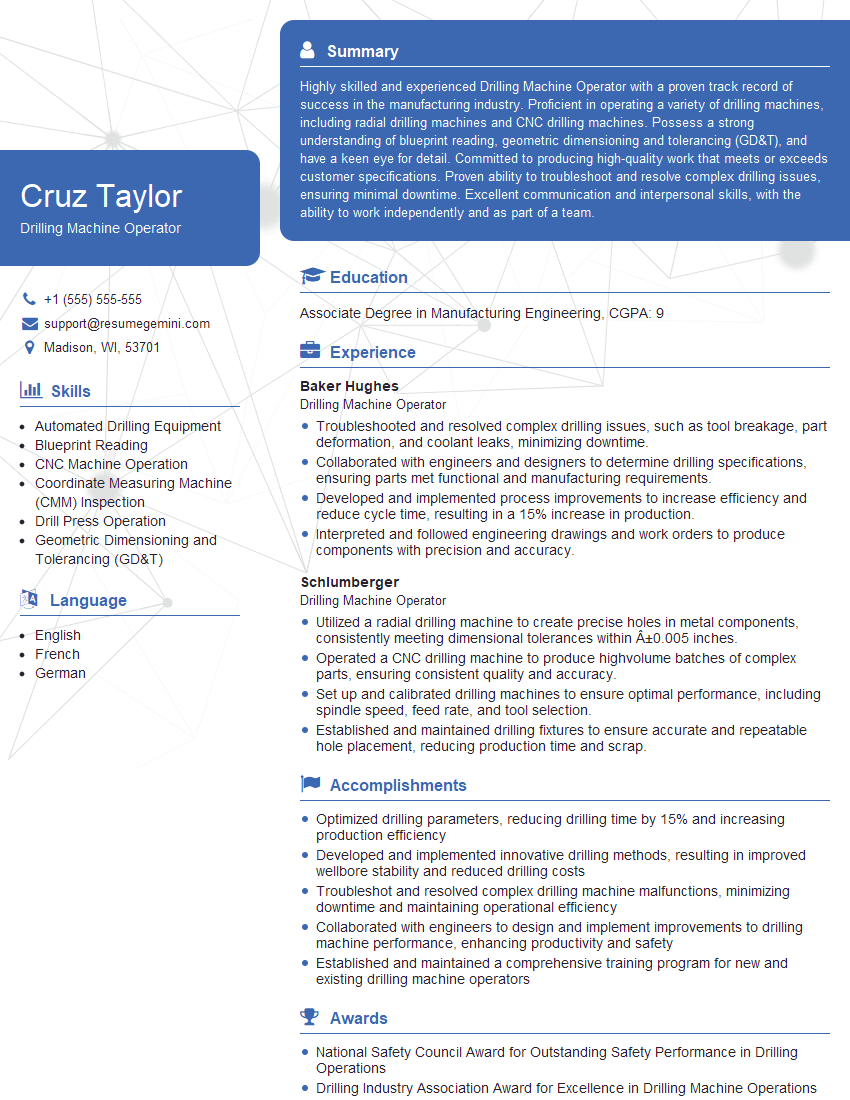
Mastering the setup and operation of drilling machines is crucial for a successful and rewarding career in manufacturing and related fields. It demonstrates valuable technical skills and attention to detail, opening doors to advanced roles and increased earning potential. To enhance your job prospects, crafting an ATS-friendly resume is essential. ResumeGemini can help you build a professional and effective resume that highlights your skills and experience. ResumeGemini offers examples of resumes tailored to “Sets up and operates drilling machines” roles, providing you with a valuable template and guidance.
Explore more articles
Users Rating of Our Blogs
Share Your Experience
We value your feedback! Please rate our content and share your thoughts (optional).
What Readers Say About Our Blog
Really detailed insights and content, thank you for writing this detailed article.
IT gave me an insight and words to use and be able to think of examples