Interviews are opportunities to demonstrate your expertise, and this guide is here to help you shine. Explore the essential Gear Repair and Maintenance interview questions that employers frequently ask, paired with strategies for crafting responses that set you apart from the competition.
Questions Asked in Gear Repair and Maintenance Interview
Q 1. Explain the different types of gear failures and their common causes.
Gear failures can be broadly categorized into several types, each with its own set of common causes. Understanding these is crucial for preventative maintenance and effective repair.
- Tooth breakage: This often results from overloading the gear, encountering unexpected impacts (like a foreign object), or fatigue from repeated stress cycles. Think of a car’s transmission gears failing under extreme acceleration or a sudden collision.
- Pitting and spalling: These surface defects are caused by high contact stresses, leading to small pits or flakes of metal breaking away. Insufficient lubrication, poor surface finish, and incorrect material selection are key contributors. Imagine the gradual wear on the teeth of bicycle gears over many miles of use.
- Wear: Gradual wear is common, especially with abrasive materials or inadequate lubrication. This can lead to increased backlash and eventually tooth failure. This is like the slow, steady erosion of a coastline – a constant process.
- Scoring and seizing: These involve damaging surface scratches or complete jamming of the gears. Lack of lubrication, contamination, or excessive loads are the primary culprits. Imagine trying to force two metal parts together without any lubricant – they would seize.
- Denting and bending: These typically occur from shock loads or misalignment, impacting the overall integrity of the gear. A heavy impact during operation can bend a gear tooth, like a sudden, hard hit on a metal bar.
Identifying the specific type of failure helps pinpoint the root cause, enabling targeted corrective action. For example, pitting suggests a lubrication problem, whereas breakage points to excessive load or material issues.
Q 2. Describe the process for diagnosing a faulty gear system.
Diagnosing a faulty gear system requires a systematic approach, combining visual inspection with performance analysis.
- Visual Inspection: Begin with a thorough visual check for obvious damage like broken teeth, pitting, scoring, or excessive wear. Look for signs of misalignment, such as uneven contact between meshing gears.
- Backlash Measurement: Use a dial indicator or specialized backlash gauge to measure the play between meshing gears. Excessive backlash indicates excessive wear or misalignment.
- Noise Analysis: Listen for unusual noises during operation – grinding, whining, or clicking sounds can indicate problems like wear, misalignment, or bearing issues.
- Performance Testing: Under controlled conditions, assess the gear system’s performance. Measure output speed, torque, and efficiency to identify deviations from the expected parameters.
- Lubrication Check: Examine the condition of the lubricant. Dirty, contaminated, or insufficient lubricant is a major contributor to gear problems.
- Gear Alignment Check: Using precision instruments, verify the proper alignment of gears, shafts, and bearings. Misalignment can create excessive wear and stress on the teeth.
By carefully evaluating these aspects, you can isolate the source of the problem, whether it is wear, misalignment, lubrication issues, or a combination thereof. This targeted approach saves both time and resources in the repair process.
Q 3. What tools and equipment are essential for gear repair?
Gear repair necessitates a range of specialized tools and equipment, varying based on the complexity of the system and the nature of the damage.
- Dial indicators and micrometers: For precise measurement of gear dimensions and backlash.
- Gear pullers and installation tools: For safely removing and installing gears on shafts.
- Gear tooth measuring tools: To assess the condition of individual gear teeth.
- Alignment tools: To ensure proper alignment of gears and shafts.
- Grinding and lapping tools (for advanced repairs): These allow for precise restoration of worn or damaged gear teeth.
- Specialized wrenches and sockets: For working on fasteners associated with gear systems.
- Cleaning equipment: To thoroughly clean components prior to inspection or repair.
- Lubrication equipment: For precise application of lubricants.
In a professional setting, having access to a well-equipped workshop with these specialized tools is essential for efficient and accurate gear repair.
Q 4. How do you determine the appropriate lubricant for a specific gear system?
Choosing the right lubricant is critical for gear system longevity and performance. Several factors must be considered:
- Gear material: Different gear materials have different compatibility requirements with lubricants. Steel gears may require a different lubricant than brass gears.
- Operating temperature: The lubricant’s viscosity must remain suitable across the operating temperature range. High-temperature applications demand high-viscosity lubricants.
- Operating speed: Higher speeds require lower-viscosity lubricants to reduce friction and heat generation.
- Load: Heavier loads necessitate lubricants with higher load-carrying capacity.
- Environmental conditions: Dust, moisture, or other contaminants necessitate lubricants with enhanced protection.
Consult the manufacturer’s specifications or industry standards (like those from the American Gear Manufacturers Association, AGMA) to determine the appropriate lubricant for a given gear system. Using the wrong lubricant can lead to premature wear, increased friction, and even catastrophic failure.
Q 5. Explain the process of gear alignment and its importance.
Gear alignment is paramount for proper gear meshing, minimizing wear, and maximizing efficiency. Misalignment causes uneven load distribution, leading to premature wear, noise, and ultimately, failure.
The alignment process generally involves:
- Centering shafts: Using alignment tools to ensure the shafts are concentric and properly spaced.
- Checking parallelism: Verifying that the shafts are parallel to each other.
- Adjusting bearing housings: Fine-tuning the positions of bearings to achieve optimal alignment.
- Using shims and spacers: Precisely adjusting the shaft spacing to compensate for minor misalignments.
Techniques may include dial indicator measurements, laser alignment systems, or optical alignment methods. Precise alignment is vital in high-precision applications where smooth operation and longevity are critical. Imagine a clock mechanism – precise alignment of gears is essential for accurate timekeeping. Misalignment in such a system would lead to a malfunctioning clock.
Q 6. Describe different gear tooth profiles and their applications.
Gear tooth profiles are carefully designed to optimize contact, reduce wear, and ensure smooth operation. Different profiles offer unique advantages depending on the application.
- Involute Profile: The most common profile, offering constant velocity ratio and good load-carrying capacity. This is well suited for most general-purpose gear applications.
- Cycloidal Profile: Provides smoother operation and reduced noise compared to involute profiles, particularly at lower speeds. However, it’s less tolerant to misalignment.
- Modified Involute Profile: This is an involute profile modified to optimize certain characteristics, such as reducing undercut or improving contact ratio. It’s often chosen for high-speed or heavy-duty applications.
The choice of tooth profile depends on factors like the required speed, load, precision, and operating conditions. For instance, a high-speed application may benefit from a modified involute profile to minimize vibration and noise, while a low-speed, high-torque application might utilize a standard involute profile for its robust load-carrying capacity.
Q 7. How do you inspect gears for wear and tear?
Inspecting gears for wear and tear requires careful examination using appropriate tools and techniques.
- Visual Inspection: Examine the gear teeth for signs of wear, such as pitting, scoring, chipping, or excessive wear on the tooth flanks. Pay attention to the root of the tooth and the tooth profile.
- Measurement of Tooth Wear: Use a gear tooth measuring tool or micrometer to precisely measure tooth thickness, profile, and other dimensions to quantify the extent of wear.
- Backlash Measurement: Use a dial indicator to measure the backlash between meshing gears. Excessive backlash is a clear indicator of wear.
Regular inspections, combined with proper lubrication and maintenance, extend the service life of gears. Early detection of wear prevents catastrophic failures and reduces downtime.
Q 8. What are the safety precautions when working with gear systems?
Safety is paramount when working with gear systems, which often involve rotating parts and potential hazards. Always start by ensuring the power source is disconnected and locked out/tagged out to prevent accidental startup. This is crucial for your safety and the safety of others. Next, use appropriate personal protective equipment (PPE), including safety glasses to protect your eyes from flying debris, gloves to prevent cuts and abrasions, and hearing protection to minimize exposure to loud noises. When handling gears, be mindful of sharp edges and wear sturdy gloves. Never attempt repairs on a running system. If you are unsure about any aspect of a repair, always consult the relevant service manual or seek assistance from a qualified professional.
- Power Isolation: Absolutely crucial before beginning any work.
- PPE: Safety glasses, gloves, and hearing protection are essential.
- Careful Handling: Avoid sharp edges and use caution.
- Professional Assistance: Seek help if unsure about any procedure.
Q 9. Explain the concept of gear backlash and its effects.
Gear backlash refers to the amount of play or looseness between meshing gears. Imagine two gears; if you were to slightly rotate one, there’d be a small amount of movement before the second gear begins to turn. This ‘slack’ is the backlash. Excessive backlash can lead to several negative consequences: increased noise (a characteristic ‘clatter’), loss of precision in positioning or speed control, increased wear on the gear teeth, and even premature gear failure. In applications requiring precise positioning, such as robotics or CNC machining, even small amounts of backlash can be problematic. Minimizing backlash often involves shimming or adjusting the gear meshing to reduce play. The acceptable level of backlash depends on the specific application and gear design.
Example: Imagine a robotic arm used for precise welding. Excessive backlash would lead to inaccurate welding positions and potentially damaged workpieces. A small amount of backlash is usually tolerated, but it needs to be carefully controlled within specific limits.
Q 10. How do you troubleshoot a noisy gear system?
Troubleshooting a noisy gear system involves a systematic approach. First, identify the type of noise – is it a high-pitched whine, a low-pitched growl, or a clattering sound? This helps pinpoint the potential cause. A high-pitched whine often indicates a lubrication problem, while a low-pitched growl might suggest misalignment or worn bearings. Clattering typically points to excessive backlash. Next, check the lubrication – is it sufficient and of the correct type? Examine the gears for wear, damage, or broken teeth. Carefully inspect for alignment issues between the gears and shafts. Check the bearings for wear or damage; worn bearings can cause noise and vibration. If the noise persists after these checks, you might need specialized tools and knowledge to further diagnose the issue. Sometimes, a professional inspection becomes necessary.
- Listen Carefully: Different noises indicate different problems.
- Check Lubrication: Proper lubrication is crucial.
- Inspect Gears & Bearings: Look for wear, damage, or misalignment.
- Seek Expert Help: When necessary, don’t hesitate to consult a specialist.
Q 11. What are the common methods for repairing damaged gears?
Repairing damaged gears depends on the extent of the damage. Minor surface damage can often be addressed by grinding or honing to restore the proper tooth profile. For more severe damage, such as chipped or broken teeth, the options are more limited. Sometimes, individual teeth can be replaced through specialized welding techniques, but this requires skill and precision. In cases of significant damage, it might be more cost-effective to replace the entire gear. The choice of repair method also depends on the material of the gear and the overall cost of repair versus replacement.
- Grinding/Honing: Suitable for minor surface damage.
- Welding: Possible for some tooth repairs, but requires specialized skill.
- Replacement: The most practical option for significant damage.
Q 12. Describe the procedure for replacing a worn gear.
Replacing a worn gear involves several steps. First, disconnect the power source and follow all safety precautions. Carefully remove the old gear, noting its orientation and any shims or spacers used. Clean the shaft and housing thoroughly before installing the new gear. Ensure the new gear is the correct type and size for the application. Install the new gear, paying close attention to its orientation and any shims or spacers. Tighten the fasteners according to the manufacturer’s specifications. Finally, reassemble the system, and carefully test it for proper operation, checking for any noise or unusual vibration.
- Safety First: Power must be disconnected.
- Careful Removal: Note the orientation and any shims.
- Thorough Cleaning: Prepare the shaft and housing.
- Correct Installation: Ensure proper orientation and spacing.
- Testing: Verify proper operation after reassembly.
Q 13. How do you ensure the proper torque when installing gears?
Ensuring proper torque during gear installation is critical for preventing damage and ensuring proper function. Always use a torque wrench calibrated to the appropriate units (Newton-meters or foot-pounds). The specific torque value depends on the gear size, material, and fastener type. Consult the manufacturer’s specifications or a relevant engineering manual for the correct torque value. Over-tightening can strip the threads or damage the gear itself, while under-tightening can lead to looseness and potential failure. Use the correct torque wrench and always double-check the torque specification to avoid mistakes.
Example: Incorrect torque on a gear in a high-speed automotive transmission could lead to premature gear failure, potentially causing damage to the vehicle and risking the driver’s safety.
Q 14. Explain the importance of proper lubrication in extending gear life.
Proper lubrication is essential for extending gear life. Lubricants reduce friction between meshing gear teeth, minimizing wear and tear. They also help to dissipate heat generated during operation, preventing overheating and potential damage. The type of lubricant used depends on the gear material, operating temperature, and load. Insufficient lubrication can lead to increased friction, excessive wear, noise, and premature failure. Using the wrong type of lubricant can also cause problems, such as the lubricant breaking down or not providing adequate protection. Regular lubrication, according to the manufacturer’s recommendations, is crucial for maintaining gear health and extending their lifespan. This often involves using specialized grease or oil designed specifically for gear applications.
Example: Think of lubricating your bicycle chain; without proper lubrication, it would quickly rust, wear out, and become noisy. The same principle applies to industrial gear systems, but on a larger and more critical scale.
Q 15. What are the different types of gear materials and their properties?
Gear materials are crucial for performance and longevity. The choice depends heavily on the application’s demands – load, speed, environment, etc. Here are some common types:
- Steel: The workhorse. Various grades offer different strengths, hardness, and toughness. Alloy steels, like those with chromium or molybdenum, provide excellent wear resistance and fatigue strength, ideal for high-stress applications like automotive transmissions or heavy machinery.
- Cast Iron: Cost-effective and good for low to moderate loads. Its inherent damping properties reduce noise and vibration, making it suitable for less demanding applications.
- Bronze: Excellent corrosion resistance and good wear characteristics, often paired with steel for self-lubricating properties. Used in marine applications or where lubrication is challenging.
- Plastics (e.g., nylon, acetal): Lightweight and quieter, often used in low-load, high-speed applications like consumer electronics or appliances. However, their load capacity and temperature resistance are limited.
- Non-ferrous metals (e.g., aluminum, brass): Aluminum offers lightweight solutions, while brass provides good corrosion resistance and machinability. Suitable for specific applications where weight or corrosion is a primary concern.
Choosing the right material involves a careful assessment of factors like strength-to-weight ratio, cost, corrosion resistance, and the expected operating conditions. For instance, a high-performance race car transmission might utilize high-strength alloy steel gears, while a garden tiller could employ cast iron due to its cost-effectiveness.
Career Expert Tips:
- Ace those interviews! Prepare effectively by reviewing the Top 50 Most Common Interview Questions on ResumeGemini.
- Navigate your job search with confidence! Explore a wide range of Career Tips on ResumeGemini. Learn about common challenges and recommendations to overcome them.
- Craft the perfect resume! Master the Art of Resume Writing with ResumeGemini’s guide. Showcase your unique qualifications and achievements effectively.
- Don’t miss out on holiday savings! Build your dream resume with ResumeGemini’s ATS optimized templates.
Q 16. How do you handle emergency repairs of a critical gear system?
Emergency gear repairs are all about minimizing downtime and ensuring safety. The approach depends on the severity and location of the damage. My first priority is always safety – securing the system to prevent further damage or injury.
Steps typically include:
- Assessment: Identify the extent of damage. Is it a broken tooth, a cracked gear, or something else? A visual inspection and sometimes even a partial disassembly might be necessary.
- Temporary Fix: For critical systems, a temporary fix might be needed to get things running. This could involve welding (if feasible and safe), using epoxy to bond broken pieces (for less critical applications), or employing a temporary replacement part (if available). This temporary fix must be safe and reliable enough for limited operation until a proper repair can be carried out.
- Documentation: Thoroughly document the issue, temporary fix applied, and the conditions of the system before and after. This is essential for planning a permanent repair and for future maintenance.
- Permanent Repair: Once the emergency is mitigated, I would schedule a permanent repair. This might involve replacing the damaged gear, re-machining existing components, or addressing the root cause of the failure (e.g., incorrect lubrication, misalignment).
For example, I once had to handle a broken gear in a conveyor belt system during a critical production run. I used a high-strength epoxy to temporarily repair the broken tooth, allowing production to resume while ordering a replacement gear. The temporary fix worked well enough for 24 hours, giving us time to install the permanent repair.
Q 17. What are the common causes of gear system overheating?
Gear system overheating is a serious issue leading to premature wear, failure, and potential safety hazards. Several factors contribute:
- Insufficient Lubrication: Lack of lubrication or using an inappropriate lubricant increases friction and heat generation. This is a very common cause.
- Excessive Load: Overloading a gear system beyond its design limits generates excessive frictional heat. This can occur due to unexpected surges or faulty design.
- Misalignment: Improper alignment of gears creates uneven contact and increased stress, leading to heat buildup. Even a slight misalignment can cause significant problems over time.
- High Speed: Operating the gear system at speeds beyond its design limits increases the rate of heat generation.
- Poor Ventilation: Insufficient ventilation traps heat, causing temperatures to rise excessively.
- Incorrect Gear Mesh: Improper gear meshing causes increased friction and stress leading to excessive heat generation.
Identifying the root cause is crucial. For instance, overheating might be due to a worn-out bearing leading to misalignment. Addressing the underlying problem is key to a lasting solution. Regular inspections, proper lubrication, and adhering to design specifications can prevent many instances of gear system overheating.
Q 18. How do you interpret gear system specifications and drawings?
Understanding gear specifications and drawings is fundamental. Drawings provide crucial information like gear dimensions (module, pressure angle, number of teeth), material specifications, tolerances, and surface finishes. Specifications detail performance parameters such as torque capacity, speed limits, and operating temperature ranges.
I use these drawings and specifications to:
- Verify Gear Compatibility: Ensure that replacement gears are compatible with existing components.
- Assess Design Adequacy: Check whether the system can handle the intended load and speed.
- Troubleshoot Problems: Identify potential issues by analyzing the design and comparing it to actual performance.
- Guide Repair and Maintenance: Ensure that repairs and maintenance are performed according to specifications.
For example, a drawing might specify a module of 4, a pressure angle of 20 degrees, and a material of Grade 8 steel. This information, combined with specifications, allows me to determine the gear’s capacity and select appropriate replacement parts during repair.
Q 19. Describe your experience with different gear types (spur, helical, bevel, etc.).
My experience encompasses various gear types, each with unique characteristics and applications:
- Spur Gears: Simple, parallel-shaft gears. Easy to manufacture but less efficient at higher speeds due to noise and vibration.
- Helical Gears: Improved efficiency and smoother operation compared to spur gears due to the gradual engagement of teeth. However, they introduce axial thrust.
- Bevel Gears: Used to transmit power between intersecting shafts. Different types exist: straight bevel, spiral bevel, hypoid. Spiral bevel gears offer smoother operation compared to straight bevel gears.
- Worm Gears: High speed reduction capabilities but lower efficiency. Used in applications requiring high torque at low speed, like in jacks or conveyors.
- Rack and Pinion Gears: Converts rotary motion to linear motion, commonly seen in steering systems.
I’ve worked on everything from the intricate gear systems in precision instruments to the robust power transmission systems in heavy machinery. Understanding the strengths and weaknesses of each type allows me to choose the most appropriate gear for a given application and identify potential problems during design or operation.
Q 20. What software or tools do you use for gear system analysis?
For gear system analysis, I utilize several software tools and techniques:
- CAD Software (SolidWorks, AutoCAD): For creating and modifying 3D models and drawings, crucial for design and analysis.
- FEA (Finite Element Analysis) Software (ANSYS, Abaqus): Simulates stress, strain, and deformation under load, helping to identify potential failure points and optimize the design.
- Gear Design Software (KISSsoft, AGMA software): Specialized software for calculating gear parameters, checking for interference, and evaluating gear performance.
- Measurement Tools (Micrometers, Calipers, Profilometers): Accurate measurements are crucial for quality control and diagnostics.
I also rely on data acquisition systems to collect data during operation (temperature, vibration, noise) to identify problems early on. This data-driven approach helps in preventative maintenance and understanding the gear system’s behavior under various conditions.
Q 21. How do you stay updated on the latest advancements in gear technology?
Staying updated in gear technology is crucial. I employ several strategies:
- Professional Organizations: Active membership in organizations like the American Gear Manufacturers Association (AGMA) provides access to latest research, standards, and networking opportunities.
- Industry Publications and Journals: Regularly reading industry-specific publications keeps me informed about new materials, manufacturing techniques, and design advancements.
- Conferences and Workshops: Attending conferences and workshops allows for direct interaction with leading experts and the opportunity to learn about cutting-edge technologies.
- Online Resources and Courses: Utilizing online resources, including webinars and online courses, provides continuous learning opportunities.
- Manufacturer’s Documentation: Staying up-to-date with the latest specifications and recommendations from major gear manufacturers ensures I am using the most current best practices.
Continuous learning is vital in this field, given the constant evolution of materials, manufacturing processes, and design methodologies. This ensures I can provide the most effective and efficient solutions for gear repair and maintenance.
Q 22. Describe your experience with preventative maintenance of gear systems.
Preventative maintenance is the key to extending the lifespan of any gear system. It’s about proactively identifying and addressing potential problems before they lead to costly failures. My approach involves a multi-faceted strategy focusing on regular inspections, lubrication, and component cleaning.
Regular Inspections: I meticulously inspect gear teeth for wear, pitting, or chipping. I check bearings for signs of play, noise, or excessive heat. I also examine seals for leaks and shafts for misalignment. Think of it like a doctor’s checkup – regular monitoring catches small issues before they become major problems.
Lubrication: Proper lubrication is paramount. I use the correct type and grade of lubricant specified by the manufacturer, ensuring adequate coverage and consistent application. Ignoring lubrication is like driving a car without oil – catastrophic failure is inevitable. I frequently assess the condition of the existing lubricant, noting any contamination or degradation.
Component Cleaning: Gear systems accumulate debris over time, which can accelerate wear. I regularly clean components, removing any dirt, metal shavings, or other contaminants. A clean system runs smoother and lasts longer. Think of it as regular car washing – it keeps the machine running optimally.
For example, in a recent project involving a large industrial gearbox, a routine inspection revealed minor pitting on a few gear teeth. By addressing this early through targeted grinding and re-lubrication, we prevented a major breakdown and significant downtime.
Q 23. How do you document your repair procedures and findings?
Documentation is crucial for traceability and accountability. I maintain detailed records of every repair procedure, including a comprehensive description of the problem, the steps taken to diagnose and resolve it, and the components replaced or repaired. My documentation process combines digital and physical methods for optimal efficiency.
Digital Records: I use a combination of digital photographs, videos, and software to document the repair process. This allows for easy sharing and reference. For example, I use software to create detailed schematics, highlighting problem areas and repair solutions. I also use image annotation software to pinpoint the exact location and nature of defects.
Physical Records: I maintain physical work orders, including signed off checklists and parts lists. These provide a tangible record of the work performed, and it acts as a reference for future maintenance. This is important because it allows for a clear audit trail, especially for compliance and warranty purposes.
A well-documented repair process not only aids in future maintenance but also facilitates troubleshooting if similar issues arise later on. This process ensures clarity and consistency across projects and technicians.
Q 24. What is your approach to troubleshooting complex gear system failures?
Troubleshooting complex gear system failures requires a systematic and methodical approach. My strategy involves a combination of visual inspection, data analysis, and component testing.
Visual Inspection: I begin by carefully inspecting the entire system, looking for obvious signs of damage, such as broken teeth, excessive wear, or misalignment. This provides a broad overview of the potential problem areas. This is crucial as sometimes the visual clues are the easiest to spot.
Data Analysis: I analyze relevant data, such as vibration readings, temperature logs, and operational parameters. This data often provides clues about the root cause of the failure. Anomalous vibrations can indicate bearing issues, while unusually high temperatures could signify lubrication problems.
Component Testing: Based on the visual inspection and data analysis, I conduct targeted testing of individual components. This may involve testing gear teeth for wear, checking bearings for play, or analyzing the lubricant for contamination. This is like performing a detailed diagnostic test on a car to pinpoint the cause of a malfunction.
Systematic Elimination: I work through potential causes, eliminating them one by one until the root cause is identified. This is a critical thinking process and involves testing hypotheses based on the gathered data and evidence. This process is iterative and sometimes involves revisiting the initial steps.
For instance, in a case of a noisy gearbox, initial inspection revealed no obvious damage. However, vibration analysis pointed toward a failing bearing. After replacing the bearing, the noise was eliminated. This approach highlights the importance of combining different diagnostic methods.
Q 25. Explain the process for balancing gears.
Gear balancing is crucial for minimizing vibrations and ensuring smooth operation, especially in high-speed applications. The process involves distributing the mass of the gear evenly to reduce centrifugal forces.
The most common method is dynamic balancing, which involves using a balancing machine. This machine measures the unbalance and determines the location and amount of material to be added or removed to achieve balance. The process typically involves the following steps:
Mounting: The gear is carefully mounted on the balancing machine’s rotor.
Measurement: The machine measures the vibrations caused by the unbalance.
Correction: Based on the measurements, material is added or removed from specific locations on the gear to compensate for the unbalance. This might involve drilling holes to remove material or adding weights.
Verification: After correction, the gear is re-measured to ensure the balance is achieved within acceptable tolerances.
Static balancing, a simpler method, is suitable for slower-speed gears. This involves balancing the gear on a knife-edge to find its center of gravity, then adding or removing material to align the center of gravity with the geometric center. The choice of method depends on the gear’s speed and size.
Q 26. Describe your experience working with various types of gearboxes.
Throughout my career, I’ve worked with a wide range of gearboxes, including:
Spur Gearboxes: These are the simplest type, with parallel shafts and straight teeth. I’ve worked on everything from small, precision gearboxes in instrumentation to larger, industrial gearboxes in heavy machinery. Understanding the limitations of spur gears, particularly with respect to noise and efficiency at high speeds, is crucial for effective repair.
Helical Gearboxes: These have angled teeth, providing smoother operation and higher load-carrying capacity compared to spur gears. I’ve handled repairs on these in various applications, from automotive transmissions to industrial robots. Knowing the helix angle and its impact on efficiency and noise reduction is essential.
Planetary Gearboxes: These offer high torque and compact design. They are complex systems, requiring a deep understanding of planetary gear kinematics for effective troubleshooting and repair. My experience in these includes working on applications such as wind turbines and aerospace systems.
Worm Gearboxes: These use a worm and worm wheel, offering high gear ratios and self-locking capabilities. I’ve repaired worm gearboxes used in various lifting mechanisms and conveyors, understanding the unique challenges of lubrication and wear in this configuration.
My experience spans different materials (steel, cast iron, plastics), sizes, and applications, allowing me to adapt my approach to the specific needs of each gearbox type.
Q 27. How do you assess the condition of a gear system before starting repairs?
Assessing the condition of a gear system before starting repairs is a critical first step. It determines the scope of work and informs the repair strategy. My approach involves a thorough visual inspection, coupled with various non-destructive testing methods.
Visual Inspection: I carefully examine the gear teeth, bearings, seals, shafts, and housing for any signs of damage, wear, or contamination. This includes looking for broken teeth, pitting, scoring, excessive wear, or misalignment. Pictures and videos are crucial for creating a comprehensive record.
Non-Destructive Testing (NDT): I utilize various NDT methods to evaluate the internal condition of components. These might include:
Vibration Analysis: Detects unusual vibrations indicative of bearing wear or gear meshing problems.
Ultrasonic Testing: Identifies internal flaws or cracks in gear teeth or shafts.
Oil Analysis: Examines the lubricant for contamination, which can indicate wear or damage within the system.
The findings from the assessment inform the repair plan. A simple cleaning and lubrication might suffice for minor issues, while major repairs or component replacements might be necessary for more severe problems. This meticulous assessment ensures the repair is targeted and efficient.
Q 28. What are your strengths and weaknesses in relation to gear repair?
My strengths lie in my systematic approach to troubleshooting, my deep understanding of gear mechanics and various gearbox types, and my meticulous documentation practices. I’m also highly adaptable, capable of working on diverse systems and applications.
However, like any specialist, I have areas for continuous improvement. While I am proficient in many NDT methods, staying abreast of the latest advancements and technologies, particularly in advanced diagnostic imaging, is an ongoing goal. Also, while I’m experienced in various repair techniques, broadening my expertise in specific niche areas, like advanced gear manufacturing processes, would be beneficial.
Key Topics to Learn for Gear Repair and Maintenance Interview
- Gear Types and Functionality: Understanding different gear types (spur, helical, bevel, worm) and their applications in various machinery. This includes knowing their strengths, weaknesses, and typical failure points.
- Lubrication and Maintenance Schedules: Practical application of proper lubrication techniques, understanding the importance of scheduled maintenance, and the consequences of neglecting it. This includes selecting the right lubricants for different gear types and operating conditions.
- Gearbox Diagnostics and Troubleshooting: Identifying common gear wear patterns, understanding the causes of gear failure (e.g., fatigue, wear, misalignment), and applying diagnostic techniques to pinpoint problems. This involves using both visual inspection and advanced diagnostic tools.
- Gear Repair Techniques: Familiarization with various gear repair methods, including gear replacement, gear honing, and gear grinding. Understanding the appropriate repair technique for different levels of damage is crucial.
- Safety Procedures and Regulations: Demonstrating a strong understanding of safety protocols in a workshop environment and adherence to relevant industry regulations and best practices.
- Preventive Maintenance Strategies: Developing and implementing effective preventative maintenance plans to minimize downtime and extend the lifespan of gear systems. This includes understanding predictive maintenance techniques.
- Material Science and Gear Manufacturing: Basic understanding of the materials used in gear manufacturing (e.g., steel alloys, plastics) and their impact on gear performance and lifespan.
Next Steps
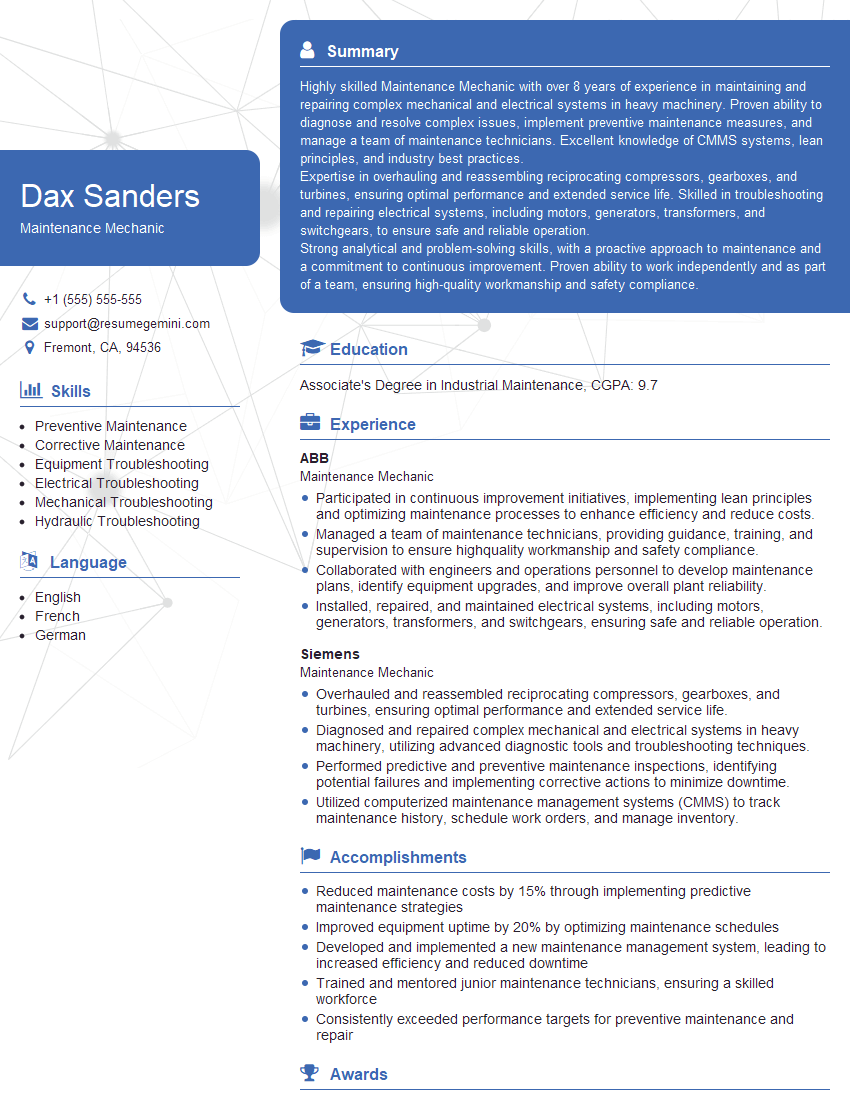
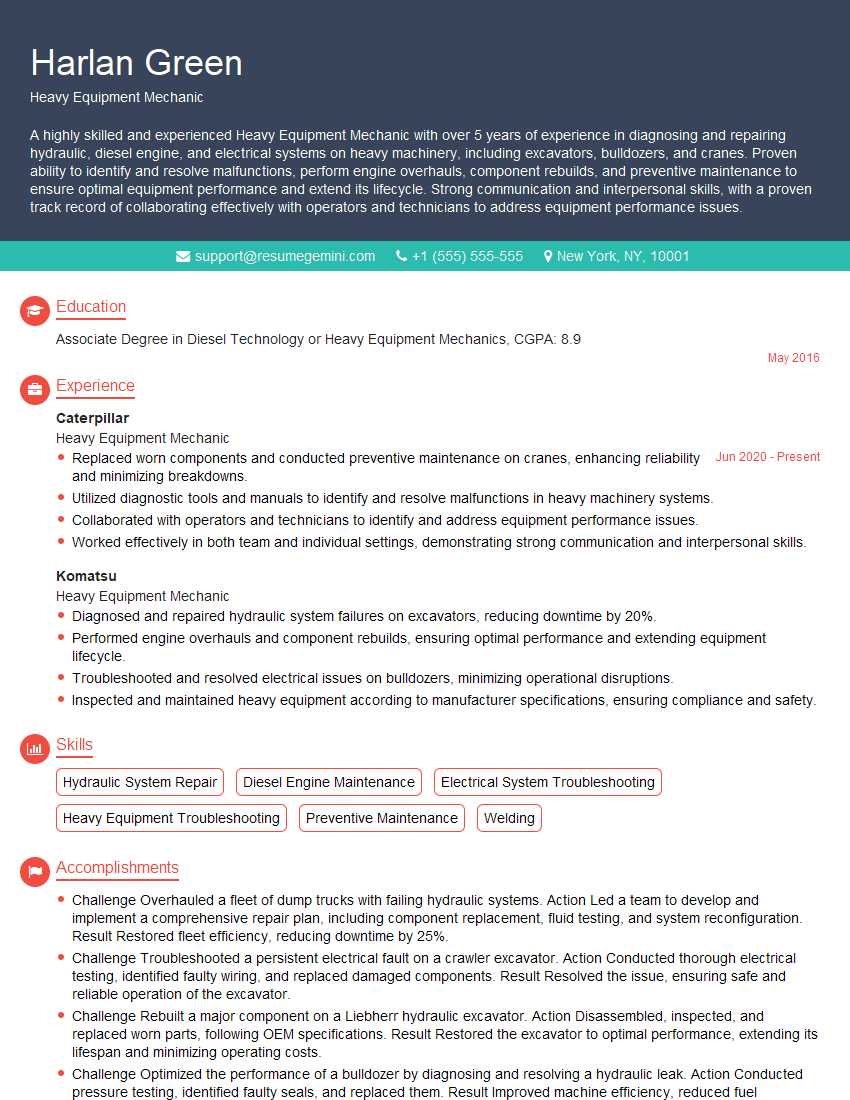
Mastering Gear Repair and Maintenance opens doors to a rewarding career with excellent growth potential. A strong understanding of these principles will significantly enhance your interview performance and increase your chances of securing your dream role. To maximize your job prospects, crafting a compelling and ATS-friendly resume is essential. We highly recommend using ResumeGemini, a trusted resource, to build a professional resume that highlights your skills and experience effectively. ResumeGemini provides examples of resumes tailored specifically to the Gear Repair and Maintenance field, helping you present yourself in the best possible light to potential employers.




Explore more articles
Users Rating of Our Blogs
Share Your Experience
We value your feedback! Please rate our content and share your thoughts (optional).
What Readers Say About Our Blog
Really detailed insights and content, thank you for writing this detailed article.
IT gave me an insight and words to use and be able to think of examples