Cracking a skill-specific interview, like one for Experience with shipping and receiving, requires understanding the nuances of the role. In this blog, we present the questions you’re most likely to encounter, along with insights into how to answer them effectively. Let’s ensure you’re ready to make a strong impression.
Questions Asked in Experience with shipping and receiving Interview
Q 1. Describe your experience with different shipping methods (e.g., LTL, FTL, air freight).
My experience encompasses a wide range of shipping methods, each chosen strategically based on factors like cost, speed, and the nature of the goods. Let’s look at three common methods:
- Less-than-Truckload (LTL): This is ideal for smaller shipments that don’t require a full truck. I’ve used LTL extensively for palletized goods, where consolidating shipments with other companies sharing the same route significantly reduces costs. For example, we once shipped a batch of smaller components using LTL, saving approximately 30% compared to a full truckload.
- Full Truckload (FTL): FTL is cost-effective for large shipments, guaranteeing faster transit times as the entire truck is dedicated to your cargo. I’ve managed FTL shipments of bulky furniture, ensuring efficient loading and proper documentation to avoid delays. For example, one time, coordinating an FTL shipment for a large retail order required close communication with the driver and the receiving warehouse to ensure timely delivery.
- Air Freight: Reserved for time-sensitive or high-value goods, air freight offers the fastest delivery but comes at a premium. I’ve overseen air freight shipments of perishable items and vital electronic components, ensuring proper packaging to withstand the rigors of air travel. One instance involved an emergency shipment of specialized medical equipment; using air freight guaranteed its arrival within 24 hours, which saved a patient’s life.
My proficiency extends to understanding the nuances of each method, including associated documentation, tracking, and potential challenges. I am adept at selecting the optimal method to balance cost and efficiency for each specific shipment.
Q 2. Explain your process for verifying incoming shipments against purchase orders.
Verifying incoming shipments against purchase orders is a critical step to ensure accuracy and prevent discrepancies. My process involves the following steps:
- Pre-Receiving: I begin by reviewing the purchase order (PO) details, noting the expected quantity, items, and their descriptions.
- Inspection upon arrival: Upon arrival, I visually inspect the shipment for damage or discrepancies. I carefully check the carrier’s documentation against the PO.
- Quantity Verification: I meticulously count each item received against the PO and the packing slip. I use both a physical count and, whenever possible, scanners to improve speed and accuracy.
- Condition Verification: I check the condition of each item, noting any damage or defects. Documentation of damaged goods is crucial at this stage.
- Documentation: I record all information, including discrepancies, on the receiving documents. Digital systems enable efficient data entry and tracking.
This structured approach minimizes errors and identifies problems early, preventing delays in the receiving process.
Q 3. How do you handle discrepancies between the packing slip and the actual contents of a shipment?
Discrepancies between the packing slip and the actual shipment contents are unfortunately common. My approach involves a systematic process to resolve these issues:
- Immediate Documentation: I document the discrepancy precisely, noting the differences in quantity, item, or condition. I take photos or videos as evidence.
- Contacting the Supplier: I promptly contact the supplier to inform them of the issue and request a resolution. This might involve sending them the documented discrepancy.
- Internal Communication: I inform my supervisor or relevant team members about the discrepancy and the steps being taken.
- Return or Adjustment: Depending on the severity and the supplier’s response, we may initiate a return of the incorrect items or request a credit/adjustment to the invoice.
- Inventory Update: The inventory management system is updated to reflect the actual received quantity and condition of the goods.
In a recent instance, a shipment of computer monitors had discrepancies. Following this process, we quickly resolved the issue with the supplier and received the correct number of monitors in a timely manner.
Q 4. What software or systems are you proficient in for managing shipping and receiving?
I’m proficient in several software and systems commonly used for shipping and receiving management. My expertise includes:
- Warehouse Management Systems (WMS): I have extensive experience with WMS platforms like Oracle WMS and SAP EWM. I understand how to use these systems for inventory tracking, order fulfillment, and reporting.
- Transportation Management Systems (TMS): I’ve utilized TMS platforms to manage and optimize freight movements. This includes carrier selection, shipment tracking, and cost analysis.
- Enterprise Resource Planning (ERP) Systems: My experience extends to integrating shipping and receiving processes with larger ERP systems such as SAP and Oracle, enabling seamless data flow across departments.
- Spreadsheet Software (Excel, Google Sheets): While not as sophisticated as WMS or TMS, I expertly use spreadsheets for tracking, data analysis, and reporting when required.
My skills allow me to efficiently manage shipping and receiving processes, generating accurate reports and identifying areas for improvement.
Q 5. Describe your experience with inventory management systems.
Inventory management is crucial for efficient shipping and receiving. My experience involves the use of both manual and automated systems. I am familiar with various inventory management principles, including:
- Cycle Counting: Regularly verifying inventory counts to detect discrepancies.
- FIFO/LIFO Methods: Implementing appropriate inventory valuation methods based on the type of goods.
- Inventory Tracking: Using barcodes, RFID tags, or similar technologies to ensure accurate tracking throughout the supply chain.
- Inventory Forecasting: Analyzing historical data to predict future inventory needs. This is crucial for reducing storage costs and preventing stockouts.
- Software Usage: Leveraging software to manage inventory levels, generate reports, and automate various tasks.
For example, in my previous role, I implemented a cycle counting program which reduced inventory discrepancies by 15% within six months.
Q 6. How do you prioritize tasks in a high-volume shipping and receiving environment?
Prioritizing tasks in a high-volume environment requires a structured approach. I use a combination of techniques:
- Urgency and Importance Matrix: I categorize tasks based on urgency and importance. Time-sensitive and critical tasks take precedence.
- First In, First Out (FIFO): For similar tasks, I follow FIFO to ensure fairness and efficient workflow.
- Communication and Collaboration: I maintain clear communication with my team and supervisors to ensure tasks are aligned with overall goals.
- Workload Management: I proactively identify potential bottlenecks and allocate resources effectively.
- Technology Leverage: I use technology, such as task management software, to track progress, assign tasks, and monitor performance.
By employing these methods, I ensure that tasks are addressed efficiently and effectively, minimizing delays and maximizing productivity.
Q 7. Explain your process for resolving shipping delays or damaged goods.
Resolving shipping delays and damaged goods requires a proactive and methodical approach:
- Immediate Investigation: I immediately investigate the cause of the delay or damage, using tracking information and communication with the carrier.
- Documentation: Thorough documentation is crucial, including photos of damaged goods and details of communication with carriers and suppliers.
- Carrier Claims: If the damage is due to carrier negligence, I file a claim promptly, following all necessary procedures.
- Supplier Communication: If the damage or delay is due to the supplier, I communicate the issue and request a resolution.
- Customer Communication: I keep the customer informed throughout the process, providing updates and alternative solutions.
- Internal Reporting: I document the incident for internal reporting purposes to identify and prevent similar issues in the future.
For instance, a recent delay was resolved by proactively contacting the carrier and identifying an alternate route, ensuring timely delivery and minimizing disruption.
Q 8. How do you ensure the accuracy and efficiency of the receiving process?
Ensuring accuracy and efficiency in the receiving process is paramount for smooth warehouse operations. It involves a multi-pronged approach that combines meticulous documentation, technological integration, and robust process controls.
Firstly, pre-receiving is crucial. We verify purchase orders against expected shipments before the goods even arrive. This allows us to anticipate any discrepancies and prepare accordingly. For example, if a PO specifies 100 units of Product X but the shipment notification indicates only 90, we can contact the supplier immediately to clarify the situation.
Secondly, during receiving, we meticulously check the contents against the packing slip and purchase order. This includes verifying the quantity, condition, and quality of each item. We utilize barcode scanners and warehouse management systems (WMS) to digitally record the receipt. This instantly updates inventory levels and flags any discrepancies. For instance, if a carton is damaged, we would note it in the system, take photos, and initiate a damage claim with the carrier.
Finally, post-receiving includes reconciliation. We compare the received quantities with the purchase order and notify relevant stakeholders of any discrepancies, ensuring that the accounting and inventory management systems are aligned. A regular audit of the receiving process also helps identify areas for improvement and maintain high accuracy.
Q 9. What safety procedures do you follow in a warehouse setting?
Safety is my top priority in a warehouse setting. We adhere to a strict set of procedures to minimize risks.
- Proper training: All employees undergo comprehensive safety training upon joining and receive regular refresher courses. This covers topics such as safe lifting techniques, forklift operation, fire safety, and hazard identification.
- Designated walkways and storage areas: Clear signage and markings guide pedestrian and forklift traffic, reducing the risk of collisions. Goods are stored strategically to optimize space and ensure safe access.
- Personal Protective Equipment (PPE): Employees are provided with and required to use appropriate PPE such as safety shoes, gloves, and high-visibility vests, depending on the task.
- Regular safety inspections: The warehouse undergoes regular inspections to identify and address potential hazards, ensuring that fire extinguishers are functional, emergency exits are clear, and equipment is in good working order.
- Incident reporting: A robust incident reporting system allows us to track near misses and accidents, analyze their causes, and implement corrective actions to prevent recurrence. We believe in a proactive approach to safety.
Q 10. Describe your experience with using scanners and other warehouse technology.
I’m highly proficient in using various warehouse technologies, including barcode scanners, handheld RF terminals, and warehouse management systems (WMS). I’ve worked extensively with systems like SAP WM and Oracle WMS.
Barcode scanners are essential for accurate and efficient data entry. I utilize them to scan incoming shipments, update inventory levels, and track goods throughout the warehouse. Handheld RF terminals allow for real-time inventory updates and location tracking, improving order fulfillment speed and accuracy.
Experience with WMS platforms is crucial. I’m skilled in using these systems to manage inventory, track shipments, generate reports, and optimize warehouse processes. For example, I have used WMS to implement cycle counting procedures, reducing inventory discrepancies and improving accuracy.
Q 11. How do you maintain accurate records of incoming and outgoing shipments?
Maintaining accurate records of incoming and outgoing shipments is critical for inventory control, financial reporting, and customer satisfaction. We achieve this through a combination of manual and automated processes.
All incoming shipments are meticulously documented using packing slips, bills of lading, and purchase orders. This information is then entered into our WMS, which automatically updates inventory levels and generates reports. We regularly perform inventory cycle counts to verify the accuracy of our records. Any discrepancies are investigated and rectified promptly.
For outgoing shipments, we use shipping labels generated by the WMS, ensuring accurate addressing and tracking information. Shipping documentation, including manifests and tracking numbers, is meticulously maintained, providing a complete audit trail for all shipments. The WMS provides real-time visibility into inventory levels and shipment status, ensuring accurate reporting.
Q 12. How do you handle returns and exchanges?
Handling returns and exchanges efficiently requires a well-defined process to minimize disruptions and maintain customer satisfaction. The process begins with inspection. We carefully examine returned items to assess their condition and determine eligibility for a refund or exchange. This might involve verifying the product’s authenticity, checking for damage, and confirming that it meets the return policy criteria.
Once the return is approved, we update inventory levels in our WMS and process the refund or exchange. Clear communication with the customer is key throughout this process. We provide regular updates on the status of the return and promptly address any concerns. For example, we might email the customer confirming receipt of the return, and then again when the refund is processed. Detailed records are kept of all returns and exchanges to track trends and improve future processes.
Q 13. What is your experience with different types of shipping labels and documentation?
I have experience with a variety of shipping labels and documentation, including those generated by various carriers such as FedEx, UPS, and USPS. I understand the importance of correctly completing shipping labels, including accurate addresses, weight, dimensions, and hazardous materials declarations (if applicable).
I am familiar with different types of shipping documents such as bills of lading, commercial invoices, packing lists, and certificates of origin. I know how to interpret these documents and use them to ensure that shipments comply with all relevant regulations. I’m proficient in using shipping software to generate labels and track shipments, ensuring accurate and timely delivery.
Furthermore, I understand the significance of proper documentation in international shipping, including customs declarations and other necessary paperwork. This ensures smooth customs clearance and prevents delays.
Q 14. Describe your experience working with third-party logistics providers (3PLs).
I have extensive experience collaborating with third-party logistics providers (3PLs). This often involves coordinating the movement of goods, managing inventory in 3PL warehouses, and tracking shipments. Effective communication and clearly defined service level agreements (SLAs) are critical for success in this area.
For example, I have worked with 3PLs to manage the warehousing and distribution of seasonal inventory. This requires close collaboration to ensure that goods are stored efficiently and delivered to customers on time. We use technology, such as EDI (Electronic Data Interchange) and API integrations, to facilitate data exchange between our systems and those of the 3PLs. This ensures accurate inventory data, timely communication, and smooth operations.
Regular performance reviews of the 3PL’s services are key to maintaining a high level of efficiency and quality. This often involves monitoring key performance indicators (KPIs) such as on-time delivery rates, inventory accuracy, and damage rates. Through this, we can identify areas for improvement and optimize the collaboration for greater efficiency and cost savings.
Q 15. How do you ensure compliance with shipping regulations and documentation requirements?
Ensuring compliance with shipping regulations and documentation is paramount for smooth operations and avoiding costly penalties. This involves a multi-faceted approach, starting with a thorough understanding of all relevant regulations, including those from agencies like the Department of Transportation (DOT) for hazardous materials, the Federal Aviation Administration (FAA) for air shipments, and customs agencies for international shipping.
My approach begins with meticulous documentation. For each shipment, I verify that all necessary paperwork is complete and accurate. This includes correctly classifying goods, using appropriate hazard labels (if needed), and accurately completing commercial invoices, packing lists, and bills of lading. I regularly update myself on changes in regulations through industry publications and training sessions to maintain a proactive approach.
For example, when shipping internationally, I meticulously ensure compliance with Incoterms (International Commercial Terms) to define responsibilities between buyer and seller, preventing misunderstandings and disputes. With hazardous materials, I carefully adhere to the Safety Data Sheets (SDS) and the proper handling, packaging, and labeling according to DOT regulations. Any discrepancy or potential issue is immediately escalated to ensure timely resolution and prevent non-compliance.
Career Expert Tips:
- Ace those interviews! Prepare effectively by reviewing the Top 50 Most Common Interview Questions on ResumeGemini.
- Navigate your job search with confidence! Explore a wide range of Career Tips on ResumeGemini. Learn about common challenges and recommendations to overcome them.
- Craft the perfect resume! Master the Art of Resume Writing with ResumeGemini’s guide. Showcase your unique qualifications and achievements effectively.
- Don’t miss out on holiday savings! Build your dream resume with ResumeGemini’s ATS optimized templates.
Q 16. What is your experience with cycle counting and inventory audits?
Cycle counting and inventory audits are vital for maintaining accurate inventory records, which are essential for efficient order fulfillment and minimizing losses. My experience includes implementing and managing both cycle counting programs and full-scale inventory audits. Cycle counting involves regularly counting a subset of inventory items, comparing them against the system’s records, and adjusting discrepancies. This method is more efficient than a full inventory audit and helps to identify and correct errors proactively. I’ve successfully implemented this in several warehouses, using a rotating schedule to ensure all items are counted periodically.
Inventory audits, on the other hand, involve a complete count of all inventory items. I’ve overseen several full audits, using established procedures to ensure accuracy. This includes assigning teams, establishing clear counting procedures, using barcode scanners for efficient data capture, and implementing reconciliation processes to compare physical counts with system data. In one instance, a full audit revealed a significant discrepancy, leading to the identification of a problem with our receiving process. We then improved the process, leading to significant improvements in inventory accuracy.
Q 17. Describe your experience with various packaging materials and techniques.
Experience with various packaging materials and techniques is crucial for protecting goods during transit and ensuring their safe arrival. I am familiar with a wide range of materials, including corrugated cardboard boxes, foam inserts, bubble wrap, air pillows, stretch film, and specialized containers for hazardous materials. My experience extends to selecting the appropriate packaging based on factors such as the fragility of the goods, their weight, the type of shipment, and the destination.
For instance, fragile items require extra cushioning, such as foam inserts or air pillows, to prevent damage. Heavy items may require reinforced boxes or specialized crates. For international shipments, packaging must comply with specific regulations to prevent damage and ensure secure transit. I also understand the importance of proper labeling, including clear address information and handling instructions. This experience has resulted in significantly reduced damage rates in the past.
Q 18. How do you handle fragile or hazardous materials during shipping and receiving?
Handling fragile or hazardous materials requires meticulous attention to detail and strict adherence to safety regulations. For fragile items, the key is proper cushioning and secure packing. This might involve using custom-fit foam inserts, bubble wrap, or other specialized packaging materials to prevent breakage during transit. Clear labeling, such as “FRAGILE” or “HANDLE WITH CARE,” is essential. In the receiving process, careful inspection is critical to identify any damage incurred during shipment.
Hazardous materials require even more stringent procedures. This includes correctly identifying the hazard class, using approved packaging and containers, and adhering to all labeling requirements as specified by the DOT. Handling must occur in designated areas with appropriate personal protective equipment (PPE). I have extensive experience in managing the receiving and shipping of hazardous materials, ensuring complete compliance with all applicable regulations, maintaining detailed records, and ensuring the safety of personnel involved. A critical aspect is ongoing training to stay updated on changing regulations.
Q 19. What metrics do you use to measure the efficiency of the shipping and receiving process?
Measuring the efficiency of the shipping and receiving process requires the use of several key metrics. These metrics help to identify areas for improvement and track progress over time. Some of the most important metrics include:
- Order fulfillment cycle time: The time it takes to receive an order, process it, and ship it out.
- On-time delivery rate: The percentage of orders delivered on time.
- Inventory accuracy: The percentage of inventory items whose quantity matches the recorded quantity.
- Damage rate: The percentage of shipments that arrive damaged.
- Receiving and shipping costs per unit: Helps track cost-effectiveness.
- Dock-to-stock time: Time taken to move goods from the dock to storage.
By tracking these metrics, we can pinpoint bottlenecks or inefficiencies, and then implement targeted solutions to improve overall operational performance. For instance, if the on-time delivery rate is low, we could investigate potential causes, such as insufficient staffing or inefficient routing.
Q 20. How do you identify and address bottlenecks in the shipping and receiving workflow?
Identifying and addressing bottlenecks in the shipping and receiving workflow requires a systematic approach. I typically start by analyzing the key metrics mentioned earlier. Low on-time delivery rates, high damage rates, or long cycle times often point to specific bottlenecks. Further investigation often involves observing the workflow firsthand, interviewing staff, and analyzing data from the WMS (Warehouse Management System).
For example, if long cycle times are a problem, we might find that the receiving process is slow due to inefficient unloading procedures. In such a case, we could implement strategies like improved staging areas, optimized equipment usage, or additional staffing during peak periods. Similarly, if the damage rate is high, this could suggest a need for improved packaging techniques or more careful handling procedures. Addressing these issues directly translates into improved efficiency and cost savings.
Q 21. Describe your experience with using a Warehouse Management System (WMS).
My experience with Warehouse Management Systems (WMS) is extensive. I’ve worked with various WMS platforms, from smaller, standalone systems to large, integrated enterprise solutions. A WMS significantly enhances shipping and receiving operations by streamlining processes, improving accuracy, and providing real-time visibility into inventory levels and movement. I’m proficient in using WMS functionalities such as receiving, putaway, picking, packing, shipping, and inventory management.
For example, in a previous role, I implemented a new WMS which integrated with our ERP (Enterprise Resource Planning) system. This integration significantly reduced manual data entry, minimized errors, and improved the accuracy of our inventory records. I’m also skilled in configuring and customizing WMS settings to optimize workflows, and providing training to warehouse staff on effective use of the system. This resulted in a significant improvement in operational efficiency and reduced operational costs. I’m comfortable with various WMS functionalities such as reporting and analytics, allowing me to track key performance indicators (KPIs) and make data-driven decisions.
Q 22. How do you handle unexpected surges in shipping volume?
Handling unexpected surges in shipping volume requires a proactive and adaptable approach. Think of it like managing a sudden influx of customers into a restaurant – you need a plan to avoid chaos. My strategy involves several key steps:
Immediate Assessment: First, I determine the extent and nature of the surge. Is it a temporary spike or a sustained increase? What types of products are driving the increase?
Resource Allocation: Based on the assessment, I reallocate resources. This could involve bringing in temporary staff, extending working hours, or prioritizing high-demand items. For example, during peak holiday seasons, I’ve successfully implemented overtime schedules and temporary staffing to handle the increased volume of orders.
Communication: Open and clear communication with carriers, suppliers, and internal teams is crucial. This ensures everyone is aware of the situation and working collaboratively towards a solution. We might need to negotiate expedited shipping options with carriers or request urgent deliveries from suppliers.
Process Optimization: I analyze our current processes to identify bottlenecks. Can we streamline picking, packing, or loading procedures to improve efficiency? Automation, where applicable, can drastically help in such situations.
Post-Surge Review: After the surge subsides, a thorough review helps us identify areas for improvement. What worked well? What could be improved for future events? This allows for continuous improvement and better preparedness for future fluctuations.
Q 23. What is your experience with international shipping regulations?
My experience with international shipping regulations is extensive. I understand the intricacies of documentation, customs procedures, and various trade agreements like NAFTA (now USMCA) and the EU’s regulations. Navigating these regulations requires meticulous attention to detail and a deep understanding of each country’s specific requirements. For example, I have firsthand experience in preparing and submitting the necessary documentation, including commercial invoices, packing lists, certificates of origin, and other import/export permits for shipments to the EU and Asia. Knowing the Harmonized System (HS) codes for products is critical for accurate customs classification, preventing delays and penalties. I’ve also managed the complexities of Incoterms (International Commercial Terms), ensuring that responsibilities and costs are clearly defined between the buyer and seller, minimizing disputes. Failure to comply can result in significant delays, fines, and even product seizure; therefore, accuracy and compliance are paramount. I consistently stay updated on the latest regulations through industry publications and training to maintain my expertise.
Q 24. How do you manage and maintain relationships with carriers and suppliers?
Maintaining strong relationships with carriers and suppliers is vital for efficient shipping and receiving. I approach this through consistent communication, mutual respect, and performance-based evaluations. Think of it as building a strong network of reliable partners.
Regular Communication: I maintain regular contact with key personnel, discussing performance metrics, addressing concerns, and proactively identifying potential issues. This fosters trust and transparency.
Performance Monitoring: I track key performance indicators (KPIs) such as on-time delivery, damage rates, and transit times to evaluate carrier performance. This data informs negotiations and helps identify areas needing improvement. We might renegotiate contracts with underperforming carriers or find alternative solutions.
Fair Negotiations: I strive for mutually beneficial agreements with both carriers and suppliers. This involves fair pricing, clear service level agreements (SLAs), and collaborative problem-solving. Building rapport is key here.
Relationship Building: I believe in fostering strong personal relationships beyond transactional exchanges. This includes attending industry events, participating in collaborative initiatives, and celebrating successes together. Strong relationships often lead to preferential treatment and better service during challenging situations.
Q 25. Describe your experience with different types of warehouse equipment (e.g., forklifts, pallet jacks).
I have extensive experience operating various warehouse equipment, including forklifts (both sit-down and stand-up), pallet jacks, and order pickers. Safety is my top priority when operating this equipment. I’m certified to operate forklifts and regularly undergo safety training to stay updated on best practices. My experience extends beyond just operation – I understand the importance of equipment maintenance, proper loading techniques to prevent damage, and the optimization of warehouse layout to maximize efficiency. For instance, I’ve successfully implemented strategies to minimize forklift travel times within the warehouse by rearranging storage locations based on order frequency.
Q 26. Explain your experience in using a Transportation Management System (TMS).
I am proficient in using Transportation Management Systems (TMS). A TMS is essentially the central nervous system of a shipping operation, managing everything from route planning and carrier selection to tracking and documentation. My experience includes using [Name of specific TMS software if comfortable sharing, otherwise omit] to streamline our shipping processes. Specifically, I’ve used TMS software to:
Optimize routes and carrier selection: The system helps find the most cost-effective and efficient routes, considering factors like distance, transit times, and carrier reliability. This saves time and reduces transportation costs.
Manage carrier communications and documentation: The TMS automates the process of creating shipping labels, tracking numbers, and other documents. This significantly reduces administrative overhead and minimizes errors.
Track shipments in real-time: Provides real-time visibility into the location and status of shipments, enabling proactive issue resolution and improved customer communication.
Analyze transportation costs and performance: The system provides data-driven insights into transportation costs, helping to identify areas for cost reduction and process improvement.
Using a TMS allows for greater efficiency, better cost control, and improved communication, all contributing to a more seamless shipping process.
Q 27. How do you ensure timely and accurate order fulfillment?
Ensuring timely and accurate order fulfillment hinges on efficient processes, precise inventory management, and a commitment to accuracy. This requires a multi-pronged approach:
Accurate Order Processing: The process begins with accurately capturing order details – no room for errors! Double-checking order information is crucial. Technology like barcode scanners and WMS (Warehouse Management Systems) are invaluable.
Efficient Picking and Packing: Optimized warehouse layout, clear labeling, and well-trained staff are essential for efficient picking and packing. We frequently use pick lists and optimize routes to minimize travel time.
Inventory Management: Real-time inventory tracking prevents stockouts and ensures we have the right products available when needed. Regular inventory audits identify discrepancies and prevent errors.
Shipping and Tracking: Choosing reliable carriers, generating accurate shipping labels, and utilizing robust tracking systems allows us to monitor shipments and ensure timely delivery. Proactive communication with customers about order status is also essential.
Quality Control: A final check before shipping minimizes errors and ensures customer satisfaction. Implementing quality control checkpoints at various stages of the process helps catch mistakes before they reach the customer.
Q 28. Describe a time you had to solve a complex shipping or receiving problem. What was your approach?
One time, a major supplier experienced an unexpected production delay, threatening a significant launch event for one of our key clients. This meant a crucial shipment of 10,000 units was delayed by five days, risking missed deadlines and substantial financial penalties.
My approach involved several steps:
Immediate Assessment: I quickly assessed the impact of the delay on the launch event and identified the potential consequences (financial penalties, reputational damage).
Problem-Solving: I explored various options to mitigate the delay. This included contacting alternative suppliers (though they had limited capacity), negotiating expedited shipping with our primary carrier, and working closely with the client to manage expectations. This involved communicating potential solutions and outlining their trade-offs (e.g., expedited shipping was more expensive, but ensured timely delivery).
Collaboration: I collaborated with the supplier, carrier, and internal teams to coordinate actions and ensure a streamlined response. Transparent communication was essential for managing expectations and fostering trust.
Negotiation: I successfully negotiated a partial expedited shipment with our primary carrier and secured a price reduction due to the urgency of the situation.
Execution: We successfully delivered the majority of the shipment on time, minimizing the impact on the launch event and averting significant financial penalties. The client was highly appreciative of our proactive and collaborative response to this unforeseen issue.
This experience highlighted the importance of proactive risk management, strong relationships with suppliers and carriers, and the ability to think creatively under pressure.
Key Topics to Learn for Experience with Shipping and Receiving Interviews
- Inventory Management: Understanding inventory control systems, cycle counting procedures, and the impact of accurate inventory data on operational efficiency. Practical application: Describe your experience with managing stock levels, identifying discrepancies, and implementing solutions to improve accuracy.
- Shipping Processes: Familiarity with various shipping methods (e.g., LTL, FTL, air freight), packaging procedures, documentation requirements (bills of lading, commercial invoices), and carrier selection. Practical application: Detail your experience in preparing shipments, tracking packages, and resolving shipping discrepancies. Consider discussing your experience with different shipping software.
- Receiving Procedures: Knowledge of receiving processes, including inspection of incoming goods, verifying quantities against purchase orders, and handling damaged or defective items. Practical application: Describe your approach to efficiently and accurately receiving shipments, and how you handled discrepancies or damaged goods.
- Warehouse Management Systems (WMS): Understanding how WMS software streamlines shipping and receiving operations, including data entry, tracking, and reporting. Practical application: Describe your experience with specific WMS software and how you utilized its features to improve efficiency. If you lack experience, mention your willingness to learn and adapt.
- Safety Regulations and Procedures: Compliance with OSHA regulations and company safety protocols related to material handling, forklift operation (if applicable), and workplace safety. Practical application: Highlight your commitment to safety and detail any safety training or certifications you hold.
- Problem-Solving and Troubleshooting: Demonstrate your ability to identify and resolve issues related to shipping, receiving, and inventory management, such as damaged goods, shipping delays, or inventory discrepancies. Practical application: Provide specific examples of problems you’ve solved and the steps you took to resolve them.
Next Steps
Mastering shipping and receiving skills is crucial for career advancement in logistics, supply chain, and warehouse management. These skills are highly sought after, opening doors to higher-paying roles and increased responsibility. To maximize your job prospects, it’s essential to create a compelling, ATS-friendly resume that highlights your accomplishments and qualifications. ResumeGemini is a trusted resource that can help you build a professional resume that stands out from the competition. They provide examples of resumes tailored to shipping and receiving roles, offering valuable guidance to ensure your resume effectively showcases your skills and experience.
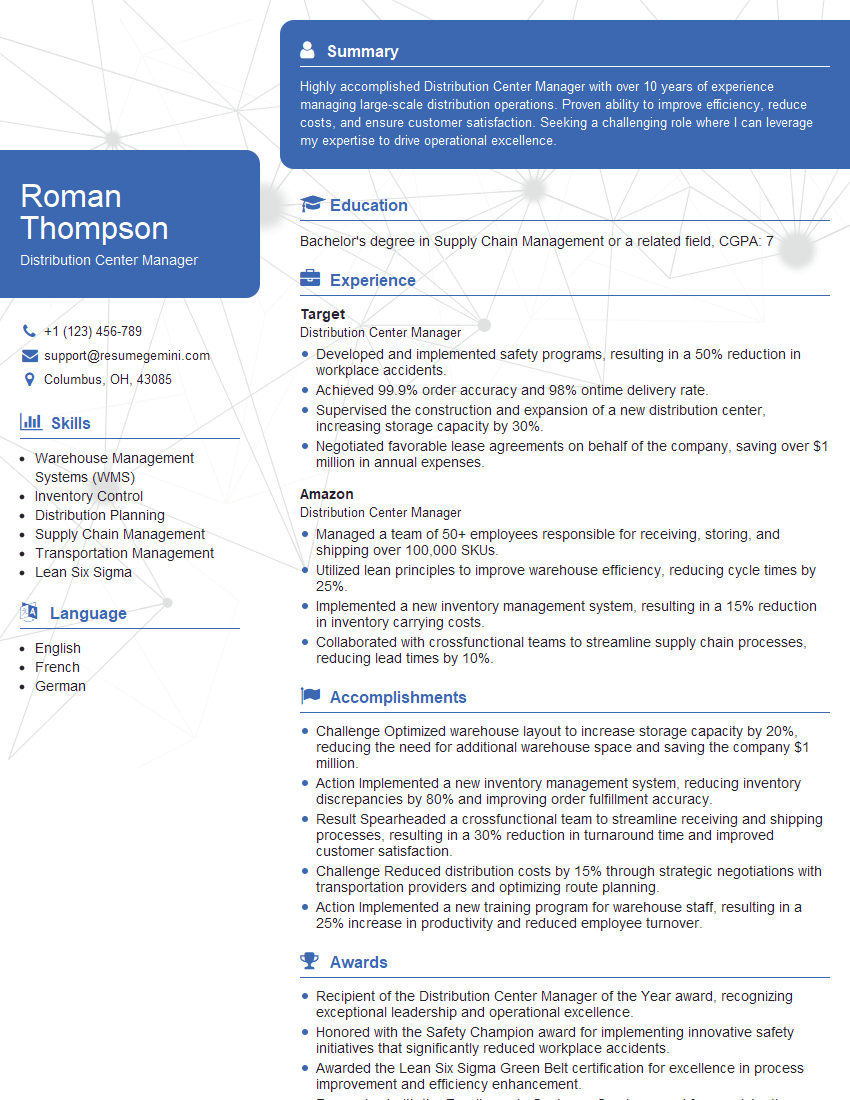
Distribution Center Manager Resume Sample
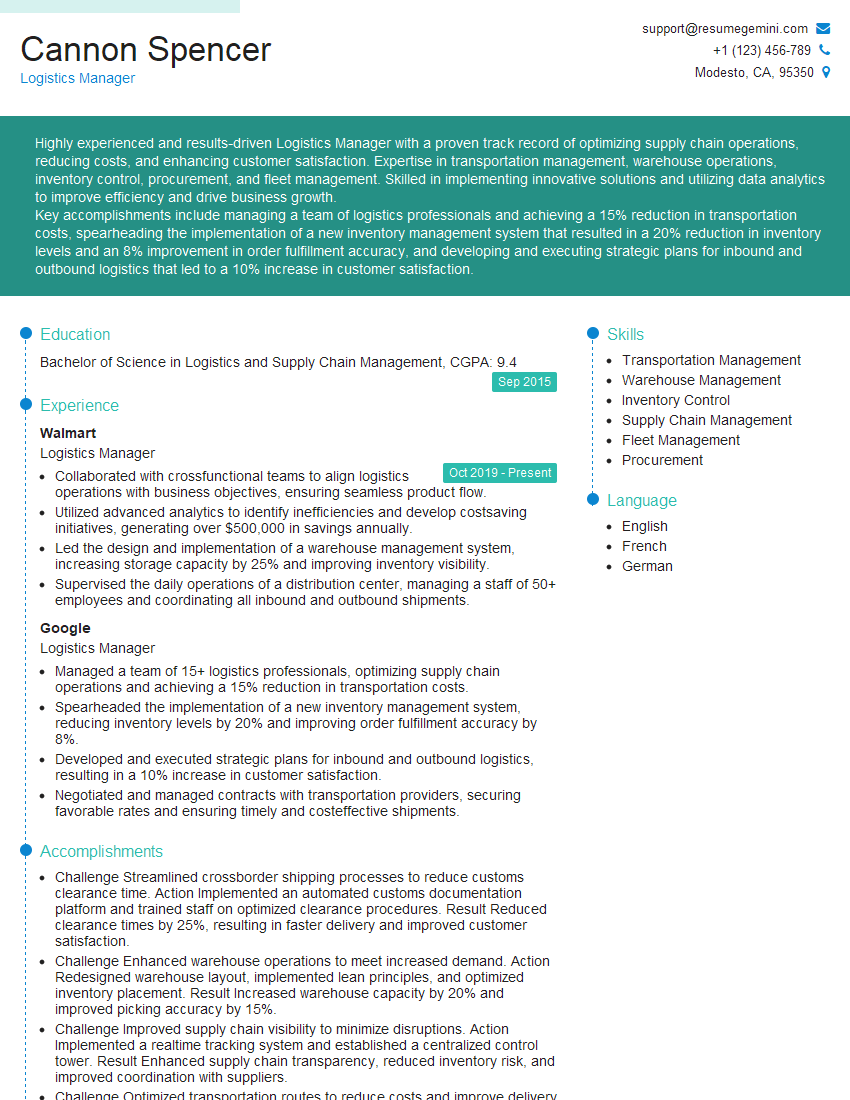
Logistics Manager Resume Sample
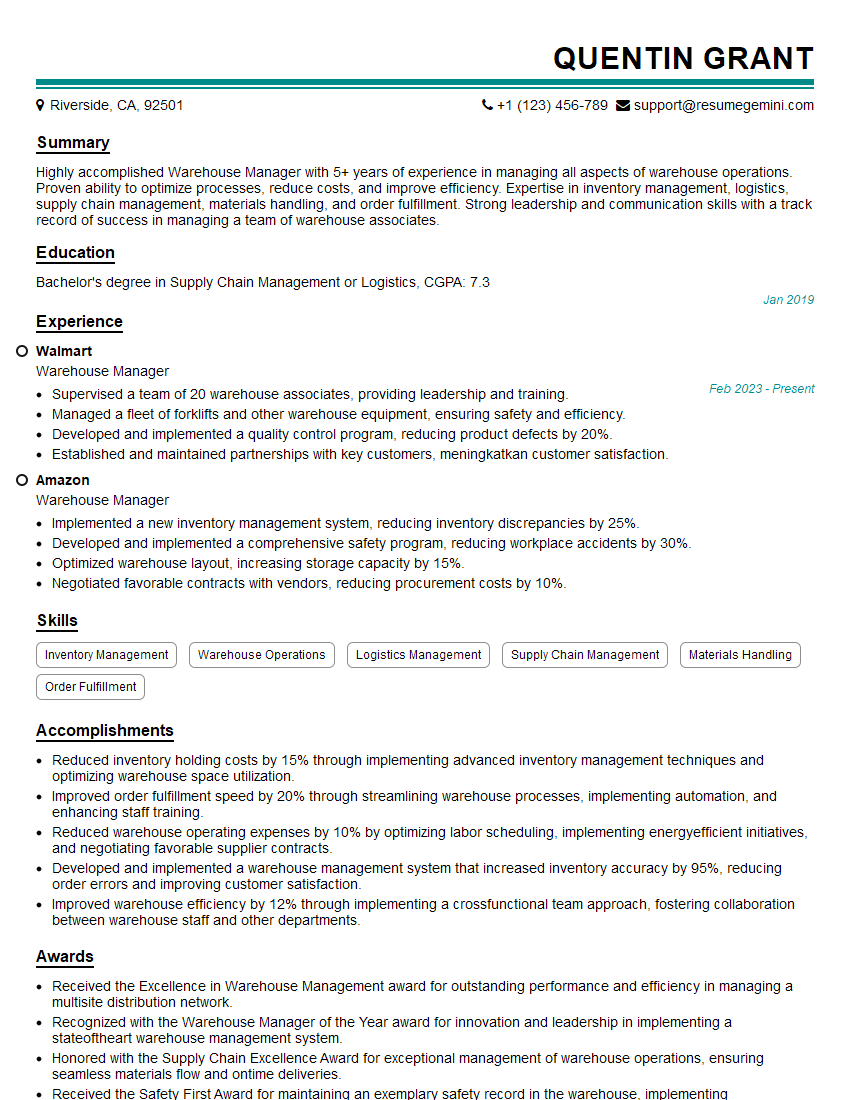
Warehouse Manager Resume Sample
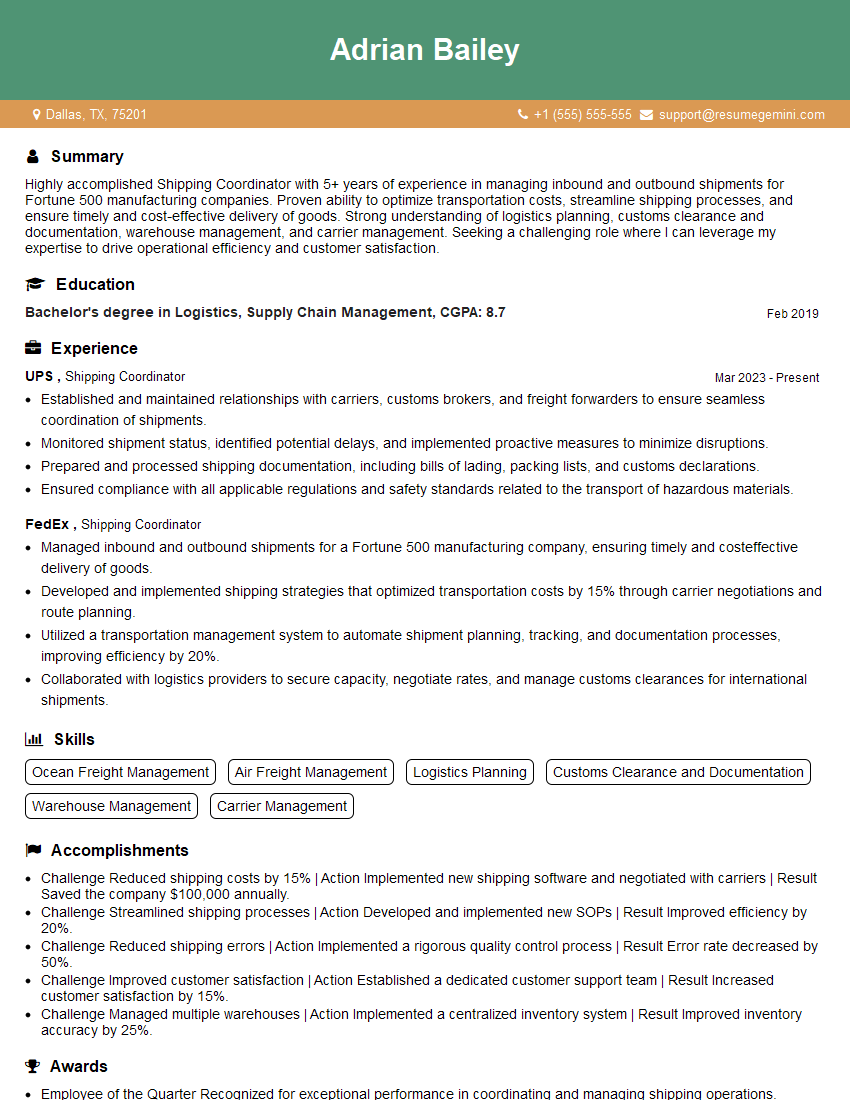
Shipping Coordinator Resume Sample
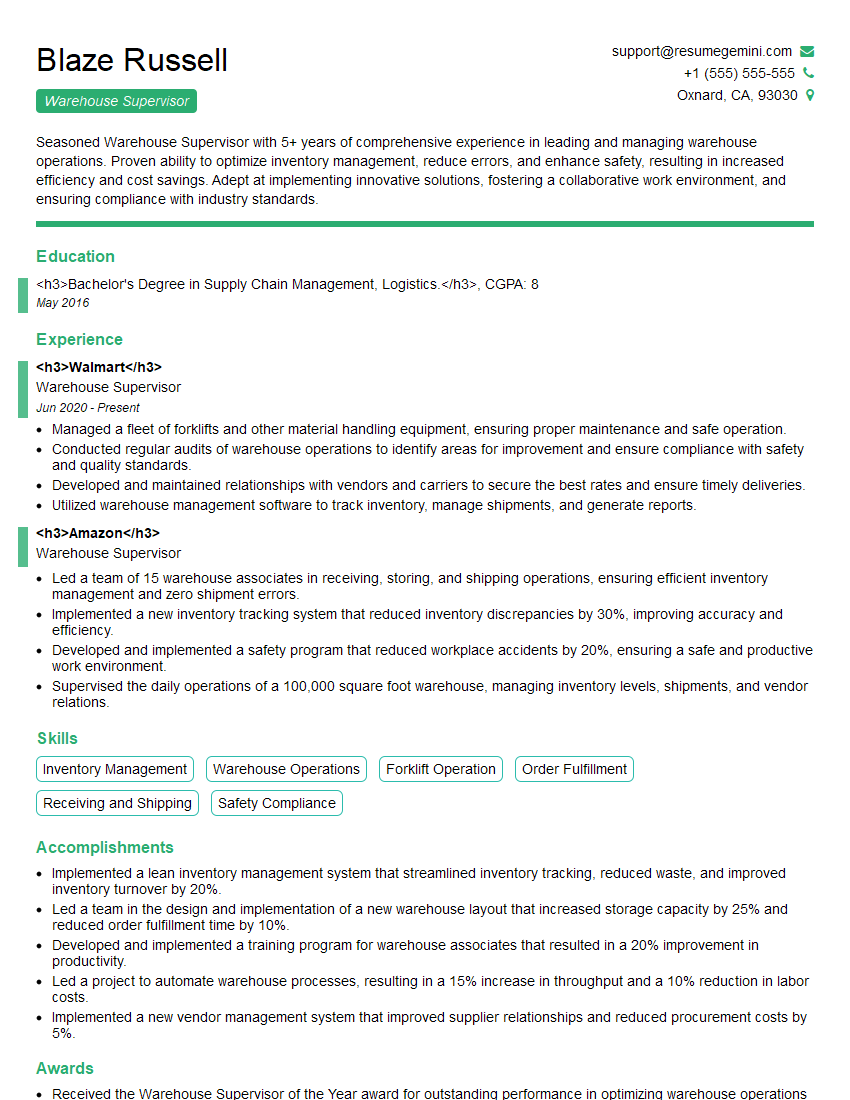
Warehouse Supervisor Resume Sample
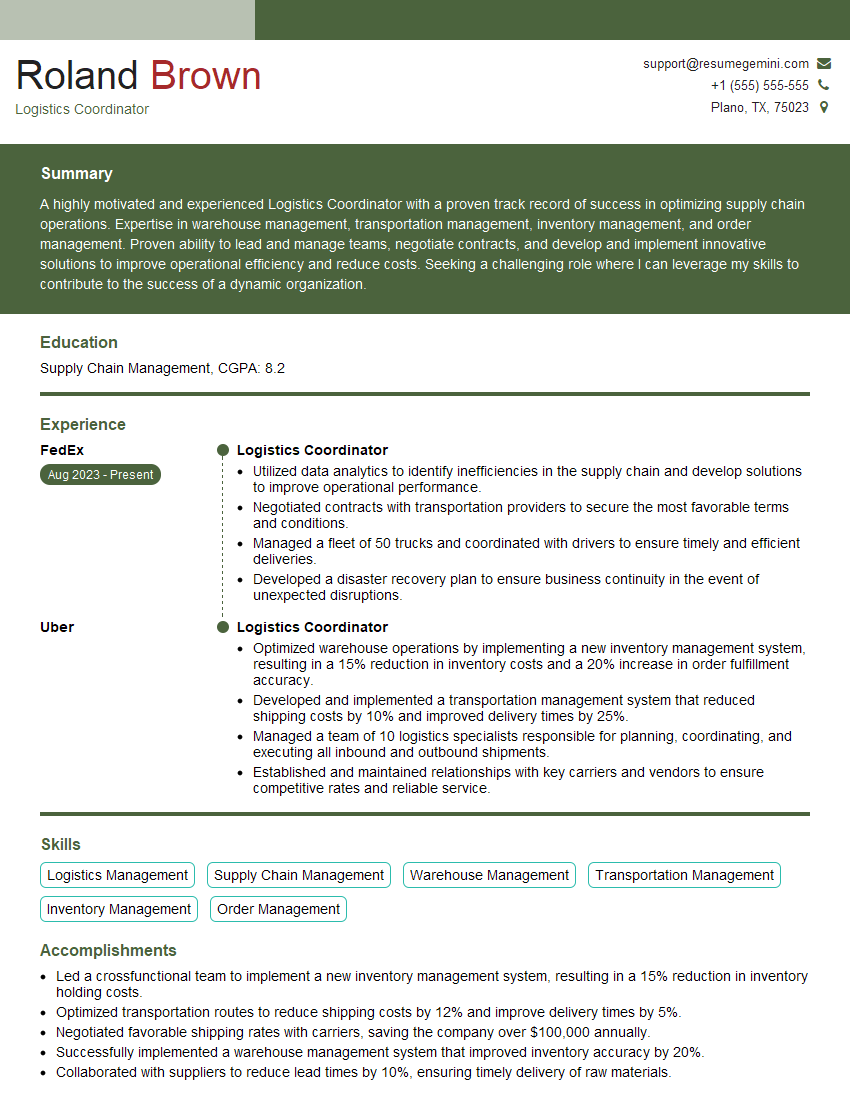
Logistics Coordinator Resume Sample
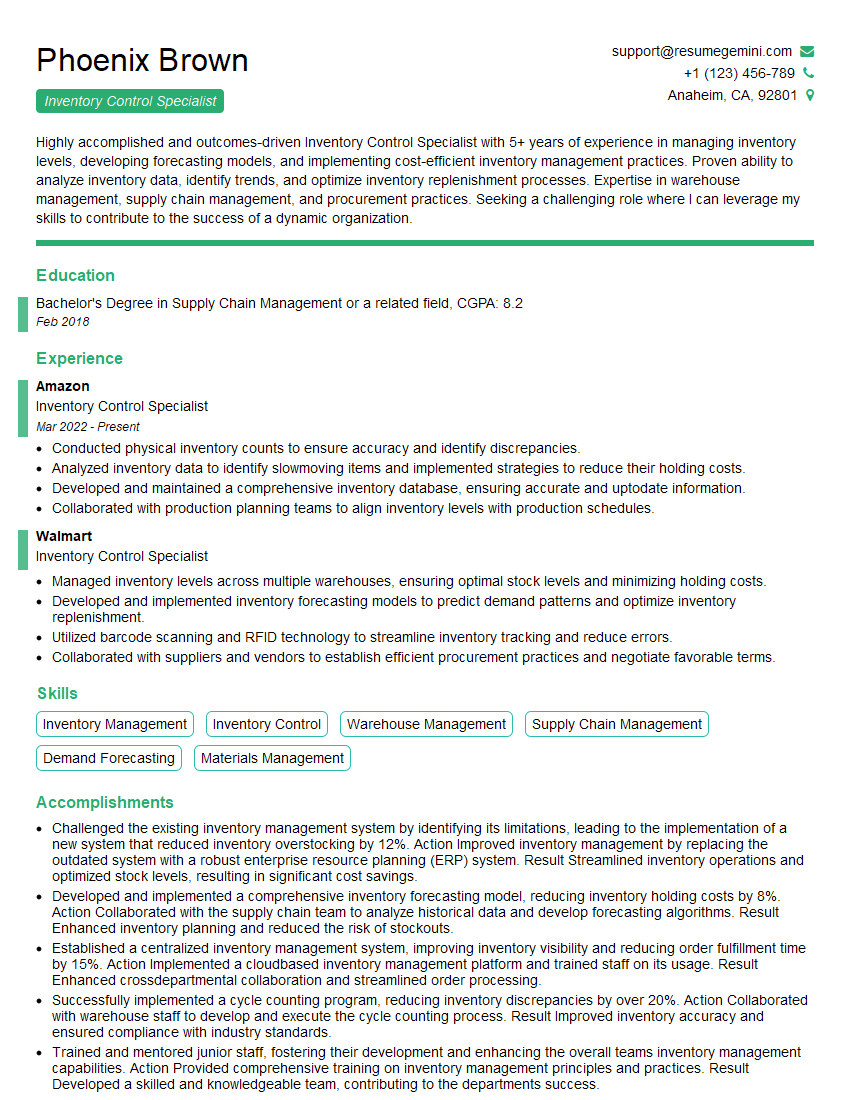
Inventory Control Specialist Resume Sample
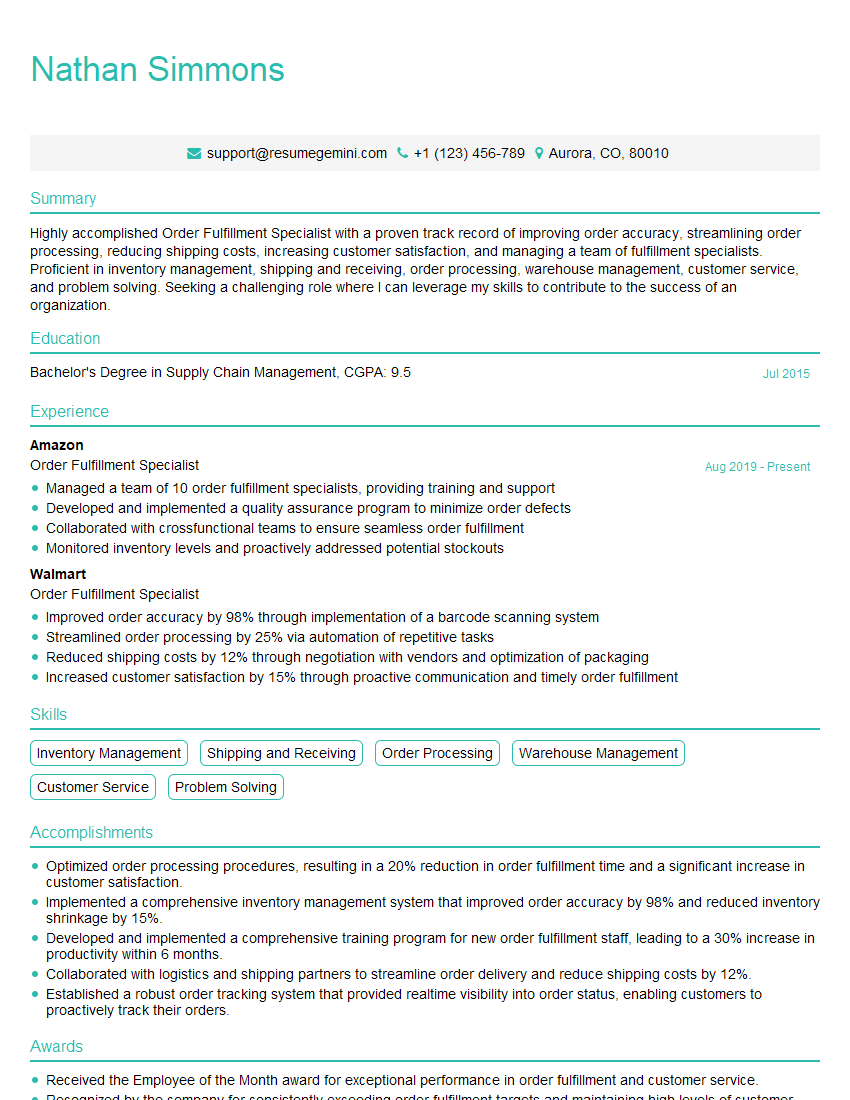
Order Fulfillment Specialist Resume Sample
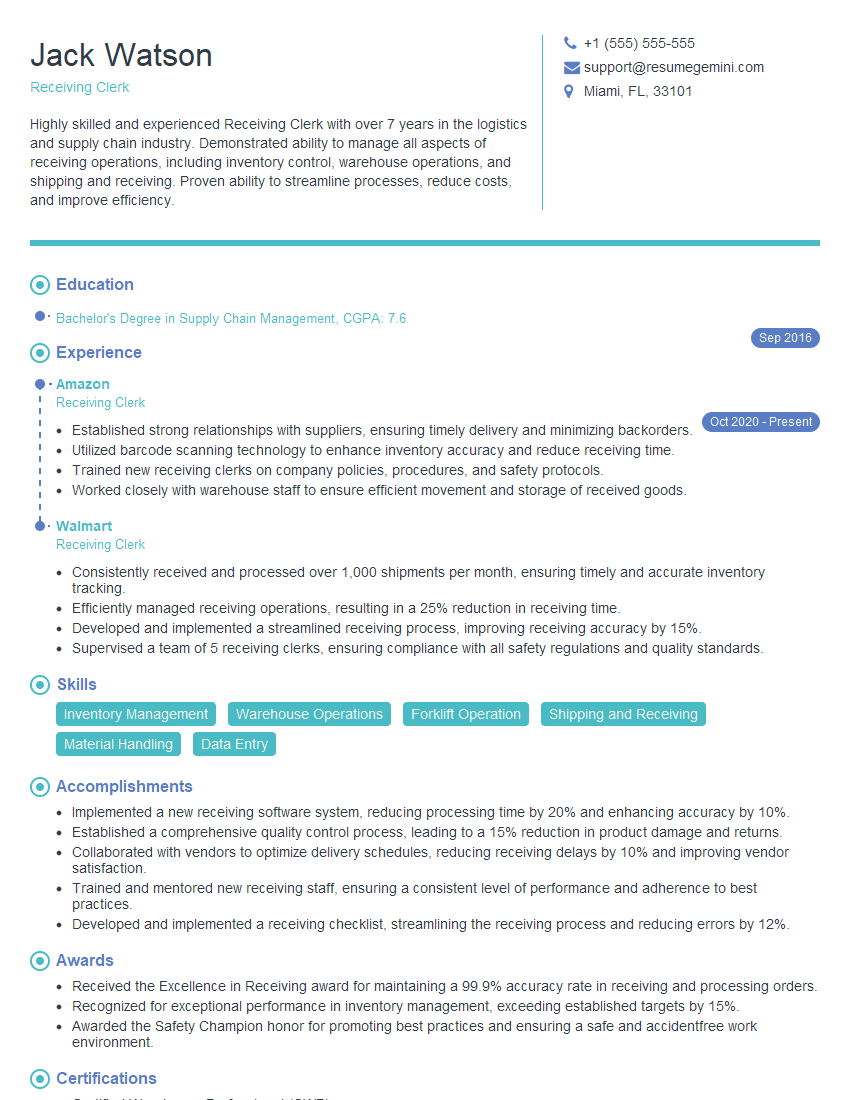
Receiving Clerk Resume Sample
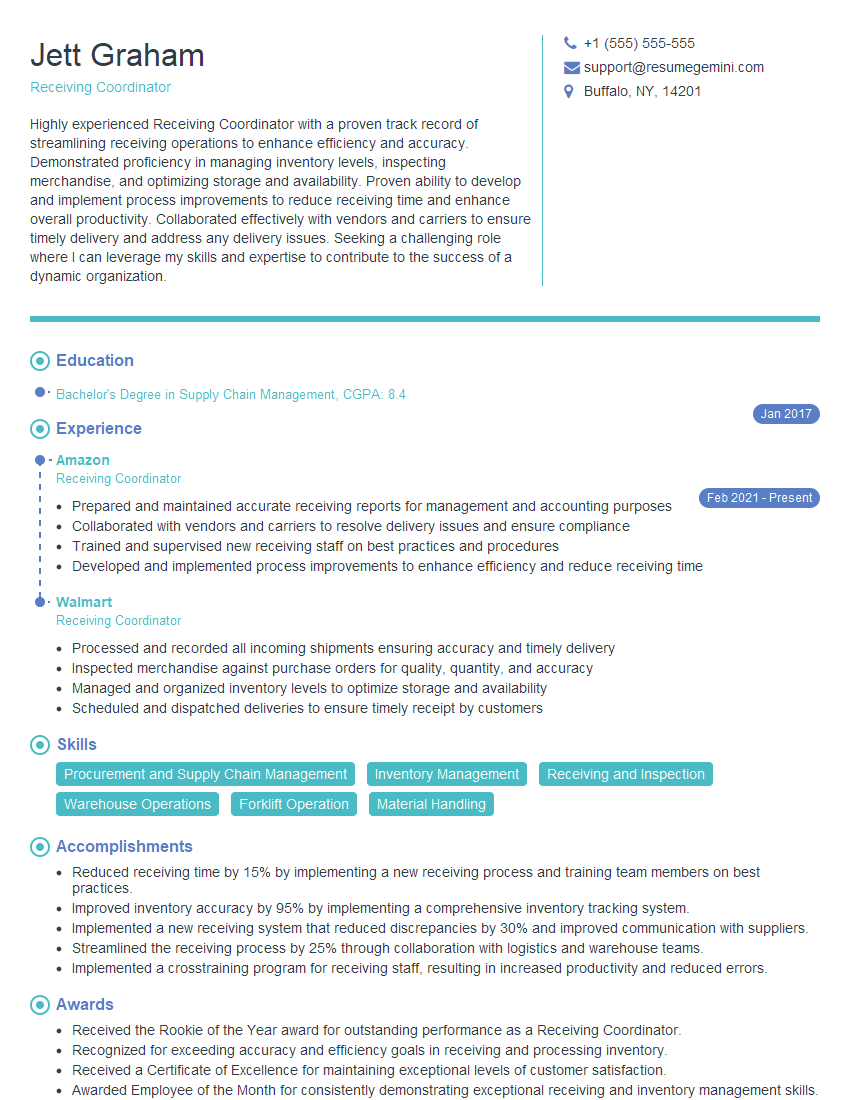
Receiving Coordinator Resume Sample

Shipping and Receiving Clerk Resume Sample
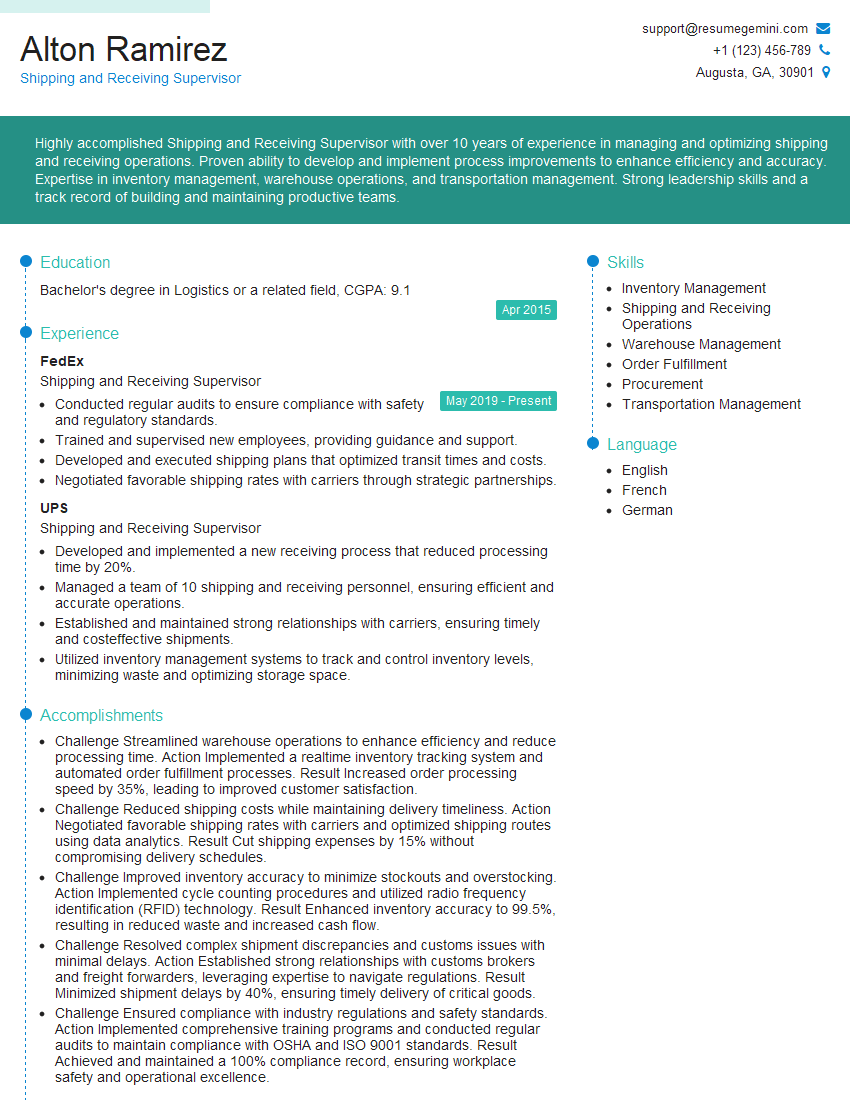
Shipping and Receiving Supervisor Resume Sample
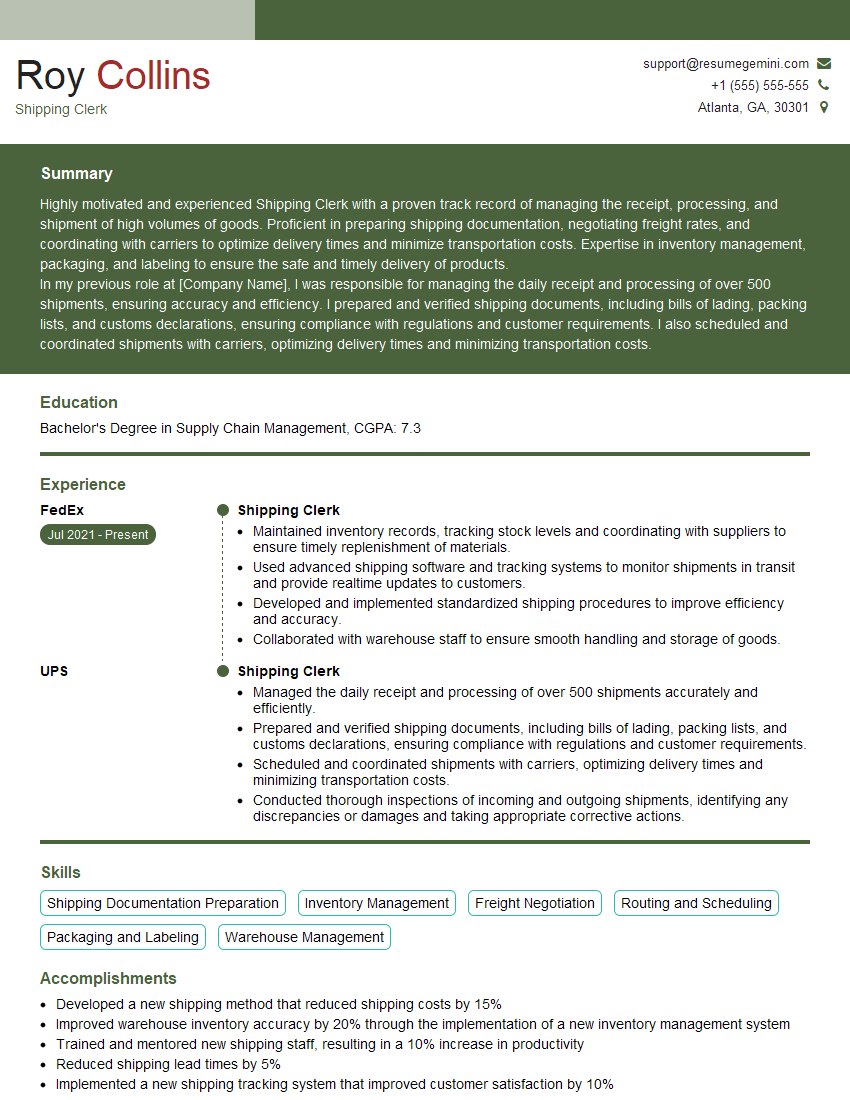
Shipping Clerk Resume Sample
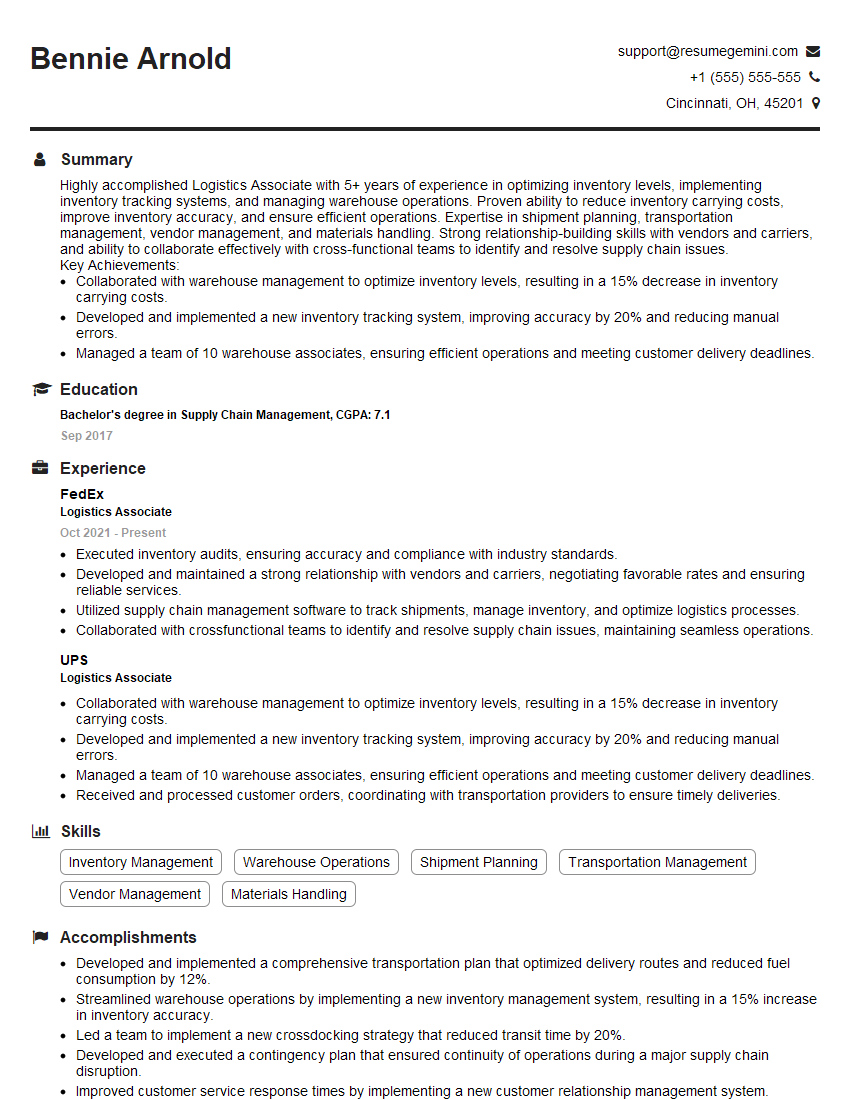
Logistics Associate Resume Sample
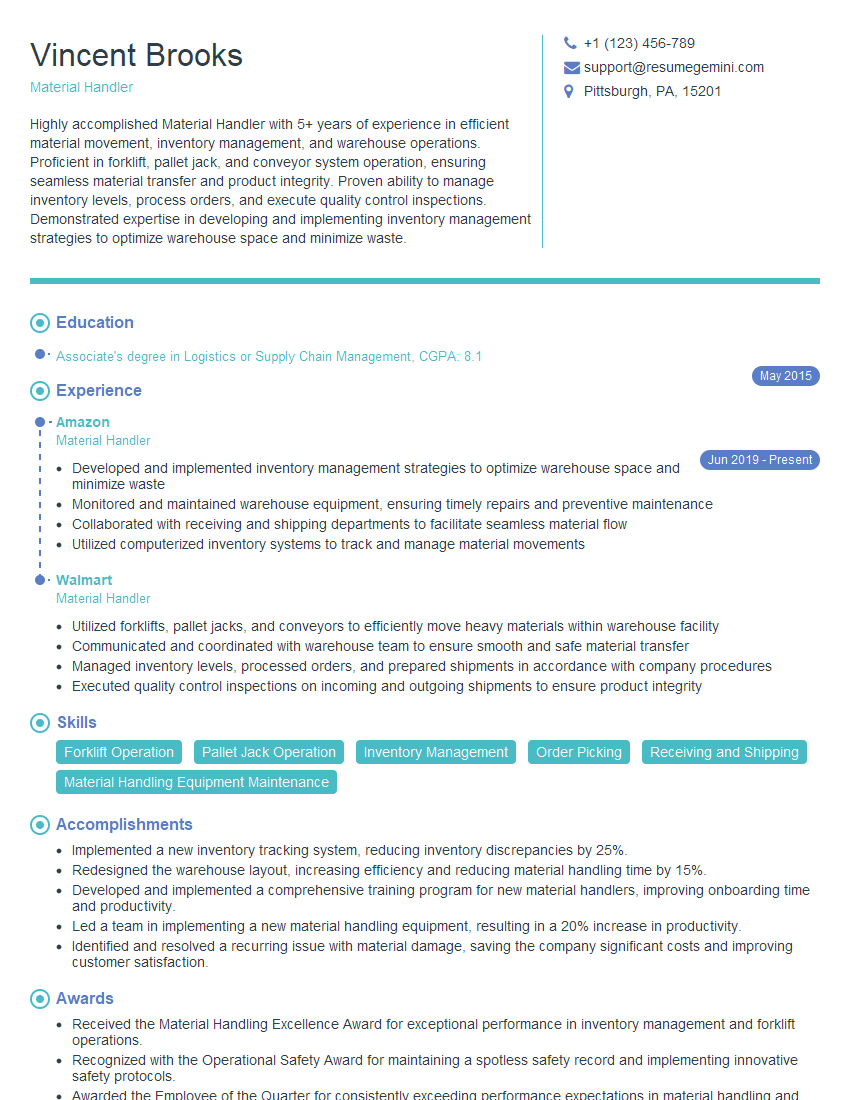
Material Handler Resume Sample
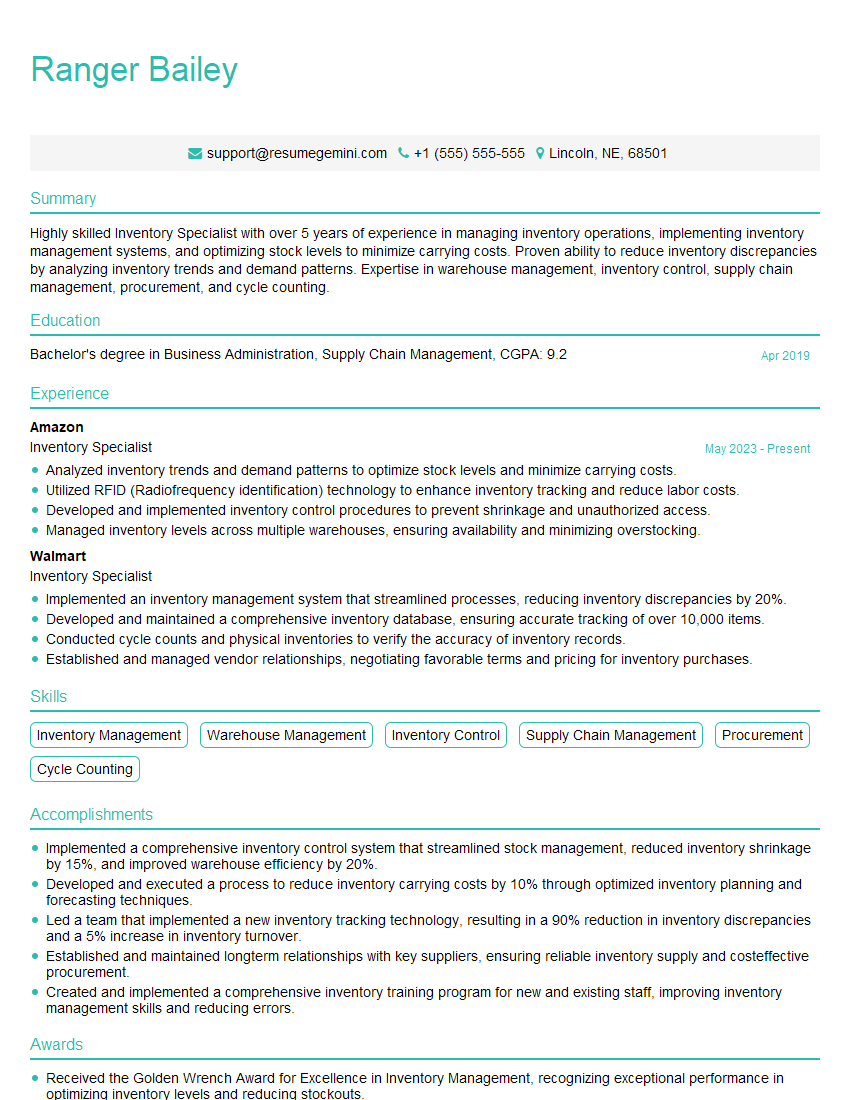
Inventory Specialist Resume Sample
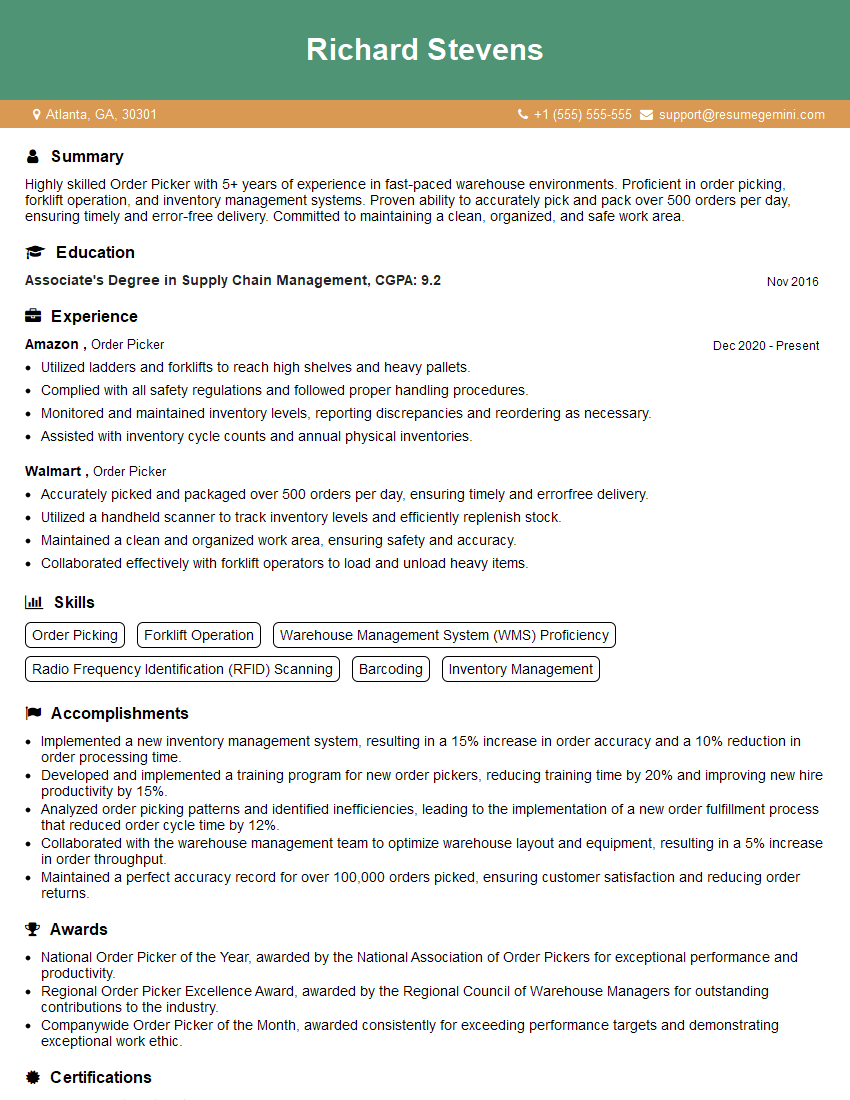
Order Picker Resume Sample
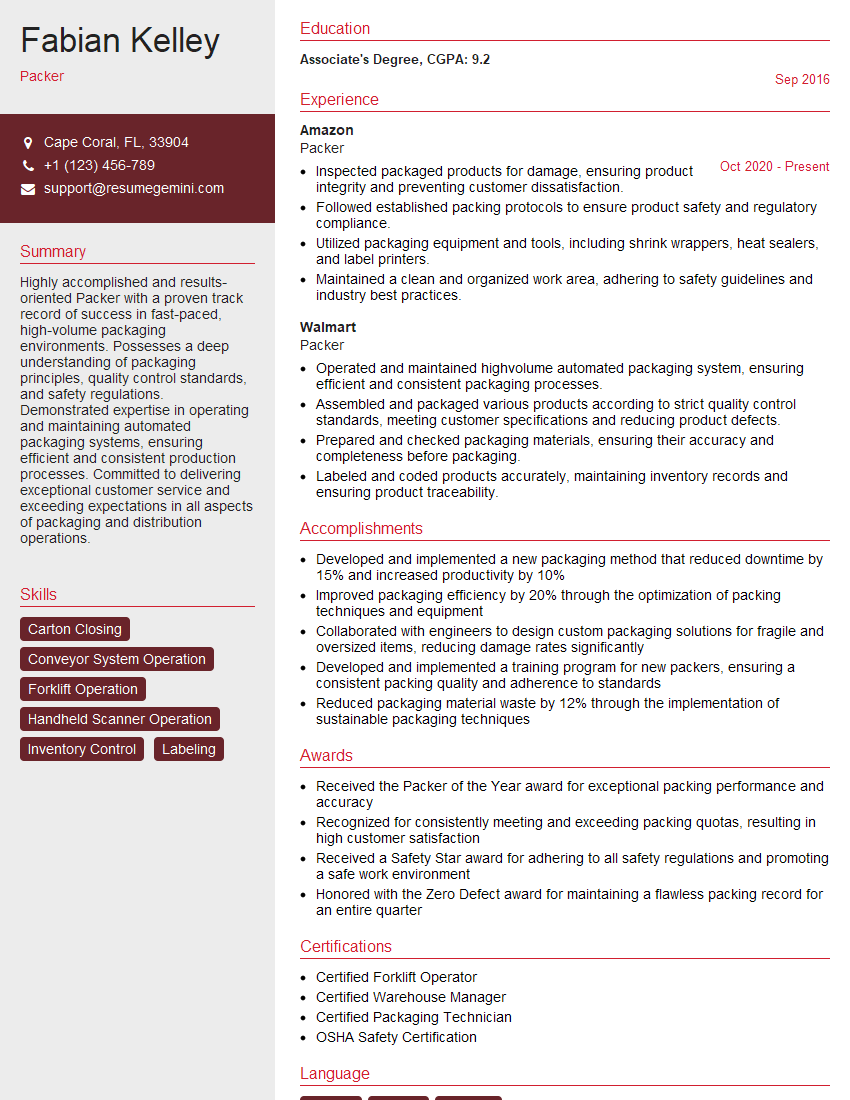
Packer Resume Sample
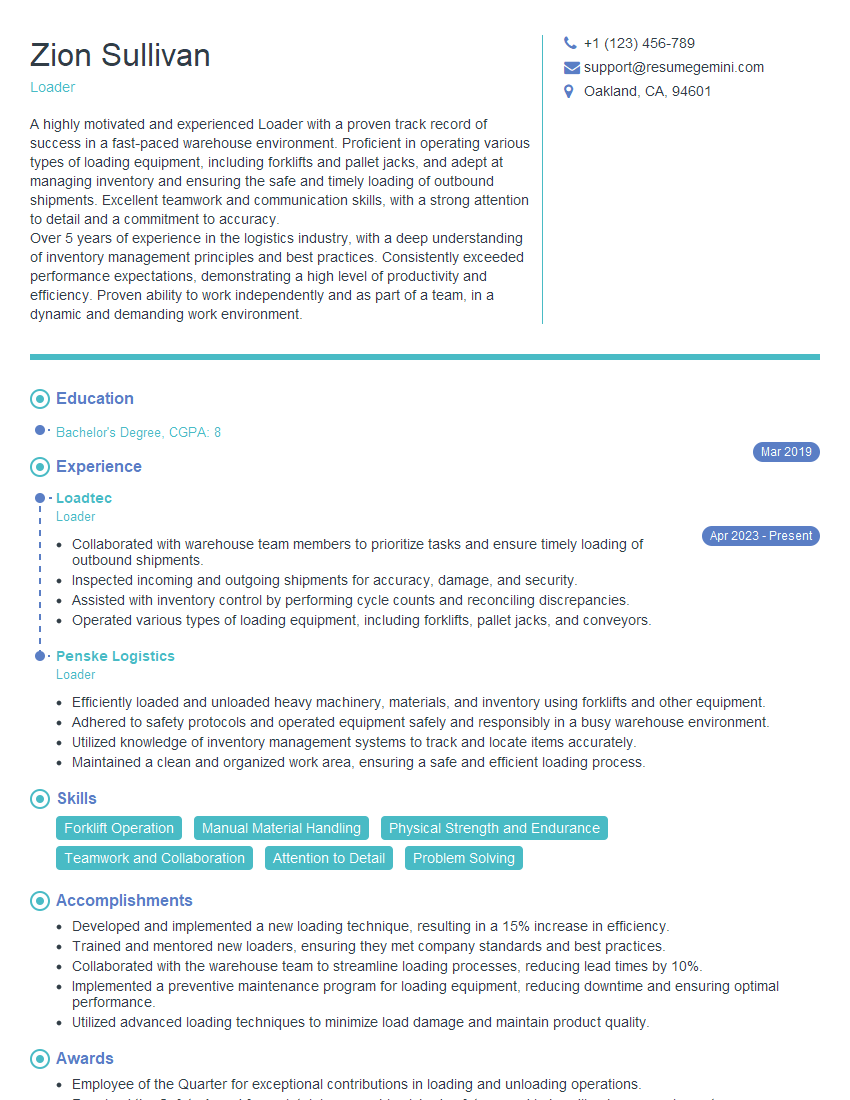
Loader Resume Sample
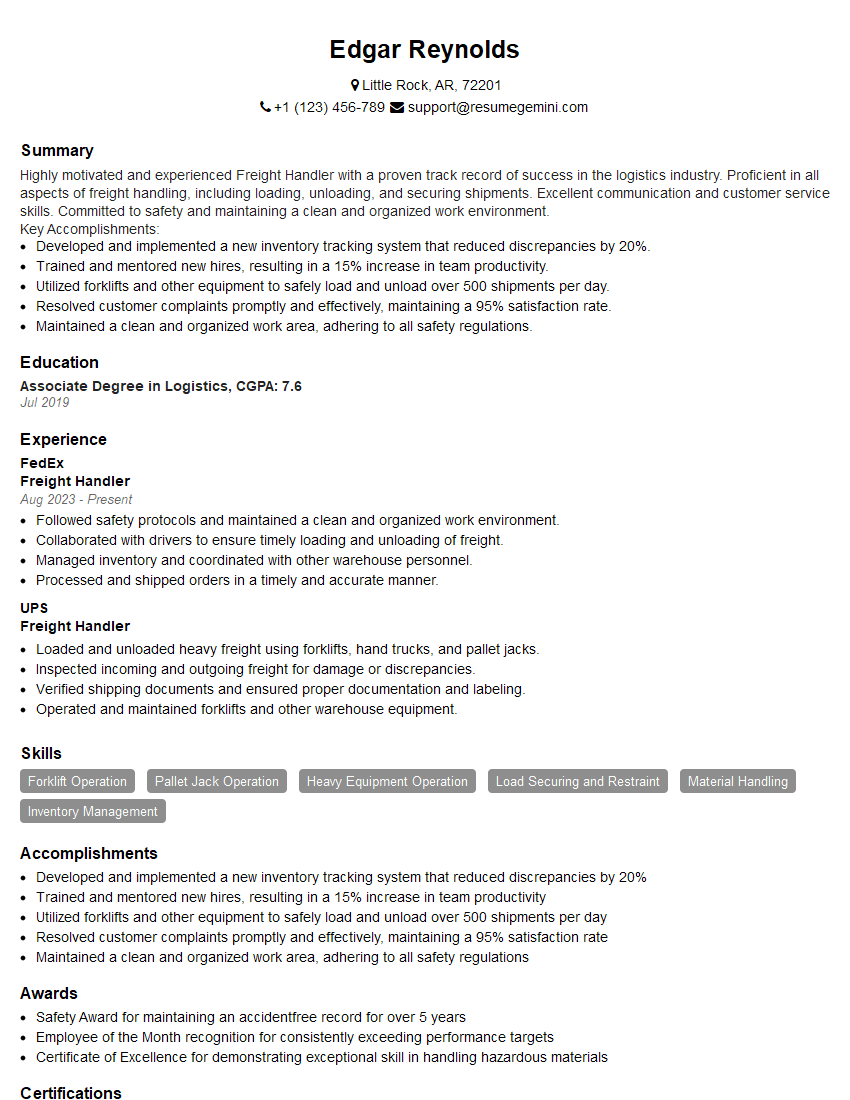
Freight Handler Resume Sample
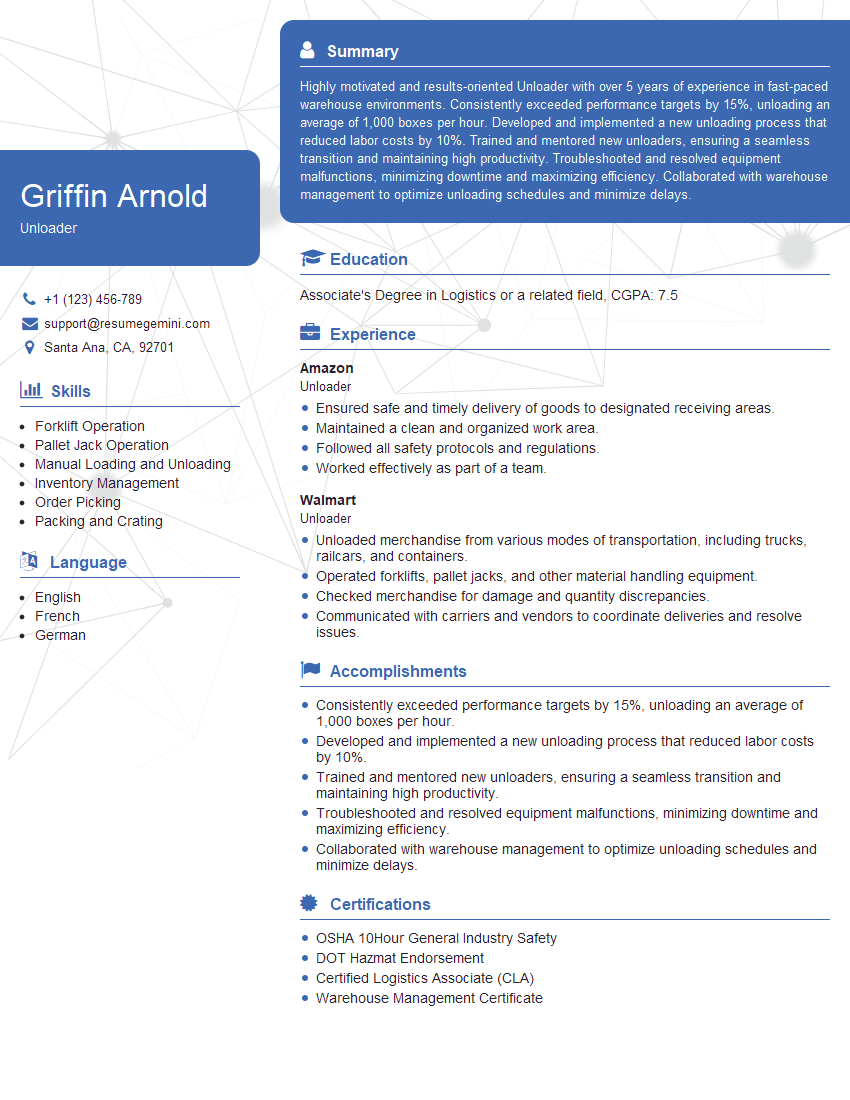
Unloader Resume Sample
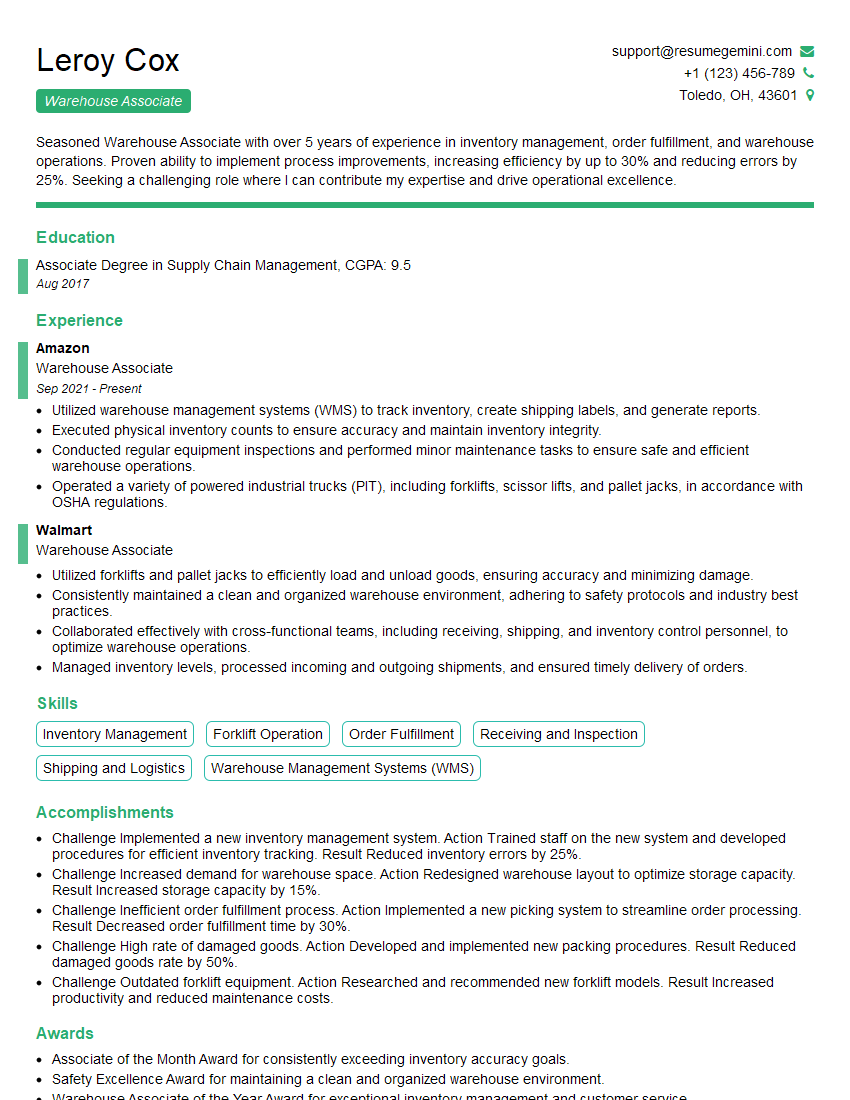
Warehouse Associate Resume Sample
- Distribution Center Manager
- Logistics Manager
- Warehouse Manager
- Shipping Coordinator
- Warehouse Supervisor
- Logistics Coordinator
- Inventory Control Specialist
- Order Fulfillment Specialist
- Receiving Clerk
- Receiving Coordinator
- Shipping and Receiving Clerk
- Shipping and Receiving Supervisor
- Shipping Clerk
- Logistics Associate
- Material Handler
- Inventory Specialist
- Order Picker
- Packer
- Loader
- Freight Handler
- Unloader
- Warehouse Associate
Explore more articles
Users Rating of Our Blogs
Share Your Experience
We value your feedback! Please rate our content and share your thoughts (optional).
What Readers Say About Our Blog
I Redesigned Spongebob Squarepants and his main characters of my artwork.
https://www.deviantart.com/reimaginesponge/art/Redesigned-Spongebob-characters-1223583608
IT gave me an insight and words to use and be able to think of examples
Hi, I’m Jay, we have a few potential clients that are interested in your services, thought you might be a good fit. I’d love to talk about the details, when do you have time to talk?
Best,
Jay
Founder | CEO