Interviews are more than just a Q&A session—they’re a chance to prove your worth. This blog dives into essential Differential GNSS Surveying interview questions and expert tips to help you align your answers with what hiring managers are looking for. Start preparing to shine!
Questions Asked in Differential GNSS Surveying Interview
Q 1. Explain the principles of Differential GNSS.
Differential GNSS (DGNSS) dramatically improves the accuracy of standard GNSS positioning by eliminating or significantly reducing systematic errors. Imagine two people using the same map to find a treasure; one has a slightly inaccurate map, while the other has a precise correction for that inaccuracy. DGNSS works similarly. A fixed base station with a known precise location receives the same satellite signals as a rover station (whose location is unknown). By comparing the differences between the signals received at both stations, corrections are calculated and applied to the rover’s data, leading to centimeter-level accuracy in many cases.
In essence, DGNSS leverages the fact that many systematic errors (atmospheric delays, satellite clock errors, orbital errors) affect both the base and rover similarly. By measuring these discrepancies at the base station with a known location, we can model and correct for these errors in the rover’s measurements.
Q 2. What are the different types of GNSS correction methods?
Several methods exist for applying GNSS corrections. These methods differ mainly in how the corrections are transmitted and applied, and the level of accuracy they achieve:
- Broadcast Corrections (Wide Area Augmentation Systems – WAAS, EGNOS, etc.): These systems use a network of reference stations to generate corrections broadcast to users via satellite signals. They offer improved accuracy compared to standalone GNSS but aren’t as precise as other methods. Think of it like a general weather forecast – useful but not highly specific.
- RTK (Real-Time Kinematic): Corrections are transmitted in real-time from a base station to the rover via radio link (typically) or cellular network. This is the highest precision method for most applications, achieving centimeter-level accuracy. This is like having a very detailed weather update for your specific location.
- Post-Processed Kinematic (PPK): Data from both the base and rover stations are recorded and processed later using specialized software. This approach can achieve high accuracy comparable to RTK but requires post-processing time. It is useful when real-time accuracy isn’t essential.
- Precise Point Positioning (PPP): This technique uses precise satellite orbit and clock information from global networks. It can achieve high accuracy without a base station but usually requires longer observation times and specialized software. This is like using a highly detailed, constantly updated map.
Q 3. Describe the role of base stations in DGNSS.
The base station plays a crucial role in DGNSS as it acts as a reference point with a known, highly accurate position. It’s essentially a permanently fixed GNSS receiver installed at a point with precisely surveyed coordinates. This known location is used as a benchmark to calculate and transmit corrections to the rover. The base station continuously monitors the GNSS satellites, receiving the same signals as the rover. By analyzing the differences between its own precisely known position and the raw GNSS measurements, it generates the correction data necessary to improve the rover’s position accuracy.
Imagine it as a lighthouse – the fixed location providing a reliable reference point for navigation.
Q 4. How does RTK (Real-Time Kinematic) GNSS work?
RTK GNSS achieves real-time centimeter-level accuracy by using carrier-phase measurements in addition to pseudorange measurements. Pseudorange measurements determine the approximate distance between the receiver and satellite, while carrier-phase measurements provide a much more precise distance. The ambiguity, a whole number of wavelengths in the carrier phase, needs to be resolved to utilize this precision.
The base station transmits corrections, including the resolved carrier-phase ambiguities, to the rover in real time. The rover then applies these corrections to its own carrier-phase measurements, significantly improving the positioning accuracy. The high precision comes from the fact that the carrier phase represents a much smaller distance than the pseudorange.
This process is dynamic and continuously updates the position based on ongoing observations, enabling real-time applications like construction surveying or machine guidance.
Q 5. What are the advantages and disadvantages of RTK GNSS?
Advantages of RTK GNSS:
- High Accuracy: Achieves centimeter-level accuracy, crucial for many surveying and engineering applications.
- Real-Time Positioning: Provides immediate positioning results, ideal for dynamic tasks.
- Relatively Simple Implementation: The equipment and software are relatively user-friendly once the setup is complete.
Disadvantages of RTK GNSS:
- Line-of-Sight Requirements: Radio communication between the base and rover is needed, which means there needs to be a clear line of sight, often limiting its use in urban canyons or heavily forested areas. The cellular data option mitigates some of these limitations, but introduces other potential issues such as signal strength and data costs.
- Cost: The initial investment in equipment can be substantial.
- Multipath and other Error Sources: Though highly accurate, RTK is still vulnerable to errors such as multipath signals, atmospheric effects, and receiver noise.
Q 6. Explain the concept of carrier-phase measurements in DGNSS.
Carrier-phase measurements in DGNSS utilize the phase of the GNSS signal’s carrier wave to determine the distance between the receiver and satellite. Unlike pseudorange measurements, which are based on the time it takes for the signal to travel, carrier-phase measurements are significantly more precise, even allowing for sub-millimeter accuracy in differential techniques.
The carrier wave’s phase is a much finer measurement than the signal’s arrival time; thus, it measures the distance with much greater precision. However, this precision comes with a complication – the initial phase (the integer number of wavelengths between the satellite and receiver) is unknown. Solving for this integer ambiguity (a process called ambiguity resolution) is crucial for achieving the high accuracy of RTK GNSS. This is typically done by combining pseudorange and carrier phase measurements.
Q 7. What are the sources of error in DGNSS measurements?
Several sources of error can affect DGNSS measurements, potentially degrading the accuracy. These include:
- Atmospheric Delays: Ionospheric and tropospheric delays affect the signal’s propagation time, causing errors. These are often the dominant source of error and are mitigated by differential techniques.
- Multipath Errors: Signals reflected off buildings, trees, or other objects can interfere with the direct signal, leading to inaccurate range measurements.
- Satellite Clock and Ephemeris Errors: Inaccuracies in satellite clock timing and orbital data can introduce errors in positioning. These are also substantially reduced by differential techniques.
- Receiver Noise: Thermal noise and other electronic noise in the receivers can affect the accuracy of measurements.
- Cycle Slips: Temporary loss of lock on the carrier phase can lead to significant errors. This is usually the biggest risk to carrier phase techniques.
- Receiver and Antenna Phase Center Variations: The point where the signal is received varies with frequency and orientation. This variation needs to be considered in high-accuracy measurements.
Understanding and mitigating these error sources is vital for achieving the desired accuracy in DGNSS applications. Techniques like careful antenna placement, robust data processing, and the use of advanced atmospheric models are employed to minimize their impact.
Q 8. How do you mitigate atmospheric errors in DGNSS?
Atmospheric errors, primarily caused by the ionosphere and troposphere, significantly impact DGNSS accuracy. The ionosphere, a layer of charged particles, delays GPS signals, while the troposphere, the lower atmosphere, introduces refractive delays. Mitigation strategies focus on modeling and correcting these delays.
Ionospheric Corrections: Dual-frequency receivers are crucial. They measure the signal at two frequencies, allowing us to calculate and remove the ionospheric delay using mathematical models. Single-frequency receivers rely on models provided by the correction services like precise point positioning (PPP) or differential corrections from a reference station.
Tropospheric Corrections: These are typically addressed using atmospheric models that consider factors like temperature, pressure, and humidity. Sophisticated models, often incorporated into DGNSS processing software, provide more accurate corrections than simpler models. The quality of these models directly affects the final accuracy.
Real-world example: Imagine surveying a long bridge; ionospheric delays could accumulate, leading to significant errors in the final measurements. Dual-frequency receivers and precise atmospheric models are essential to accurately map the bridge’s structure.
Q 9. Explain the concept of multipath errors and how to reduce them.
Multipath errors occur when GPS signals reflect off surfaces like buildings, water, or even the ground before reaching the receiver. This creates multiple signal paths, leading to inaccurate positioning. Think of it like hearing an echo – the delayed echo interferes with the original sound.
Reducing Multipath Errors: Several techniques are employed to minimize multipath effects:
- Careful Antenna Placement: Positioning the antenna in an open sky view, away from reflecting surfaces, is crucial. A clear line of sight to the satellites is essential.
- Using Choke Rings or Ground Planes: These physical devices help to block or absorb reflected signals, improving the signal-to-noise ratio.
- Advanced Signal Processing Techniques: Modern GNSS receivers use sophisticated algorithms to identify and filter out multipath signals based on their arrival times and signal characteristics. These algorithms significantly enhance accuracy.
- High-quality Receivers: High-end receivers with advanced multipath mitigation capabilities are more resilient to these errors.
Practical example: Surveying in a dense urban environment requires careful consideration of multipath. Incorrect antenna placement could lead to significant errors in the measured coordinates.
Q 10. Describe different types of GNSS receivers and their capabilities.
GNSS receivers vary significantly in capabilities, primarily based on their intended use and price point. Here are some key distinctions:
- Single-frequency vs. Dual-frequency Receivers: Single-frequency receivers are cost-effective but susceptible to ionospheric errors. Dual-frequency receivers offer significantly improved accuracy by mitigating ionospheric delays.
- Geodetic vs. Navigation Receivers: Geodetic receivers are designed for high-accuracy surveying and mapping, while navigation receivers prioritize speed and ease of use, often sacrificing accuracy.
- Real-Time Kinematic (RTK) vs. Post-Processed Kinematic (PPK) Receivers: RTK receivers provide real-time positioning solutions using differential corrections, while PPK receivers record data for later processing, allowing for even higher accuracy after corrections have been applied.
- Base Station Receivers: These receivers provide the reference data used for differential corrections in RTK and PPK surveys.
Capabilities often include: Multiple constellation tracking (GPS, GLONASS, Galileo, BeiDou), various communication interfaces (radio, cellular), data storage capabilities, and different levels of multipath mitigation techniques. The choice of receiver depends heavily on the specific application and desired accuracy.
Q 11. What are the specifications for a typical DGNSS survey?
DGNSS survey specifications are highly project-dependent and determined by the required accuracy and application. However, some general specifications include:
- Accuracy Requirements: This is often specified in centimeters (cm) or millimeters (mm) and represents the acceptable level of error in the final coordinates. Higher accuracy requirements necessitate more sophisticated equipment and techniques.
- Baseline Length: The distance between the rover (mobile) and base (reference) stations. Longer baselines can lead to increased errors if not properly accounted for by the correction model.
- Sampling Rate: How frequently the receiver records data points. A higher sampling rate is beneficial for capturing detailed information and improving the quality of post-processing.
- Antenna Type and Phase Center Offset: Specific antenna characteristics must be known for accurate results. Phase center offsets must be accounted for during processing to ensure the coordinates are correctly referenced to the center of the antenna.
- Atmospheric Conditions: These should be documented to inform post-processing and error analysis. Extreme weather can impact accuracy.
Example: A cadastral survey might require centimeter-level accuracy, while a topographic survey may need only decimeter-level accuracy. The project specifications will dictate the choice of equipment, survey methodology, and processing techniques.
Q 12. Explain the post-processing techniques used in DGNSS.
Post-processing techniques are crucial for achieving high accuracy in DGNSS surveys, especially in PPK. These techniques leverage precise orbit and clock information from independent sources to correct for errors.
- Precise Point Positioning (PPP): This technique uses precise satellite orbit and clock information from global navigation satellite systems (GNSS) analysis centers to correct for errors in the raw GNSS measurements. It is especially useful for single-receiver applications or when a base station is unavailable.
- Double-Differencing: This technique eliminates many common errors by taking the difference between measurements from two receivers at the same time, then taking the difference of that result at another time. This helps to remove errors from satellite clocks and atmospheric delays, while requiring the use of a base station
- Kinematic Positioning: In PPK, raw data is post-processed using precise ephemeris and atmospheric models, providing higher accuracy than real-time solutions by minimizing the accumulation of errors, such as atmospheric delays.
Post-processing software incorporates these techniques to refine the coordinates, minimize errors, and generate highly accurate survey data.
Q 13. How do you process and analyze DGNSS data?
DGNSS data processing and analysis involves several steps:
- Data Download and Pre-processing: Download the raw data from both the rover and base stations. This might involve transferring data from data cards or downloading remotely using cellular communication. Data should be inspected for any obvious errors.
- Data Validation: Check for gaps, outliers, and other inconsistencies in the data. This step is critical for maintaining the data’s integrity.
- Applying Corrections: Use appropriate correction services (like precise ephemeris, clock corrections, and atmospheric models) to correct the raw measurements and enhance accuracy.
- Coordinate Transformation: Transform the coordinates to the appropriate coordinate system (e.g., UTM, State Plane). This involves applying geodetic transformations.
- Quality Control (QC): Perform checks on the processed data to verify the accuracy and consistency of the results. This includes analyzing the residuals (the differences between the measured and predicted values).
- Data Visualization and Reporting: Present the results visually using maps, profiles, and tables. Create reports summarizing the survey data and its accuracy.
Software packages are typically used to automate these steps.
Q 14. What software packages are you familiar with for DGNSS processing?
I am familiar with several software packages for DGNSS processing, including:
- RTKLIB: A popular open-source software package for processing GNSS data, offering various processing options and great flexibility. It’s highly customizable but requires some technical expertise.
- Bernese GNSS Software: A widely used commercial software package for high-precision GNSS processing. It’s often used in research and demanding applications.
- Teledyne RESON (formerly Applanix) software: Specifically designed for integrating data from various sensors, including GNSS, and is commonly used for precise positioning in various applications. They offer both real-time and post-processing capabilities.
- Trimble Business Center: This software offers various post-processing options, particularly for integration with Trimble’s hardware.
The choice of software depends on factors such as budget, project requirements, available hardware, and personal preference. Many of these packages offer similar functionalities but differ in user interface and specific capabilities.
Q 15. Describe your experience with different antenna types.
My experience encompasses a wide range of GNSS antennas, from geodetic-grade antennas used for high-precision surveying to simpler, more compact antennas suitable for mobile mapping applications. The choice of antenna depends heavily on the project requirements. For instance, a geodetic antenna with a choke ring, designed to minimize multipath effects, is crucial for centimeter-level accuracy in demanding environments like urban canyons. These antennas are typically larger and more expensive, reflecting their superior performance. Conversely, a smaller, less expensive antenna might suffice for applications where sub-meter accuracy is acceptable, such as in agricultural surveying.
I’ve worked extensively with antennas exhibiting different phase center variations (PCVs). Understanding PCV is critical, as it represents the offset between the antenna’s physical center and its effective phase center – the point from which the signal appears to originate. Accurate PCV modeling is essential for high-precision results, especially when dealing with various antenna orientations and frequencies.
I also have experience with various antenna types, including:
- Choke Ring Antennas: Excellent for reducing multipath effects.
- Patch Antennas: Compact and suitable for mobile applications.
- Helical Antennas: Offer circular polarization, enhancing signal reception.
Career Expert Tips:
- Ace those interviews! Prepare effectively by reviewing the Top 50 Most Common Interview Questions on ResumeGemini.
- Navigate your job search with confidence! Explore a wide range of Career Tips on ResumeGemini. Learn about common challenges and recommendations to overcome them.
- Craft the perfect resume! Master the Art of Resume Writing with ResumeGemini’s guide. Showcase your unique qualifications and achievements effectively.
- Don’t miss out on holiday savings! Build your dream resume with ResumeGemini’s ATS optimized templates.
Q 16. How do you ensure the accuracy and reliability of DGNSS data?
Ensuring accuracy and reliability in DGNSS data is a multifaceted process. It starts with meticulous pre-survey planning, including careful site selection to minimize multipath errors – signals reflecting off buildings or other objects. During the survey, we use several techniques:
- Base Station Setup: Establishing a stable, well-defined base station is paramount. This involves selecting a location with minimal obstruction and stable geodetic coordinates. The base station data is fundamental for correcting the rover’s measurements.
- Regular Calibration: Regular calibration of both the base and rover receivers ensures their performance is within specified tolerances. This includes checking antenna phase center offsets and ensuring accurate clock synchronization.
- Data Quality Control: Rigorous post-processing of the data is critical. This includes identifying and filtering out outliers and using appropriate mathematical models to account for atmospheric delays (ionospheric and tropospheric).
- Cycle Slip Detection and Correction: Cycle slips – sudden jumps in the carrier phase – can severely impact accuracy. Detection and correction algorithms are applied to mitigate these errors.
- Using appropriate processing software: Sophisticated software packages are used for differential processing, taking into account all sources of errors and providing various quality control metrics such as DOP and RMS error.
Finally, we verify the results using independent methods or comparing them with existing data whenever possible, creating a process focused on rigorous error checking.
Q 17. What are the limitations of DGNSS technology?
DGNSS, while powerful, has limitations. The most significant are:
- Signal Obstructions: Dense foliage, tall buildings, or tunnels can block satellite signals, leading to data loss or reduced accuracy.
- Multipath Errors: Reflected signals can create errors in positioning. While mitigation techniques exist, they cannot completely eliminate this problem.
- Atmospheric Effects: Ionospheric and tropospheric delays affect signal propagation, introducing errors that need to be corrected, sometimes imperfectly.
- Satellite Geometry: Poor satellite geometry (high DOP values) can result in reduced accuracy.
- Receiver Limitations: The quality of the receiver itself, its sensitivity and noise characteristics, affects the precision attainable.
- Network Availability: The accuracy relies on a functioning network of reference stations and appropriate correction services. Outages or limitations of these services will directly impact accuracy.
These limitations need to be carefully considered during project planning and implementation, often leading to specific mitigation strategies.
Q 18. Explain the concept of PDOP (Position Dilution of Precision).
PDOP, or Position Dilution of Precision, is a measure of the geometrical strength of the satellite constellation at a given time and location. It quantifies the effect of satellite geometry on the accuracy of position estimation. Imagine a tetrahedron formed by four satellites and the receiver. If the satellites are widely spread out, the tetrahedron is large, and PDOP is low, resulting in high accuracy. If the satellites are clustered together, the tetrahedron is small, PDOP is high, and the accuracy is lower.
PDOP values typically range from 1 to infinity. A lower PDOP (e.g., 1-4) indicates good satellite geometry and high accuracy, while a higher PDOP (e.g., 5 and above) signifies poor geometry and lower accuracy. Surveying professionals aim for surveys with lower PDOP values to minimize the geometric impact on the accuracy of measurements.
Q 19. How does the number of satellites affect the accuracy of DGNSS?
The number of satellites tracked significantly impacts DGNSS accuracy, primarily by influencing PDOP. With more satellites available, the chances of having a good geometric configuration (low PDOP) increases. This means the position solution is better constrained and less susceptible to errors.
However, simply having many satellites doesn’t guarantee high accuracy. The distribution of those satellites in the sky is crucial. Even with a large number of satellites, if they are clustered in one part of the sky, the PDOP can still be high, reducing accuracy. The optimal scenario is having a well-distributed constellation with a low PDOP value. While four satellites are the minimum for a 3D position fix, more than four generally improves accuracy and reliability.
Q 20. Describe your experience with different coordinate systems.
My experience includes working with various coordinate systems, including:
- WGS 84: The World Geodetic System 1984 is the most commonly used global coordinate system, a geocentric coordinate system (Earth-centered).
- UTM: Universal Transverse Mercator, a projected coordinate system that divides the Earth into 60 zones, making it suitable for large-scale mapping projects.
- State Plane Coordinate Systems: These are localized coordinate systems optimized for specific regions or states.
- Local Datums: These are regionally defined coordinate systems based on local measurements. They are often used when dealing with historical data or specific regional requirements.
Transformations between different coordinate systems are crucial in many DGNSS projects. I am proficient in using various coordinate transformation techniques, ensuring seamless integration of data from diverse sources.
For example, when working on a project that uses historical data from a local datum, I need to accurately transform that data into the project’s primary coordinate system, ensuring consistency throughout the project.
Q 21. How do you handle data inconsistencies in DGNSS surveys?
Handling data inconsistencies in DGNSS surveys requires a systematic approach. First, the identification of inconsistencies is critical. This can be done through visual inspection of data plots, statistical analysis (checking for outliers), and using quality control checks within processing software. Inconsistencies can manifest in various ways, such as:
- Outliers: Individual data points that deviate significantly from the overall trend.
- Cycle slips: Sudden jumps in the carrier phase data.
- Multipath interference: Systematic errors due to reflected signals.
Once identified, the strategies for dealing with inconsistencies include:
- Outlier Removal: Outliers can be removed after careful consideration, ensuring not to unduly bias the results. Robust statistical methods are often employed to deal with outliers.
- Cycle Slip Repair: Specific algorithms are used to identify and repair cycle slips, often using advanced processing techniques within the survey software.
- Data Filtering: Applying filters to smooth out noise and remove high-frequency fluctuations in the data can help improve the data’s overall consistency. But care must be taken to avoid distorting the data.
- Re-observation: In some cases, re-observing problematic areas may be necessary to get more reliable data.
The choice of method depends on the nature and severity of the inconsistency. Documentation is crucial, recording all the steps taken to handle inconsistencies and their rationale. Finally, after processing, it’s crucial to perform further quality control to assess the effect of corrections and ensure data reliability.
Q 22. What are the safety protocols you follow during GNSS surveying?
Safety is paramount in GNSS surveying. My protocols begin with a thorough site assessment before commencing any work. This includes identifying potential hazards like uneven terrain, overhead power lines, and nearby traffic. I always wear high-visibility clothing and use appropriate safety equipment, such as hard hats and safety boots. When working near roads or in areas with vehicular traffic, I ensure appropriate traffic control measures are in place. Communication is key; I maintain consistent contact with my team and anyone else who might be in the vicinity. We use pre-determined emergency procedures and have clear communication channels for reporting any incidents or unexpected situations. Regular breaks are scheduled to avoid fatigue, a significant contributor to accidents. Finally, we adhere strictly to all relevant safety regulations and guidelines specified by the governing bodies in our area.
For example, during a recent survey near a construction site, we established a designated safe zone and coordinated with the site foreman to ensure our operations didn’t interfere with their work. Clear signage and communication were crucial to prevent any accidents.
Q 23. How do you ensure the quality control of DGNSS data?
Quality control in DGNSS data is crucial for accurate results. My approach involves several steps. First, I perform pre-processing checks, validating the raw data for cycle slips, multipath errors, and outliers. This often involves specialized software capable of identifying and correcting these issues. Then, I analyze the positional accuracy using statistical measures like Root Mean Square Error (RMSE). I compare the results with the expected accuracy based on the chosen GNSS technique and the receiver specifications. Post-processing involves using precise ephemeris and atmospheric models to improve the accuracy further. I meticulously document all steps, maintaining a clear audit trail. Visual inspection of the processed data using GIS software also helps identify any unusual patterns or potential errors. Finally, we might conduct independent checks, such as comparing our DGNSS data to control points obtained via other surveying methods.
For instance, during a land boundary survey, I noticed unusually high RMSE values in a specific area. Further investigation revealed a significant multipath error caused by reflections from nearby buildings. By identifying and correcting this error, we significantly improved the overall accuracy of the survey.
Q 24. Explain the importance of proper equipment calibration in DGNSS.
Proper equipment calibration is fundamental to the accuracy of DGNSS surveys. Uncalibrated or poorly calibrated equipment leads to systematic errors that can significantly impact the reliability of the data. Calibration involves checking and adjusting various parameters of the GNSS receiver and antenna. This includes phase center offset calibration, which accounts for the difference between the antenna’s phase center and its physical center. Antenna phase center variations with elevation angle are also crucial to correct. Regular checks of the receiver’s internal clocks and the signal processing algorithms are necessary to ensure optimal performance. I use specialized calibration equipment and follow manufacturer-recommended procedures to ensure accuracy. Documentation of the calibration process and the results is critical to maintain traceability and quality.
Think of it like calibrating a scale before weighing goods; an uncalibrated scale will provide inaccurate measurements, impacting the quality of your work. Similarly, an uncalibrated GNSS receiver will yield inaccurate positional data, rendering the entire survey potentially unreliable.
Q 25. Describe a challenging DGNSS survey project you worked on and how you overcame the challenges.
One challenging project involved surveying a dense urban environment with tall buildings and limited sky view. The high multipath errors and signal blockage significantly reduced the accuracy of the DGNSS data. To overcome this, we employed several strategies. First, we used a combination of base stations strategically positioned to minimize obstructions. Second, we implemented advanced signal processing techniques, including carrier-phase ambiguity resolution, to improve accuracy despite the poor signal conditions. Third, we incorporated additional ground control points surveyed using traditional methods to improve the reliability of our positioning solution. We also carefully analyzed the results to identify and mitigate the impact of any remaining errors. Despite the limitations, we were able to achieve the required level of accuracy by carefully planning the survey and using appropriate mitigation techniques.
This project underscored the importance of understanding the limitations of DGNSS in challenging environments and the need for a flexible and adaptive approach to ensure successful project completion.
Q 26. What are the current trends and future developments in DGNSS technology?
Current trends in DGNSS technology include increased integration of multi-constellation and multi-frequency signals (GPS, GLONASS, Galileo, BeiDou) to enhance accuracy and reliability, even under challenging conditions. The use of advanced signal processing techniques, such as Real-Time Kinematic (RTK) with improved ambiguity resolution algorithms, continues to improve positioning accuracy and speed. The development of more compact and robust receivers with better signal tracking capabilities is another significant development. Furthermore, the increasing availability of high-precision correction services, via satellite-based augmentation systems (SBAS) and ground-based augmentation systems (GBAS), is improving the accessibility of precise positioning for a wider range of applications.
Future developments likely involve integration with inertial measurement units (IMUs) for improved positioning in environments with poor GNSS reception. The emergence of new satellite constellations will further enhance coverage and accuracy. Artificial intelligence (AI) and machine learning (ML) will play a greater role in automated data processing and error detection. The potential for integrating GNSS with other technologies like LiDAR and imagery data to create highly accurate 3D models is also very exciting.
Q 27. How do you incorporate DGNSS data into GIS applications?
Integrating DGNSS data into GIS applications is straightforward. The processed coordinate data (latitude, longitude, and elevation) can be directly imported into GIS software using various file formats like shapefiles, DXF, or CSV. Once imported, the data can be used to create various GIS layers such as points, lines, or polygons representing surveyed features. Attribute data, such as feature descriptions or measurements, can also be linked to the spatial data. This allows for spatial analysis, such as creating buffers, calculating distances, and analyzing the relationship between different features. For example, a DGNSS survey of a pipeline can be integrated into a GIS to manage and monitor the pipeline’s location and integrity. Visualization tools within the GIS allow for easy representation of the surveyed data, creating maps and plans for various purposes such as project management, land administration, and environmental monitoring.
The integration process is greatly simplified by the use of appropriate software and tools, allowing for efficient and accurate data manipulation and analysis.
Q 28. Explain your experience with different types of mapping and surveying projects.
My experience encompasses a wide range of mapping and surveying projects. This includes cadastral surveys for land boundary determination, topographic surveys for creating detailed terrain models, construction surveys for guiding construction activities, and engineering surveys for infrastructure projects such as roads, bridges, and pipelines. I have worked on both large-scale projects involving extensive datasets and smaller, more focused surveys. I have experience using various GNSS techniques, including RTK, PPK, and static surveying, adapting the method to the specific requirements of each project. The types of data collected have varied from simple point coordinates to highly detailed 3D models. I am proficient in using various surveying and GIS software packages to process and analyze the collected data, creating accurate and reliable maps and plans for various applications. Working on diverse projects has provided me with a well-rounded understanding of the challenges and nuances of different surveying contexts and has allowed me to hone my skills in data acquisition, processing, and analysis.
Key Topics to Learn for Differential GNSS Surveying Interview
- Fundamentals of GNSS: Understanding GPS, GLONASS, Galileo, and BeiDou systems; signal structure and error sources.
- Differential Corrections: Principles of differential correction techniques; understanding base station and rover configurations; RTK and PPK methodologies.
- Error Sources and Mitigation: Analyzing atmospheric effects (ionosphere, troposphere); multipath errors; receiver noise; cycle slips; and strategies for minimizing these errors.
- Data Processing and Post-processing: Software packages used for data processing; understanding coordinate transformations; quality control and accuracy assessment.
- Practical Applications: Experience with various surveying applications such as mapping, construction layout, deformation monitoring, and precision agriculture.
- Equipment and Software: Familiarity with GNSS receivers, antennas, data loggers, and processing software (e.g., RTKLIB, Bernese GNSS Software).
- Coordinate Systems and Datums: Understanding different coordinate systems (geodetic, projected) and datums; coordinate transformations.
- Accuracy and Precision: Interpreting accuracy reports; understanding the impact of different error sources on overall accuracy.
- Problem Solving: Troubleshooting common issues encountered during GNSS surveying; diagnosing and resolving data inconsistencies.
Next Steps
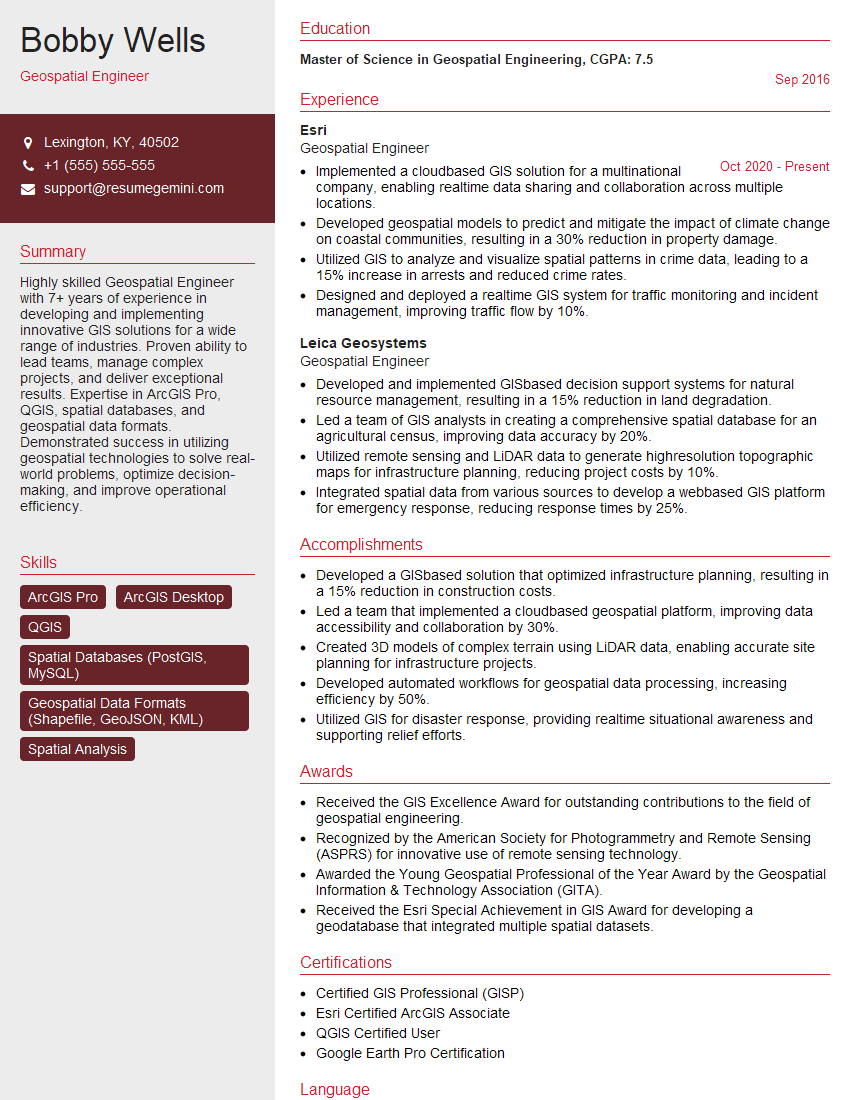
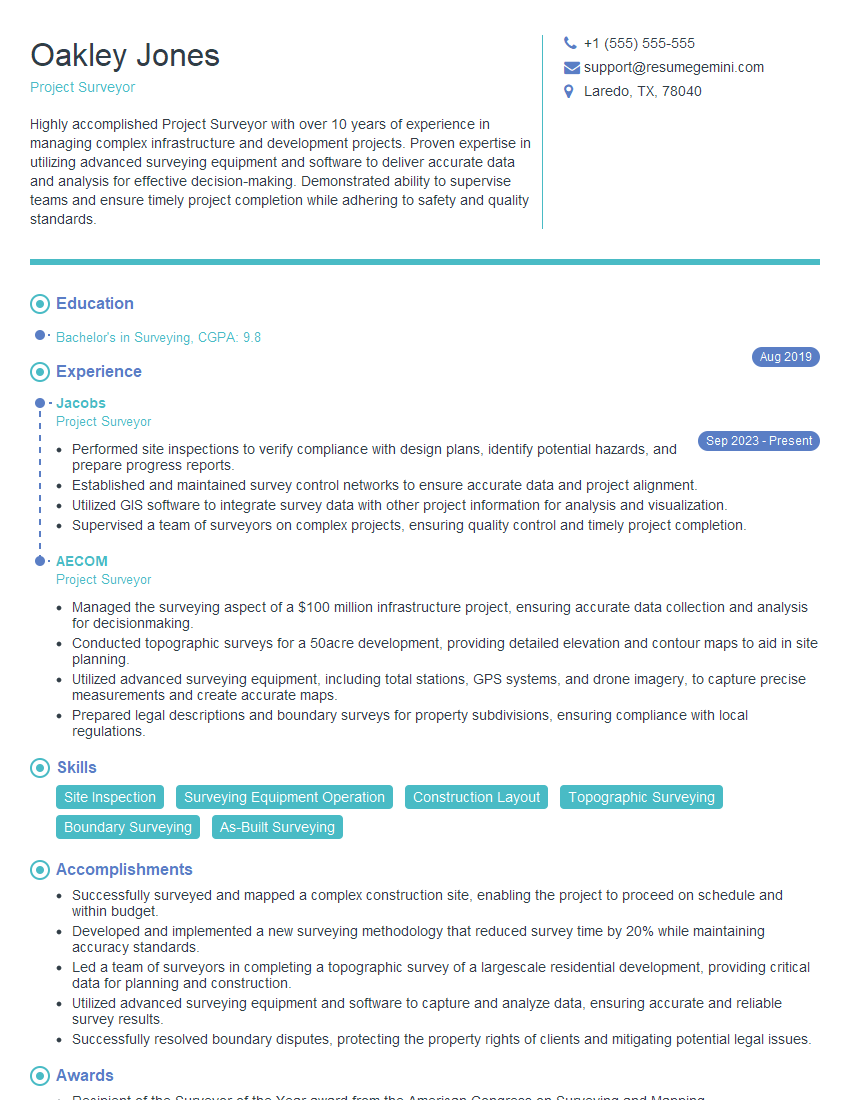
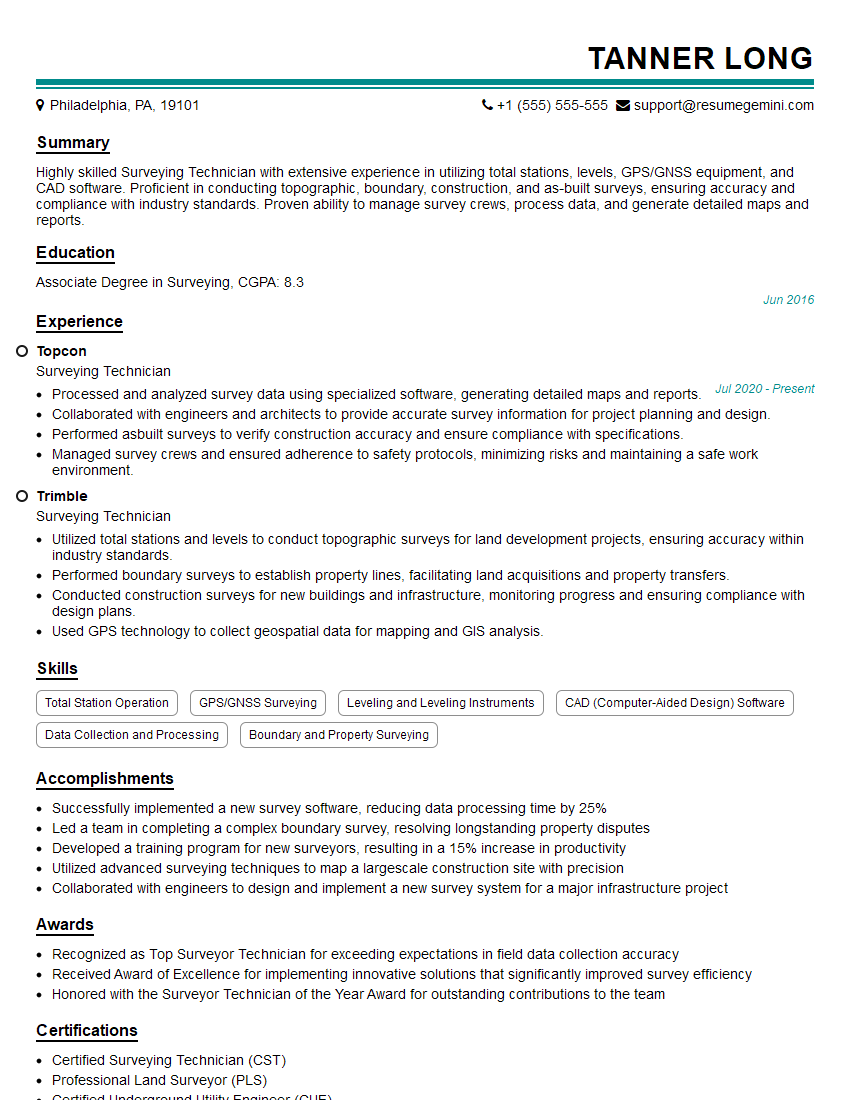
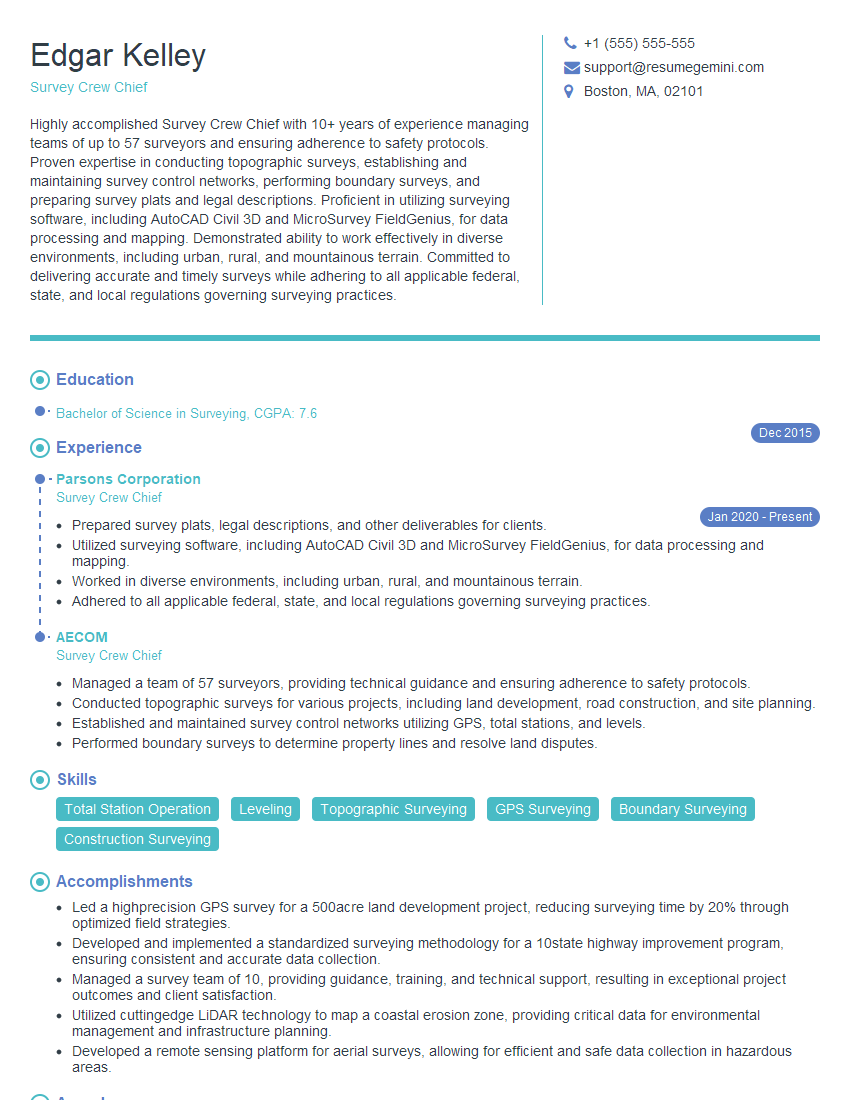
Mastering Differential GNSS Surveying opens doors to exciting career opportunities in geospatial technologies, offering high demand and competitive salaries. To maximize your job prospects, invest time in crafting a compelling and ATS-friendly resume that showcases your skills and experience effectively. ResumeGemini is a trusted resource to help you build a professional and impactful resume tailored to the specific requirements of your target roles. Examples of resumes tailored to Differential GNSS Surveying are available to guide you through the process. Take this opportunity to elevate your resume and stand out from the competition. Your expertise in this field is valuable; let’s make sure your resume reflects that!




Explore more articles
Users Rating of Our Blogs
Share Your Experience
We value your feedback! Please rate our content and share your thoughts (optional).
What Readers Say About Our Blog
Really detailed insights and content, thank you for writing this detailed article.
IT gave me an insight and words to use and be able to think of examples