Preparation is the key to success in any interview. In this post, we’ll explore crucial Molding Equipment Operation and Maintenance interview questions and equip you with strategies to craft impactful answers. Whether you’re a beginner or a pro, these tips will elevate your preparation.
Questions Asked in Molding Equipment Operation and Maintenance Interview
Q 1. Describe your experience with different types of molding machines (injection, blow, extrusion, etc.).
My experience encompasses a wide range of molding machines, including injection molding machines (IMMs), blow molding machines, and extrusion molding machines. I’ve worked extensively with various IMM tonnage capacities, from smaller machines used for prototyping and smaller runs to large-scale machines producing high-volume parts. With blow molding, I’m familiar with both extrusion blow molding (EBM) and injection blow molding (IBM), having worked with machines producing everything from simple bottles to complex, multi-layered containers. My extrusion experience includes working with both single-screw and twin-screw extruders, producing various profiles, films, and sheets.
For instance, in a previous role, I was responsible for the day-to-day operation and maintenance of a 200-ton IMM used to produce complex automotive parts. This involved managing the entire process, from material handling and machine setup to troubleshooting issues and performing preventative maintenance. In another project, I helped optimize the parameters of an EBM machine to improve the uniformity of wall thickness in a new line of polyethylene bottles.
Q 2. Explain the process of setting up and operating an injection molding machine.
Setting up and operating an injection molding machine is a multi-step process requiring precision and attention to detail. It begins with selecting the appropriate mold and installing it securely into the machine. Next, I carefully adjust the clamping force based on the mold size and part design. The next crucial step is programming the machine parameters such as injection pressure, speed, and holding time; these are determined by the material properties and the desired part quality. After setting these parameters, I conduct a trial run, carefully monitoring the part quality and making adjustments as needed. This could include fine-tuning the injection speed to eliminate short shots or adjusting the mold temperature to reduce flashing.
Throughout the process, I continuously monitor the machine’s performance, paying close attention to pressure readings, temperature gauges, and the overall efficiency. I’ll meticulously document each change made to the machine’s parameters to track production data and make data-driven decisions for continuous improvement. Think of it like baking a cake – the recipe (parameters) needs to be perfect, and constant monitoring ensures a consistently high-quality product (part).
Q 3. How do you troubleshoot common molding machine problems (e.g., short shots, flashing, weld lines)?
Troubleshooting molding machine problems requires a systematic approach. For example, short shots (parts not fully filled) often indicate insufficient injection pressure, speed, or material volume. I’d check the pressure gauges, adjust the injection parameters, and ensure the material is flowing properly. Flashing (excess material escaping the mold) typically results from excessive clamping force, improper mold temperature, or mold wear. I’d investigate the mold’s condition, adjust clamping parameters and temperatures, and ensure proper mold closing.
Weld lines are visible lines where molten plastic flows merge. These are often caused by uneven filling of the mold. Strategies to reduce weld lines involve optimizing the gate location, improving melt flow, and adjusting the injection speed and pressure. A systematic approach, involving careful examination of the part defects, coupled with systematic adjustments of machine parameters and mold design, allows for quick identification of the root cause. Think of a detective investigating a crime scene; each clue (defect) leads to the next step in solving the mystery (problem).
Q 4. What are the key safety procedures you follow when operating and maintaining molding equipment?
Safety is paramount in operating and maintaining molding equipment. I always ensure that all safety guards are in place before starting any machine. I wear appropriate personal protective equipment (PPE), including safety glasses, gloves, and hearing protection. Regularly checking the hydraulic system for leaks, and ensuring proper grounding of the equipment are essential safety measures. Lockout/Tagout procedures are strictly followed before performing any maintenance or repairs to prevent accidental startup. I am also trained in emergency procedures, such as what to do in case of a hydraulic fluid leak or a machine malfunction.
Before operating any molding equipment I always verify the molding materials and ensure they are appropriate for the machine and intended part. I treat each machine with respect, keeping the work area clean and organized, and diligently report any safety concerns immediately. Remember, safety isn’t just a procedure; it’s a culture, and one that needs to be part of every aspect of the job.
Q 5. Describe your experience with preventative maintenance on molding machines.
Preventative maintenance is crucial for maximizing the lifespan and efficiency of molding machines. My preventative maintenance routines typically include regular lubrication of moving parts, inspection of hydraulic systems, and cleaning of the machine and mold. I also perform regular checks on the heaters, sensors, and other critical components to identify any potential issues early on. Scheduled preventative maintenance checks, such as checking the mold for wear and tear, and cleaning or replacing parts as necessary, help to maintain optimal production quality and minimize unexpected downtime.
I maintain detailed records of all maintenance activities, including the date, type of maintenance performed, and any issues discovered. This detailed record keeping allows me to establish trends and predict future maintenance needs, which helps to minimize interruptions in the production process. A proactive, well-documented approach to preventative maintenance is akin to regularly servicing a vehicle – it ensures it operates smoothly and avoids costly breakdowns.
Q 6. How do you identify and address mold defects?
Identifying and addressing mold defects requires a systematic approach. I begin by carefully inspecting the molded parts for any visible defects such as sink marks, short shots, or warping. Each defect provides clues about the root cause. For instance, sink marks often indicate insufficient material or poor venting. Warping can suggest improper cooling or mold design issues. This visual inspection is followed by checking mold temperature, pressure, and cooling parameters. I use various measurement tools such as calipers and gauges to ensure the parts are within the specified tolerances.
Once the defects are identified, I investigate potential causes, which could range from mold wear and tear to improper machine settings. Solutions might include mold repair or replacement, adjustments to molding parameters, or changes to the material being used. A comprehensive approach, combining visual examination with data analysis, is key to effectively solving mold-related issues. It’s like diagnosing a medical condition; the symptoms (defects) point to the underlying cause (mold problem), which then requires a specific treatment (solution).
Q 7. What is your experience with mold changes and setup?
Mold changes and setup are routine tasks for me. This involves safely removing the existing mold from the machine, cleaning the machine surfaces and the mold, and carefully installing the new mold. I ensure proper alignment and secure clamping of the new mold before programming the machine with the appropriate parameters for the new part. This includes adjusting the injection pressure, speed, and temperature settings according to the material and the design of the new part. The process also involves testing the new mold, running trial shots, and making adjustments until the parts meet the required specifications. This process is critical for efficiency and cost-effectiveness, and it requires precision and attention to detail.
In a previous role, I was responsible for managing several mold changes per day, reducing downtime through efficient setup procedures and preventative maintenance of the molding equipment. It’s a detailed procedure but crucial for successful manufacturing. Think of it like changing a tire – you need the right tools, knowledge, and skills for a smooth and safe change.
Q 8. Explain your understanding of resin properties and their impact on the molding process.
Understanding resin properties is crucial for successful molding. Different resins have vastly different flow characteristics, curing times, and thermal properties, all of which directly impact the molding process. For instance, a resin with high viscosity will require higher injection pressure and temperature to fill the mold cavity completely, compared to a low-viscosity resin. Similarly, resins with shorter curing times allow for faster cycle times, increasing production efficiency.
Let’s take the example of Polypropylene (PP) versus Acrylonitrile Butadiene Styrene (ABS). PP, known for its low viscosity, flows easily, allowing for thin-walled parts and rapid cycle times. However, it might struggle with intricate details. ABS, on the other hand, has higher viscosity and offers better dimensional stability and strength, but might require higher injection pressure and longer cycle times, potentially leading to increased energy consumption. Understanding these differences allows for optimal process parameter settings, minimizing defects and maximizing output.
- Viscosity: Affects flow and filling of the mold.
- Melt flow index (MFI): Indicates the ease of flow at a given temperature.
- Thermal stability: Determines the temperature range for processing without degradation.
- Shrinkage: Impacts dimensional accuracy of the molded parts.
Q 9. How familiar are you with process parameters (e.g., injection pressure, temperature, cycle time)?
I’m highly familiar with process parameters and their intricate interplay. Think of them as the ‘recipe’ for a successful molding process. Incorrect settings can lead to a range of defects, from short shots (incomplete filling) to weld lines (weak points where melt streams merge), sink marks (surface depressions), and warpage (distortion).
- Injection pressure: Too low results in incomplete filling; too high can cause flash (excess resin spilling out).
- Injection velocity: Controls the speed of resin flow into the mold, affecting weld lines and orientation of fillers.
- Mold temperature: Affects the cooling rate, impacting cycle time and part shrinkage.
- Melt temperature: Too low leads to poor flow; too high leads to degradation.
- Holding pressure: Maintains pressure after the mold is filled, compensating for shrinkage and ensuring part density.
- Cycle time: Total time for one molding cycle—includes injection, holding, cooling, and ejection.
For example, I once worked on optimizing the cycle time for a complex part. By carefully adjusting the mold temperature and holding pressure, we reduced the cycle time by 15%, significantly increasing production without compromising quality.
Q 10. Describe your experience with troubleshooting hydraulic and pneumatic systems in molding machines.
Troubleshooting hydraulic and pneumatic systems is a significant part of my expertise. I’m proficient in diagnosing and resolving issues ranging from simple leaks to complex malfunctions. My approach is systematic, involving visual inspection, pressure testing, and the use of diagnostic tools.
For instance, I once encountered a situation where a molding machine experienced erratic movements due to a faulty hydraulic solenoid valve. Through systematic testing, including pressure readings at different points in the hydraulic circuit, I isolated the faulty valve. Replacing the valve immediately restored the machine’s functionality. In another case, a persistent air leak in a pneumatic clamping system led to inconsistent clamping force. We identified the leak using soapy water and resolved it by replacing a damaged o-ring.
- Leak detection: Using soapy water, pressure gauges.
- Hydraulic pump troubleshooting: Checking pressure, flow, and temperature.
- Pneumatic valve diagnosis: Testing for proper actuation and sealing.
- Sensor calibration: Ensuring accurate readings from pressure, temperature, and position sensors.
Q 11. What is your experience with robotic automation in molding processes?
I have extensive experience with robotic automation in molding processes, integrating robots for part removal, secondary operations (e.g., trimming, assembly), and material handling. This automation improves efficiency, consistency, and workplace safety. I’m familiar with various robotic systems, including six-axis robots and SCARA robots, and their programming using industrial robot languages (e.g., RAPID, KRL).
In a previous role, I oversaw the integration of a robotic system for part removal from a high-speed injection molding machine. This eliminated the need for manual handling, reducing cycle times and improving worker safety. The robot was programmed to accurately grasp the molded parts, avoiding damage and ensuring consistent placement on a conveyor belt. This automation not only increased productivity but also enhanced product quality by reducing the risk of human error.
Q 12. How do you ensure consistent product quality in a molding operation?
Consistent product quality is paramount. My approach involves a multifaceted strategy incorporating preventive maintenance, process monitoring, and statistical process control (SPC).
- Preventive maintenance: Regular inspection and servicing of molding machines to prevent unexpected downtime and maintain consistent performance.
- Process monitoring: Continuous monitoring of key process parameters (pressure, temperature, etc.) using sensors and data acquisition systems.
- Statistical process control (SPC): Employing control charts to track process parameters and identify trends indicating potential problems before they lead to defects.
- Material management: Maintaining consistent resin quality through careful storage and handling.
- Operator training: Ensuring operators are well-trained in proper machine operation and quality control procedures.
For example, by implementing SPC charts to monitor injection pressure, we identified a gradual drift in the average pressure, which could have led to inconsistencies in part wall thickness. By adjusting the machine settings, we corrected the drift and ensured consistent part quality.
Q 13. Explain your understanding of quality control procedures and documentation.
I’m well-versed in quality control procedures and documentation, adhering to industry best practices and relevant standards (e.g., ISO 9001). This includes maintaining detailed records, conducting regular inspections, and implementing corrective actions when necessary.
- Incoming material inspection: Verifying resin quality upon delivery.
- In-process inspection: Monitoring parts during production for defects (e.g., short shots, flash, sink marks).
- Final inspection: Thoroughly examining finished parts for conformance to specifications.
- Documentation: Maintaining detailed records of all inspections, corrective actions, and machine maintenance.
- Control charts: Using SPC techniques to track process parameters and identify trends.
A clear example is maintaining a comprehensive traceability system to identify and rectify any defects that occur. This involves linking each molded part back to the specific batch of resin and machine settings used during production. This allows for effective root cause analysis and prevents recurrence of problems.
Q 14. Describe your experience with data acquisition and analysis in a molding environment.
Data acquisition and analysis are crucial for optimizing the molding process. I’m experienced with various data acquisition systems, ranging from simple data loggers to sophisticated process control systems. This data is analyzed to identify trends, predict potential problems, and optimize machine parameters for improved efficiency and quality.
I’ve used this data to create predictive maintenance models. By analyzing data such as machine vibration, temperature, and pressure over time, we were able to predict potential equipment failures before they occurred, significantly reducing downtime and maintenance costs. We utilize statistical software to analyze historical data, identify trends, and make data-driven decisions to improve the efficiency and quality of the molding process. Specific tools we employ include statistical process control (SPC) software, regression analysis, and predictive modeling techniques.
Q 15. What is your experience with different types of molding materials (plastics, metals, etc.)?
My experience encompasses a wide range of molding materials, primarily focusing on thermoplastics like ABS, PP, and HDPE, and thermosets such as epoxy and polyurethane. I’ve also worked extensively with various metal alloys, including aluminum and zinc, in die-casting applications. Understanding the material properties is critical – for instance, the melt flow index (MFI) for thermoplastics directly impacts injection molding parameters. With metals, the alloy composition dictates the casting temperature and pressure. My experience includes troubleshooting material-related issues such as warping, sink marks, and short shots, and adapting molding processes accordingly. For example, I once resolved a warping issue in an ABS part by optimizing the mold temperature profile and cooling time.
Career Expert Tips:
- Ace those interviews! Prepare effectively by reviewing the Top 50 Most Common Interview Questions on ResumeGemini.
- Navigate your job search with confidence! Explore a wide range of Career Tips on ResumeGemini. Learn about common challenges and recommendations to overcome them.
- Craft the perfect resume! Master the Art of Resume Writing with ResumeGemini’s guide. Showcase your unique qualifications and achievements effectively.
- Don’t miss out on holiday savings! Build your dream resume with ResumeGemini’s ATS optimized templates.
Q 16. How do you interpret engineering drawings and specifications related to molds and molding machines?
Interpreting engineering drawings and specifications is fundamental to my work. I’m proficient in reading blueprints, understanding GD&T (Geometric Dimensioning and Tolerancing) symbols, and interpreting material specifications. I can identify critical dimensions, tolerances, surface finishes, and other crucial aspects of the mold design and the molding machine setup. For example, I’ve used engineering drawings to identify potential mold flow issues based on part geometry and gate locations before even starting the molding process, preventing costly rework and material waste. A typical process involves first verifying the overall design intent, then carefully checking the dimensions for compatibility with the machine and material, and finally cross-referencing with the mold construction details.
Q 17. What is your experience with using measuring tools (e.g., calipers, micrometers)?
I’m highly proficient in using various measuring tools, including calipers, micrometers, dial indicators, and height gauges. Accurate measurements are essential for ensuring that molded parts meet specifications and for detecting any dimensional inconsistencies. For example, using a micrometer to measure the wall thickness of a molded part helps identify potential issues like uneven cooling or excessive shrinkage. During mold maintenance, I use these tools to check for wear and tear on mold components, ensuring consistent part quality. I’m also trained in the proper calibration and use of these tools to maintain accuracy and avoid measurement errors. Regular calibration checks are crucial for maintaining the integrity of the measurements.
Q 18. Describe your experience with mold maintenance and repair.
Mold maintenance and repair are crucial for preventing production downtime and ensuring consistent part quality. My experience includes performing preventative maintenance tasks like lubricating moving parts, cleaning mold components, and inspecting for wear and tear. I’m also skilled in troubleshooting and repairing various mold issues, including replacing worn-out components, repairing cracks or damage, and polishing mold surfaces. For instance, I once repaired a cracked mold cavity by carefully welding the crack and then polishing the surface to restore its original smoothness. I use a combination of preventative and reactive maintenance strategies to optimize mold lifespan and productivity.
Q 19. How do you maintain a clean and organized work environment in a molding operation?
Maintaining a clean and organized work environment is paramount in a molding operation. This contributes directly to safety, efficiency, and product quality. My approach involves implementing 5S methodology (Sort, Set in Order, Shine, Standardize, Sustain) to organize the workspace, ensuring tools and materials are readily accessible and properly stored. Regularly cleaning the molding machines and surrounding areas prevents contamination and reduces the risk of accidents. I also enforce strict adherence to safety protocols, including proper disposal of waste materials and the use of appropriate personal protective equipment (PPE). A well-organized workspace translates to less wasted time searching for tools and fewer errors during the molding process.
Q 20. Explain your understanding of process optimization techniques.
Process optimization techniques are critical for improving efficiency and reducing costs in molding operations. My experience includes using statistical process control (SPC) methods to monitor process parameters and identify areas for improvement. I am familiar with Design of Experiments (DOE) methodologies to systematically investigate the impact of different process variables on part quality. I leverage data analysis to identify root causes of defects and optimize molding parameters to minimize defects and scrap. For example, by analyzing historical data and running DOE experiments, I once reduced cycle time by 15% and improved part consistency by minimizing warpage.
Q 21. How familiar are you with different types of mold designs and their applications?
I’m familiar with a variety of mold designs, including single-cavity molds, multi-cavity molds, family molds, progressive molds, and insert molds. Each design has specific applications and advantages. For example, single-cavity molds are ideal for prototyping or low-volume production, while multi-cavity molds are suitable for high-volume production. I understand the trade-offs involved in selecting the appropriate mold design based on factors such as production volume, part complexity, and cost considerations. My experience includes working with different types of gating systems, such as hot runner systems and cold runner systems, each with its own advantages and disadvantages in terms of efficiency and material waste.
Q 22. What is your experience with troubleshooting electrical systems in molding machines?
Troubleshooting electrical systems in molding machines requires a systematic approach combining theoretical knowledge with practical experience. My expertise spans identifying faults in control circuits, motor drives, sensors, and safety interlocks. I’m proficient in using multimeters, oscilloscopes, and other diagnostic tools to pinpoint issues ranging from blown fuses and faulty relays to more complex problems in PLC programming or sensor malfunction. For example, I once resolved a production standstill caused by a faulty proximity sensor on an injection molding machine by systematically checking the sensor’s wiring, power supply, and output signal, eventually replacing the faulty sensor itself. This prevented significant downtime and production loss.
My approach typically involves:
- Visual inspection for obvious damage or loose connections.
- Using a multimeter to check voltage, current, and continuity.
- Utilizing an oscilloscope to analyze signal waveforms for anomalies.
- Consulting electrical schematics and machine manuals.
- Implementing temporary fixes while waiting for replacement parts.
Safety is paramount; I always ensure power is isolated before working on live electrical components.
Q 23. Describe your experience with using Programmable Logic Controllers (PLCs) in molding operations.
Programmable Logic Controllers (PLCs) are the brains of modern molding machines, controlling every aspect of the process from clamping to injection and ejection. My experience includes programming, troubleshooting, and maintaining PLCs using various software platforms, such as Allen-Bradley RSLogix 5000 and Siemens TIA Portal. I’m comfortable reading ladder logic diagrams, modifying existing programs, and creating new ones to meet specific production needs. For instance, I once developed a PLC program to optimize the cycle time of a specific molding process by fine-tuning the timing of various actuators and sensors, resulting in a 15% increase in production output.
I regularly use PLCs to:
- Monitor machine parameters such as temperature, pressure, and position.
- Control actuators like hydraulic cylinders and electric motors.
- Implement safety interlocks and emergency stop functions.
- Troubleshoot machine malfunctions by analyzing PLC program data and I/O signals.
- Collect and analyze production data for process optimization.
Q 24. How do you manage and prioritize maintenance tasks effectively?
Effective maintenance task management is crucial for preventing unexpected breakdowns and maximizing machine uptime. I utilize a combination of preventative, predictive, and corrective maintenance strategies, often using Computerized Maintenance Management Systems (CMMS) to schedule and track tasks. I prioritize tasks based on their criticality, frequency, and potential impact on production. This involves regularly inspecting machines, performing scheduled lubrication, and replacing worn parts proactively.
My approach includes:
- Developing a detailed preventative maintenance schedule based on manufacturer recommendations and historical data.
- Utilizing predictive maintenance techniques such as vibration analysis and thermal imaging to identify potential problems before they occur.
- Prioritizing tasks based on a risk assessment matrix considering factors like criticality and potential downtime.
- Using a CMMS to track maintenance activities, manage spare parts inventory, and generate reports.
- Regularly reviewing and updating the maintenance schedule to reflect changes in production demands or machine performance.
Q 25. Explain your approach to problem-solving in a fast-paced molding environment.
Problem-solving in a fast-paced molding environment necessitates a structured and efficient approach. I employ a systematic methodology: first, I define the problem clearly, gathering as much information as possible. Next, I identify potential causes, prioritizing those most likely to be the root cause. Then, I test hypotheses using diagnostic tools and systematic checks. Finally, I implement the solution, verify its effectiveness, and document the process for future reference. Think of it like detective work—carefully examining clues to reach a sound conclusion.
My strategy involves:
- Clearly defining the problem and its symptoms.
- Gathering data from various sources: machine logs, operator feedback, sensor readings.
- Developing a list of potential causes based on experience and knowledge.
- Testing hypotheses using diagnostic tools and eliminating potential causes.
- Implementing the solution and verifying its effectiveness.
- Documenting the troubleshooting process for future reference.
Q 26. Describe a time you had to troubleshoot a complex molding machine issue. What was the solution?
In one instance, an injection molding machine experienced inconsistent molding quality, resulting in numerous rejects. Initial investigations revealed no obvious problems with the mold or material. After systematically examining the process parameters, I identified a significant variation in the injection pressure during the molding cycle. This variation wasn’t immediately apparent through routine monitoring. Using the PLC’s data logging capabilities, I analyzed historical data, which revealed a cyclical fluctuation in pressure linked to the hydraulic system’s pump.
Further investigation uncovered a failing pressure relief valve in the hydraulic system that was not releasing pressure consistently, leading to the erratic pressure variations. Replacing the faulty valve resolved the issue, restoring consistent molding quality and eliminating rejects. This case highlighted the importance of detailed data analysis and the power of leveraging a machine’s data logging features for effective troubleshooting.
Q 27. How do you ensure the safety of yourself and your colleagues in a molding environment?
Safety is my top priority in a molding environment. I adhere strictly to all safety regulations and company policies, using appropriate Personal Protective Equipment (PPE), such as safety glasses, hearing protection, and steel-toed boots. I regularly inspect equipment for potential hazards and ensure proper lockout/tagout procedures are followed before performing maintenance or repairs on any machinery. I actively participate in safety training and promote a safety-conscious culture among my colleagues, encouraging them to report any safety concerns immediately.
My commitment to safety includes:
- Adhering to all safety regulations and company policies.
- Using appropriate PPE at all times.
- Performing regular safety inspections of equipment and work areas.
- Following lockout/tagout procedures before working on machinery.
- Reporting any safety concerns immediately.
- Promoting a safety-conscious culture among colleagues.
Q 28. What are your salary expectations for this position?
My salary expectations are commensurate with my experience and skills, and align with the industry standards for a Molding Equipment Operation and Maintenance expert with my qualifications and proven track record. I am open to discussing a competitive compensation package that reflects the value I will bring to your team.
Key Topics to Learn for Molding Equipment Operation and Maintenance Interview
- Hydraulic Systems: Understanding hydraulic circuits, troubleshooting leaks and pressure issues, preventative maintenance schedules, and safety procedures.
- Electrical Systems: Diagnosing electrical malfunctions, working with control panels and PLCs (Programmable Logic Controllers), understanding safety protocols related to high voltage equipment.
- Molding Machine Operation: Safe startup and shutdown procedures, understanding process parameters (temperature, pressure, cycle time), recognizing and addressing common operational issues.
- Preventive Maintenance: Developing and implementing preventative maintenance schedules, lubrication techniques, identifying wear and tear, and performing routine inspections.
- Troubleshooting and Repair: Diagnosing malfunctions, using diagnostic tools effectively, understanding the importance of root cause analysis, and executing repairs efficiently and safely.
- Safety Procedures and Regulations: Adherence to OSHA and company-specific safety regulations, use of personal protective equipment (PPE), lockout/tagout procedures, and emergency response protocols.
- Material Handling and Storage: Proper handling of raw materials, understanding material properties, and ensuring efficient storage to minimize waste and damage.
- Quality Control: Understanding quality control procedures, inspecting molded parts for defects, and implementing corrective actions to improve product quality.
- Process Optimization: Identifying areas for improvement in efficiency, reducing downtime, and optimizing the molding process for improved production output and reduced costs.
Next Steps
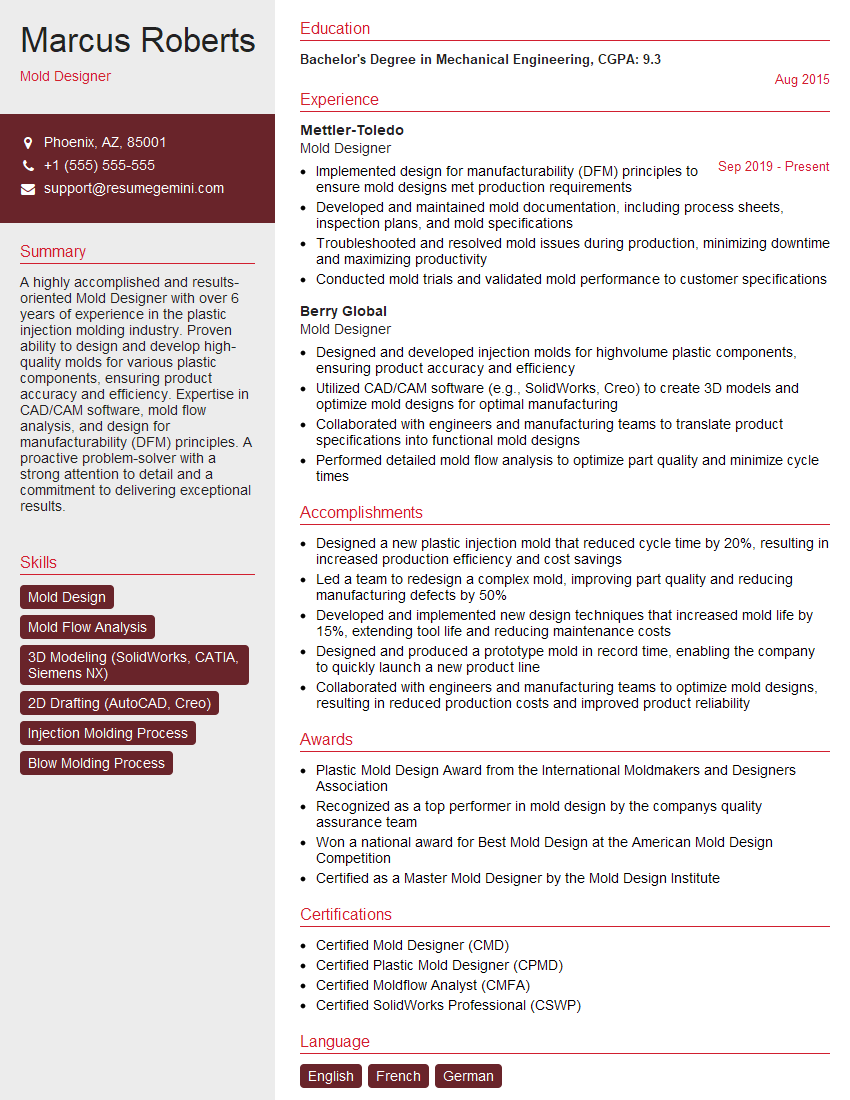
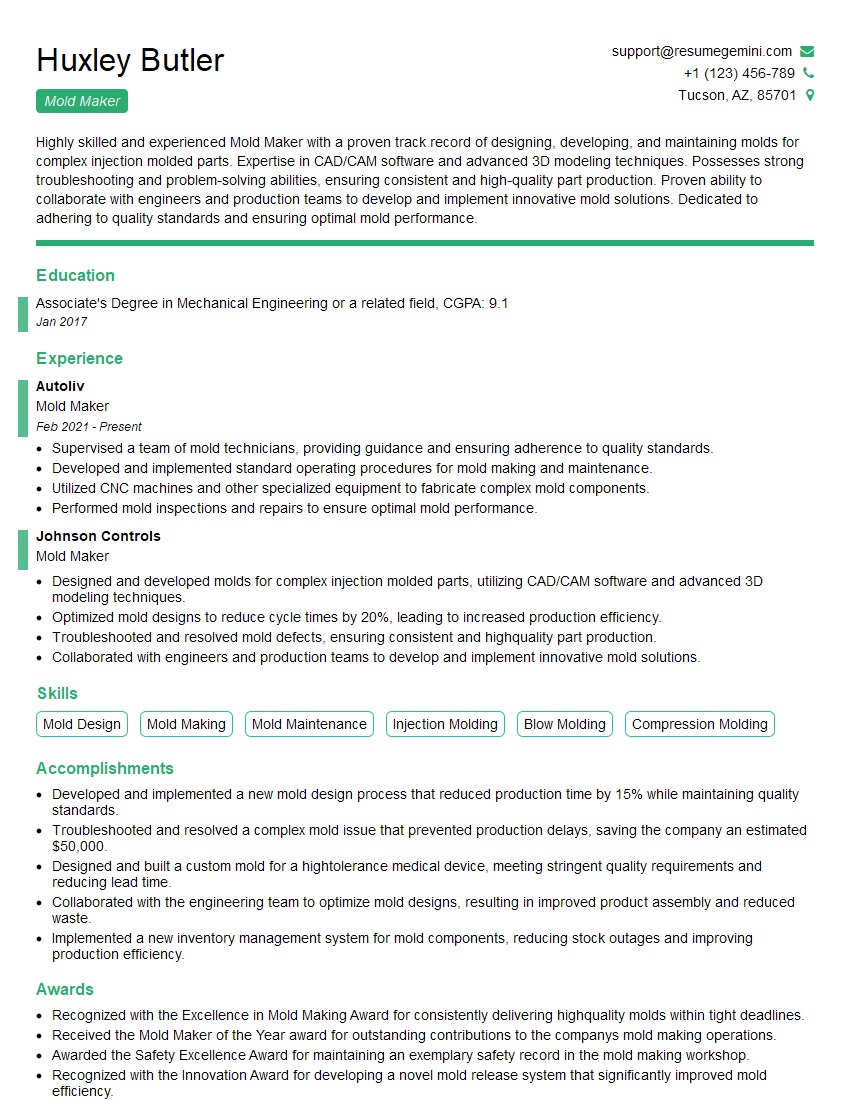
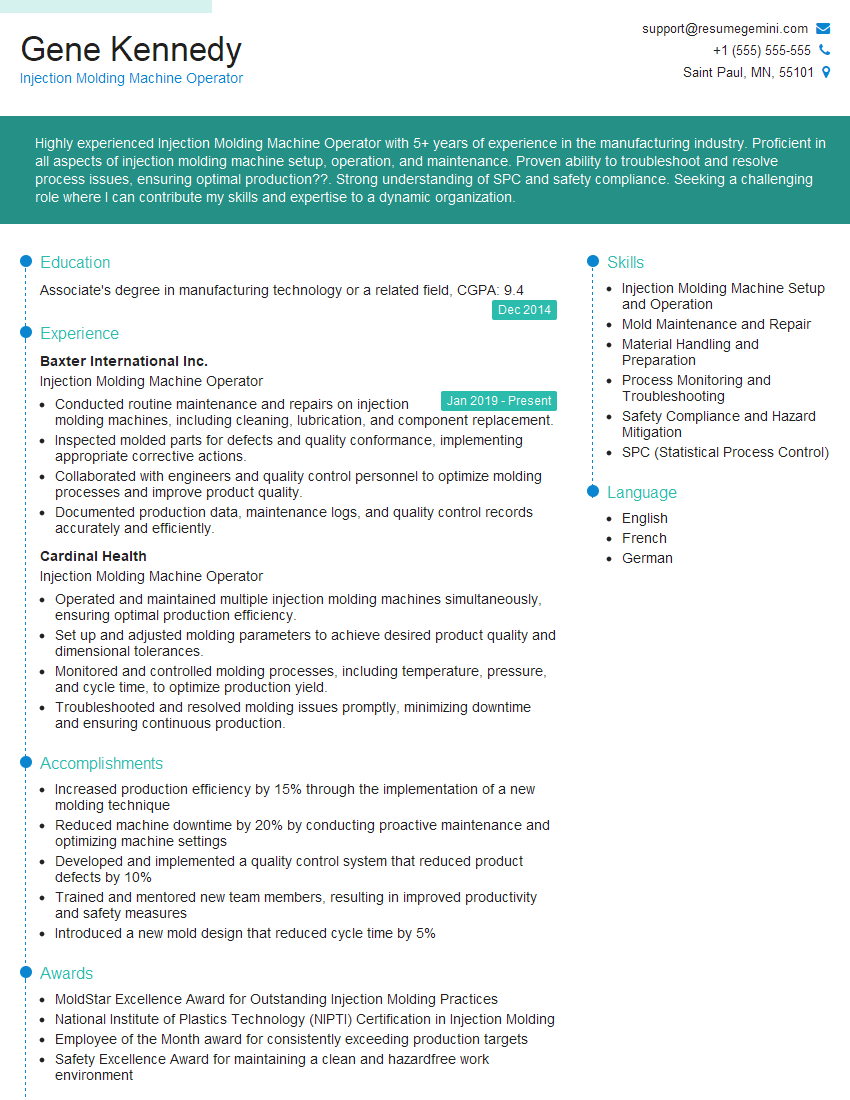
Mastering Molding Equipment Operation and Maintenance opens doors to exciting career opportunities, offering higher earning potential and increased responsibility. A strong resume is crucial for showcasing your skills and experience to potential employers. Creating an ATS-friendly resume is key to getting your application noticed. To help you build a compelling and effective resume, consider using ResumeGemini, a trusted resource for creating professional resumes. ResumeGemini provides examples of resumes tailored to Molding Equipment Operation and Maintenance, ensuring your application stands out from the competition.
Explore more articles
Users Rating of Our Blogs
Share Your Experience
We value your feedback! Please rate our content and share your thoughts (optional).
What Readers Say About Our Blog
Really detailed insights and content, thank you for writing this detailed article.
IT gave me an insight and words to use and be able to think of examples