Interviews are more than just a Q&A session—they’re a chance to prove your worth. This blog dives into essential Surveying Cultural Resources interview questions and expert tips to help you align your answers with what hiring managers are looking for. Start preparing to shine!
Questions Asked in Surveying Cultural Resources Interview
Q 1. Describe your experience with Phase I, II, and III archaeological surveys.
My experience encompasses all three phases of archaeological surveys. Phase I, the cultural resource assessment, involves a desktop review of existing data (maps, historical records, previous survey reports) to identify potential cultural resource sites within a project area. Think of it as preliminary detective work. For example, I’ve used historical land ownership maps to pinpoint areas where previous settlements were likely located. Phase II involves field investigation: This is the hands-on work, where we conduct pedestrian surveys, often with shovel testing, to confirm the presence of archaeological features or artifacts. This phase is like sifting through clues to find the buried treasure! If significant cultural resources are discovered during Phase II, a Phase III data recovery excavation might be required. This is a much more intensive process, meticulously documenting and removing artifacts and features to prevent their loss. I’ve led Phase III excavations on several projects, including a significant Native American burial site, where we adhered to strict ethical protocols and worked closely with tribal representatives.
Q 2. Explain the process of identifying and documenting cultural resources.
Identifying and documenting cultural resources is a multi-step process that begins with research. We utilize historical maps, aerial photographs, and archival documents to locate potential sites. Then, we conduct field surveys using various methods, as described in the next question. The process of documentation itself is meticulous and precise. It involves creating detailed site forms, mapping locations using GPS, and photographing features and artifacts. We carefully record the context of each find – its location, depth, and association with other materials. For example, if we find pottery shards, we meticulously record their position relative to other features, and map their exact location using total station surveying. This data is crucial for interpreting the site’s history and significance. We also work closely with state historic preservation offices to ensure compliance and to have our findings reviewed by experts.
Q 3. What are the different methods used for surveying cultural resources?
Numerous methods are employed for surveying cultural resources. These include pedestrian surveys, where teams systematically walk across the land recording surface finds; shovel testing, a non-destructive excavation method used to determine subsurface features; geophysical surveys, such as magnetometry and ground-penetrating radar (GPR), which can detect subsurface anomalies; and LiDAR (Light Detection and Ranging), which uses laser pulses to create high-resolution 3D maps of the terrain, revealing subtle features otherwise hidden by vegetation. I have extensive experience with all of these, with a particular focus on combining pedestrian survey data with LiDAR data for more effective site identification. For example, in a project involving a heavily vegetated area, LiDAR effectively revealed subtle earthworks invisible to the naked eye, while pedestrian surveys were still necessary to confirm the nature of the features and collect surface artifacts.
Q 4. How do you ensure the ethical and legal compliance in cultural resource management?
Ethical and legal compliance are paramount in cultural resource management. We strictly adhere to all relevant federal and state laws, such as the National Historic Preservation Act (NHPA) and Section 106 of that Act. This necessitates close collaboration with state historic preservation officers and potentially affected Native American tribes. For example, when working near a known Native American burial site, we’ll consult directly with the appropriate tribe, incorporating their perspectives into our methodology and obtaining necessary approvals. Ethical considerations guide our actions in every step of the process, from respecting religious or spiritual sites to ensuring that artifacts are treated with sensitivity and properly curated. Our commitment is not just to comply with the law but to conduct our work in a way that honors the past and preserves cultural heritage for future generations.
Q 5. What software and technologies are you proficient in using for cultural resource surveys (e.g., GIS, LiDAR, Photogrammetry)?
I’m proficient in various software and technologies used in cultural resource surveys. My GIS skills allow me to create and analyze maps, incorporating data from various sources (GPS, LiDAR, etc.). I use ArcGIS extensively for data management, spatial analysis, and report generation. I have experience with LiDAR data processing, using software like TerraScan to create digital elevation models and identify potential archaeological features. Photogrammetry skills assist in creating accurate 3D models of sites and artifacts using drone imagery and specialized software. In addition, I have experience with total stations and other survey equipment for precise location mapping and data collection.
Q 6. How do you handle unexpected findings during a cultural resource survey?
Unexpected findings are a common occurrence during cultural resource surveys. Our protocol dictates that all work must immediately cease upon discovering something unforeseen. We then carefully document the find, photograph it, and conduct a preliminary assessment. This might involve calling in specialists or contacting the appropriate authorities if human remains are involved. The site is protected, and the discovery is reported to the relevant agencies (like the SHPO). Depending on the nature of the finding, the project might be modified or halted to allow for further investigation and mitigation, or even the discovery might necessitate the complete re-evaluation of the project scope.
Q 7. Describe your experience with creating and interpreting archaeological maps and reports.
Creating and interpreting archaeological maps and reports is a core aspect of my work. I use GIS software to create detailed maps that illustrate site locations, features, and artifact distributions. These maps are crucial for visualizing spatial relationships between different elements within the site. Reports are written to summarize findings, including a comprehensive description of the methodology, the results of the survey, and the significance of the identified cultural resources. The interpretation section of a report integrates this information to provide a narrative of the site’s history and potential uses. For example, I’ve created reports that link artifact assemblages to specific historical periods and demonstrated how site layouts suggest particular social structures or settlement patterns. The clarity and precision of maps and reports are crucial for communicating findings to stakeholders and informing project decisions.
Q 8. Explain your understanding of National Register of Historic Places criteria.
The National Register of Historic Places (NRHP) criteria define what qualifies a property for listing. It’s not about individual artifacts, but about the overall historical significance of a place. Think of it as a national hall of fame for historically significant buildings, sites, districts, structures, and objects. There are five main criteria:
- Criterion A: Association with events that have made a significant contribution to the broad patterns of our history; think of a building where a pivotal treaty was signed.
- Criterion B: Association with the lives of persons significant in our past; perhaps the birthplace of a renowned author or a house where a major historical figure lived.
- Criterion C: Embodiment of the distinctive characteristics of a type, period, or method of construction, or representing the work of a master, or possessing high artistic values, or representing a significant and distinguishable entity whose components may lack individual distinction; imagine a perfectly preserved example of a particular architectural style.
- Criterion D: Has yielded, or may be likely to yield, important information in prehistory or history; this applies to archaeological sites which offer insights into past cultures.
- Criterion G: Represents the work of a master, possesses high artistic values, or represents a significant and distinguishable entity whose components may lack individual distinction; similar to C, but with a slightly broader focus, sometimes applicable when a site holds a range of cultural or artistic significance.
Meeting even one of these criteria can qualify a property for listing on the NRHP. The process involves extensive research, documentation, and review by state and national preservation officers.
Q 9. How do you assess the significance of a cultural resource?
Assessing the significance of a cultural resource requires a multi-faceted approach. We look at its integrity (how well-preserved it is), its association with historical events or people, and its broader cultural context. Think of a historical photograph: its significance depends on the subject matter (Criterion B), the photographic style (Criterion C), and the historical period it documents (Criterion A).
I use a combination of historical research (document review, oral histories), archaeological investigation (excavation, survey), and architectural analysis to evaluate significance. It’s crucial to understand the resource within its larger historical narrative, and often involves consulting with experts in related fields, such as historians, anthropologists, and architects.
For example, an old barn might seem insignificant at first glance, but research might reveal it was built using a rare construction technique (Criterion C) or was used to shelter enslaved people during a pivotal historical event (Criterion A), vastly changing its significance.
Q 10. What is your experience with environmental impact assessments relating to cultural resources?
My experience with environmental impact assessments (EIAs) related to cultural resources is extensive. I’ve been involved in numerous projects, from large-scale highway construction to smaller-scale development projects, where my role involves identifying, evaluating, and mitigating the potential impacts of the proposed actions on archaeological and historical sites.
The process typically begins with a Phase I cultural resource survey, which often involves a thorough review of available historical records and a field investigation to identify potential sites. If significant cultural resources are identified, further investigations (Phases II and III) may be needed, potentially involving excavation and analysis of artifacts. The findings of the survey directly inform the EIA, outlining potential impacts and recommending appropriate mitigation measures.
For instance, in a recent project involving a new wind farm, my team identified several potential archaeological sites that could be negatively affected. We recommended alternative wind turbine placements, and developed a plan for monitoring construction activities and mitigating any unavoidable impacts.
Q 11. How familiar are you with Section 106 of the National Historic Preservation Act?
Section 106 of the National Historic Preservation Act (NHPA) is the cornerstone of federal cultural resource management. It mandates federal agencies to consider the effects of their undertakings on historic properties. This means that before undertaking any project on federal land or using federal funds, the agency must take into account the potential impacts on historic properties.
My understanding of Section 106 extends to the entire process, from identifying historic properties and assessing effects to developing and implementing mitigation measures. I have experience working with federal agencies, state historic preservation offices, and tribal representatives to ensure compliance with Section 106 regulations.
Compliance often involves consultations with stakeholders, preparing documentation that demonstrates a thorough evaluation of potential impacts, and working collaboratively to develop solutions that avoid or mitigate adverse effects. Failing to comply can result in significant project delays and legal challenges.
Q 12. Describe your experience working with Native American Tribes or other stakeholders.
Working with Native American Tribes and other stakeholders is a critical component of my work. I’ve collaborated with numerous Tribes on projects involving ancestral lands, sacred sites, and culturally significant resources. It’s essential to understand that Tribes have unique perspectives and relationships with their cultural heritage.
Effective collaboration requires building trust, respecting Tribal sovereignty, and engaging in meaningful consultation. This involves attending Tribal meetings, participating in traditional ceremonies, and adapting our methods to reflect Tribal priorities and concerns. For example, on one project near a Tribal reservation, we ensured that our field work was conducted in a culturally sensitive manner, with the approval and direct participation of Tribal representatives.
This collaborative approach leads to more informed decision-making, which respects Tribal rights and ensures that projects are carried out in a way that protects and honors cultural resources.
Q 13. Explain the process of mitigation for cultural resources impacted by development.
Mitigation for cultural resources impacted by development aims to minimize or avoid harm to these resources. The process begins with careful evaluation of potential impacts during the EIA. The goal is to find a balance between development and preservation.
Mitigation strategies range from avoiding impacts altogether (e.g., relocating a structure) to minimizing impacts (e.g., carefully excavating a site before construction) to mitigating impacts (e.g., preparing detailed records of excavated features). In some cases, this may involve archaeological monitoring during construction, or even the creation of detailed documentation and curated collections of artifacts.
For example, if a road construction project will impact an archaeological site, mitigation might involve conducting a professional archaeological excavation to recover and document artifacts before construction begins. The findings would be carefully analyzed and documented, preserving the information for future generations. This approach balances development with cultural resource protection.
Q 14. What are the different types of cultural resources you are familiar with?
I’m familiar with a wide range of cultural resources, including:
- Archaeological sites: These range from ancient settlements to historic farmsteads, encompassing artifacts, features, and human-altered landscapes.
- Buildings and structures: This includes houses, barns, mills, bridges, and other structures reflecting diverse architectural styles and historical periods.
- Districts: These are areas with a concentration of historically significant buildings, often showcasing a particular architectural or historical theme.
- Objects: These can be furniture, tools, artworks, or other items that hold cultural significance.
- Landscape features: These encompass natural features that have been shaped by human activity or that have significant cultural associations, such as historic gardens or burial mounds.
My expertise extends to the identification, evaluation, and management of each of these resource types. The approach and methods used vary depending on the type of resource and the specific context.
Q 15. How do you manage data collected during a cultural resource survey?
Managing data from a cultural resource survey is crucial for ensuring accuracy and facilitating future research. It’s a multi-stage process, starting even before fieldwork begins. We establish a robust data management plan that outlines the type of data collected, the methods of collection, storage protocols, and quality control measures. This plan is vital in keeping the project organized and compliant with regulations.
During fieldwork, data is meticulously recorded using standardized forms and digital technologies. This might include GPS coordinates for site locations, detailed descriptions of features (e.g., building foundations, pottery shards), photographic records, and sketches. All data is backed up regularly to prevent loss. We use a combination of digital databases (like ArcGIS or specialized archaeological databases) and physical archiving (for example, storing field notes and photographs in climate-controlled storage).
Post-fieldwork, data undergoes a rigorous quality control process involving checks for accuracy, completeness, and consistency. Data cleaning and analysis then follow, employing statistical methods and GIS analysis to identify patterns and relationships. The data is then synthesized to create comprehensive reports and maps, ultimately contributing to a fuller understanding of the cultural landscape.
For example, during a survey of a potential development site, we might discover a previously unknown prehistoric settlement. The data collected – GPS coordinates, artifact types, stratigraphic profiles – would then be crucial in assessing the site’s significance and recommending appropriate mitigation measures. Careful data management ensures this information is accessible and usable for years to come, benefitting future researchers and protecting cultural heritage.
Career Expert Tips:
- Ace those interviews! Prepare effectively by reviewing the Top 50 Most Common Interview Questions on ResumeGemini.
- Navigate your job search with confidence! Explore a wide range of Career Tips on ResumeGemini. Learn about common challenges and recommendations to overcome them.
- Craft the perfect resume! Master the Art of Resume Writing with ResumeGemini’s guide. Showcase your unique qualifications and achievements effectively.
- Don’t miss out on holiday savings! Build your dream resume with ResumeGemini’s ATS optimized templates.
Q 16. Describe your experience with GPS and other surveying equipment.
My experience with GPS and other surveying equipment is extensive. I’m proficient in using various GPS receivers, including high-precision units like RTK (Real-Time Kinematic) GPS, which provides centimeter-level accuracy. This is crucial for precise mapping of archaeological features and sites. I’m also skilled in utilizing total stations, which enable the accurate measurement of distances, angles, and elevations. This is particularly valuable in creating detailed topographic maps and documenting the three-dimensional relationships of archaeological features.
Beyond GPS and total stations, I’m familiar with other survey tools like laser scanners for creating 3D models of sites and features. I’m also experienced using digital levels for establishing benchmarks and controlling elevations. Further, I have a deep understanding of data processing software associated with these technologies, allowing me to transform raw survey data into useful maps, cross-sections, and 3D models.
For instance, in a recent project involving a historic cemetery, using RTK-GPS allowed us to precisely map the locations of individual graves, even those unmarked, providing crucial information for preservation and future research. The accuracy achieved far surpassed what traditional methods could provide, allowing for more informed management decisions.
Q 17. How do you maintain accurate records and documentation during field work?
Maintaining accurate records and documentation during fieldwork is paramount in cultural resource management. We use a combination of digital and analog methods to ensure data integrity. Each site is assigned a unique identification number, and all field notes are clearly labeled with this number, the date, the surveyor’s initials, and the project name. This allows for easy tracking and identification of all materials related to a specific site.
Field notes are recorded in waterproof notebooks, and digital photographs and videos are taken concurrently. Photographs are always georeferenced using GPS coordinates to show their exact location within the site. Furthermore, we create detailed site maps and sketches as part of the documentation process. We also adhere to strict protocols for handling and cataloging artifacts, ensuring they are properly documented and stored. This may involve creating detailed artifact descriptions, including material, size, and any unique characteristics. Everything is meticulously logged and cross-referenced throughout the process. This system ensures that even if one form of data is lost, other information can be utilized to reconstruct the site accurately.
For example, during an excavation, we might uncover a stratified deposit containing artifacts from several different time periods. Detailed field notes, photographs, and stratigraphic drawings ensure that we can accurately reconstruct the sequence of occupation and understand the context of each artifact. This is essential for accurate analysis and interpretation.
Q 18. Explain your understanding of archaeological stratigraphy and context.
Archaeological stratigraphy refers to the study of the layers (strata) of sediment or soil that accumulate over time at a site. Each layer represents a distinct period of occupation or deposition. Understanding stratigraphy is crucial because it helps determine the chronological sequence of events at a site and the context of artifacts. The principle of superposition – that younger layers lie on top of older layers – is a fundamental concept in stratigraphy. However, this principle can be complicated by disturbances such as erosion, human activity, or animal burrowing.
Context refers to the spatial and temporal relationships of artifacts and features within a site. Understanding context is essential for interpreting the meaning and significance of archaeological finds. It includes the association of artifacts with other artifacts and features within a layer, as well as the relationship between layers themselves. For example, finding a projectile point in association with the bones of an extinct animal within a specific stratigraphic layer gives us information about both the technology of the people who lived there and their interaction with the environment at that particular point in time.
Proper documentation of stratigraphy and context is essential to avoid misinterpretations and to ensure the integrity of archaeological data. This is why detailed field notes, photographs, and drawings are critical during excavations.
Q 19. Describe your experience with artifact identification and analysis.
My experience with artifact identification and analysis is extensive, encompassing various methods and techniques. This begins with careful observation in the field, documenting the artifact’s material, shape, size, and context. Back in the lab, more detailed analysis might involve microscopic examination, chemical analysis, or comparison with known artifact typologies.
I am proficient in identifying various materials, including ceramics, stone tools, metal objects, and organic remains. I can use comparative collections and reference materials to aid in identification, and I have a strong understanding of artifact typology – the classification of artifacts based on their shared characteristics. This helps in understanding cultural trends and changes over time. Analysis goes beyond simple identification; it involves studying wear patterns on tools, assessing the manufacturing techniques, and interpreting the use and function of the objects. This integrated approach helps build a richer picture of past cultures and activities.
For example, finding fragments of decorated pottery at a site allows us to not only identify the type of pottery but also to draw conclusions about the artistic styles, trade networks, and cultural interactions present at that site during a specific time period. This information can be pieced together with other findings to create a comprehensive history of the site and its inhabitants.
Q 20. How do you address conflicts between preservation and development?
Addressing conflicts between preservation and development requires a balanced approach that respects both cultural heritage and the needs of progress. The first step involves a thorough assessment of the cultural resources present at the development site. This typically includes a Phase I cultural resource survey to identify any significant sites. If significant resources are found, a Phase II or Phase III investigation may be required to fully understand the resources’ nature and significance.
Depending on the findings, various solutions might be considered. Avoidance, where the development is redesigned to avoid impacting the site, is the preferred option. Mitigation, which involves carefully excavating and documenting the site before development proceeds, is another possibility. In some cases, preservation in place, meaning the site remains untouched, might be the most suitable solution, necessitating adjustments to the development plan. Often, this involves collaboration with developers, archaeologists, historians, and regulatory agencies to find a mutually acceptable solution.
For instance, during a highway expansion project, we discovered a significant Native American burial ground. Instead of disturbing the site, the highway alignment was modified to avoid it entirely, preserving its integrity and respecting the cultural heritage of the community.
Q 21. What is your experience with writing technical reports and presentations?
I have extensive experience writing technical reports and giving presentations. My reports follow established standards and guidelines, including those from the Society for American Archaeology (SAA). They are comprehensive and clearly articulate the methods, results, and conclusions of my research. My reports typically include detailed site descriptions, artifact analyses, and recommendations for preservation and management. I strive to make complex information accessible and understandable to a wide range of audiences, from technical experts to the general public.
My presentations are engaging and visually appealing. I utilize maps, images, and 3D models to effectively communicate my findings. I adapt my presentation style to the audience, using technical language where appropriate but also ensuring that the overall message is clear and concise. I also incorporate interactive elements and Q&A sessions to foster a deeper understanding and discussion. This ensures effective communication of complex archaeological information to varied audiences, allowing for a more comprehensive understanding of the cultural resources involved.
For example, I have presented findings from a large-scale survey to a local historical society, focusing on the visual aspects and historical implications, and separately presented a detailed technical report to a government agency overseeing the project, prioritizing the technical details and regulatory compliance aspects.
Q 22. Explain your understanding of cultural landscape assessments.
Cultural landscape assessments go beyond simply identifying individual artifacts; they examine the entire human-shaped environment, considering the interplay of natural and cultural elements over time. Think of it like reading a layered history book where each layer represents a different era or cultural influence. We’re not just looking for individual words (artifacts), but understanding the whole narrative (the landscape).
These assessments involve identifying, evaluating, and documenting the significance of a landscape’s components – features like agricultural terraces, historic roads, village layouts, and even the patterns of land use – as they relate to a particular culture or historical period. This requires a multidisciplinary approach, incorporating historical research, archaeological investigation, ethnographic studies, and geographic analysis. For example, an assessment of a historic agricultural landscape might consider the arrangement of fields, the types of crops grown, the water management systems used, and the associated settlement patterns, all to understand how humans interacted with and shaped their environment.
The assessment process typically involves defining the boundaries of the landscape, conducting a thorough literature review, conducting field surveys, analyzing aerial photography and other remote sensing data, and finally preparing a report that evaluates the cultural significance and integrity of the landscape and makes recommendations for preservation and management.
Q 23. How do you prioritize cultural resource management tasks within a project timeline?
Prioritizing tasks in cultural resource management (CRM) requires careful planning and consideration of several factors. I employ a phased approach, starting with a risk assessment that identifies potential impacts to cultural resources and their level of significance. This involves reviewing available documentation, conducting preliminary site visits, and consulting with stakeholders.
- Phase 1: High-risk areas receive immediate attention. This might involve areas known to contain significant sites or those facing imminent threats from development. These tasks would be scheduled early in the project timeline.
- Phase 2: Moderate-risk areas are tackled next. This could include areas with potential for undiscovered resources or areas where the risk is lower but still significant. These tasks are scheduled after the high-risk areas have been addressed.
- Phase 3: Low-risk areas might be investigated later or only if time and budget allow. These could be areas where the likelihood of finding culturally significant resources is relatively low.
Project budgets and deadlines heavily influence the prioritization. Legal and regulatory requirements (like permits or compliance with environmental regulations) often dictate the sequencing of tasks. We also use a prioritization matrix that weights factors such as significance, risk, cost, and regulatory urgency. This approach balances scientific rigor with practical constraints.
Q 24. Describe your experience with managing a cultural resource survey team.
I have extensive experience leading and managing cultural resource survey teams, often comprised of archaeologists, historians, GIS specialists, and field technicians. My approach focuses on building a collaborative and safe work environment. Effective management starts with clear communication. Before fieldwork begins, I provide comprehensive training and briefings on safety protocols, site procedures, data collection methods, and reporting requirements. Regular team meetings ensure everyone is on the same page and any issues are addressed promptly.
Beyond technical skills, I emphasize teamwork and problem-solving. I encourage open communication and a supportive atmosphere where team members feel comfortable sharing ideas and concerns. I’ve found that fostering a positive team dynamic not only improves morale but also enhances the quality and efficiency of our fieldwork.
On one project involving the survey of a large archaeological site, I successfully managed a team of 10, dividing them into smaller, specialized units to maximize efficiency. Each unit had specific tasks and clear reporting structures. Through daily check-ins and regular feedback, I ensured smooth operations and high-quality data collection. This resulted in the successful completion of the survey within the project’s timeline and budget.
Q 25. How do you ensure the safety of your team and the integrity of the site during fieldwork?
Ensuring team safety and site integrity is paramount. Our safety protocols begin with comprehensive risk assessments before any fieldwork. This considers potential hazards like poisonous plants, wildlife encounters, unstable terrain, weather conditions, and equipment risks. We develop site-specific safety plans that outline emergency procedures, including communication protocols and evacuation strategies.
We always provide team members with appropriate personal protective equipment (PPE), including sturdy footwear, high-visibility clothing, sun protection, and first-aid kits. Field teams are briefed on potential hazards and trained in the safe use of equipment. I emphasize the importance of maintaining a safe working distance from hazards and reporting any unsafe conditions immediately.
Protecting site integrity involves minimizing disturbance. We establish clear boundaries, implement strict procedures for recording locations and avoiding damage to artifacts or features, and utilize non-invasive survey methods whenever possible. We also maintain detailed records of all activities, including photographic documentation and site sketches. This adherence to best practices ensures we protect both the team and the invaluable historical information contained within the site.
Q 26. Describe your familiarity with various remote sensing techniques used in cultural resource management.
Remote sensing techniques are invaluable tools in cultural resource management. They allow for large-scale surveys with minimal ground disturbance, offering a comprehensive overview before targeted investigations. My familiarity encompasses a range of methods:
- Aerial photography: Analyzing historical and modern aerial photographs can reveal subtle features like crop marks, faint earthworks, or altered land use patterns that indicate the presence of buried structures or past human activities.
- LiDAR (Light Detection and Ranging): LiDAR uses laser pulses to create highly accurate 3D models of the terrain. It’s exceptionally effective for penetrating vegetation and revealing subtle topographic features associated with archaeological sites, like buried mounds or ancient roadways.
- Satellite imagery: Multispectral and hyperspectral satellite imagery can identify variations in soil composition or vegetation growth related to buried features or past land use practices.
- Ground-penetrating radar (GPR): GPR uses radar pulses to image subsurface features. It’s a powerful tool for locating buried walls, foundations, or other subsurface anomalies that might indicate archaeological sites.
I can interpret data from these various sources to inform the planning and execution of ground-based surveys and target areas for further investigation. The choice of method depends on the specific research question, the scale of the study area, and the budget and time constraints.
Q 27. How do you adapt your surveying methods to different geographical environments and cultural contexts?
Adaptability is crucial in CRM. Survey methods must be tailored to specific environmental and cultural contexts. In dense forests, ground-penetrating radar may be less effective than LiDAR, while in arid regions, surface artifacts might be more readily visible. Cultural sensitivity is equally vital; we always engage with local communities and indigenous groups to ensure our work respects their heritage and traditions.
For instance, while conducting a survey in mountainous terrain, we might use different survey techniques than in a flat coastal plain. The use of drones might be restricted by local regulations, requiring reliance on traditional survey methods. Similarly, in culturally sensitive areas, community engagement is crucial—we actively seek collaboration with local stakeholders, gaining their input and incorporating traditional ecological knowledge to ensure a culturally appropriate and respectful approach. Before starting fieldwork in any new location, we perform extensive background research to understand the environment and local customs to make informed decisions about methods and approach.
Q 28. Explain how you would interpret and report on findings from a geophysical survey.
Interpreting geophysical survey data requires careful analysis and consideration of various factors. The process involves identifying anomalies in the data, assessing their spatial relationships, and then interpreting their archaeological significance. I begin by reviewing the raw data—the GPR profiles, for instance, are visual representations of subsurface reflectivity—looking for patterns and anomalies that deviate from the background noise.
These anomalies might represent buried walls, ditches, or other subsurface features. Their shape, size, and depth provide clues about their potential nature. I then integrate the geophysical data with other information, such as historical documents, site maps, and previous archaeological findings. For example, a linear anomaly detected by GPR in conjunction with historical maps indicating a former road strongly suggests the anomaly is a buried section of the road.
The report needs to clearly present the findings in a way that is understandable to both technical and non-technical audiences. It should include: (1) a detailed description of the methodology used, (2) visual representations of the data (e.g., GPR profiles and maps showing the location of anomalies), (3) an interpretation of the anomalies and their likely nature, (4) a discussion of the limitations of the geophysical survey, (5) recommendations for further investigation, such as targeted excavations.
It’s crucial to avoid over-interpreting the data. We need to clearly differentiate between what is definitively known and what is inferred. We often use statistical methods and comparative analysis with similar sites to add confidence to the interpretations.
Key Topics to Learn for Surveying Cultural Resources Interview
- Cultural Resource Identification and Assessment: Understanding methods for identifying and evaluating the significance of archaeological sites, historical buildings, and cultural landscapes. This includes familiarity with National Register of Historic Places criteria and other relevant legal frameworks.
- Field Survey Techniques: Mastering practical skills like pedestrian surveys, remote sensing (LiDAR, aerial photography interpretation), and geophysical prospecting. Be prepared to discuss challenges encountered in the field and how you overcame them.
- Data Management and Analysis: Demonstrate your understanding of Geographic Information Systems (GIS) and database management for organizing and analyzing spatial data related to cultural resources. Discuss your experience with data visualization and presentation.
- Cultural Resource Laws and Regulations: Show familiarity with relevant federal, state, and local laws (e.g., Section 106 of the National Historic Preservation Act) that govern the protection and management of cultural resources. Understanding the permitting process and compliance requirements is crucial.
- Reporting and Documentation: Be prepared to discuss your experience in preparing comprehensive reports and documentation, including archaeological site forms, historical building assessments, and environmental impact statements.
- Ethical Considerations in Cultural Resource Management: Demonstrate an understanding of the ethical responsibilities involved in working with culturally sensitive materials and communities. Discuss the importance of respect for indigenous knowledge and cultural heritage.
- Mitigation Strategies: Understanding various approaches to mitigate the impact of development projects on cultural resources, including avoidance, minimization, and preservation strategies.
Next Steps
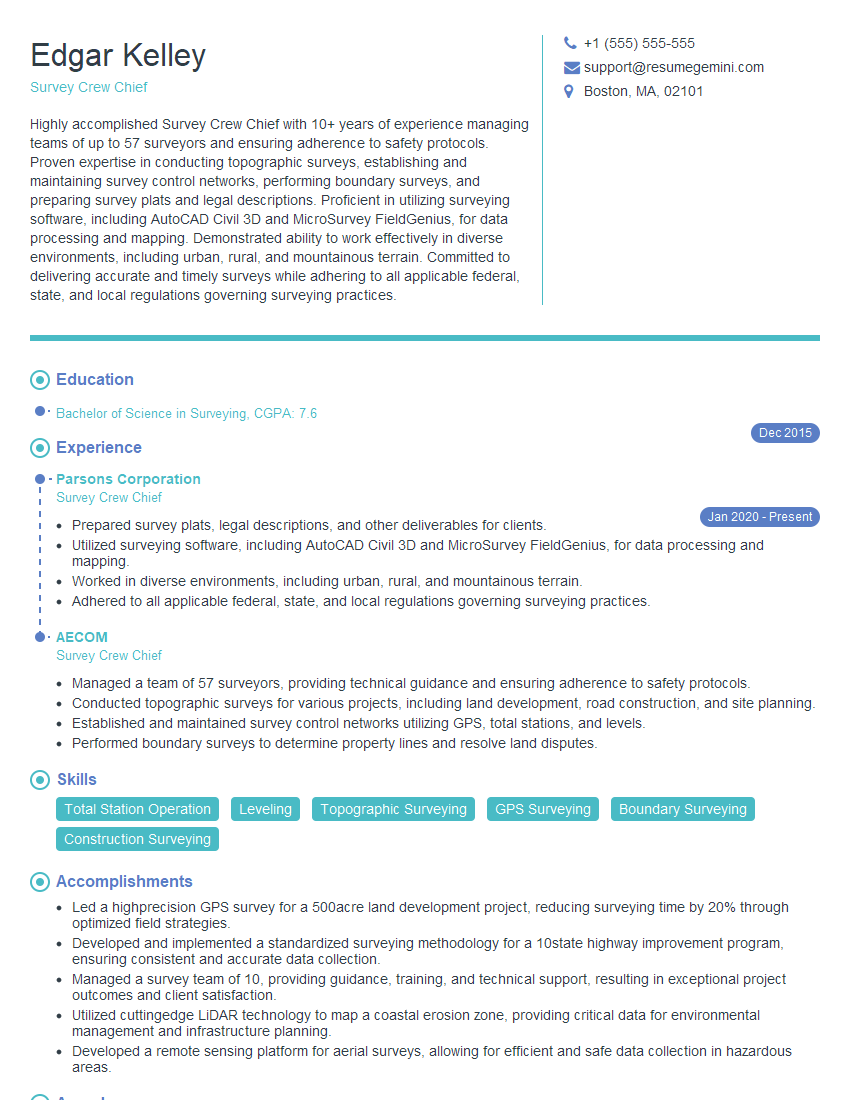
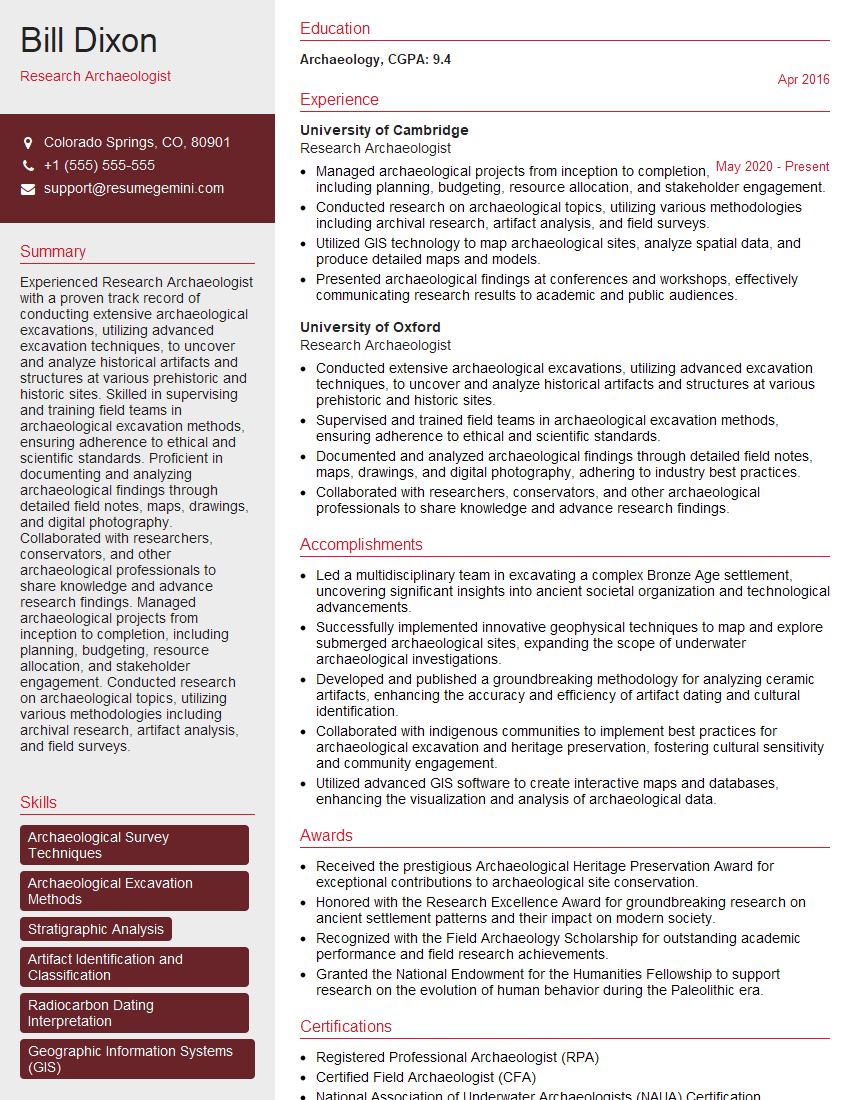
Mastering Surveying Cultural Resources opens doors to a rewarding career in heritage preservation, environmental consulting, and archaeology. The demand for skilled professionals in this field is consistently strong, offering excellent opportunities for career growth and advancement. To maximize your job prospects, crafting a compelling and ATS-friendly resume is paramount. ResumeGemini is a trusted resource to help you build a professional and effective resume that highlights your skills and experience in this specialized field. Examples of resumes tailored to Surveying Cultural Resources are provided to help guide you.
Explore more articles
Users Rating of Our Blogs
Share Your Experience
We value your feedback! Please rate our content and share your thoughts (optional).
What Readers Say About Our Blog
Really detailed insights and content, thank you for writing this detailed article.
IT gave me an insight and words to use and be able to think of examples