The thought of an interview can be nerve-wracking, but the right preparation can make all the difference. Explore this comprehensive guide to Understanding of vehicle detailing standards interview questions and gain the confidence you need to showcase your abilities and secure the role.
Questions Asked in Understanding of vehicle detailing standards Interview
Q 1. What are the different types of car washes and their suitability for various vehicle finishes?
Car washes come in various types, each with its own suitability depending on the vehicle’s finish. The wrong wash can damage delicate paintwork.
- Automatic Washes: These are convenient but can be harsh. The brushes can scratch softer paint if they’re not well-maintained. They’re generally suitable for vehicles with durable, factory clear coats but avoid them on high-end vehicles with sensitive finishes or custom paint jobs.
- Touchless Washes: These use high-pressure water and chemicals, minimizing contact and reducing the risk of scratching. They are a safer option for most vehicles.
- Self-Serve Washes: These give you more control, allowing you to adjust the pressure and choose your cleaning agents. However, they require more effort and you need to be careful not to scratch the paint with the brushes or wash mitt.
- Hand Washes: These are the gentlest and safest option, especially for vehicles with delicate finishes. A professional detailer will use two-bucket method with grit guards and specialized wash mitts to prevent scratches.
Think of it like this: an automatic wash is like using a scrub brush on your skin; it might be okay occasionally, but not ideal. A touchless wash is more like a gentle rain shower, while a hand wash is like a luxurious spa treatment.
Q 2. Explain the process of clay bar treatment and its benefits.
Clay bar treatment is a detailing process that removes embedded contaminants from the paint’s surface that washing alone can’t reach. These contaminants, such as industrial fallout, tree sap, and even bug remains, create a rough surface that feels like sandpaper.
The process involves lubricating the vehicle’s surface with a detailer spray, then gently gliding a clay bar across the paint. The clay bar acts like a magnet, picking up the contaminants, leaving the surface smooth as glass. It’s important to use a fresh section of the clay bar frequently and continue to lubricate the surface to avoid scratching the paint.
- Benefits: Improved paint smoothness, enhanced paint gloss, better adhesion for wax or sealant, improved paint protection.
Imagine your car’s paint as a carpet with embedded dirt. Washing alone only removes surface dust; the clay bar is like a deep cleaner that pulls out all the stubborn bits of dirt lodged within the carpet fibers, leaving it feeling soft and clean.
Q 3. Describe the steps involved in a complete interior detail.
A complete interior detail transforms the cabin from cluttered and dirty to pristine and organized. The process typically involves several meticulous steps:
- Vacuuming:Thoroughly vacuum all surfaces, including carpets, mats, seats, crevices, and under the seats.
- Cleaning Interior Surfaces: Use appropriate cleaners for different materials (leather, vinyl, plastic, fabric) to clean and condition dashboards, door panels, consoles, and other surfaces. Pay attention to detail, cleaning around buttons and knobs.
- Glass Cleaning: Clean all interior windows and mirrors using a dedicated glass cleaner and a microfiber cloth to avoid streaks.
- Upholstery Cleaning: Steam clean or detail carpets and upholstery using appropriate cleaning solutions and techniques, paying special attention to stains and heavily soiled areas.
- Leather Conditioning: Apply a quality leather conditioner to maintain the suppleness and prevent cracking in leather seats.
- Detailing Crevices: Use detailing brushes and compressed air to remove dirt and debris from hard-to-reach areas.
- Odor Elimination: Use an odor eliminator or air freshener to neutralize unpleasant smells.
- Final Organization: Organize the vehicle’s interior, removing unwanted items and neatly arranging what remains.
This methodical approach transforms a messy interior into a clean, inviting space.
Q 4. What are the different types of polishing compounds and their applications?
Polishing compounds are abrasive materials used to remove imperfections from a vehicle’s paint. Different compounds have different levels of abrasiveness, each suited to different tasks.
- Cutting Compounds (Heavy Cut): These are the most aggressive and designed to remove heavy scratches, swirls, and other paint defects. They’re used with a rotary buffer or dual-action polisher. Use only when absolutely necessary, as they remove a significant amount of paint.
- Compounding (Medium Cut): These are less aggressive than cutting compounds and are used to remove moderate scratches and swirls. They’re a good middle ground between cutting and polishing.
- Polishing Compounds (Light Cut/Fine Cut): These are less abrasive and are used to refine the surface, remove minor imperfections, and enhance gloss. They usually are used after a cutting or compounding stage.
- Finishing Polishes: These are the least abrasive and used to create the final shine and gloss. They’re not designed to remove imperfections, but only enhance clarity.
Think of it as sanding wood. You’d start with coarse sandpaper (cutting compound), then move to medium, fine, and finally extra-fine (finishing polish) to achieve the desired smoothness and finish.
Q 5. How do you identify and correct swirl marks and scratches?
Swirl marks and scratches are common paint imperfections that reduce a vehicle’s shine. Identifying them involves inspecting the paint surface under various lighting conditions.
Identification: Use a bright light source, ideally direct sunlight or a high-intensity LED, to scan the paint surface at different angles. Swirl marks appear as fine, circular scratches, while deeper scratches are more pronounced and linear.
Correction: Correction involves using polishing compounds and a polisher (rotary or dual-action) to carefully remove the imperfections. Start with the least abrasive compound and work your way up to more aggressive ones if needed. Always test in an inconspicuous area first. Multiple passes might be necessary, carefully assessing the results. For deeper scratches, professional paint correction might be required.
Proper technique and patience are crucial; rushing the process can lead to further damage.
Q 6. What are the best practices for maintaining a clean and organized detailing workspace?
A clean and organized detailing workspace is essential for efficiency and safety. Good practices include:
- Dedicated Space: Designate a specific area for detailing, ideally with ample space and good ventilation.
- Organized Storage: Keep products and tools organized, using shelves, drawers, and storage containers to prevent clutter.
- Waste Disposal: Have proper waste disposal systems for chemicals, microfiber towels, and other waste products.
- Cleanliness: Regularly clean and disinfect the workspace to maintain a hygienic environment.
- Proper Lighting: Ensure adequate lighting to improve visibility and reduce eye strain.
- Ergonomics: Set up the workspace ergonomically to avoid strain and fatigue.
A well-organized workspace is like a chef’s kitchen – it allows for efficient and effective work, preventing accidents and maximizing the quality of the final product.
Q 7. Explain the importance of using proper Personal Protective Equipment (PPE) during detailing.
Personal Protective Equipment (PPE) is crucial for protecting the detailer’s health and safety during the detailing process. Many detailing products contain harsh chemicals that can cause skin irritation, respiratory problems, or eye damage.
- Gloves: Always wear nitrile gloves to protect hands from chemicals and abrasives.
- Eye Protection: Safety glasses or goggles should be worn to protect eyes from splashes or dust.
- Respiratory Protection: A respirator or dust mask should be used when working with aerosols or dust to prevent inhalation of harmful particles.
- Hearing Protection: Earplugs or earmuffs should be used when operating power tools like polishers or buffers.
- Appropriate Clothing: Wear long sleeves and pants to protect skin from chemicals and abrasives.
Using PPE isn’t just about following rules; it’s about preserving your long-term health and well-being. It’s a small investment that yields significant returns in terms of your health and safety.
Q 8. How do you handle difficult stains or damage during interior detailing?
Tackling stubborn stains and interior damage requires a systematic approach. I always start by identifying the stain’s nature – is it oil-based, water-based, or something else? This dictates the cleaning agent. For example, a grease stain needs a degreaser, while a coffee stain might respond well to a specialized upholstery cleaner. I always test any cleaning product on an inconspicuous area first to check for colorfastness.
For more challenging stains like ink or pet stains, I might use a combination of techniques. This could involve pre-treating with a stain remover, then using a steam cleaner or extraction tool to lift the stain. For physical damage, like a tear in the upholstery, minor repairs might be possible with specialized adhesives and patches. Larger damage often requires professional upholstery repair.
One time, I encountered a car with a deep red wine stain on the beige leather seats. After testing a leather cleaner on a hidden area, I carefully applied it to the stain, gently working it in with a soft brush. Finally, I used a clean microfiber towel to blot and remove excess residue. The stain was significantly reduced, although some slight discoloration remained, proving that sometimes complete removal isn’t always possible.
Q 9. What are the different types of waxes and sealants and their characteristics?
Waxes and sealants are crucial for protecting a vehicle’s paint. Waxes are typically natural or synthetic products that create a thin layer of protection, enhancing shine and water beading. They offer relatively short-term protection, usually lasting a few weeks to a few months. Sealants, on the other hand, are synthetic polymers that offer longer-lasting protection, sometimes lasting six months or more. They often create a harder, more durable finish.
- Carnauba wax: A natural wax derived from a Brazilian palm tree, known for its deep shine and relatively easy application. It offers good water resistance but less durability compared to sealants.
- Synthetic waxes: These are often formulated to offer improved durability and water resistance compared to carnauba, while still providing a good shine.
- Polymer sealants: These are typically spray-on or wipe-on products that form a durable, protective layer. They offer superior water resistance and longevity compared to waxes.
- Ceramic sealants: These offer the most durable and longest-lasting protection, often lasting for years. They are more expensive and typically require professional application.
The choice depends on the client’s budget and desired protection level. For a quick shine, a carnauba wax is a good option. For longer-lasting protection, a sealant or ceramic coating is preferred.
Q 10. Explain the application process for ceramic coatings.
Applying a ceramic coating is a multi-step process requiring precision and meticulous attention to detail. Firstly, the vehicle’s surface needs to be thoroughly prepared. This involves washing, decontaminating (removing iron particles, tar, etc.), and polishing to remove imperfections and achieve a flawless finish. Then, the surface is carefully inspected for any remaining defects.
Next, the ceramic coating is applied in thin, even layers, typically using a dedicated applicator pad. This requires careful attention to avoid streaks or missed areas. After a designated curing time (specified by the manufacturer), the excess coating is removed with a clean microfiber towel. Multiple coats may be applied for enhanced protection.
Proper preparation is key. A poorly prepared surface will result in a less effective coating and may compromise its durability. I always ensure the environment is dust-free during application and curing. Any dust or debris trapped under the coating will be noticeable and could lead to issues later on. I treat each coat with the same care as the first. It is like building with precision; every layer should be flawless.
Q 11. What are the best methods for cleaning various types of upholstery (leather, fabric, etc.)?
Cleaning upholstery requires a tailored approach based on the material. Leather needs specialized cleaners formulated to condition and protect the leather while avoiding harsh chemicals that can damage it. I usually use a gentle leather cleaner and a soft brush or microfiber towel to clean it thoroughly. Afterwards, a leather conditioner helps maintain its suppleness and prevent cracking.
Fabric upholstery often requires a different approach. I might use a vacuum cleaner with upholstery attachments to remove loose dirt and debris first. Then, I would use a fabric-specific cleaner, following the product instructions carefully. Sometimes, steam cleaning is also effective, especially for removing deep-seated stains. Always pre-test any cleaner on a hidden area to avoid color damage.
For example, I once dealt with heavily soiled fabric seats in an older SUV. I started by vacuuming thoroughly, then applied a fabric cleaner and agitated it with a detailing brush. Finally, I used a wet/dry vacuum to extract the dirty solution, revealing clean, fresh-smelling seats. The entire process took several hours, but it made a tremendous difference in the overall cleanliness of the vehicle.
Q 12. How do you safely clean and protect sensitive materials like alcantara or suede?
Alcantara and suede are delicate materials that require gentle cleaning. Harsh chemicals or aggressive brushing can damage their delicate fibers, leaving them looking dull and worn. I always start by using a soft brush or a specialized Alcantara/suede cleaner to remove loose dirt. If stains are present, I use a very diluted cleaning solution, working in small areas. I always avoid rubbing vigorously. Instead, I use a gentle blotting motion to lift stains.
After cleaning, it’s essential to allow these materials to air dry completely, away from direct sunlight or heat. Specialized protectants are available for Alcantara and suede; these can help repel stains and improve water resistance. These are luxury materials. Any mistake is significant, so it is important to work with precision.
In one case, I successfully cleaned a heavily soiled Alcantara headliner using a specialized cleaner and a soft brush. The key was patience and gentle cleaning techniques. The result was a pristine-looking headliner, restored to its original beauty. The entire process involved meticulous attention to detail and avoidance of harsh chemicals.
Q 13. Describe your experience with paint correction techniques.
Paint correction involves removing imperfections like scratches, swirl marks, and holograms from a vehicle’s paintwork, using various techniques and tools. This usually involves multiple steps, starting with assessing the damage and selecting the appropriate tools and compounds. I use a combination of machine polishing (using dual-action polishers) and hand polishing with different grades of polishing compounds, moving from more aggressive to finer compounds to achieve the desired results.
The process requires skill and experience to avoid causing further damage. Different techniques are used depending on the severity of the imperfections. For light scratches, a milder compound and polishing pad might be sufficient. For deeper scratches, a more aggressive compound and pad might be needed. Proper pad selection and machine speed control are crucial to prevent burning through the clear coat.
For instance, I once corrected a car with numerous swirl marks from an automated car wash. Using a dual-action polisher and varying grades of polishing compound, I painstakingly removed the imperfections. The result was a dramatically improved shine and a paint finish free from unsightly swirls. This process demands attention to detail and patience.
Q 14. What are the safety precautions involved when working with chemicals during detailing?
Safety is paramount when working with detailing chemicals. I always work in a well-ventilated area, preferably outdoors or with proper ventilation systems. I wear appropriate personal protective equipment (PPE), including gloves, eye protection, and a respirator, especially when dealing with strong chemicals. This protects me from inhalation, skin contact, and eye irritation.
Before using any chemical, I carefully read and follow the manufacturer’s instructions, paying attention to dilution ratios and application methods. I store chemicals properly, away from children and pets, in clearly labeled containers. I also dispose of used chemicals responsibly, following local regulations.
I never mix chemicals unless explicitly instructed by the manufacturer, as this can create dangerous reactions. I am always mindful of spills and take immediate action to clean them up, preventing accidents and protecting the environment. Safety isn’t just a rule; it’s a fundamental part of my detailing process.
Q 15. How do you manage customer expectations regarding detailing services?
Managing customer expectations in vehicle detailing is crucial for a positive experience. It starts with a clear and upfront consultation. I begin by actively listening to the customer’s needs and desires, asking clarifying questions to understand their vision for their vehicle’s appearance. Then, I present a realistic assessment of what can be achieved, considering the vehicle’s condition and the chosen detailing package. For example, if a customer has an older vehicle with significant paint damage, I’ll explain that a full restoration might not be achievable with a basic detail, and instead suggest options like paint correction to address specific areas. I always provide a detailed quote outlining the services included and the expected timeframe, leaving no room for surprises. Finally, I maintain open communication throughout the process, providing updates if there are any unexpected issues or delays.
Using visual aids, such as before-and-after photos of similar projects, can further enhance clarity and manage expectations. This visual representation helps customers understand the scope of work and the potential outcome, ensuring they’re fully informed and satisfied.
Career Expert Tips:
- Ace those interviews! Prepare effectively by reviewing the Top 50 Most Common Interview Questions on ResumeGemini.
- Navigate your job search with confidence! Explore a wide range of Career Tips on ResumeGemini. Learn about common challenges and recommendations to overcome them.
- Craft the perfect resume! Master the Art of Resume Writing with ResumeGemini’s guide. Showcase your unique qualifications and achievements effectively.
- Don’t miss out on holiday savings! Build your dream resume with ResumeGemini’s ATS optimized templates.
Q 16. How do you handle customer complaints or dissatisfaction?
Handling customer complaints or dissatisfaction is handled with professionalism and empathy. My first step is always to actively listen to the customer’s concerns without interruption. I aim to understand their perspective and validate their feelings. Once I understand the issue, I carefully inspect the vehicle to identify the problem. If the issue is a genuine fault on my part, I immediately apologize and explain how I will rectify the situation. This could involve re-doing specific aspects of the detailing or offering a partial refund, depending on the nature and severity of the issue. For example, if there’s a missed spot during polishing, I’ll happily re-polish the area to perfection.
Documentation plays a vital role. If a pre-detail inspection was completed, I can reference it to compare the before and after states. Open communication is key; I keep the customer informed throughout the correction process. Even if the complaint is not directly attributable to my work (e.g., pre-existing damage not noticed), I aim to find a mutually satisfactory solution, perhaps suggesting further services or offering a discount on future detailing.
Q 17. Describe your experience with using different detailing tools and equipment.
My experience encompasses a wide range of detailing tools and equipment. I’m proficient with various types of pressure washers, from entry-level models to high-end systems offering adjustable pressure and temperature control, which is crucial for different surfaces and paint types. I’m experienced in using dual-action polishers, both rotary and random orbital, understanding their distinct applications – rotary for aggressive correction and random orbital for safer refinement and finishing. I’m also well-versed in using various types of microfiber towels, applicators, and brushes, selecting the appropriate ones for specific detailing tasks. I’m comfortable operating steam cleaners for interior disinfection and detail brushes for intricate areas. Additionally, I’m familiar with the use and maintenance of vacuum cleaners suited for vehicle interiors and specialized extraction tools for upholstery cleaning.
My experience also extends to working with various chemicals and detail products, including specialized shampoos, waxes, sealants, and coatings, ensuring safe and effective application for optimal results. Regular maintenance and calibration of my tools are important; I have a checklist and schedule to ensure everything is in top working condition.
Q 18. What are your preferred methods for cleaning and maintaining different vehicle types (e.g., cars, trucks, SUVs)?
My approach to cleaning and maintaining different vehicle types is tailored to their specific characteristics. For cars, I prioritize precision and detail, focusing on paint correction and meticulous interior cleaning. With trucks and SUVs, I adapt to the typically more rugged exterior, utilizing stronger cleaning agents and techniques for removing dirt and grime accumulated from off-road use or tough working conditions. The cleaning process for all vehicle types always begins with a thorough pre-wash, using a high-pressure washer to remove loose debris, followed by a wash using two-bucket method to avoid scratching. This is followed by a thorough clay bar treatment to remove embedded contaminants before detailing the paint.
Interior cleaning differs depending on the vehicle’s use. For instance, a truck used for hauling might require more intensive cleaning of the cargo area. I use appropriate cleaning products and techniques for each material – leather, fabric, vinyl, etc. Always, the final step involves a thorough inspection and quality control checks before the vehicle is returned to the customer.
Q 19. How do you ensure the longevity of a detailing job?
Ensuring the longevity of a detailing job involves multiple layers of protection and aftercare guidance. The choice of products is critical. High-quality waxes, sealants, or ceramic coatings offer superior protection against UV rays, environmental contaminants, and minor scratches, extending the life of the detailing. Proper application techniques are also crucial to ensure even coverage and maximum effectiveness. I’d emphasize to the customer the importance of regular maintenance washing, avoiding harsh chemicals and automatic car washes, and using a high-quality car wash soap designed to protect waxes and sealants. Further protection can include the use of a UV protectant on the interior to prevent premature fading of materials.
Providing post-detailing instructions is also part of this process. A simple, easy-to-follow care guide helps customers maintain their vehicle’s clean look. This includes advice on regular cleaning, washing techniques, and product recommendations, maximizing the long-term effects of the detailing job.
Q 20. What are the common issues encountered during vehicle detailing, and how would you address them?
Common issues in vehicle detailing range from stubborn stains and water spots to swirl marks and scratches. Stubborn stains, such as tar or tree sap, require specific solvents and careful application to avoid damaging the paint. Water spots, often caused by hard water, are addressed with dedicated detailing solutions and meticulous drying techniques. Swirl marks and scratches are typically dealt with through polishing and compounding, using varying levels of abrasiveness to correct the imperfections without causing further damage. Each step requires careful selection of tools and products, as well as patience and precision.
Another common issue is the presence of embedded contaminants, which need to be addressed before polishing and waxing. A clay bar treatment removes these contaminants effectively. Furthermore, dealing with interior stains might require specific cleaning agents for different materials (e.g., leather cleaners for leather, specialized fabric cleaners for upholstery). Understanding the root cause of the issue is crucial before selecting the appropriate remediation techniques.
Q 21. Explain the importance of quality control in vehicle detailing.
Quality control in vehicle detailing is paramount; it ensures customer satisfaction and maintains a professional reputation. It’s an ongoing process, starting from the initial assessment and continuing throughout the detailing process until final inspection. A consistent workflow, with checklists for each stage of the detailing process (pre-wash, wash, dry, interior cleaning, exterior detailing etc.), ensures nothing is overlooked. Regular checks for missed spots, even surface inconsistencies, or improperly applied products are vital. Using standardized procedures and techniques helps maintain consistency in quality across various detailing services.
Thorough inspection before returning the vehicle to the customer is crucial. This final check ensures all aspects of the work meet the expected standards, confirming the absence of any imperfections or missed spots. Regular calibration and maintenance of tools and equipment are equally important to ensure consistent, high-quality work. Continuous improvement through feedback, both from customers and self-assessment, is essential to refine techniques and maintain the highest standards of quality.
Q 22. How do you stay updated on the latest detailing techniques and products?
Staying current in the dynamic world of vehicle detailing requires a multi-pronged approach. I actively participate in online forums and communities dedicated to detailing, engaging with experienced professionals and learning about new techniques and products. These online spaces often feature discussions on the latest innovations, reviews of new products, and problem-solving for challenging detailing situations. For example, I recently learned about a new ceramic coating that offers superior durability and hydrophobic properties through a detailed online review and subsequent discussions with other detailers.
In addition to online resources, I subscribe to industry magazines and attend workshops and seminars whenever possible. These events provide hands-on training with new products and techniques, and networking opportunities to learn from industry leaders. For instance, last year, I attended a seminar on paint correction techniques using advanced polishing machines, which significantly improved my skillset. Finally, I regularly test and compare different products myself, documenting my findings to inform my future detailing practices. This iterative learning process keeps me at the forefront of this ever-evolving field.
Q 23. What is your experience with different types of cleaning solutions?
My experience with cleaning solutions spans a wide range, from basic soap and water solutions to highly specialized chemical agents. I am proficient in using various types of detergents, including pH-neutral car washes, specialized degreasers for engine bays and wheels, and various types of glass cleaners. I am deeply aware of the different chemicals and their appropriate uses. For example, I understand the importance of using a pH-neutral wash to avoid stripping the protective wax or sealant from a vehicle’s paint.
I also have significant experience with specialized solutions like tar removers, iron decontaminants, and fallout removers, each designed to tackle specific contaminants. The selection of the right solution heavily depends on the specific type of dirt, grime, or contaminant. Knowing the chemical composition and potential risks of each solution, along with understanding safe handling procedures, is paramount to successful and safe detailing. For instance, I know that using a highly alkaline degreaser on certain plastics could cause damage, so I always use the appropriate solution for the material being cleaned.
Q 24. How do you deal with unexpected issues during a detailing project?
Unexpected issues are part and parcel of detailing. My approach is methodical and always prioritizes preventing damage. However, I have procedures in place to address unforeseen circumstances efficiently and effectively. My first step is thorough assessment of the problem. For example, if I encounter a stubborn scratch that was not initially apparent, I document it, photograph it, and then consult with the client about the best course of action, weighing cost and repair options. Transparency is key.
If I encounter a chemical reaction that I don’t anticipate, like a cleaning solution causing unexpected discoloration, I immediately isolate the area, neutralize the reaction if possible, and thoroughly document the situation. I would then research the cause, which might involve consulting product data sheets or contacting the manufacturer. My ultimate goal is to mitigate the damage and find a solution that meets the client’s expectations. I view unexpected issues as learning opportunities, improving my skills and awareness for future jobs.
Q 25. Explain your understanding of different wheel cleaning techniques and products.
Wheel cleaning is crucial and often overlooked, but a neglected wheel can ruin the overall aesthetic of a car. My approach is multi-faceted and tailored to the level of contamination. I use various techniques and products, starting with a thorough pre-soak using a dedicated wheel cleaner. This helps to loosen brake dust, dirt, and grime. This is often followed by a brush, various types of brushes are used depending on the wheel design to avoid scratching the surface.
For heavily contaminated wheels, I may incorporate a dedicated iron remover, which chemically reacts with iron particles from brake dust, turning them purple and making them easier to remove. Afterwards, thorough rinsing is critical to remove all cleaning solutions. I also always use a dedicated wheel brush and avoid cross-contamination between cleaning tools; using a dedicated wheel brush and separate wash mitts and towels is essential. This minimizes the risk of transferring contaminants to other parts of the vehicle. The type of cleaning solution utilized also depends on the wheel’s finish: chrome, painted, or powder-coated wheels all require different approaches to avoid damage.
Q 26. What are your experience with paint protection films?
My experience with paint protection films (PPF) is extensive. I am proficient in the installation process, starting from precise measurement and cutting to the application and final finishing. PPF offers exceptional protection against scratches, rock chips, and other environmental damage. I understand that proper surface preparation is paramount to ensure a long-lasting and flawless installation, and I always use high-quality PPF materials from reputable brands.
Beyond installation, I also understand the various types of PPF available, including those with self-healing properties and different levels of thickness. Choosing the right film depends heavily on the client’s budget and their vehicle’s usage. I always educate my clients about the film’s properties and limitations. For instance, I explain that while PPF protects against scratches, it is not invincible and can still be damaged by extremely sharp objects or extreme impacts. Post-installation care, such as proper washing techniques, is also crucial for maximizing the film’s lifespan.
Q 27. Explain the process for properly detailing engine bays.
Detailing an engine bay requires a meticulous and systematic approach, prioritizing safety and protection. I begin by thoroughly cleaning the engine bay, removing loose dirt and debris using a compressed air blower and a detailing brush. Then, I protect sensitive electrical components with plastic covers or masking tape to avoid water damage. For cleaning, I use a specialized engine degreaser, ensuring its compatible with engine components.
After applying the degreaser, I allow it to dwell for the recommended time before carefully rinsing the engine bay with low-pressure water, avoiding high-pressure streams which can damage sensitive electronics. I pay special attention to cleaning hard-to-reach areas using brushes and detailing tools. Once everything is thoroughly rinsed and dried, I use a protectant to protect the engine components and help repel dust and dirt. A final detailed wipe-down adds to the finished look. Throughout the process, safety is paramount, using appropriate personal protective equipment (PPE) such as eye protection and gloves. The entire process is carefully documented, both for quality control and record-keeping.
Key Topics to Learn for Understanding of Vehicle Detailing Standards Interview
- Interior Detailing Standards: Understanding different levels of interior detailing (e.g., basic, premium, executive), including cleaning techniques for various materials (leather, fabric, vinyl, plastic), stain removal methods, and odor elimination strategies.
- Exterior Detailing Standards: Knowledge of washing techniques (two-bucket method, wash mitts vs. sponges), drying methods (air drying, microfiber towels), paint correction techniques (scratch removal, swirl mark removal), and the application of sealants and waxes. Understanding different types of car washes and their impact on vehicle finish.
- Product Knowledge: Familiarity with various detailing products (cleaning solutions, polishes, waxes, sealants, protectants) and their proper application and usage. Understanding the chemical composition and potential risks associated with different products.
- Safety Procedures: Adherence to safety protocols when handling cleaning chemicals, using detailing equipment, and maintaining a clean and organized workspace. Understanding proper disposal methods for hazardous materials.
- Quality Control and Inspection: Developing a keen eye for detail to identify imperfections and ensure the highest standards of quality are met. Understanding the process of inspecting a vehicle before and after detailing.
- Time Management and Efficiency: Effectively managing time and resources to complete detailing jobs efficiently and within the allotted timeframe. Understanding how to prioritize tasks and optimize workflow.
- Customer Service: Understanding how to interact professionally with clients, manage expectations, and address concerns effectively. This includes communicating clearly about service details and timelines.
Next Steps
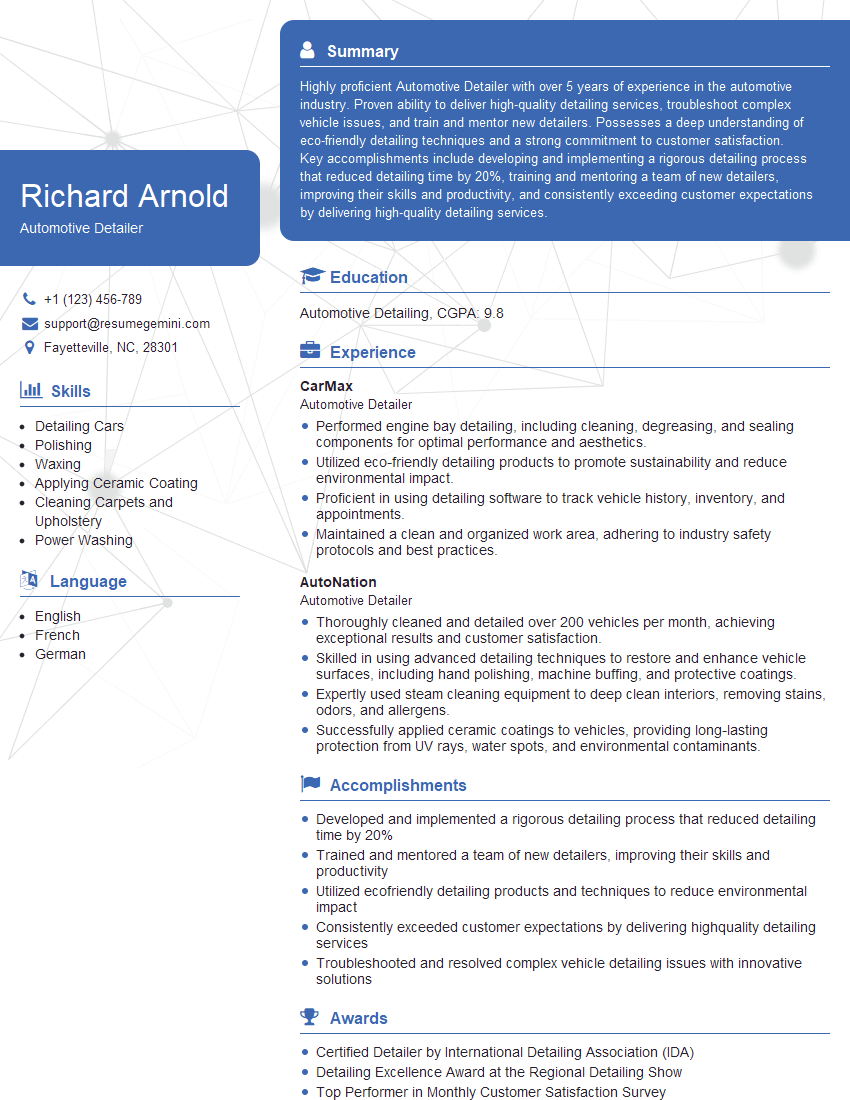
Mastering vehicle detailing standards is crucial for career advancement in the automotive industry, opening doors to higher-paying roles and specialized opportunities. A strong resume is your key to unlocking these prospects. Creating an ATS-friendly resume ensures your qualifications are effectively communicated to hiring managers. ResumeGemini is a trusted resource to help you build a professional and impactful resume that highlights your skills and experience. Examples of resumes tailored to understanding of vehicle detailing standards are available to help guide your resume creation process.
Explore more articles
Users Rating of Our Blogs
Share Your Experience
We value your feedback! Please rate our content and share your thoughts (optional).
What Readers Say About Our Blog
Really detailed insights and content, thank you for writing this detailed article.
IT gave me an insight and words to use and be able to think of examples