Interviews are more than just a Q&A session—they’re a chance to prove your worth. This blog dives into essential Extensive knowledge of design software and techniques interview questions and expert tips to help you align your answers with what hiring managers are looking for. Start preparing to shine!
Questions Asked in Extensive knowledge of design software and techniques Interview
Q 1. Explain your experience with Adobe Photoshop.
My experience with Adobe Photoshop spans over a decade, encompassing everything from basic image retouching to advanced compositing and manipulation. I’ve used it extensively for creating marketing materials, website assets, and even digital illustrations. I’m proficient in utilizing layers, masks, adjustment layers, and various filters to achieve specific visual effects. For instance, I once had to retouch hundreds of product images for an e-commerce client, ensuring consistent lighting and background removal. This required efficient batch processing techniques, using actions and scripts to streamline the workflow. Another project involved creating a photorealistic composite image for a magazine cover, requiring skillful blending and masking to seamlessly integrate different elements. I’m also comfortable using Photoshop’s advanced features such as Camera Raw for non-destructive image editing and 3D capabilities for creating stylized text effects or integrating 3D models into 2D artwork.
Q 2. Describe your workflow using Adobe Illustrator.
My Illustrator workflow is highly vector-based and centered around creating scalable graphics. I typically begin with sketching out concepts, either digitally or traditionally, before translating them into Illustrator. My process usually follows these steps: 1. **Planning:** Defining the project’s scope, target audience and desired style. 2. **Sketching:** Creating rough drafts to establish composition and key elements. 3. **Vectorization:** Using the Pen Tool, Shape tools and other vector-based tools to create clean, precise artwork. 4. **Refinement:** Adjusting curves, tweaking colors and adding details. 5. **Organization:** Using layers and layer styles for efficient organization and editing. 6. **Export:** Exporting artwork in various formats (SVG, EPS, PDF) based on the project’s requirements. For example, when designing a logo, I carefully construct each element using precise vector shapes, ensuring scalability across different applications and sizes. For more complex illustrations, I utilize techniques like live tracing to convert raster images to vector graphics, streamlining the process.
Q 3. How proficient are you in Adobe InDesign?
I’m highly proficient in Adobe InDesign, with extensive experience in creating layouts for various print and digital publications. I’m adept at mastering page layouts, typography, image placement, and the creation of interactive documents. My skills include working with master pages, styles, and text frames to create consistent and efficient document design. I have experience in pre-press preparation, ensuring files are correctly formatted for printing. A recent project involved designing a multi-page brochure with complex infographics and detailed product specifications, which demanded precise alignment, consistent typography, and efficient image handling. My proficiency extends to creating interactive PDFs with links, buttons, and animations, enabling engaging user experiences in digital publications. I understand the nuances of print production, including bleed, color profiles (CMYK, RGB), and resolution requirements.
Q 4. Compare and contrast Sketch and Figma.
Sketch and Figma are both popular UI/UX design tools, but they cater to different needs and workflows. Sketch, primarily a Mac-based application, excels in its simplicity and ease of use for creating pixel-perfect designs. Its focus is on creating beautiful interfaces, leveraging features like symbols and artboards for efficient design iteration. Figma, on the other hand, is a browser-based collaborative platform, perfect for teamwork. Its strength lies in its real-time collaboration capabilities, version control, and prototyping features. While Sketch offers a more polished, refined design experience, Figma provides a more dynamic and collaborative workflow. The choice between them often depends on the project size, team dynamics, and operating system preferences. For solo projects needing pixel-perfect precision, Sketch might be preferred; for large-scale collaborative projects demanding real-time collaboration and version history, Figma is usually the better choice.
Q 5. What are your preferred methods for prototyping?
My preferred prototyping methods depend on the project’s complexity and fidelity requirements. For low-fidelity prototypes, I often use pen and paper sketching or digital wireframing tools like Balsamiq. These methods allow for quick iteration and exploration of ideas without getting bogged down in visual details. For higher-fidelity prototypes that showcase interactive elements and animations, I utilize Figma’s prototyping capabilities or tools like Adobe XD. These allow me to create clickable prototypes demonstrating user flows, transitions, and micro-interactions. My approach focuses on creating interactive prototypes that clearly convey the user experience, enabling testing and gathering feedback early in the design process. I often incorporate user testing throughout the prototyping process, making adjustments based on observed user behavior and feedback.
Q 6. Explain your understanding of UX design principles.
My understanding of UX design principles is grounded in the belief that user-centered design is paramount. Key principles I consistently apply include:
- Usability: Designing interfaces that are intuitive, easy to navigate and efficient to use.
- Accessibility: Ensuring designs are accessible to users with disabilities, adhering to WCAG guidelines.
- Findability: Making it easy for users to locate information and complete their tasks.
- Learnability: Designing interfaces that are easy to learn and use, even for first-time users.
- Credibility: Building trust and confidence in the design through clear communication and consistent branding.
- Desirability: Creating interfaces that are aesthetically pleasing and engaging, appealing to the target audience.
Q 7. Describe your experience with responsive design.
My experience with responsive design is extensive. I understand the importance of creating designs that adapt seamlessly across different devices and screen sizes. I utilize techniques such as fluid grids, flexible images, media queries and mobile-first design approaches to ensure consistent user experiences across desktops, tablets, and smartphones. I’m proficient in using CSS frameworks like Bootstrap or Tailwind CSS to accelerate the responsive design process. A recent project involved redesigning a corporate website, requiring a responsive design that looked and functioned optimally on various devices. This involved creating different layouts for different screen sizes, optimizing images for web performance and testing thoroughly across various devices and browsers. I also leverage browser developer tools for testing responsiveness and debugging during development.
Q 8. How do you handle design feedback and criticism?
Handling design feedback is crucial for iterative improvement. I approach it as a collaborative process, not a personal attack. I start by actively listening, asking clarifying questions to fully understand the feedback’s context and intent. I then analyze the critique: Is it about usability, aesthetics, functionality, or something else?
For constructive criticism, I document the feedback, prioritizing suggestions based on their impact and feasibility. I might create quick sketches or prototypes to explore potential solutions before implementing them. For example, if feedback points to confusing navigation, I might create a revised sitemap or low-fidelity wireframes to test different approaches.
If the feedback is subjective or unclear, I initiate a discussion to gain further clarity. I might ask questions like, “Could you elaborate on why you feel this element is distracting?” or “What would make this experience more intuitive for you?” Ultimately, the goal is to understand the user’s needs and expectations and incorporate them into the design.
I document all feedback and design iterations in a shared space (like Figma or Jira) for transparency and traceability. This not only allows for easy revisiting but also demonstrates my commitment to a collaborative design process.
Q 9. Explain your process for creating a design system.
Creating a design system is a significant undertaking, requiring meticulous planning and collaboration. My process typically involves these key phases:
- Discovery and Audit: I begin by thoroughly researching existing design elements, brand guidelines, and user interface patterns. This often includes an audit of existing assets to identify inconsistencies and areas for improvement. This helps establish a baseline for the system.
- Definition and Strategy: Next, I define the scope and goals of the system. What are the key components? (e.g., typography, color palettes, buttons, spacing, grids). We define naming conventions and establish a clear governance model to ensure consistency and maintenance.
- Component Design: I design reusable UI components, paying close attention to accessibility and cross-platform compatibility. This often involves creating component libraries within design tools like Figma or Sketch. Detailed specifications are created, covering states, variations, and interactions.
- Documentation and Testing: Thorough documentation is paramount. A well-structured style guide with clear examples and usage guidelines is created. The system is rigorously tested across various devices and browsers to ensure usability and consistency.
- Implementation and Iteration: The system is gradually integrated into ongoing projects. We continuously monitor its effectiveness and gather feedback for iterative improvement. This is a crucial step to fine-tune the system and ensure it remains relevant and effective over time.
Imagine building with LEGOs; a design system is like having a standardized set of bricks, ensuring every creation is consistent and easily expandable. This approach promotes efficiency, scalability, and a cohesive brand identity.
Q 10. How do you ensure accessibility in your designs?
Accessibility is not an afterthought; it’s an integral part of my design process from the very beginning. I follow WCAG (Web Content Accessibility Guidelines) and adhere to best practices to ensure inclusive design for users with disabilities.
- Color Contrast: I use tools and plugins to ensure sufficient color contrast between text and background. Adequate contrast is essential for users with low vision.
- Keyboard Navigation: All interactive elements must be accessible via keyboard, ensuring users who cannot use a mouse can still navigate the interface. I test this thoroughly.
- Alternative Text for Images: All images have descriptive alternative text (alt text) to provide context for screen readers used by visually impaired users.
- Semantic HTML: When working with front-end development, I advocate for using semantic HTML elements, making the content understandable to assistive technologies. For example, using
<header>,<nav>,<main>,<article>, instead of generic<div>elements. - Captions and Transcripts: For video and audio content, I ensure captions and transcripts are provided.
Accessibility isn’t just about compliance; it’s about creating a welcoming and usable experience for everyone. By considering accessibility early on, we avoid costly and time-consuming retrofits later.
Q 11. What are your preferred methods for user research?
User research is the cornerstone of effective design. I employ a mixed-methods approach, combining qualitative and quantitative research techniques depending on the project’s goals and constraints.
- User Interviews: I conduct one-on-one interviews to understand users’ needs, pain points, and motivations. These are invaluable for gaining deeper insights into their experiences.
- Surveys: Surveys are used to gather quantitative data on a larger scale, helping identify trends and patterns in user behavior. I use tools like SurveyMonkey or Typeform.
- Usability Testing: I conduct usability testing sessions to observe how users interact with prototypes or existing designs. This allows me to identify usability issues and areas for improvement.
- A/B Testing: For evaluating design variations, A/B testing allows us to compare different designs and measure their impact on key metrics, such as conversion rates or task completion time.
- Card Sorting: To understand how users categorize information, card sorting is used to organize content in a way that’s intuitive and easily navigable.
Each method offers unique advantages, and combining them provides a comprehensive understanding of user behavior and preferences. For example, I might conduct user interviews to identify core pain points and then use A/B testing to evaluate design solutions aimed at addressing those issues.
Q 12. Describe your experience with wireframing and mockups.
Wireframing and mockups are essential tools in my design arsenal. They serve different purposes but work together to refine the user experience.
Wireframing focuses on the structure and functionality of the design. I use low-fidelity wireframes, often simple sketches or digital tools like Balsamiq, to quickly iterate on layouts and information architecture. These are great for brainstorming and early-stage validation.
Mockups, on the other hand, are higher-fidelity representations that focus on the visual design. I use design tools like Figma or Sketch to create mockups that showcase the visual style, typography, and imagery. These are used to communicate the visual direction and gather feedback on the aesthetic aspects of the design.
For example, I might create a low-fidelity wireframe to map out the user flow for an e-commerce checkout process. After iterating on the wireframe based on feedback, I’d then create a high-fidelity mockup to show the visual design of the checkout pages. This process allows for a streamlined approach where functionality is prioritized first, then refined visually.
Q 13. Explain your understanding of design thinking.
Design thinking is a human-centered problem-solving approach that focuses on understanding user needs and creating innovative solutions. It’s an iterative process that emphasizes empathy, experimentation, and collaboration.
The core stages typically include:
- Empathize: Understanding the user’s needs and context through user research.
- Define: Clearly defining the problem that needs to be solved.
- Ideate: Generating a wide range of potential solutions through brainstorming and sketching.
- Prototype: Creating tangible representations of the solutions to test and refine.
- Test: Evaluating the prototypes through user feedback and iterating on the designs.
It’s not a linear process; we often loop back to earlier stages based on feedback and insights gathered throughout the process. For example, if usability testing reveals a flaw in the prototype, we might go back to the ideation phase to explore alternative solutions. Design thinking ensures the final product is truly user-centric and addresses the core problem effectively.
Q 14. How do you prioritize features in a design project?
Prioritizing features requires a strategic approach to ensure that the most valuable aspects of a design project are addressed first. I often use a combination of methods:
- MoSCoW Method: This prioritization framework categorizes features as Must have, Should have, Could have, and Won’t have. This helps filter essential features from those that are less critical.
- Value vs. Effort Matrix: This involves plotting features on a matrix where the x-axis represents the effort required to implement the feature and the y-axis represents its value to the user or business. High-value, low-effort features are prioritized.
- User Stories and Story Points: In agile environments, user stories with assigned story points (representing effort) help estimate the development time and prioritize features based on user value and development capacity.
- Stakeholder Input: Collaborating with stakeholders to gather their input and understand their priorities helps ensure alignment and focus on critical features.
By carefully considering user needs, business goals, and development constraints, I can create a prioritized feature list that ensures the project delivers maximum impact within available resources. This avoids scope creep and ensures that the most valuable features are implemented first, increasing the likelihood of project success.
Q 15. What are some common design patterns you use?
Design patterns are reusable solutions to commonly occurring problems in software design. In the realm of UI/UX design, they provide a framework for creating consistent, predictable, and user-friendly interfaces. I frequently utilize several key patterns:
- Model-View-Controller (MVC): This architectural pattern separates the data (Model), the presentation (View), and the logic (Controller), making the design more maintainable and scalable. I use this when designing complex applications with lots of interactive elements, ensuring clear separation of concerns.
- Singleton Pattern: This ensures that only one instance of a class is ever created. In design, this is useful for managing global settings or resources across different parts of an application. For instance, a single color palette or font library can be implemented this way.
- Composite Pattern: This lets you treat individual objects and compositions of objects uniformly. This is invaluable when building complex UI components that can be nested or grouped. Think of a website menu where individual menu items and sub-menus are all handled similarly.
- Decorator Pattern: This allows adding responsibilities to objects dynamically. For example, adding interactive elements or animations to existing UI components without altering the base code. In practice, this means adding tooltips to buttons or implementing hover effects.
Choosing the right pattern depends heavily on the project’s complexity and requirements. I always aim for simplicity and maintainability, opting for the most straightforward solution possible.
Career Expert Tips:
- Ace those interviews! Prepare effectively by reviewing the Top 50 Most Common Interview Questions on ResumeGemini.
- Navigate your job search with confidence! Explore a wide range of Career Tips on ResumeGemini. Learn about common challenges and recommendations to overcome them.
- Craft the perfect resume! Master the Art of Resume Writing with ResumeGemini’s guide. Showcase your unique qualifications and achievements effectively.
- Don’t miss out on holiday savings! Build your dream resume with ResumeGemini’s ATS optimized templates.
Q 16. Describe your experience with version control for design files.
Version control is paramount in design. I’ve extensively used Git, often integrated with platforms like GitHub or Bitbucket. My workflow involves creating separate branches for each design iteration, feature, or bug fix. This allows me to experiment freely without impacting the main project branch. I meticulously commit changes with clear, descriptive messages, outlining the purpose of each modification. For example, git commit -m "Updated homepage hero image with improved typography". This detailed history helps track changes over time, facilitating collaboration and providing a fallback point if needed. Furthermore, I utilise platforms that support various design file formats (like Sketch, Figma, Adobe XD) to manage version history within the cloud itself, providing automated backups and easy comparison of different versions.
Q 17. Explain how you stay up-to-date with design trends.
Staying current is critical in the rapidly evolving design landscape. My strategies include:
- Following design publications and blogs: Sites like Awwwards, Dribbble, Behance, and various design blogs provide a constant stream of inspiring work and design trends. This allows me to stay abreast of the latest styles and techniques, fostering creativity.
- Attending conferences and workshops: These events offer valuable insights from industry leaders, allowing for networking and learning from experts firsthand.
- Experimenting with new tools and technologies: I actively explore emerging design tools, plugins, and technologies to expand my skillset and stay ahead of the curve.
- Analyzing competitor work: Studying competitor designs provides a deeper understanding of market trends and best practices, allowing me to identify areas for innovation and improvement.
- Utilizing social media strategically: Following influential designers on platforms like Twitter and Instagram provides a curated feed of design news, resources, and inspirational work.
This multi-faceted approach ensures I remain well-informed about the latest design trends and best practices.
Q 18. How do you measure the success of your designs?
Measuring design success is a multifaceted process. It goes beyond simple aesthetics; it’s about understanding whether the design achieves its intended goals. I use a combination of qualitative and quantitative methods:
- User testing: Conducting usability tests helps identify pain points and areas for improvement. I collect user feedback on task completion rates, perceived ease of use, and overall satisfaction.
- A/B testing: Comparing different design iterations allows me to identify which performs better in terms of key metrics, such as conversion rates or engagement.
- Analytics tracking: Tracking website traffic, user behavior, and other relevant metrics provides valuable insights into how users interact with the design. This data allows informed decision-making for design optimization.
- Feedback from stakeholders: Gathering feedback from clients, developers, and other stakeholders ensures that the design aligns with the business goals and technical constraints. This is often combined with surveys or feedback sessions.
By combining these methods, I can gain a comprehensive understanding of the design’s effectiveness and areas for further optimization.
Q 19. Describe a challenging design problem you solved.
One challenging project involved designing a mobile banking app for visually impaired users. The challenge was to create an intuitive and accessible interface that adhered to WCAG (Web Content Accessibility Guidelines) standards without compromising the overall design aesthetic. My solution involved:
- Thorough research: I conducted extensive research on accessibility best practices and interviewed users with visual impairments to understand their needs and preferences.
- Utilizing appropriate assistive technologies: I implemented features such as screen reader compatibility, robust keyboard navigation, and sufficient color contrast.
- Employing clear and concise language: The language used in the app was carefully chosen to avoid ambiguity and ensure clarity.
- Iterative testing: The design underwent several rounds of testing with visually impaired users to gather feedback and identify areas for improvement.
The result was a user-friendly and highly accessible mobile banking app that met the needs of its target audience while upholding a clean and modern visual style. The success of the project was measured by its positive user feedback, high usability scores from independent assessments, and improved accessibility ratings. This was a rewarding project because it demonstrated the importance of considering accessibility from the very beginning of the design process.
Q 20. How do you collaborate with developers and other stakeholders?
Collaboration is key. I foster effective communication through:
- Regular meetings: Scheduled meetings with developers and stakeholders ensure everyone stays informed and aligned. These meetings facilitate brainstorming, problem-solving, and feedback exchange.
- Design reviews and feedback sessions: This allows for constructive criticism, iterative improvements, and early detection of potential issues.
- Version control systems: Using Git or similar systems enables seamless sharing of design files and collaborative editing.
- Using shared design tools: Platforms like Figma or Adobe XD facilitate real-time collaboration and feedback directly within the design files.
- Clear documentation: Detailed design specifications, style guides, and user flows ensure developers have all the necessary information to accurately implement the design.
I prioritize building strong relationships with developers and stakeholders. By communicating clearly, actively listening, and understanding their perspectives, I create a collaborative environment that leads to successful project outcomes.
Q 21. What are your strengths and weaknesses as a designer?
Strengths: I am a highly creative and adaptable designer with a strong understanding of UX principles. My attention to detail is exceptional, and I excel at delivering high-quality designs that meet both aesthetic and functional requirements. I am a strong problem-solver, capable of finding creative solutions to complex design challenges. I am adept at using various design tools and thrive in collaborative environments.
Weaknesses: While I am detail-oriented, sometimes this can make it challenging to meet tight deadlines. I’m actively working on improving my time management skills and prioritizing tasks more effectively. Occasionally, my desire for perfection can lead to over-design, and I am learning to balance the need for refinement with the need for efficient project delivery. I aim to improve my skills in motion graphics to further enhance user experience and engagement.
Q 22. What are your salary expectations?
My salary expectations are commensurate with my experience and the responsibilities of the role. Considering my extensive background in design software and techniques, including proficiency in animation, 3D modeling, and user interface design, along with my proven track record of successfully delivering high-impact projects, I am seeking a competitive salary within the range of $X to $Y per year. This range reflects my market value and the potential for growth within your organization. I am, of course, open to discussing this further based on the specific details of the position and its associated benefits package.
Q 23. What is your experience with A/B testing?
A/B testing is crucial for optimizing design choices. My experience involves designing variations of UI elements, landing pages, or email templates, and then using analytics platforms like Google Analytics or Optimizely to track key metrics such as click-through rates, conversion rates, and user engagement. For example, I once A/B tested two different call-to-action buttons on a product landing page – one with a more aggressive tone and another with a softer approach. The results clearly showed the softer approach led to a 15% higher conversion rate, demonstrating the power of data-driven design decisions. This iterative process of testing and refinement ensures we create designs that are not only visually appealing but also highly effective.
Q 24. Describe your experience with animation software (e.g., After Effects).
I have extensive experience with Adobe After Effects, utilizing it for a wide range of animation projects. This includes creating everything from short explainer videos and motion graphics for social media campaigns to complex visual effects for marketing materials. For instance, I recently used After Effects to animate a product demonstration video, incorporating subtle transitions and micro-interactions to keep viewers engaged. My proficiency extends to keyframing, expressions, and working with external assets like 3D models. I am also familiar with integrating After Effects projects into larger video editing workflows within Adobe Premiere Pro.
Q 25. How familiar are you with design systems?
I am highly familiar with design systems and deeply appreciate their role in creating cohesive and scalable design solutions. A well-defined design system acts as a single source of truth for all design elements, ensuring consistency across various platforms and projects. This includes creating style guides encompassing typography, color palettes, iconography, and component libraries. For example, in my previous role, I helped develop and maintain a design system for a large e-commerce platform. This system streamlined the design process, facilitated collaboration among team members, and resulted in a more unified and user-friendly experience for customers.
Q 26. How do you handle conflicting design requirements?
Handling conflicting design requirements is a common challenge, but a crucial skill for a designer. My approach involves fostering open communication and collaboration. I start by clearly understanding each stakeholder’s needs and priorities. I then facilitate a discussion to identify common ground and find creative solutions that balance these needs. This often involves prioritizing features, using prototyping to visualize different options, and presenting data-backed arguments to support design decisions. When compromises are necessary, I prioritize user experience and business goals, ensuring the final design effectively addresses the core needs.
Q 27. What are your preferred methods for visual communication?
My preferred methods for visual communication are versatile and depend heavily on the context. For complex information, I often use data visualizations, infographics, and diagrams. For conveying emotional narratives, I lean towards storytelling through imagery and illustrations. When speed and accessibility are key, I utilize simple, concise icons and typography. I’m also proficient in creating user flows, wireframes, and mockups to effectively communicate design concepts and user journeys. Ultimately, my goal is to choose the most effective method to clearly and persuasively convey the intended message.
Q 28. Explain your experience with 3D design software (e.g., Blender, Cinema 4D)
I possess experience with both Blender and Cinema 4D, using them for various 3D modeling and animation tasks. My work has ranged from creating realistic product renders for marketing campaigns to designing stylized 3D assets for video games. For example, in one project I used Blender to create a 3D model of a new product, rendering high-quality images for use on the company website. My familiarity extends beyond modeling to texturing, lighting, animation, and rendering techniques. I understand the strengths and limitations of each software, and I choose the most appropriate tool depending on project requirements and deadlines.
Key Topics to Learn for Extensive Knowledge of Design Software and Techniques Interview
- Software Proficiency: Deep understanding and practical experience with industry-standard design software (e.g., Adobe Creative Suite, Figma, Sketch, etc.). Be prepared to discuss your expertise in specific tools and demonstrate your ability to leverage their features effectively.
- Design Principles: Solid grasp of core design principles like typography, color theory, layout, visual hierarchy, and user interface (UI) and user experience (UX) best practices. Be ready to explain how you apply these principles in your work and justify your design choices.
- Workflow & Collaboration: Familiarity with various design workflows, version control systems (e.g., Git), and collaborative design platforms. Highlight your ability to work effectively within a team and manage design projects efficiently.
- Problem-Solving & Creativity: Showcase your ability to approach design challenges creatively and methodically. Prepare examples demonstrating how you identified user needs, developed innovative solutions, and iterated based on feedback.
- Technical Skills: Understanding of image formats, resolution, color spaces, and file optimization techniques. Be able to discuss your understanding of responsive design and cross-platform compatibility.
- Design Thinking & Process: Articulate your design process – from initial concept to final product – and how you incorporate user research and testing throughout.
Next Steps
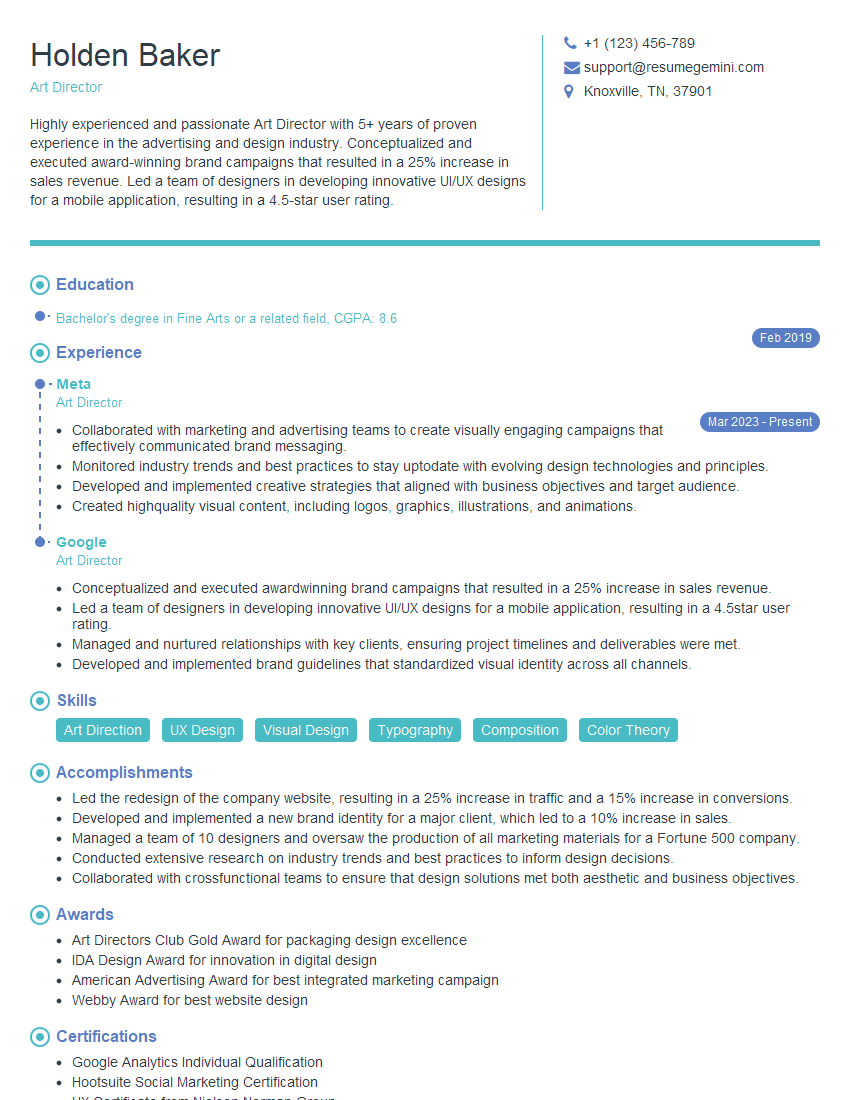
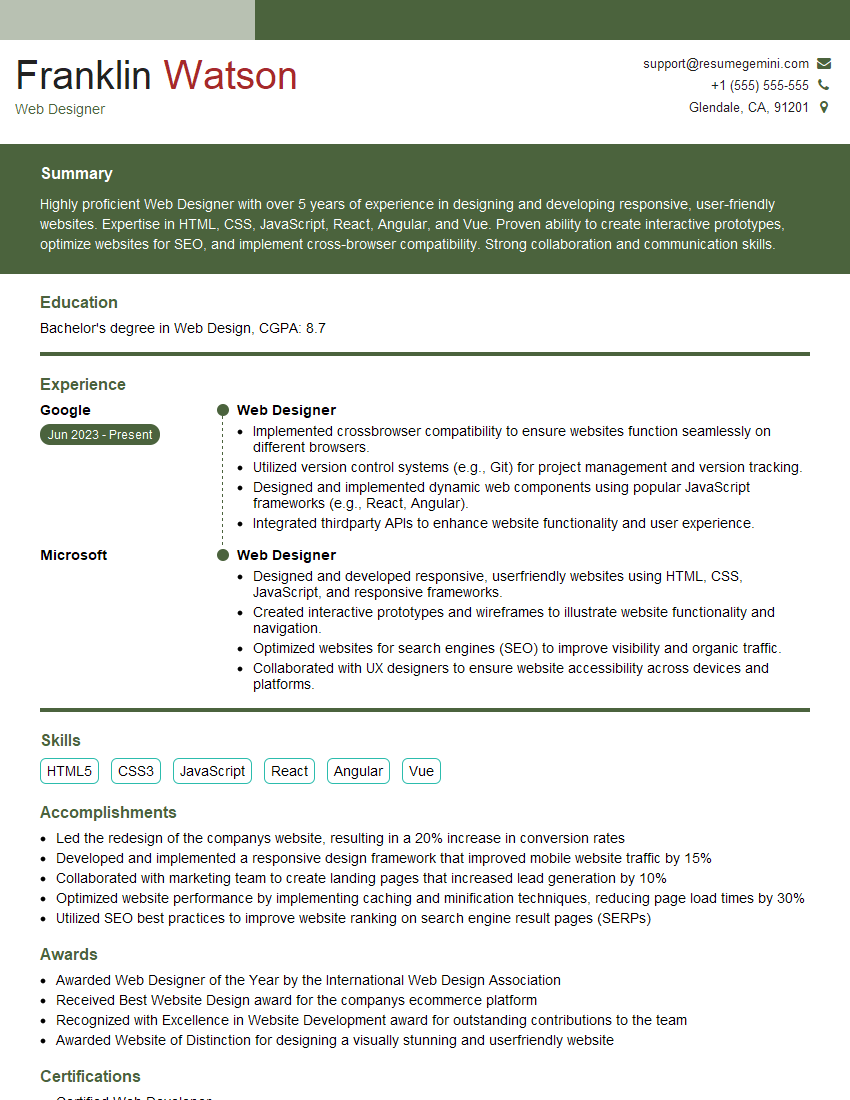
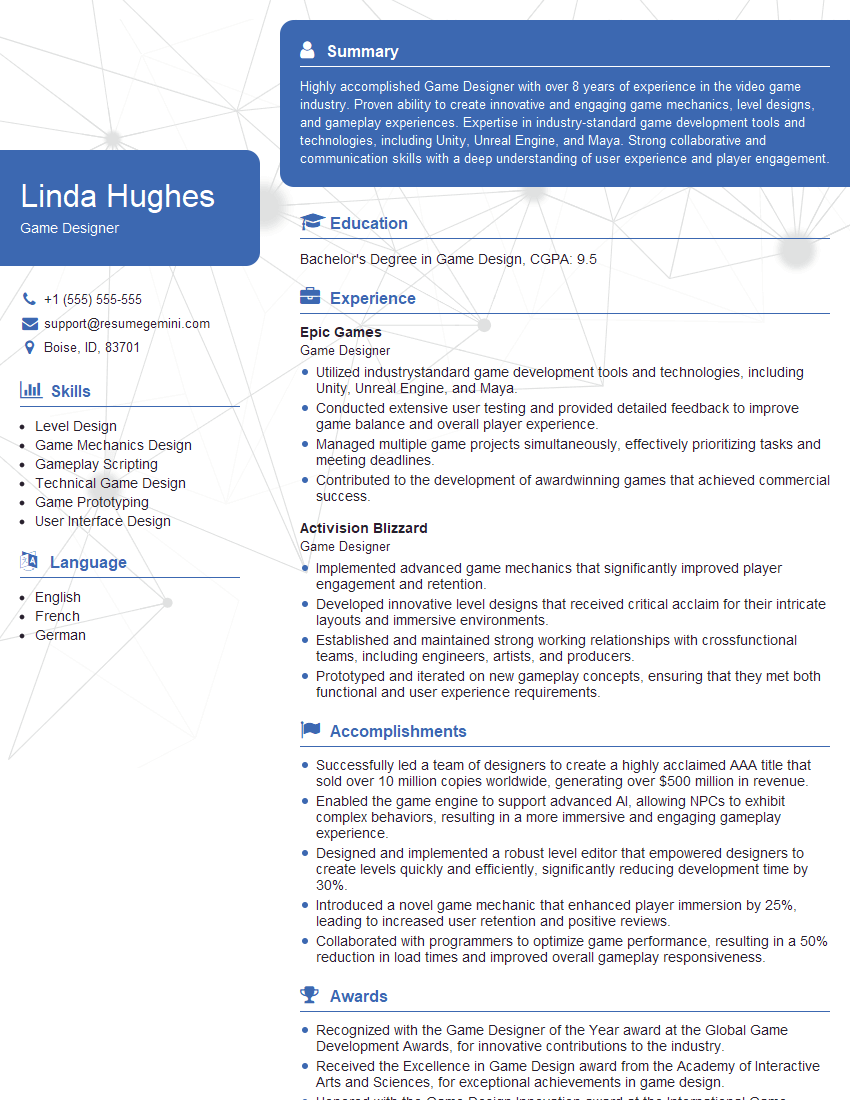
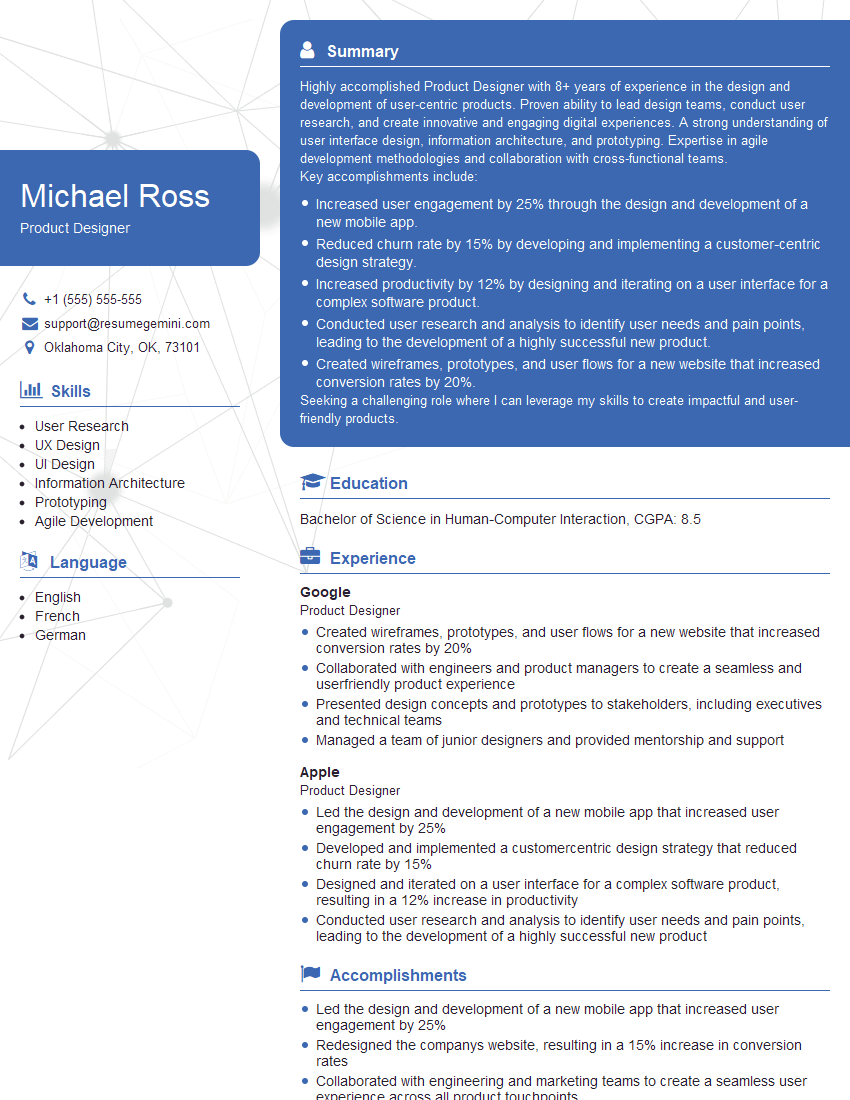
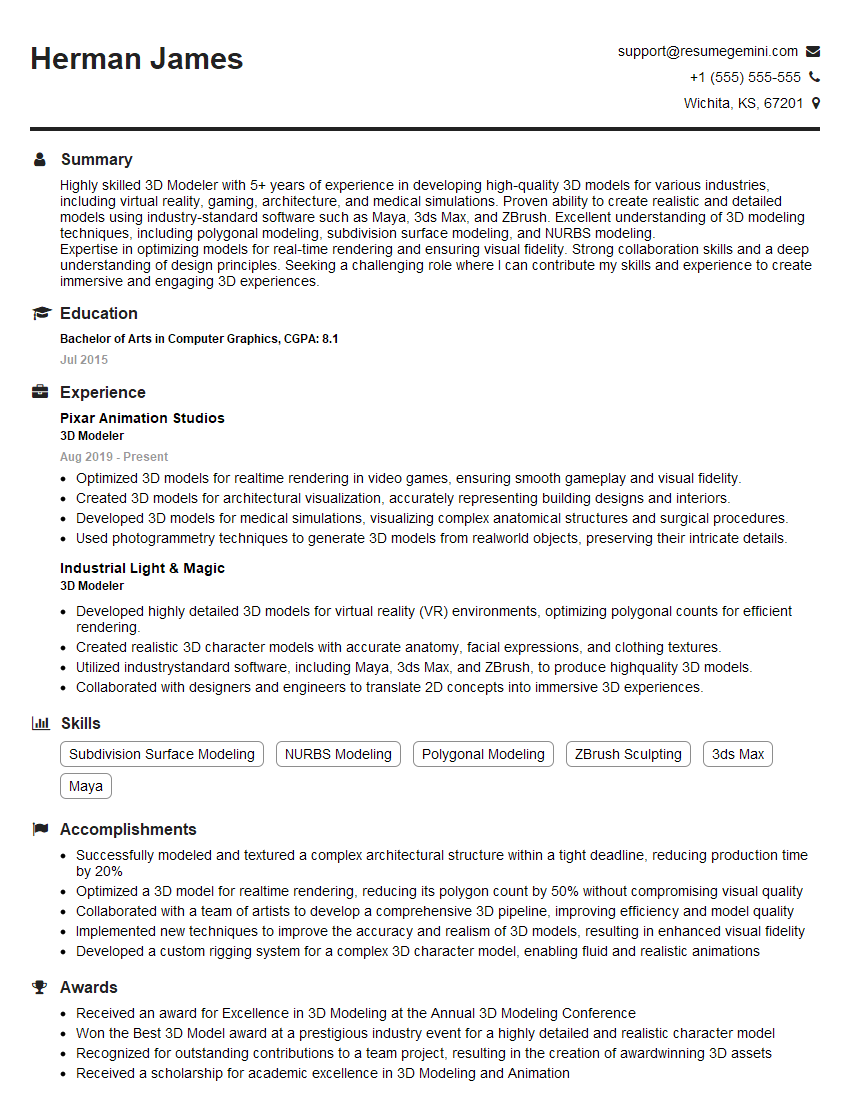
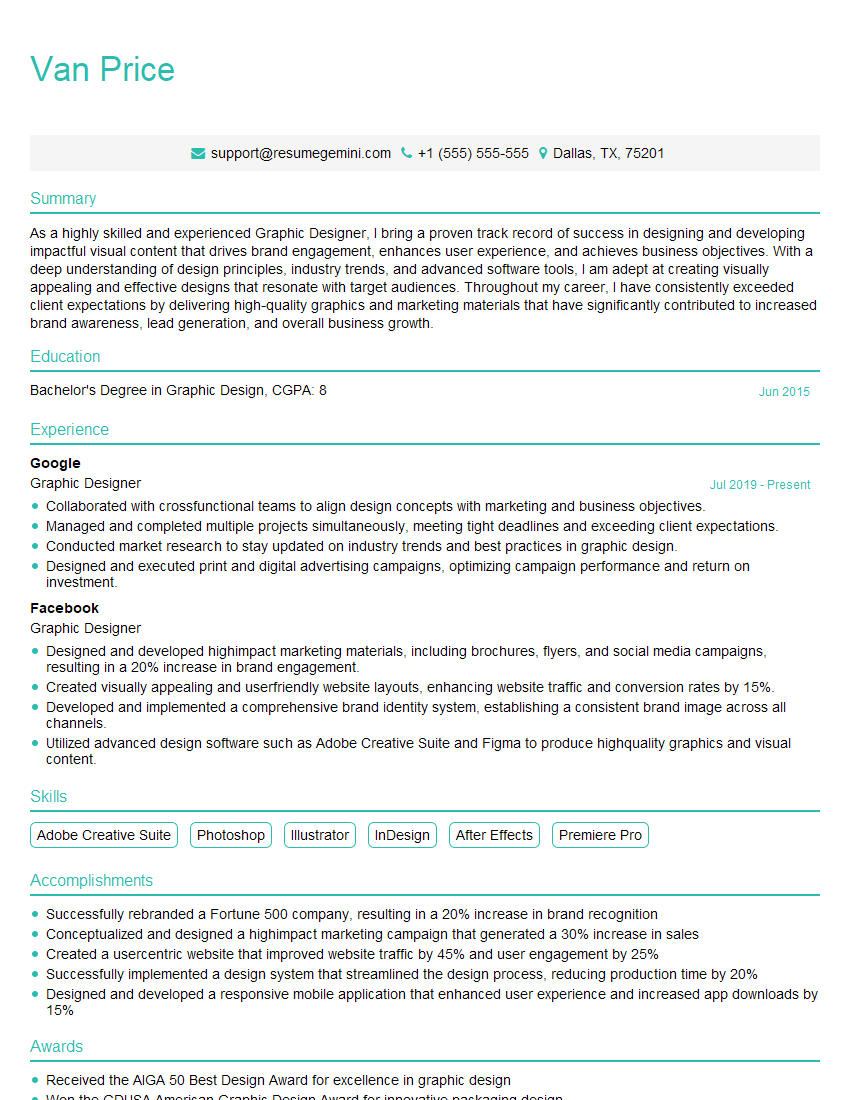
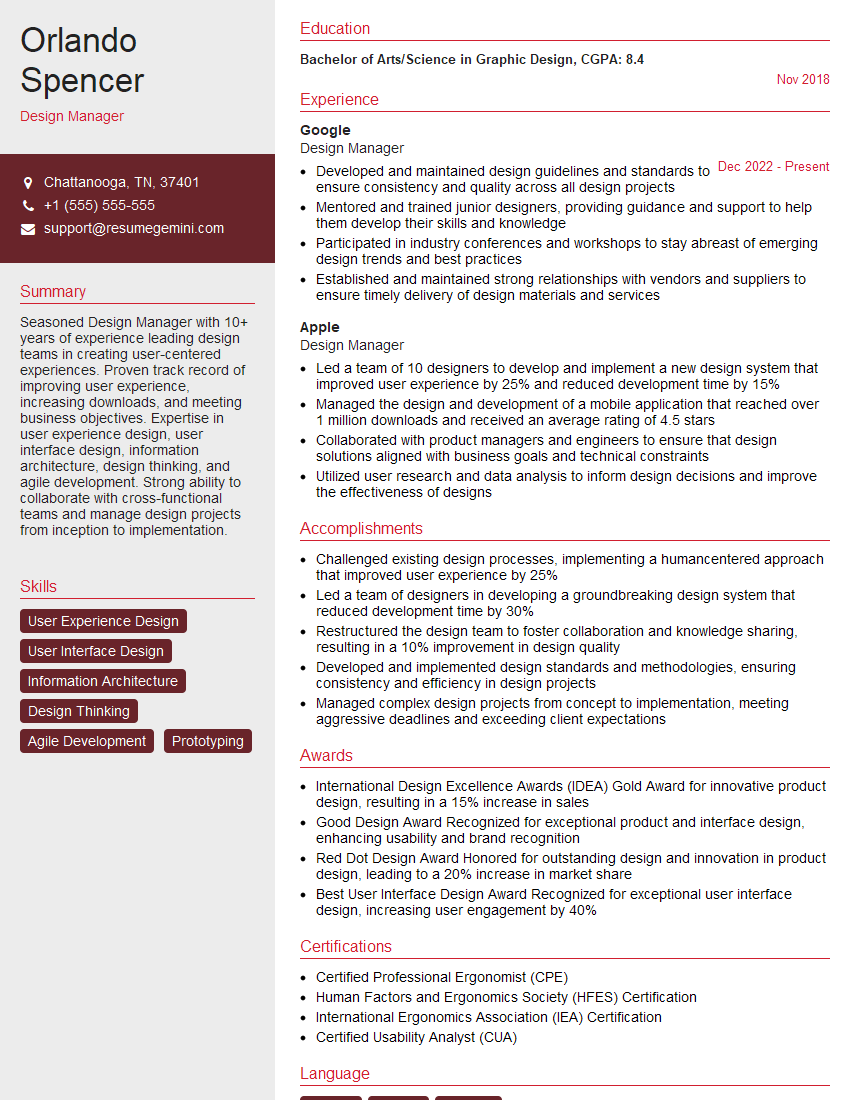
Mastering design software and techniques is crucial for career advancement in today’s competitive market. Demonstrating a strong command of these skills is essential for securing your dream design role. To significantly boost your job prospects, create an ATS-friendly resume that effectively highlights your expertise. ResumeGemini is a trusted resource that can help you build a professional and impactful resume, ensuring your skills and experience shine. Examples of resumes tailored to showcasing extensive knowledge of design software and techniques are available on ResumeGemini to help guide you.


Explore more articles
Users Rating of Our Blogs
Share Your Experience
We value your feedback! Please rate our content and share your thoughts (optional).
What Readers Say About Our Blog
Really detailed insights and content, thank you for writing this detailed article.
IT gave me an insight and words to use and be able to think of examples