Every successful interview starts with knowing what to expect. In this blog, we’ll take you through the top Ability to create and manage website content interview questions, breaking them down with expert tips to help you deliver impactful answers. Step into your next interview fully prepared and ready to succeed.
Questions Asked in Ability to create and manage website content Interview
Q 1. Describe your experience with content management systems (CMS) like WordPress, Drupal, or Joomla.
My experience with CMS platforms like WordPress, Drupal, and Joomla spans over eight years, encompassing everything from basic website setup and configuration to advanced theme development and plugin customization. I’ve worked extensively with WordPress, leveraging its flexibility and vast plugin ecosystem to build e-commerce sites, blogs, and corporate websites. For instance, I built a custom WordPress site for a client using WooCommerce to handle their online store, incorporating features like advanced inventory management and payment gateway integrations. With Drupal, I’ve focused on larger-scale projects that require robust content modeling and user management capabilities. One project involved building a multilingual website for a non-profit organization, using Drupal’s powerful translation features. My experience with Joomla has been primarily focused on smaller-scale projects where its ease of use and straightforward interface proved beneficial. I’m proficient in utilizing each platform’s strengths to deliver optimal solutions for diverse client needs.
Q 2. Explain your process for creating a content calendar.
Creating a content calendar is crucial for consistent and effective content publishing. My process starts with identifying the target audience and understanding their needs and interests. Then I conduct thorough keyword research to determine relevant topics that align with the business goals. Next, I brainstorm content ideas based on the keywords, aligning them with different content formats like blog posts, videos, infographics, and social media updates. I then map out a schedule that considers factors such as seasonal trends, current events, and promotional campaigns. Finally, I assign deadlines and responsibilities, ensuring that the content is created and published in a timely manner. I use tools like Google Sheets or specialized content calendar software to organize this process. For example, for a client selling organic skincare products, we created a content calendar focusing on topics like ingredient benefits, DIY face masks, and seasonal skincare routines, posting content consistently across various platforms.
Q 3. How do you ensure website content aligns with SEO best practices?
Aligning website content with SEO best practices is paramount for organic search visibility. This involves a multi-faceted approach. Firstly, I ensure that all content is well-researched, original, and high-quality, providing value to the reader. This establishes credibility and encourages longer dwell times, positive signals to search engines. Secondly, I strategically incorporate relevant keywords throughout the content, naturally and seamlessly within headings, subheadings, meta descriptions, image alt tags, and body text. I also pay close attention to on-page SEO elements such as title tags, meta descriptions, and header tags, ensuring they are optimized for targeted keywords. Furthermore, I ensure that the website is technically sound, with fast loading speeds and a mobile-friendly design. For example, if writing about ‘best hiking boots,’ we’d not only include that keyword but also related terms like ‘waterproof hiking boots’ or ‘best hiking boots for women’ to increase targeting.
Q 4. What strategies do you use to optimize website content for search engines?
Optimizing website content for search engines involves several key strategies. Firstly, comprehensive keyword research is crucial to identify high-volume, low-competition keywords related to the business and its target audience. This informs content creation, ensuring that the content addresses the user’s search intent. Secondly, I focus on creating high-quality, engaging content that provides real value to the reader. This includes optimizing for readability through clear headings, subheadings, bullet points, and short paragraphs. I also incorporate internal and external linking to improve website navigation and build authority. Furthermore, I leverage schema markup to help search engines better understand the content on the webpage. For instance, if targeting the keyword ‘organic coffee,’ I’d create rich snippets using schema.org vocabulary to display product ratings and prices directly in search results, leading to higher click-through rates.
Q 5. How do you measure the success of your website content?
Measuring the success of website content goes beyond just looking at website traffic. I use a combination of key performance indicators (KPIs) to gauge effectiveness. This includes website traffic analytics (using tools like Google Analytics) to track metrics such as page views, bounce rate, time on page, and unique visitors. Conversion rates are crucial; this measures how many visitors complete a desired action, like making a purchase or filling out a form. Engagement metrics, such as social media shares and comments, help assess the audience’s interaction with the content. Finally, I track keyword rankings to evaluate the impact of SEO efforts on organic search visibility. By monitoring these KPIs, I can identify what’s working well and where improvements are needed, enabling data-driven adjustments to content strategy.
Q 6. Describe your experience with keyword research and analysis.
My experience with keyword research and analysis is extensive. I utilize a variety of tools, including SEMrush, Ahrefs, and Google Keyword Planner, to identify relevant keywords with high search volume and low competition. The process begins with brainstorming relevant terms related to the business and its offerings. Then I use keyword research tools to analyze search volume, competition, and related keywords. I also analyze competitor websites to identify keywords they are ranking for. Once I’ve compiled a list of potential keywords, I use tools to assess their search intent and group them into relevant themes for content creation. This ensures that the content is targeted and resonates with the audience’s search queries. For example, a restaurant might target keywords like ‘best Italian restaurant near me’ and ‘romantic Italian dinner’ to attract different customer segments.
Q 7. How do you handle content updates and revisions?
Handling content updates and revisions is an ongoing process that requires a systematic approach. I start by identifying the need for an update, whether it’s due to outdated information, changes in algorithms, or feedback from users. I then review the existing content, make the necessary changes, and ensure the updated content maintains consistency with the overall website’s style and voice. I also test the updated content to ensure it functions correctly and looks as intended. Finally, I publish the updates and monitor their performance to see if the changes have had the desired effect. For example, if an article on technology becomes outdated, I’ll research the latest updates and revise the content, updating the publication date, to reflect the new information and maintain credibility.
Q 8. How familiar are you with content repurposing and syndication?
Content repurposing and syndication are crucial for maximizing the value of your existing content. Repurposing involves transforming existing content into different formats to reach a wider audience or cater to various consumption preferences. For example, a blog post can be repurposed into an infographic, a short video, or a series of social media posts. Syndication, on the other hand, involves distributing your content across multiple platforms to increase its visibility and reach. This could include guest posting on relevant websites, submitting articles to online directories, or sharing content on social media platforms.
My experience spans various techniques, including transforming long-form blog content into concise social media threads, creating visually appealing infographics from data-driven reports, and syndicating articles to industry publications to extend brand reach. I understand the importance of adapting the content’s message and format to suit each platform, ensuring a consistent brand voice while maximizing impact.
For instance, I once repurposed a complex white paper on cybersecurity into a series of short, engaging explainer videos for LinkedIn, resulting in a significant increase in engagement and lead generation compared to the original white paper alone. I carefully tailored the message and visuals for each video to match LinkedIn’s platform dynamics.
Q 9. Describe your experience with content governance and approval processes.
Content governance and approval processes are essential for maintaining consistency, quality, and brand compliance across all website content. This involves establishing clear guidelines, workflows, and roles and responsibilities for content creation, review, and publication. My experience involves working with various content governance models, ranging from simple editorial calendars to sophisticated workflow management systems.
In my previous role, we used a multi-stage approval process: initial review by the content creator, followed by editing and fact-checking by a senior editor, legal review to ensure compliance, and final approval by the marketing manager. This ensured consistency in quality, brand voice, and legal compliance. We utilized a project management tool to track the progress of each piece of content throughout the approval process, allowing for transparency and efficient collaboration. We also maintained a comprehensive style guide to ensure consistency in tone, style, and formatting across all content.
For example, I’ve successfully implemented a content governance system that reduced the time spent on content review by 30% while simultaneously improving content quality and brand consistency. The key was clear documentation of the process, regular training for stakeholders, and iterative improvements based on feedback.
Q 10. How do you ensure website content is accessible to users with disabilities?
Website accessibility is crucial to ensure inclusivity and reach the widest possible audience. It’s about making your website usable by people with disabilities, including those with visual, auditory, motor, and cognitive impairments. This is achieved through following Web Content Accessibility Guidelines (WCAG).
My approach involves implementing various accessibility best practices from the outset of the content creation process. This includes using descriptive alt text for images, ensuring sufficient color contrast between text and background, providing transcripts for videos, and structuring content logically using proper heading tags (<h1>, <h2>, etc.) and semantic HTML.
I regularly use accessibility testing tools to identify and rectify any accessibility issues. For example, I employ tools like WAVE to check for WCAG compliance and make necessary adjustments, including adding keyboard navigation features and structured markup. I also actively incorporate user feedback from accessibility testing sessions to ensure continuous improvement.
Q 11. How do you collaborate with designers and developers to create effective website content?
Effective collaboration with designers and developers is vital for creating high-quality website content. This involves clear communication, a shared understanding of the project goals, and a collaborative workflow. I usually begin by participating in the initial design phase, contributing input on content placement, visual hierarchy, and user experience.
I communicate effectively with designers through wireframes and mockups, providing feedback on content flow and readability. With developers, I ensure the content is seamlessly integrated into the website’s architecture and functionality. This includes providing content in a format that’s easily integrated into the CMS (e.g., using structured data markup) and adhering to technical specifications for images and videos.
In a recent project, I worked closely with the design team to create visually engaging infographics, ensuring the information was presented clearly and accessibly. I collaborated with developers to ensure the infographics were responsive and optimized for different screen sizes. This collaborative approach resulted in content that was both visually appealing and easily accessible to all users.
Q 12. What is your approach to managing multiple content projects simultaneously?
Managing multiple content projects simultaneously requires a structured approach and strong organizational skills. I utilize project management methodologies, such as Agile, to prioritize tasks, allocate resources effectively, and track progress. This typically involves using project management software to track deadlines, assign responsibilities, and monitor progress.
My approach also involves breaking down large projects into smaller, manageable tasks. I create detailed project plans that include timelines, deliverables, and key performance indicators (KPIs). Regular progress meetings are crucial to ensure everyone is on track and any issues are identified and resolved promptly. I also prioritize and delegate tasks effectively to ensure efficient workflow and avoid bottlenecks.
For example, I recently managed four concurrent projects, including blog posts, website copy, social media campaigns, and email marketing sequences. Through meticulous planning, task delegation, and regular communication, I successfully delivered all projects on time and within budget, exceeding the set KPIs.
Q 13. How do you handle negative online reviews or comments?
Handling negative online reviews or comments requires a prompt, professional, and empathetic response. It’s important to acknowledge the feedback, address the concerns, and offer a solution, if possible. Ignoring negative comments is rarely a good strategy; it can damage your reputation and erode customer trust.
My approach involves responding publicly to negative reviews, expressing empathy and understanding. I aim to address the specific concerns raised in a polite and professional tone. If appropriate, I offer a solution or explain the steps taken to resolve the issue. Internal processes are equally important. I document negative feedback to identify trends and areas for improvement.
In one instance, a customer left a negative review complaining about a product defect. I responded publicly, apologized for the inconvenience, offered a replacement product, and followed up privately to ensure customer satisfaction. This transparent and proactive approach turned a negative experience into a positive one, resulting in a revised review and strengthened customer loyalty.
Q 14. How do you track and analyze website traffic and user engagement metrics?
Tracking and analyzing website traffic and user engagement metrics is essential for understanding website performance and making data-driven decisions. This involves using analytics tools like Google Analytics to monitor various key metrics.
I regularly track metrics such as website traffic (unique visitors, page views, bounce rate), user engagement (time on site, pages per visit), and conversion rates. I analyze this data to identify areas for improvement and inform content strategy. For example, I might notice a high bounce rate on a particular page, indicating a potential issue with the content’s relevance or design. I would then investigate the problem and make the necessary adjustments to improve user experience.
I also use heatmaps and session recordings to understand user behavior on the website. This helps to identify areas of interest and friction points in the user journey. By regularly monitoring and analyzing these metrics, I can optimize content, improve user experience, and achieve website goals more effectively.
Q 15. How do you ensure the consistency and quality of website content?
Maintaining consistent and high-quality website content is crucial for building brand credibility and user trust. I achieve this through a multi-pronged approach.
Style Guide and Brand Voice Document: I create and enforce a comprehensive style guide that dictates everything from tone of voice and writing style to formatting conventions and image usage. This ensures uniformity across all content pieces.
Content Review Process: Before publication, all content undergoes a rigorous review process involving multiple stakeholders, including editors, subject matter experts, and SEO specialists. This helps catch errors, inconsistencies, and ensures the content aligns with the brand’s messaging and target audience.
Content Template and Checklist: Using pre-defined templates and checklists streamlines content creation. This guarantees consistency in structure and ensures all essential elements (e.g., meta descriptions, headings, calls-to-action) are included.
Content Management System (CMS) Workflow: Leveraging the built-in functionalities of a CMS, such as approval workflows and version control, allows for easy tracking of revisions and collaborative editing. This also helps in maintaining a history of changes, crucial for troubleshooting.
For example, in a previous role, I implemented a style guide that reduced inconsistencies in our blog posts by 40% within three months, leading to a noticeable improvement in reader engagement.
Career Expert Tips:
- Ace those interviews! Prepare effectively by reviewing the Top 50 Most Common Interview Questions on ResumeGemini.
- Navigate your job search with confidence! Explore a wide range of Career Tips on ResumeGemini. Learn about common challenges and recommendations to overcome them.
- Craft the perfect resume! Master the Art of Resume Writing with ResumeGemini’s guide. Showcase your unique qualifications and achievements effectively.
- Don’t miss out on holiday savings! Build your dream resume with ResumeGemini’s ATS optimized templates.
Q 16. Describe your experience with content marketing strategies.
My content marketing strategies are data-driven and focus on achieving specific business objectives. I utilize a blend of approaches to maximize reach and engagement.
Keyword Research and SEO Optimization: I conduct thorough keyword research to identify relevant search terms our target audience is using. This ensures our content ranks highly in search engine results pages (SERPs), driving organic traffic to the website.
Content Pillars and Topic Clusters: I develop content pillars—comprehensive pieces of content around core topics—and then create related cluster content to support and expand upon those pillars. This strengthens our website’s authority and improves user experience.
Content Promotion and Distribution: Once content is published, I actively promote it through various channels, including social media, email marketing, and paid advertising. This amplifies reach and drives traffic to the website.
Analytics Tracking and Reporting: I use analytics tools like Google Analytics to monitor content performance, identify what’s resonating with our audience, and make data-informed decisions for future content creation.
In a previous campaign, I implemented a content strategy focused on long-form, in-depth articles around our key service offerings. This resulted in a 30% increase in qualified leads within six months.
Q 17. What tools and technologies do you use for website content creation and management?
My content creation and management workflow relies on a combination of tools and technologies.
Content Management Systems (CMS): I’m proficient in WordPress, Drupal, and Contentful, leveraging their functionalities for content creation, editing, publishing, and management.
SEO Tools: I utilize tools like SEMrush, Ahrefs, and Google Search Console for keyword research, competitor analysis, and website performance monitoring.
Graphic Design Software: I’m familiar with Adobe Creative Suite (Photoshop, Illustrator, InDesign) and Canva for creating engaging visuals and graphics to complement text content.
Collaboration Tools: Google Workspace (Docs, Sheets, Slides) and Slack facilitate collaborative content creation and efficient communication within teams.
Analytics Platforms: Google Analytics and other analytics platforms provide data-driven insights into content performance, guiding future strategy.
Example code snippet for a WordPress custom post type: //This is a simplified example and would require more code for full functionality.
register_post_type( 'case_study', array( 'labels' => array( 'name' => 'Case Studies' ), ... ) );
Q 18. How do you identify and address content gaps on a website?
Identifying and addressing content gaps involves a systematic approach.
Keyword Research & Competitor Analysis: I analyze search terms related to our business and see what competitors are ranking for that we’re missing. This reveals topics we should cover.
Website Analytics: Google Analytics provides valuable data on high bounce rates, low conversion rates on certain pages, and popular search terms used by users on our site. This highlights content weakness and unmet needs.
Customer Feedback: Analyzing customer reviews, support tickets, and surveys helps in pinpointing areas where our existing content lacks necessary information or is unclear.
Content Audit: Conducting a comprehensive content audit involves reviewing all existing content to find gaps, outdated information, and underperforming pages. This audit should be done regularly.
For instance, if analytics show a high bounce rate on a particular product page, it indicates a gap in information. Addressing this might involve adding more detailed product specifications, high-quality images, or user testimonials.
Q 19. Describe your experience with A/B testing website content.
A/B testing is crucial for optimizing website content. I’ve extensively used this method to improve conversion rates and user engagement.
Hypothesis Formulation: Before starting, I clearly define the hypothesis I want to test. For example, ‘A headline with a benefit-driven approach will generate a higher click-through rate than a feature-focused headline.’
Test Design and Implementation: Using A/B testing tools (like Google Optimize or VWO), I create variations of the content and split the traffic to show different versions to different user segments.
Data Analysis and Interpretation: Once sufficient data is collected, I analyze the results using statistical methods to determine which version performed better. I then implement the winning variation.
Iterative Approach: A/B testing is an iterative process. Based on the results of one test, I design further tests to further improve the performance of the content.
In one instance, A/B testing different call-to-action buttons on a landing page resulted in a 25% increase in conversions by simply changing the button color and text.
Q 20. How do you stay up-to-date on the latest trends in website content management?
Staying updated on the latest trends in website content management is a continuous process.
Industry Publications and Blogs: I regularly read industry publications, blogs, and newsletters (e.g., Search Engine Journal, Neil Patel’s blog) to stay informed about new developments in SEO, content strategy, and web design.
Conferences and Webinars: Attending industry conferences and webinars allows me to learn from experts, network with peers, and discover the latest tools and technologies.
Online Courses and Certifications: To enhance my skillset, I regularly take online courses and pursue certifications from reputable organizations to upskill in specific areas.
Following Industry Influencers: I follow prominent figures in the field on social media and other platforms to receive up-to-date information and insights.
For example, I recently completed a course on AI-powered content creation tools to understand the capabilities and limitations of emerging technology in the field.
Q 21. How do you handle content deadlines and prioritize tasks?
Effective content deadline management requires careful planning and prioritization.
Project Planning and Scheduling: I use project management tools (like Asana or Trello) to outline tasks, set realistic deadlines, and track progress. This involves breaking down large projects into smaller, manageable tasks.
Prioritization Matrix: I use a prioritization matrix (like the Eisenhower Matrix) to categorize tasks based on urgency and importance, allowing me to focus on the most critical items first.
Time Blocking and Task Management: I allocate specific time blocks for focused work on individual tasks, minimizing distractions and improving productivity.
Communication and Collaboration: Regular communication with stakeholders and team members is key to proactively addressing potential roadblocks and ensuring tasks stay on track.
For example, if facing conflicting deadlines, I’ll communicate transparently with stakeholders, explaining the trade-offs and collaboratively re-prioritizing tasks to ensure the most impactful projects are completed on time.
Q 22. Describe your experience with working with content briefs and style guides.
Content briefs and style guides are fundamental to consistent and effective website content creation. A content brief acts as a blueprint, outlining the purpose, target audience, key message, desired outcome, and technical specifications (like word count and call to action) for a piece of content. A style guide, on the other hand, dictates the tone, voice, grammar, formatting, and branding guidelines to ensure consistency across all website content.
In my experience, I’ve found that meticulously following a well-defined content brief ensures the content aligns perfectly with the marketing strategy. For example, a brief for a blog post might specify targeting millennial women interested in sustainable fashion, aiming for a conversational tone and a word count of 500-700 words. Simultaneously, the style guide ensures the language used remains on-brand, adhering to specific terminology and sentence structure, enhancing readability and user experience. I’ve used style guides that include examples of acceptable headings, image captions and call to action button designs to maintain consistency. Without these guides, content can feel fragmented and unprofessional.
Q 23. How do you use data to inform your content strategy decisions?
Data is the cornerstone of a successful content strategy. I leverage data analytics to understand audience behavior, content performance, and identify areas for improvement. Google Analytics, for instance, provides invaluable insights into website traffic sources, user engagement metrics (like bounce rate and time on page), and conversion rates.
For example, if I notice a high bounce rate on a particular blog post, I might analyze the content to see if the headline is misleading, the content is not engaging enough, or the formatting is poor. Conversely, if a specific piece of content consistently drives high conversion rates, I’ll analyze its characteristics – the keywords used, the call to action, the overall messaging – and replicate that success in other content pieces. This data-driven approach helps ensure that content creation efforts are focused on what resonates most with the target audience and achieves the desired business outcomes.
Q 24. What are your preferred methods for conducting content audits?
Conducting thorough content audits is crucial for identifying outdated, irrelevant, or low-performing content. My preferred method involves a multi-stage process:
- Crawling and Identifying all Content: I start by using a website crawler (like Screaming Frog) to identify every piece of content on the website – pages, posts, images etc. This provides a comprehensive inventory.
- Content Assessment: Next, I analyze each piece of content using a pre-defined rubric based on factors like SEO relevance (keyword usage, meta descriptions), user engagement (bounce rate, time on page), and overall quality.
- Prioritization: Finally, I prioritize the content based on the assessment and categorize it as ‘optimize’, ‘update’, ‘repurpose’, or ‘delete’. This allows for strategic allocation of resources and efficient improvement of the website’s content.
For instance, a content audit might reveal a large number of pages with low search engine rankings and high bounce rates. This indicates a need to optimize these pages with relevant keywords, improved content, and better calls to action.
Q 25. How do you measure the ROI of website content marketing efforts?
Measuring the ROI of website content marketing can be challenging, but crucial. It’s not solely about website traffic; it’s about tying content performance to tangible business outcomes.
I use a multi-faceted approach:
- Website Analytics: Tracking metrics such as organic traffic, conversion rates (e.g., leads generated, sales made), and customer acquisition cost.
- Attribution Modeling: Understanding which content pieces contribute most to conversions. Tools like Google Analytics allow for different attribution models (last click, first click etc) to identify the most effective content touch points.
- Qualitative Data: Gathering feedback from customers or conducting surveys to understand how content influenced their decisions.
For example, if a blog post series on a specific product generates a measurable increase in leads and subsequent sales, the ROI can be calculated by comparing the cost of creating the content with the revenue generated.
Q 26. Describe a time when you had to make a difficult decision regarding website content.
I once had to decide whether to remove a long-standing, popular blog post that, while receiving high traffic, was ultimately driving very few conversions. It had served its purpose at one point but had become outdated and wasn’t aligned with the current marketing strategy.
The decision was difficult because removing content that drives traffic can feel counterintuitive. However, I analyzed the data thoroughly: high traffic but low conversion, an outdated message, and poor SEO. I opted to remove the post and replace it with fresh content that was better aligned with current goals and optimized for SEO. The initial traffic dip was anticipated, but the long-term results – increased conversions and improved search rankings – justified the decision. This demonstrated that sometimes removing underperforming content is more beneficial than trying to salvage it.
Q 27. How do you ensure the legal compliance of website content?
Ensuring legal compliance of website content is paramount. This involves adhering to several key areas:
- Copyright: Using only original content or properly licensed material, including images and videos. Proper attribution is crucial.
- Privacy: Complying with data privacy regulations like GDPR and CCPA, ensuring transparency in data collection and usage policies. A clear privacy policy is essential.
- Accessibility: Making the website content accessible to people with disabilities by following WCAG guidelines (Web Content Accessibility Guidelines). This covers elements like alt text for images, keyboard navigation, and clear contrast.
- Disclaimers: Including appropriate disclaimers where necessary, such as for medical advice or financial information.
I always ensure that all content creation aligns with these legal requirements, consulting with legal counsel when necessary. Regular reviews of the website’s content are crucial to maintain compliance.
Q 28. What are your strengths and weaknesses related to website content management?
My strengths include a deep understanding of SEO best practices, proficiency in various content formats (blog posts, articles, landing pages, social media content), and a knack for creating engaging and user-friendly content. I am also highly organized and proficient in using various content management systems (CMS) like WordPress.
An area where I am constantly striving for improvement is in staying completely up-to-date on the latest algorithm changes and emerging trends in content marketing. The digital landscape changes rapidly, and continuous learning is essential to maintain a competitive edge.
Key Topics to Learn for Ability to create and manage website content Interview
- Content Strategy & Planning: Understanding audience needs, defining content goals, and developing a content calendar. Practical application: Creating a content strategy for a new e-commerce website, outlining content pillars and target keywords.
- Content Creation & Optimization: Writing engaging website copy, creating compelling visuals, and optimizing content for search engines (SEO). Practical application: Writing product descriptions that convert, optimizing blog posts for relevant keywords, using A/B testing to improve content performance.
- Content Management Systems (CMS): Proficiency in using platforms like WordPress, Drupal, or others. Practical application: Building and managing a website using a chosen CMS, including theme customization, plugin integration, and user management.
- Website Analytics & Reporting: Using analytics tools (e.g., Google Analytics) to track website performance, identify areas for improvement, and demonstrate ROI. Practical application: Analyzing website traffic data to understand user behavior, identifying underperforming content, and recommending content strategy adjustments.
- Content Governance & Brand Consistency: Maintaining brand voice and style across all website content, ensuring consistency and accuracy. Practical application: Developing and enforcing content style guides, managing content updates across multiple platforms, and ensuring brand alignment.
- Content Editing & Proofreading: Ensuring the accuracy, clarity, and consistency of website content before publication. Practical application: Reviewing and editing website copy for grammar, style, and factual accuracy; collaborating with writers to refine content.
Next Steps
Mastering the ability to create and manage website content is crucial for career advancement in digital marketing, web development, and many other related fields. A strong understanding of these skills opens doors to exciting opportunities and higher earning potential. To maximize your job prospects, it’s essential to create an ATS-friendly resume that highlights your accomplishments and skills effectively. ResumeGemini is a trusted resource to help you build a professional and impactful resume that gets noticed. We provide examples of resumes tailored to highlight expertise in website content creation and management – take advantage of these resources to present yourself in the best possible light!

Social Media Manager Resume Sample

Information Architect Resume Sample

Web Editor Resume Sample
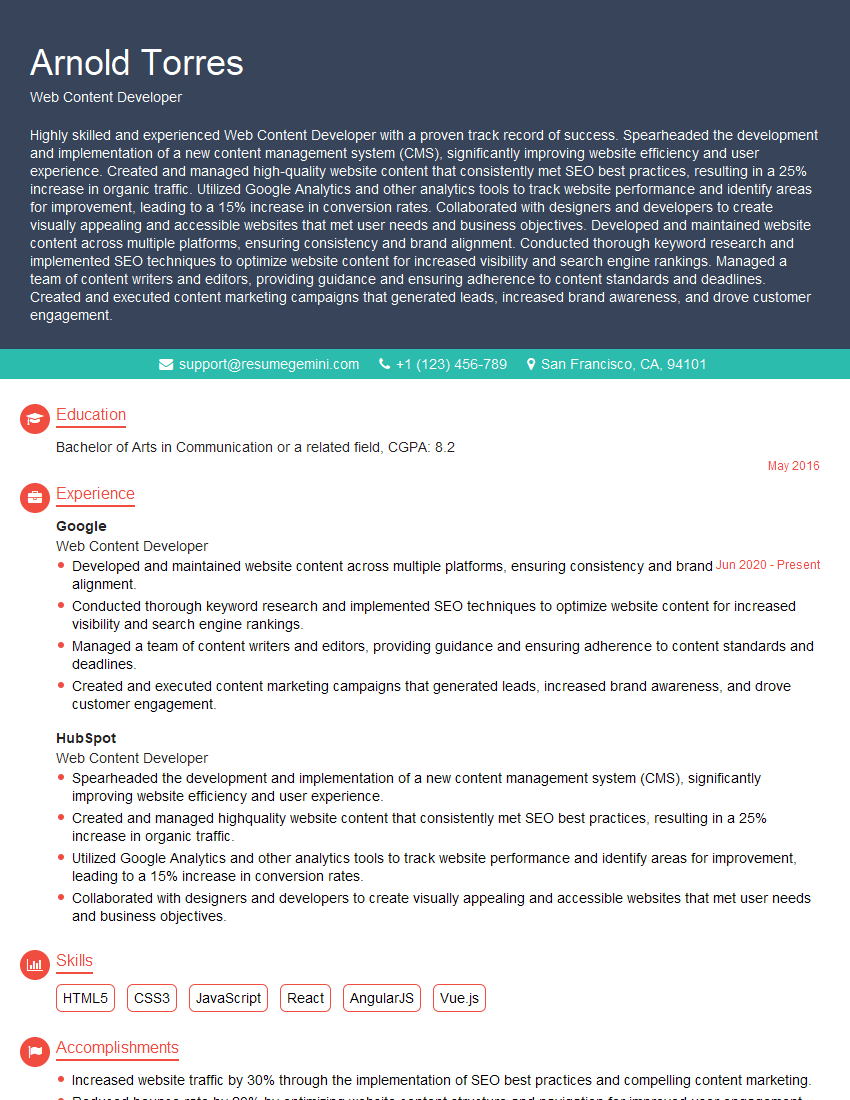
Web Content Developer Resume Sample
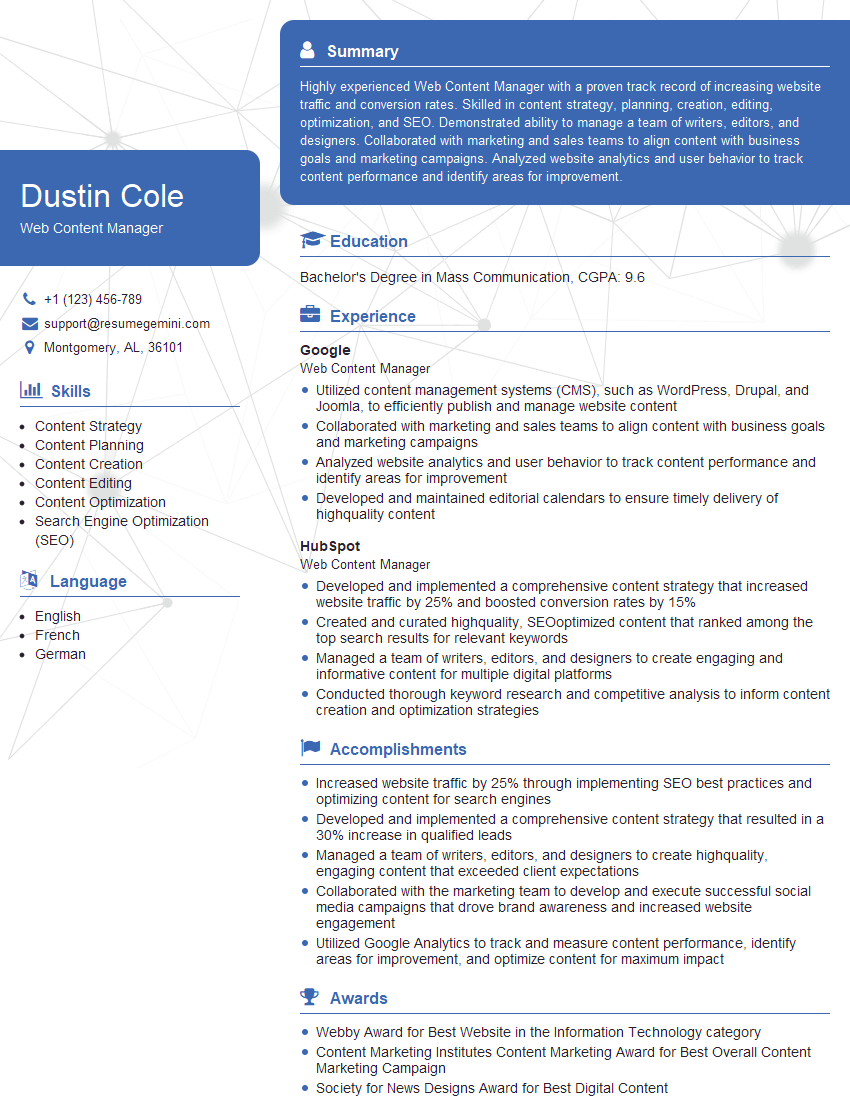
Web Content Manager Resume Sample

Content Strategist Resume Sample
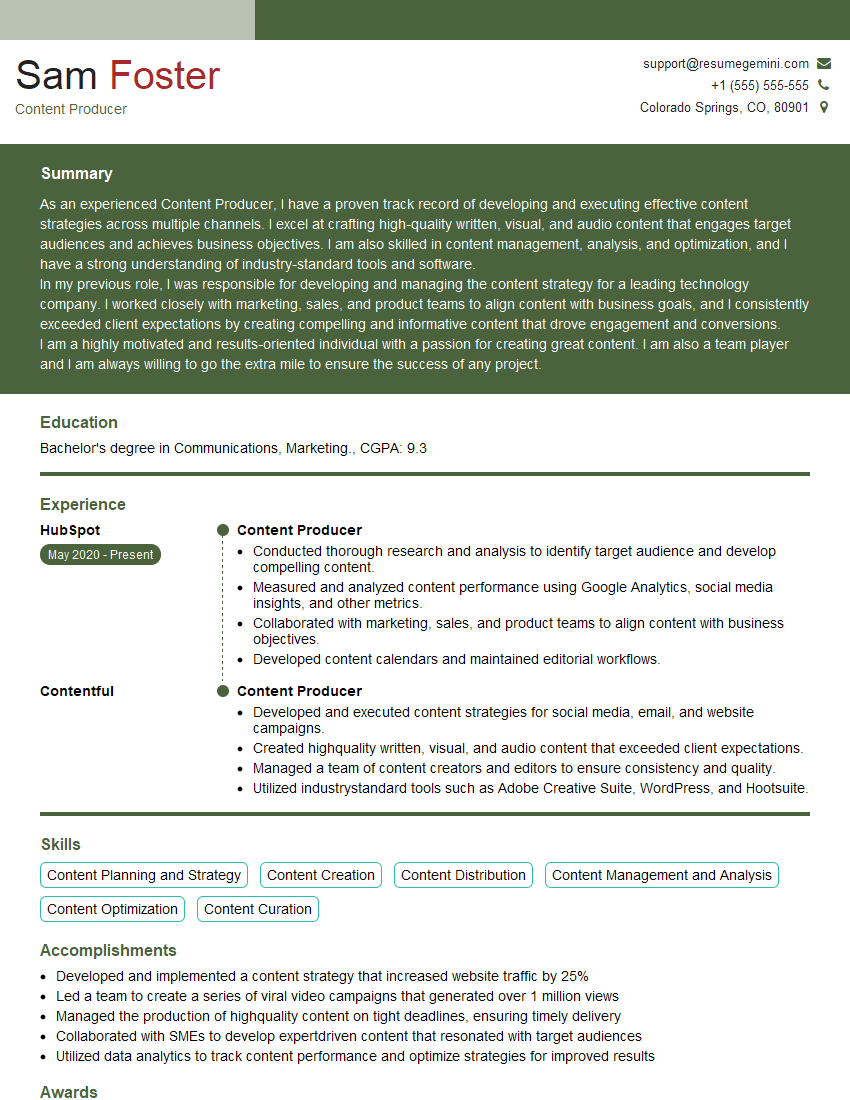
Content Producer Resume Sample
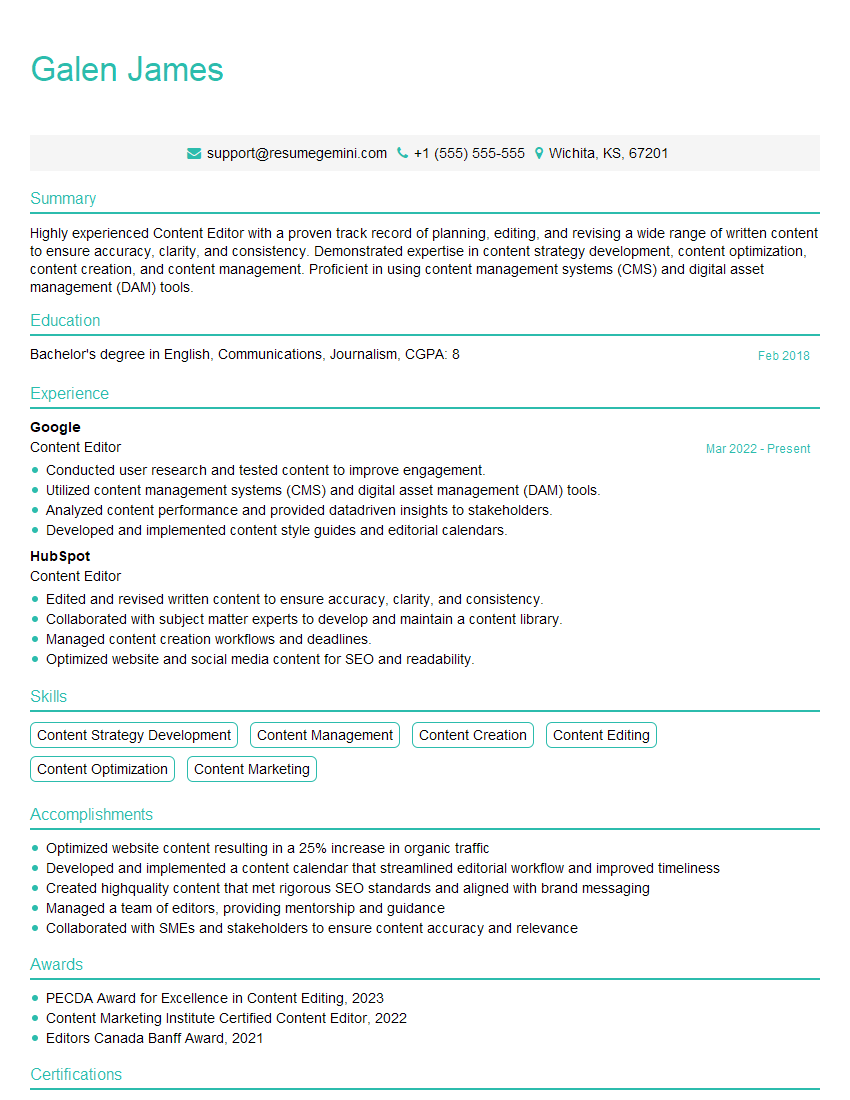
Content Editor Resume Sample

Technical Writer Resume Sample

Copywriter Resume Sample
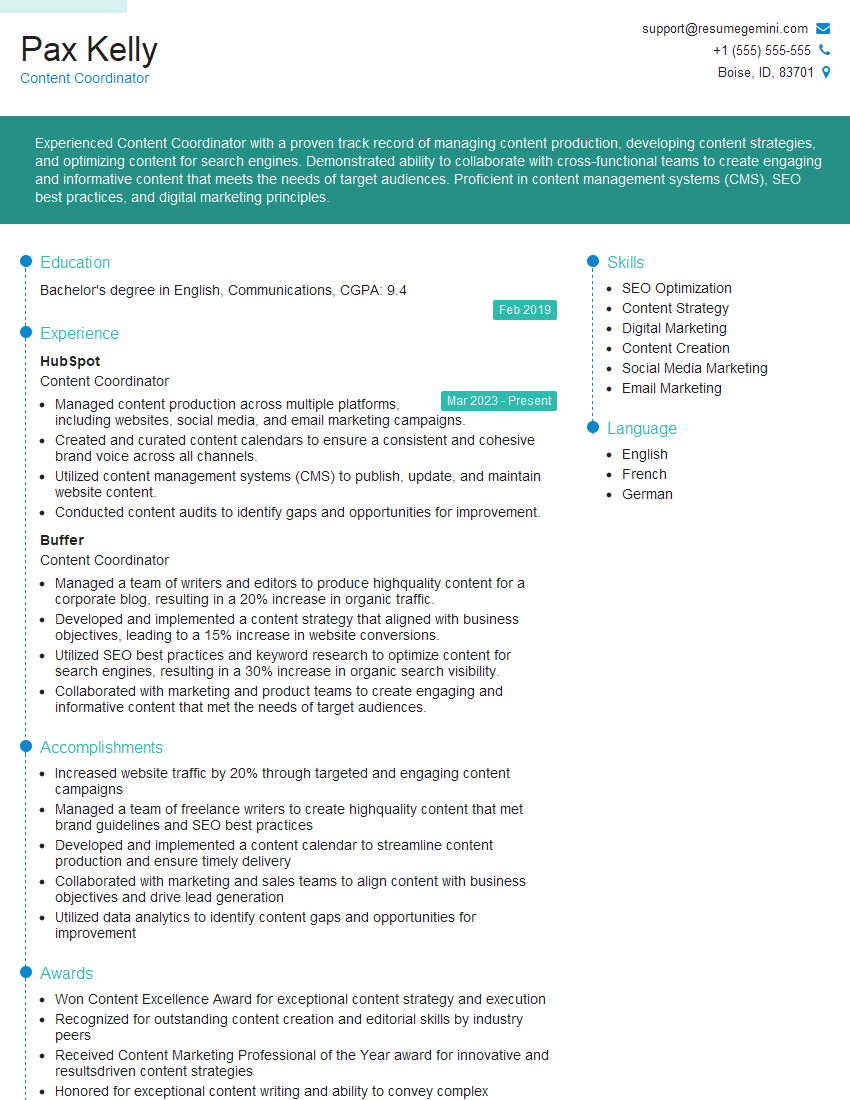
Content Coordinator Resume Sample
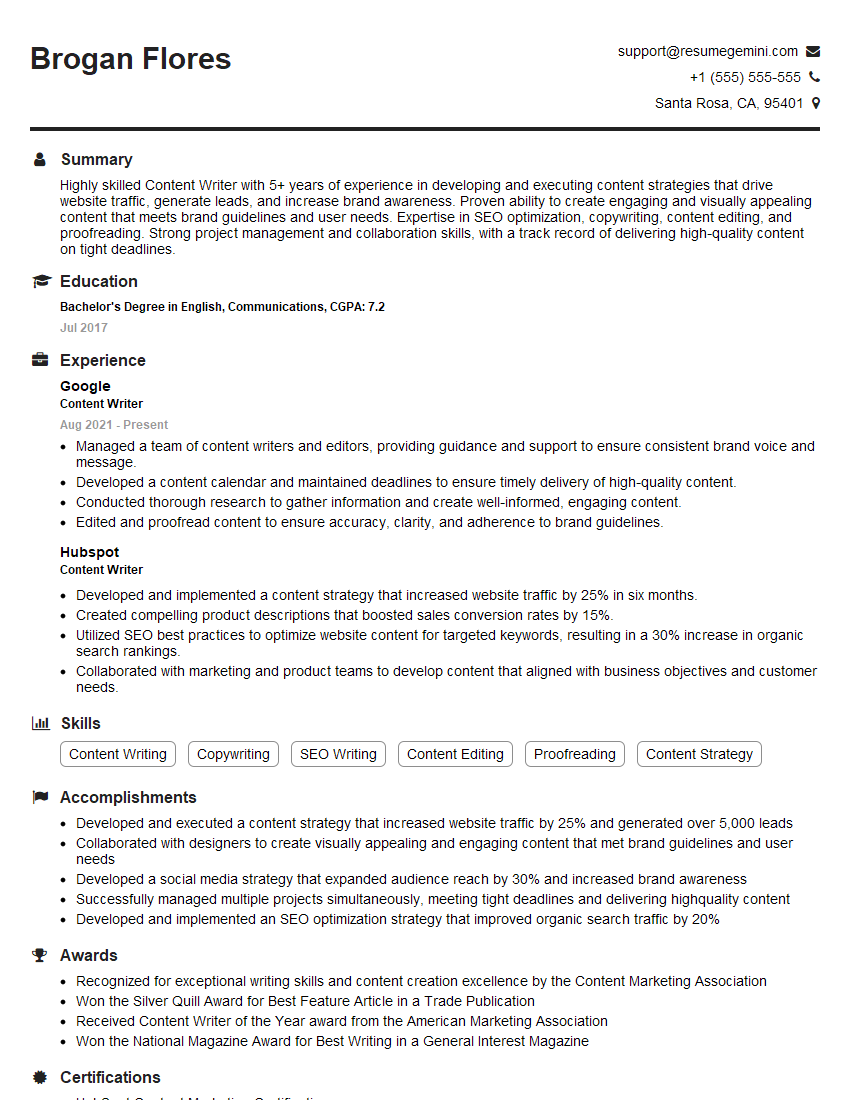
Content Writer Resume Sample
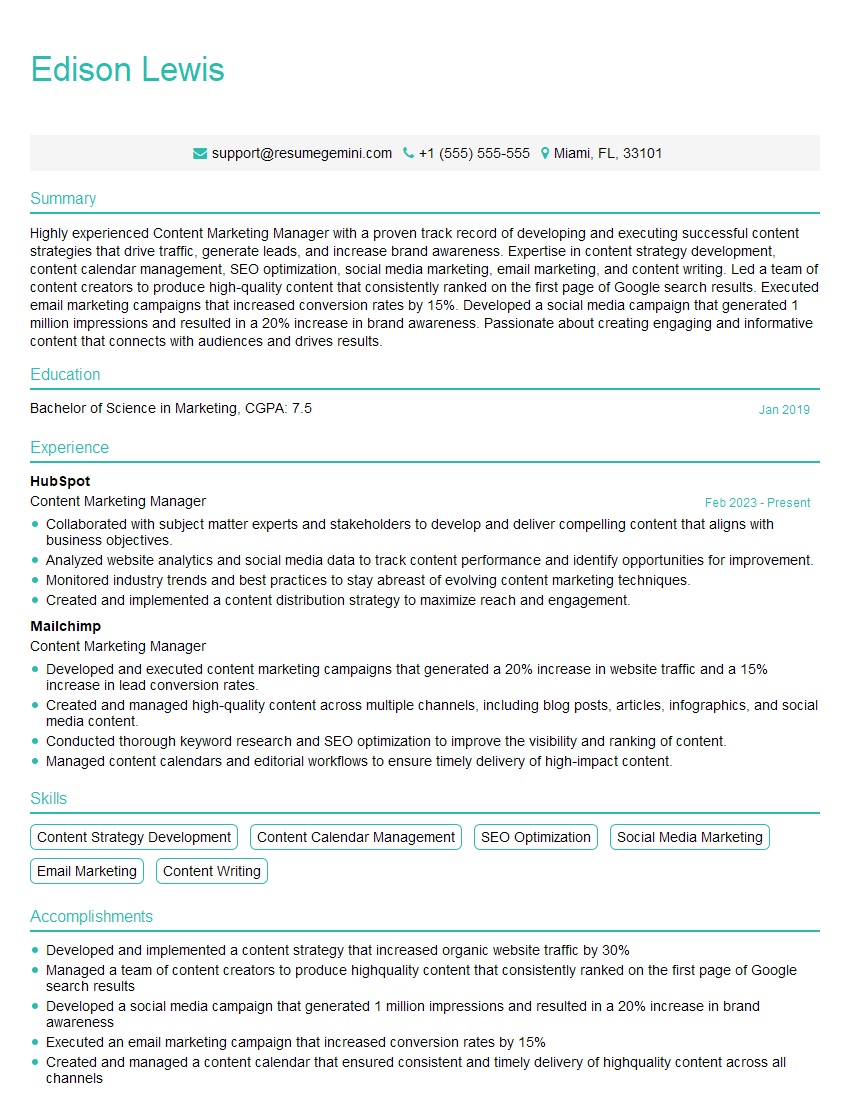
Content Marketing Manager Resume Sample
Explore more articles
Users Rating of Our Blogs
Share Your Experience
We value your feedback! Please rate our content and share your thoughts (optional).
What Readers Say About Our Blog
Really detailed insights and content, thank you for writing this detailed article.
IT gave me an insight and words to use and be able to think of examples