The right preparation can turn an interview into an opportunity to showcase your expertise. This guide to Geospatial Analysis and Mapping interview questions is your ultimate resource, providing key insights and tips to help you ace your responses and stand out as a top candidate.
Questions Asked in Geospatial Analysis and Mapping Interview
Q 1. Explain the difference between vector and raster data.
Vector and raster data are two fundamental ways to represent geographic information in GIS. Think of it like drawing a map: vector data is like using precise lines and points to draw features, while raster data is like using a grid of colored pixels to create an image.
- Vector Data: Represents geographic features as points, lines, and polygons. Each feature has precise coordinates and can store attributes (e.g., a point representing a tree might have attributes like species and height). Vector data is ideal for representing discrete features like roads, buildings, and rivers, where precise geometry is crucial. It’s also more efficient for storing data with fewer features.
- Raster Data: Represents geographic features as a grid of cells or pixels, each with a value representing a specific characteristic (e.g., elevation, temperature, land cover). Raster data is excellent for representing continuous phenomena like elevation, temperature, or satellite imagery, where variation across space is important. However, it can be less efficient for storing data with many small features.
Example: A map showing building footprints would use vector data (polygons defining the building shapes), while a satellite image showing land cover would use raster data (pixels representing different land cover types).
Q 2. Describe your experience with various GIS software (e.g., ArcGIS, QGIS).
I have extensive experience with both ArcGIS and QGIS, using them for various projects ranging from spatial analysis to cartography and data management. In ArcGIS, I’m proficient in ArcMap, ArcGIS Pro, and its various extensions like Spatial Analyst and Geostatistical Analyst. I’ve used these tools for tasks such as creating complex spatial models, performing geoprocessing operations, and producing high-quality maps. My experience with QGIS focuses on its open-source capabilities and its strengths in processing large datasets and working with various open data formats. I’ve leveraged QGIS’s plugin system to enhance its functionality and perform specialized analyses. A recent project involved using QGIS to process LiDAR data to create a digital elevation model.
I’m comfortable with both environments, choosing the best tool for the job based on factors such as project scope, data size, and licensing restrictions. I also have experience with other GIS software, like Global Mapper and GRASS GIS.
Q 3. How do you handle spatial data inconsistencies and errors?
Handling spatial data inconsistencies and errors is a critical aspect of geospatial analysis. This often involves a multi-step process:
- Data Discovery & Cleaning: Begin by thoroughly inspecting the data for inconsistencies using visual inspection and data profiling tools. This involves checking for attribute errors, topological errors (e.g., overlapping polygons), and geometric inconsistencies.
- Data Transformation and Editing: Use GIS software tools to rectify these errors. For instance, you might use tools for snapping, cleaning, and smoothing geometries to ensure data quality. Attribute errors might be fixed by using scripts or tools for data validation and standardization.
- Spatial Accuracy Assessment: Assess the accuracy and precision of your data using statistical measures and spatial comparison techniques. This could involve comparing your data to a reference dataset or using ground control points.
- Spatial Interpolation/Prediction: For missing data, apply appropriate spatial interpolation techniques like kriging or inverse distance weighting. The choice depends on the nature of the data and the research question.
- Error Propagation Assessment: Understand that errors in input data will likely propagate throughout any analysis, therefore, an assessment and discussion of potential impacts on the results are essential.
For example, I once worked on a project where street network data had gaps and inconsistencies. By using a combination of data cleaning tools, referencing high-resolution imagery, and manual editing, I was able to significantly improve the quality of the spatial data and ensure the reliability of downstream analyses.
Q 4. What are the different types of map projections and when would you use each?
Map projections are mathematical transformations that translate the three-dimensional Earth’s surface onto a two-dimensional map. No projection is perfect, as all introduce some distortion. The type of distortion depends on the projection type.
- Equidistant Projections: Preserve distance measurements from a central point or along specific lines. Useful for navigation or distance calculations.
- Conformal Projections: Preserve angles and shapes, making them suitable for navigation and applications where accurate representation of local shapes is crucial.
- Equal-Area Projections: Preserve area, crucial when working with spatial data relating to area-based calculations (e.g., population density).
- Compromise Projections: Attempt to balance distortions in different properties. Robinson projection is an example that minimizes various types of distortion.
Choosing a Projection: The best projection depends on the purpose of the map and the geographic extent of the area being mapped. For a world map showing area comparisons, an equal-area projection (like Albers Equal-Area) would be suitable. For a large-scale map focused on local area shape preservation (e.g., a city map), a conformal projection (like UTM) would be more appropriate. Smaller areas might benefit from using a simple cylindrical projection.
Q 5. Explain the concept of spatial autocorrelation.
Spatial autocorrelation describes the degree to which nearby spatial features have similar attribute values. In simpler terms, it measures the tendency of nearby locations to be more alike than locations farther apart. For example, if you were mapping house prices, you would expect nearby houses to have more similar prices than houses further apart.
Types of Spatial Autocorrelation:
- Positive Spatial Autocorrelation: Nearby locations tend to have similar values. (e.g., high house prices clustered together).
- Negative Spatial Autocorrelation: Nearby locations tend to have dissimilar values. (e.g., a pattern of alternating high and low values).
- No Spatial Autocorrelation: There’s no discernible relationship between the values of nearby locations. (e.g., completely random distribution of houses with varying prices).
Measuring Spatial Autocorrelation: Several statistical measures exist to quantify spatial autocorrelation, including Moran’s I and Geary’s C. These indices help assess the spatial patterns and inform decisions on the choice of analytical methods.
Q 6. Describe your experience with geoprocessing tools and techniques.
I possess extensive experience with various geoprocessing tools and techniques, using them to perform a wide range of tasks in different GIS software. This includes:
- Data Conversion and Formatting: Converting data between different formats (e.g., shapefiles, GeoJSON, GeoTIFF) using tools like the ArcGIS Data Management toolbox or the QGIS Processing Toolbox.
- Spatial Analysis: Performing overlay analysis, proximity analysis, network analysis, and other spatial queries.
- Raster Processing: Working with raster data, including image classification, reclassification, and raster calculations (using tools like ArcGIS Spatial Analyst or QGIS Raster Calculator).
- Vector Processing: Managing vector data, including geometry editing, dissolving, clipping, and spatial joins.
- Scripting and Automation: Automating repetitive tasks using Python scripting in ArcGIS and QGIS. This enables efficient processing of large datasets and the creation of repeatable workflows.
For example, I recently used model builder in ArcGIS Pro to automate the process of creating land suitability maps, which involved multiple geoprocessing steps, including raster calculations, overlay analysis and reclassification. This significantly reduced processing time and ensured consistency.
Q 7. How do you perform spatial analysis using overlay operations?
Overlay operations are fundamental geoprocessing tools used to combine information from multiple spatial layers. They involve integrating data from different layers to extract new information. The most common overlay operations are:
- Intersect: Creates a new layer containing only the features that overlap in the input layers. This is useful for identifying areas where multiple criteria are met (e.g., finding areas with high population density and low-income households).
- Union: Combines all features from both input layers, maintaining all geometries even those that don’t overlap. This gives a complete representation of all features across all input layers.
- Clip: Extracts a portion of one layer based on the boundaries of another layer. Useful to focus your analysis on a specific area of interest.
- Erase: Removes features from one layer that overlap with another layer. The result shows the features that do not intersect with the second layer.
Example: Imagine you have two layers: one showing land use and another showing soil type. Using an intersect operation, you could create a new layer showing the areas where, for example, forests are located on sandy soil. This type of analysis is helpful in environmental planning or resource management.
Q 8. Explain your understanding of GPS and its limitations.
GPS, or the Global Positioning System, uses a network of satellites to pinpoint a receiver’s location on Earth. It works by measuring the time it takes for signals to travel from multiple satellites to the receiver. By using triangulation based on these time differences, the receiver can calculate its latitude, longitude, and altitude.
However, GPS isn’t perfect. Its limitations include:
- Atmospheric interference: The ionosphere and troposphere can affect signal propagation, leading to inaccuracies.
- Multipath error: Signals can bounce off buildings or other objects before reaching the receiver, causing errors in distance calculation.
- Obstructions: Dense foliage, tall buildings, or even tunnels can block satellite signals, resulting in weak or no reception.
- Dilution of Precision (DOP): The geometric arrangement of satellites influences the accuracy of the position fix. Poor geometry leads to higher DOP and lower accuracy.
- Selective Availability (SA): Though currently deactivated, SA was a deliberate degradation of GPS accuracy for civilian users.
Imagine trying to find a specific tree in a dense forest using only a compass and a rough map – you’d get a general area, but pinpointing the exact location would be challenging. GPS is similar; while it’s incredibly useful, understanding its limitations is crucial for accurate and reliable results.
Q 9. What are the different types of remote sensing data and their applications?
Remote sensing data comes from sensors that collect information about the Earth’s surface without physical contact. There are two main types:
- Passive remote sensing: This type of sensing uses naturally occurring energy, primarily reflected sunlight. Examples include:
- Multispectral imagery: Captures images in multiple wavelengths, often visible and near-infrared, used for vegetation analysis, land cover classification, and mineral mapping.
- Hyperspectral imagery: Captures images in hundreds of narrow and continuous spectral bands, enabling precise material identification.
- Thermal infrared imagery: Detects heat emitted by objects, valuable for monitoring volcanic activity, urban heat islands, and precision agriculture.
- Active remote sensing: This type emits its own energy and measures the return signal. Examples include:
- LiDAR (Light Detection and Ranging): Uses lasers to measure distances, creating highly accurate 3D point clouds useful for terrain modelling, urban mapping, and forestry applications.
- Radar (Radio Detection and Ranging): Uses radio waves to penetrate clouds and vegetation, providing data regardless of weather conditions, ideal for mapping topography and monitoring land subsidence.
Applications are vast, ranging from environmental monitoring (deforestation, pollution), urban planning (infrastructure assessment), disaster response (damage assessment), and precision agriculture (crop yield prediction).
Q 10. How do you handle large geospatial datasets?
Handling large geospatial datasets requires specialized techniques. My approach involves a combination of strategies:
- Data compression: Reducing file sizes using techniques like lossless compression (GeoTIFF with LZW compression) improves storage efficiency and speeds up processing.
- Database management systems (DBMS): Utilizing spatial databases such as PostGIS (PostgreSQL extension) or Oracle Spatial allows for efficient storage, querying, and analysis of large datasets.
- Cloud computing: Platforms like AWS, Azure, or Google Cloud offer scalable storage and computing resources for processing massive datasets. I use cloud-based services for storage and processing using tools such as GeoPandas and Rasterio within cloud-based Jupyter Notebooks.
- Data tiling and partitioning: Breaking down large datasets into smaller, manageable tiles or partitions enables parallel processing and reduces memory requirements.
- Data sampling and aggregation: For specific analyses, strategically sampling or aggregating data reduces the processing load while maintaining sufficient accuracy. This approach allows for faster processing without significant loss of information by utilizing only the necessary data.
Imagine trying to manage a massive library. You wouldn’t keep all books in one pile; you’d organize them by category and use a catalog system. Similarly, managing large geospatial data necessitates structured storage and efficient querying techniques.
Q 11. Describe your experience with spatial statistics.
Spatial statistics involves analyzing spatially referenced data to understand patterns, relationships, and processes. My experience encompasses a range of techniques, including:
- Spatial autocorrelation: Assessing the degree to which nearby locations exhibit similar values (e.g., using Moran’s I or Geary’s C). This helps identify spatial clustering or dispersion.
- Point pattern analysis: Analyzing the distribution of points in space to determine if they are randomly distributed, clustered, or regularly spaced (e.g., using Ripley’s K-function). Useful for analyzing crime hotspots or disease outbreaks.
- Geostatistics: Techniques like kriging for interpolating values at unsampled locations based on spatial correlation, essential for creating continuous surfaces from point data (e.g., creating a surface of elevation from elevation points).
- Spatial regression models: Incorporating spatial effects into regression models (e.g., spatial lag or spatial error models) to account for spatial dependence among observations.
For example, I used spatial autocorrelation to analyze the spread of a particular invasive plant species in a national park, helping resource managers to target control efforts more effectively.
Q 12. How do you ensure data quality in a geospatial project?
Data quality is paramount in geospatial projects. My approach involves a multi-stage process:
- Data source evaluation: Carefully assessing the reliability, accuracy, and completeness of the data sources (e.g., verifying metadata and comparing with other sources). This involves investigating the source and understanding any inherent limitations, such as data acquisition method and limitations.
- Data cleaning and pre-processing: Identifying and correcting errors, inconsistencies, and outliers in the data. This might involve filling gaps using interpolation techniques or removing obviously erroneous data points.
- Data validation and verification: Using both automated checks (e.g., topological checks for spatial data) and visual inspections to ensure data consistency and accuracy. This can involve cross-referencing data against other sources and using techniques such as visual inspection and field verification.
- Metadata management: Maintaining detailed documentation of the data’s origin, processing steps, and limitations. This ensures traceability and enables others to understand and use the data effectively.
- Quality control checks throughout the workflow: Implementing regular checks at each stage of the project to identify and address potential quality issues early on. This proactive approach minimizes the risk of significant errors or inaccuracies later in the process.
Think of building a house; you wouldn’t start constructing without ensuring the foundation is solid. Similarly, a geospatial project’s success depends on robust data quality control measures throughout the project lifecycle.
Q 13. Explain your experience with data visualization and cartography.
Data visualization and cartography are crucial for communicating geospatial information effectively. My experience includes creating various map types using GIS software such as ArcGIS and QGIS:
- Thematic maps: Using choropleth maps, graduated symbol maps, and dot density maps to display spatial patterns and relationships (e.g., population density, disease prevalence).
- Isomap: Creating contour lines to represent continuous surfaces (e.g., elevation, temperature).
- Cartographic design principles: Applying principles of map design, including appropriate symbology, color schemes, labeling, and layout, to create clear and visually appealing maps.
- Interactive maps and web mapping: Utilizing web mapping frameworks (e.g., Leaflet, OpenLayers) to create dynamic and interactive maps for online dissemination.
For a recent project, I created an interactive web map displaying real-time air quality data, allowing users to explore pollution levels across a city and identify areas requiring attention. Effective communication through visualization is just as important as the accuracy of the analysis.
Q 14. Describe a project where you used spatial analysis to solve a problem.
In a project for a city planning department, I used spatial analysis to optimize the location of new public parks. The challenge was to find locations that maximized accessibility for residents while minimizing environmental impact.
My approach involved:
- Accessibility analysis: Using network analysis to calculate travel times from residential areas to potential park sites. This involved integrating road networks, public transportation data and walkability considerations.
- Environmental sensitivity mapping: Integrating various environmental datasets such as protected areas, wetlands, and steep slopes to identify environmentally sensitive areas that should be avoided.
- Overlay analysis: Combining accessibility and environmental sensitivity maps using spatial overlay operations (e.g., weighted overlay) to identify optimal locations that balanced accessibility and environmental protection.
- Spatial optimization: Employing spatial optimization techniques to select the best locations for new parks given a budget constraint and prioritized areas of need. This ensured that the selected locations maximized overall benefit for residents while adhering to environmental considerations.
The result was a prioritized list of locations for new parks that were both accessible and environmentally sustainable, leading to improved community well-being and environmental protection. The project successfully used geospatial analysis to support decision-making and contribute to the city’s sustainability goals.
Q 15. What are the ethical considerations in handling geospatial data?
Ethical considerations in geospatial data handling are paramount. We’re dealing with information that often represents real-world locations and potentially sensitive attributes about people, places, and things. Neglecting ethical practices can lead to serious consequences, from privacy violations to misrepresentation and unfair outcomes.
- Privacy: Anonymizing data is crucial. Direct identifiers like names and addresses should be removed or replaced with pseudonyms wherever possible. Even seemingly innocuous data aggregations can reveal individual identities through linkage attacks. For example, combining publicly available data on property ownership with crime statistics could potentially identify specific individuals involved in a crime if not carefully anonymized.
- Accuracy and Bias: Geospatial data is never perfectly accurate, and biases can creep in during data collection, processing, and analysis. It’s crucial to be transparent about data limitations and potential biases and to actively mitigate them. For instance, using outdated maps for planning infrastructure projects can lead to costly errors and environmental damage.
- Data Security: Protecting geospatial data from unauthorized access and misuse is critical. Implementing robust security measures, such as encryption and access controls, is essential, especially when dealing with sensitive information like national security or healthcare data. A data breach of sensitive location data could have severe repercussions.
- Transparency and Accountability: Openness about data sources, methodology, and limitations builds trust and allows for scrutiny. This includes clearly stating any assumptions made during analysis and acknowledging potential errors. For instance, a study of environmental pollution using geospatial data should clearly state the limitations of the data’s spatial resolution.
- Social Equity and Justice: Geospatial analysis should not perpetuate or exacerbate existing social inequalities. Careful consideration should be given to how the results of analysis are used and their potential impacts on different communities. For example, redlining historical patterns can inadvertently perpetuate bias if not accounted for in the context of location-based services.
Career Expert Tips:
- Ace those interviews! Prepare effectively by reviewing the Top 50 Most Common Interview Questions on ResumeGemini.
- Navigate your job search with confidence! Explore a wide range of Career Tips on ResumeGemini. Learn about common challenges and recommendations to overcome them.
- Craft the perfect resume! Master the Art of Resume Writing with ResumeGemini’s guide. Showcase your unique qualifications and achievements effectively.
- Don’t miss out on holiday savings! Build your dream resume with ResumeGemini’s ATS optimized templates.
Q 16. Explain your understanding of coordinate systems and datum transformations.
Coordinate systems define how we represent locations on the Earth’s surface, while datums are reference surfaces used to define those coordinates. Think of it like this: the coordinate system is the grid, and the datum is the foundation upon which that grid is built. Different coordinate systems (e.g., UTM, geographic) have different properties and uses. Geographic coordinate systems use latitude and longitude, while projected coordinate systems transform those coordinates onto a flat surface. This transformation inevitably introduces distortions.
Datum transformations are crucial because different datums have slightly different representations of the Earth’s shape and size. Data collected using one datum needs to be transformed to another datum for consistency and accurate analysis. This is often done using well-established algorithms and tools like PROJ or GDAL. For instance, a GPS device might use WGS84 datum, while a national map might use a different datum like NAD83. Failure to transform between datums would lead to positional errors and inaccurate spatial analyses.
For example, if you’re overlaying data from different sources on a map, ensuring they all use the same coordinate system and datum is essential to avoid misalignments. This becomes particularly important in large-scale projects where even small errors can significantly impact the results.
Q 17. How do you manage and organize geospatial data?
Managing and organizing geospatial data requires a systematic approach. Effective management involves careful planning, selection of appropriate file formats, and use of robust databases. I typically follow these steps:
- Metadata Management: Comprehensive metadata (data about the data) is crucial. This includes details like data source, projection, coordinate system, accuracy, and any limitations. I use standardized metadata schemas whenever possible (e.g., ISO 19115).
- File Naming Conventions: Consistent file naming conventions are critical for ease of organization and retrieval. This might involve using a specific date format, project identifier, and a descriptive file name. For example:
Project_A_20240308_Elevation.tif. - Data Storage: Appropriate storage solutions are essential, depending on the data volume and type. Cloud storage (like AWS S3 or Google Cloud Storage) can be excellent for large datasets. Local storage, organized by project folders, is useful for smaller projects. Version control is also crucial for tracking changes and ensuring data integrity.
- Database Management Systems (DBMS): For large and complex projects, a spatial DBMS like PostGIS (PostgreSQL extension) is invaluable. It offers spatial indexing and querying capabilities, making data management and analysis significantly more efficient. I employ SQL queries to retrieve and manipulate spatial data.
- Geospatial Data Formats: I utilize appropriate geospatial data formats like Shapefiles (.shp), GeoTIFF (.tif), GeoJSON (.geojson), and others based on the needs of the project. Understanding the strengths and limitations of each format is key.
Q 18. Describe your experience with different spatial indexing methods.
Spatial indexing methods are critical for efficient spatial queries in large datasets. Without them, searching for features within a specific area could be incredibly slow. I have experience with several methods:
- R-trees: A classic method that organizes spatial data into a tree-like structure. Each node represents a bounding box, and leaf nodes contain actual spatial objects. R-trees are widely used due to their balance between query performance and storage efficiency.
- Quadtrees: These divide the spatial space recursively into quadrants. They are particularly efficient for regularly spaced data or when dealing with point data. Quadtrees offer fast search times for spatial queries.
- Grid Index: This approach divides the spatial extent into a grid of cells. Spatial objects are assigned to the cells they intersect. It’s computationally simple and efficient for point data and regular grids. However, it may not perform as well as other methods for complex geometries or irregularly distributed data.
- RTree Extensions: PostGIS, for example, uses R-tree extensions to optimize spatial queries. Understanding the parameters and tuning options within these extensions is vital for achieving optimal query performance.
Choosing the right spatial indexing method depends on the type and distribution of the data and the types of queries typically performed. For instance, for real-time applications involving many point queries, a quadtree or grid index might be preferable, while for complex polygonal data, an R-tree is often better suited. I usually conduct benchmarks to assess the effectiveness of each method in the context of a particular dataset and application.
Q 19. What is your experience with spatial databases (e.g., PostGIS)?
I have extensive experience working with PostGIS, a powerful spatial extension for PostgreSQL. It provides a comprehensive set of functions and operators for managing and querying spatial data, integrating seamlessly with other GIS tools. PostGIS allows for:
- Storage of various spatial data types: Points, lines, polygons, and multi-part geometries are efficiently stored and managed.
- Spatial indexing: As mentioned before, using R-trees for efficient spatial queries.
- Spatial analysis functions: PostGIS offers a vast array of functions for spatial operations like intersection, union, distance calculations, and buffer generation. For example, calculating the distance between points, finding features within a specific buffer zone, or performing overlay analyses are easily performed using PostGIS’s spatial functions.
- Integration with other tools: PostGIS works well with QGIS, ArcGIS, and other GIS software, enabling seamless data exchange and workflow integration.
I routinely use SQL queries within PostGIS to perform complex spatial analyses, such as identifying overlapping areas, calculating distances between geographic features, and performing network analysis. A common example would be identifying all buildings within a 1-kilometer radius of a proposed new school, a crucial task in urban planning. This type of query is easily expressed and efficiently executed using PostGIS.
Q 20. How do you perform spatial interpolation?
Spatial interpolation estimates values at unsampled locations based on known values at sampled locations. It’s essential in many applications, from creating elevation models from point measurements to predicting pollution levels across an area.
Several methods are available, each with its strengths and weaknesses:
- Inverse Distance Weighting (IDW): This method assigns weights inversely proportional to the distance from the known points. Points closer to the interpolation location get higher weights. It’s simple to implement and understand but can be sensitive to outlier data points.
- Kriging: A geostatistical method that considers spatial autocorrelation to make more accurate predictions. It requires estimating parameters like the semivariogram to capture the spatial dependence in the data. Kriging provides more sophisticated interpolation but requires more in-depth knowledge and parameter tuning.
- Spline Interpolation: Creates a smooth surface that passes through or near the known points. Different types of splines (e.g., thin-plate splines) offer various degrees of smoothness and flexibility. Spline interpolation is generally good for creating visually pleasing surfaces but may not accurately represent the underlying process.
The choice of method depends on the characteristics of the data, desired smoothness, and computational resources. For example, IDW is computationally less intensive than Kriging but may produce less accurate results for datasets with complex spatial patterns. I usually assess the suitability of different methods by experimenting with them and visually inspecting the results.
Q 21. What is your experience with 3D GIS?
3D GIS extends traditional GIS capabilities to the third dimension, allowing for the analysis and visualization of three-dimensional spatial data. My experience with 3D GIS includes working with:
- 3D Point Clouds: Processing and analyzing point cloud data from LiDAR or other sources. This involves techniques like classification, filtering, and visualization of terrain, buildings, and other features in 3D.
- 3D Building Models: Working with 3D building models (often in formats like CityGML) for urban planning, simulation, and visualization. This often involves manipulating and analyzing model attributes alongside spatial location to gain insights into building heights, volumes, and spatial relationships.
- Terrain Modeling: Creating and analyzing 3D terrain models using digital elevation models (DEMs). This facilitates applications like flood modeling, slope analysis, and visualization of topography.
- 3D Visualization and Analysis Software: Proficiency in using specialized 3D GIS software such as ArcGIS Pro, QGIS, and specialized point cloud processing software. This allows for interactive exploration, analysis, and communication of 3D spatial information.
A recent project involved using LiDAR data to create a highly accurate 3D model of a city for urban planning purposes. This enabled the city council to better understand building heights, tree canopy coverage, and identify potential flood risks, allowing for better-informed decision-making.
Q 22. Explain your understanding of network analysis.
Network analysis in geospatial analysis involves studying the connectivity and relationships between different geographic features. Think of it like mapping roads and figuring out the fastest route, or analyzing social networks and identifying key influencers based on their geographic proximity. It goes beyond simple distance calculations; it considers factors like travel time, impedance (resistance to movement), and network topology (the structure of the network itself).
For example, we might use network analysis to model emergency response times by calculating the shortest paths from fire stations to potential emergency locations, considering road speeds and traffic patterns. Or, in a transportation network, we could identify critical links whose failure would significantly disrupt the system. The key is understanding how the structure of the network affects movement and flow.
Common network analysis techniques include shortest path algorithms (like Dijkstra’s algorithm), finding connected components, identifying central nodes (those with the most connections), and calculating network flows. These techniques are implemented in GIS software and programming languages.
Q 23. Describe your experience with geospatial web services (e.g., WMS, WFS).
I have extensive experience working with geospatial web services, specifically WMS (Web Map Service) and WFS (Web Feature Service). WMS allows me to access and display map images from remote servers, essentially acting as a ‘map viewer’ on the internet. This is crucial for accessing base maps, thematic layers (like soil types or population density), and integrating data from various sources without needing to download massive datasets. I’ve used WMS extensively to incorporate background imagery from sources like OpenStreetMap or government agencies into my projects.
WFS is more powerful; it allows me to download and manipulate the actual vector data (points, lines, polygons) from a server. This is essential when needing to perform analyses or integrate data directly into my workflow. For instance, I’ve used WFS to acquire detailed building footprints from a city’s open data portal and then used that data to analyze urban growth patterns. I’m proficient in configuring and working with these services in various GIS software platforms and programming languages.
Q 24. How familiar are you with cloud-based GIS platforms (e.g., ArcGIS Online, Google Earth Engine)?
I’m highly familiar with cloud-based GIS platforms, having worked extensively with both ArcGIS Online and Google Earth Engine. ArcGIS Online provides a user-friendly interface for map creation, sharing, and collaboration, ideal for projects requiring accessible data visualizations and web map applications. I’ve leveraged its capabilities for tasks ranging from creating interactive maps for public engagement to managing and analyzing spatial data within a team environment.
Google Earth Engine, on the other hand, is a powerful platform for big data geospatial analysis. Its immense computing resources and vast collection of satellite imagery make it perfect for large-scale analyses involving time-series data. For example, I’ve used it to monitor deforestation patterns over several decades by processing vast quantities of Landsat imagery, something practically impossible with traditional desktop GIS software. I understand the strengths and limitations of each platform and choose them strategically based on project requirements.
Q 25. Explain your experience with Python libraries for geospatial analysis (e.g., GeoPandas, Rasterio).
My Python skills for geospatial analysis are a core strength. I use GeoPandas for efficient handling and manipulation of vector data – think working with shapefiles, GeoJSON, etc. For example, I’ve used GeoPandas to perform spatial joins, calculate area statistics for polygons, and perform buffer analysis with ease. GeoPandas makes complex spatial operations manageable and automatable.
I’m equally proficient with Rasterio, which is vital for working with raster data such as satellite imagery and elevation models. I’ve used Rasterio to read, write, and process various raster formats, perform calculations like NDVI (Normalized Difference Vegetation Index) analysis for vegetation health monitoring, and create raster mosaics. In combination with other libraries like NumPy, I can perform complex image processing and analysis tasks efficiently.
# Example GeoPandas code snippet: import geopandas as gpd gdf = gpd.read_file('shapefile.shp') gdf['area'] = gdf.geometry.area print(gdf)
Q 26. How do you approach a new geospatial project?
My approach to a new geospatial project follows a structured process:
- Project Definition: Clearly define project goals, deliverables, and timelines. Understand the client’s needs and the problem we’re trying to solve.
- Data Acquisition and Assessment: Identify necessary data sources, assess their quality and suitability, and implement appropriate data acquisition strategies. This might involve using web services, downloading datasets, or collecting field data.
- Data Preprocessing: Clean, transform, and prepare the data for analysis. This often involves handling missing values, projecting data into a consistent coordinate system, and ensuring data consistency and accuracy.
- Spatial Analysis: Select and apply the appropriate spatial analysis techniques based on the project goals. This could range from simple queries to complex modelling.
- Visualization and Communication: Create effective maps, charts, and reports to communicate results clearly and concisely to both technical and non-technical audiences. This might involve using GIS software or creating interactive web maps.
- Project Documentation and Delivery: Maintain thorough documentation throughout the project and deliver a final report that outlines the methodology, findings, and conclusions.
This iterative process ensures a high-quality deliverable that meets client requirements.
Q 27. What are your strengths and weaknesses as a geospatial analyst?
Strengths: My strengths lie in my analytical skills, particularly my ability to translate complex spatial problems into effective solutions. I’m proficient in multiple GIS software packages and programming languages, and I have a strong understanding of geospatial data structures and analysis techniques. My experience with large datasets and cloud-based platforms allows me to tackle challenging projects efficiently. I’m also a strong communicator, adept at explaining complex concepts to non-technical audiences.
Weaknesses: While I have a broad skill set, I am always striving to deepen my expertise in specific niche areas of geospatial analysis like advanced 3D modelling or machine learning applications within GIS. I also aim to further refine my project management skills, focusing on even more efficient workflow optimization in complex, multi-faceted projects. I actively seek opportunities to expand my knowledge and overcome these areas of growth.
Key Topics to Learn for Your Geospatial Analysis and Mapping Interview
- Geographic Information Systems (GIS): Understand the fundamental concepts of GIS software, data structures (vector, raster), and spatial data models. Be prepared to discuss your experience with common GIS software packages like ArcGIS, QGIS, or similar.
- Spatial Analysis Techniques: Familiarize yourself with various spatial analysis methods, including spatial autocorrelation, interpolation, overlay analysis, network analysis, and geostatistics. Practice explaining how you’ve applied these techniques to solve real-world problems.
- Cartography and Map Design: Demonstrate your understanding of map design principles, including map projections, symbolization, and data visualization. Be ready to discuss the importance of creating clear, effective, and visually appealing maps for different audiences.
- Remote Sensing: If applicable to the role, understand the principles of remote sensing, image processing, and the interpretation of remotely sensed data. Be able to discuss different types of sensors and their applications.
- Data Management and Databases: Showcase your knowledge of spatial databases, data management techniques, and the importance of data quality and accuracy in geospatial analysis. Be prepared to discuss data cleaning, transformation, and integration processes.
- Problem-Solving and Analytical Skills: Interviewers will assess your ability to approach geospatial problems systematically. Practice articulating your thought processes and demonstrating your problem-solving skills using relevant examples from your experience.
- Programming and Scripting (Python, R): Depending on the role, proficiency in programming languages commonly used in geospatial analysis (such as Python with libraries like GeoPandas or R with packages like sf) can be a significant advantage. Be ready to discuss your experience with these tools.
Next Steps
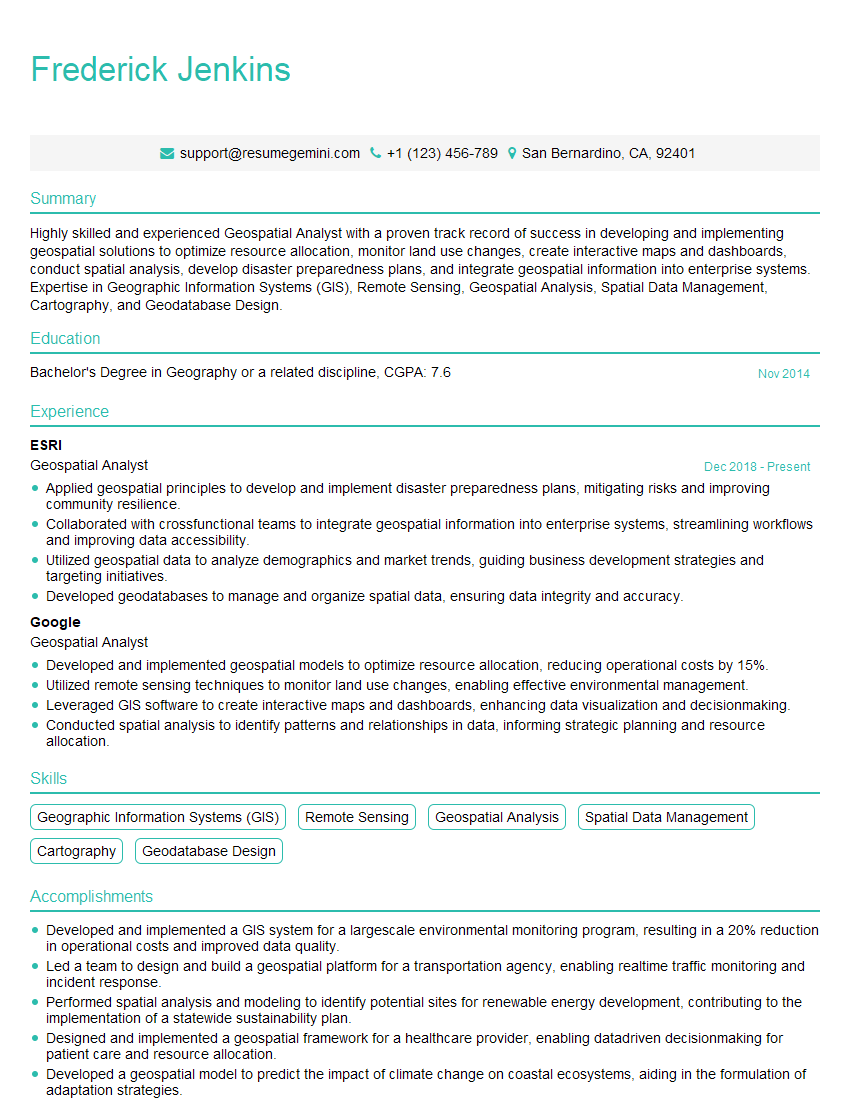
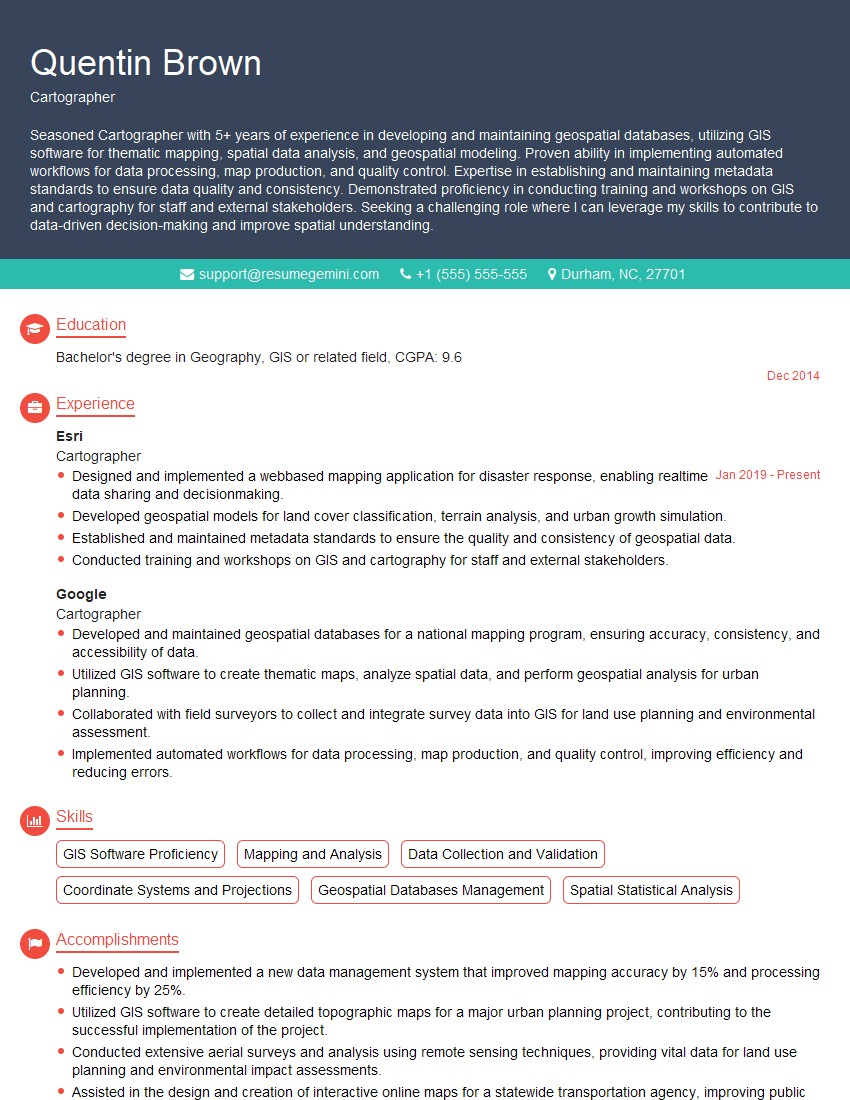
Mastering Geospatial Analysis and Mapping opens doors to exciting and impactful careers in various fields. To maximize your job prospects, it’s crucial to present your skills and experience effectively. Creating an ATS-friendly resume is key to getting your application noticed. ResumeGemini is a trusted resource that can help you build a professional and impactful resume, ensuring your qualifications shine. We provide examples of resumes tailored to Geospatial Analysis and Mapping to help you get started. Take the next step towards your dream career today!

Explore more articles
Users Rating of Our Blogs
Share Your Experience
We value your feedback! Please rate our content and share your thoughts (optional).
What Readers Say About Our Blog
Really detailed insights and content, thank you for writing this detailed article.
IT gave me an insight and words to use and be able to think of examples