Every successful interview starts with knowing what to expect. In this blog, we’ll take you through the top Aerodynamic Performance Analysis interview questions, breaking them down with expert tips to help you deliver impactful answers. Step into your next interview fully prepared and ready to succeed.
Questions Asked in Aerodynamic Performance Analysis Interview
Q 1. Explain the concept of boundary layer separation and its impact on aerodynamic performance.
Boundary layer separation occurs when the flow in the boundary layer (the thin layer of fluid near a surface) detaches from the surface. Imagine a river flowing smoothly; then it encounters a rock. The water initially flows smoothly around the rock, but at a certain point, it separates and forms eddies behind it. Similarly, in aerodynamics, when the pressure gradient becomes sufficiently adverse (pressure increases in the flow direction), the flow’s momentum is not enough to overcome this adverse pressure gradient, and the boundary layer separates.
This separation drastically impacts aerodynamic performance because it creates a region of recirculating flow downstream of the separation point. This recirculating flow significantly increases drag (the resistance to motion through a fluid) and reduces lift (the upward force perpendicular to the flow). For instance, a stalled airplane wing experiences massive boundary layer separation, resulting in a dramatic loss of lift and a dangerous increase in drag.
Minimizing boundary layer separation is crucial in aerodynamic design. This is achieved through techniques like streamlining the body shape (reducing adverse pressure gradients), using boundary layer control devices (like vortex generators or suction slots to energize the boundary layer), and optimizing the surface roughness.
Q 2. Describe different turbulence modeling approaches used in CFD simulations.
Turbulence modeling in Computational Fluid Dynamics (CFD) is crucial for accurately predicting the effects of turbulence on aerodynamic performance. Turbulence is characterized by chaotic, three-dimensional fluctuations in velocity. Direct Numerical Simulation (DNS) solves the Navier-Stokes equations directly, resolving all turbulent scales. However, it’s computationally very expensive and impractical for most engineering applications.
Therefore, we rely on turbulence modeling approaches such as:
- Reynolds-Averaged Navier-Stokes (RANS) models: These models decompose the flow variables into mean and fluctuating components and solve for the mean flow. Different RANS models exist, each with varying complexity and accuracy. Examples include the k-ε model (a two-equation model solving for turbulent kinetic energy and its dissipation rate) and the k-ω SST model (a more advanced model that blends k-ω and k-ε formulations for improved accuracy near walls).
- Large Eddy Simulation (LES): This approach resolves the larger, energy-containing turbulent eddies directly while modeling the smaller, dissipative scales. LES is more computationally expensive than RANS but provides greater accuracy than RANS in capturing unsteady flow phenomena.
- Detached Eddy Simulation (DES): This is a hybrid approach that combines RANS and LES techniques. RANS is used in regions with attached boundary layers, while LES is used in regions where separation and turbulence are dominant. DES offers a good balance between accuracy and computational cost.
The choice of turbulence model depends on the specific application and computational resources available. For simple flows, RANS models might suffice, while for complex flows with significant separation and unsteady effects, LES or DES is necessary.
Q 3. How do you validate CFD results against experimental data?
Validating CFD results against experimental data is crucial for ensuring the accuracy and reliability of CFD simulations. This validation process typically involves a comparison of key aerodynamic parameters obtained from both CFD and experiments.
The steps involved are:
- Selecting appropriate experimental data: The experimental data should be obtained from a reputable source and be relevant to the specific flow conditions and geometry of the CFD simulation. This might include wind tunnel tests or flight test data.
- Mesh refinement and convergence study: The CFD mesh must be sufficiently refined to capture the important flow features. A mesh convergence study should be performed to ensure the results are independent of the mesh resolution.
- Comparing key parameters: This involves comparing parameters such as lift coefficient (Cl), drag coefficient (Cd), pressure distributions, and velocity profiles obtained from CFD simulations with their experimental counterparts.
- Quantifying the difference: Statistical measures such as root mean square (RMS) error or percentage difference are used to quantify the discrepancies between CFD and experimental results. Acceptable error margins vary depending on the application.
- Analyzing discrepancies: Any significant discrepancies should be investigated to identify the source of errors, which might include issues with the CFD model, mesh resolution, turbulence model, or experimental errors.
A good validation process should demonstrate a good agreement between CFD and experimental results, building confidence in the CFD model’s predictive capabilities. Discrepancies can lead to refinements of the CFD model, mesh or experimental procedures.
Q 4. What are the key differences between potential flow and viscous flow simulations?
Potential flow and viscous flow simulations represent fundamentally different approaches to modeling fluid flow. Potential flow assumes inviscid (frictionless) and irrotational flow, while viscous flow accounts for the effects of viscosity (internal friction) within the fluid. This difference has profound implications on the accuracy and applicability of each approach.
Potential flow simulations are computationally less demanding and are useful for obtaining quick estimates of overall flow features. They can predict lift for streamlined bodies relatively well but completely fail to predict drag (since drag is primarily a viscous phenomenon), and they can’t accurately predict flow separation or boundary layer behavior.
Viscous flow simulations solve the full Navier-Stokes equations, considering both the inertial and viscous forces within the fluid. They are computationally more expensive but provide a significantly more accurate description of the flow, including boundary layer effects, separation, turbulence, and drag. Viscous flow simulations are essential for accurate aerodynamic prediction, especially for high-Reynolds-number flows (typical of many aerospace applications).
In summary: Potential flow is a simplified model suitable for quick estimations and conceptual understanding, while viscous flow is necessary for accurate predictions of aerodynamic forces and detailed flow features. Often, a combination of both approaches may be used; for example, potential flow can be used to obtain an initial solution which is then used to initialize a viscous flow simulation.
Q 5. Explain the concept of lift and drag. How are they affected by angle of attack?
Lift is the aerodynamic force acting perpendicular to the direction of the airflow, while drag is the aerodynamic force acting parallel to the direction of the airflow. Think of an airplane wing: lift pushes it upwards, and drag resists its forward motion.
Angle of attack (AoA) is the angle between the wing’s chord line (a line connecting the leading and trailing edges) and the oncoming airflow. Changes in AoA significantly influence both lift and drag.
Increasing AoA initially increases lift. However, beyond a critical angle (the stall angle), the flow separates from the upper surface of the wing, causing a dramatic loss of lift and a sharp increase in drag. This is because the separated flow creates a large wake of low-pressure air behind the wing, reducing the pressure difference between the upper and lower surfaces necessary for lift generation. The aircraft then loses the ability to maintain flight.
Drag generally increases with AoA due to increased flow separation and induced drag (a type of drag associated with the generation of lift). However, at very low AoA, drag may be relatively low. Understanding the relationship between lift, drag and AoA is crucial for controlling aircraft attitude and maneuvering.
Q 6. Describe the process of designing and conducting a wind tunnel test.
Designing and conducting a wind tunnel test involves careful planning and execution to ensure accurate and reliable results. The process includes:
- Defining objectives: Clearly stating the goals of the test, identifying the key aerodynamic parameters to measure (e.g., Cl, Cd, pitching moment), and the range of operating conditions to be tested.
- Model design and construction: The model should accurately represent the geometry of the object being tested, incorporating appropriate surface finish and scaling. The model’s size is determined based on the wind tunnel’s test section dimensions and available space.
- Wind tunnel selection: Choosing a wind tunnel appropriate for the test’s objectives, taking into account factors such as the desired test speed range, turbulence intensity, and available instrumentation.
- Instrumentation setup: Selecting and installing appropriate instrumentation such as pressure transducers, force balances, hot-wire anemometers, or particle image velocimetry (PIV) systems to measure the desired parameters. Calibration is essential.
- Test execution: Conducting the test runs, maintaining consistent flow conditions, recording the data accurately, and documenting the procedures followed.
- Data acquisition and processing: Collecting the measured data, applying corrections for various effects (e.g., blockage corrections, wall interference corrections), and processing the raw data into meaningful aerodynamic parameters.
Proper planning, meticulous execution, and rigorous data analysis are crucial for producing reliable and useful results from a wind tunnel test.
Q 7. How do you interpret and analyze wind tunnel data?
Interpreting and analyzing wind tunnel data involves extracting meaningful aerodynamic information from the raw data collected during the tests. This process often involves:
- Data cleaning and validation: Checking for outliers, errors, and inconsistencies in the raw data. This often involves comparing multiple data runs at the same conditions to ensure consistency and reliability.
- Data reduction: Processing the raw data to obtain relevant aerodynamic coefficients (e.g., Cl, Cd, Cm) and other parameters of interest. This typically involves calculating averages, applying corrections for tunnel interference, and non-dimensionalizing the data.
- Graphical representation: Visualizing the data through plots and charts (e.g., Cl-AoA curves, Cd-AoA curves, pressure distributions) to understand trends and relationships between different parameters.
- Comparison with predictions: Comparing the experimental data with theoretical predictions or results from other sources (such as CFD simulations) to validate the experimental results and identify any discrepancies.
- Uncertainty analysis: Quantifying the uncertainties associated with the experimental measurements and data analysis. This helps assess the reliability and accuracy of the obtained results.
- Drawing conclusions: Based on the analysis, drawing meaningful conclusions related to the aerodynamic performance of the tested object and identifying areas for design improvements.
Effective interpretation and analysis of wind tunnel data requires a solid understanding of aerodynamics and data analysis techniques. Detailed documentation of the test procedures and results is crucial for transparency and reproducibility.
Q 8. What are the limitations of CFD simulations?
Computational Fluid Dynamics (CFD) simulations, while powerful tools, have inherent limitations. These limitations stem from several sources, including the need for simplifying assumptions, computational resources, and the accuracy of input data.
- Mesh Dependency: The accuracy of a CFD solution is highly dependent on the quality of the computational mesh used to discretize the flow field. A poorly refined mesh can lead to inaccurate results, especially in regions with high flow gradients.
- Turbulence Modeling: Accurately simulating turbulent flows is computationally expensive and often requires using turbulence models which are approximations of the true physics. The choice of turbulence model significantly impacts the accuracy of the results. For example, a k-ε model might be sufficient for a basic prediction, but a more advanced LES (Large Eddy Simulation) model may be necessary for highly turbulent flows such as those near a wingtip.
- Computational Cost: High-fidelity simulations, especially those resolving fine-scale turbulence, demand significant computational resources, both in terms of processing power and memory. This can limit the feasibility of simulating complex geometries or large domains.
- Boundary Conditions: Accurate definition of boundary conditions (e.g., inflow, outflow, wall conditions) is crucial. Incorrect boundary conditions can lead to significantly flawed results. For example, improperly specifying the far-field boundary can influence the simulation’s prediction of drag.
- Numerical Errors: Discretization errors inherent in the numerical methods used to solve the governing equations can affect the accuracy of the solution. These errors can be minimized through mesh refinement and careful selection of numerical schemes.
Imagine trying to model the flow around a complex aircraft. You might need to simplify the geometry to reduce computational costs, or you might make assumptions about turbulence that compromise the accuracy of certain flow features. Understanding these limitations is key to interpreting CFD results effectively and using them in a meaningful engineering design process.
Q 9. Explain the concept of Reynolds number and its significance in aerodynamics.
The Reynolds number (Re) is a dimensionless quantity that describes the ratio of inertial forces to viscous forces within a fluid. It’s a crucial parameter in aerodynamics because it determines the nature of the flow – whether it’s laminar (smooth) or turbulent (chaotic).
The formula for the Reynolds number is: Re = (ρVL)/μ
ρ: Density of the fluidV: Velocity of the fluidL: Characteristic length (e.g., chord length of an airfoil)μ: Dynamic viscosity of the fluid
A low Reynolds number indicates that viscous forces dominate, leading to laminar flow. High Reynolds numbers signify that inertial forces are dominant, resulting in turbulent flow. The transition from laminar to turbulent flow is crucial, as turbulence significantly increases drag. For example, a golf ball’s dimples are designed to manipulate the boundary layer and delay the transition to turbulence at high Reynolds numbers, reducing drag and increasing distance.
In aerodynamic design, understanding the Reynolds number is crucial. Wind tunnel testing often aims to match the Reynolds number of the full-scale flight conditions to obtain reliable results. CFD simulations also require careful consideration of the Reynolds number to select appropriate turbulence models and ensure accurate predictions.
Q 10. What are the different types of wind tunnels and their applications?
Wind tunnels are indispensable tools for aerodynamic testing. Different types cater to specific needs and scales:
- Low-speed wind tunnels: These tunnels operate at speeds up to approximately 200 mph, making them suitable for testing aircraft and automobiles at relatively low speeds. They’re often used for basic aerodynamic testing, such as measuring lift and drag.
- High-speed wind tunnels: Designed for testing at supersonic and hypersonic speeds, these tunnels use powerful compressors and can reach velocities exceeding Mach 5. They’re crucial for testing high-speed aircraft and spacecraft.
- Transonic wind tunnels: These tunnels operate around the speed of sound, where complex flow phenomena occur. They’re essential for testing aircraft that fly at transonic speeds. Careful design is crucial to avoid problems associated with shock waves.
- Cryogenic wind tunnels: These tunnels use cryogenic fluids (like liquid nitrogen) to reduce the temperature and viscosity of the air, allowing for higher Reynolds numbers at lower speeds, making them useful for simulating high-altitude flight conditions.
- Water tunnels: These use water instead of air as the working fluid. They’re beneficial for testing marine vehicles and hydrofoils, where the higher density of water allows for better visualization of flow patterns.
The choice of wind tunnel depends heavily on the specific application. For example, testing a passenger jet would likely involve a low-speed wind tunnel, whereas testing a hypersonic missile would require a high-speed facility. The type of wind tunnel dictates the information it can provide and the accuracy of the aerodynamic data collected.
Q 11. Explain the concept of drag reduction techniques.
Drag reduction is a critical aspect of aerodynamic design, aimed at minimizing the resistance an object experiences as it moves through a fluid. Techniques span multiple approaches:
- Streamlining: Shaping the body to minimize flow separation and reduce pressure drag. Think of the sleek, teardrop shape of many vehicles and aircraft.
- Boundary Layer Control: Manipulating the boundary layer (the thin layer of fluid adjacent to the surface) to delay or prevent flow separation. This can be achieved through techniques like suction, blowing, or vortex generators.
- Surface Roughness Control: Optimizing surface roughness to reduce skin friction drag. For example, golf balls use dimples to create a turbulent boundary layer, which reduces drag compared to a smooth ball.
- Passive Flow Control Devices: Utilizing devices like winglets, vortex generators, and spoilers to modify the airflow and reduce drag, lift-induced drag, or improve stability.
- Active Flow Control: Employing active mechanisms like blowing and suction through strategically placed slots or jets. This approach allows for real-time adaptation to changing flight conditions.
The application of these techniques depends on the specific design goals and constraints. For example, an aircraft might use winglets to reduce induced drag, while a car might employ streamlining to minimize pressure drag. Effective drag reduction leads to improved fuel efficiency, increased speed, and enhanced overall performance.
Q 12. How do you account for compressibility effects in aerodynamic simulations?
Compressibility effects become significant when the flow velocity approaches a substantial fraction of the speed of sound. At these speeds, changes in density and pressure become important, and the incompressible flow assumption (used in many low-speed simulations) breaks down.
To account for compressibility in aerodynamic simulations, you need to use computational tools that solve the compressible Navier-Stokes equations. These equations account for changes in density as a function of pressure and temperature. Several methods are employed:
- Euler Equations: These equations neglect viscous effects but are suitable for high-speed flows where viscosity plays a minor role.
- Navier-Stokes Equations with Compressibility: These are the most complete equations, accounting for both viscous and compressibility effects. Solving them requires sophisticated numerical techniques and significant computational resources.
- Appropriate Equation of State: The equation of state (relationship between pressure, density, and temperature) must be appropriately chosen to reflect the fluid’s behavior under compressible conditions. For air, the ideal gas law is often a good starting point.
Consider the design of a supersonic aircraft. Neglecting compressibility would lead to inaccurate predictions of shock waves, lift, and drag. Properly accounting for compressibility ensures that simulations accurately capture the complex phenomena associated with high-speed flight and provide reliable design data.
Q 13. Describe the different types of aerodynamic forces acting on an aircraft.
Several aerodynamic forces act on an aircraft, primarily:
- Lift (L): The upward force that counteracts gravity, allowing the aircraft to fly. Generated by the shape of the wings and their interaction with the airflow.
- Drag (D): The force resisting the aircraft’s motion through the air. Comprises pressure drag (due to pressure differences) and skin friction drag (due to viscosity).
- Thrust (T): The forward force generated by the engines or propellers, propelling the aircraft through the air.
- Weight (W): The downward force due to gravity acting on the aircraft’s mass.
- Side Force (Y): A force acting perpendicular to the lift and drag vectors; often induced by sideslip or yaw.
These forces interact dynamically during flight. For steady level flight, lift equals weight, and thrust equals drag. Understanding these forces is fundamental to aircraft design, stability analysis, and performance prediction. For instance, a wing’s design focuses on optimizing the lift-to-drag ratio, enhancing fuel efficiency and range.
Q 14. Explain the concept of vortex shedding and its impact on aerodynamic performance.
Vortex shedding is the periodic release of vortices (swirling masses of fluid) from an object immersed in a moving fluid. This phenomenon primarily occurs when a bluff body (an object with a non-streamlined shape) is exposed to a flow.
As the fluid flows past the body, vortices form alternately on either side, detaching periodically and creating a fluctuating wake. This periodic shedding generates oscillating forces on the body, which can cause vibrations, noise, and even structural damage in extreme cases.
The frequency of vortex shedding is characterized by the Strouhal number (St), a dimensionless quantity that depends on the geometry of the body and the flow velocity. The Strouhal number is important in structural analysis, as it can be used to predict the resonant frequency of structures which could lead to unwanted vibrations and potential failure. For example, a long bridge subjected to wind flow can experience vortex shedding-induced vibrations, hence the need for design considerations to prevent catastrophic structural failure. In addition to bridges, tall buildings, and transmission lines are also susceptible to this effect and therefore should account for vortex shedding in their design. Mitigation techniques include modifying the body shape to disrupt the vortex formation or adding devices to control the wake.
Q 15. What are the key parameters used to assess aerodynamic performance?
Aerodynamic performance is assessed using several key parameters, all revolving around how effectively a body moves through a fluid (usually air). These parameters can be broadly categorized into forces and moments, and dimensionless coefficients derived from them.
- Lift (L): The upward force perpendicular to the direction of motion. Crucial for aircraft and other flying vehicles. Think of the lift generated by an airplane’s wings allowing it to stay aloft.
- Drag (D): The resistive force acting parallel and opposite to the direction of motion. Minimizing drag is paramount for fuel efficiency. It’s like the friction you feel when pushing something through water – the faster you go, the more drag you experience.
- Thrust (T): The propulsive force that overcomes drag and allows for acceleration or sustained flight. This is what the engines provide for airplanes.
- Weight (W): The downward force due to gravity. In equilibrium flight, lift equals weight.
- Lift Coefficient (CL): A dimensionless parameter relating lift to dynamic pressure and reference area (CL = L / (0.5 * ρ * V2 * S), where ρ is air density, V is velocity, and S is the reference area). A higher CL indicates better lift generation for a given speed and size.
- Drag Coefficient (CD): A dimensionless parameter relating drag to dynamic pressure and reference area (CD = D / (0.5 * ρ * V2 * S)). Lower CD values signify better aerodynamic efficiency.
- Moment Coefficients (CM, Cl, Cn): Dimensionless parameters describing the pitching, rolling, and yawing moments respectively. These are crucial for stability and control of the vehicle.
Analyzing these parameters provides a comprehensive understanding of an aerodynamic body’s performance.
Career Expert Tips:
- Ace those interviews! Prepare effectively by reviewing the Top 50 Most Common Interview Questions on ResumeGemini.
- Navigate your job search with confidence! Explore a wide range of Career Tips on ResumeGemini. Learn about common challenges and recommendations to overcome them.
- Craft the perfect resume! Master the Art of Resume Writing with ResumeGemini’s guide. Showcase your unique qualifications and achievements effectively.
- Don’t miss out on holiday savings! Build your dream resume with ResumeGemini’s ATS optimized templates.
Q 16. How do you use computational fluid dynamics (CFD) to analyze aerodynamic performance?
Computational Fluid Dynamics (CFD) is a powerful tool for aerodynamic performance analysis. It involves solving the Navier-Stokes equations – the fundamental equations governing fluid motion – numerically using computational methods. The process typically involves these steps:
- Geometry Creation/Import: The aerodynamic body’s geometry is created or imported into the CFD software (e.g., using CAD software).
- Mesh Generation: The geometry is divided into a mesh of smaller elements (cells). Mesh quality is critical for accuracy. Finer meshes near the surface capture complex flow features better but increase computational cost.
- Solver Setup: The solver is configured by specifying the fluid properties (density, viscosity), boundary conditions (velocity, pressure), and turbulence model. The choice of turbulence model (e.g., k-ε, k-ω SST) greatly impacts accuracy and efficiency for turbulent flows.
- Simulation Run: The solver numerically solves the Navier-Stokes equations on the mesh.
- Post-Processing: The results (pressure, velocity, forces, moments, etc.) are visualized and analyzed to understand the flow field and aerodynamic performance. This might involve plotting pressure contours, streamlines, or coefficient of lift and drag curves.
For example, in designing an aircraft wing, CFD can predict the lift and drag at different angles of attack, helping engineers optimize the wing shape for maximum efficiency.
Q 17. Describe your experience with different CFD software packages.
I have extensive experience with various CFD software packages, including ANSYS Fluent, OpenFOAM, and Star-CCM+. Each has its strengths and weaknesses.
- ANSYS Fluent: A widely used commercial package known for its robust solver and extensive turbulence models. I’ve used it extensively for complex simulations, particularly in aerospace applications, including detailed analysis of aircraft wings and engine nacelles.
- OpenFOAM: An open-source platform offering great flexibility and customization. Its strength lies in its versatility and ability to tailor the solver to specific needs. I’ve employed OpenFOAM for various projects where specific modifications to the solver were required, and also for educational purposes to understand the underlying algorithms.
- Star-CCM+: Another commercial software package with a user-friendly interface and powerful meshing capabilities. I’ve used this for simulating multiphase flows and complex geometries, often in projects involving fluid-structure interaction.
My experience spans various applications, allowing me to select the most appropriate software based on the specific project requirements and constraints.
Q 18. How do you handle meshing challenges in complex geometries?
Meshing complex geometries is a significant challenge in CFD. Poor mesh quality can lead to inaccurate or unstable solutions. My approach involves several strategies:
- Appropriate Meshing Technique Selection: The choice of meshing technique (structured, unstructured, hybrid) depends heavily on the geometry’s complexity. For example, structured meshes are efficient for simple geometries, while unstructured meshes are better suited for complex shapes.
- Refinement in Critical Regions: I employ mesh refinement in regions of high flow gradients (e.g., near the leading and trailing edges of an airfoil, or in the wake region) to capture flow features accurately. Adaptive mesh refinement (AMR) techniques can automate this process during the simulation.
- Mesh Quality Check: Before running the simulation, I rigorously assess mesh quality using metrics such as aspect ratio, skewness, and orthogonality. This helps identify and rectify potential issues that can affect solution accuracy.
- Mesh Independence Study: To ensure the results are independent of the mesh resolution, I perform a mesh independence study by comparing results from simulations with different mesh densities. This helps determine the optimal mesh resolution for accuracy and efficiency.
For example, in analyzing a Formula 1 car, I would use a hybrid mesh – structured mesh for body parts with simple geometries, and unstructured mesh for the complex parts such as the wings and diffusers.
Q 19. What are your experiences with experimental aerodynamic techniques?
My experience with experimental aerodynamic techniques includes wind tunnel testing and pressure measurements. Wind tunnel testing provides valuable validation data for CFD simulations.
- Wind Tunnel Testing: I’ve participated in numerous wind tunnel tests, where we measured forces and moments on models using load cells, and also visualized flow features using techniques like smoke visualization or tufting.
- Pressure Measurements: I’ve used pressure taps and pressure sensitive paint (PSP) to measure surface pressure distributions, which provide insights into flow separation and pressure drag. This data is essential for validating CFD simulations and improving model accuracy.
A memorable project involved testing a novel airfoil design in a low-speed wind tunnel. We used PSP to visualize flow separation and optimize the airfoil’s shape for better performance. The results validated the CFD predictions and led to significant improvements in the airfoil design.
Q 20. Describe your experience with data analysis and visualization tools.
I am proficient in several data analysis and visualization tools. Effective data analysis is crucial for extracting meaningful insights from CFD simulations and experimental results.
- Tecplot: A powerful tool for visualizing CFD data, such as pressure contours, streamlines, and velocity vectors. I routinely use Tecplot to analyze simulation results and identify areas needing further investigation.
- EnSight: Another excellent visualization tool commonly used for complex geometries and large datasets. Its ability to handle massive datasets is critical for large-scale simulations.
- MATLAB & Python: I utilize these programming languages for advanced data processing, statistical analysis, and generating custom visualizations. For example, I might write a script to automate data extraction from multiple CFD simulation runs and analyze trends in lift and drag coefficients.
My skills in these tools enable me to effectively interpret and communicate complex aerodynamic data to engineering teams and stakeholders.
Q 21. How do you identify and troubleshoot errors in CFD simulations?
Troubleshooting errors in CFD simulations requires a systematic approach. I typically follow these steps:
- Mesh Quality Check: Poor mesh quality is a frequent source of errors. I always start by carefully inspecting the mesh for problems such as poor aspect ratios, skewed cells, or insufficient resolution in critical regions.
- Boundary Condition Verification: Incorrect boundary conditions can significantly affect simulation results. I double-check the boundary conditions to ensure they accurately reflect the physical problem.
- Solver Settings Review: Incorrect solver settings (e.g., inappropriate convergence criteria, incorrect turbulence models) can lead to inaccurate or unstable solutions. I carefully review and adjust solver parameters as needed.
- Solution Monitoring: During the simulation, I monitor key parameters (e.g., residuals, lift and drag coefficients) for convergence and stability. Unusual trends or oscillations can indicate problems.
- Grid Independence Study: As mentioned previously, a mesh independence study helps eliminate errors related to mesh resolution.
- Comparison with Experimental Data: Whenever possible, I compare CFD results with experimental data (e.g., wind tunnel tests) to validate the accuracy of the simulation.
For example, if I observe non-physical oscillations in the solution, I might adjust the time step or use a different discretization scheme. Systematic troubleshooting allows me to identify and resolve errors efficiently.
Q 22. Explain your understanding of the finite volume method.
The Finite Volume Method (FVM) is a powerful numerical technique used to solve partial differential equations (PDEs), particularly those governing fluid flow in Computational Fluid Dynamics (CFD). Instead of solving for the solution at discrete points like in the Finite Difference Method, FVM divides the computational domain into a finite number of control volumes. The PDE is then integrated over each control volume, converting the differential equation into an algebraic equation. This allows for a more flexible and robust approach to handling complex geometries and boundary conditions.
Imagine dividing a cake into many small slices. Each slice represents a control volume. We then apply the conservation laws (like conservation of mass, momentum, and energy) to each slice. The interactions between neighboring slices are considered through fluxes across the shared faces. By solving the algebraic equations for each control volume, we obtain an approximate solution for the entire domain.
FVM’s strength lies in its conservation properties. Because the equations are integrated over control volumes, the conservation laws are inherently satisfied at the discrete level, leading to more accurate and physically realistic results, especially for complex flows with shocks or discontinuities. Popular CFD software packages like ANSYS Fluent and OpenFOAM extensively utilize the FVM.
Q 23. Explain the concept of aerodynamic optimization and your experience with it.
Aerodynamic optimization involves systematically modifying the shape of an aircraft or vehicle to improve its aerodynamic performance, such as reducing drag, increasing lift, or improving stability. This typically involves using optimization algorithms coupled with CFD simulations. My experience includes working on various optimization projects using both gradient-based and gradient-free methods. Gradient-based methods, like adjoint optimization, are efficient for smooth design spaces but can struggle with discontinuities. Gradient-free methods, like genetic algorithms, are more robust for complex problems but can be computationally expensive.
For example, I worked on a project to optimize the wing shape of a high-speed civil transport. Using adjoint optimization coupled with a high-fidelity CFD solver, we successfully reduced the drag coefficient by 5%, leading to significant fuel savings. In another project, we employed a genetic algorithm to optimize the geometry of a UAV for maximum lift-to-drag ratio in a challenging flight regime. These experiences provided me with a deep understanding of various optimization techniques and their applicability to different aerodynamic problems.
Q 24. How do you ensure the accuracy and reliability of your aerodynamic analyses?
Ensuring accuracy and reliability in aerodynamic analyses requires a multi-pronged approach. First, grid independence studies are crucial. This involves refining the computational mesh (the division of the domain into smaller elements) until the solution no longer changes significantly. This ensures the results are not unduly influenced by the mesh resolution.
Second, validation against experimental data is paramount. Comparing the simulated results with wind tunnel data or flight test data helps verify the accuracy of the simulation model and identify potential discrepancies. This validation process often involves carefully considering experimental uncertainties as well.
Third, code verification techniques are employed. This may include comparing results against analytical solutions for simplified cases or using different CFD solvers to see if they produce consistent results. A methodical approach, including rigorous documentation and quality control, is vital to maintain the integrity of the analysis.
Q 25. Describe your experience working with different types of aircraft or vehicles.
My experience spans a range of aircraft and vehicles, including fixed-wing aircraft (both subsonic and supersonic), rotorcraft (helicopters), and high-speed trains. I’ve worked on projects involving detailed aerodynamic simulations of complete aircraft configurations, as well as component-level analyses focusing on wings, fuselages, nacelles, and empennages. The computational demands and modeling strategies vary significantly depending on the vehicle type. For instance, simulating rotorcraft necessitates accounting for the complex unsteady flow phenomena associated with rotating blades, while high-speed train simulations focus on accurate representation of ground effects and turbulent wakes.
Q 26. Explain how you would approach the aerodynamic design of a new aircraft wing.
Designing a new aircraft wing is a complex iterative process. It begins with defining the mission requirements and performance targets. This includes specifying the desired lift, drag, and pitching moment characteristics across various flight conditions. Then, preliminary design concepts are explored, often using simplified analytical methods or low-fidelity CFD simulations. These initial designs are then refined through higher-fidelity CFD simulations, which allow for a more detailed assessment of the aerodynamic performance. This iterative process often involves design of experiments (DOE) to efficiently explore the design space and identify optimal configurations. Structural considerations and manufacturing constraints must also be integrated into the process, often via multidisciplinary optimization.
For example, during the wing design, I’d consider using tools like XFOIL or other panel codes for initial shapes and then moving towards Reynolds-Averaged Navier-Stokes (RANS) solvers like ANSYS Fluent or OpenFOAM for detailed simulations. This would allow me to assess the impact of different design parameters (e.g., airfoil shape, aspect ratio, twist, sweep) on the overall wing performance, ensuring compliance with the predefined objectives.
Q 27. What are your experiences with uncertainty quantification in aerodynamic simulations?
Uncertainty quantification (UQ) is crucial in aerodynamic simulations because the input parameters (like atmospheric conditions, surface roughness, and material properties) and the models themselves are inherently uncertain. Neglecting uncertainty can lead to misleading predictions and potentially unsafe designs. My experience involves employing both probabilistic and non-probabilistic methods for UQ. Probabilistic methods, like Monte Carlo simulations, involve running multiple simulations with randomly sampled input parameters to obtain a probability distribution of the output. Non-probabilistic methods, like interval analysis, focus on bounding the range of possible outcomes.
In practice, I’ve utilized UQ techniques to estimate the uncertainty associated with predicted lift and drag coefficients, allowing engineers to assess the robustness of their designs and incorporate appropriate safety margins. Furthermore, UQ helps in identifying the most influential input parameters, which can guide subsequent design and experimental efforts.
Q 28. Describe a challenging aerodynamic problem you solved and how you approached it.
One challenging problem involved predicting the aerodynamic performance of a high-speed vehicle with complex geometries and flow separation. Standard RANS solvers struggled to accurately capture the flow features due to the strong shock-boundary layer interactions. The initial simulations yielded inaccurate predictions of the drag and lift forces.
To overcome this, I implemented a hybrid approach that combined RANS simulations with Large Eddy Simulation (LES) techniques, employing LES near the regions of flow separation to better resolve the turbulent structures. This combination enabled more accurate prediction of the aerodynamic forces and provided valuable insights into the complex flow physics. Further refinement involved using advanced turbulence models and mesh adaptation techniques. This iterative process, incorporating advanced simulation methods and a thorough understanding of the flow physics, ultimately led to a successful solution and improved design recommendations.
Key Topics to Learn for Aerodynamic Performance Analysis Interview
- Fundamental Aerodynamics: Understanding lift, drag, and their components (pressure and viscous drag). This includes mastery of relevant equations and their applications.
- Computational Fluid Dynamics (CFD): Familiarity with CFD principles, mesh generation, solver selection, and result interpretation. Practical experience with common CFD software packages is highly beneficial.
- Experimental Aerodynamics: Knowledge of wind tunnel testing techniques, data acquisition, and uncertainty analysis. Understanding different types of wind tunnels and their applications is crucial.
- Performance Prediction and Optimization: Applying aerodynamic principles to predict aircraft or vehicle performance. This includes analyzing drag reduction strategies, lift enhancement techniques, and overall efficiency improvements. Experience with performance analysis software is a plus.
- Data Analysis and Visualization: Proficiency in analyzing large datasets, extracting meaningful insights, and effectively visualizing results using tools like MATLAB or Python.
- Boundary Layer Theory: A deep understanding of laminar and turbulent boundary layers and their impact on aerodynamic performance. Knowledge of boundary layer control techniques is advantageous.
- Aircraft Design Considerations: Understanding how aerodynamic performance analysis informs design choices in aircraft components such as wings, fuselage, and control surfaces.
- Problem-Solving and Analytical Skills: Demonstrating your ability to approach complex aerodynamic problems systematically, using appropriate theoretical frameworks and analytical tools. This also includes the ability to troubleshoot and debug CFD simulations or experimental setups.
Next Steps
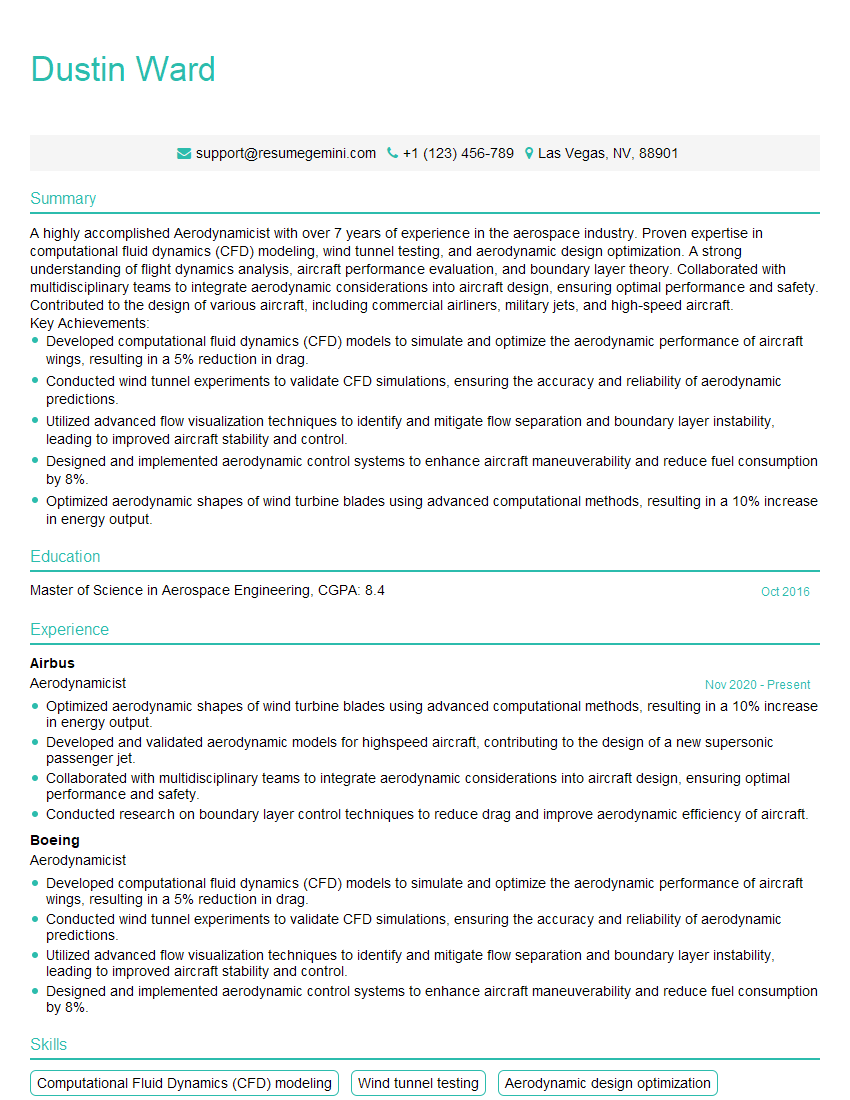
Mastering Aerodynamic Performance Analysis opens doors to exciting careers in aerospace, automotive, and renewable energy sectors, offering opportunities for innovation and significant impact. To maximize your job prospects, creating a compelling and ATS-friendly resume is paramount. ResumeGemini is a trusted resource to help you build a professional resume that highlights your skills and experience effectively. They provide examples of resumes tailored to Aerodynamic Performance Analysis to help guide you. Invest time in crafting a strong resume – it’s your first impression on potential employers.
Explore more articles
Users Rating of Our Blogs
Share Your Experience
We value your feedback! Please rate our content and share your thoughts (optional).
What Readers Say About Our Blog
Really detailed insights and content, thank you for writing this detailed article.
IT gave me an insight and words to use and be able to think of examples