Unlock your full potential by mastering the most common Agricultural Best Management Practices (BMPs) interview questions. This blog offers a deep dive into the critical topics, ensuring you’re not only prepared to answer but to excel. With these insights, you’ll approach your interview with clarity and confidence.
Questions Asked in Agricultural Best Management Practices (BMPs) Interview
Q 1. Describe the key principles of Integrated Pest Management (IPM).
Integrated Pest Management (IPM) is a sustainable approach to pest control that prioritizes minimizing pesticide use while maximizing crop protection. It’s not about eliminating pests entirely – that’s often impossible and environmentally damaging – but rather keeping pest populations below economically damaging levels.
- Monitoring: Regular scouting of crops to identify pests and assess their damage levels is the cornerstone of IPM. This involves visual inspection, traps, and other monitoring tools to understand the pest population dynamics.
- Identification: Accurate identification of the pest is crucial to determine the most effective and environmentally sound control measures. Misidentification can lead to ineffective or even harmful treatments.
- Prevention: Proactive measures like crop rotation, using pest-resistant varieties, and maintaining field sanitation help prevent pest infestations before they become severe. Think of this as proactive healthcare, preventing disease before it strikes.
- Cultural Controls: These involve manipulating the environment to make it less hospitable to pests. Examples include adjusting planting dates, proper irrigation, and maintaining appropriate plant spacing.
- Biological Controls: Utilizing natural predators, parasites, or pathogens to control pests. This could involve introducing beneficial insects like ladybugs to control aphids, for example.
- Chemical Controls: Pesticides are used only as a last resort, and only when necessary to prevent significant crop loss. The selection prioritizes products with minimal environmental impact and target-specific action.
Example: Imagine an apple orchard experiencing a codling moth infestation. An IPM approach would start with monitoring moth populations using pheromone traps. If numbers are low, cultural controls like proper pruning might be enough. If the population explodes, a targeted biopesticide might be used before resorting to a broad-spectrum insecticide.
Q 2. Explain the importance of nutrient management in reducing water pollution.
Nutrient management is crucial for reducing water pollution because excess nutrients, primarily nitrogen and phosphorus, from fertilizers and manure runoff contribute significantly to eutrophication in water bodies.
Eutrophication is the excessive enrichment of water with nutrients, leading to algal blooms. These blooms deplete oxygen levels, creating ‘dead zones’ where aquatic life cannot survive. This process degrades water quality, harming ecosystems and making water unsuitable for drinking and other uses.
Effective nutrient management involves:
- Soil Testing: Determining the nutrient content of the soil before fertilization allows for precise application, avoiding excess nutrients that could leach into water sources.
- Targeted Fertilization: Applying the right amount of fertilizer at the right time, using methods like split applications or precision agriculture techniques, minimizes nutrient loss.
- Manure Management: Proper storage and application of manure prevent nutrient runoff and minimize environmental impact. This includes using appropriate application rates and methods.
- Cover Cropping: Cover crops absorb excess nutrients, preventing them from entering waterways. This acts like a natural sponge, soaking up nutrients.
- Buffer Strips: Planting vegetative buffer strips along waterways helps filter out nutrients before they reach water bodies.
Example: A farmer who regularly tests their soil can tailor fertilizer application to the specific needs of their crops, reducing the amount of nitrogen and phosphorus applied and minimizing the risk of nutrient runoff into nearby streams and rivers.
Q 3. How do cover crops contribute to soil health and erosion control?
Cover crops are plants grown specifically to improve soil health and protect it from erosion. They are typically planted after the main crop is harvested or before the planting of the next crop, essentially acting as a ‘living mulch’.
Soil Health Benefits:
- Improved Soil Structure: Cover crops’ roots help to break up compacted soil, improving aeration and water infiltration.
- Increased Organic Matter: When cover crops decompose, they add organic matter to the soil, improving its fertility and water-holding capacity.
- Nutrient Cycling: Cover crops absorb nutrients from the soil, preventing them from leaching into waterways, and release them back into the soil as they decompose.
- Suppression of Weeds: Cover crops compete with weeds, reducing weed pressure in subsequent crops.
Erosion Control:
- Soil Protection: Cover crops protect the soil surface from wind and water erosion, minimizing soil loss.
- Reduced Runoff: Cover crops’ extensive root systems increase water infiltration, reducing surface runoff and the potential for nutrient and sediment transport.
Example: Planting a winter rye cover crop after harvesting corn helps protect the soil from winter erosion and provides organic matter for the next season’s crops. The rye also scavenges residual nitrogen, preventing its runoff into waterways.
Q 4. What are the best practices for managing irrigation to conserve water?
Efficient irrigation is critical for water conservation in agriculture. Overwatering wastes water, increases energy costs, and can lead to soil salinity and nutrient leaching. Best practices include:
- Irrigation Scheduling: Using soil moisture sensors or weather data to determine when and how much to irrigate, optimizing water use based on actual crop needs.
- Drip or Trickle Irrigation: This method delivers water directly to the plant roots, minimizing evaporation and runoff. This is like giving a plant a targeted drink of water.
- Sprinkler Irrigation: While less efficient than drip, modern sprinkler systems can be optimized for reduced water use through low-pressure nozzles and automated control.
- Mulching: Applying mulch around plants reduces evaporation by shading the soil and moderating soil temperature.
- Water Harvesting: Collecting rainwater for irrigation, reducing reliance on groundwater or surface water sources.
- Soil Improvement: Enhancing soil structure through practices like no-till farming improves water infiltration and retention, reducing the need for irrigation.
Example: A farmer installing a soil moisture monitoring system in their fields can adjust their irrigation schedule based on real-time data, avoiding unnecessary watering and saving significant water resources. The system alerts them when irrigation is needed based on precise soil conditions.
Q 5. Describe different methods for reducing pesticide runoff.
Reducing pesticide runoff requires a multifaceted approach:
- Integrated Pest Management (IPM): As discussed earlier, IPM minimizes pesticide use, thus reducing the potential for runoff.
- Targeted Application: Using precise application techniques like nozzle adjustments, boom height control, and GPS-guided sprayers ensures pesticides are applied only where needed, minimizing off-target drift.
- Buffer Strips: Vegetative buffer strips intercept pesticide runoff, filtering out pesticides before they reach water bodies.
- No-Till Farming: No-till practices reduce soil erosion, minimizing the transport of pesticides attached to soil particles.
- Cover Cropping: Cover crops act as a filter, binding pesticides and preventing their movement.
- Proper Storage and Handling: Following label instructions for pesticide storage, mixing, and application prevents accidental spills and contamination.
Example: A farmer utilizing GPS-guided sprayers to apply herbicides can accurately target weed infestations while avoiding areas with sensitive vegetation, significantly reducing pesticide runoff.
Q 6. Explain the role of buffer strips in protecting water quality.
Buffer strips are vegetated areas planted along the edges of fields, waterways, or other sensitive areas to act as a filter and protect water quality. They effectively intercept runoff and filter pollutants before they reach water bodies.
Functions of Buffer Strips:
- Sediment Trapping: Buffer strips slow down runoff, allowing sediment to settle out before entering waterways.
- Nutrient Filtration: They absorb nutrients like nitrogen and phosphorus from runoff, preventing eutrophication.
- Pesticide Adsorption: Buffer strips help filter out pesticides from runoff.
- Erosion Control: They stabilize stream banks, preventing erosion and maintaining water quality.
- Habitat Provision: They provide habitat for wildlife, enhancing biodiversity.
Types of Buffer Strips: Different types of buffer strips are used depending on the specific pollutants and environmental conditions. These might include grass buffers, forested buffers, or riparian buffers (along waterways).
Example: A farmer establishing a grass buffer strip along a stream helps prevent sediment and nutrient runoff from entering the water, protecting aquatic life and maintaining water quality downstream.
Q 7. What are the benefits of no-till farming practices?
No-till farming is a method of agriculture that minimizes soil disturbance. Instead of plowing, seeds are planted directly into the soil, leaving the previous crop’s residue on the surface.
Benefits of No-Till Farming:
- Reduced Soil Erosion: The undisturbed soil surface reduces wind and water erosion, protecting topsoil and preventing sediment runoff.
- Improved Soil Health: No-till farming increases soil organic matter, enhancing water infiltration and retention, and improving soil structure.
- Increased Biodiversity: The undisturbed soil surface supports a greater diversity of soil organisms, contributing to improved soil health.
- Reduced Labor and Fuel Costs: Eliminating plowing reduces fuel consumption and labor requirements.
- Carbon Sequestration: No-till practices can enhance carbon sequestration in soils, contributing to climate change mitigation.
- Improved Water Quality: Reduced soil erosion leads to less sediment and nutrient runoff, improving water quality.
Example: A corn farmer practicing no-till farming reduces soil erosion, maintains better soil structure, and improves water infiltration compared to a farmer using conventional tillage methods. This translates to reduced input costs, better crop yields, and enhanced environmental sustainability.
Q 8. How do you assess the effectiveness of BMP implementation on a farm?
Assessing the effectiveness of BMP implementation requires a multi-faceted approach. We don’t just look at one factor, but rather a combination of indicators to get a holistic view. Think of it like a doctor’s checkup – you need various tests to get a complete picture of someone’s health. Similarly, for BMPs, we use a combination of quantitative and qualitative measures.
Water Quality Monitoring: This is crucial. We analyze water samples from streams, rivers, or ditches near the farm to measure nutrient levels (nitrogen, phosphorus), sediment load, and pesticide residues. A significant reduction in these pollutants compared to pre-implementation levels indicates effective BMPs. For example, a reduction in phosphorus runoff after implementing cover cropping demonstrates the effectiveness of that specific BMP.
Soil Health Indicators: We assess soil health through testing which includes measuring organic matter content, soil structure, and water infiltration rates. Improved soil health often translates to reduced erosion and nutrient runoff. Imagine a sponge: healthy soil acts like a sponge, absorbing water and nutrients, preventing them from running off.
Yield Data: While not a direct measure of BMP effectiveness, improved yields can be an indirect indicator, suggesting healthier soils and efficient nutrient use. For instance, a farmer employing precision nitrogen application might see a yield increase coupled with reduced nitrogen loss.
Field Observations: Visual inspections of the farm are important. Are there signs of erosion? Is there adequate vegetative cover? Are there areas with poor drainage? These observations provide valuable context for the quantitative data.
Compliance Audits: Regular checks ensure adherence to BMP implementation protocols. This includes verifying the correct application rates of fertilizers and pesticides and ensuring proper maintenance of erosion control structures.
By combining these approaches, we build a strong evidence base to evaluate the success of implemented BMPs and identify areas needing improvement.
Q 9. What are the common challenges in implementing BMPs, and how can they be overcome?
Implementing BMPs presents several challenges, but many are surmountable with proper planning and collaboration.
Economic Constraints: Many BMPs require upfront investment in new equipment, technologies, or infrastructure. This can be a significant barrier, especially for smaller farms. Solutions: Government subsidies, cost-share programs, and access to low-interest loans can alleviate these financial burdens.
Technical Expertise: Proper implementation necessitates knowledge and skills that might be lacking among some farmers. Solutions: Workshops, training programs, and technical assistance from experts are essential. On-farm demonstrations showcasing successful BMP implementation can encourage adoption.
Time Constraints: Implementing BMPs can be time-consuming, adding to existing workloads. Solutions: Prioritizing BMPs that offer the greatest environmental benefits and integrating them into existing farming practices can improve efficiency. Sharing labor resources among farmers can also ease the burden.
Lack of Information and Awareness: Some farmers may lack awareness about the benefits of BMPs or be unsure how to implement them effectively. Solutions: Educational outreach, dissemination of best practices, and successful case studies can help overcome this barrier.
Regulatory Complexity: Navigating environmental regulations can be challenging. Solutions: Clear and concise guidelines, simplified permitting processes, and access to regulatory support can make compliance easier.
Q 10. Describe your experience with soil testing and its use in nutrient management.
Soil testing is fundamental to effective nutrient management. It’s like getting a blood test for your soil – it provides critical information on its health and nutritional status. I’ve extensively used soil testing throughout my career, guiding farmers in optimizing fertilizer application based on precise soil nutrient levels.
The process typically involves collecting soil samples from representative areas of the field. These samples are then sent to a certified laboratory for analysis, which typically measures levels of macronutrients (nitrogen, phosphorus, potassium) and micronutrients (e.g., zinc, manganese).
The results guide decisions on fertilizer application. For instance, if a soil test reveals low phosphorus levels, we can recommend the appropriate amount of phosphorus fertilizer to be applied to achieve optimum crop yields, without over-fertilizing and potentially causing nutrient runoff. This precision approach minimizes environmental impacts and maximizes resource efficiency.
Beyond nutrient levels, soil testing also helps us assess other soil properties such as pH, organic matter content, and texture, which all influence nutrient availability and plant growth. By integrating soil test results with factors like crop nutrient requirements and weather conditions, we can develop tailored nutrient management plans.
Q 11. Explain the concept of precision agriculture and its role in BMP implementation.
Precision agriculture uses technology to optimize farming practices, improving efficiency and reducing environmental impact. Think of it as farming with GPS. It’s about applying the right inputs – fertilizers, water, pesticides – at the right rate, in the right place, and at the right time.
In the context of BMPs, precision agriculture plays a vital role. For example:
Variable Rate Technology (VRT): This allows for precise application of fertilizers based on site-specific soil nutrient needs identified through soil sampling and mapping. This minimizes fertilizer waste, reducing nutrient runoff and improving yields.
GPS-guided machinery: Precision planting and tillage optimize seed placement and soil disturbance, reducing erosion and improving water use efficiency.
Remote Sensing and Imaging: Drones and satellites can monitor crop health and stress, enabling timely interventions, for example, applying targeted pesticide treatments where needed, thus minimizing unnecessary chemical use and preserving beneficial insects.
Yield Mapping: Analyzing yields across fields reveals areas of high and low productivity, guiding future management decisions.
By integrating these technologies, precision agriculture enables a more targeted and efficient approach to BMP implementation, leading to significant environmental and economic benefits.
Q 12. How do you monitor and evaluate the effectiveness of implemented BMPs?
Monitoring and evaluating BMP effectiveness is an ongoing process, not a one-time event. It’s like regularly checking your car’s vital signs – oil levels, tire pressure – to make sure everything is running smoothly.
We employ several strategies:
Regular Water Quality Monitoring: Periodic water sampling at pre-determined locations helps track the effectiveness of BMPs in reducing pollutant loads. We compare the data to baseline data collected before BMP implementation.
Soil Health Monitoring: Repeated soil testing allows us to track changes in soil health indicators over time. We look for improvements in organic matter, water infiltration rates, and nutrient availability.
Yield Monitoring: We track crop yields across the farm to identify areas where BMPs have resulted in increased productivity.
Visual Inspections: Regular site visits allow us to observe the effectiveness of BMPs in controlling erosion, managing irrigation, and preventing pest outbreaks. This provides valuable qualitative information that supplements quantitative data.
Data Analysis and Reporting: We analyze the collected data using statistical methods to assess trends and identify areas for improvement. Regular reports provide a comprehensive overview of BMP effectiveness.
This continuous monitoring allows for adaptive management strategies, ensuring BMPs are updated and improved to maximize their effectiveness.
Q 13. What are the regulations and compliance requirements related to agricultural BMPs in your region?
(Note: Regulations vary significantly by region. The following is a general example and should not be considered legal advice. Consult relevant state and local authorities for specific requirements.)
In many regions, regulations related to agricultural BMPs are designed to protect water quality and promote sustainable agricultural practices. These regulations might include:
Nutrient Management Plans: Farmers may be required to develop and implement nutrient management plans that outline strategies to optimize fertilizer application, minimizing nutrient runoff.
Manure Management Plans: Regulations often govern the storage, handling, and application of manure to prevent nutrient and pathogen pollution.
Erosion and Sediment Control Measures: Practices such as conservation tillage, cover cropping, and buffer strips might be mandated to minimize soil erosion and sediment runoff.
Pesticide Use Restrictions: Regulations may limit the types and amounts of pesticides that can be used, promoting integrated pest management (IPM) strategies.
Permitting Requirements: Certain agricultural practices, such as large-scale livestock operations, may require permits to ensure compliance with environmental regulations.
Compliance with these regulations is often mandatory, with potential penalties for non-compliance. Many regulatory agencies offer technical assistance and resources to help farmers meet these requirements.
Q 14. Describe your understanding of the Clean Water Act and its relevance to agricultural practices.
The Clean Water Act (CWA) is a federal law in the United States that sets the basic structure for regulating discharges of pollutants into the waters of the United States and regulating quality standards for surface waters. It’s fundamentally important for agricultural practices because agriculture is a significant source of water pollution.
The CWA aims to restore and maintain the chemical, physical, and biological integrity of the nation’s waters. This includes protecting water quality from agricultural pollutants such as:
Nutrients: Excessive nitrogen and phosphorus from fertilizers and manure can lead to eutrophication, harming aquatic life.
Sediment: Soil erosion from agricultural fields contributes to water turbidity, harming aquatic habitats.
Pesticides: Pesticide runoff can harm aquatic organisms and contaminate drinking water sources.
The CWA influences agricultural practices through various regulations, including those related to point and non-point source pollution. BMPs are critical for reducing non-point source pollution from agriculture and achieving the CWA’s goals. Farmers who fail to comply with the CWA’s provisions related to water pollution can face significant penalties.
Q 15. Explain your experience with developing and implementing farm conservation plans.
Developing and implementing farm conservation plans involves a collaborative process, starting with a thorough assessment of the farm’s unique characteristics. This includes soil type, topography, water resources, and existing farming practices. I begin by working closely with farmers to understand their operational goals and challenges. Then, I use this information, along with data from soil surveys and aerial imagery, to identify areas vulnerable to erosion, nutrient runoff, or other environmental concerns.
Next, I design a plan that incorporates specific Best Management Practices (BMPs) tailored to address these vulnerabilities. This might include implementing cover crops to improve soil health and reduce erosion, establishing buffer strips along waterways to filter pollutants, or utilizing precision agriculture techniques for efficient fertilizer application. The plan is documented, outlining the chosen BMPs, their implementation schedule, and the expected outcomes. Finally, I work with the farmer to monitor the plan’s effectiveness and make adjustments as needed. For example, I recently helped a dairy farmer implement a nutrient management plan that involved analyzing soil tests, creating a manure application schedule, and installing a manure storage system, resulting in a significant reduction in nutrient runoff into a nearby stream.
Career Expert Tips:
- Ace those interviews! Prepare effectively by reviewing the Top 50 Most Common Interview Questions on ResumeGemini.
- Navigate your job search with confidence! Explore a wide range of Career Tips on ResumeGemini. Learn about common challenges and recommendations to overcome them.
- Craft the perfect resume! Master the Art of Resume Writing with ResumeGemini’s guide. Showcase your unique qualifications and achievements effectively.
- Don’t miss out on holiday savings! Build your dream resume with ResumeGemini’s ATS optimized templates.
Q 16. How do you communicate the benefits of BMPs to farmers?
Communicating the benefits of BMPs requires a multifaceted approach that resonates with farmers’ practical concerns. I find that focusing on the economic advantages, along with environmental benefits, is key. For example, I explain how cover cropping can improve soil structure, reducing the need for tillage and saving on fuel costs. I show them data demonstrating how improved nutrient management can increase crop yields and reduce fertilizer expenses. I also highlight the potential for government incentives and cost-share programs that offset some of the initial investment in BMP implementation. Visual aids like graphs, maps, and photographs showcasing successful case studies are incredibly effective in demonstrating the tangible results of BMPs. Finally, building strong relationships based on trust and mutual respect is crucial. Farmers are more likely to adopt BMPs when they feel supported and understand that the changes will ultimately benefit their farms’ long-term sustainability.
Q 17. What are the economic considerations associated with implementing BMPs?
Implementing BMPs involves a range of economic considerations. The initial investment can be substantial, particularly for practices like installing irrigation systems or constructing manure storage facilities. There are often upfront costs associated with purchasing equipment, materials, or engaging consultants. However, the long-term economic benefits can outweigh these costs. Improved soil health translates to higher yields, reduced input costs (fertilizers, pesticides, fuel), and increased resilience to climate change. Government cost-share programs and financial incentives can significantly reduce the initial financial burden. For example, a farmer might receive a percentage of the cost of installing a conservation tillage system or a nutrient management plan. It’s important to conduct a thorough cost-benefit analysis that accounts for both the short-term and long-term economic implications to make informed decisions about which BMPs to prioritize. This analysis should consider factors like crop prices, input costs, and the potential for increased income due to improved yields or enhanced environmental stewardship.
Q 18. Describe your familiarity with various conservation tillage practices.
Conservation tillage practices aim to minimize soil disturbance, leaving crop residue on the soil surface to protect it from erosion and improve soil health. I have extensive experience with several techniques, including:
- No-till farming: Seeds are planted directly into the residue of the previous crop without any tillage. This is highly effective in reducing erosion and improving soil structure.
- Strip-till: Only narrow strips of soil are tilled before planting, leaving the rest undisturbed. This balances the benefits of reduced tillage with adequate seedbed preparation.
- Ridge-till: Crops are planted on raised ridges, leaving furrows undisturbed. This improves drainage and aeration while reducing soil compaction.
The selection of the most appropriate conservation tillage method depends on factors such as soil type, climate, crop, and available equipment. I frequently advise farmers on which technique best suits their specific needs and circumstances, considering factors like soil erodibility, water availability, and the type of farming operation.
Q 19. How do you manage livestock manure to minimize environmental impacts?
Managing livestock manure effectively is crucial to prevent water and air pollution. My approach involves a comprehensive strategy that considers storage, application, and nutrient management. This includes:
- Proper storage: Using well-designed manure storage facilities (lagoons, concrete pads, or covered storage) to prevent runoff and leaching of nutrients into groundwater.
- Nutrient management planning: Analyzing soil tests and manure composition to determine the appropriate amount of manure to apply to fields, taking into consideration crop needs and soil nutrient levels. This helps prevent excess nutrient runoff.
- Targeted application techniques: Employing strategies like injection or incorporation of manure into the soil to minimize ammonia volatilization and surface runoff.
- Best timing for application: Applying manure during appropriate times of the year to optimize nutrient uptake by crops and minimize environmental impacts.
Furthermore, I always advise farmers to comply with all relevant environmental regulations concerning manure management to prevent potential legal issues and protect the environment.
Q 20. Explain the role of GIS technology in planning and implementing BMPs.
Geographic Information Systems (GIS) technology plays a vital role in planning and implementing BMPs. GIS allows us to visualize and analyze spatial data, such as soil types, topography, water bodies, and field boundaries. This information is essential for identifying areas prone to erosion, nutrient runoff, or other environmental risks. I use GIS to create detailed maps that overlay these various data layers, allowing us to pinpoint the most appropriate locations for implementing specific BMPs. For example, we can identify areas suitable for establishing buffer strips along waterways or prioritize the application of conservation tillage in fields with high erosion potential. GIS also helps in monitoring the effectiveness of implemented BMPs by tracking changes in soil health indicators, vegetation cover, and water quality over time. Using remote sensing data integrated into GIS, we can visually assess the impact of different BMPs on a larger scale, providing quantitative and qualitative data to evaluate the project’s success.
Q 21. What are the key indicators of soil health, and how are they measured?
Soil health is a multifaceted concept encompassing several key indicators. These indicators provide insights into the soil’s capacity to support plant growth, regulate water cycles, and sustain biodiversity.
- Soil organic matter (SOM): Represents the total organic carbon in the soil. It’s crucial for soil structure, water retention, nutrient availability, and microbial activity. Measured using laboratory analysis of soil samples.
- Soil aggregation: Refers to the formation of soil particles into larger units (aggregates). Strong aggregation improves soil structure, aeration, and water infiltration. Measured through various methods, including wet sieving and visual assessment.
- Soil biological activity: Reflects the abundance and diversity of soil organisms, essential for nutrient cycling and decomposition. Measured through methods like microbial biomass carbon determination and enzyme assays.
- Water infiltration rate: Indicates how quickly water penetrates the soil surface. High infiltration rates are crucial for reducing runoff and erosion. Measured using infiltrometers.
- Nutrient content: The levels of essential nutrients (nitrogen, phosphorus, potassium, etc.) in the soil, indicating its fertility. Measured through laboratory analysis of soil samples.
Monitoring these indicators helps evaluate the effectiveness of BMPs and guide management decisions aimed at enhancing soil health. Regular monitoring is crucial to track progress and make necessary adjustments to the conservation plan.
Q 22. Describe your understanding of water budgeting for irrigation.
Water budgeting for irrigation is essentially a careful accounting of water resources to optimize irrigation scheduling and minimize water waste. It involves estimating the crop’s water requirements, factoring in rainfall, and determining the amount of supplemental irrigation needed. Think of it like a household budget, but instead of tracking expenses, we’re tracking water needs.
The process typically involves:
- Estimating crop evapotranspiration (ET): This is the water lost to the atmosphere through evaporation from the soil and transpiration from the plant. Several methods exist, including using weather data and crop coefficients in formulas or employing specialized software. For example, the Penman-Monteith equation is a widely used method for calculating ET.
- Monitoring soil moisture: Using tools like soil moisture sensors or simply feeling the soil helps determine how much water is already available in the root zone.
- Accounting for rainfall: Rainfall effectively reduces the amount of irrigation water needed. Rain gauges and weather forecasts are key here.
- Determining irrigation scheduling: Based on ET, soil moisture, and rainfall data, we create a schedule outlining when and how much to irrigate. This could involve drip irrigation, sprinkler irrigation, or other methods. The goal is to provide the right amount of water at the right time to meet crop needs without overwatering.
- Evaluating irrigation efficiency: After irrigation, we assess how effectively the water was used. This might involve measuring runoff or checking for deep percolation, indicating water waste.
For example, in a corn field, we might use weather data and crop coefficients to calculate a daily ET of 0.3 inches. If we have 0.1 inches of rainfall, we only need to supplement with 0.2 inches of irrigation. Regular monitoring ensures we avoid both water stress and over-irrigation, which can lead to leaching of nutrients and other environmental problems.
Q 23. How do you address potential conflicts between agricultural production and wildlife habitat?
Balancing agricultural production and wildlife habitat requires a multifaceted approach that acknowledges the interconnectedness of both. Conflicts can arise from habitat loss, pesticide use, water resource competition, and more. Finding solutions involves integrated strategies.
- Habitat Creation and Enhancement: Setting aside portions of farmland as wildlife corridors, buffer strips along waterways, or creating hedgerows provides crucial habitat. This can include planting native vegetation that supports local species.
- Integrated Pest Management (IPM): Reducing reliance on broad-spectrum pesticides minimizes harm to non-target species, including beneficial insects and pollinators. IPM strategies focus on preventing pest problems and using targeted treatments only when necessary.
- Water Management Practices: Efficient irrigation techniques prevent water depletion and protect riparian habitats. This could include using techniques like drip irrigation to reduce water waste.
- Crop Rotation and Diversification: Planting a variety of crops throughout the year can support diverse wildlife. Cover crops can improve soil health and provide habitat for beneficial insects and birds.
- Conservation Tillage: Minimizing soil disturbance through no-till or reduced-till farming can improve soil health and provide habitat for soil organisms, increasing biodiversity.
For instance, a farmer might create a wildlife buffer zone along a stream by planting native shrubs and trees. This provides habitat for birds and other animals while also filtering runoff and protecting water quality. Collaboration with wildlife agencies and conservation organizations is key to implementing effective strategies.
Q 24. What are some strategies for minimizing greenhouse gas emissions from agriculture?
Agriculture is a significant source of greenhouse gas (GHG) emissions, primarily methane (CH4) from livestock and nitrous oxide (N2O) from fertilizers. Minimizing these emissions requires a concerted effort focusing on several key areas:
- Improved Nitrogen Management: Using precision fertilization techniques, applying nitrogen fertilizers at the right time and in the right amount reduces N2O emissions. Using slow-release fertilizers and cover crops also help prevent nitrogen loss to the atmosphere.
- Manure Management: Efficient manure storage and handling practices, like anaerobic digesters, reduce methane emissions. Anaerobic digesters break down manure in the absence of oxygen, producing biogas that can be used for energy.
- Sustainable Livestock Practices: Improved feed efficiency and livestock breeds reduce enteric methane (methane produced during digestion) emissions. Reducing livestock density and improving grazing management can also help.
- Carbon Sequestration: Implementing no-till farming, cover cropping, and agroforestry practices increases soil carbon storage, offsetting GHG emissions. Soil acts as a carbon sink, capturing atmospheric carbon dioxide.
- Renewable Energy Sources: Using solar or wind energy to power farm operations reduces reliance on fossil fuels and minimizes GHG emissions.
For example, a dairy farm might invest in an anaerobic digester to capture methane from manure, using the resulting biogas to generate electricity. This reduces GHG emissions while providing a renewable energy source for the farm. A combination of these strategies is needed for a significant impact on reducing agriculture’s contribution to climate change.
Q 25. Explain your experience with data analysis related to agricultural BMPs.
My experience with data analysis related to agricultural BMPs is extensive. I’ve utilized various tools and techniques to analyze data from diverse sources, such as yield monitors, soil sensors, weather stations, and farm management software.
For example, I used GIS software to map soil types and drainage patterns on a farm, optimizing fertilizer application rates based on spatial variability. This precision approach reduced fertilizer overuse, saving costs and minimizing environmental impact. I have also analyzed yield data to assess the effectiveness of different tillage practices, revealing that no-till farming resulted in consistent yield improvements while reducing erosion.
I am proficient in using statistical software (R, SAS) to perform analyses such as ANOVA, regression, and time series analysis to evaluate the impact of different BMPs on various parameters like crop yields, water use, and GHG emissions. Furthermore, I’m experienced in creating dashboards and visualizations to communicate complex data effectively to stakeholders.
# Example R code for linear regression analysis: model <- lm(yield ~ fertilizer, data = farmdata) summary(model)
Data analysis allows for evidence-based decision-making in implementing and improving BMPs, leading to more efficient and sustainable farming practices.
Q 26. How do you stay updated on the latest advancements in agricultural BMPs?
Staying updated on the latest advancements in agricultural BMPs requires a multi-pronged approach.
- Professional Organizations: Active membership in organizations like the Soil and Water Conservation Society (SWCS) or the American Society of Agronomy (ASA) provides access to publications, conferences, and networking opportunities.
- Scientific Journals and Databases: Regularly reviewing peer-reviewed journals and accessing databases like Scopus and Web of Science helps stay abreast of research findings. Keywords such as ‘Precision Agriculture’, ‘Sustainable Agriculture’ and ‘Climate-Smart Agriculture’ are helpful for targeted searches.
- Industry Publications and Websites: Following industry-specific publications and websites keeps me informed about new technologies and best practices. This includes government agencies' publications and reports.
- Conferences and Workshops: Attending conferences and workshops allows for direct interaction with experts and provides opportunities to learn about cutting-edge research and technologies.
- Online Courses and Webinars: Various online platforms offer courses and webinars covering the latest BMPs, offering convenient professional development.
Continuous learning is crucial for effective implementation of BMPs. The agricultural landscape is constantly evolving, so staying updated is paramount to ensuring the best practices are adopted.
Q 27. Describe a situation where you had to troubleshoot a problem related to BMP implementation.
During a BMP implementation project focusing on reducing nitrogen runoff from a corn field, we noticed unexpectedly high nitrate levels in a nearby stream despite implementing a precise nitrogen application strategy. Initial investigations suggested the application rate was appropriate. Troubleshooting involved several steps:
- Re-examining Application Maps: We reviewed the precision application maps to identify potential inconsistencies in fertilizer distribution. A software error was discovered resulting in incorrect application rates in a specific area of the field. This was an oversight during the initial implementation of the BMP.
- Soil Sampling: Additional soil samples revealed unusually high levels of nitrate in specific areas, indicating potential issues with soil drainage and leaching. This suggested areas of high clay content, despite the field having been assumed homogeneous.
- Water Sampling and Analysis: More frequent water sampling from different points in the stream and the field drainage ditches helped pinpoint the source of the high nitrate concentration and the rate of flow.
- Addressing Underlying Issues: Based on our analysis, we implemented corrective measures such as improved drainage management in those clay-rich areas to reduce runoff, as well as updated the application maps to correct the software error and reduce overall nitrogen application. This led to significantly decreased nitrate levels.
This situation highlighted the importance of thorough data analysis and multi-faceted investigation when troubleshooting BMP implementation challenges. It underscored the need for regular monitoring and flexibility in adapting BMPs based on site-specific conditions and potential unforeseen issues.
Q 28. How do you ensure the long-term sustainability of BMPs on a farm?
Ensuring the long-term sustainability of BMPs on a farm requires a holistic approach that extends beyond initial implementation.
- Farmer Education and Engagement: Farmers need comprehensive training on the rationale, implementation, and maintenance of the BMPs. This fosters ownership and ensures long-term commitment.
- Regular Monitoring and Evaluation: Continuous monitoring of key indicators like soil health, water quality, and crop yields is essential to assess the effectiveness of the BMPs. This enables timely adjustments and corrections.
- Adaptive Management: BMPs should be viewed as flexible and responsive to changes in climate, technology, and market conditions. Regular review and modification are crucial for adaptation.
- Economic Incentives and Support: Financial incentives and government support for implementing and maintaining BMPs can be highly beneficial for farmer participation and long-term adoption.
- Community Building and Collaboration: Sharing best practices and experiences among farmers fosters a sense of community and mutual support, crucial for sustainable adoption.
For example, regularly monitoring soil health using soil tests and analyzing the data helps identify any deficiencies or issues that might arise over time. This allows for timely corrections and adjustments to fertilization and cropping strategies, ensuring the long-term success of conservation tillage.
Key Topics to Learn for Agricultural Best Management Practices (BMPs) Interview
- Soil Health & Conservation: Understand the principles of soil health, including nutrient management, erosion control, and the role of cover crops. Consider practical applications like no-till farming and crop rotation strategies.
- Water Quality Management: Explore best practices for minimizing nutrient runoff and sediment erosion into waterways. This includes understanding buffer strips, manure management plans, and irrigation efficiency techniques. Be prepared to discuss the impact of various farming practices on water quality.
- Pest & Disease Management: Learn about integrated pest management (IPM) strategies, emphasizing biological controls, resistant varieties, and targeted pesticide applications. Discuss the economic and environmental implications of different pest control methods.
- Nutrient Management: Master the principles of efficient fertilizer application, including soil testing, nutrient balancing, and avoiding nutrient losses. Consider the role of precision agriculture technologies in optimizing nutrient use.
- Livestock Management: Understand best practices for livestock grazing, manure handling, and waste management to minimize environmental impact. This includes understanding grazing systems and their impact on soil and water.
- Environmental Regulations & Compliance: Familiarize yourself with relevant environmental regulations and permits related to agricultural practices in your region. Be prepared to discuss compliance procedures and reporting requirements.
- Sustainable Agricultural Practices: Explore various sustainable farming techniques and their benefits, including reduced chemical inputs, improved biodiversity, and enhanced carbon sequestration. Be ready to discuss the economic and environmental advantages of these practices.
Next Steps
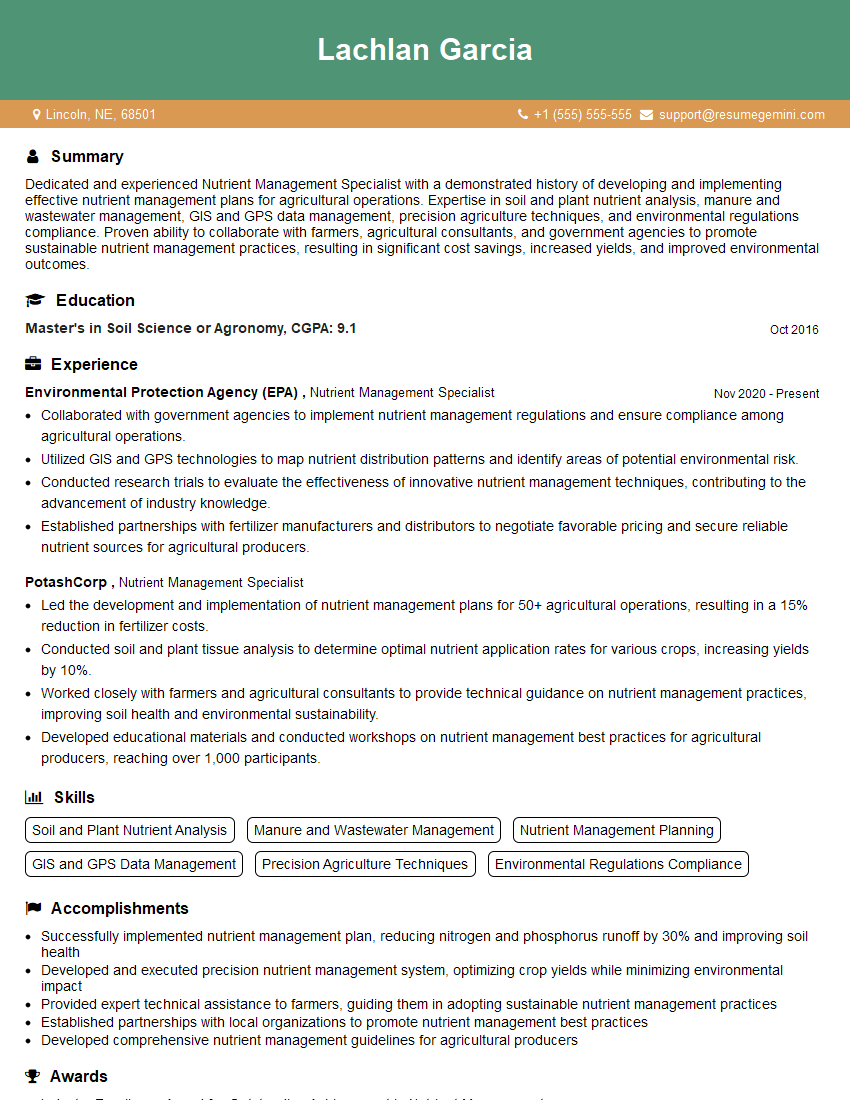
Mastering Agricultural Best Management Practices (BMPs) is crucial for career advancement in the agricultural sector. Demonstrating your knowledge of sustainable and environmentally responsible farming techniques will significantly enhance your job prospects. To make a strong impression on potential employers, it’s essential to have an ATS-friendly resume that highlights your skills and experience effectively. We strongly encourage you to use ResumeGemini to build a professional and impactful resume. ResumeGemini offers tools and resources to create a compelling document, and examples of resumes tailored to Agricultural Best Management Practices (BMPs) are available to help guide your creation process.


Explore more articles
Users Rating of Our Blogs
Share Your Experience
We value your feedback! Please rate our content and share your thoughts (optional).
What Readers Say About Our Blog
Really detailed insights and content, thank you for writing this detailed article.
IT gave me an insight and words to use and be able to think of examples