Every successful interview starts with knowing what to expect. In this blog, we’ll take you through the top Aircraft Stress Analysis interview questions, breaking them down with expert tips to help you deliver impactful answers. Step into your next interview fully prepared and ready to succeed.
Questions Asked in Aircraft Stress Analysis Interview
Q 1. Explain the differences between static and fatigue stress analysis.
Static stress analysis focuses on the response of a structure to a constant load, applied slowly enough that inertial effects are negligible. Think of it like slowly placing a heavy book on a table – you’re interested in whether the table will break under that *constant* weight. Fatigue stress analysis, on the other hand, examines the effect of repeated or cyclic loading. Imagine repeatedly slamming the book onto the table. Even if the book’s weight is well below the table’s static strength, repeated impacts can lead to fatigue failure due to crack initiation and propagation.
The key difference lies in the time dependency: static analysis considers a single load application, while fatigue analysis accounts for the cumulative effect of numerous load cycles. We use different methods and criteria for each. Static analysis often involves simple calculations or Finite Element Analysis (FEA) to determine stresses and compare them to material strength. Fatigue analysis, however, requires more advanced techniques like S-N curves (stress versus number of cycles to failure) and fracture mechanics to predict the lifespan of a component under cyclic loading. A classic example is the difference in design requirements for an aircraft’s landing gear, which experiences high static loads during landing but also high-cycle fatigue loads from taxiing and flight maneuvers.
Q 2. Describe your experience with Finite Element Analysis (FEA) software (e.g., ANSYS, NASTRAN).
I have extensive experience with ANSYS and NASTRAN, employing them for a wide variety of aircraft stress analysis tasks. My work with ANSYS has primarily involved creating detailed finite element models of aircraft components, including wings, fuselages, and landing gear, performing both static and dynamic analyses, and post-processing results to identify critical stress regions and potential failure points. I’ve used ANSYS Workbench extensively for model creation, meshing, and solution setup, leveraging its capabilities for advanced material models and non-linear analysis. For example, I successfully utilized ANSYS to optimize the design of a composite wing spar, reducing weight while maintaining structural integrity under various load cases.
With NASTRAN, my focus has been on large-scale structural analyses, where its efficiency in solving complex models is crucial. I’ve used NASTRAN’s capabilities in modal analysis to determine the natural frequencies and mode shapes of aircraft structures, which is essential for avoiding resonance issues during flight. For example, I utilized NASTRAN to analyze the dynamic response of an aircraft fuselage to turbulence loads, ensuring the design was adequately robust to prevent structural fatigue issues under such conditions. My expertise extends to both pre- and post-processing techniques, ensuring data accuracy and effective interpretation of simulation results. I am comfortable with various solver types and can tailor my approach based on the specific problem and computational resources available.
Q 3. How do you handle uncertainties and assumptions in stress analysis?
Uncertainties are inherent in any engineering analysis, and stress analysis is no exception. We address these through a combination of methods. First, we carefully define the scope of the analysis, explicitly stating our assumptions. This could involve specifying load conditions based on flight test data, using simplified material models when detailed characterization is impractical, or neglecting minor geometric details to simplify the model.
Second, we employ probabilistic methods to quantify uncertainties. This could include sensitivity analysis, which helps determine how changes in input parameters affect the results. For example, we might vary the material properties within their tolerances to see how much the predicted stresses change. Monte Carlo simulations can also be used to account for random variations in loads and material properties, providing a distribution of possible outcomes rather than a single deterministic value. Finally, we use safety factors, which are multipliers applied to the predicted stresses to account for uncertainties and provide a margin of safety. The choice of safety factor depends on the criticality of the component, the level of uncertainty, and regulatory requirements.
Q 4. Explain the concept of stress concentration and its impact on design.
Stress concentration refers to the localized increase in stress around geometric discontinuities, such as holes, fillets, or cracks. Imagine pulling on a piece of paper: if it’s uniform, the stress is evenly distributed. But if you punch a hole in the paper and pull on it, the stress will be much higher around the hole’s edges than in the rest of the paper. This is stress concentration.
Stress concentration factors (Kt) quantify this increase. They are typically determined experimentally or through FEA. High stress concentrations are a major concern in design because they significantly reduce the component’s fatigue life and increase the likelihood of failure, even if the average stress is well below the material’s yield strength. To mitigate stress concentrations, designers often employ techniques such as optimizing the geometry (e.g., using larger fillets), selecting materials with better crack resistance, or adding reinforcement features around critical areas. Ignoring stress concentration can lead to premature component failures, making it a crucial aspect of aircraft design and a significant factor in aircraft fatigue life analysis.
Q 5. Describe your experience with different material models used in aircraft stress analysis.
Aircraft stress analysis utilizes a wide range of material models, depending on the specific material used. For metals, we typically use elastic-plastic models, which account for both linear elastic behavior (Hooke’s law) and non-linear plastic deformation beyond the yield strength. This is crucial for analyzing situations involving high loads and potential yielding. For composite materials, which are increasingly common in aircraft structures, the models become significantly more complex. We might use orthotropic or anisotropic models to represent the directional properties of the material (different strength in different directions). These models can be further refined to incorporate non-linear effects such as matrix cracking, fiber failure, and delamination.
For advanced materials, such as titanium alloys and nickel-based superalloys used in high-temperature applications (e.g., turbine engines), we often need to account for temperature-dependent material properties, creep (time-dependent deformation under constant load), and viscoplastic behavior. The selection of appropriate material models is critically important for obtaining accurate stress predictions and assessing the structural integrity of the component. The wrong model can lead to inaccurate or unsafe predictions.
Q 6. How do you validate your stress analysis results?
Validation is crucial to ensure the accuracy and reliability of stress analysis results. We employ several methods. First, we compare our FEA results with simplified hand calculations, where feasible. This serves as a quick check for gross errors and helps build confidence in the model. Second, and most importantly, we validate our analysis using experimental data. This could involve static testing (applying loads to a physical component and measuring stresses and strains) or fatigue testing (applying cyclic loads until failure). We compare the predicted stresses and fatigue life with experimental measurements. If discrepancies exist, a thorough investigation is carried out to identify the source of error—this could be related to the FEA model, material properties, load assumptions, or experimental limitations.
Further, we can also use existing design data and industry standards for validation. Many aerospace components have well-established design practices and databases based on extensive testing and experience. Comparing our analysis against these established norms helps assess the accuracy and reasonableness of our predictions. A thorough validation process is essential for ensuring the safety and reliability of aircraft structures and is often subjected to rigorous peer review before certification.
Q 7. What are the different failure criteria used in aircraft stress analysis?
Several failure criteria are used in aircraft stress analysis, depending on the material and loading conditions. For ductile materials under static loading, the von Mises yield criterion is commonly employed. This criterion states that yielding occurs when the von Mises stress exceeds the material’s yield strength. For brittle materials, the maximum principal stress criterion or the Mohr-Coulomb criterion may be more appropriate. These criteria consider the tensile and compressive strengths of the material.
For fatigue failure, we use fatigue life prediction methods such as the S-N curve approach, which correlates stress amplitude to the number of cycles to failure. Fracture mechanics is used for analyzing cracks and predicting crack growth rates. The Paris law is a commonly used model for this purpose. Furthermore, for components subjected to combined stresses (e.g., tension and shear), more sophisticated failure criteria such as the Tsai-Hill criterion (for composites) or the modified Mohr-Coulomb criterion may be needed. The selection of the appropriate failure criterion is critical, as choosing an inappropriate criterion can lead to unsafe or overly conservative designs.
Q 8. Explain the significance of factor of safety in aircraft design.
The factor of safety (FOS) is a crucial element in aircraft design, acting as a buffer against unforeseen circumstances and uncertainties. It’s the ratio of the ultimate strength of a material or component to the maximum expected stress it will experience during its operational life. A higher FOS means the structure can withstand loads significantly greater than anticipated, enhancing safety and reliability. Think of it like this: if you design a bridge to hold 100 tons, but you expect only 50 tons to be its maximum load, you might build in a safety factor of 2, meaning the bridge could theoretically hold 200 tons. In aircraft design, FOS is not a single number; it varies depending on the component’s criticality and the associated risks. For instance, a primary structural element like a wing spar will have a considerably higher FOS than a less critical component like a cabin panel. This is due to the catastrophic consequences of failure in critical components.
For example, a wing spar might have a FOS of 1.5 to 2, ensuring it remains well within its design limits even with unexpected gust loads or manufacturing variations. Regulations and standards like those set by the FAA and EASA dictate minimum FOS values for different components and flight conditions. Choosing the appropriate FOS involves a balance between safety, weight, and cost. A very high FOS leads to an unnecessarily heavy and expensive aircraft, while a low FOS compromises safety. Careful consideration of all these factors is paramount in the design process.
Q 9. How do you account for buckling in your stress analysis?
Buckling, the sudden and catastrophic collapse of a structural member under compressive loads, is a major concern in aircraft design. We account for buckling through several methods within the stress analysis process. Firstly, we carefully select materials with high stiffness-to-weight ratios, like aluminum alloys or carbon fiber composites, to minimize the risk of buckling. Secondly, we optimize the structural design. This often involves using stiffened panels, stringers, and ribs to increase the member’s resistance to buckling. These elements distribute the compressive load more effectively, preventing localized stresses that could lead to failure.
Furthermore, buckling is rigorously analyzed through Finite Element Analysis (FEA). We use FEA software to model the structure and apply compressive loads, simulating the real-world conditions. The software calculates the critical buckling load – the point at which the structure buckles – allowing us to ensure that the design operating loads remain well below this critical load. We employ advanced FEA techniques like eigenvalue buckling analysis, which determines the buckling modes and corresponding loads. This informs design modifications to enhance buckling resistance. Finally, experimental testing, often using scaled-down models or coupons of the material, is crucial to validate our analytical predictions and demonstrate the robustness of the design against buckling.
Q 10. Describe your experience with fatigue and fracture analysis.
Fatigue and fracture analysis are essential aspects of aircraft stress analysis as they account for the progressive degradation of materials due to repeated loading cycles. This is especially critical for aircraft components that endure countless cycles of loading and unloading during their operational life. My experience encompasses applying various analytical and numerical methods to predict fatigue life. This involves using S-N curves (stress-life curves), which relate the stress amplitude to the number of cycles to failure.
I’ve extensively used FEA to model fatigue crack initiation and propagation, employing techniques such as fracture mechanics and fatigue crack growth analysis. For example, I’ve worked on projects using the Paris Law, which describes crack growth rate as a function of stress intensity factor. Understanding crack propagation is crucial for predicting the remaining life of components and scheduling inspections. Real-world scenarios I’ve dealt with include analyzing the fatigue life of wing ribs subjected to repeated flight loads and evaluating the effect of stress concentrations around fastener holes on fatigue crack propagation. The results of these analyses guide design changes, material selection, and maintenance strategies aimed at preventing fatigue failures.
Q 11. Explain the process of generating a finite element model.
Generating a finite element model (FEM) is a systematic process that begins with defining the geometry of the structure. This often involves using Computer-Aided Design (CAD) software to create a three-dimensional representation of the component or assembly. Once the geometry is defined, it’s imported into the FEA software. The next crucial step is meshing – dividing the geometry into smaller, simpler elements. The accuracy of the FEA results directly depends on the mesh quality; finer meshes near stress concentrations or areas of geometric complexity are usually employed.
After meshing, material properties are assigned to each element based on the chosen material. This includes data such as Young’s modulus, Poisson’s ratio, and yield strength. Next, boundary conditions must be defined. This involves specifying how the structure is supported or constrained, and where loads will be applied. These loads can be static, dynamic, or thermal, representing various flight conditions. Once the model is completely defined, the FEA software can solve the equations and provide stress, strain, and displacement results. Finally, careful post-processing of results is vital. This includes visualizing the results, identifying potential stress concentrations, and extracting critical data for design evaluation.
Q 12. How do you handle complex geometries in FEA?
Handling complex geometries in FEA is a major challenge. Simply using a very fine mesh on a complex geometry will result in extremely large model sizes and excessively long computational times. Therefore, various techniques are employed to manage this complexity effectively. One approach is to use adaptive meshing, where the mesh is refined only in areas of high stress gradients, while coarser meshes are used in areas with lower stress. This allows for an accurate representation of the geometry without excessive computational demands.
Another strategy is to use higher-order elements. These elements can accurately represent complex curved surfaces with fewer elements than lower-order elements. Additionally, sub-modeling can be employed, where a highly refined mesh is used only in a smaller region of the model, focusing on a specific area of interest. This isolates areas of concern such as stress concentrations for detailed analysis without the need for excessively large models. Finally, effective mesh generation techniques, including specialized meshing algorithms and appropriate element types, are crucial for achieving accurate and efficient FEA results with complex geometries.
Q 13. What are the common types of loads considered in aircraft stress analysis?
Aircraft stress analysis considers a wide range of loads, categorized broadly as follows:
- Aerodynamic Loads: These are forces generated by airflow over the aircraft’s surfaces. They include lift, drag, and moments. These loads are heavily dependent on flight conditions such as airspeed, altitude, and angle of attack.
- Inertial Loads: These are forces resulting from the aircraft’s acceleration or deceleration. Maneuvering loads, caused by changes in flight path, are significant inertial loads. During a sharp turn, the aircraft experiences increased inertial loads that significantly impact its structural integrity.
- Gust Loads: These are transient loads caused by atmospheric turbulence. Gusts can impose high stress on the aircraft structure, especially the wings and tail. Accurate prediction of gust loads requires statistical models and analysis of weather data.
- Landing Loads: These are the impact forces experienced during landing. They’re crucial design factors, particularly for the landing gear and fuselage. These loads include vertical, lateral, and longitudinal components.
- Self-Weight: The weight of the aircraft itself is a constant load impacting the structure. This includes the weight of the fuselage, wings, engines, and payload.
- Engine Loads: These encompass thrust, vibration, and other forces generated by the engines.
These loads are rarely applied individually; rather, they act in combination. Analysis must account for all load cases, considering worst-case scenarios and potential load combinations to ensure the aircraft’s structural integrity.
Q 14. Explain the concept of modal analysis.
Modal analysis is a technique used to determine the natural frequencies and mode shapes of a structure. In simpler terms, it identifies how a structure vibrates at its natural resonant frequencies. Imagine plucking a guitar string; it vibrates at a specific frequency. Similarly, an aircraft structure has multiple natural frequencies, and each frequency is associated with a unique mode shape, which describes the pattern of deformation.
The significance of modal analysis lies in avoiding resonance. If an external excitation force (e.g., engine vibrations, turbulence) matches one of the structure’s natural frequencies, resonance can occur. This can lead to excessive vibrations and potential structural failure. Modal analysis allows us to identify these natural frequencies so that we can ensure that the operational excitation frequencies are significantly different, preventing resonance. This analysis is performed using FEA software; it involves solving an eigenvalue problem to determine the natural frequencies and mode shapes. The results of modal analysis inform design changes to shift natural frequencies away from potential excitation frequencies, thus improving the structural integrity and safety of the aircraft.
Q 15. How do you perform a static analysis?
Static analysis in aircraft stress analysis focuses on determining the stresses and deformations within an aircraft structure under a constant or slowly applied load. Think of it like examining the stresses on a wing when the aircraft is parked on the ground, fully loaded with passengers and cargo. We aren’t concerned with how quickly the load is applied, just the final state.
The process typically involves:
- Defining the structure: Creating a Finite Element Model (FEM) of the aircraft component using software like ANSYS or NASTRAN. This involves defining the geometry, material properties (like Young’s modulus and Poisson’s ratio), and boundary conditions (how the component is supported).
- Applying loads: Simulating the various loads acting on the structure. These could include gravity, pressure loads (from air pressure or internal pressurization), and concentrated loads (from attachment points).
- Solving the equations: The FEA software solves a system of linear equations to determine the displacement, stress, and strain at each element within the model.
- Post-processing: Analyzing the results to ensure that the stresses and strains are within acceptable limits defined by airworthiness standards. This might involve checking for yielding, buckling, or excessive deformation.
For example, in analyzing a wing spar, we’d apply loads representing the weight of the wing, fuel, and passengers and then check if the stresses within the spar remain below its yield strength.
Career Expert Tips:
- Ace those interviews! Prepare effectively by reviewing the Top 50 Most Common Interview Questions on ResumeGemini.
- Navigate your job search with confidence! Explore a wide range of Career Tips on ResumeGemini. Learn about common challenges and recommendations to overcome them.
- Craft the perfect resume! Master the Art of Resume Writing with ResumeGemini’s guide. Showcase your unique qualifications and achievements effectively.
- Don’t miss out on holiday savings! Build your dream resume with ResumeGemini’s ATS optimized templates.
Q 16. How do you perform a dynamic analysis?
Dynamic analysis, on the other hand, considers the effect of time-varying loads. This is crucial for understanding how an aircraft responds to maneuvers, gusts, and vibrations. Imagine the stresses on the aircraft during takeoff, where there are rapidly changing forces acting on the structure.
There are several approaches to dynamic analysis, including:
- Modal analysis: Determines the natural frequencies and mode shapes of the structure. This helps identify potential resonance issues, where external vibrations could amplify the response of the aircraft.
- Harmonic analysis: Examines the response of the structure to sinusoidal loads (e.g., engine vibrations). This is particularly important for components near engines or other vibrating equipment.
- Transient analysis: Simulates the aircraft’s response to a time-varying load, such as a sudden gust or a landing impact. This provides information on the peak stresses and displacements experienced by the structure.
For example, in analyzing an aircraft during turbulence, we might use transient analysis to assess the stresses on the wing during a sudden gust. We would input the time-varying wind load data and observe the resulting stresses and vibrations within the structure to ensure they remain below allowable limits. Understanding these dynamic loads is key to ensuring flight safety and preventing fatigue-related failures.
Q 17. What are your experiences with experimental stress analysis techniques?
My experience with experimental stress analysis includes using strain gauges, photoelasticity, and digital image correlation (DIC).
- Strain gauges: These are small sensors bonded to the surface of a component that measure strain. By using several gauges and applying a known load, we can determine stress distribution. I’ve used this extensively in validating FEA results, comparing the experimental strain measurements to predicted values.
- Photoelasticity: This technique uses polarized light to visualize stress distributions in transparent materials. This method is particularly useful for visualizing stress concentrations, which can often be difficult to capture solely through FEA. I’ve used it to investigate stress concentrations around fastener holes and complex joints.
- Digital Image Correlation (DIC): DIC is a non-contact optical measurement technique capable of determining displacement and strain fields on the surface of a component. It has higher accuracy and flexibility than strain gauges for many applications, providing a full-field measurement of strain distribution. I’ve used it in analyzing complex structures with non-uniform strain fields, such as composite materials.
The integration of experimental data with FEA results is crucial for validating the accuracy of the numerical models. Discrepancies highlight areas needing improvement in model creation or material properties definition.
Q 18. Explain your understanding of damage tolerance.
Damage tolerance is a design philosophy that acknowledges that aircraft structures will inevitably develop some level of damage during their operational lifespan. Instead of aiming for a flawless structure, the focus shifts to designing structures that can tolerate a certain amount of damage without catastrophic failure. It’s about accepting that cracks and imperfections might develop, but having a system in place to detect and manage those imperfections before they cause issues.
Key aspects of damage tolerance include:
- Crack initiation and propagation: Understanding the mechanisms by which cracks form and grow under cyclic loading (fatigue) or static overload.
- Crack detection methods: Implementing non-destructive inspection (NDI) techniques like ultrasonic testing or eddy current testing to regularly inspect for cracks.
- Damage growth monitoring: Tracking the growth of any detected cracks over time.
- Safe-life design: Establishing the acceptable period of operation before inspections and repairs are needed, often through computational life predictions.
- Fail-safe design: Designing structures such that failure of one element doesn’t lead to catastrophic failure of the entire structure.
In practice, damage tolerance ensures that even if an aircraft structure is damaged it will allow sufficient time for detection before that damage causes failure. This approach ensures enhanced safety and reduces unnecessary maintenance.
Q 19. Describe your experience with different types of element formulations in FEA.
My experience encompasses various element formulations in FEA, each with strengths and weaknesses depending on the application.
- Solid elements (hexahedral, tetrahedral): Solid elements are versatile and can model complex geometries. Hexahedral elements generally offer higher accuracy and faster convergence than tetrahedral elements, but can be more challenging to mesh complex geometries. Tetrahedral elements are easier to mesh, allowing automatic meshing of complex parts.
- Shell elements: These elements are used to model thin-walled structures, like aircraft skins or panels. They’re computationally efficient compared to solid elements for these applications.
- Beam elements: These are used to model structural members like spars, ribs, and stringers. They are highly efficient for slender structures.
The choice of element type depends heavily on the geometry and loading conditions of the component being analyzed. A careful consideration of trade-offs between accuracy, computational cost, and meshing complexity is essential. For instance, while hexahedral elements offer better accuracy, the significant time investment in meshing might outweigh the benefit for a large, complex assembly.
Q 20. How do you ensure the accuracy and reliability of your FEA results?
Ensuring the accuracy and reliability of FEA results is paramount. It requires a meticulous approach throughout the entire process.
- Model validation: Comparing FEA results with experimental data (e.g., strain gauge measurements) to validate the accuracy of the model. Discrepancies help to identify areas needing refinement.
- Mesh convergence studies: Refining the mesh until further refinement no longer significantly affects the results. This ensures that the solution is independent of the mesh size.
- Material property verification: Using accurate material properties that reflect the specific material used in the aircraft structure. Material variability must also be accounted for through the use of appropriate statistical methods.
- Boundary condition checks: Ensuring that the boundary conditions in the model accurately represent the actual constraints and supports on the structure.
- Load case assessment: Thorough verification that the loads applied to the model appropriately represent the actual loading conditions.
- Independent verification and validation (IV&V): Having a separate team review the model, methodology, and results, provides a critical check against errors.
A systematic approach, including thorough documentation and peer reviews, is key to maintaining confidence in the results. It is also imperative to understand the limitations of FEA and to interpret the results within that context.
Q 21. Describe your approach to meshing complex geometries for FEA.
Meshing complex geometries for FEA requires a strategic approach combining automated and manual techniques. It’s not a simple process, but rather a crucial step that directly impacts the accuracy and reliability of the final results. Poor meshing will always lead to poor results.
- Geometry cleanup: Before meshing, any inconsistencies or errors in the CAD model need to be addressed. This often involves smoothing surfaces, filling gaps, and repairing any other imperfections.
- Appropriate mesh density: The mesh should be refined in areas of high stress concentration, such as around holes or sharp corners, while coarser meshes can be used in areas with relatively uniform stress.
- Mesh type selection: Choosing the right element type (tetrahedral, hexahedral, etc.) based on the geometry and the required accuracy. This selection is part of the overall analysis plan.
- Mesh refinement techniques: Employing adaptive mesh refinement techniques in regions with high stress gradients, ensuring optimal resolution in areas of interest. This ensures a highly focused approach.
- Mesh quality assessment: Checking the quality of the mesh using metrics such as aspect ratio, skewness, and Jacobian values. Poor mesh quality can significantly compromise results.
- Meshing software: Leveraging specialized meshing software and tools to improve efficiency and mesh quality.
For extremely complex geometries, a combination of automated mesh generation tools and manual adjustments might be necessary. My approach focuses on developing a well-structured mesh that balances accuracy, computational cost, and time efficiency. It’s always important to remember that meshing is an iterative process, requiring careful attention to detail and ongoing refinement.
Q 22. How do you interpret and present your stress analysis results?
Interpreting and presenting stress analysis results involves more than just numbers; it’s about communicating critical information effectively to engineers and stakeholders. I typically start by visualizing the results using various methods, such as contour plots showing stress distribution, deformed shapes highlighting critical areas, and animations to understand load cases.
For example, a contour plot might show high stress concentrations around fastener holes or at the wing-fuselage junction. I would then use these visualizations to create clear, concise reports that include:
- Summary of findings: Highlighting maximum stresses, locations of critical stress concentrations, and safety factors.
- Detailed tables: Presenting key stress values at critical points, along with material properties and applied loads.
- 3D models: Showing stress and displacement results directly on the CAD model for intuitive understanding.
- Recommendations: Suggesting design modifications or further investigation based on the analysis results, such as reinforcing specific areas or changing material selection.
Finally, I always ensure that the presentation is tailored to the audience. A report for senior management will focus on the high-level conclusions and risks, while a report for a design team will delve into the specifics and provide detailed recommendations.
Q 23. Explain the significance of boundary conditions in FEA.
Boundary conditions in Finite Element Analysis (FEA) are crucial because they define how the structure interacts with its surroundings. Think of it like building a model airplane – you need to fix it somewhere to simulate the real-world forces. Inaccurate boundary conditions lead to inaccurate results.
For instance, consider analyzing a wing spar. We might define the spar as fixed at its root, simulating its attachment to the aircraft fuselage. This ‘fixed’ condition means zero displacement at that point. At the wingtip, we might apply a load, representing aerodynamic forces. Other types of boundary conditions include:
- Fixed Support: Restricts all degrees of freedom (translation and rotation).
- Hinged Support: Allows rotation but restricts translation.
- Roller Support: Allows translation in one direction but restricts movement in others.
- Pressure Loads: Simulate aerodynamic pressure on surfaces.
- Concentrated Loads: Simulate forces applied at specific points.
Selecting the right boundary conditions is essential for obtaining realistic and reliable results. Misinterpreting this can lead to a significant underestimation or overestimation of the structural integrity, which could have severe consequences.
Q 24. How do you account for temperature effects in your stress analysis?
Temperature effects significantly influence stress analysis because thermal expansion and contraction can induce substantial stresses in aircraft structures. I account for these effects through thermal loading in my FEA simulations. This involves specifying temperature distributions across the aircraft model.
This can be done in various ways:
- Uniform temperature change: Applying a uniform temperature increase or decrease across the entire model to simulate overall heating or cooling.
- Gradient temperature change: Defining a temperature gradient across the model, reflecting non-uniform heating or cooling—for instance, due to aerodynamic heating on the leading edge of a wing during flight.
- Transient thermal analysis: Performing a time-dependent analysis that simulates changes in temperature over time.
The FEA software then calculates the thermal strains based on the material’s coefficient of thermal expansion. These thermal strains are then converted into equivalent thermal stresses and combined with the mechanical stresses due to external loads. A classic example is analyzing the stresses induced in a turbine blade due to a rapid temperature change during engine operation.
Q 25. What are your experiences with different aircraft certification standards?
Throughout my career, I’ve worked extensively with various aircraft certification standards, including those from the Federal Aviation Administration (FAA) and the European Union Aviation Safety Agency (EASA). These standards define stringent requirements for structural integrity, ensuring the safety of aircraft and passengers.
My experience includes:
- FAR Part 25 (FAA): The main regulation governing the airworthiness of transport-category airplanes, which specifies the required methods of analysis and validation for the structural aspects.
- CS-25 (EASA): The European equivalent of FAR Part 25, outlining similar requirements for structural certification.
- Damage Tolerance Analysis: Applying methodologies to assess crack propagation and residual strength, essential for ensuring safe operation even with existing flaws.
- Fatigue and Fracture Mechanics: Analyzing the effects of cyclic loading on the lifespan of aircraft structures, predicting potential failure mechanisms.
Understanding these standards is crucial in ensuring that my stress analysis meets all regulatory requirements, which requires understanding the specific requirements, acceptance criteria, and methods of compliance for each specific certification standard relevant to the project.
Q 26. Describe your experience with optimization techniques in stress analysis.
Optimization techniques significantly enhance the efficiency and effectiveness of stress analysis, leading to lighter, stronger, and more cost-effective aircraft designs. I have experience using several methods, including:
- Topology Optimization: This method removes material from areas of low stress, resulting in designs that use minimal material while maintaining structural integrity. Imagine starting with a solid block of material and letting the software ‘carve’ away unnecessary portions, leaving behind an optimized structure.
- Shape Optimization: This refines the shape of existing components to improve their stress performance. For example, it can optimize the shape of a wing rib to reduce stress concentrations.
- Size Optimization: This adjusts the thickness or dimensions of structural elements to minimize weight while meeting strength requirements. We could use this for optimizing the thickness of a wing skin.
These techniques are often integrated with FEA software to iteratively improve design based on stress analysis results. The goal is always to reach the best balance of structural performance, weight, and manufacturing feasibility. I typically utilize commercially available optimization software integrated into the FEA workflow.
Q 27. Explain your understanding of the limitations of FEA.
While FEA is a powerful tool, it’s important to acknowledge its limitations. Understanding these limitations is essential for interpreting results accurately and making informed engineering decisions.
Some key limitations include:
- Model Simplification: FEA models are often simplifications of complex real-world structures. Geometric idealizations, material property approximations, and boundary condition assumptions can influence the accuracy of results.
- Mesh Dependency: The accuracy of the results can be influenced by the fineness of the mesh used in the model. A coarser mesh might miss localized stress concentrations.
- Material Model Limitations: Constitutive models used in FEA are approximations of material behavior. They might not accurately capture complex material responses, such as plasticity or damage.
- Computational Cost: Analyzing large, complex models can be computationally expensive and time-consuming.
To mitigate these limitations, I employ techniques like mesh refinement studies, material model validation, and comparison with experimental data. It’s also crucial to have a sound understanding of the physics of the problem and the limitations of the FEA method.
Q 28. How do you handle non-linear effects in your stress analysis?
Non-linear effects, such as material plasticity (permanent deformation), large displacements, and contact non-linearity, significantly impact stress analysis results. Ignoring them can lead to inaccurate predictions and potentially unsafe designs.
I handle these effects using advanced FEA techniques:
- Non-linear material models: Employing material models that capture the non-linear stress-strain relationship, such as plasticity models, to accurately simulate the material behavior under large loads.
- Large displacement analysis: Using formulations that account for the changes in geometry during deformation, especially crucial when dealing with large deflections.
- Contact analysis: Modeling contact between different parts of the structure using appropriate contact algorithms. This is vital in analyzing bolted joints, landing gear, and other contact interfaces.
Handling non-linear effects often necessitates more computational resources and expertise. The selection of the appropriate non-linear solution strategy depends on the specific characteristics of the problem. For instance, analyzing a landing gear impact requires a highly accurate non-linear model to capture the large deformations and material plasticity during the impact event.
Key Topics to Learn for Aircraft Stress Analysis Interview
- Finite Element Analysis (FEA): Understanding the fundamentals of FEA, meshing techniques, and interpreting results is crucial. Practical application includes modeling aircraft components under various load conditions.
- Fatigue and Fracture Mechanics: Mastering concepts like S-N curves, crack propagation, and fatigue life prediction is essential for ensuring aircraft safety. Practical application involves assessing the lifespan of critical components.
- Material Properties and Behavior: A deep understanding of material properties (e.g., yield strength, ultimate tensile strength, modulus of elasticity) and their behavior under stress is vital. Practical application includes selecting appropriate materials for specific aircraft components.
- Static and Dynamic Load Analysis: Analyze aircraft structures under static (e.g., weight, pressure) and dynamic (e.g., gusts, maneuvers) loads. Practical application includes designing components to withstand these loads safely.
- Buckling and Instability Analysis: Understanding the concepts of buckling and instability is critical for designing lightweight yet strong structures. Practical application includes analyzing the stability of thin-walled components.
- Vibration Analysis: Analyzing the vibrational behavior of aircraft components to prevent resonance and fatigue failure. Practical application involves predicting and mitigating vibrations caused by engines or flight conditions.
- Aerospace Standards and Regulations: Familiarity with relevant aerospace standards (e.g., FAA, EASA regulations) is crucial. Practical application includes ensuring designs meet safety and certification requirements.
- Software Proficiency: Demonstrate proficiency in relevant software such as Nastran, Abaqus, or ANSYS. Practical application includes showcasing your ability to model, analyze, and interpret results using these tools.
Next Steps
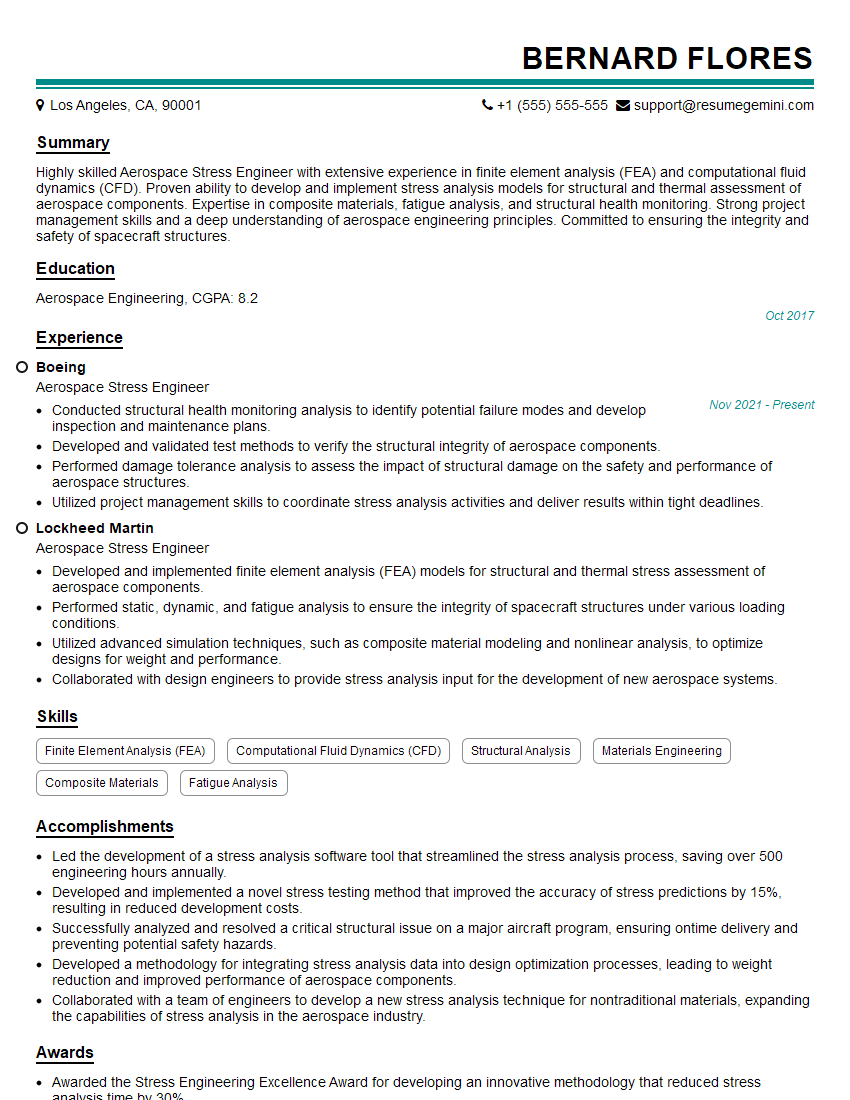
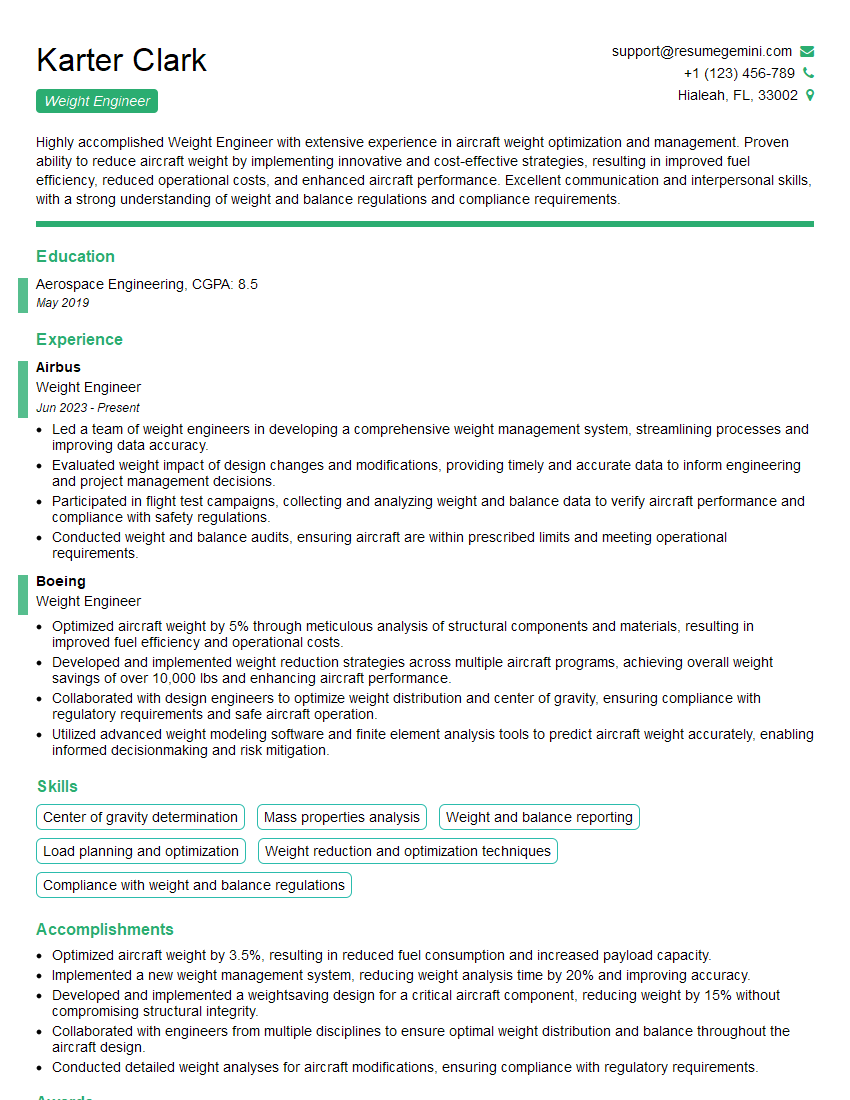
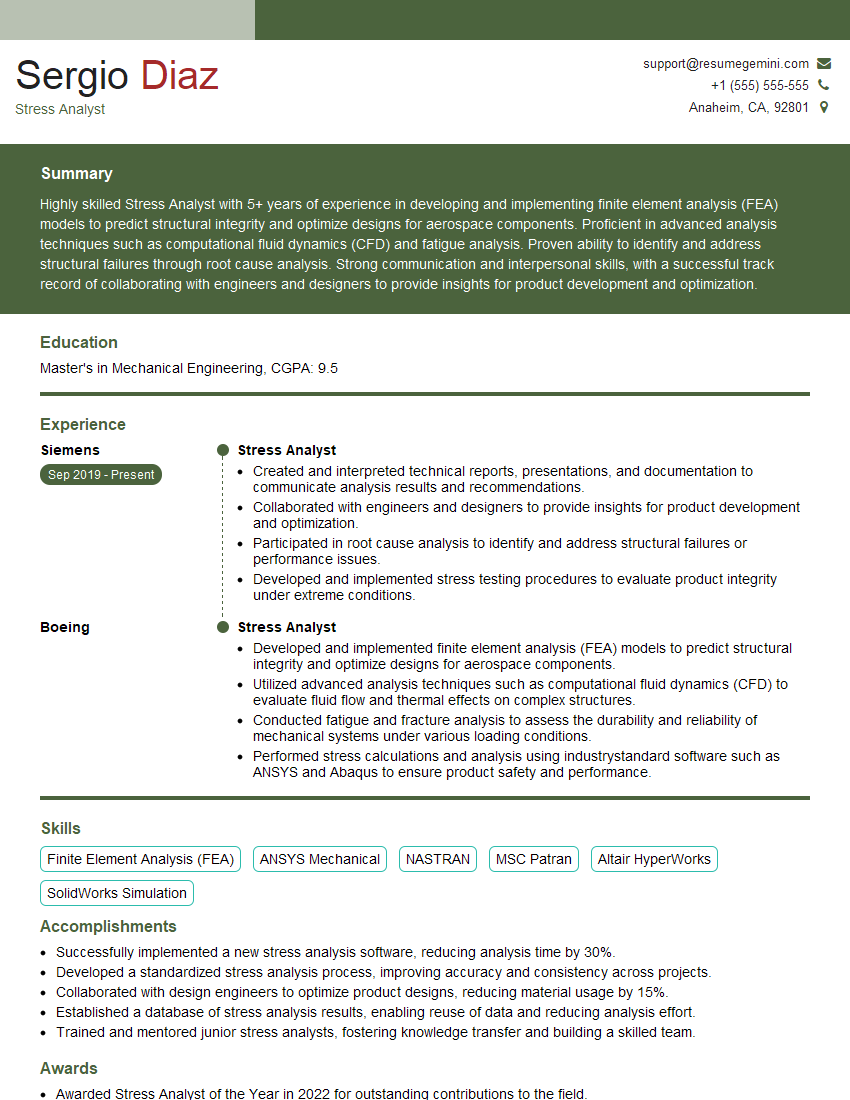
Mastering Aircraft Stress Analysis is paramount for a successful and rewarding career in aerospace engineering. It opens doors to challenging and impactful roles, contributing to the safety and innovation of flight. To significantly enhance your job prospects, focus on crafting an ATS-friendly resume that effectively highlights your skills and experience. We highly recommend using ResumeGemini to build a professional and compelling resume. ResumeGemini provides an intuitive platform and offers examples of resumes tailored to Aircraft Stress Analysis to guide you through the process, maximizing your chances of landing your dream job.
Explore more articles
Users Rating of Our Blogs
Share Your Experience
We value your feedback! Please rate our content and share your thoughts (optional).
What Readers Say About Our Blog
Really detailed insights and content, thank you for writing this detailed article.
IT gave me an insight and words to use and be able to think of examples