Are you ready to stand out in your next interview? Understanding and preparing for Airframe Design interview questions is a game-changer. In this blog, we’ve compiled key questions and expert advice to help you showcase your skills with confidence and precision. Let’s get started on your journey to acing the interview.
Questions Asked in Airframe Design Interview
Q 1. Explain the difference between a monocoque and semi-monocoque airframe.
The key difference between monocoque and semi-monocoque airframes lies in how they distribute structural loads. Think of it like comparing an eggshell to a soda can.
A monocoque airframe, much like an eggshell, relies entirely on its thin, curved outer skin to provide strength and stiffness. All structural loads – from the weight of the aircraft, passengers, and cargo to aerodynamic forces during flight – are carried by this single shell. This results in a lightweight structure, but it’s highly susceptible to damage from punctures or impacts.
A semi-monocoque airframe, similar to a soda can, uses a combination of a stressed skin and internal structural members (stringers and frames) to distribute loads. The outer skin provides some strength, but the bulk of the load-bearing responsibility is shared with these internal reinforcements. This design is more robust and can tolerate higher stresses and localized damage better than a pure monocoque structure. Most modern aircraft utilize a semi-monocoque design for its improved strength-to-weight ratio and resilience.
Q 2. Describe the process of airframe stress analysis using Finite Element Analysis (FEA).
Airframe stress analysis using Finite Element Analysis (FEA) is a crucial step in aircraft design. FEA essentially breaks down the complex airframe structure into a large number of smaller, simpler elements (like tiny cubes or tetrahedrons). Each element has its own material properties and is connected to its neighbors.
The process involves several key steps:
- Geometry Creation: A 3D model of the airframe is created using CAD software.
- Mesh Generation: The model is divided into a mesh of interconnected elements. A finer mesh provides greater accuracy but increases computational cost.
- Material Properties Definition: The material properties (Young’s modulus, Poisson’s ratio, density, etc.) for each element are specified.
- Load Application: Loads representing flight conditions, weight, and other forces are applied to the model. This includes aerodynamic loads, inertial forces, and internal pressures.
- Boundary Conditions: Constraints that simulate the aircraft’s attachment points and fixed supports are defined.
- Solution: The FEA software solves a system of equations to calculate stresses, strains, and displacements at each element.
- Post-processing: Results are analyzed to identify areas of high stress, potential failure points, and overall structural integrity.
This data informs design modifications and ensures the airframe can safely withstand expected operating loads. Software like ANSYS, ABAQUS, and Nastran are commonly used for this analysis.
Q 3. What are the common failure modes in airframe structures?
Airframe structures face a variety of failure modes, many related to the intense stresses and fatigue they experience during their lifespan. Common failure modes include:
- Fatigue: This is perhaps the most significant failure mode, resulting from repeated cyclic loading over time, eventually leading to crack initiation and propagation. Think of repeatedly bending a paperclip until it breaks.
- Buckling: A sudden and often catastrophic failure due to compressive forces exceeding the material’s critical buckling load. Imagine squashing a thin aluminum can.
- Yielding: Permanent deformation of the material due to exceeding its yield strength. This may not immediately lead to failure, but it significantly reduces the structural integrity.
- Fracture: Complete separation of the material due to excessive stress concentrations or pre-existing cracks.
- Creep: Time-dependent permanent deformation under sustained stress, especially at high temperatures. This can be a concern for engine components and high-speed aircraft.
- Corrosion: Degradation of material properties due to chemical reactions, often accelerated by exposure to moisture and salt.
Understanding these modes is vital for designing robust and safe airframes.
Q 4. How do you account for fatigue and creep in airframe design?
Accounting for fatigue and creep is critical for ensuring the long-term safety and reliability of an airframe. These effects are incorporated through various methods:
- Fatigue Analysis: This involves predicting the lifespan of components under cyclic loading using methods like S-N curves (stress vs. number of cycles to failure) and fracture mechanics. Detailed simulations are performed using FEA, coupled with fatigue analysis software.
- Creep Analysis: This uses constitutive models (mathematical equations that describe the material’s behavior under sustained stress and temperature) to predict creep deformation and rupture. FEA is frequently used for creep analysis to determine the long-term deformation and life expectancy of components.
- Safety Factors and Design Margins: Conservative design practices utilize higher safety factors for stress and fatigue limits, thereby ensuring that the actual stresses remain well below the failure thresholds.
- Material Selection: Choosing materials with high fatigue and creep resistance is crucial. This often involves advanced materials like titanium alloys and composites.
- Regular Inspections and Maintenance: Periodic inspections help to detect early signs of fatigue or creep damage, enabling timely repairs or replacements.
By addressing fatigue and creep during the design process, and employing rigorous testing and inspection procedures, airframe designers maintain a high degree of safety.
Q 5. Explain the concept of flutter and how it’s mitigated in airframe design.
Flutter is a self-excited aerodynamic phenomenon where an aircraft structural component (like a wing or tail) begins to oscillate uncontrollably due to a positive feedback loop between the structure’s motion and the aerodynamic forces generated. Imagine a leaf caught in a gust of wind, repeatedly twisting and flapping.
If left unmitigated, flutter can lead to catastrophic structural failure. Mitigation strategies include:
- Aerodynamic Design: Shaping the airframe to minimize aerodynamic forces that could trigger flutter.
- Structural Stiffening: Increasing the stiffness of vulnerable components to make them less susceptible to oscillations.
- Mass Balancing: Adjusting the mass distribution of components to shift natural frequencies away from potentially dangerous ranges.
- Flutter Dampers: Incorporating mechanical devices that absorb energy from oscillatory motion.
- Active Control Systems: Utilizing sensors and actuators to detect and counteract flutter-inducing vibrations.
- Flutter Testing: Rigorous experimental testing (both in wind tunnels and flight tests) is conducted to verify the design’s resistance to flutter.
Flutter analysis involves advanced computational techniques, often utilizing sophisticated computational fluid dynamics (CFD) coupled with FEA to simulate aeroelastic behavior.
Q 6. What are the advantages and disadvantages of using composite materials in airframe construction?
Composite materials, such as carbon fiber reinforced polymers (CFRP), offer significant advantages in airframe construction, but also present some drawbacks:
Advantages:
- High Strength-to-Weight Ratio: Composites are significantly stronger and stiffer than traditional metals for a given weight, leading to lighter and more fuel-efficient aircraft.
- Design Flexibility: They can be molded into complex shapes that are difficult or impossible to achieve with metals, enabling more aerodynamically efficient designs.
- Corrosion Resistance: Composites are inherently resistant to corrosion, reducing maintenance costs and extending the lifespan of the aircraft.
- Fatigue Resistance: Many composites exhibit superior fatigue resistance compared to aluminum alloys.
Disadvantages:
- High Manufacturing Costs: The manufacturing processes for composite parts are often more complex and expensive than those for metals.
- Damage Tolerance: While some composites have excellent fatigue properties, damage detection and repair can be challenging.
- Susceptibility to Impact Damage: Depending on the type and lay-up of the composite, it might be more susceptible to damage from impact compared to metallic structures.
- Long-term Durability: Understanding and predicting the long-term durability and performance of composites under various environmental conditions is still an ongoing area of research.
The careful selection of composite materials and design strategies can successfully mitigate many of these challenges.
Q 7. Describe different types of composite materials used in airframes.
A wide variety of composite materials are used in airframes, each with its own strengths and weaknesses. Some common types include:
- Carbon Fiber Reinforced Polymers (CFRP): This is the most prevalent composite material in modern aircraft, offering a superior strength-to-weight ratio and high stiffness. Different types of carbon fiber and resin systems are used depending on the application.
- Glass Fiber Reinforced Polymers (GFRP): GFRP is a less expensive alternative to CFRP, suitable for lower-stress applications. It’s often used for non-structural components.
- Aramid Fiber Reinforced Polymers (AFRP): Aramid fibers (like Kevlar) offer high strength and toughness, particularly good for impact resistance. They are frequently used in impact-critical areas.
- Hybrid Composites: Combining different fibers (e.g., carbon and aramid) or matrices (resins) to create materials with tailored properties to optimize performance for specific structural needs.
The choice of composite material depends on the specific requirements of the airframe component, considering factors such as strength, stiffness, weight, cost, and damage tolerance.
Q 8. How do you ensure the structural integrity of an airframe during design?
Ensuring structural integrity in airframe design is paramount for safety and performance. It’s a multifaceted process involving rigorous analysis and testing throughout the design lifecycle. We begin with defining the aircraft’s mission profile – what loads and stresses it will endure (e.g., maneuvers, turbulence, weight). This guides the selection of materials and the overall structural layout.
Next, we use sophisticated Finite Element Analysis (FEA) software to model the airframe and simulate its response to these loads. FEA breaks down the structure into a mesh of elements, allowing us to calculate stresses, strains, and deflections at various points. We then refine the design iteratively, adjusting material thickness, component geometry, and structural reinforcements until we meet stringent safety factors and regulatory requirements. This ensures the airframe can withstand significantly higher loads than anticipated during its operational life. For example, we might add stiffeners to areas experiencing high bending moments or use composite materials known for their high strength-to-weight ratio in critical areas.
Finally, physical testing plays a crucial role. We conduct static and fatigue tests on components and subassemblies to validate our analyses and verify the airframe’s ability to withstand repeated stress cycles. This ensures our design predictions match real-world behavior and provides confidence in the airframe’s longevity and reliability.
Q 9. Explain the role of weight management in airframe design.
Weight management is absolutely critical in airframe design; it’s often considered the single most important factor impacting performance and economics. Every extra kilogram adds to fuel consumption, reducing range and increasing operating costs. It also impacts the aircraft’s maneuverability, climb rate, and payload capacity.
We employ a multi-pronged approach to weight optimization. This starts with material selection – using lightweight yet strong composites like carbon fiber reinforced polymers (CFRP) wherever feasible. We then optimize the structural design itself, using topology optimization techniques to remove unnecessary material while maintaining structural integrity. This results in designs that are lighter yet strong enough to handle the applied loads.
Throughout the design process, we perform rigorous weight estimations and track every component’s weight. This helps identify areas where weight reduction strategies can be most effectively applied. Think of it like a budget – every component has a ‘weight budget’, and we carefully manage it to stay within the overall target weight.
Q 10. What are the key considerations for designing airframes for different flight regimes (e.g., subsonic, supersonic)?
Designing airframes for different flight regimes requires significant design adaptation. Subsonic flight involves different aerodynamic considerations compared to supersonic flight, leading to diverse structural requirements. At subsonic speeds, we prioritize lift generation and drag reduction through careful wing design, fuselage shaping, and high-lift devices (flaps, slats). Structural design emphasizes efficient load distribution and minimizing weight for improved fuel efficiency.
Supersonic flight introduces new challenges, primarily concerning aerodynamic heating. The airframe experiences significant temperature increases due to friction with the atmosphere, requiring the use of heat-resistant materials and advanced thermal management systems. The structural design must withstand these high temperatures without compromising strength or integrity. Wave drag, which becomes significant at supersonic speeds, also necessitates a slender fuselage shape and careful wing design. In essence, a subsonic design might prioritize lift and weight efficiency, while supersonic design prioritizes heat resistance and minimizing wave drag.
Hypersonic flight presents even more extreme challenges, pushing the boundaries of material science and thermal management. These designs often require advanced materials like ceramic matrix composites and innovative cooling techniques to protect the airframe from extreme temperatures. The structural design must withstand extreme thermal stresses and aerodynamic loads.
Q 11. Describe your experience with CAD software used in airframe design (e.g., CATIA, NX).
I have extensive experience with several leading CAD software packages, including CATIA and NX. My expertise involves not only the basic modeling aspects but also the advanced functionalities crucial for airframe design, such as FEA integration, surface modeling, and parametric design. In a recent project involving a regional jet design, I utilized CATIA V5 to create the entire 3D model, from the fuselage and wings to the internal structures. The software’s robust capabilities allowed for seamless integration with our FEA software, streamlining the analysis process and facilitating design iterations. This resulted in a lighter and more structurally efficient design.
My experience with NX is equally extensive, particularly in its ability to manage complex assemblies and perform interference checks. I remember using NX to design a novel winglet configuration, leveraging its advanced surface modeling tools to achieve the desired aerodynamic profile while maintaining structural integrity. The software’s powerful simulation tools allowed for a thorough assessment of the winglet’s performance characteristics, ensuring it met our design specifications.
Proficiency in these tools isn’t just about creating pretty 3D models; it’s about efficiently managing large datasets, integrating simulation tools, and collaborating effectively within a multidisciplinary design team. This collaborative approach to design and use of the tools is crucial for effective design.
Q 12. How do you handle design changes and revisions during the airframe design process?
Design changes and revisions are an inherent part of the airframe design process. We use a structured approach to manage these changes, employing a robust change management system that tracks all revisions and their impact on the overall design. This typically involves a formal change request process, where proposed modifications are reviewed by relevant stakeholders (aerodynamics, structures, systems engineering) to assess their impact on performance, weight, cost, and schedule.
We employ configuration management software to maintain version control of all design data. This prevents conflicts and ensures that everyone is working with the most up-to-date information. Furthermore, we utilize digital mock-up (DMU) tools to visualize changes in a 3D environment, identifying potential interference issues early in the process. This minimizes costly rework later in the design cycle.
A recent example involves a design change to the wing’s leading edge. A proposed modification aimed to improve aerodynamic performance. Using the change management system, we documented the change request, evaluated its impact using FEA and CFD (Computational Fluid Dynamics) simulations, and then communicated the updated design to the team. This systematic approach ensured a smooth and efficient integration of the modification into the overall design.
Q 13. Explain the importance of aerodynamic considerations in airframe design.
Aerodynamic considerations are fundamental to airframe design; they directly impact the aircraft’s performance, efficiency, and stability. The shape of the airframe – wings, fuselage, tail – is meticulously designed to optimize lift, minimize drag, and ensure stability and control throughout the flight envelope. We use Computational Fluid Dynamics (CFD) simulations to analyze airflow over the airframe and refine the design to achieve optimal aerodynamic performance.
CFD simulations allow us to visualize airflow patterns, pressure distributions, and aerodynamic forces, providing critical insights for design improvements. For instance, we might use CFD to optimize the wing’s airfoil shape to maximize lift at low speeds while minimizing drag at high speeds. Similarly, we can refine the fuselage shape to reduce drag and improve fuel efficiency. These simulations are crucial in achieving the desired aerodynamic characteristics, such as lift-to-drag ratio, which directly influences the aircraft’s range and fuel consumption.
Wind tunnel testing complements CFD simulations, providing experimental validation of the design’s aerodynamic performance. Wind tunnel tests allow us to measure forces and moments on the airframe under various flight conditions, validating our CFD predictions and identifying potential areas for further refinement. Both CFD and wind tunnel data are critical in ensuring the aircraft meets its performance targets.
Q 14. What are the key regulatory standards and certifications related to airframe design?
Airframe design is governed by a comprehensive set of regulatory standards and certifications that prioritize safety and airworthiness. These standards vary depending on the aircraft’s type and intended use, but some key regulations include those issued by the Federal Aviation Administration (FAA) in the United States and the European Union Aviation Safety Agency (EASA) in Europe. These bodies define stringent requirements for structural integrity, aerodynamic performance, systems reliability, and manufacturing processes.
The certification process is rigorous and involves extensive testing and documentation. This includes demonstrating compliance with airworthiness standards through structural testing, flight testing, and rigorous analysis. Specific standards such as FAR Part 25 (FAA) and CS-25 (EASA) govern the design and certification of transport category airplanes, covering aspects from structural strength and fatigue to systems redundancy and emergency procedures. These standards incorporate many factors based on past accidents and improvements over time.
Meeting these regulatory standards is not merely a matter of compliance; it’s a demonstration of the aircraft’s safety and reliability. The certification process ensures that the airframe is designed, manufactured, and maintained to the highest standards, providing confidence for both operators and passengers.
Q 15. How do you ensure manufacturability during the design phase of an airframe?
Ensuring manufacturability during airframe design is paramount. It’s not enough to design a beautiful, theoretically sound aircraft; it must be feasible to build. This involves a deep understanding of manufacturing processes from the outset. We need to consider the materials, the available tooling, the production capacity, and the overall cost-effectiveness.
- Design for Manufacturing (DFM): This principle guides design choices to simplify manufacturing steps, reduce assembly time, and minimize material waste. For example, we might choose to design components with simpler geometries that require less machining or favor standardized fasteners over custom-made ones.
- Tolerance Analysis: We meticulously define tolerances to ensure parts fit together correctly without excessive rework or scrap. Tight tolerances might be necessary for critical aerodynamic surfaces, but excessively tight tolerances will increase manufacturing costs and time.
- Material Selection: The choice of materials is crucial. While lightweight composites offer excellent performance, their manufacturing can be complex and require specialized equipment. We weigh performance against manufacturing feasibility. For instance, a readily available aluminum alloy might be preferable to a new, high-performance composite if it simplifies the manufacturing process without significant performance drawbacks.
- Collaboration with Manufacturers: Early and continuous engagement with manufacturing engineers is vital. Their expertise ensures the design is buildable, cost-effective, and meets quality standards.
In one project, we initially designed a complex wing rib with intricate curves. After consulting with the manufacturer, we simplified the geometry slightly, enabling them to use a more efficient forming process. This resulted in significant cost savings and faster production.
Career Expert Tips:
- Ace those interviews! Prepare effectively by reviewing the Top 50 Most Common Interview Questions on ResumeGemini.
- Navigate your job search with confidence! Explore a wide range of Career Tips on ResumeGemini. Learn about common challenges and recommendations to overcome them.
- Craft the perfect resume! Master the Art of Resume Writing with ResumeGemini’s guide. Showcase your unique qualifications and achievements effectively.
- Don’t miss out on holiday savings! Build your dream resume with ResumeGemini’s ATS optimized templates.
Q 16. What is your experience with different types of joining techniques for airframe components?
My experience encompasses a wide range of joining techniques, each with its advantages and disadvantages depending on the application.
- Bolting and Riveting: These are classic techniques for joining metallic structures, offering robust mechanical strength and reliability. Riveting is often favored for its ability to join multiple sheets together, while bolting allows for disassembly and maintenance. However, they can introduce weight and stress concentrations if not carefully designed.
- Welding: Various welding techniques, such as spot welding, laser welding, and friction stir welding, are commonly used for joining both metallic and composite materials. They offer lightweight solutions and high strength. However, they can introduce heat-affected zones that need careful consideration.
- Adhesive Bonding: This is becoming increasingly popular, especially for joining composite structures. It offers high strength-to-weight ratios, superior fatigue resistance, and the ability to join dissimilar materials. However, it requires careful control of surface preparation and curing conditions.
- Hybrid Joining: This approach combines different techniques to optimize performance. For instance, we might use adhesive bonding to join smaller components and bolting for larger, higher-load joints. This can offer a balance of weight, strength, and cost-effectiveness.
For instance, in a recent project involving a composite tail section, we employed a hybrid approach using adhesive bonding for the primary structure and bolting for removable access panels. This allowed us to achieve a strong, lightweight, and easily maintainable structure.
Q 17. Explain the design considerations for integrating avionics and other systems into an airframe.
Integrating avionics and other systems into an airframe requires careful planning and consideration of numerous factors. It’s about more than just physically fitting the equipment; it needs to be seamlessly integrated, ensuring functionality and safety.
- Electromagnetic Compatibility (EMC): This is crucial. We must ensure the different systems don’t interfere with each other. Shielding and grounding are essential to prevent electromagnetic interference.
- Weight and Balance: The weight and location of avionics and systems affect the aircraft’s center of gravity, impacting stability and handling. This is rigorously analyzed during the design process.
- Environmental Considerations: Avionics and systems must withstand extreme temperatures, vibrations, and humidity experienced in flight. Robust mounting and environmental sealing are necessary.
- Thermal Management: Avionics systems generate heat, requiring effective cooling solutions. This can involve incorporating heat sinks, fans, or other cooling mechanisms.
- Access for Maintenance: Designing for easy access to components for maintenance and repair is essential. Modular design can facilitate this.
For example, in a small unmanned aerial vehicle (UAV) design, we had to carefully integrate all the systems within a very limited space. We used miniaturized components, custom-designed mounting brackets, and a sophisticated thermal management system to ensure proper functionality and weight restrictions were met.
Q 18. How do you manage risks and uncertainties during the airframe design process?
Risk management is an iterative and crucial aspect of airframe design. We use a combination of methods to identify, assess, and mitigate potential risks and uncertainties.
- Failure Modes and Effects Analysis (FMEA): This systematic approach helps us identify potential failures and their consequences. We then assess the severity, probability, and detectability of each failure mode to prioritize mitigation efforts.
- Risk Registers: We maintain a centralized repository of identified risks, including their potential impact, mitigation strategies, and assigned owners. Regular reviews ensure risks remain under control.
- Design Reviews: Formal design reviews involve cross-functional teams examining the design for potential risks and recommending corrective actions. This allows for early identification and resolution of potential problems.
- Redundancy and Fail-Safes: Incorporating redundant systems or fail-safe mechanisms can mitigate the impact of failures. For example, a dual-channel flight control system provides backup in case one channel fails.
- Simulation and Testing: Extensive computational fluid dynamics (CFD) simulations, finite element analysis (FEA), and physical testing help verify the design’s robustness and identify weaknesses before manufacturing.
For instance, in a high-altitude aircraft design, the risk of icing was a major concern. We addressed it through a combination of aerodynamic design choices, de-icing systems, and rigorous testing in icing conditions.
Q 19. Describe your experience with design optimization techniques.
Design optimization is integral to achieving optimal performance, weight reduction, and cost-effectiveness. We employ various techniques:
- Topology Optimization: This method determines the optimal material layout within a given design space to achieve maximum strength and stiffness with minimum weight. This is commonly used for creating lightweight and efficient structural components.
- Shape Optimization: This refines the shape of existing components to improve performance or reduce weight while meeting specific constraints. For example, it might be used to optimize the shape of an airfoil for better aerodynamic efficiency.
- Size Optimization: This adjusts the dimensions of components to achieve optimal performance within specified constraints. This often involves balancing strength, stiffness, and weight.
- Multidisciplinary Optimization (MDO): This integrates optimization across multiple disciplines, such as aerodynamics, structures, and propulsion, to find the best overall design. It helps in finding trade-offs between conflicting objectives.
- Genetic Algorithms and other Evolutionary Algorithms: These techniques efficiently explore a vast design space to identify optimal solutions. They’re particularly useful when the design problem is complex and involves multiple variables.
In a recent project, we used topology optimization to reduce the weight of a wing spar by 15% without sacrificing strength or stiffness. This led to a significant improvement in fuel efficiency.
Q 20. Explain the importance of material selection in airframe design.
Material selection is a critical decision in airframe design. It directly impacts weight, strength, stiffness, durability, cost, and manufacturability. The choice depends on the specific application and the performance requirements.
- Aluminum Alloys: Widely used due to their high strength-to-weight ratio, good corrosion resistance, and relatively low cost. However, they might not be suitable for high-temperature applications or where extreme stiffness is required.
- Titanium Alloys: Offer even higher strength-to-weight ratios than aluminum, along with superior corrosion resistance and high-temperature capability. However, they are much more expensive to manufacture.
- Steel: Used in areas requiring high strength, stiffness, and resistance to impact damage, but it’s heavier than aluminum and titanium.
- Composite Materials: Offer exceptional strength-to-weight ratios and design flexibility, allowing for complex shapes and aerodynamic optimizations. However, they are more expensive and require specialized manufacturing techniques.
The selection process involves carefully considering material properties, manufacturing processes, cost, and environmental factors. Often, different materials are used in different parts of the airframe to optimize overall performance and cost.
Q 21. How do you handle conflicting design requirements?
Conflicting design requirements are inevitable in airframe design. It’s a matter of balancing competing objectives – weight versus strength, cost versus performance, etc. We employ several techniques to address this.
- Prioritization: We carefully assess the importance of each requirement and prioritize them based on safety, performance, and cost. This usually involves discussions with stakeholders to understand their relative importance.
- Trade-off Studies: We perform systematic studies to analyze the impact of changes in one requirement on other aspects of the design. This allows us to identify acceptable compromises and make informed decisions.
- Pareto Analysis: This technique helps us identify the vital few requirements that have the most significant impact on the overall design. We focus on optimizing these key requirements first.
- Multi-objective Optimization: Employing mathematical methods to explore the design space and find a solution that balances conflicting objectives. This uses techniques like weighted sum methods or Pareto frontier analysis.
- Iterative Design Process: We often employ an iterative design process, refining the design based on feedback from analysis, simulations, and reviews. This allows us to gradually reconcile conflicting requirements.
For example, in a high-speed aircraft design, there was a conflict between the requirement for high speed and the need for low drag. We employed a combination of aerodynamic optimizations, material selection, and trade-off studies to achieve a design that balances both requirements.
Q 22. What are the different types of loads acting on an airframe during flight?
Airframes experience a complex interplay of loads during flight. These can be broadly categorized into aerodynamic loads, inertial loads, and gravitational loads.
- Aerodynamic Loads: These are forces generated by the interaction of the airframe with the airflow. They include lift (the upward force counteracting gravity), drag (the resistance to motion through the air), and moments (rotational forces). Lift distribution along the wing is crucial and varies with angle of attack and flight conditions. Drag is influenced by airframe shape and surface roughness. Moments can cause pitching, rolling, and yawing.
- Inertial Loads: These arise from changes in the airframe’s velocity or acceleration. During maneuvers like turns or sudden changes in speed, significant inertial forces can act on the structure. Think of the force you feel being pushed back into your seat during a rapid acceleration in a car – this is an inertial load. These are often calculated using Newton’s second law (F=ma).
- Gravitational Loads: Simply put, these are the forces due to the weight of the airframe and its contents. While seemingly simple, the distribution of weight and the effect of maneuvers on the weight distribution must be considered.
Understanding these load types is critical for structural design, ensuring the airframe can withstand the stresses it will experience throughout its operational life. We use sophisticated analysis techniques, including finite element analysis (FEA), to model these loads and predict their impact.
Q 23. Describe your experience with CFD simulations in airframe design.
I have extensive experience using Computational Fluid Dynamics (CFD) simulations in airframe design. I’ve used software like ANSYS Fluent and OpenFOAM to analyze airflow around various airframe components, including wings, fuselages, and control surfaces.
For example, in a recent project designing a high-speed business jet, we employed CFD to optimize the wing’s airfoil shape to minimize drag and maximize lift at transonic speeds. The simulations provided detailed visualizations of pressure distribution, boundary layer separation, and shockwave formation, allowing us to iteratively refine the design and achieve significant improvements in performance. We also used CFD to assess the effectiveness of various high-lift devices such as slats and flaps, ensuring the aircraft could achieve safe and efficient takeoff and landing speeds.
Furthermore, I’m proficient in mesh generation techniques and the validation and verification of CFD results using experimental data from wind tunnel testing. This iterative process of simulation, analysis, and validation is crucial for ensuring the accuracy and reliability of the CFD predictions.
Q 24. How do you ensure the airframe meets performance requirements (e.g., speed, range)?
Meeting performance requirements involves a multidisciplinary approach. It starts with a clear definition of requirements – range, speed, payload, fuel efficiency, etc. These requirements often have trade-offs; for example, increasing speed may necessitate sacrificing fuel efficiency.
We use a combination of methods:
- Preliminary Design: This involves initial sizing and configuration studies, using empirical relationships and simplified models to estimate performance.
- Aerodynamic Optimization: This includes CFD simulations and wind tunnel testing to refine the airframe shape for optimal aerodynamic performance.
- Propulsion System Integration: The propulsion system significantly impacts performance. We must carefully select engines that provide sufficient thrust, considering factors like fuel consumption and weight.
- Weight Management: Every component contributes to the aircraft’s weight, which directly impacts performance. This involves careful material selection and design optimization to minimize weight without compromising structural integrity.
- Performance Analysis: We use specialized software (e.g., flight simulation software) to model the aircraft’s flight dynamics and predict its performance under various conditions.
Throughout the design process, iterative design cycles and rigorous analysis are vital to ensure the final design meets or exceeds all performance requirements.
Q 25. Explain the concept of airframe stability and control.
Airframe stability and control are fundamental aspects of aircraft design. Stability refers to an aircraft’s tendency to return to its original flight condition after a disturbance, while control refers to the pilot’s ability to maneuver the aircraft.
Stability: A stable aircraft will naturally correct for deviations from its equilibrium flight path. This is achieved through careful design of the airframe’s geometry and the placement of its center of gravity relative to its aerodynamic center. For example, longitudinal stability (pitching motion) is often achieved through the use of a horizontal tail that provides a restoring moment when the aircraft pitches up or down.
Control: Control surfaces, such as ailerons, elevators, and rudder, are used to manipulate the airflow around the airframe, enabling pilots to control its attitude and trajectory. Control systems need to be designed to provide effective and predictable control authority, while also being robust and reliable.
Stability and control are closely linked; an aircraft must be both stable and controllable. Poorly designed stability characteristics can lead to difficult or dangerous handling qualities, while inadequate control authority can make it challenging to maintain safe flight.
Q 26. Describe your experience with design reviews and presentations.
I have extensive experience participating in and leading design reviews and presentations. I am comfortable presenting complex technical information to diverse audiences, including engineers, managers, and clients. I’ve presented at various stages of the design process, from initial conceptual designs to detailed engineering reviews.
My approach to design reviews emphasizes collaboration and constructive feedback. I ensure that presentations are well-structured, clear, and concise, using visuals and data to support my points. I actively solicit feedback from participants and use it to improve the design. I also have experience documenting design decisions and changes meticulously.
For example, in a recent review for a new unmanned aerial vehicle (UAV) design, I effectively presented the aerodynamic performance simulations, structural analysis results, and mission planning data, enabling the team to make informed decisions about design trade-offs.
Q 27. What are your strengths and weaknesses in Airframe Design?
Strengths: My key strengths lie in my strong analytical abilities, my proficiency in using advanced simulation tools (CFD and FEA), and my experience in leading and participating in multidisciplinary design teams. I am a quick learner and adapt readily to new challenges. My ability to effectively communicate complex technical information is also a significant asset.
Weaknesses: While I am proficient in many areas of airframe design, my experience with composite materials design is comparatively less extensive than with metallic structures. I am actively working to address this through online courses and seeking opportunities to work with composite materials in future projects.
Q 28. What are your salary expectations?
My salary expectations are in line with the industry standard for an experienced Airframe Design Engineer with my skillset and experience. I am open to discussing a competitive compensation package that reflects my contributions and aligns with the company’s compensation structure. I am more interested in a position with significant challenges and opportunities for professional growth than in a specific salary number.
Key Topics to Learn for Airframe Design Interview
- Aerodynamics: Understanding lift, drag, and stability characteristics; application in airfoil design and wing optimization.
- Structural Analysis: Finite Element Analysis (FEA) application for stress and strain calculations; practical considerations for material selection and weight optimization.
- Aircraft Performance: Range, speed, and fuel efficiency calculations; understanding the trade-offs between different design choices.
- Design for Manufacturing (DFM): Considerations for assembly, tooling, and cost-effectiveness; exploring different manufacturing processes relevant to airframe components.
- Computational Fluid Dynamics (CFD): Application of CFD simulations for aerodynamic analysis and optimization; interpreting and utilizing CFD results effectively.
- Flight Dynamics and Control: Understanding aircraft stability and control systems; application of control surface design and flight control laws.
- Materials Science: Knowledge of different materials used in airframe construction (e.g., aluminum alloys, composites); understanding material properties and their influence on design choices.
- Regulatory Compliance: Familiarity with relevant aviation regulations and standards (e.g., FAA, EASA); understanding the certification process for airframe designs.
- Problem-Solving and Design Iteration: Demonstrating a systematic approach to problem-solving and iterative design; ability to analyze and improve designs based on test results and feedback.
Next Steps
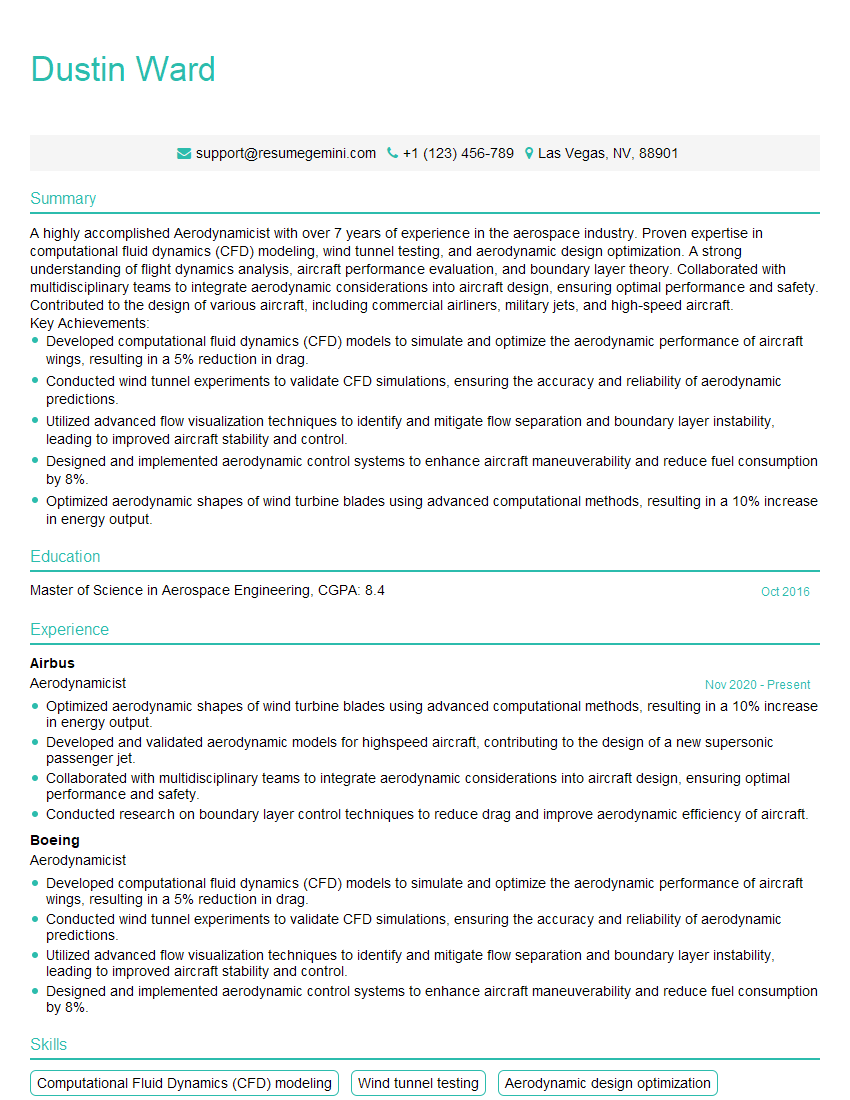
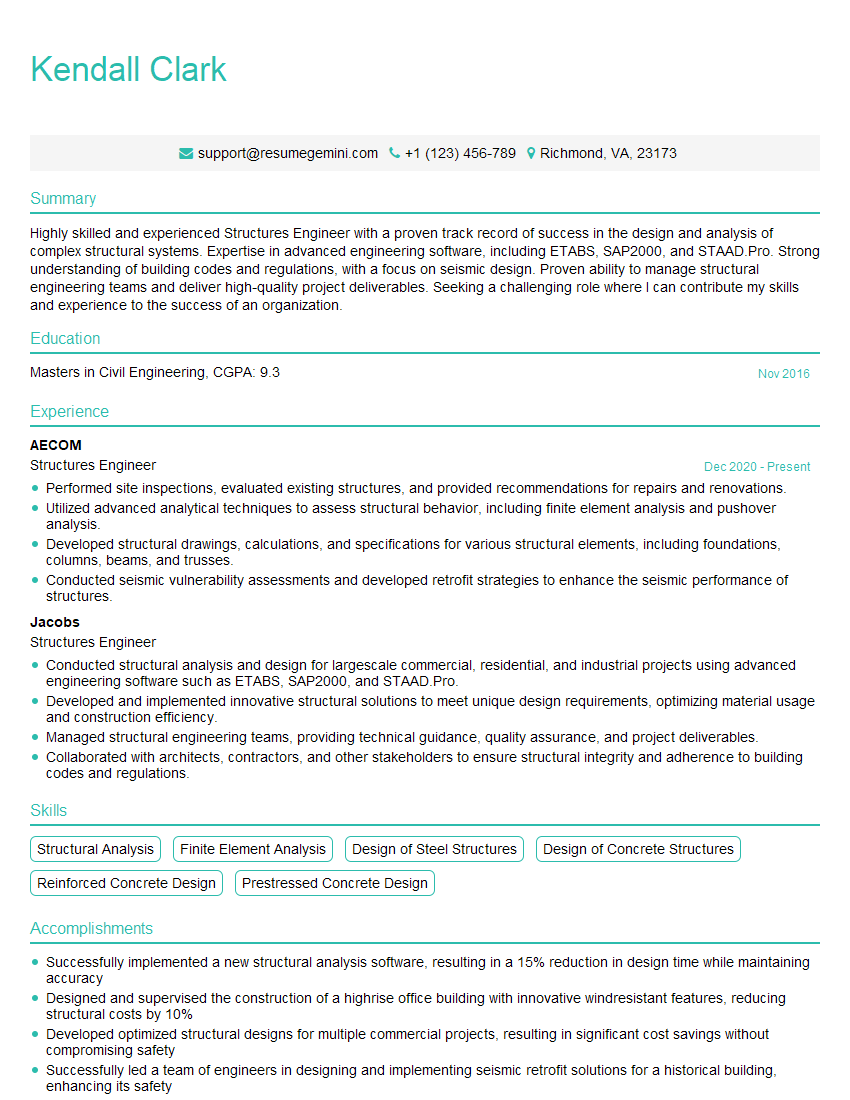
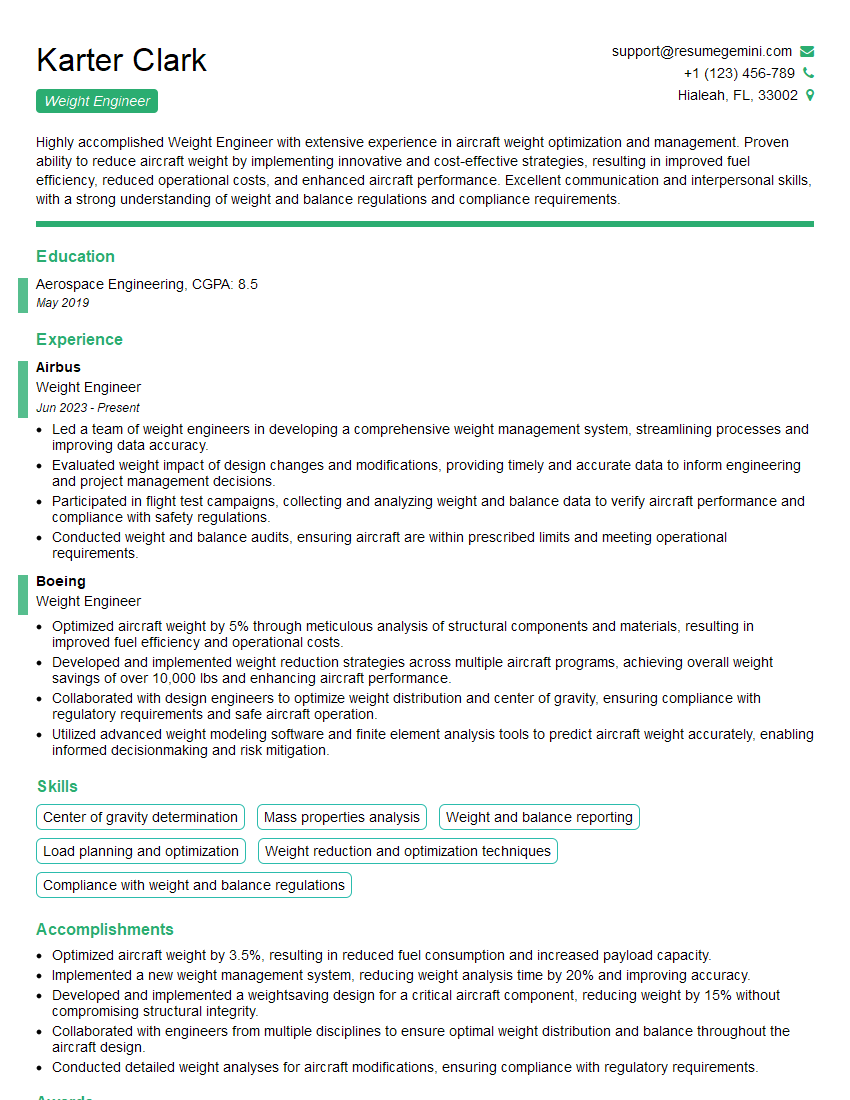
Mastering Airframe Design opens doors to exciting and impactful careers in the aerospace industry, offering opportunities for innovation and contributing to advancements in aviation technology. A well-crafted resume is crucial for showcasing your skills and experience to potential employers. Creating an ATS-friendly resume is vital to ensuring your application gets noticed. ResumeGemini is a trusted resource that can help you build a professional and impactful resume, maximizing your chances of landing your dream job. Examples of resumes tailored to Airframe Design are available to help guide your efforts.
Explore more articles
Users Rating of Our Blogs
Share Your Experience
We value your feedback! Please rate our content and share your thoughts (optional).
What Readers Say About Our Blog
Really detailed insights and content, thank you for writing this detailed article.
IT gave me an insight and words to use and be able to think of examples