Cracking a skill-specific interview, like one for Transmission Service, requires understanding the nuances of the role. In this blog, we present the questions you’re most likely to encounter, along with insights into how to answer them effectively. Let’s ensure you’re ready to make a strong impression.
Questions Asked in Transmission Service Interview
Q 1. Explain the difference between AC and DC transmission systems.
The core difference between AC and DC transmission lies in the direction of current flow. AC (Alternating Current) transmission involves current that periodically reverses direction, typically 50 or 60 times per second. DC (Direct Current) transmission, on the other hand, involves a unidirectional flow of current.
Think of it like a water pump: AC is like a pump that pushes and pulls water back and forth, while DC is like a pump that consistently pushes water in one direction. AC transmission historically has been more prevalent due to the ease of stepping up and down voltage using transformers, crucial for efficient long-distance power delivery. However, DC transmission is gaining popularity for long distances due to lower losses and the ability to interconnect AC systems with different frequencies.
Advantages of AC: Easier voltage transformation, established infrastructure.
Advantages of DC: Lower transmission losses over long distances, better for submarine cables and connecting AC grids with different frequencies.
Q 2. Describe the various types of transmission lines used in power systems.
Several types of transmission lines are employed in power systems, each suited to different voltage levels and applications:
- Overhead Lines: These are the most common type, consisting of conductors suspended on towers or poles. They are cost-effective for high-voltage, long-distance transmission but are susceptible to weather conditions and require extensive right-of-way. They can be further categorized based on the conductor configuration (e.g., single circuit, double circuit).
- Underground Cables: Used primarily in densely populated areas or where overhead lines are impractical. They offer better aesthetics and protection from weather but are more expensive to install and maintain, with higher losses than overhead lines.
- Submarine Cables: Specialized high-voltage cables used for underwater transmission, often connecting islands or countries. These cables require robust insulation and careful design to withstand the harsh underwater environment.
The choice of transmission line depends on factors like cost, environmental impact, voltage level, power capacity, and reliability requirements. For example, a long-distance high-voltage transmission line will likely use overhead lines, while a connection across a river might necessitate a submarine cable.
Q 3. What are the factors affecting the voltage drop in a transmission line?
Voltage drop in a transmission line is the reduction in voltage between the sending and receiving ends. Several factors contribute to this drop:
- Line Resistance (R): The inherent resistance of the conductors causes a voltage drop proportional to the current flowing through them (V = IR, Ohm’s law). Larger diameter conductors reduce resistance and voltage drop.
- Line Reactance (X): The inductive reactance of the line due to the magnetic field around the conductors. This is significant at higher frequencies and longer lines. It causes a voltage drop that’s not in phase with the current.
- Line Susceptance (B): The capacitive reactance between conductors and ground. At higher voltages and longer lines, this can become significant, partially offsetting the inductive reactance.
- Load Current (I): Higher load currents cause a larger voltage drop across the line resistance and reactance.
- Line Length (L): Longer transmission lines experience larger voltage drops.
Minimizing voltage drop is crucial for efficient power transmission. Techniques to mitigate voltage drop include using larger conductors, higher transmission voltages, and reactive power compensation (discussed later).
Q 4. Explain the concept of reactive power compensation in transmission systems.
Reactive power compensation involves improving the power factor of the transmission line by adding devices that either generate or consume reactive power. A low power factor means a significant portion of the current is used for magnetizing the line’s inductance rather than delivering real power to the load. This leads to increased line losses and reduced transmission efficiency.
Methods for Reactive Power Compensation:
- Shunt Capacitors: These devices provide reactive power to the line, offsetting the inductive reactance and improving the power factor. They are usually installed at strategic locations along the transmission line.
- Series Capacitors: These capacitors are connected in series with the line, reducing the line’s overall reactance, thereby reducing voltage drop.
- Static Synchronous Compensators (STATCOMs): These advanced devices use power electronic converters to provide both reactive and real power compensation, offering flexible and dynamic control.
- Synchronous Condensers: These are synchronous motors running without mechanical load, which can generate or absorb reactive power as needed.
By compensating for reactive power, we reduce losses, improve voltage stability, and increase the transmission capacity of the line. Imagine it as balancing a seesaw: reactive power compensation helps balance the inductive and capacitive elements, ensuring efficient power transfer.
Q 5. Describe different methods for power system protection and their applications.
Power system protection is crucial to ensure the safety of equipment and personnel and the reliable operation of the power system. Several methods are employed:
- Relays: These are electronic devices that monitor various parameters (current, voltage, frequency, impedance) and trip circuit breakers to isolate faulty sections of the system. Different types of relays are used for various faults (e.g., overcurrent, distance, differential relays).
- Circuit Breakers: These are electromechanical switches that rapidly interrupt the flow of current to isolate a faulty section. They are essential for quickly clearing faults and preventing cascading outages.
- Protective Relays and Circuit Breakers coordination: These work in tandem to ensure a fast and efficient clearing of faults. Accurate settings of relays and coordination between circuit breakers are critical to preventing unnecessary tripping and ensuring system stability.
- Busbars and transformers protection: Protection schemes are designed to safeguard crucial components like busbars (central points of connection in a substation) and transformers from damage during faults. Differential protection is commonly employed for these critical elements.
- Distance protection: This scheme utilizes the impedance measured along the transmission line to detect the fault location and isolate the faulty section. It is especially useful for long transmission lines.
The specific protection scheme employed depends on the type of equipment and the characteristics of the power system. A well-designed protection system is essential for the reliable and safe operation of any power grid.
Q 6. What is the purpose of a surge arrester in a transmission system?
A surge arrester, also known as a lightning arrester, is a protective device that limits voltage surges in a transmission system. These surges can be caused by lightning strikes, switching operations, or other transient events. The purpose is to divert the excessive voltage to the ground, protecting valuable equipment from damage.
Surge arresters typically use metal-oxide varistors (MOVs) that exhibit a non-linear voltage-current characteristic. Under normal operating conditions, the MOV has a high impedance and allows minimal current flow. However, when a voltage surge exceeds a certain threshold, the MOV’s impedance dramatically decreases, allowing the surge current to flow to ground. Once the surge subsides, the MOV returns to its high-impedance state.
Imagine a pressure relief valve in a boiler: It normally keeps the pressure contained, but when pressure gets too high, it opens to release the excess pressure and prevent an explosion. Similarly, a surge arrester protects the equipment by safely diverting excessive voltage.
Q 7. How does a transformer work in a transmission system?
Transformers are essential in transmission systems for stepping up and stepping down voltage levels. They use the principle of electromagnetic induction to change the voltage without significantly altering the power. This is crucial for efficient long-distance power transmission.
A step-up transformer increases the voltage at the generating station before transmission. This reduces the current, lowering the line losses (I²R losses are proportional to the square of the current). At the receiving end, a step-down transformer reduces the voltage to a safer and usable level for consumers.
How it works: A transformer consists of two coils (primary and secondary) wound around a common ferromagnetic core. When an alternating current flows through the primary coil, it creates a changing magnetic flux in the core. This changing flux induces a voltage in the secondary coil, whose magnitude is proportional to the ratio of the number of turns in the primary and secondary coils.
Voltage Ratio = (Number of turns in secondary coil) / (Number of turns in primary coil)
For instance, a step-up transformer with a 10:1 turns ratio will increase the voltage by a factor of 10 while reducing the current by a factor of 10 (assuming 100% efficiency).
Q 8. Explain the working principle of a circuit breaker.
A circuit breaker is essentially a safety switch that automatically interrupts the flow of electricity in a transmission line when a fault occurs. Imagine it as a highly sophisticated, lightning-fast fuse. It works on the principle of detecting abnormal current or voltage levels, indicative of a short circuit, overload, or ground fault. Once such an abnormality is detected, the breaker’s internal mechanism operates to quickly separate the contacts, breaking the circuit and preventing damage to equipment or injury to personnel.
The mechanism varies depending on the type of circuit breaker (e.g., oil circuit breaker, air circuit breaker, vacuum circuit breaker, SF6 circuit breaker), but generally involves a tripping mechanism activated by current or voltage transformers. These transformers sense the fault condition and send a signal to the tripping mechanism, which may involve magnetic coils, springs, or compressed air to physically separate the contacts. Arc extinction is crucial; the design of the circuit breaker helps to quench the arc formed when the contacts separate. This prevents reignition and ensures the fault is effectively cleared.
For example, in a power substation, circuit breakers are vital for isolating faulty sections of the transmission network. If a lightning strike causes a short circuit on a transmission line, the circuit breaker will rapidly disconnect the affected line, protecting the rest of the system.
Q 9. Describe the importance of insulators in transmission lines.
Insulators are critical components in transmission lines because they prevent the flow of electricity to ground. They act as barriers, ensuring that the high-voltage current remains confined to the conductors. Without insulators, the current would leak to the ground, causing significant power loss, potential fires, and safety hazards. Think of them as the pillars supporting the high-voltage lines, preventing the current from taking an unwanted shortcut to earth.
Different types of insulators are used depending on the voltage level and environmental conditions. Common types include porcelain, glass, and polymer insulators. Porcelain and glass insulators are known for their high dielectric strength and resistance to weather. Polymer insulators offer lighter weight and improved flexibility, making them suitable for certain applications.
Insulators are designed to withstand high voltages, mechanical stresses (from wind, ice, and vibrations), and environmental factors like rain and pollution. Their failure can lead to severe consequences, including power outages and system instability. Regular inspection and maintenance of insulators are therefore essential for the reliable operation of transmission lines.
Q 10. What is the significance of grounding in transmission systems?
Grounding in transmission systems is crucial for safety and protection. It provides a low-resistance path for fault currents to flow to the earth, preventing dangerous voltage buildup on equipment and protecting personnel. Without grounding, a fault could lead to high voltages on exposed metal parts, resulting in electric shock or equipment damage.
Grounding involves connecting various parts of the transmission system (e.g., towers, neutral points of transformers, equipment enclosures) to the earth through low-resistance conductors. This creates a safe path for fault currents to flow, allowing circuit breakers to quickly interrupt the fault. Effective grounding also helps to minimize the effects of lightning strikes and reduce voltage surges.
Imagine a scenario where a transmission line falls to the ground. If the system is properly grounded, the fault current will flow safely to the earth, preventing the dangerous voltages from appearing on nearby structures or equipment. However, if the grounding is inadequate, the voltage could spread, posing a serious risk to people and property.
Q 11. Explain the concept of power system stability.
Power system stability refers to the ability of the power system to maintain synchronism between generators and loads after a disturbance. In simpler terms, it’s the system’s ability to remain balanced and continue operating without significant voltage drops or frequency deviations following an event like a fault or a sudden change in load.
There are two main aspects of power system stability: angle stability and voltage stability. Angle stability concerns the ability of synchronous generators to remain in synchronism; it focuses on the rotor angles of generators. Voltage stability relates to the system’s ability to maintain acceptable voltage levels at all buses. Loss of stability can lead to cascading outages and widespread blackouts.
Maintaining stability involves various strategies including proper control of generation and load, robust transmission network design, and effective protection systems. Advanced control systems, such as power system stabilizers (PSS), are used to enhance stability by dampening oscillations in generator rotor angles. The study of power system stability employs sophisticated mathematical models and simulations to assess system strength and plan for contingencies.
Q 12. What are the different types of faults that can occur in a transmission line?
Several types of faults can occur in a transmission line, each having different characteristics and implications. These can be broadly classified as:
- Phase-to-ground fault: One phase comes into contact with the ground.
- Phase-to-phase fault: Two phases come into contact.
- Phase-to-phase-to-ground fault: Two phases and the ground are involved.
- Three-phase fault: All three phases come into contact (a short circuit).
The severity and impact of a fault depend on its type, location, and duration. Phase-to-ground faults are the most common, while three-phase faults are the most severe, causing the most significant disruption to the system. Protection systems in transmission lines are designed to detect and clear these faults quickly, minimizing their impact.
Q 13. How do you calculate the impedance of a transmission line?
Calculating the impedance of a transmission line depends on the line’s physical characteristics and the frequency of the operating current. The most common model is the ‘nominal π’ model, which represents the line as a π network with series impedance (Z) and shunt admittances (Y/2) at each end. The calculation involves the following parameters:
- Resistance (R): Determined by the conductor material and length.
- Inductance (L): Determined by the conductor geometry and spacing.
- Capacitance (C): Determined by conductor geometry and spacing.
The series impedance Z is calculated as Z = R + jωL, where ω is the angular frequency (2πf, where f is the frequency). The shunt admittance Y is calculated as Y = jωC. For longer lines, more sophisticated models like the ABCD parameters or distributed parameter models are often employed, which account for the variation of line parameters along the length. Specialized software packages are commonly used to perform these more complex calculations. For shorter lines, however, the simpler nominal π model often provides sufficient accuracy.
Q 14. Describe the methods for measuring transmission line parameters.
Several methods exist for measuring transmission line parameters, ranging from simple field measurements to sophisticated laboratory tests. Some common techniques include:
- Bridge methods: These methods use bridge circuits to measure the resistance, inductance, and capacitance of the line sections. Variations include the Maxwell bridge and the Schering bridge. These methods are suitable for shorter line segments.
- Time domain reflectometry (TDR): TDR sends a pulse of electromagnetic energy down the line, and by measuring the reflections, one can locate faults and determine line impedance. This method is widely used for fault location and assessing the overall condition of the line.
- Frequency domain measurements: These involve injecting a known current or voltage signal at one end of the line and measuring the response at the other. By analyzing the frequency response, one can determine the impedance parameters of the line. This method usually requires specialized equipment.
- Impedance relay testing: Protection relay testing involves injecting known currents and measuring the resulting voltages to indirectly assess the line parameters and to validate the proper operation of protective devices.
The choice of measurement method depends on factors like the length of the line, the required accuracy, and the available equipment. Modern techniques often incorporate sophisticated data acquisition and analysis systems for improved accuracy and efficiency.
Q 15. Explain the concept of load flow studies in power systems.
Load flow studies, also known as power flow studies, are fundamental analyses in power systems engineering. They determine the steady-state operating conditions of a power system network under a given load scenario. Imagine it like mapping the flow of water through a network of pipes; load flow studies do the same for electricity, showing how power is generated, transmitted, and consumed across the entire system.
These studies calculate key parameters at each bus (connection point) in the network, including voltage magnitude and angle, real and reactive power flow in lines, and line losses. This information is crucial for planning, operation, and control of the power system. For example, a load flow study might reveal that a particular transmission line is overloaded, prompting upgrades or alternative routing of power.
Different methods exist to perform load flow studies, including the Gauss-Seidel method and Newton-Raphson method. These methods iteratively solve a set of non-linear equations representing the power balance at each bus. Sophisticated software packages are used for these analyses, capable of handling large, complex power systems.
Career Expert Tips:
- Ace those interviews! Prepare effectively by reviewing the Top 50 Most Common Interview Questions on ResumeGemini.
- Navigate your job search with confidence! Explore a wide range of Career Tips on ResumeGemini. Learn about common challenges and recommendations to overcome them.
- Craft the perfect resume! Master the Art of Resume Writing with ResumeGemini’s guide. Showcase your unique qualifications and achievements effectively.
- Don’t miss out on holiday savings! Build your dream resume with ResumeGemini’s ATS optimized templates.
Q 16. What are the different types of transmission towers and their applications?
Transmission towers are designed to support high-voltage transmission lines, and their type depends on factors like voltage level, terrain, and environmental conditions. Some common types include:
- Lattice towers: These are the most common type, constructed from a framework of steel members. They’re versatile and can be adapted for various terrains and voltage levels. Think of them as strong, intricate metal scaffolding.
- Self-supporting towers: These are designed to stand independently, often used in areas with difficult terrain or where space is limited. They are self-sufficient and don’t require guy wires for stability.
- Guyed towers: These towers use guy wires (cables) anchored to the ground to provide stability. They’re typically taller and more slender than self-supporting towers, making them cost-effective for long spans in flat areas.
- Suspension towers: These are used to support the conductors at the turning points of the transmission line. They’re specifically designed to handle the changing angles of the wires.
The choice of tower type is a critical design consideration, balancing cost, structural integrity, and environmental impact. For example, in mountainous regions, self-supporting towers might be preferred for their stability, whereas in flat areas, guyed towers could be more cost-effective.
Q 17. What is the role of SCADA in transmission system monitoring and control?
Supervisory Control and Data Acquisition (SCADA) systems are the nervous system of modern transmission systems. They provide real-time monitoring and control of the entire network. Imagine a sophisticated dashboard showing the status of every component, from generating stations to substations and transmission lines.
SCADA systems collect data from various sensors and devices throughout the network, including voltage, current, power, and temperature. This data is then transmitted to a central control room, where operators can monitor the system’s performance and make adjustments as needed. For instance, SCADA allows operators to remotely switch lines, regulate voltage, and respond to faults, ensuring the stability and reliability of the power supply.
The system also includes sophisticated alarms and alerts, notifying operators of abnormal conditions. This allows for proactive intervention, preventing potential problems from escalating into widespread outages. SCADA systems are indispensable for efficient and safe operation of transmission networks, enhancing situational awareness and enabling quicker responses to disturbances.
Q 18. Explain the concept of FACTS devices and their benefits.
Flexible AC Transmission Systems (FACTS) devices are power electronic-based systems designed to enhance the controllability and efficiency of AC transmission systems. Think of them as advanced valves and regulators for the flow of electricity, allowing for fine-grained control over power transfer.
Examples of FACTS devices include Static Synchronous Compensators (STATCOMs), which control reactive power flow, and Thyristor-Controlled Series Compensators (TCSCs), which control the impedance of transmission lines. These devices can improve power transfer capability, enhance voltage stability, and mitigate oscillations. For instance, a TCSC can reduce the reactance of a long transmission line, allowing for more power to be transmitted without exceeding thermal limits.
The benefits of FACTS devices include increased transmission capacity, improved power quality, enhanced stability, and better utilization of existing transmission infrastructure. They are becoming increasingly important as power systems grow larger and more complex, and the demand for reliable power continues to increase.
Q 19. How do you troubleshoot a transmission line fault?
Troubleshooting a transmission line fault involves a systematic approach combining field observations, protective relay data, and network analysis. It’s like detective work, piecing together clues to pinpoint the problem’s location and cause.
The first step is to isolate the faulted section using protective relaying information, which provides data on the time and location of the fault. Next, field crews visually inspect the line for signs of damage, such as broken conductors, damaged insulators, or evidence of lightning strikes. Specialized equipment like fault locators are used to pinpoint the exact location of the fault along the transmission line.
Once the fault location is identified, the cause is determined (e.g., lightning strike, conductor galloping, tree contact, equipment failure). Appropriate repairs are then carried out, and testing ensures the line is safe and functioning correctly before being restored to service. Throughout the process, safety is paramount, employing strict procedures to prevent further damage or injury.
Q 20. What are the safety precautions you would take when working on a transmission line?
Safety is paramount when working on transmission lines. High-voltage electricity poses a lethal threat; mistakes are not an option. Precautions include:
- Lockout/Tagout procedures: Ensuring the line is completely de-energized and locked out to prevent accidental energization.
- Grounding: Thoroughly grounding the line to prevent any residual voltage from causing harm.
- Personal Protective Equipment (PPE): Using appropriate PPE, including insulated gloves, protective clothing, and safety helmets.
- Proper training and certification: All personnel must be trained and certified to work on high-voltage equipment.
- Safety briefings: Conducting thorough safety briefings before starting any work.
- Weather monitoring: Avoiding work during severe weather conditions.
Adherence to these rigorous safety protocols is not just a matter of compliance, but a commitment to the safety and wellbeing of all personnel involved.
Q 21. Describe your experience with transmission line maintenance and repair.
Throughout my career, I’ve been extensively involved in transmission line maintenance and repair. This includes planning and overseeing preventative maintenance schedules, responding to emergency repairs, and managing projects involving line upgrades and replacements. I have experience with various maintenance activities, from routine inspections and conductor cleaning to more complex repairs of damaged structures and conductors.
I’ve led teams in troubleshooting and resolving numerous transmission line faults, employing the methods I described earlier. For instance, one memorable project involved a lightning strike that caused extensive damage to a section of high-voltage transmission line. My team swiftly responded, using aerial lift platforms and specialized equipment to repair the damaged conductors and insulators, restoring power within the shortest possible timeframe while adhering to the strictest safety protocols. This experience strengthened my skills in fault analysis, coordination of resources, and managing complex projects under pressure. My proficiency in using specialized diagnostic tools and interpreting protective relay data is integral to efficiently resolving line outages.
Q 22. Explain your understanding of transmission line sag and tension calculations.
Transmission line sag and tension calculations are crucial for ensuring the structural integrity and safety of overhead power lines. Sag refers to the vertical distance between the conductor and its lowest point of support, while tension is the force exerted within the conductor. These are interdependent; increased tension reduces sag but risks exceeding the conductor’s breaking strength, while excessive sag can lead to ground clearance issues or conductor swaying in high winds.
The calculations involve several factors, including conductor weight, span length (distance between supports), temperature variations (affecting conductor length and hence sag), and wind and ice loading. We use catenary equations, which account for the curved shape of the conductor due to its weight, to model the line’s behavior. Simplified parabolic equations are sometimes used for approximation, especially in preliminary designs.
For example, imagine designing a line crossing a wide river. A longer span requires more careful consideration of sag and tension. We’d input the conductor’s properties (weight, tensile strength, material properties), the span length, expected wind and ice loads, and temperature variations into specialized software or utilize manual calculations based on the catenary equations. The output provides the optimal tension for a given sag, ensuring sufficient ground clearance while staying within the conductor’s safe operating limits. This process requires iterative adjustments to meet all constraints.
Addressing issues like uneven terrain or changes in elevation requires adjustments to the calculations. Specialized software packages can help model these complex scenarios and ensure an optimal, safe design.
Q 23. Describe different types of transmission line insulators and their characteristics.
Transmission line insulators are critical components, preventing current from flowing to the supporting tower and grounding the system. Various types cater to different voltage levels and environmental conditions.
- Pin Insulators: These are the simplest, consisting of a porcelain or glass insulator with a pin at the top and a groove at the bottom for conductor attachment. Suitable for lower voltage applications (up to 33 kV), they are cost-effective but vulnerable to flashover due to their relatively small creepage distance.
- Suspension Insulators: Used in high-voltage lines (above 33 kV), these consist of multiple disc insulators strung together. The arrangement increases the overall creepage distance, improving insulation strength. This design allows for flexibility in line configuration and easier maintenance and replacement of individual units.
- Strain Insulators: These are stronger and designed to withstand higher mechanical stresses at the dead-end or angle towers where tension is significantly higher. They are similar to suspension insulators in that they are composed of multiple units.
- Post Insulators: These are typically used in compact substations or where space is limited. They are strong and are designed to withstand high mechanical and electrical stresses. They have a single, solid body with a long creepage distance.
Each insulator type is characterized by its mechanical strength, electrical strength (flashover voltage), creepage distance (surface path length for current to flow around), and weather resistance. Selection depends on the voltage level, environmental conditions (pollution, humidity, altitude), and mechanical stresses imposed by the conductor.
Q 24. How do you ensure the reliability of a transmission system?
Ensuring transmission system reliability is paramount for maintaining a consistent power supply. This involves a multi-faceted approach encompassing proactive maintenance, robust design, and advanced monitoring systems.
- Regular Maintenance: Scheduled inspections, testing, and replacement of aging components are crucial. This includes visual inspections of conductors, insulators, and towers, as well as testing for insulation strength and conductor resistance.
- Redundancy and Protection: Designing the system with redundant lines and protective devices (circuit breakers, relays) ensures that a fault in one section doesn’t cause widespread outages. These systems quickly isolate faulty sections, minimizing disruption.
- Advanced Monitoring Systems: Implementing SCADA (Supervisory Control and Data Acquisition) systems allows real-time monitoring of system parameters, enabling early detection of potential issues. This proactive approach allows for timely intervention and prevents larger problems.
- Proper Grounding: A well-designed grounding system protects equipment from lightning strikes and other transient overvoltages, enhancing the overall system reliability.
- Environmental Factors: Addressing environmental risks such as lightning strikes, heavy snow, or extreme temperatures through proper design and maintenance is also crucial for reliability.
Reliability is often quantified by metrics such as SAIDI (System Average Interruption Duration Index) and SAIFI (System Average Interruption Frequency Index). Lower values indicate higher reliability.
Q 25. Explain your experience with transmission system planning and design.
My experience in transmission system planning and design spans over [Number] years, encompassing projects ranging from [Project scale/type] to [Another project scale/type]. I’ve been involved in all stages, from initial feasibility studies and load flow analysis to detailed design, route selection, and construction supervision.
A significant project involved the [Project description, highlighting challenges and solutions]. This included conducting load flow and stability studies using [Software names], optimizing conductor sizing and tower configurations to meet various environmental and load demands, and performing detailed cost-benefit analyses to identify the most economically viable solution. The project successfully delivered a reliable transmission line within budget and schedule.
I’m proficient in using various design standards and best practices, ensuring compliance with regulatory requirements. My approach emphasizes a holistic view, considering not just technical aspects but also environmental impacts, stakeholder concerns, and land acquisition challenges.
Q 26. What is your experience with using specialized software for transmission line analysis?
I have extensive experience using specialized software for transmission line analysis, including [List software names, e.g., PSS/E, CYME, PowerWorld Simulator]. My expertise covers various applications, such as:
- Load flow studies: Analyzing power flow and voltage profiles under various operating conditions.
- Fault analysis: Determining the impact of faults on system stability and protection coordination.
- Stability studies: Assessing the dynamic stability of the transmission system under various disturbances.
- Transient stability studies: Analyzing the system’s response to large disturbances like short circuits.
- Optimal power flow (OPF): Optimizing the operation of the system to minimize losses and improve efficiency.
I am adept at interpreting the results from these analyses to inform design decisions and ensure the system operates safely and reliably. For instance, I used [Software name] to optimize the placement of shunt capacitors in a [Project description] to improve voltage regulation and reduce power losses.
Q 27. Describe your experience with working on high-voltage transmission systems.
My experience with high-voltage transmission systems is extensive, focusing on [Mention specific voltage levels]. I’ve worked on projects involving the design, construction, and maintenance of [Types of projects, e.g., substations, transmission lines] operating at voltages ranging from [Voltage range]. This includes hands-on experience with high-voltage testing procedures and safety protocols, adhering to strict safety regulations to prevent accidents.
One notable experience involved [Project detail showing high voltage experience and safety measures implemented]. This project highlighted the importance of meticulous planning, thorough risk assessment, and robust safety procedures in high-voltage environments. We successfully commissioned the system without any safety incidents, showcasing my commitment to safe and efficient operations.
Q 28. Explain your understanding of the environmental impact of transmission lines.
Transmission lines, while crucial for energy delivery, have environmental impacts that must be carefully considered. These include:
- Visual Impact: The presence of tall towers and conductors can affect the visual landscape, particularly in scenic areas. Mitigation strategies involve careful route selection, using aesthetically pleasing tower designs, and integrating the lines into the environment.
- Habitat Fragmentation: Transmission lines can fragment wildlife habitats, affecting animal movement and ecosystem connectivity. Route selection should consider minimizing impacts on sensitive habitats, and mitigation measures may include wildlife crossings.
- Electromagnetic Fields (EMFs): Concerns exist about the potential health effects of EMFs generated by transmission lines. While scientific consensus points to minimal risks at current exposure levels, it’s crucial to adhere to safety standards and minimize EMF exposure where feasible.
- Right-of-Way Impacts: The land occupied by transmission lines and their associated access roads can impact land use and potentially disrupt agricultural activities. Careful land management and potentially using existing corridors are ways to mitigate this.
Environmental Impact Assessments (EIAs) are crucial for evaluating these potential impacts and developing appropriate mitigation strategies. My experience includes conducting and reviewing EIAs for transmission projects, ensuring compliance with environmental regulations and minimizing the overall ecological footprint.
Key Topics to Learn for Transmission Service Interview
- Power System Analysis: Understanding power flow, fault analysis, and stability studies is crucial. This forms the bedrock of Transmission Service operations.
- Transmission Line Parameters: Learn to calculate and interpret parameters like impedance, reactance, and capacitance. Practical application involves understanding their impact on power flow and voltage regulation.
- Protection and Control Systems: Familiarize yourself with relaying principles, protective devices, and SCADA systems. Be prepared to discuss real-world scenarios involving system protection and control.
- Substation Design and Operation: Understand the components and functionalities of various substation equipment, including transformers, circuit breakers, and switchgear. Be ready to discuss operational procedures and safety protocols.
- Power System Planning and Operation: Explore concepts related to transmission network expansion planning, optimal power flow, and economic dispatch. Practical application includes understanding grid management strategies.
- Renewable Energy Integration: Discuss the challenges and solutions associated with integrating renewable energy sources (solar, wind) into the transmission grid. This is a rapidly evolving area.
- High Voltage Engineering: Grasp fundamental principles of high voltage phenomena and insulation coordination. This is vital for understanding safety and equipment reliability.
- Power System Simulation Software: Familiarity with software tools used for power system analysis (e.g., PSS/E, PowerWorld Simulator) demonstrates practical skills and problem-solving abilities.
Next Steps
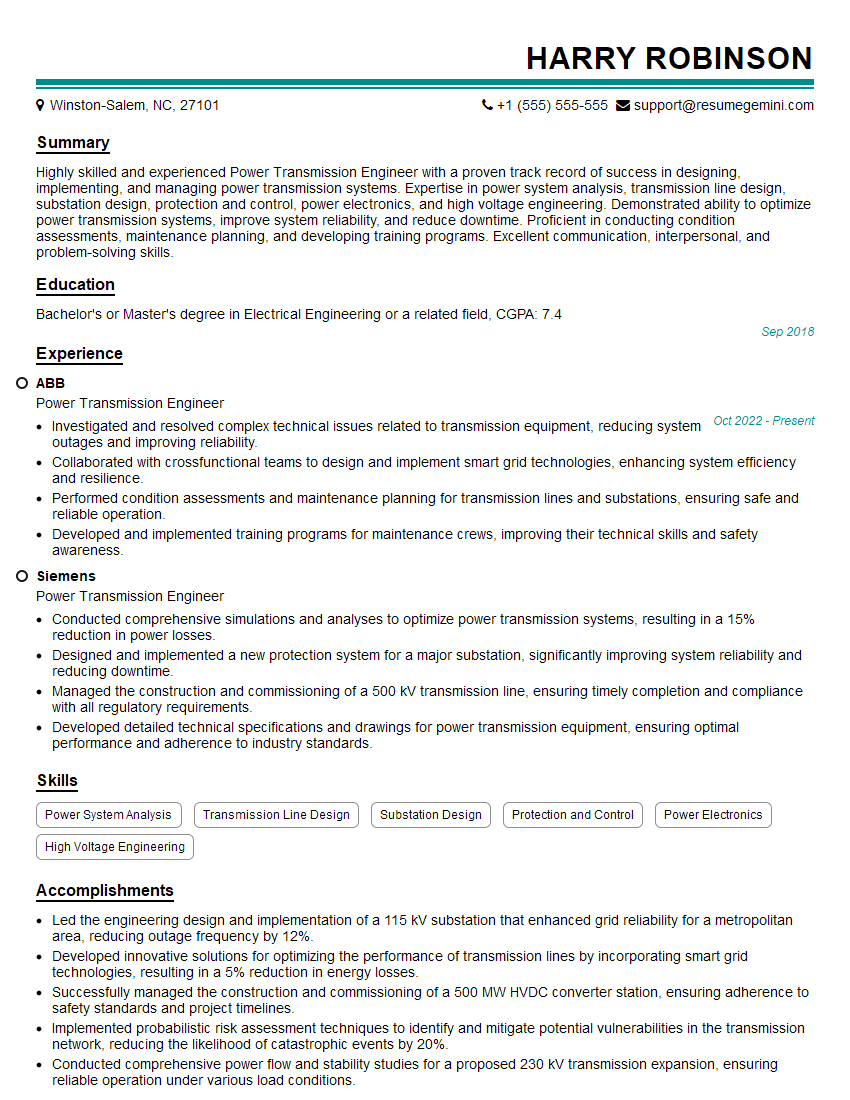
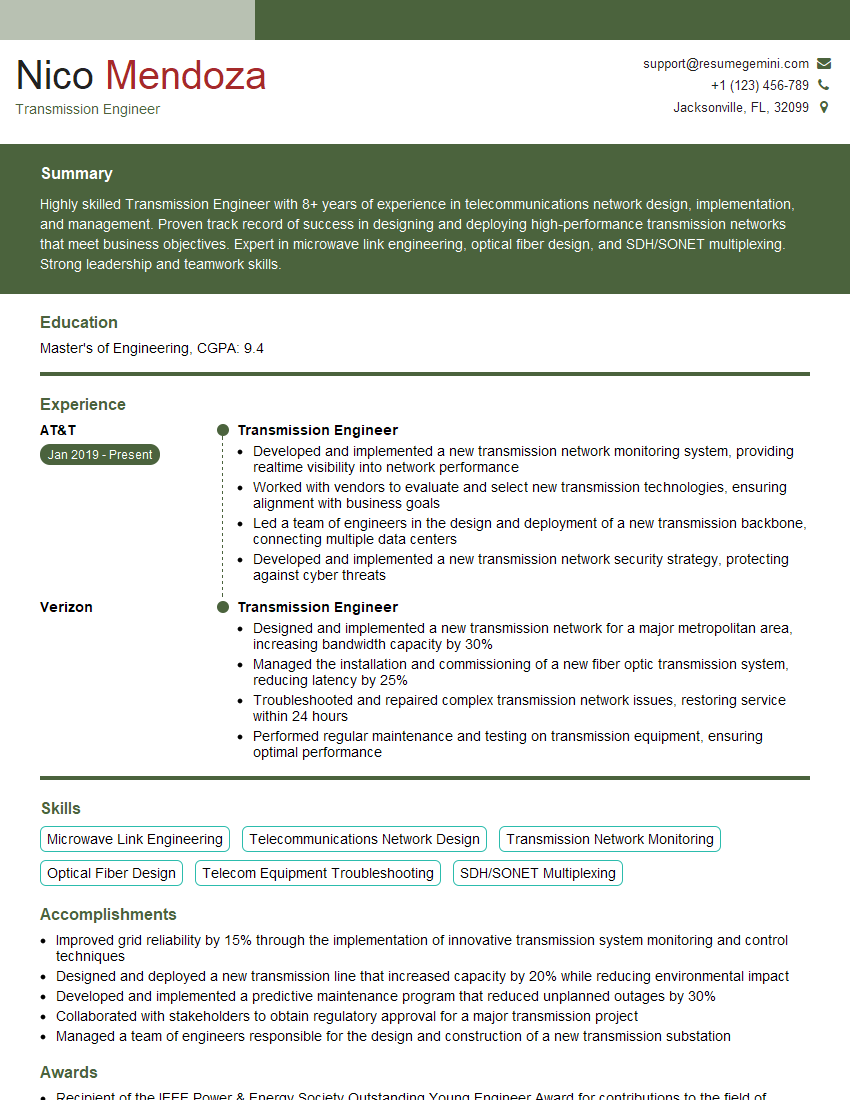
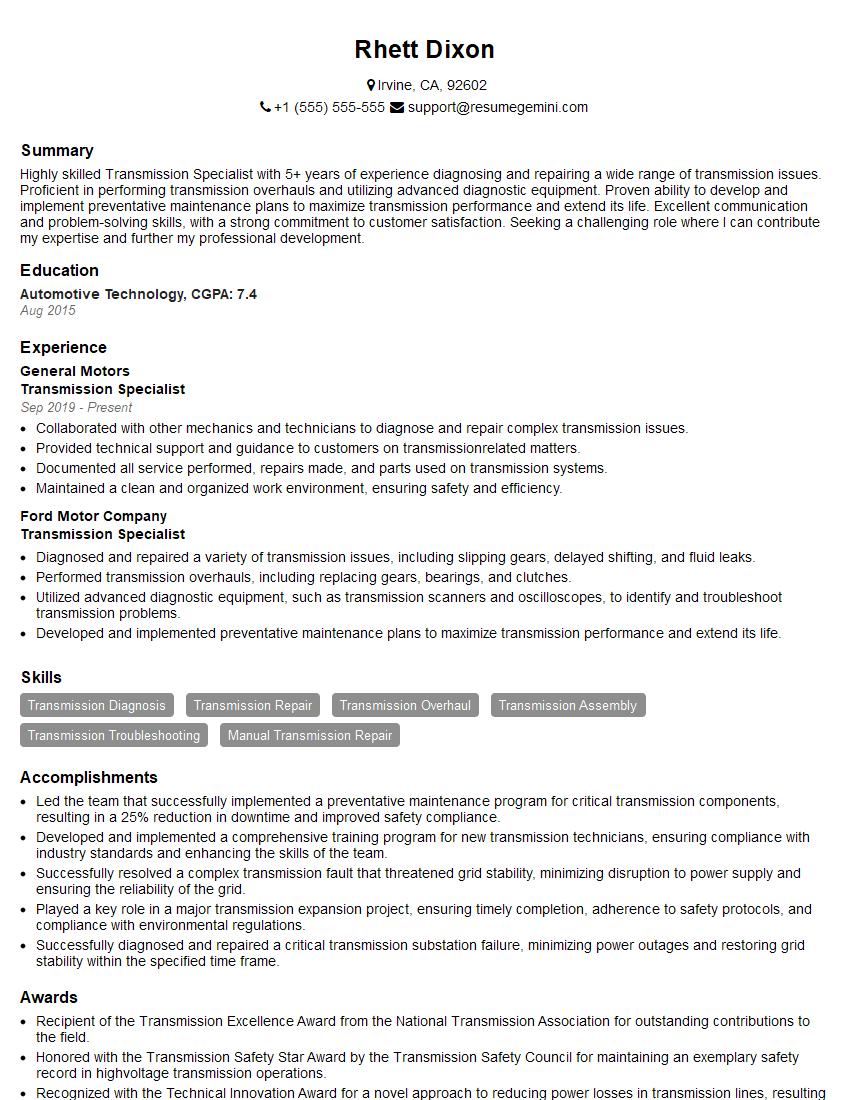
Mastering Transmission Service principles is vital for a successful and rewarding career in the power industry. It opens doors to diverse roles with excellent growth potential. To significantly enhance your job prospects, creating a strong, ATS-friendly resume is paramount. ResumeGemini is a trusted resource that can help you build a professional and impactful resume, tailored to highlight your skills and experience. Examples of resumes specifically designed for Transmission Service roles are available within ResumeGemini to guide you.
Explore more articles
Users Rating of Our Blogs
Share Your Experience
We value your feedback! Please rate our content and share your thoughts (optional).
What Readers Say About Our Blog
Really detailed insights and content, thank you for writing this detailed article.
IT gave me an insight and words to use and be able to think of examples