Are you ready to stand out in your next interview? Understanding and preparing for Audit Trail Analysis interview questions is a game-changer. In this blog, we’ve compiled key questions and expert advice to help you showcase your skills with confidence and precision. Let’s get started on your journey to acing the interview.
Questions Asked in Audit Trail Analysis Interview
Q 1. Explain the importance of maintaining a comprehensive audit trail.
Maintaining a comprehensive audit trail is paramount for several reasons. Think of it as a detailed logbook of everything that happens within a system. It’s crucial for ensuring accountability, maintaining data integrity, and facilitating investigations. A strong audit trail allows you to track user activities, system changes, and data modifications, providing a verifiable history of all events. This is essential for complying with regulations like GDPR and HIPAA, which mandate the ability to demonstrate data provenance and responsible data handling. Without a reliable audit trail, identifying the source of errors, security breaches, or fraudulent activities becomes nearly impossible, leading to significant financial and reputational damage.
For example, imagine a bank transaction where a large sum of money is unexpectedly transferred. A comprehensive audit trail allows investigators to trace the transaction back to its origin, identify the responsible party (if any), and determine whether it was authorized or fraudulent.
Q 2. What are the key components of a robust audit trail system?
A robust audit trail system comprises several key components working in concert. These include:
- Event Logging: Every significant event, like user logins, data modifications, system configuration changes, and security alerts, should be recorded. This forms the bedrock of your audit trail.
- Timestamping: Each event must be precisely time-stamped with sufficient granularity (e.g., milliseconds) to establish accurate sequencing.
- User Identification: Each event should be linked to a specific user account, ensuring accountability for actions performed.
- Source Information: The system component or application initiating the event should be recorded to identify the origin of the activity.
- Data Integrity Checks: Measures such as digital signatures or cryptographic hashes should be implemented to guarantee the integrity of the audit trail itself, preventing tampering or unauthorized alterations.
- Secure Storage: The audit trail data should be stored in a secure, immutable location, protected from unauthorized access and modification. Consider using write-once-read-many (WORM) storage for enhanced protection.
- Retention Policy: A clearly defined policy specifying the duration for which audit trail data needs to be retained is critical, considering legal and regulatory requirements.
Q 3. Describe different types of audit trails (e.g., database, application, system).
Audit trails aren’t monolithic; they vary depending on their scope and purpose. Here are some common types:
- Database Audit Trails: These trails track changes made to database records, including inserts, updates, and deletes. They often include information about the user, timestamp, and the specific data modified. A typical example would be recording every change made to a customer’s account information in a CRM database.
- Application Audit Trails: These logs track events within a specific application, encompassing user actions, workflows, and processing steps. For instance, an e-commerce application might log each step in an order processing workflow – from adding items to the cart to final payment confirmation.
- System Audit Trails: These trails monitor overall system events, such as login attempts, security failures, software updates, and system resource usage. This often includes information about system processes and their activity.
These types can overlap; a single event might be recorded in multiple audit trails.
Q 4. How do you ensure the integrity and reliability of an audit trail?
Ensuring audit trail integrity and reliability is paramount. This requires a multi-faceted approach:
- Immutable Storage: Utilize WORM storage to prevent modification of existing log entries.
- Digital Signatures: Employ digital signatures to cryptographically verify the authenticity and integrity of the log data.
- Hashing: Implement cryptographic hashing algorithms (e.g., SHA-256) to detect any tampering or unauthorized alterations.
- Access Control: Restrict access to the audit trail data to authorized personnel only.
- Regular Audits: Conduct periodic audits of the audit trail system itself to validate its functionality and security. This involves verifying the completeness, accuracy, and reliability of the recorded information.
- Log Management System: Implement a robust log management system that centralizes, analyzes, and securely stores the audit trail data. This system should facilitate efficient search, retrieval, and analysis of log entries.
Q 5. What are the common challenges in audit trail analysis?
Analyzing audit trails can present significant challenges:
- Data Volume: Modern systems generate massive amounts of audit data, making analysis computationally intensive and storage costly.
- Data Complexity: Audit data can be highly unstructured, making it challenging to correlate events and identify meaningful patterns.
- Data Silos: Audit data may reside in disparate systems, hindering comprehensive analysis.
- Lack of Standardization: Inconsistent logging practices across different systems make integrating and analyzing data difficult.
- Alert Fatigue: Too many alerts, many of which are false positives, can overwhelm security personnel and lead to a diminished response to genuine threats.
Q 6. How do you handle large volumes of audit trail data?
Handling large volumes of audit trail data effectively requires a strategic approach:
- Data Aggregation and Summarization: Aggregate and summarize data to reduce volume while retaining critical information. For instance, instead of storing every individual database query, summarize the number of queries per user per hour.
- Data Filtering and Indexing: Implement efficient filtering and indexing mechanisms to quickly locate specific events or patterns within the vast dataset. This might involve creating indices on critical fields like user ID, timestamp, or event type.
- Data Archiving: Archive older, less critical data to less expensive storage tiers, retaining only crucial information in readily accessible locations.
- Big Data Technologies: Employ big data technologies like Hadoop or Spark to process and analyze large datasets efficiently.
- Data Sampling: When necessary, employ statistically valid data sampling techniques to analyze a representative subset of the data, reducing computational load while still providing valuable insights.
Q 7. Explain the process of identifying and analyzing suspicious activities within an audit trail.
Identifying and analyzing suspicious activities involves a systematic process:
- Establish Baseline Behavior: Define normal system activity patterns by analyzing historical audit data. This helps establish thresholds for detecting anomalies.
- Develop Anomaly Detection Rules: Create rules to identify deviations from established baselines. For example, unusual login attempts from unfamiliar locations, sudden bursts of data access from a specific user, or significant changes to system configurations.
- Utilize Security Information and Event Management (SIEM): Employ a SIEM system to aggregate and correlate events from various sources, identifying potentially suspicious patterns.
- Correlation Analysis: Analyze related events across multiple audit trails to uncover connections and understand the context of suspicious activities. For example, an unusual database query followed by a file deletion might indicate malicious intent.
- Data Visualization: Utilize data visualization techniques to identify trends and patterns within the audit trail data, making it easier to spot suspicious behavior.
- Investigate and Validate: Investigate any identified anomalies thoroughly to determine whether they represent genuine threats or simply benign events.
Consider a scenario where a user suddenly accesses a large number of sensitive files shortly before leaving the company. This would trigger an alert, prompting further investigation to determine if this was authorized access or data exfiltration.
Q 8. What techniques do you use to correlate data from multiple audit trails?
Correlating data from multiple audit trails is crucial for building a complete picture of an event or activity. Think of it like piecing together a puzzle; each audit trail provides a piece of the picture. To effectively correlate this data, I employ several techniques. Firstly, I establish a common timeframe or event identifier. This allows me to align records across various systems. For example, if investigating a suspicious login attempt, I’d look for corresponding entries in the authentication logs, network logs, and application logs, all synchronized by timestamps.
Secondly, I use techniques such as pattern matching and anomaly detection. I search for consistent patterns or unusual deviations in behavior across different audit trails. For instance, a user accessing sensitive data followed by a failed login attempt from an unusual location might signal malicious activity. This requires analyzing log entries for repeated actions, sudden changes in activity, or accesses outside a typical user profile.
Thirdly, I leverage data enrichment. This involves adding context to the log entries by linking them to other data sources like user profiles, network devices, or geographic locations. This helps to fully understand the impact and nature of the event. For example, knowing the geographic location of a login attempt alongside the user’s usual login location provides crucial context.
Finally, I utilize specialized tools and scripting. These automate the process of data extraction, transformation, and correlation, enabling me to handle large volumes of data efficiently. Tools can identify relationships based on predefined rules or machine learning algorithms, making the process much faster and more comprehensive.
Q 9. How do you prioritize and investigate audit trail alerts?
Prioritizing and investigating audit trail alerts is a critical aspect of security monitoring. I use a risk-based approach, focusing first on alerts indicating high-impact events with a high likelihood of being malicious. This prioritization typically involves a scoring system that takes into account factors like the severity of the event, the affected system’s criticality, and the user’s privilege level.
For example, an alert indicating a root user logging in from an unknown location would receive higher priority than an alert for a standard user accessing a non-sensitive file. This high-priority alert would trigger an immediate investigation, perhaps involving checking security cameras or contacting the user directly.
My investigation process involves verifying the alert, gathering additional context, and analyzing the related audit trail entries. I meticulously document each step and conclusion. For lower-priority alerts, I may schedule them for later review or utilize automated responses if they meet predefined thresholds.
The process often involves using tools that provide visualization and analysis capabilities, helping me to quickly identify patterns and relationships amongst the alerts. This aids in efficient triage and prioritization, ensuring that critical threats are addressed promptly.
Q 10. Describe your experience with different audit trail analysis tools.
Throughout my career, I’ve gained experience with a variety of audit trail analysis tools. This includes SIEM (Security Information and Event Management) systems like Splunk, QRadar, and LogRhythm, which enable centralized log collection, correlation, and analysis. I’m also proficient with dedicated log management tools such as Graylog and ELK stack (Elasticsearch, Logstash, Kibana), which provide robust searching, filtering, and visualization capabilities.
For more specialized analysis, I’ve utilized tools designed for specific operating systems or applications. Furthermore, I’ve developed custom scripts and tools using languages like Python to automate repetitive tasks and extract specific data from various log formats, adapting to unique organizational needs. This versatility allows me to tailor my approach based on the environment and specific requirements.
My experience extends to working with both cloud-based and on-premise solutions. Understanding the nuances of each platform helps to ensure efficient and effective analysis, whether dealing with cloud logs from AWS, Azure or GCP, or on-premise systems running Windows or Linux.
Q 11. How do you ensure the confidentiality and security of audit trail data?
Ensuring the confidentiality and security of audit trail data is paramount. This involves implementing a multi-layered approach focusing on data encryption, access control, and regular security audits. Audit trail data should be encrypted both in transit and at rest to protect it from unauthorized access. Strong encryption algorithms are essential, and key management must follow strict security protocols.
Access to audit trail data should be strictly controlled using role-based access control (RBAC), granting access only to authorized personnel based on their job responsibilities. This principle of least privilege restricts access to only the data needed to perform specific tasks. Regular security audits and penetration testing should be conducted to identify and mitigate potential vulnerabilities.
Data retention policies must comply with legal and regulatory requirements, defining how long audit data needs to be kept. Once data is no longer required, it should be securely deleted, adhering to data sanitization best practices. Finally, regular monitoring for unauthorized access attempts and unusual activity is vital to ensure the continued integrity and confidentiality of the audit trail data.
Q 12. What are the legal and regulatory requirements related to audit trails?
Legal and regulatory requirements related to audit trails vary greatly depending on the industry, location, and specific regulations. For example, industries like finance (PCI DSS, SOX) and healthcare (HIPAA) have stringent requirements for data retention, access control, and data integrity related to audit logs. These regulations often mandate the retention of audit trails for a specific period and specify the information that must be included.
Other regulations like GDPR (General Data Protection Regulation) focus on data privacy and require organizations to demonstrate compliance with data protection principles, impacting how audit trail data related to personal information is handled. Understanding these requirements is critical for ensuring that audit trails are managed appropriately and that the organization is in compliance with all applicable laws and regulations. This involves staying informed about changes and updates to relevant regulations and ensuring that processes and technologies are aligned with these legal obligations.
Q 13. How do you document your audit trail analysis findings?
Documenting audit trail analysis findings is essential for demonstrating due diligence and providing evidence for investigations, audits, or legal proceedings. My documentation process involves creating a detailed report that clearly outlines the scope of the analysis, the methodologies used, and the key findings. This typically includes a summary of the investigation, a description of the events or anomalies detected, supporting evidence in the form of screenshots and log excerpts, and any conclusions or recommendations.
I follow a structured approach using a template to ensure consistency and completeness. This includes sections for the investigation’s objective, methodology, timeline of events, evidence, and conclusions. Clear and concise language is used, avoiding technical jargon unless necessary, and always defining any specialized terms. The report is tailored to the audience, with technical details included only where appropriate.
The documentation should be easily accessible and auditable, and any supporting evidence should be securely stored and version-controlled. This ensures that the findings remain verifiable and can be readily retrieved if needed for future reference.
Q 14. Explain your experience with different types of log formats.
My experience encompasses a wide range of log formats, including the common ones like syslog, Windows Event Log, and various application-specific logs. Syslog is a standard for system logging, using a simple, text-based format that’s widely used across different platforms. Windows Event Log employs a proprietary binary format, offering detailed information about system events. Application-specific logs can vary considerably depending on the application and its design, sometimes using proprietary formats or standard formats like JSON or XML.
Understanding these different formats is critical to effective analysis. This involves knowing how to parse and interpret different log entries, extracting relevant information, and adapting analysis techniques to accommodate the specific structure of each log format. I often utilize parser tools and scripting to handle different formats efficiently. This might involve using regular expressions for text-based formats or libraries specifically designed for parsing binary or XML/JSON formats.
Furthermore, I’m experienced with handling both structured and unstructured logs. Structured logs are easier to analyze as they follow a predefined schema, while unstructured logs often require more advanced parsing and data transformation techniques. My approach adapts to the characteristics of each format, leveraging appropriate tools and methodologies to extract meaningful insights.
Q 15. How do you interpret and analyze different log message types?
Interpreting and analyzing log message types requires a deep understanding of the system generating them. Different systems use different formats and levels of detail. My approach involves several steps. First, I identify the source of the log messages – is it a web server, database, operating system, or a security information and event management (SIEM) system? This determines the context. Next, I examine the message structure, looking for key fields like timestamp, user ID, source IP address, event type, and event details. I focus on the event type, categorizing messages as authentication attempts (successful or failed), file access events (read, write, delete), system changes (configuration modifications), network activity (connections, data transfer), and application-specific events. Finally, I correlate these messages with other logs to gain a complete picture of the event sequence. For example, a failed login attempt followed by a series of brute-force attacks clearly indicates a potential breach attempt.
Consider a web server log. A message like 2023-10-27 10:00:00 192.168.1.100 GET /admin/login.php 401 Unauthorized indicates an unauthorized access attempt to the administrative login page from a specific IP address. Conversely, 2023-10-27 10:05:00 192.168.1.101 POST /admin/login.php 200 OK shows a successful login. Analyzing this sequence helps me identify suspicious activities.
Career Expert Tips:
- Ace those interviews! Prepare effectively by reviewing the Top 50 Most Common Interview Questions on ResumeGemini.
- Navigate your job search with confidence! Explore a wide range of Career Tips on ResumeGemini. Learn about common challenges and recommendations to overcome them.
- Craft the perfect resume! Master the Art of Resume Writing with ResumeGemini’s guide. Showcase your unique qualifications and achievements effectively.
- Don’t miss out on holiday savings! Build your dream resume with ResumeGemini’s ATS optimized templates.
Q 16. What are the common indicators of compromise (IOC) found in audit trails?
Common Indicators of Compromise (IOCs) in audit trails are telltale signs of malicious activity. They can be broadly categorized into several types. Account activity is a crucial area: unusual login times or locations, multiple failed login attempts, access to sensitive files by unauthorized users, or sudden creation of numerous accounts are red flags. System changes can also indicate a compromise: unexpected modifications to system configurations, the appearance of unknown or suspicious processes, disabling of security features (like antivirus or firewall), or modification of system-critical files. Network activity often reveals compromise: suspicious network connections (especially to known malicious IP addresses or domains), unusual data transfer patterns (large outbound data transfers), and attempts to scan internal networks for vulnerabilities. Finally, data exfiltration attempts might reveal themselves through anomalous data access patterns or unusual data transfer methods. For instance, identifying a user account accessing files containing sensitive customer data outside normal working hours, or multiple unauthorized copies of these files being transferred to external IP addresses, clearly points to malicious activity.
Q 17. How do you use audit trail analysis to support incident response investigations?
Audit trail analysis is pivotal in incident response. It provides the chronological record of events leading up to, during, and after a security incident. My approach begins with identifying the scope of the incident. Then, I use the audit trail to reconstruct the sequence of events. This involves identifying the initial point of compromise, tracing the attacker’s actions, identifying compromised systems, and determining the extent of data exfiltration. The analysis helps to determine root cause and identify vulnerabilities that facilitated the attack. For example, if a ransomware attack occurred, I would analyze logs to identify how the attacker gained initial access, how they moved laterally within the network, and which systems were encrypted. This information is critical for remediation, recovery, and preventing future incidents.
In practice, this might involve querying the audit logs for specific events (e.g., all file access events within a specific time window) and correlating them with other sources such as network logs and security alerts. I might use tools like SIEM systems to efficiently search and analyze vast amounts of log data, visualize the timeline of events, and identify patterns of malicious activity.
Q 18. Describe your experience with data mining and pattern recognition techniques in audit trail analysis.
I have extensive experience using data mining and pattern recognition techniques to enhance audit trail analysis. This is crucial when dealing with large datasets and identifying subtle anomalies that might escape manual review. Techniques like anomaly detection algorithms (e.g., clustering, outlier analysis) can be used to identify unusual patterns in user behavior, access patterns, or system activities. For instance, a sudden spike in failed login attempts from a particular IP address can be flagged as an anomaly. Machine learning techniques, such as classification and regression models, can also be used to predict future security events. I employ data mining tools (e.g., Weka, RapidMiner) and programming languages (like Python with libraries like scikit-learn) to build and deploy these models. The results aid in proactively identifying potential threats and prioritizing security resources.
Q 19. How do you handle incomplete or missing audit trail data?
Incomplete or missing audit trail data is a common challenge in security analysis. My strategy involves a multi-pronged approach. First, I investigate the reasons for the data gaps. Is it due to log rotation policies, storage limitations, or intentional deletion? Understanding the cause helps determine the reliability of the remaining data. Secondly, I use data imputation techniques. This may involve filling in missing data points based on existing patterns, trends, and similar data. However, I’m cautious about using imputation, because it can introduce inaccuracies. Thirdly, I leverage contextual information from other sources like network logs, security alerts, or even eyewitness accounts, to reconstruct the missing parts of the audit trail as accurately as possible. Lastly, I clearly document the limitations imposed by missing data in my analysis reports, ensuring transparency and acknowledging potential uncertainties.
Q 20. How do you ensure the accuracy of your audit trail analysis?
Ensuring accuracy is paramount. My approach involves several key steps: validation of data sources – verifying the integrity and trustworthiness of the logs being analyzed. This includes examining log timestamps for inconsistencies, checking the reliability of log sources and ensuring that logs haven’t been tampered with, cross-referencing data across multiple log sources to identify discrepancies and ensure consistency, meticulous documentation of all assumptions and limitations made during the analysis process, and using appropriate tools and techniques for data analysis. For instance, utilizing automated data validation tools can detect and highlight inconsistent or anomalous data points. Peer review of the analysis is also crucial. Having another expert review the findings helps identify potential biases or errors, ensuring that the conclusions drawn are accurate and reliable. Finally, comparing analysis results with known ground truth data whenever possible validates the process.
Q 21. Explain your experience with different audit trail analysis methodologies.
My experience encompasses a range of audit trail analysis methodologies, including log file analysis (manual and automated), security information and event management (SIEM) analysis, and user and entity behavior analytics (UEBA). Log file analysis involves directly examining individual log files to identify patterns and anomalies. SIEM analysis leverages dedicated tools to aggregate and analyze logs from multiple sources, providing a comprehensive view of security events. UEBA uses machine learning to establish baseline behavior and identify deviations that could indicate malicious activity. The choice of methodology depends on the specific context, data available, and resources at hand. For example, in a small environment, manual log file analysis might suffice. However, large organizations often rely on SIEM and UEBA for comprehensive analysis. My experience spans both manual and automated techniques, empowering me to adapt to different environments and challenges effectively.
Q 22. How do you communicate your findings effectively to technical and non-technical audiences?
Communicating audit trail findings effectively requires tailoring the message to the audience. For technical audiences, I use precise terminology, detailed reports with technical specifications, and potentially code snippets illustrating anomalies. For non-technical audiences, I focus on the high-level impact, using clear, concise language and visualizations like charts or graphs to illustrate key findings. For example, instead of saying “The user account accessed unauthorized resources through a privilege escalation vulnerability,” I might explain to a non-technical audience: “Someone accessed data they shouldn’t have been able to, which could expose sensitive information.” The key is to translate technical jargon into plain language while retaining the core meaning and urgency.
- Technical Audience: Detailed reports, log analysis, code examples, technical diagrams
- Non-Technical Audience: Summary reports, visual dashboards, concise explanations of impact, avoiding technical jargon
Q 23. Describe a situation where you had to troubleshoot a problem related to audit trail data.
During a security audit for a large e-commerce platform, we noticed a significant drop in successful transactions logged in the audit trail during a specific time window. The standard reports didn’t pinpoint the cause. My troubleshooting involved several steps:
- Data Validation: I first checked for data corruption or missing entries in the audit logs.
- Correlation: I correlated the audit trail data with other system logs (e.g., web server logs, database logs) to find related events around the time of the transaction drop.
- Pattern Analysis: I analyzed the sequence of events to identify any anomalies. This revealed a spike in error messages from the payment gateway during that time frame.
- Root Cause Identification: I collaborated with the payment gateway support team, pinpointing a temporary outage on their end.
- Reporting: I documented the entire process, presenting my findings and recommendations in a clear report.
This case highlighted the importance of not just relying on a single data source but integrating information from various logs for comprehensive analysis.
Q 24. What are some best practices for designing an effective audit trail system?
Designing an effective audit trail system involves several key best practices:
- Comprehensive Logging: Capture all relevant events, including user actions, system changes, and security events. Think of it like creating a comprehensive history book for your system’s actions.
- Data Integrity: Ensure the audit trail data is tamper-proof, using mechanisms like digital signatures and checksums to prevent alteration or deletion. This ensures the data remains reliable.
- Data Retention Policy: Define a clear policy for how long audit trail data will be retained, considering compliance and security requirements. Balance the need for data retention with storage limitations.
- Efficient Storage and Retrieval: Choose appropriate storage mechanisms and indexing strategies for efficient querying and analysis. You don’t want to spend hours searching through gigabytes of logs.
- Granularity: Log events with appropriate detail. Too little detail makes analysis challenging, but excessive detail can lead to unmanageable log sizes.
- Security: Protect the audit trail system itself from unauthorized access or modification. Treat the audit trail like the crown jewels – extremely valuable and needing high-level protection.
- Automated Alerts: Set up alerts for critical events, allowing for timely responses to potential security incidents. This is like having a security guard actively monitoring the system.
Q 25. How do you stay updated with the latest trends and technologies in audit trail analysis?
Staying current in audit trail analysis requires a multi-faceted approach:
- Industry Publications: I regularly read journals and publications focusing on information security, audit, and compliance.
- Conferences and Webinars: Attending industry events and webinars provides exposure to the latest research, technologies, and best practices.
- Online Courses and Certifications: I pursue relevant online courses and certifications to deepen my technical expertise.
- Professional Networks: Engaging with peers and experts through professional organizations and online communities is crucial for sharing knowledge and insights.
- Hands-on Experience: I actively seek out opportunities to apply new techniques and technologies to real-world scenarios.
This ensures my skills remain relevant and adaptable to evolving technologies and threats in the field.
Q 26. How do you handle conflicting information from different audit trails?
Conflicting information from different audit trails is a common challenge. I address it through a systematic approach:
- Data Source Verification: I first validate the reliability of each audit trail source. Are the sources trustworthy? Are they properly configured?
- Timestamp Analysis: I carefully examine the timestamps of events in each audit trail to determine the chronological order of events and identify discrepancies.
- Correlation with Other Data: I correlate the audit trail information with other sources, such as system logs, security alerts, or network traffic data, to identify potential explanations for the discrepancies.
- Contextual Analysis: I consider the context in which the conflicting information arose. What were the system conditions at the time? What were the user actions?
- Reconciliation: I try to reconcile the conflicting information. If irreconcilable, I document the conflict and the reasons why, indicating the most likely scenario based on the available evidence.
This process helps to build a more complete and accurate picture of the events, even with conflicting data.
Q 27. Describe your experience with using scripting or programming languages for audit trail analysis.
I have extensive experience using scripting and programming languages for audit trail analysis. My go-to languages include Python and PowerShell. Python provides powerful libraries like pandas for data manipulation and analysis, and matplotlib for visualization. PowerShell excels in interacting with Windows systems and parsing Windows event logs.
For example, I’ve used Python to automate the collection, parsing, and analysis of security logs from multiple sources. This involved writing scripts to extract specific fields, filter out irrelevant data, and identify suspicious patterns. A snippet illustrating data extraction from a CSV log file using pandas would look like this:
import pandas as pd
df = pd.read_csv('security_log.csv')
suspicious_events = df[(df['event_type'] == 'access_denied') & (df['user'] == 'unknown')]
print(suspicious_events)
This automated the tedious process, significantly improving efficiency and accuracy.
Key Topics to Learn for Audit Trail Analysis Interview
- Understanding Audit Trail Fundamentals: Defining audit trails, their purpose, and the different types (e.g., database, system, application).
- Data Integrity and Security: How audit trails ensure data integrity and contribute to a robust security posture. Explore concepts like non-repudiation and accountability.
- Analyzing Audit Trail Data: Practical application of data analysis techniques (e.g., filtering, sorting, aggregation) to extract meaningful insights from audit logs. Consider various data formats and structures.
- Identifying Security Threats and Anomalies: Learning to recognize patterns indicative of malicious activity, unauthorized access, or data breaches within audit trail data.
- Regulatory Compliance and Standards: Understanding relevant industry standards and regulations (e.g., SOX, HIPAA) and how audit trails support compliance efforts.
- Tools and Technologies: Familiarity with common audit trail analysis tools and technologies used in various environments (e.g., SIEM systems, log management platforms).
- Effective Reporting and Communication: Presenting findings clearly and concisely, both verbally and in written reports, to technical and non-technical audiences.
- Problem-Solving and Critical Thinking: Developing strong analytical skills to effectively investigate incidents, identify root causes, and propose solutions based on audit trail data.
Next Steps
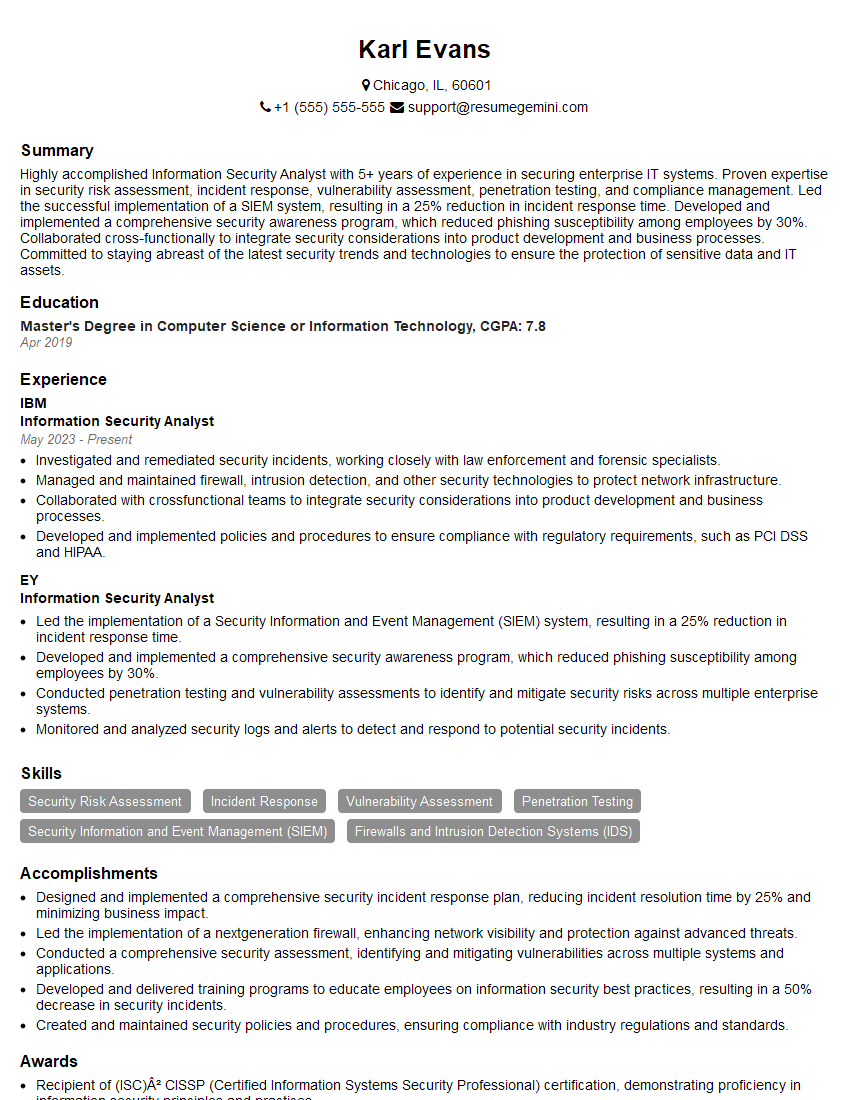
Mastering Audit Trail Analysis significantly enhances your career prospects in cybersecurity, IT auditing, and compliance. It demonstrates a crucial skillset highly valued by employers. To maximize your job search success, focus on creating an ATS-friendly resume that highlights your relevant skills and experience. ResumeGemini is a trusted resource to help you build a professional and impactful resume. We offer examples of resumes tailored to Audit Trail Analysis to provide you with a strong foundation for your job search. Take the next step towards your dream career – build a compelling resume that showcases your expertise in this in-demand field.
Explore more articles
Users Rating of Our Blogs
Share Your Experience
We value your feedback! Please rate our content and share your thoughts (optional).
What Readers Say About Our Blog
Really detailed insights and content, thank you for writing this detailed article.
IT gave me an insight and words to use and be able to think of examples