The thought of an interview can be nerve-wracking, but the right preparation can make all the difference. Explore this comprehensive guide to Automotive Styling interview questions and gain the confidence you need to showcase your abilities and secure the role.
Questions Asked in Automotive Styling Interview
Q 1. Describe your experience with different automotive styling software packages (e.g., Alias, Rhino, VRED).
My experience spans several leading automotive styling software packages. I’m highly proficient in Alias Automotive, a cornerstone in the industry, leveraging its powerful surfacing tools for creating Class-A surfaces – the smooth, high-quality surfaces required for production vehicles. I’ve extensively used its sculpting and modeling capabilities for everything from initial concept explorations to highly detailed final designs. Rhino, with its versatility, has been instrumental in early-stage concept development and creating complex geometries, particularly beneficial for exploring unconventional design language. Finally, VRED has been crucial in the visualization and rendering process, allowing for photorealistic representations of my designs, complete with materials and lighting, to effectively communicate concepts to clients and engineering teams. I’ve used VRED to create high-quality renderings, animations, and virtual reality experiences that allow clients to virtually interact with the vehicle.
For instance, on a recent project, I used Alias to create the highly sculpted surfaces of a luxury SUV, Rhino to model the intricate details of its grille, and VRED to present the final design in a captivating virtual showroom environment. This integrated approach allowed for a highly efficient and effective design process.
Q 2. Explain your understanding of automotive design trends and future styling directions.
Automotive design trends are constantly evolving, driven by technological advancements, shifting consumer preferences, and environmental concerns. Currently, we’re seeing a move towards more streamlined and aerodynamic designs, often incorporating subtle curves and sharp creases. Sustainability is a major driver, with a focus on lightweight materials and efficient aerodynamics to improve fuel economy. Personalization is also a key trend, with manufacturers offering more options to customize vehicles to individual tastes.
Future styling directions point towards greater integration of technology. We can expect to see more autonomous driving features integrated into the design, leading to a shift in interior layouts and exterior aesthetics. Advanced materials like bioplastics and carbon fiber will play a larger role, further impacting both design and manufacturing processes. The integration of augmented reality and virtual reality into the ownership experience will also inform future styling choices, ensuring seamless integration between the physical and digital worlds. I believe that a balance between futuristic elements and timeless design language will be crucial in the coming years, creating vehicles that are both exciting and enduring.
Q 3. How would you approach designing a car for a specific target demographic?
Designing for a specific demographic requires deep market research and a thorough understanding of their lifestyle, values, and aspirations. I start by creating detailed buyer personas, outlining their demographics, psychographics, and needs. For example, a design for young urban professionals might prioritize features like connectivity, advanced technology, and stylish aesthetics, while a design for families might prioritize spaciousness, safety, and practicality.
This understanding informs every aspect of the design, from the overall proportions and stance to the choice of colors, materials, and interior features. I then translate these insights into a design language that resonates with the target audience, ensuring that the vehicle’s styling communicates the desired message effectively. For example, a vehicle targeting environmentally conscious consumers would prioritize eco-friendly materials and a sleek, aerodynamic design. A sports car targeting thrill-seekers would use aggressive lines and a low, wide stance.
Q 4. Discuss your experience with creating and presenting design concepts.
My experience encompasses all aspects of creating and presenting design concepts, from initial sketching and digital modeling to the final presentation to clients and stakeholders. I’m adept at creating compelling presentations that effectively communicate the design’s intent, functionality, and aesthetic appeal. My presentations typically include mood boards, initial sketches, 3D renderings, and detailed technical specifications. I use storytelling to connect with the audience, highlighting the design’s unique selling points and addressing potential challenges.
I find that presenting a design in multiple formats – physical models, digital renderings, and virtual reality experiences – maximizes audience engagement and enhances understanding. I believe in actively listening to feedback and incorporating constructive criticism to continuously improve the design. For example, I once used a clay model alongside digital renders to showcase the form and feel of a new sedan’s design, allowing the audience to physically interact with the design in addition to seeing high-resolution images and animations. This multi-faceted approach helped secure client approval.
Q 5. How do you balance aesthetic appeal with functionality and engineering constraints in automotive design?
Balancing aesthetics with functionality and engineering constraints is a critical aspect of automotive design. It’s a constant iterative process involving close collaboration with engineering and manufacturing teams. Aesthetic appeal is paramount, but it cannot come at the expense of functionality or manufacturability. For example, a stunning design might require complex manufacturing processes that are cost-prohibitive, or it might compromise safety features.
My approach involves early and ongoing communication with engineers to understand the limitations and possibilities. I use digital modeling software to constantly check for feasibility, ensuring the design is not only visually striking but also structurally sound and aerodynamically efficient. Sometimes compromises are necessary, requiring a delicate balance between preserving the core aesthetic vision and meeting engineering requirements. For example, I might need to adjust the shape of a door panel to accommodate an airbag, but in doing so, I’d ensure this adjustment still retains the intended design language, even if slightly modified.
Q 6. Explain your process for creating a 3D model of a vehicle, from initial sketches to final renderings.
My process for creating a 3D model begins with initial sketches, exploring various design directions and capturing the essence of the vehicle’s form. These sketches are then refined and translated into a 3D model using software like Alias. I start with a basic form, gradually refining the surfaces and details to achieve the desired level of precision.
The next step involves creating Class-A surfaces, ensuring smooth and highly accurate representations ready for manufacturing. Throughout the process, I continually check for feasibility and address potential manufacturing constraints in collaboration with the engineering team. Finally, the model is rendered using software like VRED, creating photorealistic images and animations that effectively showcase the design to clients and stakeholders. The entire process is iterative, refining the design through numerous cycles of modeling, rendering, and feedback.
Q 7. Describe your experience with material selection for automotive interiors and exteriors.
Material selection for both automotive interiors and exteriors is a critical aspect of the design process. The choice of materials significantly impacts the vehicle’s aesthetics, durability, cost, and environmental impact. For exteriors, I consider factors like durability, weather resistance, scratch resistance, and recyclability. Materials like high-strength steel, aluminum, and carbon fiber are often used, each with its own advantages and disadvantages.
For interiors, the focus shifts towards tactile appeal, comfort, and safety. Materials such as leather, Alcantara, wood, and various plastics are carefully selected based on their texture, feel, and durability. Sustainability is increasingly important, with a move towards using recycled materials and reducing the environmental footprint of the manufacturing process. I often work closely with material suppliers to explore innovative and sustainable options that meet both design and performance requirements. I recently worked on a project where we sourced recycled ocean plastics for interior trim pieces, reducing our environmental impact and creating a unique aesthetic for the vehicle’s interior.
Q 8. How do you ensure your designs are ergonomically sound and user-friendly?
Ergonomics is paramount in automotive design. It’s about creating a vehicle that’s not only visually appealing but also comfortable, safe, and intuitive to use. I ensure ergonomic soundness by integrating human factors research throughout the design process. This involves:
- Anthropometric data analysis: Using data on human body dimensions and movements to ensure sufficient space for drivers and passengers of varying sizes and builds. This includes headroom, legroom, and reach to controls.
- Mock-up and physical prototyping: Creating scale models and full-size mockups allows for physical testing and iterative improvements based on user feedback. We use these to evaluate driver posture, visibility, and the accessibility of controls.
- Usability testing: Observing individuals interacting with the design to identify areas for improvement. This involves tasks like adjusting seats, using the infotainment system, and accessing storage compartments.
- Virtual reality (VR) and human-machine interface (HMI) simulations: Using VR allows us to test the design in a realistic environment before physical prototypes are created, significantly reducing development costs and time. HMI simulations help us evaluate the intuitiveness and ease of use of various controls.
For example, on a recent project, usability testing revealed that the placement of the climate control buttons was not intuitive. By repositioning them based on user feedback, we significantly improved the user experience and overall ergonomic design.
Q 9. How familiar are you with the design process of various vehicle types (e.g., SUV, sedan, sports car)?
My experience encompasses the design process for a range of vehicle types, each with its unique design considerations:
- Sedans: Focus on aerodynamic efficiency, sleek lines, and a balance between luxury and practicality. The design often prioritizes fuel efficiency and a refined driving experience.
- SUVs: Emphasize versatility, robustness, and spaciousness. Design considerations include maximizing interior space, providing a commanding driving position, and incorporating features for off-road capability (where applicable).
- Sports cars: Prioritize performance and aesthetics. The design emphasizes low center of gravity, aerodynamic optimization, and aggressive styling cues to convey speed and agility.
The design process, however, follows a similar structure across all vehicle types: initial concept sketches, digital modeling (using software like Alias and CATIA), clay modeling, wind tunnel testing, and final production design. The specific emphasis and priorities shift depending on the vehicle’s intended use and target market.
Q 10. How do you incorporate sustainability considerations into your automotive design process?
Sustainability is no longer a ‘nice-to-have’ but a necessity. I integrate sustainability considerations through the entire design process, from initial concept to final production. This includes:
- Lightweighting: Using lightweight materials (e.g., aluminum, carbon fiber, advanced high-strength steel) to reduce vehicle weight, improving fuel efficiency and reducing emissions.
- Aerodynamic optimization: Designing for reduced drag to improve fuel economy. This includes features like active aero elements and optimized body shapes.
- Material selection: Choosing sustainable and recyclable materials, reducing reliance on resource-intensive materials.
- Design for disassembly and recyclability: Designing components for easy disassembly at the end-of-life to facilitate recycling and minimize waste.
- Reducing waste during manufacturing: Collaborating with manufacturing engineers to optimize processes, minimize material waste, and improve energy efficiency.
For instance, I recently worked on a project where we explored the use of recycled plastics in interior components, reducing reliance on virgin materials and minimizing environmental impact.
Q 11. Describe your experience collaborating with engineering and manufacturing teams.
Collaboration is crucial in automotive design. I’ve extensively worked with engineering and manufacturing teams throughout my career. My approach emphasizes clear communication and a shared understanding of project goals. This includes:
- Regular meetings and design reviews: Presenting designs to engineering and manufacturing teams, incorporating their feedback and addressing any feasibility concerns early in the process.
- Data sharing and digital collaboration tools: Utilizing platforms for seamless data exchange and feedback, ensuring everyone is working from the same design information.
- Joint problem-solving: Working collaboratively to overcome design challenges and finding solutions that balance aesthetics, functionality, and manufacturing constraints.
- Understanding manufacturing processes: Having a good understanding of manufacturing capabilities and limitations informs the design choices, ensuring the final design is feasible and cost-effective to produce.
In one project, the initial design required a complex and costly manufacturing process. By collaborating with manufacturing engineers, we were able to simplify the design, reducing costs and lead times without compromising the aesthetics or functionality.
Q 12. Explain your understanding of different styling cues and their impact on brand identity.
Styling cues are the visual elements that contribute to a vehicle’s overall appearance and brand identity. These can include:
- Grill design: Often a key brand identifier, representing the brand’s personality and heritage.
- Headlight and taillight signatures: Unique shapes and light patterns that are instantly recognizable.
- Character lines: Sculptural lines that run along the vehicle’s body, creating a sense of movement and dynamism.
- Proportions and stance: The overall shape and silhouette of the vehicle, contributing to its visual appeal and conveying performance or luxury.
Understanding how these cues impact brand identity is crucial. For example, a sporty brand might use aggressive lines and large wheels to convey performance, while a luxury brand might focus on elegant curves and sophisticated details. I ensure that the design elements I incorporate align with the brand’s overall aesthetic and target market, reinforcing its identity and creating a cohesive visual language across its model range.
Q 13. How do you handle design critiques and feedback?
Design critiques are an integral part of the process; they are opportunities for growth and improvement. I approach feedback constructively, viewing it as a valuable tool for refining the design. My approach includes:
- Active listening: Paying close attention to the feedback, clarifying any ambiguities, and understanding the rationale behind the critique.
- Open-mindedness: Considering all feedback objectively, even if it challenges my initial ideas.
- Iterative design process: Using feedback to iterate on the design, making adjustments and improvements based on constructive criticism.
- Documenting changes and rationale: Keeping a record of all design changes and the reasoning behind them, ensuring transparency and traceability.
I find it useful to visualize and analyze the feedback visually. Sometimes sketching different alternatives can be very helpful in understanding the effectiveness of proposed changes.
Q 14. Describe a challenging automotive design project and how you overcame it.
One particularly challenging project involved designing a compact SUV with stringent aerodynamic requirements while maintaining a bold and distinctive design language. The initial designs struggled to balance these conflicting goals, resulting in either a compromised aesthetic or poor aerodynamic performance. To overcome this, we employed the following strategies:
- Computational Fluid Dynamics (CFD) simulations: Used CFD software to test various design iterations, optimizing the body shape and minimizing drag without sacrificing visual appeal.
- Wind tunnel testing: Physical wind tunnel testing validated the CFD results and provided more detailed data on airflow patterns.
- Cross-functional collaboration: Close collaboration with aerodynamics engineers was crucial in finding design compromises that satisfied both aesthetic and aerodynamic requirements.
- Iterative design refinement: Multiple iterations of design changes were made based on the CFD and wind tunnel data, gradually optimizing the design until we reached an acceptable balance.
The final design successfully achieved both excellent aerodynamic performance and a visually striking appearance, showcasing the importance of iterative design and collaboration in overcoming challenging design constraints.
Q 15. How would you design a vehicle to meet specific safety regulations and crash test standards?
Designing a vehicle to meet safety regulations and crash test standards is a multi-faceted process that begins even before the first sketch. It involves a deep understanding of the specific regulations (like those from NHTSA or Euro NCAP) and the physics of impact. We need to strategically engineer the vehicle’s structure to effectively absorb and redirect crash energy, minimizing the impact on occupants.
This starts with the selection of high-strength steel or other advanced materials like aluminum or carbon fiber for critical areas like the A-pillars, B-pillars, and side sills. These materials are positioned to create a rigid ‘safety cage’ around the cabin. Computer simulations, using finite element analysis (FEA) software, play a crucial role in predicting crash behavior before physical testing. These simulations allow us to virtually ‘crash’ the vehicle thousands of times, optimizing the structure to meet various impact scenarios (frontal, side, rollover). The design of crumple zones, strategically engineered areas designed to deform and absorb energy, is equally crucial. They’re designed to progressively collapse, extending the time of the impact and reducing the force transmitted to the passenger compartment. Finally, passive safety features like airbags and seatbelts are integrated with the overall structural design, working in concert to protect the occupants.
For example, designing a reinforced cross-member under the dashboard to manage frontal impacts is a direct application of this process. Similarly, strategically placed side impact beams in the doors aim to protect occupants from side collisions. It’s an iterative process – simulations lead to design refinements, followed by physical crash testing to validate the results. Meeting the standards involves a combination of smart material selection, advanced simulation tools, and rigorous testing.
Career Expert Tips:
- Ace those interviews! Prepare effectively by reviewing the Top 50 Most Common Interview Questions on ResumeGemini.
- Navigate your job search with confidence! Explore a wide range of Career Tips on ResumeGemini. Learn about common challenges and recommendations to overcome them.
- Craft the perfect resume! Master the Art of Resume Writing with ResumeGemini’s guide. Showcase your unique qualifications and achievements effectively.
- Don’t miss out on holiday savings! Build your dream resume with ResumeGemini’s ATS optimized templates.
Q 16. Discuss your understanding of aerodynamics and its impact on automotive design.
Aerodynamics plays a pivotal role in automotive design, influencing not only fuel efficiency but also vehicle stability, handling, and even noise levels. Essentially, it’s about understanding how air flows around the vehicle and how we can manipulate that flow to our advantage.
A streamlined shape, minimizing drag, is key to better fuel economy. This is often achieved through careful shaping of the body, with features like curved surfaces, and underbody panels to manage airflow underneath the car. The drag coefficient (Cd) is a key metric, lower values indicating better aerodynamic performance. Think of it like swimming – a streamlined body cuts through the water with less resistance, just as a streamlined car cuts through the air.
Beyond fuel efficiency, aerodynamics impacts high-speed stability. We need to manage lift, the upward force generated by air pressure, especially at higher speeds. Conversely, downforce, a downward force, can enhance grip and handling, particularly in high-performance vehicles. Features like spoilers, diffusers, and carefully designed underbody panels can be used to generate downforce, pressing the car to the road. Lastly, aerodynamic design also contributes to noise reduction by minimizing wind noise and turbulence around the vehicle. Every curve, every panel, is a considered effort to create a harmonious interaction between the vehicle and the surrounding air. A classic example is the difference between the boxy shape of older vehicles and the sleek, rounded designs of modern cars – the latter significantly reduces drag.
Q 17. Explain your familiarity with different manufacturing processes (e.g., stamping, molding).
My familiarity with manufacturing processes is essential to my design work. A designer who doesn’t understand manufacturing limitations creates impractical designs. I’m well-versed in several key processes.
- Stamping: This is a crucial process for creating sheet metal parts of the car’s body. I understand the limitations of stamping dies, including the maximum size and complexity of shapes that can be efficiently produced. I also consider material thickness and the potential for springback – the slight deformation that occurs after stamping – during the design phase. The design must be optimized for efficient die creation and minimal material waste.
- Molding: This includes various techniques like injection molding (for plastic parts), blow molding (for hollow parts), and casting (for metal parts). Understanding the properties of different plastics and metals is critical here. Design choices depend on the part’s function, aesthetics, and desired tolerances. The design must account for mold filling, shrinkage, and ejection systems. For example, complex undercuts in a design could require more complex and costly molds.
- Other processes: I also have a working knowledge of extrusion, machining, and other techniques used in automotive manufacturing. This holistic understanding enables me to make informed design decisions that are both aesthetically pleasing and feasible from a production perspective.
For example, a sharp edge on a stamped part might be impractical to manufacture efficiently, requiring a design modification that retains the aesthetic appeal while using a more manufacturable radius. This constant awareness of the manufacturing process ensures that the final product is not only beautiful but also producible and cost-effective.
Q 18. How do you use sketching and rendering to communicate design ideas effectively?
Sketching and rendering are fundamental communication tools for automotive designers. They’re more than just pretty pictures; they’re powerful tools for conveying design intent, exploring concepts, and communicating with engineers and stakeholders.
Sketching is the initial phase, a rapid exploration of ideas. Rough sketches allow for quick iterations and the capturing of initial concepts. It’s a fluid process, ideal for capturing initial proportions, shapes, and overall design language. I use various sketching techniques, depending on the stage of the design process. Looser sketches allow for rapid exploration of various ideas, while tighter sketches help refine and communicate specific details. Rendering, on the other hand, takes the sketches to a more realistic representation, giving a better sense of the final product’s form, materials, and color. Digital rendering software allows for precise control over lighting, textures, and materials, creating highly realistic visualisations that are crucial for presenting the designs to stakeholders and obtaining feedback.
For instance, a simple quick sketch can capture the basic profile and proportions of a new car, while a full digital rendering can showcase the final design’s details, including the reflections on the car’s surfaces and the subtle curves of its body panels, significantly enhancing the presentation and facilitating efficient communication with the entire project team.
Q 19. What are some key design elements you consider when creating a car’s exterior?
Designing a car’s exterior involves a careful balance of aesthetics, functionality, and aerodynamics. Several key design elements are considered:
- Proportions: The overall visual balance of the car. This includes the relationship between the wheelbase, overhangs, height, and width. A well-proportioned car feels naturally balanced and visually appealing.
- Surface treatment: The shaping of the body panels, employing curves, creases, and lines to create visual interest and direct the flow of air around the vehicle. This element significantly contributes to the car’s aerodynamics and aesthetics.
- Character lines: These are strong visual lines that run along the car’s body, often reflecting its underlying structure and giving it a distinct identity. They can guide the eye and create a sense of dynamism or elegance.
- Headlights and taillights: These are key elements that define the car’s personality and style. They are designed not just for functionality, but also as strong visual elements.
- Wheels and tires: Wheels contribute significantly to the car’s overall aesthetic appeal, complementing the overall design. They enhance the car’s visual stance and often project specific design messages.
- Brand identity: The design needs to integrate elements that reflect the brand’s overall design language and values.
For instance, a sporty car might feature sharp, aggressive lines and prominent air intakes, while a luxury car might prioritize smooth, flowing surfaces and understated elegance.
Q 20. How would you design a user-friendly and aesthetically pleasing vehicle interior?
Designing a user-friendly and aesthetically pleasing interior requires understanding ergonomics and human-centered design principles. It’s about creating a space that is both functional and enjoyable to be in.
Ergonomics plays a crucial role in the placement of controls and the overall layout. Controls should be intuitive to use, within easy reach, and clearly labeled. The driver’s seating position is paramount, ensuring comfort and good visibility. The use of high-quality materials is key to creating a premium feel, while the selection of color and trim should create a harmonious and aesthetically pleasing environment. Space optimization is important, balancing passenger comfort with storage space and features. Features like infotainment systems and climate control need to be intuitive and easy to operate. Careful consideration must be paid to ambient lighting to add a sense of luxury or practicality, based on the intended audience and vehicle style. Furthermore, the integration of various elements, from the dashboard layout to the choice of materials, must create a visually cohesive and pleasing experience.
For example, the placement of the gear shifter, the ergonomics of the steering wheel, and the easy access to climate control buttons all impact the user experience. A well-designed interior considers these details alongside the overall visual appeal, creating a functional and visually engaging cabin space.
Q 21. Explain your approach to creating a cohesive color and trim palette for a vehicle.
Creating a cohesive color and trim palette is a crucial aspect of automotive design, impacting both the interior and exterior aesthetics and conveying the brand’s identity and the car’s personality. The process often begins with defining the car’s overall character and target market. A luxurious vehicle might have a palette quite different from a sporty vehicle.
Color psychology plays a significant role. Colors evoke emotions and create associations. For example, blues and greens can convey feelings of calm and sophistication, while reds and oranges can suggest excitement and energy. The color choice is usually driven by market research and trend analysis, aiming to appeal to the intended customer base. The trim materials — leather, wood, fabric, metal — are selected to complement the color palette and reflect the vehicle’s target price point and image. The combination of colors and trims create a visual harmony, enhancing the aesthetic experience. Sustainability aspects, such as the use of recycled or eco-friendly materials, are also considered, in line with increasing consumer preference for environmentally conscious products. The final palette is often presented as a series of mood boards showcasing various material options and color combinations.
For example, a high-performance vehicle might utilize bold colors like racing red or electric blue, accented by carbon fiber or aluminum trim, whereas a family sedan could employ more subdued colors like silver, grey, or beige, paired with softer materials like plush fabrics.
Q 22. What are your thoughts on the current state of automotive lighting design?
Automotive lighting design is undergoing a dramatic transformation, moving beyond mere functionality to become a key element of a vehicle’s identity and user experience. We’re seeing a shift from traditional halogen and incandescent bulbs to highly sophisticated LED and laser technologies, enabling intricate designs and dynamic lighting features.
Current trends include the increasing use of adaptive headlights that adjust beam patterns based on driving conditions, signature daytime running lights (DRLs) that instantly identify a brand, and integrated lighting systems that seamlessly blend with the car’s bodywork. Think of the intricate light signatures of the Audi e-tron GT or the futuristic designs found on many electric vehicles. These designs not only enhance visibility and safety but also contribute significantly to the vehicle’s aesthetic appeal and brand recognition.
However, challenges remain. The miniaturization of components while maintaining high light output and energy efficiency is a constant pursuit. Additionally, regulatory compliance regarding light intensity and beam patterns requires careful consideration throughout the design process.
Q 23. How familiar are you with human-machine interface (HMI) design in vehicles?
My experience with HMI design in vehicles is extensive. I understand that a well-designed HMI is crucial for a safe and enjoyable driving experience. It’s not just about aesthetics; it’s about intuitive controls, clear information displays, and minimal distraction. I’m familiar with various HMI design principles, including usability testing, ergonomic considerations, and the importance of minimizing cognitive load on the driver.
I’ve worked with a range of HMI technologies, including touchscreens, voice control systems, head-up displays (HUDs), and instrument cluster designs. For instance, in a recent project, we optimized the placement and size of buttons and controls on the center console based on driver reach and visibility studies. We also integrated a gesture control system for certain functions, enhancing ease of use without taking the driver’s eyes off the road.
My focus is always on minimizing driver distraction. This involves thoughtful placement of information and controls, prioritizing critical information and using clear visual hierarchies. I believe the future of HMI is in seamless integration of different technologies, creating a cohesive and intuitive user experience.
Q 24. Describe your experience with creating digital mock-ups and virtual reality simulations.
Digital mock-ups and VR simulations are integral to my design process. I’m proficient in software such as Alias, Rhino, and Keyshot, along with VR platforms like VRED and Unreal Engine. These tools allow me to create highly realistic representations of vehicle designs, from early concept sketches to detailed renderings.
I leverage digital mock-ups to explore various design options quickly and efficiently, iterating on designs before committing to physical prototypes. This saves time and resources. VR simulations allow me to experience the design from the driver’s perspective, identifying ergonomic issues and potential usability problems early on. For example, I recently used VR to evaluate the visibility and accessibility of controls in a concept vehicle, leading to significant improvements in the design. The ability to quickly iterate and test in the virtual space makes this a pivotal part of the modern design pipeline.
Q 25. How would you design a car for improved accessibility?
Designing for improved accessibility requires a user-centered approach, focusing on the needs of drivers and passengers with various physical limitations. This involves considering factors such as reach, strength, vision, and dexterity. My approach involves a multi-faceted strategy.
- Ergonomic Controls: Optimizing the placement and size of controls to be easily reachable and operable by individuals with limited reach or dexterity. This includes adjustable pedals, steering wheels, and seats.
- Enhanced Visibility: Incorporating features like larger, clearer instrument clusters and displays, with adjustable font sizes and high contrast color schemes for individuals with visual impairments.
- Auditory Feedback: Integrating clear and informative audio cues for various functions, assisting users who rely less on visual information.
- Adaptive Technologies: Exploring the integration of adaptive technologies such as voice control, gesture recognition, and haptic feedback, providing alternative methods of interaction.
For example, I would consider incorporating adjustable ramps for wheelchair access and wide-opening doors to improve ease of entry and exit. The overall design philosophy must prioritize ease of use and intuitive operation for all users.
Q 26. Describe your experience working with clients to translate their vision into a design.
Collaborating with clients is a crucial aspect of my work. I believe in a strong client-designer relationship built on open communication and mutual understanding. My process begins with thoroughly understanding the client’s vision, including their brand identity, target market, and technical requirements. I use active listening and questioning techniques to uncover their needs and expectations.
Once I have a clear grasp of the brief, I present initial concept sketches and digital mock-ups, followed by iterative refinement based on client feedback. I present ideas clearly and concisely, making sure to explain my design choices and justify them based on design principles and practical considerations. I value constructive criticism and use it to refine the design. I believe in fostering an environment where the client feels comfortable expressing their ideas and concerns, ensuring the final product accurately reflects their vision and meets their expectations. One memorable project involved extensive workshops with the client team to define the key emotional drivers for the vehicle’s design, leading to a highly successful and satisfying result.
Q 27. How do you stay up-to-date on the latest automotive design innovations?
Staying current in automotive design requires a multifaceted approach. I regularly attend industry conferences, such as the North American International Auto Show (NAIAS) and design festivals, to observe the latest trends and technological advancements. I follow industry publications like Automotive News and Car Design News, and subscribe to relevant design blogs and websites.
I also actively engage with online communities and professional networks, participating in discussions and exchanging ideas with other designers and engineers. Furthermore, I constantly explore new design software and technologies, keeping abreast of innovations in digital modeling, rendering, and simulation. This constant engagement with the field ensures I remain at the forefront of automotive design and can translate that knowledge into innovative design solutions.
Q 28. Discuss your understanding of intellectual property rights in automotive design.
Understanding intellectual property rights (IPR) is vital in automotive design. I’m aware of various forms of IPR protection, including patents, trademarks, and design rights. Patents protect inventions, while trademarks protect brand names and logos. Design rights protect the aesthetic aspects of a product, such as the shape, configuration, and ornamentation of a vehicle.
In my work, I always ensure that designs are developed while respecting existing IPR. This includes conducting thorough prior art searches to avoid infringement and collaborating with legal counsel to secure appropriate protection for original designs. Protecting intellectual property ensures the originality and value of design work, safeguarding both my work and my clients’ investments. Understanding and adhering to these regulations is crucial for ethical and successful operations in the automotive design industry.
Key Topics to Learn for Automotive Styling Interview
- Automotive Design Principles: Understanding fundamental design elements like form, proportion, balance, and visual weight as applied to vehicles. Practical application includes sketching and 3D modeling exercises demonstrating these principles.
- Exterior Styling & Aerodynamics: Exploring the interplay between aesthetic appeal and aerodynamic efficiency. Practical application involves analyzing existing vehicle designs and proposing improvements in both form and function.
- Interior Design & Ergonomics: Focusing on creating comfortable and functional interiors. Practical application includes understanding human factors and designing layouts optimized for driver and passenger experience.
- Material Selection & Surface Treatment: Knowledge of various materials used in automotive design (plastics, metals, composites) and their surface treatments (painting, texturing). Practical application involves selecting appropriate materials based on cost, durability, and aesthetic requirements.
- CAD Software Proficiency: Demonstrating expertise in industry-standard software like Alias, Rhino, or SolidWorks. Practical application includes showcasing your skills through portfolio pieces or case studies.
- Sketching & Visualization Techniques: Effective communication of design ideas through sketching and rendering. Practical application involves presenting your design concepts clearly and persuasively.
- Design Trends & Market Research: Staying updated on current trends and understanding consumer preferences. Practical application includes using market research to inform design decisions and justify choices.
- Collaboration & Communication: Effectively working with engineers, marketing teams, and other stakeholders. Practical application involves demonstrating your ability to present and defend your design choices.
- Problem-Solving & Creative Thinking: Addressing design challenges creatively and efficiently. Practical application involves discussing your approach to resolving design constraints within given parameters.
Next Steps
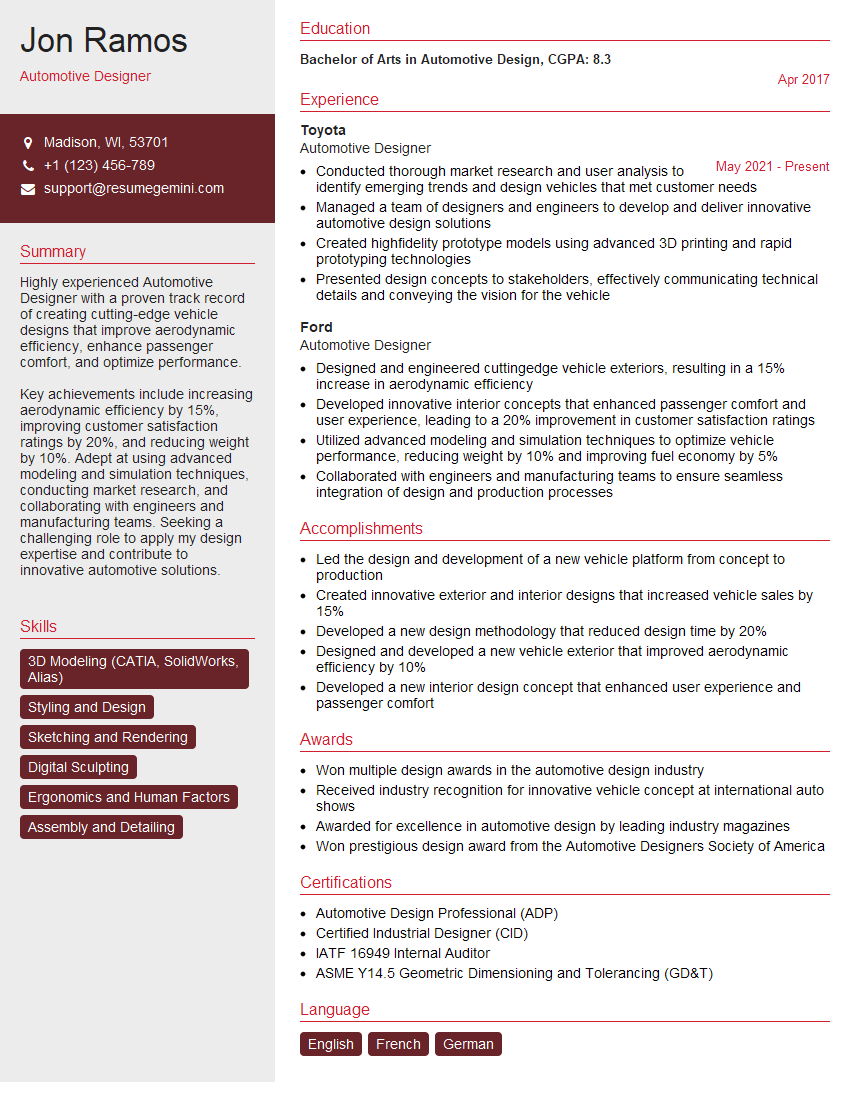
Mastering automotive styling opens doors to a rewarding career with significant growth potential, offering opportunities in design studios, manufacturing companies, and even independent consulting. To maximize your chances of landing your dream job, creating an ATS-friendly resume is crucial. ResumeGemini can significantly enhance your resume-building experience, helping you craft a professional and impactful document that highlights your skills and achievements effectively. We provide examples of resumes tailored specifically to the Automotive Styling field to guide you.
Explore more articles
Users Rating of Our Blogs
Share Your Experience
We value your feedback! Please rate our content and share your thoughts (optional).
What Readers Say About Our Blog
Really detailed insights and content, thank you for writing this detailed article.
IT gave me an insight and words to use and be able to think of examples