Every successful interview starts with knowing what to expect. In this blog, we’ll take you through the top Avionics System Troubleshooting interview questions, breaking them down with expert tips to help you deliver impactful answers. Step into your next interview fully prepared and ready to succeed.
Questions Asked in Avionics System Troubleshooting Interview
Q 1. Explain the troubleshooting process for an inoperative transponder.
Troubleshooting an inoperative transponder begins with understanding the system’s basic operation. A transponder receives interrogations from ground radar and transmits a coded reply, identifying the aircraft. The troubleshooting process is systematic, moving from simple checks to more complex diagnostics.
- Visual Inspection: Start with a visual check of the transponder unit itself, looking for obvious damage, loose connections, or indicator lights that might provide clues.
- Power Check: Verify that power is reaching the transponder. This often involves checking fuses, circuit breakers, and the aircraft’s main power bus.
- Mode Check: Confirm that the transponder is set to the correct mode (e.g., Standby, TA, RA). An incorrect mode setting is a surprisingly common cause of apparent failure.
- Antenna Check: Examine the transponder antenna for damage or misalignment. A faulty or improperly connected antenna can significantly impair performance.
- Test Equipment: Utilize specialized test equipment, such as a transponder tester, to verify the unit’s functionality. This equipment can simulate ground radar interrogations and check the quality of the transmitted replies.
- Log Book Review: Consult the aircraft’s maintenance log book to see if there’s a history of transponder issues, potentially suggesting a recurring problem or a specific component failure.
- Consult Schematics: If the problem persists, refer to the aircraft’s maintenance manuals and schematics to trace the transponder’s wiring and identify potential points of failure.
For example, I once encountered a seemingly inoperative transponder where the issue was simply a blown fuse. A quick fuse replacement restored full functionality, highlighting the importance of starting with the simplest checks. Another time, a faulty antenna connection was the culprit, which could have been easily overlooked without a thorough visual inspection.
Q 2. Describe your experience with diagnosing and resolving GPS navigation system issues.
Diagnosing GPS navigation system issues requires a methodical approach, combining theoretical knowledge with practical experience. The first step is usually identifying the nature of the malfunction: Is there no GPS signal at all, is the signal weak or intermittent, or are the position data inaccurate?
- Signal Strength Check: Start by assessing the GPS signal strength. A weak or absent signal suggests problems with the antenna, its cabling, or atmospheric interference.
- Antenna Integrity: Examine the GPS antenna for physical damage, obstructions, or improper installation. Even slight misalignment can dramatically impact signal reception.
- Power Supply: Verify that the GPS receiver is receiving adequate power. Low voltage can lead to erratic performance or complete failure.
- Internal GPS Receiver Diagnostics: Modern GPS units often have built-in diagnostic capabilities that can identify internal faults or errors. This frequently includes error codes that can be looked up in the system’s maintenance documentation.
- Software Issues: Check for software glitches or updates needed for the GPS system. Outdated software can cause incompatibility problems or glitches that could manifest as malfunction.
- Integration with Other Systems: Ensure that the GPS receiver is properly integrated and communicating with other aircraft systems, like the flight management computer (FMC). Incorrect data exchange can lead to seemingly GPS-related problems.
I recall an instance where a seemingly faulty GPS receiver was actually caused by a software bug in the FMC. After updating the FMC software, the GPS system worked perfectly. This demonstrates the importance of considering the broader avionics system architecture when troubleshooting.
Q 3. How do you identify and isolate faults in an aircraft’s communication system?
Identifying and isolating faults in an aircraft’s communication system involves systematically testing various components, starting from the simplest checks and progressing to more intricate diagnostics. The troubleshooting approach depends on the type of communication system (e.g., VHF, HF, SATCOM) and the nature of the malfunction (e.g., no transmission, no reception, static, distorted audio).
- Power Supply Verification: Always start with checking the power supply to the communication system. Low voltage or power interruptions are common causes of communication failures.
- Antenna and Cable Check: Inspect the antenna and its connecting cables for any signs of damage, corrosion, or loose connections. This is a critical step as antenna issues are frequent culprits.
- Audio Checks: For audio communication systems, ensure microphones, speakers, and volume controls are functioning correctly. Check audio levels and verify there’s no significant static or feedback.
- Radio Frequency (RF) Signal Strength Measurement: Using appropriate test equipment, measure the RF signal strength both at the transmitting and receiving ends to diagnose signal attenuation or interference issues.
- Frequency Selection: Verify the correct frequency is selected on both the transmitting and receiving radio units. It’s often a simple fix for communication problems.
- Transmitter/Receiver Function Tests: Use test equipment, such as signal generators and spectrum analyzers, to test the transmitter and receiver functions to confirm whether the problem lies in the transmitter, receiver, or both.
- Intermodulation Interference Detection: Conduct checks for intermodulation interference. This occurs when signals from multiple sources combine and create interference that degrades or prevents communication.
In one case, I traced a communication problem to a corroded connection in the antenna cable. This highlights the often-overlooked importance of basic visual inspections and thorough cable checks in avionics troubleshooting.
Q 4. What are the common causes of autopilot malfunctions and how would you troubleshoot them?
Autopilot malfunctions can stem from various sources, from simple sensor errors to complex computer failures. A systematic approach is key.
- Sensor Data Check: Start by checking the data from the autopilot’s sensors (e.g., airspeed indicator, altimeter, heading indicator, attitude indicator). Inaccurate sensor data can cause erratic autopilot behavior.
- Autopilot Control Unit Checks: Investigate the autopilot control unit itself for faults. This may involve checking for error codes displayed on the autopilot’s control panel or using diagnostic tools to run system checks.
- Actuator Functionality: Test the functionality of the autopilot’s actuators (the components that physically move the control surfaces). Faulty actuators can prevent the autopilot from effectively controlling the aircraft.
- Power Supply Verification: As with many avionics systems, ensure a stable power supply is reaching the autopilot. Insufficient voltage can cause erratic functioning or complete failure.
- Software Issues: Examine the autopilot’s software for potential bugs or glitches. Software errors can sometimes be resolved by software updates or reboots.
- Hydraulic System Check: For autopilots that rely on a hydraulic system, check hydraulic pressure and fluid levels to rule out hydraulic system related issues as the cause of the autopilot malfunction.
I once dealt with an autopilot malfunction where the problem was traced to a faulty airspeed sensor. Replacing the sensor resolved the issue immediately. This underscores the critical role of sensors in accurate autopilot operation.
Q 5. Explain your understanding of aircraft electrical systems and their troubleshooting.
Aircraft electrical systems are complex networks providing power to all onboard systems. Troubleshooting involves understanding DC and AC power generation, distribution, and management.
- Power Source Check: Begin by verifying the main power sources (generators, batteries) are functioning correctly and providing adequate power. Low voltage or insufficient power is a frequent cause of system failures.
- Bus Voltage Monitoring: Monitor the voltage levels on the aircraft’s electrical buses to identify voltage drops or imbalances that could indicate wiring problems or faulty components.
- Circuit Breakers and Fuses: Inspect circuit breakers and fuses to identify and replace those that have tripped or blown. This is often a quick way to solve an electrical problem.
- Wiring Harness Inspection: Check the aircraft’s wiring harnesses for damage, chafing, or loose connections. These issues can easily cause short circuits or power interruptions.
- Load Testing: Conduct load tests to measure the current draw of various components to identify abnormally high currents, indicating potential shorts or overloaded circuits.
- Specialized Test Equipment: Utilize multimeters, oscilloscopes, and other electrical test equipment to accurately measure voltage, current, and resistance to isolate faulty components.
I remember an incident where a seemingly random system failure was tracked down to a loose connection in a wire harness, emphasizing the significance of thorough visual inspections in electrical troubleshooting.
Q 6. Describe your experience with troubleshooting flight control systems.
Troubleshooting flight control systems is a critical and complex task requiring a thorough understanding of aerodynamics, mechanics, and electronics. It often involves a multi-faceted approach.
- Mechanical Inspection: Begin with a thorough visual inspection of the flight control surfaces, linkages, and actuators for any signs of damage, wear, or misalignment. This includes checking for play, binding, or corrosion.
- Control System Checks: Verify the proper functioning of the control system components, including the servo actuators, control cables, and pushrods. This may involve operational checks and physical inspections.
- Hydraulic System Check: If the flight control system uses hydraulic power, assess the hydraulic fluid level, pressure, and overall system health. Low fluid or pressure could lead to malfunction.
- Electrical System Checks: Assess the electrical components of the flight control system, including sensors, computers, and power supplies. Electrical faults can lead to malfunctions in many parts of the system.
- Flight Control Computer Diagnostics: Modern aircraft use flight control computers (FCCs). Check for error codes or diagnostic information provided by the FCC. This is an important step to determine what part of the system is malfunctioning.
- Flight Testing: In some cases, flight tests are required to accurately diagnose flight control issues. This is always done in accordance with safety regulations and is closely monitored.
In my experience, a seemingly small issue like a loose bolt in a flight control linkage can have significant implications. This highlights the importance of meticulous inspections in this critical system.
Q 7. How familiar are you with using aircraft maintenance manuals and schematics?
Aircraft maintenance manuals (AMMs) and schematics are essential tools for avionics troubleshooting. My familiarity with these documents is extensive.
I routinely use AMMs to access detailed information on system architecture, component specifications, troubleshooting procedures, wiring diagrams, and fault isolation guides. Schematics are indispensable in tracing wiring paths, identifying components, and understanding signal flow within the various avionics systems. I am proficient in interpreting both simple and complex diagrams, including electrical schematics, hydraulic schematics, and block diagrams.
My experience includes using both paper-based and electronic versions of AMMs and schematics. I can efficiently navigate through these documents to locate the specific information needed for diagnosing and resolving a particular problem.
Using these resources is not simply a matter of finding the right page; it also involves understanding the information presented and applying it practically to diagnose the problem, test components, and implement corrective actions. This capability is crucial for effectively troubleshooting aircraft systems, ensuring compliance with safety regulations, and maintaining airworthiness.
Q 8. Explain your experience with different types of avionics test equipment.
My experience with avionics test equipment spans a wide range of tools, from basic multimeters and oscilloscopes to sophisticated integrated test systems. I’m proficient with:
- Multimeters: Essential for verifying voltage, current, and resistance levels in various avionics components.
- Oscilloscopes: Used to analyze signal waveforms, identify anomalies, and troubleshoot issues related to timing and signal integrity. For example, I once used an oscilloscope to pinpoint a faulty signal in the aircraft’s communication system, tracing it back to a corroded connector.
- Signal Generators: These allow for simulating various signals and verifying the proper response of different avionics units. This is crucial for testing the functionality of components without relying solely on real-world flight conditions.
- Integrated Test Systems (ITS): These advanced systems provide comprehensive testing capabilities, often automated, allowing for rapid diagnosis of complex avionics issues. I have extensive experience with the [mention specific ITS, e.g., Boeing’s Integrated Maintenance System], including programming and interpreting test results.
- Specialized Test Sets: Depending on the specific avionics system (e.g., flight control, navigation, communication), there are specialized test sets designed for specific troubleshooting and diagnostics. I’ve worked with numerous such specialized tools, including those for testing Air Data Computers and GPS receivers.
My expertise extends beyond simply using these tools; I understand their limitations and know how to interpret the results to accurately diagnose faults. I also have experience maintaining and calibrating this equipment to ensure accurate and reliable measurements.
Q 9. How do you handle situations where multiple avionics systems fail simultaneously?
Simultaneous avionics system failures are serious and require a systematic approach. My strategy focuses on:
- Prioritization: Identify the most critical failures first. For example, if both the primary and backup flight control systems fail, that takes immediate precedence over a non-critical communication system malfunction. Safety is always the primary concern.
- Isolation: Attempt to isolate the failures. Are they related, or are they independent events? A common power source issue could be causing multiple failures. I’d begin by checking power buses and circuit breakers.
- Emergency Procedures: If the aircraft has to be landed immediately, following emergency checklists is paramount. This includes communication with air traffic control and executing the established emergency procedures for the specific aircraft type.
- Systematic Troubleshooting: Once the immediate safety concerns are addressed, I’d systematically troubleshoot each system individually using the appropriate test equipment. I follow a logical path, starting with the most likely causes and working through progressively less likely scenarios. A fault tree analysis is invaluable for this process.
- Data Logging: If possible, I’d collect data from the aircraft’s data recorders (FDR and CVR) to identify trends and patterns. This data often helps pinpoint the root cause, especially in recurring incidents.
Working through these steps quickly and efficiently is crucial to ensuring flight safety and minimizing disruption.
Q 10. What safety procedures do you follow when troubleshooting avionics systems?
Safety is paramount in avionics troubleshooting. My procedures always adhere to:
- Lockout/Tagout (LOTO): Power must be isolated and locked out before working on any avionics component. This prevents accidental electrical shock and damage.
- Grounding: Proper grounding prevents static discharge, which can damage sensitive electronic components. Static straps are essential.
- Following Approved Procedures: I strictly adhere to the aircraft’s maintenance manual and any relevant service bulletins. This ensures that all procedures are performed safely and correctly. This includes using appropriate personal protective equipment (PPE).
- Double-Checking: Every step of the troubleshooting process requires careful verification to ensure accuracy. I always double-check my work to prevent unintended consequences.
- Reporting: All findings, repairs, and actions taken are meticulously documented, including any deviations from standard procedures. This ensures accountability and facilitates future troubleshooting.
Safety is not just a checklist; it’s a mindset. I always prioritize safety above all else when troubleshooting avionics systems.
Q 11. Explain your knowledge of different avionics communication protocols.
I’m familiar with a variety of avionics communication protocols, including:
- ARINC 429: A high-speed, digital data bus widely used for communication between various avionics systems. I understand its data formats and error-detection mechanisms.
- AFDX (Avionics Full Duplex Switched Ethernet): A modern, Ethernet-based protocol providing high-bandwidth, deterministic communication. I’m experienced in troubleshooting network issues related to AFDX.
- RS-232/RS-422/RS-485: Serial communication protocols used for various avionics applications. I understand how to interpret data transmitted using these standards.
- CAN bus (Controller Area Network): A robust and efficient protocol used for real-time control and data acquisition. I’ve dealt with CAN bus diagnostics and troubleshooting in multiple aircraft systems.
- 1553B: A military standard bus, known for its reliability in demanding conditions. Troubleshooting 1553B can be challenging but is a skill I have honed over time.
Understanding these protocols is vital for effective troubleshooting. For example, knowing the timing constraints of ARINC 429 allows me to quickly identify timing-related issues.
Q 12. Describe your experience with troubleshooting avionics software issues.
Troubleshooting avionics software issues requires a different skillset than hardware troubleshooting. My approach involves:
- Reading Fault Logs: Modern avionics systems provide detailed logs of software events. Analyzing these logs is often the first step in identifying the problem’s location and nature.
- Using Diagnostic Software: Specialized diagnostic software allows for in-depth analysis of software behavior and data streams. I have experience using various tools to access software parameters, debug code, and perform software updates.
- Understanding the Software Architecture: A strong understanding of the avionics software architecture – including the interaction between different modules – is crucial. This knowledge aids in pinpointing the source of a software error.
- Software Version Control: In many cases, software updates can fix bugs. Familiarity with version control systems and update procedures is important to ensure safe and controlled software updates.
- Working with Software Developers: Software issues often require collaboration with software developers. I can effectively communicate technical issues and findings, assisting in the resolution process.
One memorable incident involved a software glitch causing incorrect altitude readings. By analyzing the fault logs and working with the software team, we identified a faulty calculation in one of the altitude algorithms, and a software patch corrected the issue.
Q 13. How do you determine the root cause of a recurring avionics problem?
Identifying the root cause of a recurring avionics problem requires a methodical approach:
- Data Analysis: Gather all relevant data, including maintenance logs, flight data recorder information, and any troubleshooting reports. Look for patterns and common factors across multiple occurrences of the problem.
- Systematic Elimination: Use a structured troubleshooting methodology to eliminate possible causes. This may involve isolating the affected system, performing functional tests, and analyzing data to eliminate potential factors.
- Root Cause Analysis Techniques: Employ techniques such as the 5 Whys, fishbone diagrams, or fault tree analysis to drill down to the underlying cause of the problem. This helps avoid treating symptoms rather than the core issue.
- Environmental Factors: Consider potential environmental factors such as temperature, humidity, and altitude which may influence the problem’s recurrence.
- Component Aging: Recurring issues could indicate component degradation or aging. Consider replacing components, if appropriate and supported by evidence.
It’s essential to document the entire process, including all steps taken, data collected, and conclusions drawn. This documentation can prevent recurring issues and aid in future troubleshooting.
Q 14. How familiar are you with the use of diagnostic software for avionics systems?
I’m very familiar with diagnostic software for avionics systems. My experience encompasses using both built-in diagnostic tools and external software packages. I can use these tools to:
- Access system parameters: Retrieve real-time data and configuration settings.
- Run built-in tests: Execute automated tests to assess system functionality and identify faults.
- Analyze fault logs: Examine detailed system logs to pinpoint the source of issues.
- Perform software updates: Apply software updates and patches to resolve known bugs.
- Monitor system health: Continuously monitor system parameters to detect anomalies and potential problems.
The specific diagnostic software I’m familiar with depends on the aircraft and avionics systems involved, but my skills in using and interpreting diagnostic software are transferable across different platforms. My experience includes using both manufacturer-specific tools and open-source diagnostic platforms when available.
Q 15. Explain your experience with troubleshooting hydraulic and pneumatic systems related to avionics.
Troubleshooting hydraulic and pneumatic systems in avionics requires a deep understanding of pressure, flow, and component functionality. These systems are crucial for flight control surfaces, landing gear, and other essential mechanisms. My experience involves diagnosing malfunctions ranging from leaks and low pressure to faulty actuators and control valves.
For instance, I once worked on a case where a aircraft experienced erratic movement of its flaps. After initial investigation ruling out electrical faults, we focused on the hydraulic system. Using pressure gauges and flow meters, we identified a leak in a hydraulic line connecting to the flap actuator. Careful inspection revealed a small crack caused by fatigue. The repair involved replacing the damaged section of the line and bleeding the system, restoring proper flap operation. Another example involves troubleshooting pneumatic systems which control things like the air conditioning system and anti-ice. This would often involve leak detection using specialized equipment such as leak detectors to check for pressure drop across various components.
My approach always involves a systematic process: starting with a visual inspection, checking pressure readings, verifying the integrity of the lines and components, and finally, using specialized test equipment to isolate the problem. Safety is paramount, and I always adhere to strict safety procedures when working with high-pressure systems.
Career Expert Tips:
- Ace those interviews! Prepare effectively by reviewing the Top 50 Most Common Interview Questions on ResumeGemini.
- Navigate your job search with confidence! Explore a wide range of Career Tips on ResumeGemini. Learn about common challenges and recommendations to overcome them.
- Craft the perfect resume! Master the Art of Resume Writing with ResumeGemini’s guide. Showcase your unique qualifications and achievements effectively.
- Don’t miss out on holiday savings! Build your dream resume with ResumeGemini’s ATS optimized templates.
Q 16. Describe your experience with the troubleshooting of Instrument Landing Systems (ILS).
Troubleshooting Instrument Landing Systems (ILS) requires a thorough understanding of radio frequencies, signal processing, and antenna alignment. ILS provides pilots with precision guidance during approach and landing in low-visibility conditions. Malfunctions can have serious safety implications.
In one instance, an aircraft experienced inaccurate glide slope indications. My troubleshooting process began with examining the ILS signal quality at the aircraft using specialized test equipment. We verified that the signals being transmitted were meeting the required specifications. Upon finding them to be acceptable, I then checked the aircraft’s ILS receiver and antenna system. We systematically checked the connections and eventually located a loose connection within the glide slope antenna. Once repaired, the system functioned correctly. We conducted multiple test approaches to validate the repair.
Common troubleshooting steps for ILS include signal strength checks, antenna alignment verification, and analysis of the received signals using specialized test equipment. It’s essential to have a clear understanding of the ILS standards and procedures to accurately diagnose and resolve issues. Accurate documentation is critical for compliance and safety.
Q 17. How do you document your troubleshooting process and findings?
Thorough documentation is essential for effective troubleshooting and maintaining a clear audit trail. I use a structured approach that combines both written reports and electronic data logging where possible.
- Initial Problem Report: This includes a detailed description of the problem, observed symptoms, and initial hypotheses.
- Troubleshooting Steps: A chronological record of all tests performed, data collected (including readings from test equipment), observations, and decisions made during the troubleshooting process. This often includes flowcharts of logical problem-solving processes.
- Component Checks: Detailed records of each component inspected, testing performed, and the results.
- Corrective Actions: A clear description of the repairs or replacements made and the rationale behind the chosen solutions.
- Verification Tests: Documentation of the tests conducted to verify the effectiveness of the repairs and ensure the system is functioning as intended.
- Final Report: A summary of the entire process, including conclusions, recommendations, and any safety-related considerations.
I use specialized software and databases to maintain detailed logs and records. This enables efficient tracking of past issues and assists in identifying potential patterns or recurring problems. All documentation strictly adheres to company and regulatory standards for accuracy and completeness.
Q 18. Explain your experience with troubleshooting air data systems.
Air data systems provide critical flight information such as altitude, airspeed, and outside air temperature. Troubleshooting these systems involves understanding the various sensors (pitot-static system, temperature probes), and their interaction with the flight management system. Malfunctions can lead to inaccurate flight instruments, which will have significant safety implications.
One time, an aircraft experienced inaccurate airspeed readings. My troubleshooting started with a thorough inspection of the pitot-static system, checking for blockages, leaks, or damage to the tubes. I then used a specialized test set to verify the accuracy of the pressure sensors. After discovering a partially blocked pitot tube, the blockage was successfully removed. Subsequent testing confirmed the airspeed readings were accurate and within tolerance.
My approach to air data system troubleshooting is systematic, starting with visual inspection, followed by pressure and temperature checks, and finally the use of specialized test equipment. The troubleshooting of air data systems needs to be done with utmost precision to ensure flight safety.
Q 19. Describe the process for verifying repairs to avionics systems.
Verifying repairs to avionics systems requires a rigorous process to ensure safety and compliance. It is not enough to simply replace a component. My verification process typically involves:
- Functional Tests: Performing tests to ensure all repaired or replaced components are functioning correctly and within specified tolerances.
- System Tests: Testing the entire system to ensure all components are working together as intended.
- Calibration: Calibrating the system to factory specifications, ensuring accuracy and precision. This often involves specialized test equipment.
- Flight Tests (where applicable): In some cases, flight tests may be necessary to validate repairs under real-world conditions, observing the system’s performance in different flight regimes.
- Documentation: Meticulous documentation of all tests performed, results obtained, and any deviations from expected values. This documentation is crucial for demonstrating compliance with regulatory requirements.
The specific verification steps will depend on the type of avionics system being repaired and the complexity of the repair. Safety is the utmost priority in verifying repairs, and all repairs are performed and verified in accordance with the relevant maintenance manuals and regulatory standards.
Q 20. How do you ensure compliance with relevant regulations during troubleshooting?
Compliance with relevant regulations is paramount in avionics troubleshooting. This involves adhering to guidelines set by aviation authorities such as the FAA (Federal Aviation Administration) and EASA (European Union Aviation Safety Agency).
My approach incorporates several key aspects:
- Adherence to Maintenance Manuals: All troubleshooting and repair procedures strictly follow the aircraft’s maintenance manuals and any applicable service bulletins.
- Use of Approved Parts: Only approved parts from certified suppliers are used in repairs, ensuring compliance with airworthiness standards.
- Proper Documentation: All actions are meticulously documented, including the rationale behind decisions, test results, and any deviations from standard procedures.
- Regulatory Compliance: Staying updated on all relevant regulations and ensuring the work adheres to the latest standards, including any safety directives.
- Continuous Training: Regular training and updates on the latest regulations and maintenance practices are crucial to maintain compliance.
Non-compliance can lead to serious safety risks and regulatory penalties. It’s my responsibility to ensure all troubleshooting and repair work meets the highest standards of safety and compliance.
Q 21. Explain your experience working with different types of aircraft avionics systems.
My experience encompasses a variety of aircraft avionics systems, from older, analog systems to modern, highly integrated digital systems. This includes working with different aircraft types, from small general aviation aircraft to larger commercial airliners.
I have worked on systems such as:
- Flight Management Systems (FMS): Troubleshooting issues related to navigation, flight planning, and performance calculations.
- Communication Systems: Diagnosing problems with VHF, HF, and satellite communication equipment.
- Navigation Systems: Troubleshooting issues with VOR, ILS, GPS, and other navigational aids.
- Weather Radar Systems: Diagnosing and repairing malfunctions in weather radar systems.
- Autopilot Systems: Troubleshooting and repairing various autopilot and flight control systems.
My ability to adapt to various systems and technologies is a key strength, enabling me to troubleshoot effectively across a range of aircraft and avionics platforms. Each system presents unique challenges requiring specialized knowledge and expertise to resolve efficiently and safely.
Q 22. Describe a challenging avionics troubleshooting situation you faced and how you resolved it.
One of the most challenging situations I encountered involved a complete loss of navigation data on a long-haul flight. The aircraft’s IRS (Inertial Reference System) failed, causing the primary and backup navigation systems to go offline. This resulted in a complete loss of GPS position, heading, and airspeed data on the flight deck displays. The initial panic was palpable, but my training kicked in. I systematically followed a troubleshooting process.
First, I reviewed the aircraft’s maintenance logs to rule out any known issues or recent repairs that could have contributed to the failure. Then, I carefully went through each system’s checklists, verifying power, communication links, and sensor inputs. We discovered that a crucial power bus shared by the IRS and a critical data acquisition unit had failed. Replacing the faulty power bus module restored power to both systems. While the IRS itself still needed replacement, we were able to safely divert to the nearest airport using a combination of VOR (VHF Omnidirectional Range) navigation and dead reckoning techniques, based on estimated airspeed and heading from the remaining instrumentation. The situation highlighted the importance of redundancy, thorough maintenance, and calm, systematic troubleshooting under extreme pressure.
Q 23. How familiar are you with the principles of fault isolation?
I’m highly familiar with fault isolation principles. These are fundamental to effective avionics troubleshooting. It involves systematically identifying the root cause of a malfunction using a combination of techniques. A common approach is the ‘divide and conquer’ method: You start by narrowing down the problem area by isolating sections or modules of the system. This often involves checking power supplies, signal paths, and comparing readings against known good values from schematics and service manuals. Specialized test equipment like oscilloscopes and logic analyzers are critical here. Beyond this, techniques such as visual inspection, continuity checks, signal tracing, and the use of built-in test equipment (BITE) are crucial components of fault isolation. It’s not just about fixing a symptom; it’s about finding the underlying cause, preventing recurrence and ensuring safety.
Q 24. How do you prioritize repairs to multiple failed avionics systems?
Prioritizing repairs to multiple failed avionics systems is crucial for safety and efficient operation. The process hinges on a risk assessment that takes into account several factors: Safety of Flight – Systems vital for safe flight (e.g., flight controls, primary navigation) take top priority. Legal compliance – Systems required by regulations (e.g., transponders, communication systems) need urgent attention. Mission impact – The importance of the affected system to the flight’s overall goals (e.g., weather radar for efficient routing) influences the priority. Time sensitivity – Some systems might require immediate repair to ensure safety or comply with regulations, while others can be addressed later without jeopardizing the mission. I use a matrix combining these factors to establish the order of repairs, ensuring that critical systems are addressed first, then proceeding to less critical ones.
Q 25. Describe your experience with troubleshooting engine-related avionics systems.
My experience with troubleshooting engine-related avionics systems is extensive. This often involves systems like Engine Indicating and Crew Alerting Systems (EICAS), Full Authority Digital Engine Control (FADEC) systems, and engine monitoring sensors. Troubleshooting in this area frequently requires a deep understanding of engine operation and the interplay between mechanical and electronic systems. For example, a faulty sensor reading on the EICAS display might not point directly to the sensor itself. It could be an issue with the wiring harness, the data acquisition unit, or even a software glitch in the EICAS computer. We use systematic troubleshooting, incorporating diagnostic tools specific to the engine type and consulting the manufacturer’s documentation. Careful analysis of sensor data trends, along with cross-referencing parameters from multiple sensors, is critical for accurate diagnosis.
Q 26. Explain your understanding of the importance of maintaining accurate maintenance records.
Maintaining accurate maintenance records is paramount in avionics. These records provide a detailed history of all maintenance activities, including repairs, inspections, and part replacements. This is critical for several reasons: Safety – Accurate records ensure that all necessary maintenance tasks have been performed, reducing the risk of failures. Compliance – Aviation authorities require meticulous record-keeping to ensure compliance with regulations. Troubleshooting – During troubleshooting, historical data helps trace the root cause of failures, identify patterns, and predict potential problems. Cost-effectiveness – By preventing unexpected failures, proper maintenance and detailed records contribute to reduced downtime and costs. In short, accurate records aren’t just paperwork; they are fundamental to safe and efficient aircraft operations.
Q 27. What are the common causes of communication system failure in flight?
Communication system failures in flight can stem from various sources. Some common causes include: Radio Frequency Interference (RFI) – External sources like thunderstorms, other aircraft, or ground-based equipment can disrupt radio signals. Antenna problems – Damage to the antenna, misalignment, or faulty connections can impact transmission and reception. Transmitter or receiver malfunctions – Internal component failures in the radio equipment itself can cause complete or intermittent communication losses. Power supply issues – Interruptions or insufficient power to the communication system can lead to failures. Software glitches – In modern systems, software errors can disrupt normal communication functions. Troubleshooting involves checking each component, from antennas and wiring to the radio unit itself. The use of signal strength meters and spectrum analyzers is often essential in diagnosing these problems.
Q 28. How do you troubleshoot problems related to data bus systems?
Troubleshooting data bus systems requires a methodical approach. Data bus systems, such as ARINC 429 or AFDX, are critical for transferring data between various avionics units. Issues can arise from a range of problems: Hardware failures – Faulty data bus transceivers, connectors, or cables can disrupt communication. Software glitches – Errors in the software controlling data transmission and reception can cause data loss or corruption. Data integrity issues – Errors in data packets, such as checksum errors, can lead to malfunction. Signal interference – Noise or crosstalk on the data bus can corrupt data. Diagnosing these issues necessitates the use of specialized bus analyzers and protocol decoders to monitor data traffic, identify errors, and pinpoint the source of the problem. The process is often iterative, requiring the systematic isolation of components and the verification of data integrity at different points along the data bus path.
Key Topics to Learn for Avionics System Troubleshooting Interview
- Fundamentals of Avionics Systems: Understanding the basic principles of operation for various avionics components, including navigation, communication, and flight control systems. This includes theoretical knowledge of their underlying technologies.
- Fault Isolation Techniques: Mastering systematic troubleshooting methodologies, such as the use of schematics, wiring diagrams, and troubleshooting flowcharts. Practical application includes simulating fault conditions and tracing signals to pinpoint the source of a malfunction.
- Diagnostic Equipment and Software: Familiarity with common avionics test equipment (e.g., multimeters, oscilloscopes, specialized diagnostic tools) and software applications used for system monitoring and fault analysis. Hands-on experience is crucial.
- Safety Regulations and Procedures: Understanding relevant aviation safety regulations and standard operating procedures for troubleshooting avionics systems. This includes awareness of potential hazards and mitigation strategies.
- Data Interpretation and Analysis: Ability to interpret data from various sources (e.g., flight data recorders, maintenance logs) to identify trends, patterns, and potential system failures. This requires strong analytical and problem-solving skills.
- Communication Systems Troubleshooting: Specific focus on troubleshooting issues related to communication systems, including VHF radios, transponders, and satellite communication links.
- Navigation Systems Troubleshooting: Deep understanding of GPS, inertial navigation systems, and other navigation aids, along with their troubleshooting procedures.
- Flight Control Systems Troubleshooting: Knowledge of flight control systems, including their components and troubleshooting techniques, while emphasizing safety considerations.
Next Steps
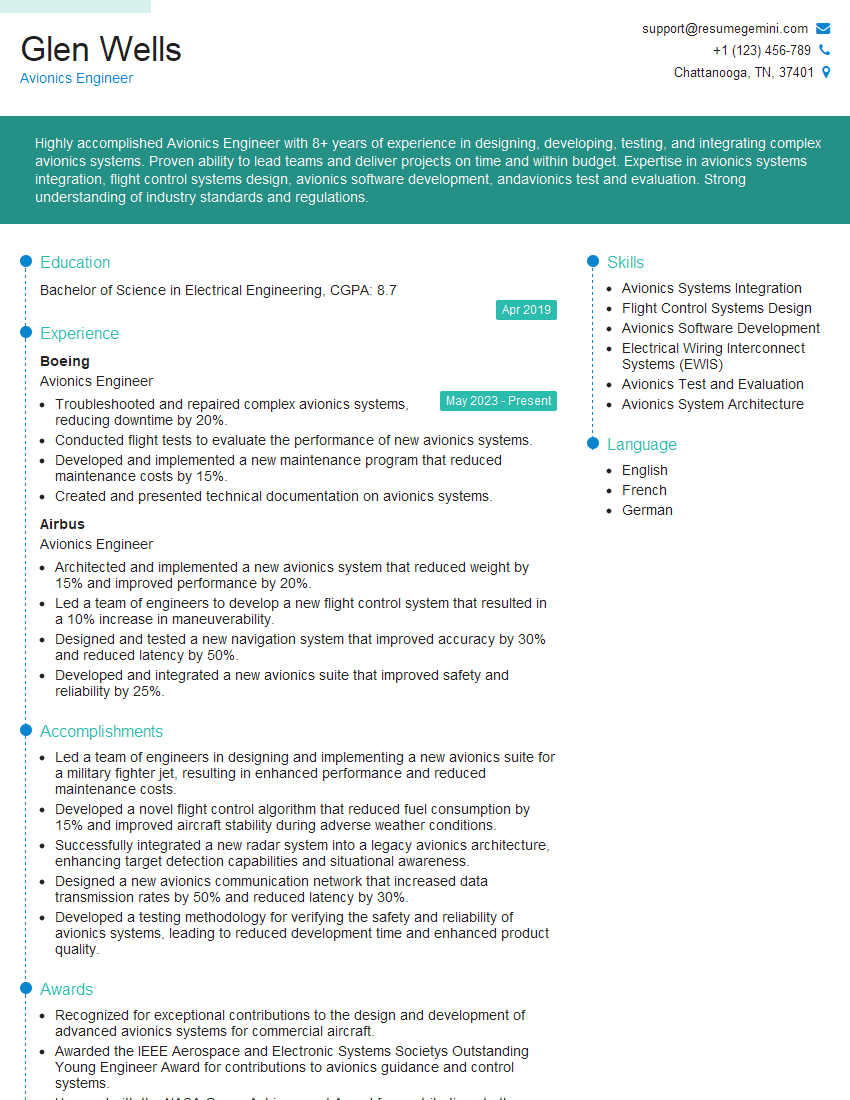
Mastering Avionics System Troubleshooting is vital for a successful and rewarding career in aviation. It demonstrates a high level of technical expertise and problem-solving skills, opening doors to advanced roles and increased earning potential. To maximize your job prospects, it’s crucial to create a resume that effectively showcases your skills and experience to Applicant Tracking Systems (ATS). ResumeGemini is a trusted resource to help you build a professional and ATS-friendly resume that highlights your unique qualifications. Examples of resumes tailored to Avionics System Troubleshooting are available to guide you. Invest time in crafting a compelling resume—it’s your first impression on potential employers.
Explore more articles
Users Rating of Our Blogs
Share Your Experience
We value your feedback! Please rate our content and share your thoughts (optional).
What Readers Say About Our Blog
Really detailed insights and content, thank you for writing this detailed article.
IT gave me an insight and words to use and be able to think of examples