The right preparation can turn an interview into an opportunity to showcase your expertise. This guide to Basic carpentry and framing interview questions is your ultimate resource, providing key insights and tips to help you ace your responses and stand out as a top candidate.
Questions Asked in Basic carpentry and framing Interview
Q 1. What types of wood are commonly used in framing?
The choice of wood for framing depends largely on the project’s requirements, budget, and regional availability. However, several species are consistently popular for their strength, durability, and workability.
- Spruce: Known for its lightweight nature and relatively straight grain, making it easy to work with. It’s a cost-effective option, often used in wall framing and roof trusses.
- Pine: Another common choice, offering good strength-to-weight ratio. Pine is readily available and comes in various grades, affecting cost and suitability for specific applications. Different pine species (like Southern Yellow Pine) offer varying strengths.
- Fir: Strong and durable, fir is frequently selected for heavier-duty framing applications like floor joists and beams. It boasts excellent nail-holding capabilities.
- Hemlock: Often used in conjunction with other species, hemlock provides decent strength and is moderately priced. It’s sometimes less strong than fir or spruce.
It’s important to check local building codes and engineering requirements, as they will specify the minimum grade of lumber acceptable for various framing components.
Q 2. Explain the purpose of a plumb bob.
A plumb bob is a simple yet indispensable tool in carpentry and construction used to establish a perfectly vertical line. It consists of a pointed weight suspended from a string. By hanging the plumb bob from a high point, you can precisely locate a true vertical line on the ground or a wall.
Imagine you’re framing a wall and need to make sure it’s perfectly upright. You’d use a plumb bob to ensure that the corners of the frame are exactly vertical, preventing the wall from leaning. This is crucial for structural integrity and a visually appealing finished product. Any deviation from vertical can lead to instability and unevenness.
Q 3. Describe the different types of saws used in carpentry.
Carpenters use a variety of saws, each designed for specific tasks. Here are some of the most common:
- Hand Saws: These are versatile saws powered by hand. Types include rip saws (for cutting wood with the grain), crosscut saws (for cutting across the grain), and backsaws (for finer, more precise cuts).
- Circular Saws: These power tools use a rotating circular blade to cut through wood quickly. They are great for cutting lumber to length and making straight cuts.
- Jigsaw: Ideal for curved cuts and intricate work, jigsaws are smaller, more maneuverable power saws.
- Reciprocating Saw (Sawzall): These are powerful saws that use a reciprocating (back-and-forth) motion. They are excellent for demolition and cutting through tough materials, but less precise for framing applications.
- Miter Saw: Used for precise angled cuts, often employed when constructing framing components that need to join at angles, like roof rafters.
Choosing the right saw for the job is essential for efficiency, safety and accuracy.
Q 4. How do you calculate the amount of lumber needed for a project?
Calculating lumber accurately is critical to avoid material waste and extra costs. It involves several steps:
- Detailed Plans: Start with complete plans specifying the dimensions of all framing members (studs, joists, rafters, etc.).
- Measurements: Measure the length of each piece required. Account for waste during cutting (saw kerf).
- Quantities: Determine the number of each type of framing member needed.
- Board Feet: Lumber is typically sold by board feet (a unit of measurement: 1 board foot = 12 inches x 12 inches x 1 inch). Calculate the total board feet needed for each component.
- Add Waste: Always add extra lumber to compensate for cutting errors, damaged boards, and unforeseen needs. A 10-15% extra is a common practice.
For example, if you need 10 studs, each 8 feet long and 2×4 (actually about 1.5” x 3.5”), you’d need 10 * 8 = 80 linear feet. You’d then convert to board feet considering the dimensions (though lumber is often sold by the linear foot for framing lumber). Always consult accurate lumber dimensions and account for waste. Using a lumber calculator or software can automate this process.
Q 5. What are the different types of nails and screws used in framing?
Framing uses a variety of nails and screws each designed for specific applications:
- Nails: Common nails used in framing include common nails (for general framing), sinkers (for a less prominent head), and roofing nails (for roof sheathing). The size of the nail is chosen based on the size of the lumber and the required holding strength.
- Screws: While less common in traditional stick framing, screws offer superior holding power and resistance to withdrawal. Common types include structural screws (specifically designed for framing) and deck screws (for applications requiring higher resistance to moisture).
The choice between nails and screws often depends on the project’s requirements and the carpenter’s preference. In certain situations, screws may be preferable for their increased holding strength and ability to withstand movement. However, nails remain the traditional and in many cases the fastest and most cost-effective fastener for framing applications.
Q 6. Explain the process of building a basic wall frame.
Building a basic wall frame involves these steps:
- Layout: Determine the wall’s dimensions and layout the placement of studs, typically spaced 16” or 24” on center.
- Cutting: Cut the studs to the appropriate length (wall height + extra for the sill and top plates).
- Sill Plate: Lay down the sill plate (typically a double 2×4 or 2×6) to form the bottom of the wall. Ensure the sill plate is level and plumb.
- Top Plate: Lay down the top plate in the same manner as the sill plate.
- Stud Placement: Place the studs on the sill plate and top plate according to the layout. They should be spaced according to your desired layout.
- Fastening: Nail the studs to both the sill plate and the top plate. Use appropriate sized nails and ensure proper nail spacing.
- Bracing: Add temporary bracing to maintain the wall’s squareness until it is installed.
This is a simplified description. Wall construction might also include additional components like headers for windows and doors and other structural considerations.
Q 7. How do you ensure the squareness of a frame?
Ensuring a frame’s squareness is vital for a structurally sound and aesthetically pleasing structure. Here’s how to achieve this:
- Measure the Diagonals: Measure the diagonals of the frame. If the frame is perfectly square, the diagonals will be equal in length. Any difference indicates a deviation from squareness. For example, if one diagonal measures 12 feet and the other measures 12.1 feet there’s a problem.
- Adjust as Needed: If the diagonals are unequal, adjust the frame by slightly moving the studs or plates until the diagonals are equal. This often involves a process of trial and error, measuring and adjusting until the diagonals match.
- Use a Square: While measuring diagonals is crucial, a speed square can also help ensure that corners are true 90-degree angles. Using both methods offers additional verification.
- Bracing: Temporary bracing is used to hold the frame square while the fasteners are driven home. This prevents any movement that could cause the frame to go out of square.
A square frame is fundamental; deviations can lead to structural issues and visual imperfections. Using a combination of diagonal measurements and a speed square, combined with proper bracing, will allow for precision.
Q 8. What are the safety precautions when using power tools?
Safety is paramount when working with power tools. Think of it like this: power tools are incredibly efficient, but they’re also potentially dangerous if not handled correctly. Always start by ensuring your work area is well-lit, organized, and free of clutter. This minimizes the risk of tripping or accidentally hitting something.
- Personal Protective Equipment (PPE): This is non-negotiable. Always wear safety glasses or a face shield to protect your eyes from flying debris. Hearing protection is crucial, especially with louder tools like circular saws. Work gloves provide protection from splinters and sharp edges. Depending on the task, a dust mask is also essential to prevent inhaling harmful particles.
- Tool Maintenance: Regularly inspect your tools for damage. A dull blade, for instance, requires more force and increases the risk of kickback. Keep your tools clean and lubricated as per the manufacturer’s instructions.
- Proper Technique: This is where experience and training come in. Mastering the proper grip, posture, and technique for each tool significantly reduces the risk of accidents. Never force a tool; let it do the work.
- Disconnecting Power: Always unplug the tool before making adjustments, changing blades, or cleaning it.
- Awareness of Surroundings: Be mindful of others in the area. Let people know you’re using power tools and keep a safe distance from them.
Ignoring these precautions can lead to serious injuries, so treat every job with the respect it deserves.
Q 9. Describe the different types of joints used in carpentry.
Carpentry relies on a variety of joints to connect pieces of wood securely and aesthetically. The choice of joint depends on the application, the type of wood, and the desired strength and appearance. Here are a few common examples:
- Butt Joint: The simplest joint, where two pieces of wood meet end to end. It’s typically reinforced with glue, screws, or dowels for added strength. This is often used in framing where speed and simplicity are key, but it’s not the strongest joint.
- Lap Joint: Two pieces of wood overlap, providing more surface area for glue and fasteners. There are many variations, including half-lap, full-lap, and mitered lap joints, each offering different levels of strength and aesthetic appeal.
- Miter Joint: Two pieces of wood are cut at an angle and joined together. Often used for decorative purposes, miter joints need careful precision and are typically reinforced with glue and additional fasteners for stability.
- Dovetail Joint: Interlocking “tails” and “pins” create a strong and visually appealing joint, particularly used in fine woodworking, such as drawers. It’s time consuming but exceptionally strong.
- Mortise and Tenon Joint: A tenon (projection) fits into a mortise (hole) in a mating piece. Extremely strong, used in furniture and structural applications. Think of traditional wooden chair legs!
Understanding the properties of each joint is crucial for choosing the right one for the job.
Q 10. Explain the importance of proper leveling and alignment in framing.
Proper leveling and alignment in framing are absolutely critical for a structurally sound and aesthetically pleasing building. Think of a house as a giant Jenga tower – even a slight misalignment can compromise the entire structure.
Leveling: Ensures that the structure is plumb (vertical) and level (horizontal). This prevents uneven settling, sagging, and potential structural failure. An unlevel foundation will create problems throughout the entire build, leading to doors and windows that won’t close properly, uneven floors and walls, and more. We use levels and plumb bobs to ensure accuracy.
Alignment: Guarantees that all framing members are properly spaced and aligned with each other and the building plans. Accurate alignment prevents racking (distortion of the frame) and ensures the building’s dimensions are consistent. This is crucial for wall stability and for proper placement of doors, windows, and other building elements.
Achieving both leveling and alignment requires careful measurement, planning, and the use of appropriate tools like levels, plumb bobs, squares, and measuring tapes. Any deviation from the plan can have significant consequences down the line, so accuracy is paramount.
Q 11. How do you read and interpret blueprints?
Reading blueprints is like learning a visual language. You need to understand the symbols, dimensions, and annotations to translate the architect’s design into a physical structure. It’s a skill that’s developed with practice, but here’s a breakdown:
- Scale: Blueprints are drawn to scale – a smaller representation of the actual dimensions. The scale is usually indicated on the drawing (e.g., 1:10, 1/4″ = 1′). This allows you to accurately measure everything.
- Views: Blueprints generally include multiple views: floor plans, elevations (showing the exterior walls), and sections (showing internal structures). You need to understand what each view represents.
- Symbols: Blueprints use standard symbols to represent different building elements (walls, doors, windows, plumbing, electrical). Becoming familiar with these symbols is key. A good set of blueprints will have a legend explaining the symbols.
- Dimensions: Dimensions are crucial. They specify the exact size and location of elements. Always double-check your measurements against the plans.
- Notes and Specifications: Read all the notes and specifications carefully. They provide crucial details about materials, construction methods, and other critical information.
Practice makes perfect. Start by reviewing simple blueprints and gradually work your way up to more complex designs. Consulting with experienced carpenters is always helpful.
Q 12. What are the different types of fasteners used in carpentry?
Carpentry uses various fasteners, each with its own advantages and disadvantages. The choice depends on the type of wood, the joint, and the desired strength.
- Nails: Common, versatile, and relatively inexpensive. Different types exist, including common nails, finish nails, brads, and roofing nails, each suited for specific applications.
- Screws: Provide stronger and more adjustable fastening than nails. Wood screws, sheet metal screws, and drywall screws are all used in carpentry, offering varying levels of holding power.
- Bolts: Used for heavy-duty applications where significant strength is required, like structural connections. They often incorporate washers and nuts for added security and distribution of stress.
- Dowels: Wooden pins used to reinforce joints, particularly in furniture making. They provide excellent strength when combined with glue.
- Connectors: Metal plates and brackets designed to reinforce joints, such as hurricane ties for added resistance to lateral forces in wall framing. They are becoming increasingly popular for improving the structural performance of buildings.
Proper selection and use of fasteners is essential for creating durable and safe structures.
Q 13. What are some common framing techniques?
Framing techniques are the backbone of building construction. These techniques dictate how the structural elements are assembled, influencing strength, stability and efficiency. Here are some common techniques:
- Platform Framing: The most common method, where floors are built as platforms and walls are framed on top. It’s efficient and allows for easy access to different levels.
- Balloon Framing: Walls are continuously framed from foundation to roof, with studs extending the full height. Offers more flexibility but can be less efficient and more complex.
- Post and Beam Framing: Heavy timbers are used to create a strong and visually appealing structure. Often seen in barns and high-end homes, this requires specialized skills and strong timbers.
- Truss Framing: Pre-fabricated triangular structures made from smaller lumber pieces offer lightweight, efficient, and strong roof framing. This is a cost and time efficient method for roof construction.
- Shear Walls: Engineered panels or frames used to resist lateral forces (wind, earthquakes). They are essential for structural stability in areas prone to seismic activity.
The choice of technique depends on factors such as building design, budget, local building codes, and the experience of the builder.
Q 14. How do you handle different types of wood grain?
Different wood grains influence how the wood works and how it should be treated. Understanding grain direction is crucial for proper cutting, fastening, and finishing.
Straight Grain: The fibers run relatively parallel to the length of the board. This is generally the strongest and most stable type of grain, making it easier to work with. It’s ideal for most applications.
Wavy Grain: Fibers run in a wavy pattern. This wood can be slightly weaker and more difficult to work with, prone to splitting during cutting or fastening. Careful consideration is required when working with this grain, especially in areas with stress.
Spiral Grain: Fibers spiral around the tree’s axis. This can be the weakest and most unpredictable grain pattern, often leading to warping and twisting. Avoid this grain if possible in structural applications.
Dealing with Grain: When cutting, always cut with the grain. This minimizes splitting and chipping. When fastening, consider the grain direction to prevent splitting. Pre-drilling pilot holes before driving screws or nails can help significantly, especially in hardwoods or wood with a tight grain.
Understanding grain characteristics allows carpenters to select the right wood for the job and to employ techniques that prevent issues.
Q 15. Explain the process of installing a door frame.
Installing a door frame is a fundamental carpentry task requiring precision and attention to detail. It involves several key steps ensuring the door operates smoothly and the frame is securely fixed.
- Preparation: First, you need to accurately measure the rough opening in the wall where the door will be installed. The opening should be slightly larger than the door frame to allow for proper fitting and shimming. You’ll also need the door frame itself, shims (thin wedges for leveling), screws, wood glue, and a level.
- Frame Placement: Carefully position the door frame into the rough opening, ensuring it’s plumb (perfectly vertical) and level. Use a level to check both vertically and horizontally. Shims are crucial here to compensate for any irregularities in the wall.
- Securing the Frame: Once plumb and level, temporarily secure the frame using screws or nails. Avoid over-tightening at this stage.
- Shimming and Plumb Check: After initial securing, meticulously re-check for plumb and level. Add or adjust shims as needed to achieve perfect alignment. This step is vital for a correctly functioning door and preventing future problems.
- Permanent Fastening: After achieving perfect alignment, secure the frame permanently. Typically, this involves using longer screws driven through the frame into the studs of the wall. Wood glue can be added for increased strength and stability.
- Finishing: Once the frame is firmly in place, remove any excess shims. Caulk any gaps around the frame to prevent drafts and improve aesthetics. You can then install the door itself.
For example, when working on an older house with uneven walls, having a good supply of shims of varying thicknesses is crucial. You might find yourself using a combination of several shims to get a perfectly plumb and level frame.
Career Expert Tips:
- Ace those interviews! Prepare effectively by reviewing the Top 50 Most Common Interview Questions on ResumeGemini.
- Navigate your job search with confidence! Explore a wide range of Career Tips on ResumeGemini. Learn about common challenges and recommendations to overcome them.
- Craft the perfect resume! Master the Art of Resume Writing with ResumeGemini’s guide. Showcase your unique qualifications and achievements effectively.
- Don’t miss out on holiday savings! Build your dream resume with ResumeGemini’s ATS optimized templates.
Q 16. What are the different types of wood finishes?
Wood finishes are crucial for protecting wood from the elements, enhancing its appearance, and increasing its lifespan. The type of finish chosen depends on the wood, the application, and the desired aesthetic. Here are some common types:
- Paints: Offer excellent protection from moisture and UV damage and come in a wide range of colors. They completely hide the wood grain.
- Stains: Penetrate the wood, enhancing its natural color and grain. They provide less protection than paint.
- Varnishes: Create a hard, clear protective layer that enhances the wood’s natural beauty. They offer good protection against scratches and moisture.
- Polyurethanes: Similar to varnish, they offer excellent durability, scratch resistance, and water resistance, but are more expensive.
- Shellac: A natural finish derived from lac insects. It’s easy to apply and provides a warm, amber tone, but is less durable than polyurethane or varnish.
- Lacquer: Dries quickly, offering a hard, durable finish with excellent clarity. It can be applied in multiple coats for added protection.
For instance, exterior doors often require paint for maximum protection against the weather, while interior trim might benefit from a stain and varnish combination to highlight the wood grain while providing sufficient protection.
Q 17. How do you troubleshoot common framing problems?
Troubleshooting framing problems requires a systematic approach. Identifying the issue correctly is the first step.
- Uneven Walls: This is often addressed during framing using shims and precise measurements. If discovered after framing, careful adjustments and repairs will be needed, possibly requiring the removal and replacement of sections.
- Misaligned Studs: Using a laser level or a plumb bob can help to identify and correct misaligned studs before drywalling. Significant misalignments may require additional framing work to bring the studs into alignment.
- Sagging Walls: This often points to insufficient bracing or inadequate support. Adding additional bracing or structural supports is necessary to correct the sag.
- Weak Connections: Weak nail or screw connections can lead to instability. Reinforce connections by adding additional fasteners and checking for loose or improperly driven fasteners. Using proper fastening techniques for the type of lumber and building codes is critical.
- Improper Sheathing: If the sheathing (exterior covering on the frame) is improperly installed, it could lead to structural problems. This may require removing and reinstalling the sheathing.
For example, if a wall is sagging, you wouldn’t just add a single brace. You need to determine the cause (perhaps a weak header or insufficient bottom plate support) and address the root issue before adding bracing to prevent further sagging or collapse.
Q 18. Explain the concept of load-bearing walls.
Load-bearing walls are critical structural elements in a building, designed to support the weight of the structure above them. They transfer the load from upper floors, roof, and other structural components down to the foundation. Think of them as the backbone of the building.
Imagine a house with two stories. The second floor’s weight, along with the roof, doesn’t simply float. Load-bearing walls are specifically designed and positioned to withstand that weight, distributing it evenly to the foundation. These walls typically have thicker studs and more bracing than non-load-bearing walls, which are primarily for partitioning spaces.
Identifying load-bearing walls is crucial for any renovation or modification work. Incorrectly removing or altering a load-bearing wall can compromise the entire building’s structural integrity and may even lead to collapse. You should consult building plans or an engineer before attempting any work on a potentially load-bearing wall.
Q 19. What are the building codes related to framing?
Building codes related to framing vary by location and jurisdiction, but there are common principles focused on ensuring structural safety and integrity. These codes dictate:
- Spacing of Studs: The maximum spacing between studs is typically 16 inches or 24 inches on center (the distance between the center of one stud to the center of the next). This depends on the type of construction and load requirements.
- Stud Size: Codes specify the minimum dimensions of studs based on their function (load-bearing or non-load-bearing) and the height of the wall.
- Fastener Requirements: Codes specify the type, size, and number of fasteners required for various connections, ensuring adequate strength and resistance to forces like wind and earthquakes.
- Bracing Requirements: Codes specify requirements for bracing walls to prevent racking (deformation under lateral loads). This often involves diagonal bracing or sheathing.
- Header Requirements: For openings in walls, like windows and doors, headers (horizontal beams spanning the opening) must meet specific size and load requirements.
Ignoring building codes can lead to significant safety hazards, structural instability, and legal issues. Always consult local building codes and obtain necessary permits before starting any framing project.
Q 20. How do you ensure the structural integrity of a frame?
Ensuring the structural integrity of a frame relies on careful planning, precision execution, and adherence to building codes. Key factors include:
- Proper Planning and Design: Accurate calculations of load requirements, stud spacing, header sizes, and bracing are critical. Using engineering software or consulting with structural engineers is crucial for complex projects.
- Accurate Measurements and Cutting: Precision in cutting lumber and ensuring proper alignment of studs and other framing members is essential for stability.
- Proper Fastening Techniques: Using the correct number and type of fasteners for each connection is crucial for load transfer and resistance to lateral forces. Over-driving or under-driving nails or screws can compromise the strength of the connection.
- Sufficient Bracing: Adequate bracing prevents racking (deformation) and ensures overall stability. Diagonal bracing, sheathing, and proper connection of walls to floors and roofs are crucial.
- Quality Lumber: Using straight, dry, and defect-free lumber is critical. Damaged or warped lumber can weaken the structure.
- Regular Inspections: Throughout the framing process, regular inspections should be conducted to identify and rectify any errors or issues before they become significant problems.
For example, consistently checking the plumb and level of walls throughout construction, and ensuring proper connections between wall studs and the floor and ceiling joists, prevents significant problems later in the construction process.
Q 21. What are the different types of roofing materials used?
A wide variety of roofing materials are available, each with its own advantages and disadvantages in terms of cost, durability, aesthetic appeal, and maintenance requirements.
- Asphalt Shingles: The most common type, they are relatively inexpensive, easy to install, and come in a variety of colors and styles. They have a moderate lifespan.
- Wood Shakes and Shingles: Natural and aesthetically pleasing, they provide good insulation but are more expensive and require more maintenance than asphalt shingles. They are susceptible to rot and insect damage.
- Tile Roofing (Clay or Concrete): Highly durable and long-lasting, offering excellent fire resistance. However, they are heavy, expensive, and require specialized installation.
- Metal Roofing (Steel or Aluminum): Extremely durable, long-lasting, and resistant to fire, wind, and insects. They are relatively expensive but can save money in the long run due to low maintenance.
- Slate Roofing: One of the most durable and long-lasting options, offering excellent weather resistance. However, it is very heavy, expensive, and requires skilled installation.
- Built-up Roofing (BUR): A common type for flat roofs, it consists of layers of asphalt and felt, offering good waterproofing but is less aesthetically pleasing.
The choice of roofing material depends on factors such as budget, climate, architectural style, and the homeowner’s preferences. For example, in areas with heavy snow loads, a heavier roofing material like tile or slate might be preferred for its ability to withstand the weight, while in areas prone to wildfires, a fire-resistant roofing material like metal or tile would be the safer choice.
Q 22. Describe the process of installing a window frame.
Installing a window frame is a crucial step in construction, ensuring both structural integrity and weatherproofing. The process involves several key stages, beginning with preparation and ending with a perfectly fitted and sealed frame.
- Preparation: This includes carefully measuring the rough opening in the wall to ensure the frame fits precisely. Any discrepancies need to be addressed before proceeding. We check for plumbness and squareness of the opening, using a level and square for accuracy.
- Framing: The window frame is carefully positioned within the rough opening. Shims are used to level and plumb the frame, ensuring it’s perfectly aligned in all directions. It’s crucial to avoid excessive shimming; too much can compromise the structural integrity.
- Securing: The frame is then secured to the surrounding framing members using appropriate fasteners, such as nails or screws, driven in at strategic points for maximum strength and stability. The type of fastener will depend on the frame material and wall construction.
- Flashing: Weatherproofing is critical. We install flashing around the frame to prevent water intrusion. Flashing creates a barrier, redirecting water away from the window and the wall. Proper flashing is essential to prevent rot and damage.
- Insulation: Once the frame is secure and flashed, we install insulation around the frame to improve energy efficiency. This helps maintain a comfortable indoor temperature and reduces energy costs.
- Finishing: Finally, we install the window into the frame. This involves carefully aligning the window and securing it properly, ensuring smooth operation and a secure fit.
For example, on a recent project involving a large bay window, precise measurements and careful shimming were crucial to ensure the frame sat perfectly square and level. Any mistake there would have led to issues with the window operation and potential water leakage.
Q 23. What is the difference between rough carpentry and finish carpentry?
Rough carpentry and finish carpentry are two distinct aspects of the trade, differentiated primarily by their function and the level of precision required. Think of it like this: rough carpentry is the structural backbone, while finish carpentry is the cosmetic face.
- Rough Carpentry: This involves the structural elements of a building. It’s the unseen work that creates the skeleton—framing walls, floors, and roofs; building stairs; and installing structural supports. Accuracy is important, but the focus is on structural integrity and efficiency. It’s often rougher in appearance because it’s usually covered by other materials later.
- Finish Carpentry: This focuses on the visible and aesthetic aspects of the building. It’s about the detail work—installing doors and windows, baseboards, crown molding, cabinetry, and other trim. Precision, accuracy, and a high level of craftsmanship are essential here; the quality of the finish work directly impacts the building’s overall appearance.
In a typical house construction, framing the walls would be rough carpentry, while installing the baseboards would be finish carpentry. I’ve personally worked extensively on both; the satisfaction of seeing the finished product is different in both cases, one providing the foundation and the other the finishing touches.
Q 24. Explain the use of different types of measuring tools
Accurate measurements are fundamental to carpentry. Different tools are suited for different tasks and levels of precision.
- Measuring Tape: This is the most common tool for basic measurements, offering various lengths and markings (metric and imperial). I typically use a 25-foot tape for most jobs, appreciating the robustness and clear markings.
- Level: Essential for ensuring surfaces are perfectly horizontal or vertical. I use both a torpedo level (small, for tight spaces) and a longer level (for larger surfaces). A laser level is also extremely useful on bigger projects.
- Square: Used to check for 90-degree angles. A speed square is invaluable for making quick and precise cuts.
- Chalk Line: For marking long, straight lines on surfaces. This is much faster and more accurate than freehand marking for repetitive tasks such as laying out foundation footings.
- Digital Caliper: For highly precise measurements, particularly when working with smaller or intricate pieces. This tool is indispensable for woodworking projects, offering accuracy to the hundredth of an inch.
For example, when installing crown molding, I rely heavily on the measuring tape and level to ensure a perfectly straight and even line. In framing a wall, I utilize the square and chalk line to layout the studs precisely.
Q 25. How do you work effectively as part of a team on a construction site?
Effective teamwork on a construction site is paramount. Clear communication, mutual respect, and a shared commitment to safety and quality are key.
- Clear Communication: This involves daily briefings, keeping each other updated on progress and potential challenges. I always make sure to clearly communicate my tasks and any potential roadblocks to the foreman and my fellow crew members.
- Collaboration: Teamwork requires each person to play their role efficiently. I am always happy to help my colleagues if they require assistance with their tasks, promoting a collaborative environment.
- Safety First: A safe working environment is the highest priority. We follow all safety procedures, and I always look out for the safety of my fellow workers.
- Problem Solving: If we encounter problems, we work together to find the best solution. Open communication is crucial in these situations, and I always contribute my expertise to help find efficient and safe solutions.
On one project, a sudden change in the plans caused some initial panic. But by calmly communicating the issues and working together to find solutions, we managed to stay on schedule and maintain a high standard of work. That’s why collaboration is so essential for success in our work.
Q 26. Describe your experience with different types of building materials.
My experience encompasses a wide range of building materials, each with its own properties and applications.
- Wood: From dimensional lumber (for framing) to plywood (for sheathing and subflooring) to engineered wood products (like I-joists and LVL), I’m proficient in selecting and working with various types of wood, understanding their strengths and weaknesses.
- Steel: I have experience with steel framing members and components, understanding their structural properties and proper installation techniques.
- Concrete: I’m familiar with working with concrete for foundations, slabs, and other elements, understanding the curing process and safety precautions.
- Masonry: Experience with brick, block, and stone, including proper laying techniques and mortar application.
- Insulation: I’m familiar with various insulation materials, including fiberglass, cellulose, foam, and spray foam, understanding their R-values and proper installation methods.
For instance, I was part of a project where we used engineered wood I-joists for the floor system, significantly reducing weight while maintaining structural integrity. This is a more sustainable and efficient approach to traditional wood framing.
Q 27. What is your experience with using hand tools?
Proficiency with hand tools is fundamental to carpentry. Years of experience have honed my skills in using a variety of tools safely and efficiently.
- Hand Saws: I’m comfortable using various hand saws, including crosscut saws, rip saws, and backsaws for precise cuts.
- Chisels and Mallet: Essential for shaping wood, removing excess material, and creating joints.
- Planes: For smoothing and shaping wood surfaces.
- Claw Hammer and Mallet: For driving nails and other fasteners.
- Screwdrivers: Various types of screwdrivers for different screw heads.
- Measuring Tools (as mentioned previously): Critical for precise work.
I recall a project where power tools were inaccessible, and I had to rely solely on hand tools to create intricate dovetail joints for a custom-built cabinet. The result was a testament to the precision and skill achievable with hand tools.
Q 28. What software or technology are you familiar with related to carpentry?
While my primary expertise lies in hands-on carpentry, I’m familiar with several software and technologies that enhance efficiency and precision.
- CAD Software (AutoCAD, SketchUp): I have experience using CAD software for creating detailed drawings and plans, visualizing projects, and ensuring accuracy before construction.
- Estimating Software: This assists in accurately calculating material quantities and costs for bids and projects.
- Laser Measuring Tools: These significantly enhance the accuracy and speed of measurements, particularly in large-scale projects.
For example, on a recent project, we used SketchUp to create a 3D model of the structure before construction, allowing us to identify potential issues and make adjustments to the design prior to beginning the build, resulting in cost savings and efficiency.
Key Topics to Learn for Basic Carpentry and Framing Interview
- Reading and Interpreting Blueprints: Understanding architectural drawings, identifying dimensions, and visualizing the structure.
- Material Selection and Estimation: Choosing appropriate lumber based on grade, dimensions, and intended use; accurately calculating material needs for a project.
- Hand and Power Tool Usage: Safe and proficient operation of saws, drills, hammers, levels, and other essential tools.
- Basic Framing Techniques: Constructing walls, floors, and roofs using proper techniques, including nailing, screwing, and bracing.
- Understanding Building Codes and Safety Regulations: Adherence to safety protocols and relevant building codes for structural integrity and compliance.
- Measuring and Cutting Techniques: Achieving precise measurements and accurate cuts to ensure structural accuracy and efficiency.
- Square and Leveling Techniques: Ensuring the accurate alignment and stability of framed structures using appropriate tools and techniques.
- Troubleshooting and Problem-Solving: Identifying and resolving common issues encountered during construction, such as warped lumber or misaligned framing members.
- Understanding different types of joints: Knowing when and how to use various joints like butt joints, miter joints, lap joints etc.
- Working with different types of wood: Understanding the properties and applications of various wood types commonly used in framing.
Next Steps
Mastering basic carpentry and framing opens doors to a rewarding career with excellent growth potential. From residential construction to commercial projects, skilled framers are always in demand. To maximize your job prospects, it’s crucial to present your skills effectively. Creating an ATS-friendly resume is key to getting your application noticed by potential employers. ResumeGemini is a trusted resource that can help you build a professional resume tailored to highlight your carpentry and framing expertise. Examples of resumes tailored to Basic carpentry and framing are provided to help guide you.
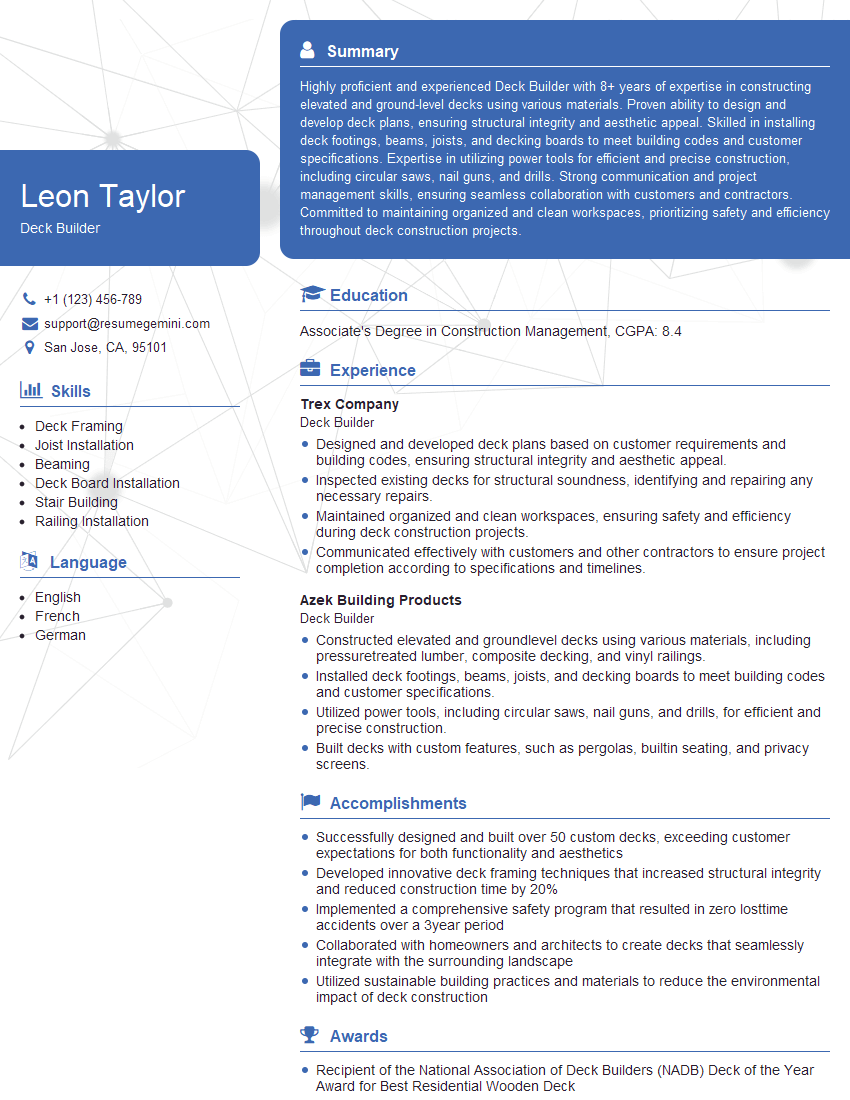
Deck Builder Resume Sample
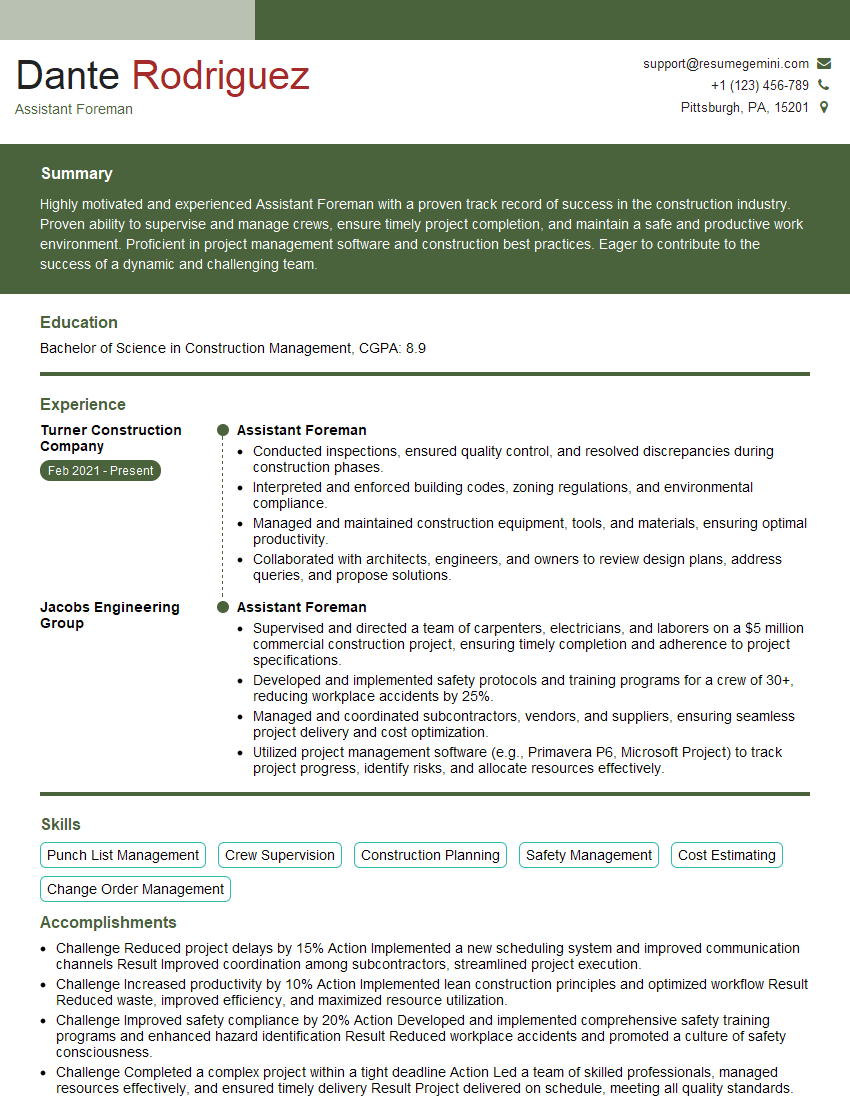
Assistant Foreman Resume Sample
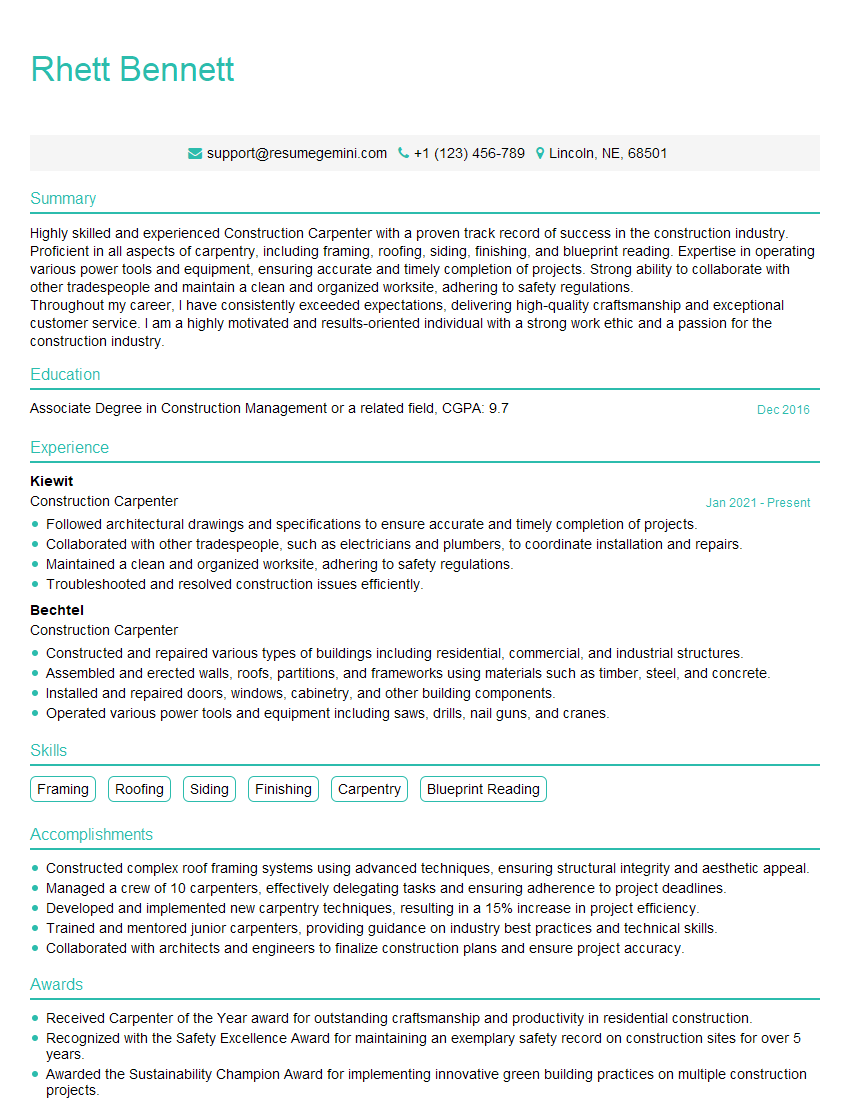
Construction Carpenter Resume Sample
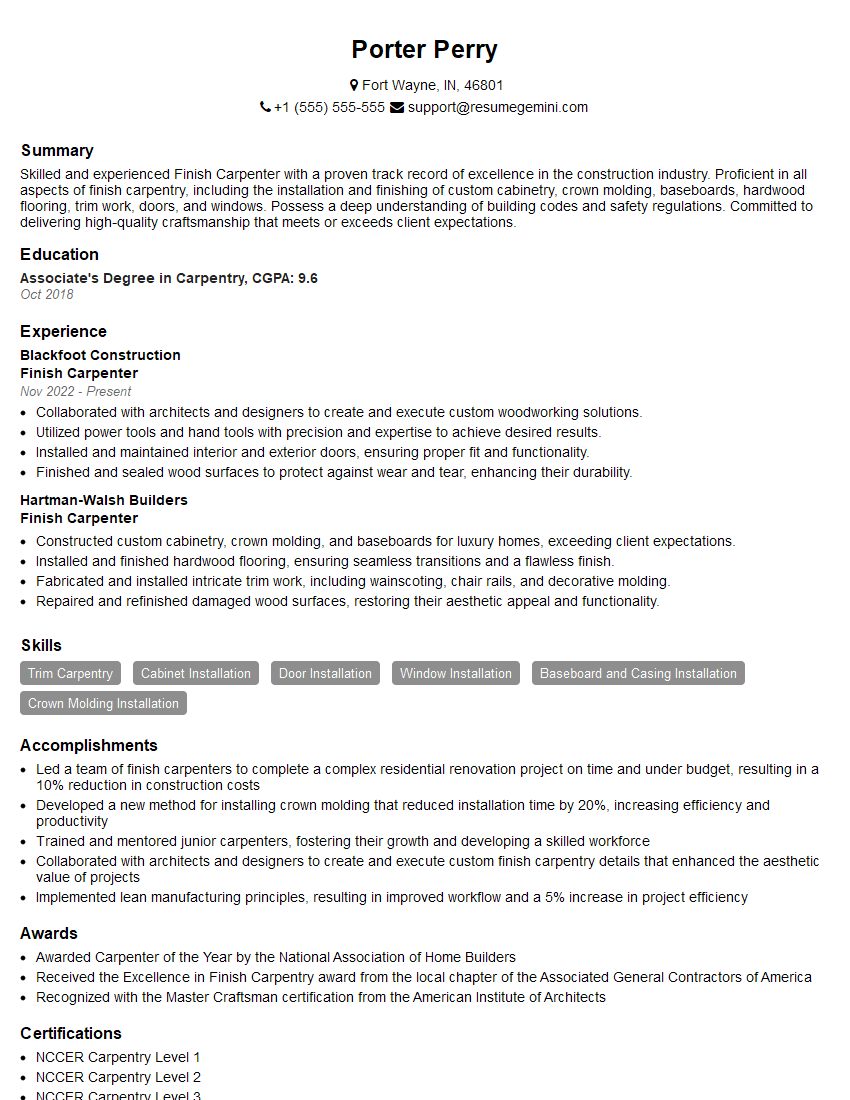
Finish Carpenter Resume Sample
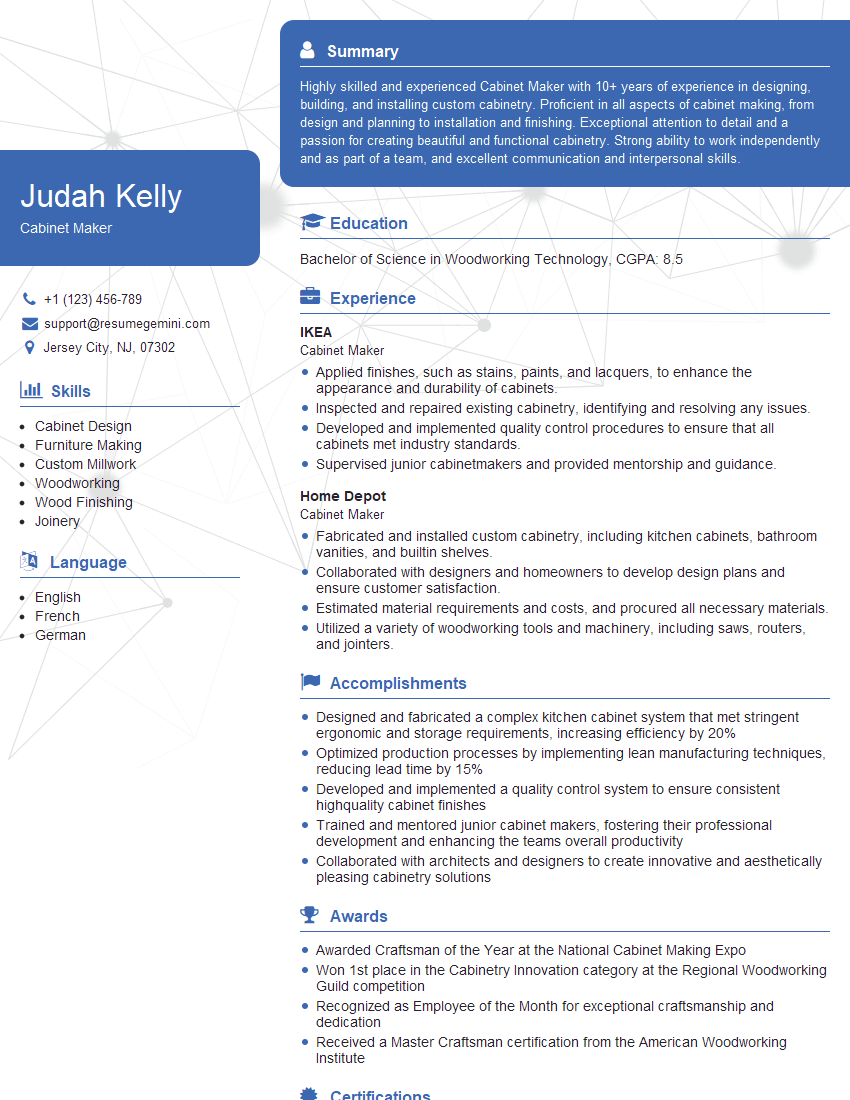
Cabinet Maker Resume Sample
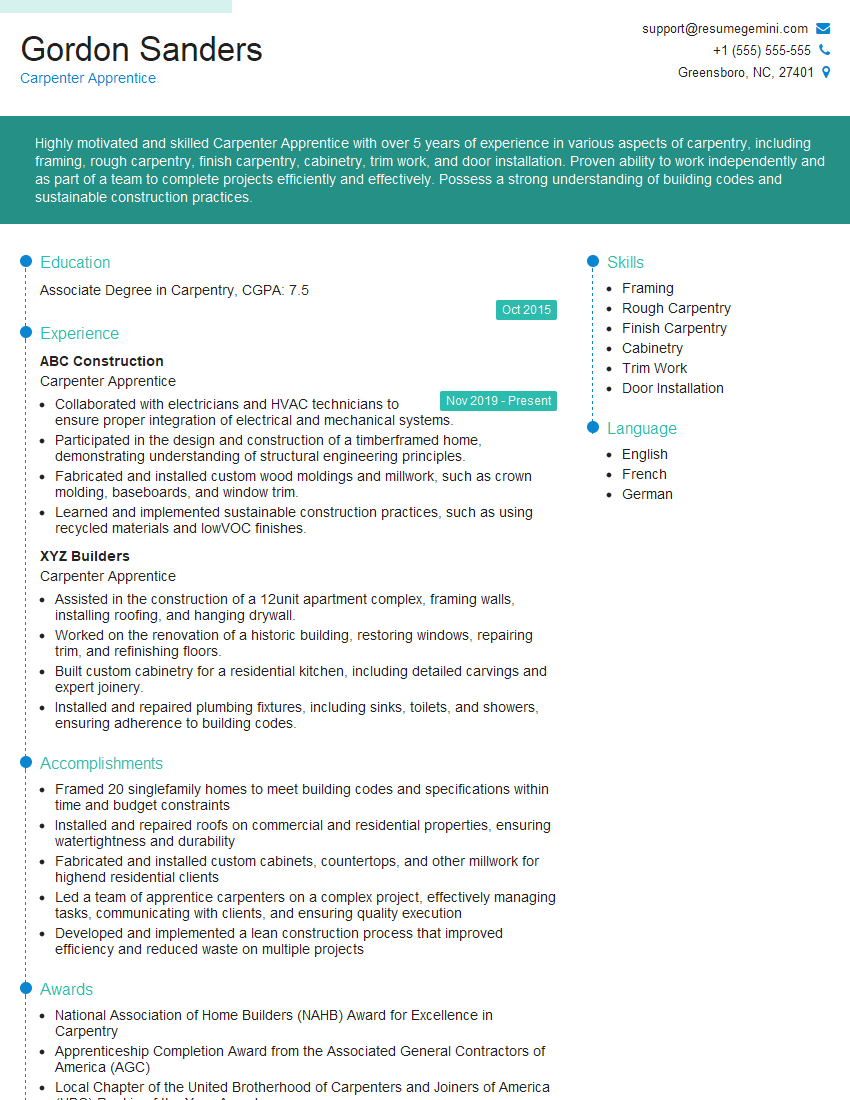
Carpenter Apprentice Resume Sample
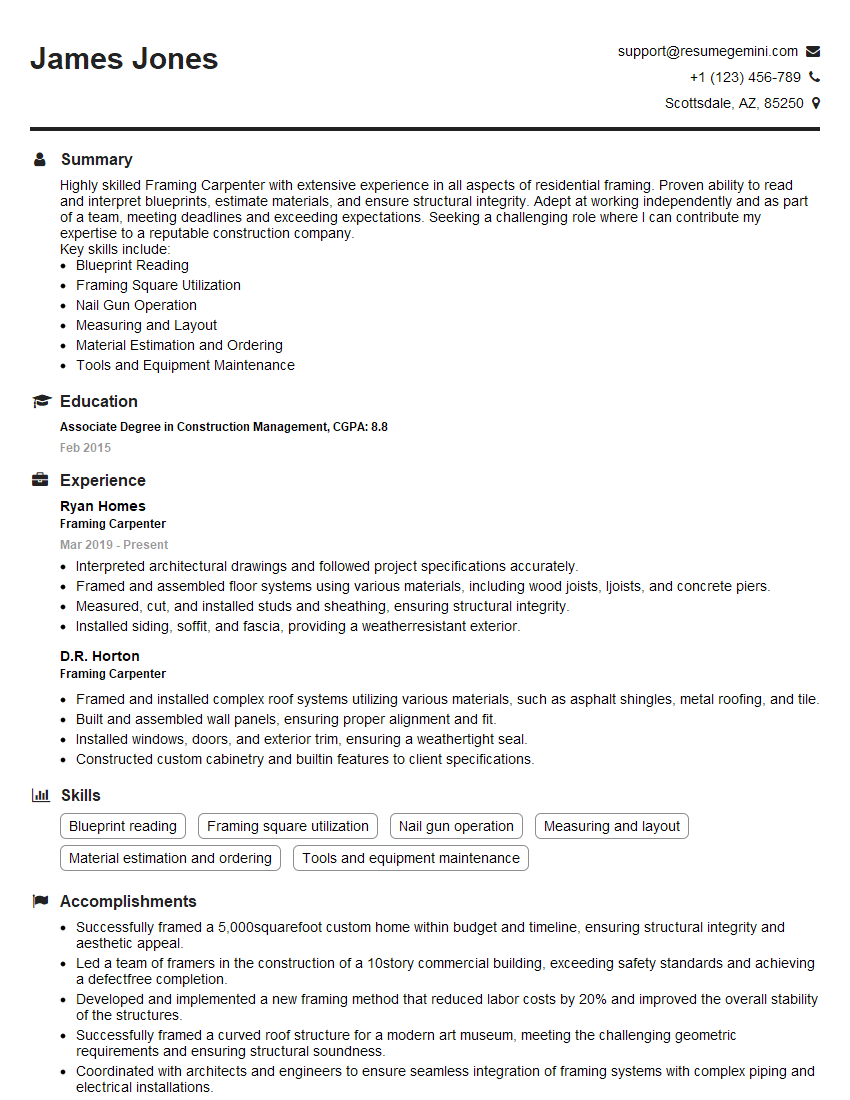
Framing Carpenter Resume Sample
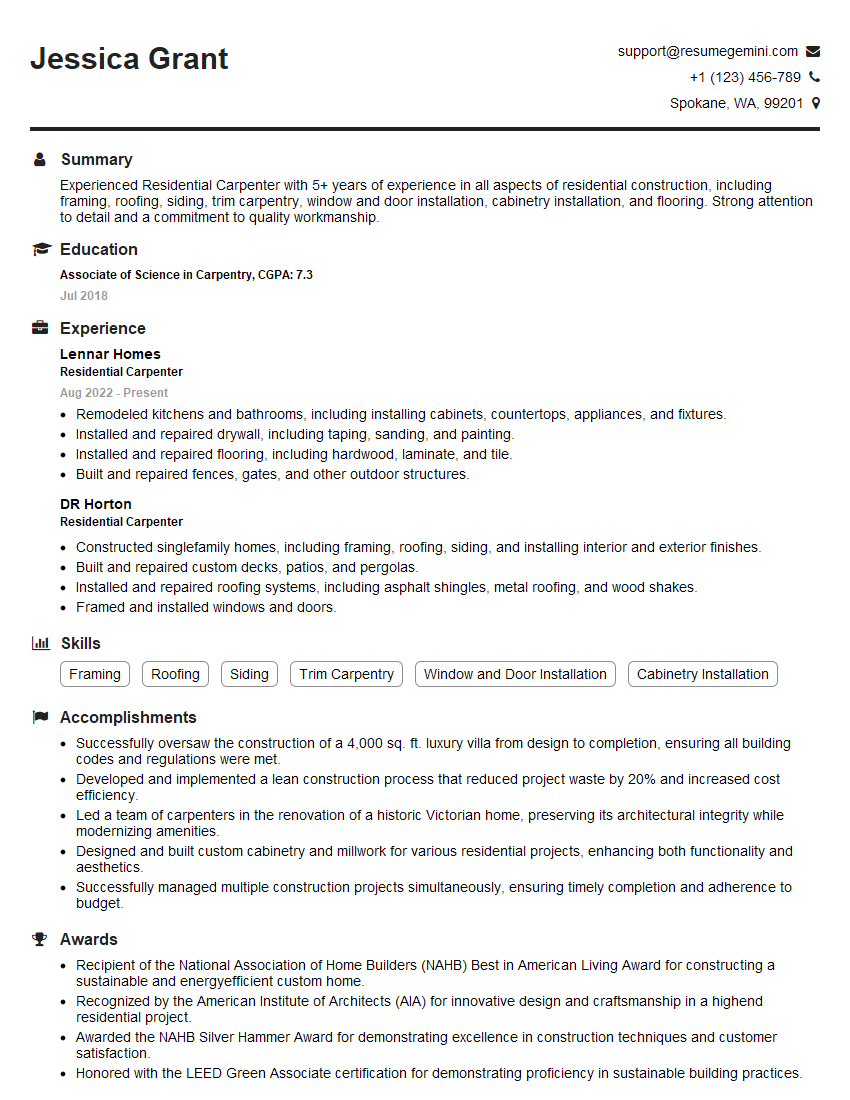
Residential Carpenter Resume Sample
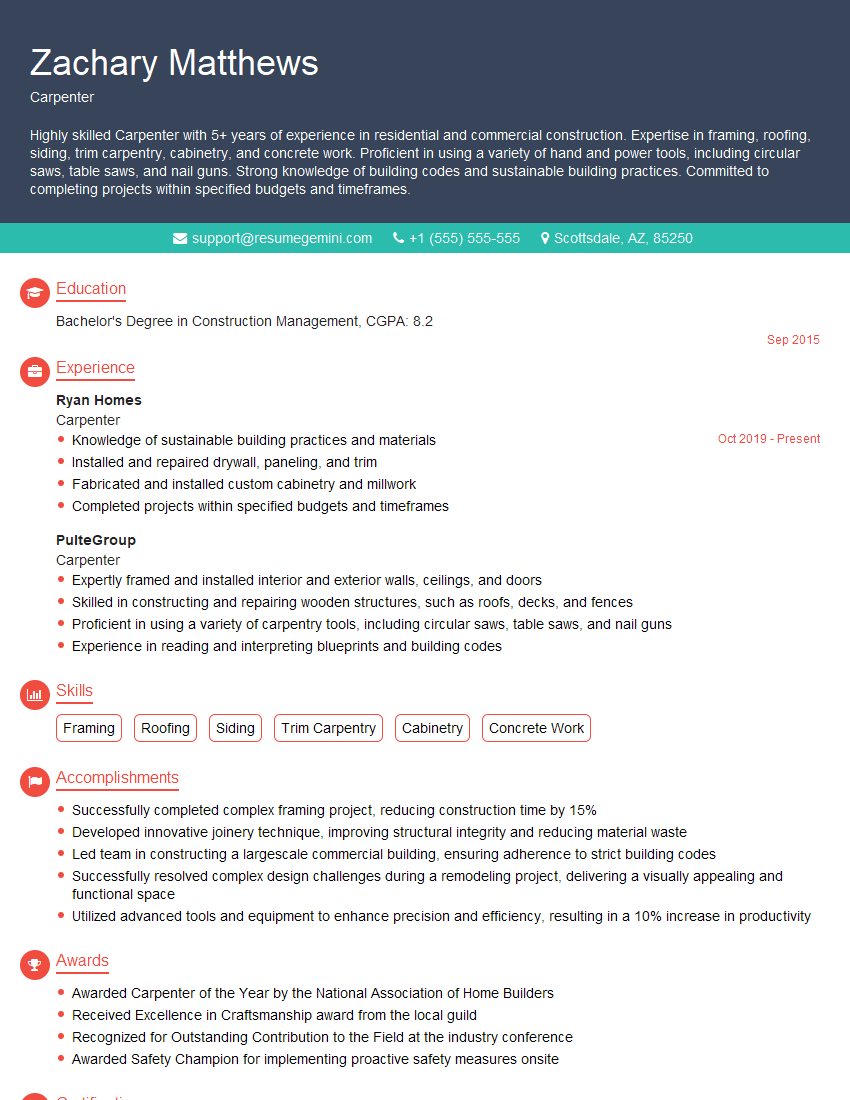
Carpenter Resume Sample
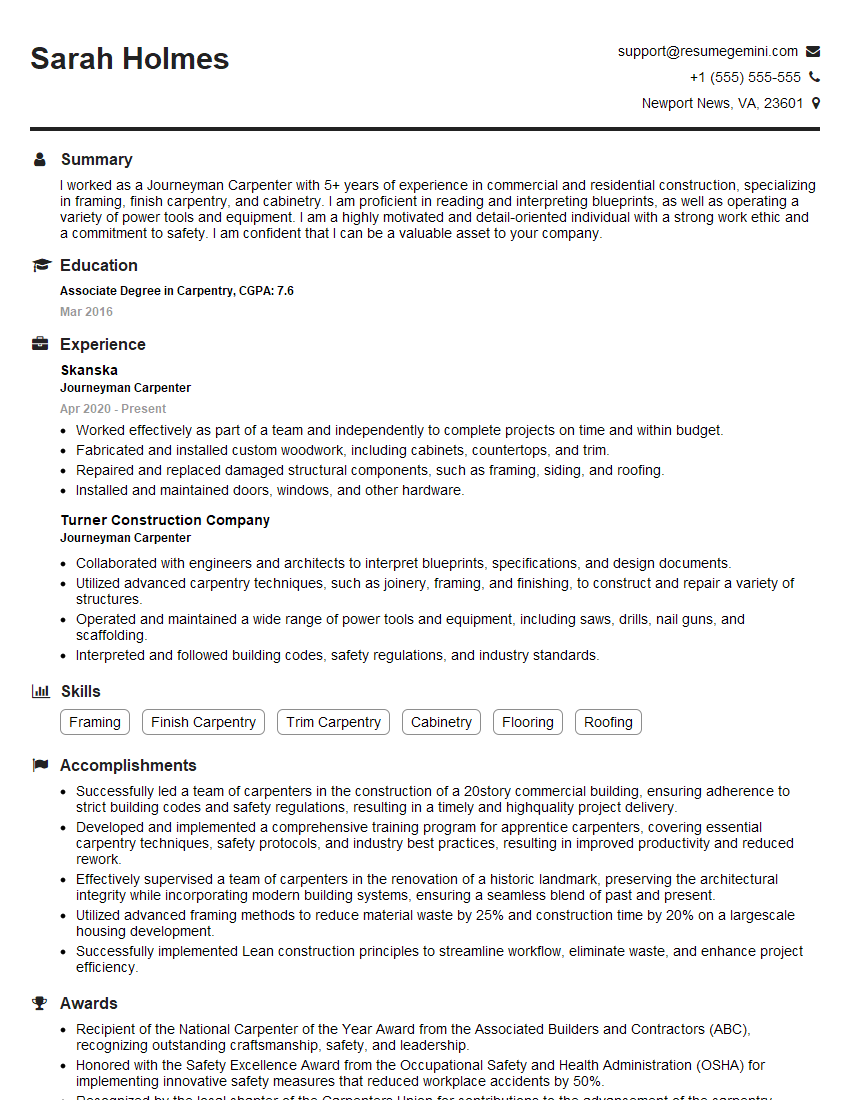
Journeyman Carpenter Resume Sample
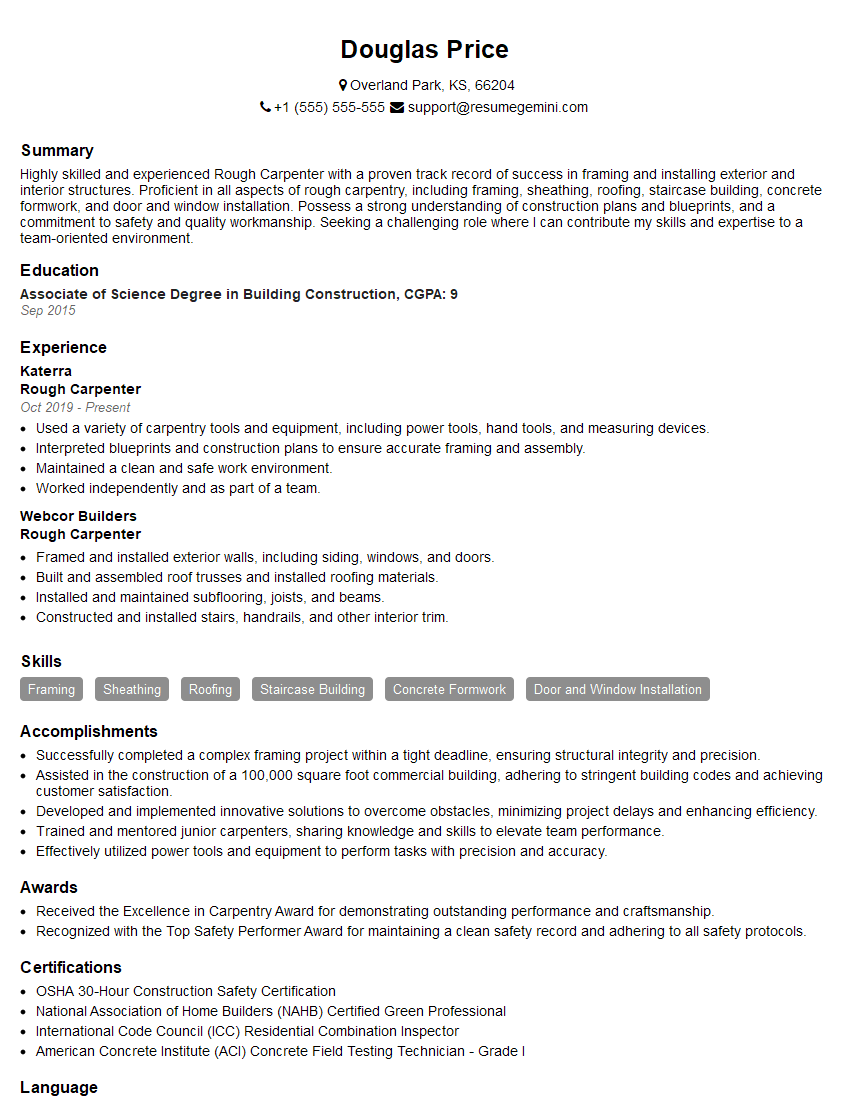
Rough Carpenter Resume Sample
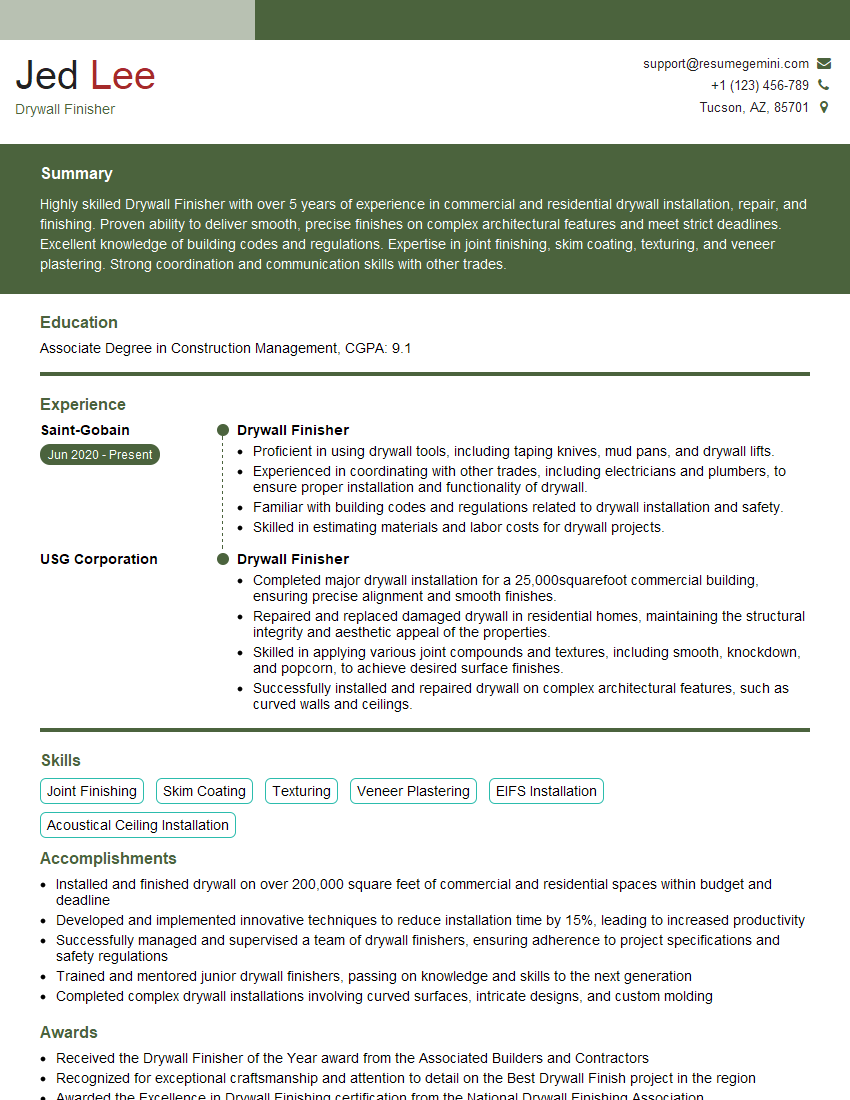
Drywall Finisher Resume Sample
Explore more articles
Users Rating of Our Blogs
Share Your Experience
We value your feedback! Please rate our content and share your thoughts (optional).
What Readers Say About Our Blog
Really detailed insights and content, thank you for writing this detailed article.
IT gave me an insight and words to use and be able to think of examples