Preparation is the key to success in any interview. In this post, we’ll explore crucial Blowfish interview questions and equip you with strategies to craft impactful answers. Whether you’re a beginner or a pro, these tips will elevate your preparation.
Questions Asked in Blowfish Interview
Q 1. Explain the Feistel network structure used in Blowfish.
Blowfish employs a Feistel network, a classic structure in symmetric-key cryptography. Imagine it like a sophisticated, iterative mixing machine for your data. The Feistel network repeatedly divides the input block into two halves, processes one half using a round function, and then combines the result with the other half. This process is repeated multiple times (16 rounds in Blowfish), with each round using a different subkey derived from the main encryption key. The round function itself is a complex series of substitutions and permutations, making it computationally difficult to reverse the encryption process without knowing the key.
More formally, in each round:
- The input block is split into two halves, Li and Ri.
- The right half, Ri, is transformed using a round function F and the round subkey Ki: F(Ri, Ki).
- The result of the round function is XORed with the left half: Li+1 = Li ⊕ F(Ri, Ki).
- The right half is updated: Ri+1 = Li.
- This process continues for 16 rounds.
After 16 rounds, the left and right halves are swapped to produce the final ciphertext. The complexity and repeated application of the round function significantly enhance the algorithm’s security.
Q 2. Describe the key schedule algorithm in Blowfish.
Blowfish’s key schedule is a crucial part of its strength. It expands the relatively short user-provided key (up to 448 bits) into a set of 18 subkeys (each 32 bits) used in each of the 16 rounds of the Feistel network. This expansion is done through a series of operations involving the Blowfish S-boxes (substitution boxes) and the user key. Think of it as a key-dependent transformation that significantly alters the encryption process for every unique key.
The process involves:
- Initialization of the S-boxes using a pre-defined, hardcoded set of constants and a complex mathematical process. These S-boxes provide non-linearity, crucial for security.
- Expanding the user key into a series of 18 subkeys, P1 to P18 using multiple iterations involving the S-boxes and the key itself. This is an iterative process, the output of each step informing the next.
This key schedule’s complexity, combined with its reliance on the S-boxes, makes it computationally infeasible to reverse-engineer the subkeys from the ciphertext, unless you have the original key.
Q 3. What is the block size of Blowfish?
Blowfish operates on 64-bit blocks of data. This means the algorithm processes data in chunks of 64 bits (8 bytes) at a time. Imagine it like a conveyor belt that moves 8-byte packages of information through the encryption process.
Q 4. What is the key size range supported by Blowfish?
Blowfish supports key sizes ranging from 32 bits to 448 bits. This wide range of key lengths offers flexibility for different security needs. Longer keys naturally increase the security of the encryption, making brute-force attacks exponentially more challenging.
Q 5. How does Blowfish achieve its security?
Blowfish’s security stems from a combination of factors: its Feistel network structure, the complex key schedule algorithm, and the use of S-boxes. The Feistel network provides confusion and diffusion, two essential cryptographic principles. Confusion obscures the relationship between the key and the ciphertext, while diffusion spreads the impact of a single bit change throughout the ciphertext. The key schedule’s iterative nature and reliance on the S-boxes contribute significantly to the algorithm’s resistance to cryptanalysis. Essentially, the iterative transformations and non-linear operations in the algorithm make it extremely difficult for attackers to predict the ciphertext from the plaintext or vice versa.
Q 6. What are the advantages and disadvantages of using Blowfish?
Blowfish, while a robust algorithm, possesses both advantages and disadvantages:
Advantages:
- Public domain: No licensing fees or restrictions.
- Fast and efficient: Relatively quick encryption and decryption speeds.
- Widely tested and analyzed: Years of scrutiny have not revealed significant weaknesses.
- Flexible key size: Supports various key lengths.
Disadvantages:
- Slightly slower than AES: Although efficient, it is generally considered slower than AES on modern hardware.
- Limited block size (64 bits): The smaller block size could be a concern with massive datasets, raising potential vulnerabilities with certain attack vectors (although not a critical flaw at this stage).
Q 7. Compare Blowfish to other symmetric encryption algorithms like AES.
Blowfish and AES (Advanced Encryption Standard) are both symmetric block ciphers, but they differ in several key aspects:
Blowfish:
- Feistel network structure
- Block size: 64 bits
- Key size: 32-448 bits
- Public domain
- Generally considered slower than AES
AES:
- Substitution-permutation network structure
- Block size: 128 bits
- Key sizes: 128, 192, or 256 bits
- Standardized and widely adopted
- Generally considered faster than Blowfish on modern hardware
In essence, AES is a more modern algorithm optimized for performance on contemporary hardware and standardized for widespread use. While Blowfish remains secure for many applications, AES has become the dominant standard for its speed and rigorous standardization process. The choice between them often depends on the specific application’s performance requirements and security needs. For most modern applications, AES is preferred for its speed and wider industry support; however, Blowfish remains a viable and secure option in certain circumstances, especially where its public-domain nature is beneficial.
Q 8. Explain the concept of subkey generation in Blowfish.
Blowfish’s subkey generation is a crucial step that transforms a relatively short secret key into a large set of subkeys used in the encryption process. It’s like building a complex lock using a simple key – the simple key unlocks the instructions to create a far more intricate locking mechanism. This process ensures that even a small change in the original key results in a drastically different set of subkeys, dramatically increasing security.
The process begins by initializing two arrays, P (containing 18 32-bit subkeys) and four 32-bit S-boxes (S[0], S[1], S[2], S[3], each containing 256 entries). These are initialized using a fixed string based on the hexadecimal digits of π and are then modified using a series of steps involving the user-provided key. This key is iteratively XORed and used in a series of rounds of encryption to modify P and the S-boxes, effectively “mixing” the key material into these structures. The final set of subkeys is derived from P and S, ready to be used in the encryption/decryption rounds. The key schedule ensures a strong dependency between the key and the subkeys making brute-force attacks computationally expensive.
Q 9. Discuss the S-boxes used in Blowfish and their importance.
Blowfish utilizes four 32-bit S-boxes, each containing 256 entries (8-bit input, 32-bit output). These S-boxes are the heart of the algorithm’s confusion and diffusion components. Think of them as complex substitution tables: they take an 8-bit input and transform it into a completely different 32-bit value. This non-linear transformation is crucial for cryptographic security; without it, the encryption would be much easier to crack. The values within the S-boxes are not simply random; they are carefully chosen and initialized as described in the key schedule to provide strong cryptographic properties. The initialization using π digits and the key-dependent modifications ensure the complexity and effectiveness of the S-boxes and their contribution to the algorithm’s security against cryptanalysis.
Their importance lies in their contribution to the algorithm’s resistance against known attacks. The non-linearity provided by the S-boxes makes it incredibly difficult for attackers to reverse the encryption process. The design ensures that even a minor change in the input values results in significant changes in the output, a key characteristic for strong encryption algorithms.
Q 10. How does Blowfish handle padding?
Blowfish uses a simple padding scheme known as PKCS#5 padding (or sometimes called PKCS#7 padding if you generalize it to other block sizes). This padding ensures that the plaintext message is a multiple of the block size (8 bytes for Blowfish). If the plaintext length is already a multiple of 8 bytes, an entire 8-byte block of padding is appended. Otherwise, the padding consists of bytes, each containing the number of padding bytes added. For example, if 3 bytes need to be added to reach the next 8-byte boundary, three bytes containing the value ‘3’ are appended.
This approach avoids ambiguity, making it easy to remove the padding after decryption. The padding process ensures the message is correctly processed in the block cipher, avoiding issues that could lead to inconsistencies or vulnerabilities in the encryption and decryption processes.
Q 11. Describe the different modes of operation for Blowfish.
Blowfish, while primarily a block cipher, can be used in various modes of operation to enhance its capabilities and address different security requirements. Common modes include:
- Electronic Codebook (ECB): Each 8-byte block is encrypted independently. While simple, ECB is vulnerable to pattern detection if similar plaintext blocks exist. It’s generally not recommended for anything beyond very simple use cases.
- Cipher Block Chaining (CBC): Each block is XORed with the previous ciphertext block before encryption. This introduces dependency between blocks, making pattern detection much harder and enhancing security.
- Cipher Feedback (CFB): Similar to CBC but operates in a stream cipher mode, encrypting data in smaller units using feedback from the previous ciphertext block. It allows for encryption and decryption in a stream-like manner.
- Output Feedback (OFB): Generates a keystream that is XORed with the plaintext. It’s a self-synchronizing stream cipher, making it suitable for applications where bit errors can occur during transmission.
- Counter (CTR): Uses a counter that is incremented for each block. This mode allows for parallel encryption and decryption and is widely preferred for its performance and security advantages.
The choice of mode significantly impacts the security and performance of the overall Blowfish-based system. The mode should be carefully selected based on the specific application and its security requirements.
Q 12. Explain the concept of avalanche effect in the context of Blowfish.
The avalanche effect refers to the property that a small change in either the plaintext or the key should result in a significant change in the ciphertext. In Blowfish, this is achieved through the complex interplay of the subkeys, S-boxes, and the Feistel network structure. If you change even a single bit in the plaintext or the key, the impact propagates through the multiple rounds of encryption, resulting in a drastically different ciphertext. Think of it like a ripple effect in a pond – a small pebble (change) creates large waves (changes in the output).
The avalanche effect is a crucial characteristic for a strong cipher, ensuring that even minor errors or alterations are easily detected, providing resilience against certain types of attacks. The non-linearity of the S-boxes is directly responsible for this effect, amplifying minor changes throughout the encryption process.
Q 13. What are the known vulnerabilities or weaknesses of Blowfish?
While Blowfish has been widely used and considered secure for many years, some weaknesses have been identified, mostly theoretical and not practical threats to modern deployments:
- Key schedule analysis: While not broken, the key schedule has been a subject of analysis, raising concerns that specific key values might lead to slight weaknesses. However, these weaknesses are not considered practical threats with appropriately long keys.
- Related-key attacks: There have been theoretical attacks discovered in related-key scenarios, which assume the attacker has access to encryption results from related keys. However, this is a highly specific scenario that is unlikely to be found in real-world applications.
- Short key sizes: While not a weakness of the algorithm itself, using very short key sizes (e.g., less than 128 bits) significantly reduces the security of Blowfish, making it vulnerable to brute-force attacks.
It’s important to note that these weaknesses are largely theoretical and haven’t led to practical attacks in real-world applications using appropriately sized keys. The current consensus is that these potential vulnerabilities are far outweighed by its long-term track record of secure use.
Q 14. Is Blowfish considered secure for modern applications? Why or why not?
For many modern applications, Blowfish is no longer the preferred choice. While it has a robust history and has shown no practical vulnerabilities after extensive scrutiny, newer algorithms like AES offer superior security and often better performance. The AES algorithm has undergone rigorous review and testing by the cryptographic community and is currently considered the gold standard for symmetric encryption. AES also benefits from hardware acceleration, making it faster in many applications.
However, Blowfish remains a viable option for legacy systems or low-resource environments where its lightweight nature is beneficial. It is important to carefully weigh the security requirements, performance needs, and available resources when selecting an encryption algorithm for any given application. Using a less secure algorithm when a more secure and performant algorithm is available is generally considered poor cryptographic practice.
Q 15. What are the performance characteristics of Blowfish?
Blowfish’s performance is highly dependent on the hardware and implementation. Generally, it’s considered relatively fast, especially when compared to some older ciphers. Its speed comes from its efficient design, employing a Feistel network structure with 16 rounds of encryption. However, it’s not as fast as modern algorithms like AES, particularly in hardware implementations optimized for AES. Factors like the key size used also influence performance; larger keys will naturally take longer to process. In software implementations, the speed will vary depending on the coding efficiency and the underlying processor architecture.
Think of it like this: Blowfish is a reliable, sturdy car, while AES is a high-performance sports car. Both get you to your destination, but one does so with more speed and agility.
Career Expert Tips:
- Ace those interviews! Prepare effectively by reviewing the Top 50 Most Common Interview Questions on ResumeGemini.
- Navigate your job search with confidence! Explore a wide range of Career Tips on ResumeGemini. Learn about common challenges and recommendations to overcome them.
- Craft the perfect resume! Master the Art of Resume Writing with ResumeGemini’s guide. Showcase your unique qualifications and achievements effectively.
- Don’t miss out on holiday savings! Build your dream resume with ResumeGemini’s ATS optimized templates.
Q 16. How does Blowfish compare to AES in terms of speed and security?
AES (Advanced Encryption Standard) generally outperforms Blowfish in both speed and, arguably, security in modern contexts. AES benefits from widespread hardware acceleration, making it significantly faster for encryption and decryption. While Blowfish hasn’t shown any significant vulnerabilities, AES has undergone more extensive cryptanalysis and enjoys greater community scrutiny, leading to a higher confidence level in its long-term security. The difference is particularly significant in high-throughput scenarios, like encrypting large files or network streams.
In essence, AES is the modern standard for a reason. It offers a robust balance of speed, security, and widespread acceptance. Blowfish, while still secure for many applications, is showing its age in comparison.
Q 17. Discuss the implementation challenges of Blowfish.
Implementing Blowfish presents some unique challenges. The most prominent is the key schedule. Blowfish’s key expansion function is computationally intensive, particularly for larger key sizes. This key expansion needs to happen only once per key, but it can introduce noticeable latency, especially on resource-constrained devices. Efficient implementation requires careful optimization of this key schedule, often using lookup tables or other techniques to minimize computation time.
Furthermore, Blowfish’s reliance on 32-bit operations can be a constraint on architectures with differing word sizes. This could necessitate additional workarounds or less efficient implementations on systems not designed for 32-bit operations.
Imagine building a complex lock: the key schedule is like creating the intricate internal mechanism. It’s time-consuming but vital for security.
Q 18. How can you protect against known attacks on Blowfish?
While no catastrophic weaknesses have been found in Blowfish, using it securely necessitates proper practices. The most crucial is to always use a strong, randomly generated key. Never reuse keys. This mitigates known attacks that leverage key reuse or predictable key generation. Also, proper use of initialization vectors (IVs) – described below – is crucial in preventing known-plaintext attacks, where an attacker has access to both ciphertext and corresponding plaintext. Furthermore, using Blowfish in a mode of operation that supports authentication, like CBC with a strong MAC (Message Authentication Code), protects against various manipulations and tampering of ciphertext.
In short: Strong key generation, non-reuse of keys, correct IV handling, and choosing an appropriate mode of operation are critical defensive measures.
Q 19. Explain the role of initialization vectors (IVs) in Blowfish.
Initialization vectors (IVs) in Blowfish are essential to prevent encrypting identical plaintext blocks with the same key from producing the same ciphertext. Blowfish, when used in modes like Cipher Block Chaining (CBC), uses the IV to randomize the first block of encryption. Each subsequent block’s encryption depends on the previous block’s ciphertext, creating a chain. Without a unique IV for each encryption operation, identical plaintext blocks will result in identical ciphertext, compromising the security of the cipher. IVs must be unpredictable and unique, typically generated randomly and as long as the block size of the cipher (64 bits for Blowfish).
Think of it as adding a unique starting point for each encryption operation – like a random starting position on a maze ensures different paths each time.
Q 20. How does Blowfish handle different key lengths?
Blowfish supports variable key lengths, ranging from a single bit to 448 bits. The key length directly affects the security of the encryption and, as mentioned earlier, its performance. The key schedule, the process that expands the user-provided key into the subkeys used internally by the cipher, adapts to the key length. Longer keys increase the computational cost of the key schedule but significantly enhance security by increasing the effective key space, making brute-force attacks more computationally expensive. However, there’s a diminishing return with keys beyond a certain length.
Q 21. Describe the process of encrypting and decrypting a single block using Blowfish.
Blowfish operates on 64-bit blocks of data. Encrypting and decrypting a single block involves the following (simplified):
- Key Schedule: Before encryption, the user-provided key is expanded into a set of 18 32-bit subkeys. This expansion is done only once per key.
- Initial Permutation (Encryption): The 64-bit input block is divided into two 32-bit halves (XL, XR). These halves are then XORed with two subkeys.
- Rounds of Encryption: The core of the algorithm is 16 rounds of Feistel operations. In each round, one half undergoes a complex function
Finvolving the subkeys and S-boxes. The result is XORed with the other half. The two halves are then swapped. - Final Permutation (Encryption): After 16 rounds, a final XOR operation with the last two subkeys is performed.
- Decryption: Decryption is essentially the reverse of encryption; the same steps are followed, but the subkeys are used in the reverse order.
The F function is a central part of Blowfish’s security. It involves the use of four 8×32-bit S-boxes and several XOR and addition operations. A detailed explanation of its inner workings requires extensive detail on the function itself, which goes beyond the scope of this answer.
Q 22. Explain the differences between ECB, CBC, CFB, and OFB modes in Blowfish.
Blowfish, like many block ciphers, can operate in various modes to handle data larger than its block size (64 bits). Each mode offers different properties regarding efficiency and security.
- ECB (Electronic Codebook): ECB mode encrypts each block independently. This is the simplest mode but suffers from a significant weakness: identical plaintext blocks produce identical ciphertext blocks. This reveals patterns in the data, compromising confidentiality. Imagine encrypting an image with large areas of the same color; those areas would have identical ciphertext, betraying the image’s structure. It’s generally avoided for anything beyond very short messages.
- CBC (Cipher Block Chaining): CBC mode overcomes the ECB weakness by XORing each plaintext block with the previous ciphertext block before encryption. This introduces a dependency between blocks, making identical plaintext blocks produce different ciphertext. Think of it as a chain reaction—a change in one block affects all subsequent blocks. CBC is much more secure than ECB and widely used.
- CFB (Cipher Feedback): In CFB mode, the cipher output is fed back into the cipher as input for the next block’s encryption. This makes it a self-synchronizing stream cipher, meaning it can recover from errors within a single block without losing synchronization. This is useful for situations with noisy transmission channels.
- OFB (Output Feedback): OFB mode uses the cipher output to generate a keystream. The plaintext is then XORed with this keystream to produce the ciphertext. This is also a stream cipher but doesn’t have the self-synchronizing property of CFB. It’s very efficient but requires careful handling of synchronization.
In summary, while ECB is simple, CBC, CFB, and OFB offer significantly enhanced security by introducing dependencies between blocks or using a keystream for encryption. The choice of mode depends heavily on the application’s specific security requirements and data characteristics.
Q 23. What is the significance of the P-array in Blowfish?
The P-array in Blowfish is a crucial component responsible for generating subkeys used throughout the encryption process. It’s an array of 18 32-bit subkeys. The significance lies in its role as the core of Blowfish’s key schedule—the process of expanding the user-supplied key (between 32 and 448 bits) into a much larger set of subkeys that are used for encryption and decryption.
The P-array, along with four 32-bit S-boxes (substitution boxes), are initialized with a fixed, carefully chosen set of constants. Then, the key is used in a series of iterations involving XOR operations and encryption-like passes to initialize the P-array and S-boxes, essentially embedding the key’s information deeply into these subkeys.
The complexity and iterative nature of this key scheduling process make brute-force attacks extremely difficult. Without the correctly generated subkeys from the P-array and S-boxes, decryption becomes practically impossible, ensuring strong confidentiality.
Q 24. How does Blowfish ensure confidentiality and integrity?
Blowfish ensures confidentiality primarily through its strong encryption algorithm. The complex key schedule and multiple rounds of substitution and permutation operations make it computationally infeasible to recover the plaintext from the ciphertext without the correct key. Integrity, however, is not intrinsically guaranteed by Blowfish alone.
To ensure integrity, Blowfish is typically used in conjunction with a Message Authentication Code (MAC) or a digital signature scheme. A MAC, such as HMAC (Hash-based Message Authentication Code), adds a checksum to the ciphertext. Any alteration to the ciphertext will result in an invalid MAC, alerting the recipient to tampering. A digital signature, on the other hand, uses a cryptographic hash function and a private key to verify both authenticity and integrity.
In essence, Blowfish provides strong confidentiality, but the addition of a separate mechanism is needed to ensure the integrity of the data. This is a standard practice with many encryption algorithms.
Q 25. Describe how to implement Blowfish in a specific programming language (e.g., C, Python).
Implementing Blowfish directly from scratch is complex but valuable for understanding the algorithm. However, in practice, using established cryptographic libraries is highly recommended due to security concerns and code optimization.
Python Example (using PyCryptodome):
from Crypto.Cipher import Blowfish
from Crypto.Random import get_random_bytes

key = get_random_bytes(16)  # 128-bit key
cipher = Blowfish.new(key, Blowfish.MODE_CBC)
iv = cipher.iv

plaintext = b'This is a secret message'
ciphertext = cipher.encrypt(plaintext)

print(f'IV: {iv.hex()}')
print(f'Ciphertext: {ciphertext.hex()}')

cipher_decrypt = Blowfish.new(key, Blowfish.MODE_CBC, iv)
decrypted_message = cipher_decrypt.decrypt(ciphertext)

print(f'Decrypted message: {decrypted_message.decode()}')
This Python code snippet shows a basic CBC mode implementation. Remember to always use a strong, randomly generated key. Note that other languages like C offer similar libraries.
C Example (Conceptual Outline): A C implementation would involve writing functions to implement the key schedule, the Feistel network, and the various modes of operation. This would be a more extensive undertaking, requiring a deep understanding of the algorithm’s details. Utilizing a well-vetted library is strongly encouraged.
Q 26. Explain how to select appropriate parameters for Blowfish based on security requirements.
Parameter selection for Blowfish primarily revolves around the key size and the mode of operation. The key size directly impacts security: longer keys result in exponentially more computational effort for brute-force attacks.
Key Size: Blowfish supports keys from 32 bits to 448 bits. While longer keys are safer, the performance overhead increases. A 128-bit key is generally considered sufficient for most applications unless exceptionally high security is required. In practice, 128 bits offers a great balance between security and performance.
Mode of Operation: The choice of mode (ECB, CBC, CFB, OFB) depends on the application’s security requirements and sensitivity to data patterns. As discussed earlier, ECB should be avoided in almost all cases due to its vulnerability to pattern analysis. CBC is generally preferred for its balance of security and ease of implementation.
Initialization Vector (IV): For modes like CBC, a unique and randomly generated IV must be used for each encryption operation. Reusing IVs can weaken the security of the encryption.
In professional settings, these considerations are guided by industry standards and best practices. For example, specific regulatory requirements might mandate specific key sizes or modes of operation to meet compliance standards.
Q 27. Discuss the impact of key size on Blowfish’s security.
The key size in Blowfish directly determines the security strength against brute-force attacks. A larger key size exponentially increases the number of possible keys, making exhaustive searches computationally infeasible. With a 128-bit key, there are 2128 possible keys—a number far beyond the reach of current and foreseeable computing power. Smaller keys, however, are vulnerable to brute-force attacks, especially as computing power increases.
While the algorithm itself isn’t vulnerable to cryptanalysis beyond brute-force attacks (as far as is currently known), the key size is the primary determinant of its overall security. A 128-bit key provides robust protection, but for especially sensitive applications, larger key sizes might be preferable—although the performance impact must be considered. The choice often involves balancing security needs with the constraints of the system.
Q 28. What are the potential risks associated with using outdated or insecure implementations of Blowfish?
Using outdated or insecure implementations of Blowfish carries several risks:
- Vulnerabilities: Older implementations might contain undiscovered security flaws or bugs that could be exploited by attackers. These vulnerabilities could allow for attacks such as side-channel attacks (e.g., timing or power analysis attacks) that exploit implementation-specific details, even if the algorithm itself is sound.
- Weak Key Management: Poor key generation, storage, and handling practices in older implementations can lead to key compromise, rendering the encryption useless. Modern best practices for key management are crucial to robust security.
- Lack of Support and Updates: Outdated implementations may no longer receive security patches or updates, leaving them vulnerable to newly discovered exploits. A maintained library ensures that known vulnerabilities are addressed.
- Interoperability Issues: Inconsistent implementation of padding or modes of operation can lead to interoperability problems and potential security breaches.
In short, using updated, well-vetted implementations from reputable cryptographic libraries is paramount. Maintaining a security-conscious development process and choosing libraries with active maintenance are essential to mitigating these risks. A secure implementation requires more than just the correct algorithm; it also requires robust handling of keys and adherence to industry best practices.
Key Topics to Learn for Blowfish Interview
- Blowfish Algorithm Overview: Understand the fundamental structure of the Blowfish algorithm, including its Feistel network design and key-dependent S-boxes.
- Key Schedule: Grasp the process of key expansion and how the key is used to generate subkeys for each round of encryption/decryption.
- Encryption and Decryption Process: Be able to walk through the steps of both encryption and decryption, demonstrating a thorough understanding of each round function.
- Modes of Operation: Familiarize yourself with common Blowfish modes of operation like ECB, CBC, CFB, and OFB, and their respective strengths and weaknesses. Understand when to choose which mode.
- Security Analysis: Understand the known strengths and weaknesses of Blowfish. Be prepared to discuss its security in relation to modern cryptographic standards and potential vulnerabilities.
- Practical Application: Discuss scenarios where Blowfish might have been (or could be) used in securing data, such as in legacy systems or specific protocols.
- Comparison with other ciphers: Be able to compare and contrast Blowfish with other symmetric encryption algorithms like AES and DES, highlighting their similarities and differences in terms of performance, security, and key sizes.
- Implementation Considerations: Discuss potential challenges and considerations in implementing Blowfish, such as optimization techniques and handling of various data formats.
Next Steps
Mastering Blowfish demonstrates a strong foundation in cryptography and showcases your understanding of fundamental security principles. This expertise is highly valued in many roles across various industries, significantly boosting your career prospects. To increase your chances of landing your dream job, a well-crafted, ATS-friendly resume is crucial. ResumeGemini is a trusted resource that can help you build a professional and impactful resume tailored to your specific skills and experience. Examples of resumes tailored to highlight Blowfish expertise are available to help you craft a compelling application.

Compliance Officer Resume Sample

Security Analyst Resume Sample

Security Consultant Resume Sample
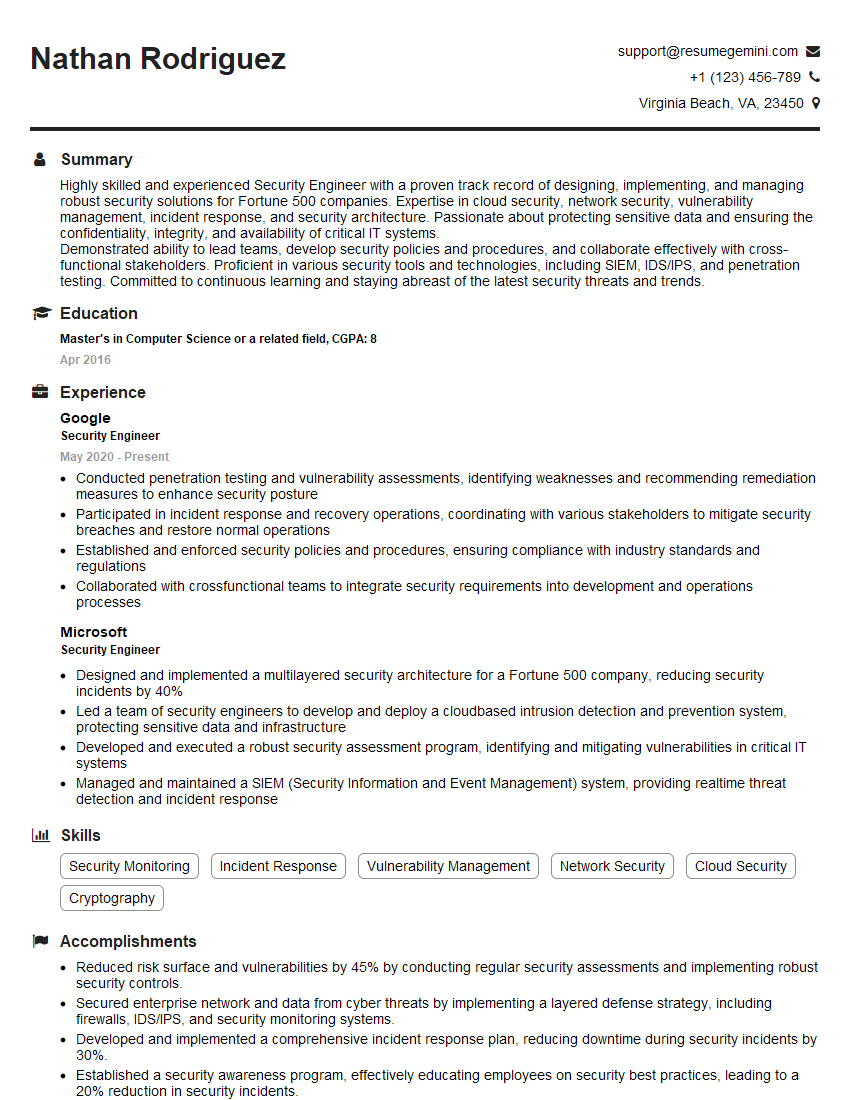
Security Engineer Resume Sample

Information Security Manager Resume Sample

Network Security Engineer Resume Sample
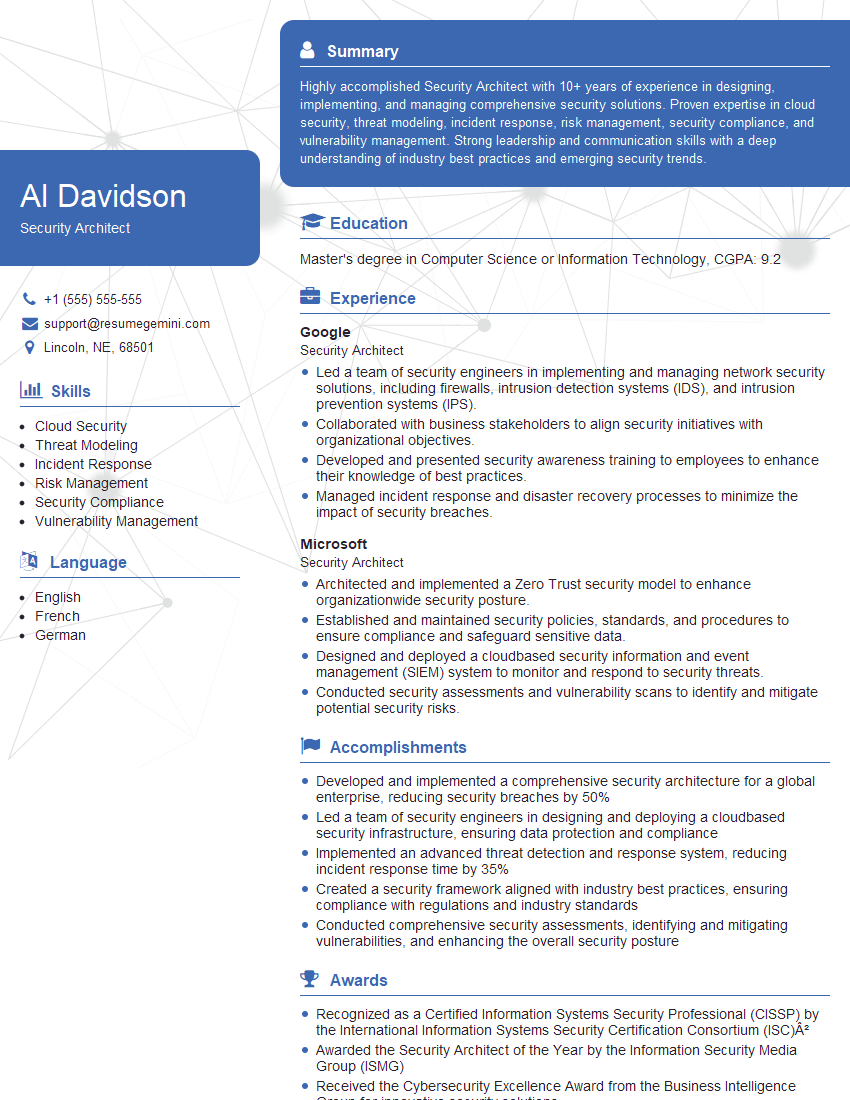
Security Architect Resume Sample

Cryptographer Resume Sample

Cloud Security Engineer Resume Sample
Explore more articles
Users Rating of Our Blogs
Share Your Experience
We value your feedback! Please rate our content and share your thoughts (optional).
What Readers Say About Our Blog
Really detailed insights and content, thank you for writing this detailed article.
IT gave me an insight and words to use and be able to think of examples